

This study aims to identify the counterproductive knowledge behavior (CKB) of volunteers in nonprofit organizations and its influencing factors, based on the theories of planned behavior and well-being.
An online survey was used to collect 496 valid responses. A structural equation model was constructed, and the relationships among the constructs were estimated via the maximum likelihood method. To analyze the direct and indirect effects, 2,000 bootstrapping runs were conducted. A Kruskal-Wallis test was also conducted to analyze the relationship between the variables.
A combination of organizational factors and individual attitudes and perceptions can be used to explain CKB. Insecurity about knowledge sharing had the greatest impact on CKB. A competitive organizational norm induced CKB while a knowledge-sharing organizational norm did not have a significant impact. Further, the more self-determined the volunteer activity was, the more the CKB was suppressed. However, well-being did not have a significant direct effect. Volunteers with high levels of well-being and self-determination had significantly lower levels of insecurity about knowledge sharing compared to those who did not.
Well-being arising from volunteering did not directly suppress CKB. To improve organizational efficiency by reducing CKB, nonprofit organization managers should provide intrinsically motivating tasks and interact with the volunteers.
There is a lack of empirical research on CKB in volunteer organizations; therefore, the authors propose a new approach to knowledge management in volunteer activities.
Introduction
The nonprofit sector plays an important role to resolve social problems. Nonprofit organizations (NPOs) require volunteers with diverse skills and backgrounds, who come together and share knowledge (Grant, 1996), thereby creating social value (Lettieri et al., 2004). However, knowledge sharing in organizations does not happen automatically (Davenport and Prusak, 1998), and counterproductive knowledge behaviors (CKB), such as knowledge hiding (i.e. intentionally avoiding the sharing of knowledge) are frequent (Connelly et al., 2012). It undermines organizational efficiency and NPOs’ ability to ameliorate social issues.
The consequences of deliberate knowledge hiding behavior in organizations can not only undermine their efficiency and but also reduce opportunities for volunteers to obtain nonmonetary rewards for their activities (Wilson and Musick, 1997). Volunteering can help improve physical and mental health (Dury et al., 2014; Morrow-Howell et al., 2003). It can also increase hedonic well-being (Diener, 1984), such as positive emotions (O’Shea, 2006; Pavlova and Silbereisen, 2012; Rebok et al., 2004), and eudaimonic well-being (Keyes, 1998), such as fulfillment through role awareness (Greenfield and Marks, 2004) and personal growth (Macleod et al., 2016). If organizational members realize that they gain well-being from their activities, they may be motivated to display more productive knowledge behaviors and avoid CKBs.
This study identifies the CKB of volunteers at NPOs and its influencing factors. We used the theory of planned behavior (TPB) framework (Ajzen, 1991), which explains intentional behavior from the perspective of organizational pressure and individual attitudes and perceptions. The self-determination theory (Ryan and Deci, 2000) that posits self-determination as a leading factor responsible for well-being creation (WBC) and the concept of trustworthy relationships within an organization (Martín-Alcázar et al., 2019) were also used. Research on CKB as the dark side of knowledge management has progressed in the past decade, especially in the context of corporate settings (Serenko, 2019). Meanwhile, knowledge management research on NPOs has demonstrated the effectiveness of knowledge sharing among members (Mohd Noor et al., 2015) and between organizations (Rathi et al., 2014) on organizational effectiveness. Knowledge management systems (Huck et al., 2011) that promote knowledge sharing among volunteers have also been developed. These studies take the standpoint of promoting productive knowledge behavior. However, few studies have analyzed CKB in NPOs by integrating empirical data on organizational behavior and participants’ well-being.
Theoretical background and hypothesis development
Counterproductive knowledge behavior
Knowledge management is responsible for promoting knowledge sharing to increase organizational efficiency and effectiveness (Davenport and Prusak, 1998). In the past, the Socialization-Externalization-Combination-Internalization (SECI) model (Nonaka and Takeuchi, 1995) that uses the dynamics of organizational knowledge creation to effectively share individual knowledge and turn it into organizational knowledge, and the theory of “Ba” (Nonaka and Konno, 1998) that puts the SECI model into practice were developed. Knowledge sharing and creation are now very important processes for organizational capacity building. However, the transfer of best practices into organizations is not easy. Szulanski (1996) argued that this is due to the lack of absorptive capability of the recipient, uncertainty about the effect of the knowledge being transferred (causal ambiguity), an arduous relationship between the source and the recipient, and proposed a knowledge transfer model (Szulanski, 2000). However, these seminal studies seem to assume that members of an organization are motivated to share effective knowledge. Nevertheless, knowledge sharing among organizational members is not obligatory (Davenport, 1997; Li et al., 2020). Rather, CKB, such as intentionally not sharing knowledge or transferring incorrect knowledge, are frequently observed (Serenko, 2019). The CKB has negative effects on task performance (Chatterjee et al., 2021; Singh, 2019), team performance (Wang et al., 2019) and creativity (Chen et al., 2020; Peng et al., 2019). Consequently, the factors causing CKB have recently attracted attention in knowledge management research (Issac et al., 2021; Di Vaio et al., 2021; Xiao and Cooke, 2019).
A well-known type of CKB is knowledge hiding, which is “an intentional attempt by an individual to withhold or conceal knowledge that has been requested by another person” (Connelly et al., 2012; p. 65). Originally, the following three kinds of knowledge hiding behaviors were observed: playing dumb, evasive hiding and rationalized hiding (Bari et al., 2020; Connelly et al., 2012). The mechanisms of not sharing knowledge and knowledge hiding are not identical. Not sharing knowledge may occur unintentionally due to the individual’s poor communication skills (Ford et al., 2015) or lack of shareable knowledge (Connelly et al., 2012). In contrast, knowledge hiding behavior is intentional in a particular context. Intentional CKB includes knowledge hiding, partial knowledge sharing (Ford and Staples, 2010), counter-questioning knowledge hiding (Jha and Varkkey, 2018; Zhai et al., 2021), bullying knowledge hiding (Yuan et al., 2020), counter-knowledge sharing (Bolisani and Cegarra-Navarro, 2021) and knowledge sabotage (Serenko, 2019). Though rarely observed, the distribution of incorrect knowledge significantly impacts organizations (Serenko, 2019, 2020). In this study, knowledge hiding and partial knowledge sharing, which are more common and should be assessed from the perspective of organizational efficiency, are considered as CKBs.
Theory of planned behavior
The TPB is used to predict and explain the intentions behind human behavior in a particular context (Ajzen, 1991). Intention refers to the effort that individuals put into behavior and is influenced by three elements, namely, subjective norms, attitudes and perceived behavioral control. Subjective norms refer to the expectations of others and social pressures regarding whether a behavior should be performed. Meanwhile, attitudes refer to the favorable or unfavorable evaluations of behavior, and perceived behavioral control refers to the ease/difficulty of performing a behavior. In other words, the TPB is a framework to explain the background of individuals’ intentional behavior in terms of the organizational climate’s influence and their attitudes and perceptions toward organizational behavior, considering them as organizational personnel (or personnel who belong to some community or group).
Socially desirable behavior is the theme of many TPB studies. Knowledge management research has adopted TPB to understand knowledge sharing in business settings (Chennamaneni et al., 2012; Jeon et al., 2011; Lin and Lee, 2004; Ranasinghe and Dharmadasa, 2013), educational settings (Göksel and Aydintan, 2017) and online communities (Alajmi, 2012; Erden et al., 2012; Kuo and Young, 2008; Zhao et al., 2016). The three elements of the TPB framework focus on organizational pressures and individual perceptions of knowledge sharing (Gagné, 2009), although they vary slightly across research topics. However, in the results of a meta-analysis of 26 studies analyzing knowledge sharing via the TPB until 2017, eight out of 26 extended the original TPB model to the context of knowledge sharing while 18 added their own supplementary factors (Nguyen et al., 2019). Thus, the construction of analytical models based on the TPB permits flexible design according to the research target.
Counterproductive knowledge behavior and the theory of planned behavior
The TPB has explanatory power for dishonest actions, such as cheating and lying in tests (Beck and Ajzen, 1991). As CKB can be considered a dishonest action, we assume that the application of the TBP framework is appropriate in examining its mechanism. Xiong et al.(2021) qualitative study on the antecedents of CKB among research and development personnel found that the three elements of the TPB may have explanatory power in knowledge hiding behavior; thus we hypothesize as follows:
CKBs such as knowledge hiding and partial knowledge sharing can be explained by the TPB framework.
The main facet of subjective norms in the TPB view is the impact of organizational pressure on CKB. Competitive work environments (Anand et al., 2020; Qureshi and Evans, 2015) and time pressure (Škerlavaj et al., 2018) can promote knowledge hiding. In a competitive organizational environment, those who achieve rapid results have an advantage, which may cause organizational members to lose the incentive to share knowledge or to intentionally hide knowledge. On the contrary, the formation of a knowledge-sharing climate is encouraged in many organizations as a form of knowledge management that aims to increase efficiency (Davenport and Prusak, 1998). Sharing knowledge with others basically requires a cooperative relationship, which promotes positive characteristics among organizational members, such as a willingness to enhance the power of the other through effective communication while competitive relationships tend to have negative effects, such as the motivation to reduce the power of the other (Deutsch, 2006). Banagou et al. (2021) examined the relationship among human personality, cooperative organizational climate and knowledge hiding, and found that people with high openness hide knowledge less under a high communal sharing climate. However, the effect of a knowledge-sharing organizational climate on CKB in relation to a competitive organizational climate has not been demonstrated. Under the conflicting organizational pressures of competition and cooperation, organizational members, who are aware of the competitive environment, may distort the meaning of knowledge sharing and be motivated to share superficial knowledge. In this context, it is difficult to fully determine whether the organization’s knowledge-sharing climate is positive or negative, and how it affects CKB. Thus, we formulate the following two hypotheses including the exploratory-oriented H1.1(b):
As a subjective norm element of the TPB, the perception of an organization’s competitive climate positively affects volunteers’ CKB.
As a subjective norm element of the TPB, the perception of an organization’s knowledge-sharing climate has an impact on the volunteers’ CKB.
In the original TPB approach, preferences for CKBs (like/dislike, attractive/unattractive, etc.) might be recommended to identify the attitude toward the behavior. However, questionnaire surveys require respondents to make ethical judgments. In a study that applied the TPB to dark side behaviors, ethical attitudes did not have sufficient explanatory power as a background for deviant behavior (Beck and Ajzen, 1991); i.e. even if the importance of ethical attitudes about socially unacceptable behavior is known, actual behaviors often differ from these attitudes. Therefore, we examine attitudes toward knowledge sharing, which is considered socially “good” rather than directly examining attitudes toward CKB, which is considered socially “bad.”
Therefore, in this study, we set the sense of psychological ownership of knowledge as an attitudinal element in the TPB. Knowledge sharing is “a set of individual behaviors involving sharing one’s work-related knowledge and expertise with other members within one’s organization” (Yi, 2009, p. 68), which implies sharing knowledge ownership with others. However, as it is difficult to see the ownership of knowledge (Grant, 1996), psychological ownership becomes important. The psychological ownership that knowledge creators have over their discoveries (Jha and Varkkey, 2018) creates a territorial sense of knowledge, which leads to knowledge hiding (Bhattacharya and Sharma, 2019; Huo et al., 2016; Li et al., 2020; Peng, 2013). In addition, negative attitudes toward sharing psychological ownership of knowledge promote partial knowledge sharing (Ford and Staples, 2010). Therefore, to judge the appropriateness of introducing the psychological ownership of knowledge into the TPB framework, we suggest as follows:
As an attitudinal element of the TPB, the sense of psychological ownership of knowledge positively affects CKB.
For perceived control, the question is whether CKB is easy or difficult to perform. However, CKB in this study refers to intentional CKB in response to requests from others, which is a context-dependent behavior. Xiong et al. (2021) noted that the sense of perceived control varies depending on whether the target of the CKB is smart or not, which is difficult to estimate in advance. The knowledge hider often discovers later whether the knowledge seeker is smart, and the former’s estimates are sometimes wrong. Therefore, we focus on insecurity about knowledge sharing, which depends on context rather than self-efficacy over CKB. An individual’s lack of confidence in their knowledge (Jha and Varkkey, 2018) can induce knowledge hiding. In addition, the fear of losing one’s advantage while sharing knowledge (Koay et al., 2020) can influence rational knowledge hiding, i.e. not sharing knowledge for plausible reasons. Thus, we hypothesize as follows:
As an element of the TPB’s perceived control, insecurity about knowledge sharing positively affects CKB.
Counterproductive knowledge behavior and well-being
Well-being generally refers to happiness. In psychology, well-being is based on subjective perceptions, and there is a vast amount of research on this topic (Diener, 1984). There are two research traditions as follows: eudaimonic well-being, which focuses on functioning in life, and hedonic well-being, which focuses on feelings about life (Keyes, 2006). Eudaimonic well-being is a state of possession of human potential that can lead to positive functions in life (Keyes, 2006; Ryff and Singer, 1996). Volunteering gives participants a sense of purpose through role identification (Greenfield and Marks, 2004) and allows them to experience personal growth (Macleod et al., 2016). Therefore, volunteering without losing sight of one’s intrinsic motivation for the activity (Ryan and Deci, 2000) is thought to inhibit CKB because counterproductive behaviors decrease volunteers’ ability to thrive (Jiang et al., 2019), which is an obstacle to WBC. Thus, we formulate the following hypothesis:
The creation of organizational members’ well-being positively affects CKB.
Self-determination (Ryan and Deci, 2000) is considered an important driving force in eudaimonic WBC. Self-determination includes autonomy, competence (the perception of high performance) and relatedness (the perception that the results of one’s activities are related to others) (Ryan and Deci, 2000). This is also relevant to the concept of psychological well-being as a form of eudaimonic well-being. Ryff and Singer (1996) proposed the concept of psychological well-being by focusing on mental health and discovered the positive meaning of being mentally healthy, which includes self-acceptance, autonomy and environmental mastery (Ryff, 1989; Ryff and Singer, 1996, 2008). A sense of burnout at work also impacts knowledge hiding (Ali et al., 2021). If an individual loses sight of the purpose of their work or is not satisfied with their performance, they may conceal knowledge. In other words, when people are self-determined, they are not likely to choose CKBs. Thus, we hypothesize as follows:
Organizational members’ sense of self-determination negatively affects CKB (directly and indirectly mediated by well-being).
Hedonic well-being, meanwhile, is based on the human tendency to maximize the amount and duration of positive, pleasant emotions and minimize negative, unpleasant emotions and it attempts to understand well-being in terms of both cognitive judgments and emotional responses (Diener, 1984; Diener et al., 1985). Negative emotions cause knowledge hiding behaviors (Ali et al., 2021; Koay et al., 2020); in particular, emotional distrust in relationships within an organization leads to knowledge hiding (Pereira and Mohiya, 2021; Su, 2021; Yuan et al., 2020). For example, experiences of mistreatment (Rasheed et al., 2020) and disrespect (Irum et al., 2020) elicit negative emotions and produce knowledge hiding behavior. Knowledge hiding due to distrust is more likely to occur in the early years of employment, when relationships are not yet mature (Issac et al., 2020). Distrust in interpersonal relationships not only causes stress in the form of interpersonal conflicts but also deprives organizational members of a positive mood. This process results in the depletion of resources and a defensive posture to preserve remaining resources, which leads to knowledge hiding (Losada-Otálora et al., 2021). However, organizational members may inhibit knowledge hiding behavior by trusting, and being trusted by others (de Geofroy and Evans, 2017). This process implies the creation of well-being through the construction of human relationships. Positive emotions enable people to cope better with problems in the organization and inhibit knowledge hiding (Jahanzeb et al., 2020). Thus, we hypothesize as follows:
Trustworthy relationships in the organization negatively affect CKB (directly and indirectly mediated by well-being).
Research framework
The study’s hypotheses are illustrated in Figure 1. The mechanism of CKB as an intentional behavior in volunteer activities was analyzed from two different perspectives. The first is based on the TPB perspective of volunteers as members of NPOs while the second is based on volunteer participants being autonomous individuals. The “trustworthy relationships” factor related to positive emotions, and the “degree of self-determination” factor related to eudaimonic well-being. This study integrates organizational and individual well-being perspectives and identifies the relationship among the two perspectives and CKB in volunteer activities.
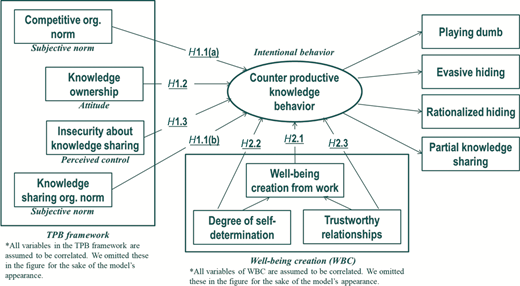
After testing the hypotheses, we investigated the relationship between the most influential TPB-related and well-being-related factors to understand the relationship between finding meaning in volunteering as a form of individual WBC and the perception of knowledge sharing as an organizational member.
Method
Sample and data collection
Data were collected through a survey panel of Macromill, a Japanese internet research company. Online surveys provide more demographically diverse samples than other methods while the reliability of their data is comparable (Buhrmester et al., 2011). However, the participants may sometimes respond multiple times (Wright, 2017). The Macromill system does not allow double responses, and responses with extremely short response times are not registered. Questions with the same content presented in different ways were also created to prevent bogus responses.
The survey was conducted between March 12–14, 2021. The screening conditions were as follows:
Those who currently belonged to a volunteer organization and
Those who participated in the organization’s activities (before the COVID-19 pandemic) for more than four days in a year (more than one day every three months).
As the research topic was knowledge sharing in volunteer organizations, regular participation in volunteer activities was considered important. In total, 552 data items from respondents in the age group 30–70 or older were collected during the survey period, of which 496 were valid, excluding 42 with clearly contradictory answers and 14 in which the respondents answered that on average only one person participated in the activities. The respondents’ basic information is shown in Table 1.
Characteristics of survey respondents
| Variables | n | (%) | |
|---|---|---|---|
| Age | 30–39 | 95 | 19 |
| 40–49 | 99 | 20 | |
| 50–59 | 98 | 20 | |
| 60–69 | 102 | 20 | |
| 70 and over | 102 | 21 | |
| Gender | Male | 343 | 69 |
| Female | 153 | 31 | |
| Years of experience | 1 year or less | 32 | 6.5 |
| 1–3 years | 113 | 22.8 | |
| 3–5 years | 81 | 16.3 | |
| Over 5 years | 270 | 54.4 | |
| How many people do you regularly work with? | 2–4 | 47 | 9.5 |
| 5–9 | 110 | 22.2 | |
| 10–14 | 100 | 20.1 | |
| 15–19 | 45 | 9.1 | |
| Over 20 | 194 | 39.1 | |
Measurement items
The scales used in this study (listed in Table 2) were based on those that have been tested and validated in previous research. To measure organizational climate, we applied Lei et al. (2019) and Nerstad et al. (2013) scales and fit them into the context of knowledge behavior. To measure insecurity about knowledge sharing as a perceptual control, we created questions about the anxiety in sharing knowledge by referring to the concept of knowledge power loss, which is the perception of power and unique value loss due to knowledge contributed to others (Kankanhalli et al., 2005). The psychological ownership of knowledge was tested by applying Avey et al. (2009) research to knowledge behavior. To examine knowledge hiding, we used Connelly et al. questionnaire (2012), and for self-determination, we used the basic ideas of self-determination theory (competence, autonomy, relatedness and intrinsic motivation) (Ryan and Deci, 2000). The concept of trustworthy human relationships was developed from the social capital theory (Coleman, 1988), with a particular focus on the trust-focused relational dimension (Martín-Alcázar et al., 2019). Well-being gained from volunteer activities was captured using items based on psychological well-being (Ryff and Singer, 1996), which was studied mainly from the perspective of the benefits that good mental health and being in good physical shape offers.
Details and internal validity of the measurement items
| Construct (alpha | AVE | CR) | Items | Key references |
|---|---|---|
| Knowledge sharing organizational norm (0.72 | 0.48 | 0.73) |
| Lei et al. (2019), Nerstad et al. (2013) |
| Competitive organizational norm (0.84 | 0.76 | 0.86) |
| Nerstad et al. (2013) |
| Insecurity about knowledge sharing (0.91 | 0.78 | 0.91) |
| Kankanhalli et al. (2005) |
| Psychological knowledge ownership (0.77 | 0.54 | 0.78) |
| Avey et al. (2009) |
| Knowledge hiding Playing dump (0.91 | 0.78 | 0.91) Evasive hiding (0.87 | 0.81 | 0.89) Rationalized hiding - Partial knowledge sharing (0.81 | 0.60 | 0.82) | Playing dumb
Evasive hiding
Rationalized hiding
Partial knowledge sharing
| Connelly et al. (2012); Ford and Staples (2008, 2010) |
| Self-determination (0.71 | 0.54 | 0.73) |
| Ryan and Deci (2000) |
| Trustworthy relationships (0.71 | 0.55 | 0.74) |
| Martin-Alcazar et al. (2019) |
| WBC from work (0.80 | 0.58 | 0.81) |
| Ryff and Singer (1996) |
The responses were measured using a Likert scale with responses from 1 (strongly disagree) to 5 (strongly agree). While the TPB is a particularly useful framework to consider the effects on behavioral intentions, it is difficult to measure the intentions that could lead to behaviors using a questionnaire, and the essential issue is whether the behavior was actually implemented (Kuo and Young, 2008; Nguyen et al., 2019). Therefore, we considered CKB to be an intentional behavior and asked respondents whether they engaged in it.
The measures of the internal consistency of the constructs (Cronbach’s α, average variance extracted [AVE] and composite reliability [CR]) are shown in Table 2 while the constructs’ validity and the correlation between the constructs are shown in Table 3. All constructs were greater than 0.5 except for “knowledge sharing organizational norm” that had an AVE value of 0.48, which was very close to the cutoff value of 0.5 (Gefen et al., 2000; Peter, 1979). The CR values ranged from 0.73 to 0.91. It is desirable for α to be greater than 0.7, AVE to be greater than 0.5 (Fornell and Larcker, 1981; Joe et al., 2014), and CR to be greater than 0.7 (Grewal et al., 2004). Our results showed low AVE and CR values for some constructs; however, Cronbach’s α, which was above 0.7, showed that the data had sufficient reliability and convergent validity.
Correlations among major variables
| Construct | M | s.t.d | CC | KSC | KO | IK | SD | TR | WB | PD | EK | RK | PK |
|---|---|---|---|---|---|---|---|---|---|---|---|---|---|
| Generation | 4 | 1.41 | −0.31 | −0.32 | −0.23 | −0.28 | |||||||
| Years of experience | 3 | 1.00 | −0.23 | −0.28 | −0.16 | −0.23 | |||||||
| Competitive climate (CC) | 2.28 | 1.14 | 0.87 | ||||||||||
| Knowledge sharing culture (KSC) | 3.77 | 0.74 | 0.06 | 0.69 | |||||||||
| Knowledge ownership (KO) | 2.7 | 0.96 | 0.64 | 0.17 | 0.74 | ||||||||
| Knowledge sharing anxiety (IK) | 2.36 | 1.04 | 0.66 | 0.21 | 0.69 | 0.88 | |||||||
| Sense of self-determination (SD) | 3.89 | 0.63 | 0.03 | 0.42 | 0.04 | 0.09 | 0.74 | ||||||
| Good human relations (TR) | 3.64 | 0.73 | 0.01 | 0.61 | 0.06 | 0.12 | 0.49 | 0.74 | |||||
| Well-being (WB) from activities | 3.77 | 0.72 | 0.02 | 0.38 | 0.02 | 0.11 | 0.71 | 0.48 | 0.76 | ||||
| Playing dumb (PD) | 2.27 | 1.08 | 0.65 | 0.16 | 0.63 | 0.69 | 0.12 | 0.11 | 0.12 | 0.88 | |||
| Evasive knowledge hiding (EK) | 2.15 | 1.08 | 0.67 | 0.14 | 0.65 | 0.71 | 0.11 | 0.11 | 0.13 | 0.87 | 0.90 | ||
| Rational knowledge hiding (RK) | 2.23 | 1.22 | 0.59 | 0.09 | 0.56 | 0.61 | 0.03 | 0.07 | 0.07 | 0.72 | 0.74 | ||
| Partial knowledge sharing (PK) | 2.49 | 1.04 | 0.57 | 0.07 | 0.57 | 0.62 | 0.02 | 0.06 | 0.05 | 0.78 | 0.80 | 0.70 | 0.77 |
Notes:
M = medium only for generation and years of experience and = mean for other factors. The numbers in Italic indicate the square roots of AVE
Discriminant validity indicates the extent to which the constructs differ (Erden et al., 2012). As shown in Table 3, this can be confirmed by comparing the square root of the AVE with the correlation of the other constructs (Fornell and Larcker, 1981). The results showed that the AVE values were more correlated than the other constructs, meaning that each construct was perceived to be different from the others.
Analysis
As the internal consistency of the constructs was ensured, the mean value of each observed variable was used as the score of the construct. For example, the competitive organizational climate was represented by the average value of the three observed variables. A structural equation model was constructed based on the analytical model shown in Figure 1, and the relationships among the constructs were estimated using the maximum likelihood method (Kline, 2015) using Stata17. As the model included mediation effects, we conducted 2,000 bootstrapping runs to obtain confidence intervals, which allowed us to analyze the direct and indirect effects (Preacher and Hayes, 2008; Preacher and Kelley, 2011).
The relationship between individual perceptual and attitudinal elements related to intentional behavior and the well-being obtained from the activity and its major antecedents was examined based on the test of difference. First, normality tests were conducted for individual perceptions and attitudinal elements related to intentional behavior. The variables did not satisfy normality; therefore, as a nonparametric analysis, Kruskal-Wallis tests were conducted on the individual perceptual and attitudinal elements related to intentional behavior, with self-determination and well-being as conditional variables, to analyze whether there were significant differences among the items. Thereafter, the Dunn test was conducted as a post hoc test to identify those categories that had significant differences.
Results
The mean scores for counterproductive behaviors were all in the two-point range (Table 3); however, the NPO volunteers did perform CKBs. In particular, the mean score for partial knowledge sharing was relatively high, thus indicating that knowledge senders do not always teach knowledge seekers everything they know but transfer knowledge at some cost to the seekers. This result may appear to be an educational form of knowledge sharing; however, the correlations with “playing dumb” and “evasive hiding” were high (r = 0.78 and r = 0.80, respectively). Therefore, it cannot necessarily be considered an educational behavior. The CKB also negatively correlated with generation and years of service in the NPO.
Regarding the structural equation modeling (SEM) analysis, the goodness of fit of the structural equation model was Chi-square (27) = 34.349, p = 0.156, comparative fit index (CFI) = 0.997, Tucker-Lewis index (TLI) = 0.996, root mean square error of approximation (RMSEA) = 0.023, standardized root mean square residual (SRMR) = 0.019. If the SRMR and RMSEA scores are less than 0.07 and the CFI and TLI scores are greater than 0.90, the model fit is good (Hopper et al., 2008; Hu and Bentler, 1999). Therefore, this study’s model fit the data well, which also means that the TPB framework explains CKBs, such as knowledge hiding and partial knowledge sharing. Figure 2 and Table 4 show the standardized path coefficients and significance levels associated with the hypotheses. H1.1(a) was supported by the high significance level (p < 0.001) for the relationship between the TPB elements and CKB. H1.2 and H1.3 were also confirmed by the high level of significance (p < 0.001). Among the three elements in the TPB framework, CKB was most influenced by “insecurity about knowledge sharing” as perceived control (β = 0.38; p < 0.001), followed by the “competitive organizational norm” as a subjective norm (β = 0.31; p < 0.001) and “psychological ownership of knowledge” as an attitude (β = 0.24; p < 0.001). An organizational norm that encourages knowledge sharing, however, did not have a significant path coefficient.
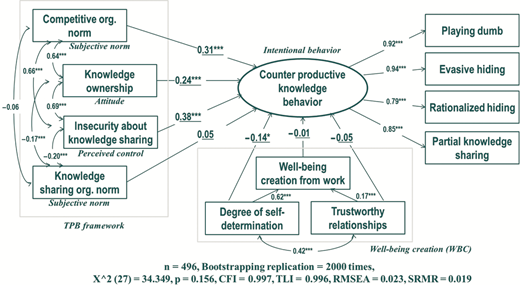
Results of SEM analysis
| Structural path | Path coefficient | Bootstrap Std. err. | z-value | 95% CI | Conclusion | ||
|---|---|---|---|---|---|---|---|
| TPB * CKB | CKB | ||||||
| H1.1(a) | ←Competitive organizational norm | 0.31*** | 0.05 | 5.98 | (0.21, 0.41) | Supported | |
| H1.1(b) | ←Knowledge sharing organizational norm | 0.05 | 0.04 | 1.32 | (−0.03, 0.13) | Not supported | |
| H1.2 | ←Psychological knowledge ownership | 0.24*** | 0.05 | 4.91 | (0.14, 0.33) | Supported | |
| H1.3 | ←Insecurity about knowledge sharing | 0.38*** | 0.06 | 6.82 | (0.27, 0.49) | Supported | |
| WBC * CKB | Direct effects CKB | ||||||
| H2.1 | ←WBC from work | −0.01 | 0.05 | 0.17 | (−0.11, 0.09) | Not supported | |
| H2.2 | ←Degree of self-determination | −0.14* | 0.06 | 2.36 | (−0.25, −0.02) | Supported | |
| H2.3 | ←Trustworthy human relationships | −0.05 | 0.06 | 0.79 | (−0.16, 0.07) | Not supported | |
| Indirect effects (mediated by WBC from work) CKB | |||||||
| ←Degree of self-determination | −0.01 | 0.04 | 0.17 | (−0.08, 0.06) | |||
| ←Trustworthy human relationships | −0.00 | 0.00 | 0.17 | (−0.02, 0.02) | |||
| Total effects (direct and indirect effects) CKB | |||||||
| ←Degree of self-determination | −0.14** | 0.05 | 2.76 | (−0.24, −0.04) | |||
| ←Trustworthy human relationships | −0.05 | 0.06 | 0.81 | (−0.16, 0.07) | |||
| WBC from work | |||||||
| ←Degree of self-determination | 0.62*** | 0.04 | 16.16 | (0.55, 0.70) | |||
| ←Trustworthy human relationships | 0.17*** | 0.04 | 4.55 | (0.10, 0.25) | |||
Notes:
p < 0.001,
p < 0.01 and
p < 0.05. TPB: Theory of planned behavior; CKB: Counterproductive knowledge behavior; WBC: Well-being creation
Regarding the hypothesis on WBC, H2.1 and H2.3 showed no significant path coefficient; therefore, they were discarded. However, for H2.2, the direct effect of self-determination on CKB had a significant negative path (β = −0.14; p < 0.05), i.e. the effect of “degree of self-determination” on CKB before the inclusion of mediation effects. The mediation effect of well-being from the “degree of self-determination” to CKB was not significant (β = −0.01, n.s.). The “degree of self-determination” had a significant effect on WBC in volunteer activities (β = 0.62; p < 0.001); thus WBC does not necessarily affect the promotion/suppression of CKB. However, the combination of the direct and indirect effects of the degree of self-determination on CKB had a negative path coefficient and was significant at the 1% level (β = −0.14; p < 0.01), thereby indicating that increased self-determination suppresses CKB.
To understand the relationship between the TPB perspective and the well-being perspective with regard to CKB, we analyzed relationships among “insecurity about knowledge sharing,” “psychological knowledge ownership,” “well-being creation,” and “degree of self-determination.” As the variables “insecurity about knowledge sharing” and “psychological knowledge ownership” were nonparametric data that did not satisfy normality, quartiles were derived for the degrees of WBC and self-determination and four classes were defined. Kruskal-Wallis tests were conducted to find differences between the nonparametric data.
The Kruskal-Wallis test showed a significant difference (chi2[3] = 32.615, p < 0.001) between the four groups based on “well-being creation” and “insecurity about knowledge sharing.” Pairwise comparisons using the Dunn test showed a significant difference between the groups in the fourth quartile compared to the other groups [first quartile (p < 0.001); second quartile (p < 0.001); third quartile (p < 0.001)]. In addition, there was a significant difference (chi2[3] = 11.271, p = 0.01) between the four groups based on the degree of self-determination against respondents’ “insecurity about knowledge sharing.” Pairwise comparisons using Dunn’s test observed a significant difference between the groups in the fourth quartile compared to the other groups [first quartile (p < 0.01); second quartile (p < 0.05)].
There was also a significant difference (chi2[3] = 20.777, p < 0.001) between the four groups based on the “degree of well-being” for “possession of a sense of psychological ownership of knowledge.” Further pairwise comparisons using the Dunn test revealed a significant difference between the groups in the fourth quartile compared to the other groups [first quartile (p < 0.01); second quartile (p < 0.01); third quartile (p < 0.001)]. However, there was no significant difference in the possession of psychological knowledge ownership among the four groups based on the degree of self-determination (chi2[3] = 0.802, p = 0.849).
Discussion
Theoretical implications
This study determined the kind of CKBs that NPO volunteers tend to engage in and the factors that contribute to these behaviors in terms of TPB and well-being. There were three distinctive findings. The first was that CKB, especially partial knowledge sharing, occurs in volunteer activities. The study explained the mechanism of CKBs through a combination of organizational factors, individual attitudes and perception factors. In particular, insecurity about knowledge sharing was the most significant factor that affected CKBs. When organizational members are concerned that knowledge sharing will dissipate their knowledge advantage or negatively affect their beliefs, they intentionally conceal their knowledge.
Further, as H1.1(a) was supported while H1.1(b) was rejected, an organizational knowledge-sharing norm did not significantly impact CKB, but a competitive organizational norm induced CKB. As there was no statistically significant correlation between organizational knowledge-sharing norm and competitive organizational norm, volunteers perceive cooperation and competition as separate entities. The results suggest that no matter how actively an organization promotes a knowledge-sharing culture when individuals perceive competition-oriented cultural norms (e.g. the perception that the organization prioritizes high performers over others), they tend to conceal their knowledge. This behavior indicates that the tendency of the competitive environment in a company promoting knowledge hiding and sabotage (Oubrich et al., 2021; Serenko and Choo, 2020) is also found in NPOs. Furthermore, this finding suggests that knowledge sharing and CKB are fundamentally distinct and that promoting knowledge sharing has no positive or negative effect on CKB. It empirically supports the findings of existing research that knowledge sharing and knowledge hiding are formed through different mechanisms (Connelly et al., 2012), and extends it to the NPO context.
The second finding revealed that the more self-determined volunteers are, the more they tend to suppress CKBs. Previous studies on self-determination theory and knowledge hiding have not sufficiently represented knowledge senders’ perspectives. When knowledge seekers perceive that their counterparts have concealed knowledge, they are intrinsically motivated to adjust the negative psychological effects they have experienced and perform better to reduce the hider’s knowledge advantage (Wang et al., 2019). However, this study showed that the self-determination mechanism also works in the CKB of knowledge senders.
Previous studies have shown that reduced well-being at work promotes CKB (Ali et al., 2021); however, this study did not find a direct negative relationship between well-being and CKB. Moreover, we found that volunteers who had high levels of well-being and self-determination had significantly lower insecurity about knowledge sharing than those who did not. When the participants increase their well-being through volunteering, they might become confident in knowledge sharing within the organization, which, in turn, reduces CKB. However, a lack of well-being arising from volunteer activities may lead to insecurity about knowledge sharing, which may further motivate CKB as a defensive routine to protect themselves and their weaknesses through knowledge hiding (Cegarra-Navarro et al., 2021).
This study integrated aspects of volunteers as both organizational personnel and autonomous, spontaneous individuals in an analytical framework. The third major finding was the empirical demonstration of the relationship between well-being and the perceived self-control of knowledge sharing in the organization, which adds a new perspective to knowledge management in volunteer organizations. Although many empirical studies on knowledge hiding have been conducted in corporate settings (Siachou et al., 2021), few have examined CKB in NPOs that engage in volunteer activities. Unlike corporate entities, volunteer organizations have a role in ameliorating social problems and providing opportunities for participants to increase their well-being. This study found that even in an NPO setting, participants’ CKBs depend on organizational factors and individual attitudes, and it clarified the characteristics of this mechanism.
Practical implications
This study shows that NPOs must improve their organizational efficiency while working toward tackling social issues. Volunteer activities in NPOs provide opportunities for the participants to develop multifaceted well-being. Thus, it is necessary to promote effective knowledge sharing and reduce intentional CKB, such as knowledge hiding, among members, for the sake of creating social value and participants’ well-being.
Volunteers at NPOs are diverse in terms of their age, gender and experience (Grant, 1996); therefore, it is important to create a psychologically safe (Edmondson, 2012) environment to reduce their insecurity about sharing knowledge and assure them that they will be recognized for doing so.
Our analysis showed that those who achieved greater well-being had less insecurity about knowledge sharing compared to those who did not. Volunteers who feel that their knowledge behavior contributes societies may be less conscious of how they are viewed by organizational members after they have shared their knowledge. They may also avoid CKB because they are truly motivated by the social activity rather than a sense of competition with others. Consequently, NPO managers should provide intrinsically motivating tasks through sufficient dialog with volunteers to prevent CKB.
The degree of well-being generated from volunteer activities depends on their content. In the case of interpersonal service activities, regardless of the effort involved, value can be co-created or co-destructed by others’ activities (Plé and Chumpitaz Cáceres, 2010). Therefore, organizational managers must understand the kind of experiences that volunteers have and support them as much as possible so as not to damage their sense of fulfillment.
Conclusion and future directions
This study identified the CKB of volunteers in NPOs and its influencing factors, based on TPB and the well-being theory. An analysis of data obtained from 496 online survey responses showed that insecurity about knowledge sharing as a perceived control in TPB had the greatest impact on CKB. It was found that a competitive organizational norm under the subjective norm of TPB could induce CKB while a knowledge-sharing organizational norm did not have a significant influence. We analyzed the relationship between CKB and the following three aspects: psychological well-being status, self-determination as the driving force of eudaimonic well-being, and trustworthy human relationships as the driving force of hedonic well-being. The results showed that the more self-determined the volunteer activity was, the more the CKB was suppressed. However, the status of well-being did not have a significant direct effect.
The results of the analysis using the framework integrating the two perspectives, TPB and well-being theory, showed the impact of each on CKB. They also revealed a relationship between the perspectives such that the volunteers with high levels of well-being and self-determination had significantly lower levels of insecurity about knowledge sharing, which mitigates CKB compared to those who did not. This finding provides a variety of strategies for NPO managers to avoid CKB among volunteers and adds a new perspective to the study of knowledge management in NPOs, where that of knowledge sharing as productive knowledge behavior has been dominant.
While this study makes a significant contribution to the understanding of CKB in NPOs, it has several limitations. First, it deals only with transmitting knowledge to others (i.e. knowledge senders) and does not examine experiences of knowledge hiding from others. Therefore, we could not fully determine whether the questionnaire respondents were hiding knowledge as a retaliatory behavior based on their past experiences or purely due to organizational influences or individual thinking. Second, we could only partially demonstrate how the influence of self-determination is related to the mitigation of CKB. Studies have shown that altruism negatively affects knowledge hiding. In the case of intrinsically motivated individuals with a sense of self-determination, it is important to distinguish whether the target of the motivation is self-oriented or other-oriented. If the motivation is other-oriented, it may negatively affect knowledge hiding; if it is self-oriented, it may further induce knowledge hiding. Finally, this study examined the CKB mechanism in NPOs. In recent years, due to the growing awareness of sustainable development goals, many companies have been promoting decent work, i.e. the creation of a productive working environment in which employees can work with human dignity. In that context, the integrated aspects of volunteers as both organizational personnel and autonomous, spontaneous individuals in an analytical framework will be a useful perspective to consider the CKB mechanism in the for-profit sector too, which will need to be tested in the future.
This work was supported by JSPS KAKENHI Grant Number 20H01529 and JAIST Open Access Paper Support Project.

