

Purpose
This paper aims to recall the attention on a key challenge for customer relationship management related to the role of human agents in the management of the “switch point” for ensuring the effectiveness and efficiency in a customer-machine conversation.
Design/methodology/approach
This study contributes to the discussion about the firms’ approach to artificial intelligence (AI) in frontline interactions under the conceptual umbrella provided by knowledge management studies.
Findings
This paper provides a theoretical model for clarifying the role of human intelligence (HI) in AI-based frontline interactions by highlighting the relevance of the actors’ subjectivity in the dynamics and perceptions of customer-machine conversations.
Originality/value
An AI-HI complementarity matrix is proposed in spite of the still dominant replacement view.
1. Introduction
Technology and the changing nature of work, on the one hand, and technology and the customer experience, on the other hand, represent the first two priorities in the service research agenda (Ostrom et al., 2021). Firms are increasingly replacing employees with artificial intelligence (AI) in their organizations (Ostrom et al., 2015). In frontline interactions, this replacement is fundamentally altering the interplay between customers and firms (Larivière et al., 2017). Automated technical systems will serve as autonomous agents of service providers (Pakkala and Spohrer, 2019) and will replace traditional, physical or dyadic service interactions with digital service interactions (Huang and Rust, 2018).
This scenario is amplified when automated service interactions generate nonacceptance of new AI technologies by customers, as revealed by negative comments on digital and social media platforms (Skålén et al., 2015; de Carvalho Botega and da Silva, 2020; Arias-Pérez and Vélez-Jaramillo, 2021). Moreover, when a customer does not feel understood by the technologies, negative emotions arise, which could escalate into a state of distress, causing the customer to interrupt the interaction (Caputo et al., 2019; Grudin and Jacques, 2019). Customers’ negative emotions caused by the lack of emotional adherence with the firm during service interactions may result in value codestruction (Čaić et al., 2018; Cillo et al., 2021).
Although AI is progressing fast in incorporating empathetic or feeling skills, only in certain conditions firms can effectively replace employees with it (Huang and Rust, 2018, 2021). In fact, while technologies are good at performing simple tasks, they are still limited in detecting and managing customer emotions or moods. The reading of emotions remains a feature associated with human intelligence (HI) (Huang and Rust, 2018) and human knowledge (Berkeley and Jessop, 1952).
To contribute to addressing the limitations of AI instruments from a relational and emotional viewpoint, this study emphasizes the relevance of a complementarity rather than replacement view of the use of AI and HI in frontline service interaction by adopting the interpretative lens provided by knowledge management (KM) under a systems thinking cognitive view (Saviano et al., 2017) that identifies and depicts main contact points in humans-technologies interactions within knowledge practices. The complementarity view is adopted by paying more attention to the subjectivity in the human side of interaction (e.g. emotions, moods, feelings) than to the technical capabilities of AI instruments. In such a vein, this study aims at debating the following research question:
How to detect the point at which a customer-machine conversation needs to be taken over by a human agent (switch point [SP]).
With this aim in mind, the rest of this paper is structured as follows: after this introductory section, the section 2 illustrates the main findings of an exploration of literature. Then, by drawing upon and advancing previous knowledge, the section 3 proposes an interpretative pathway for framing the AI-HI complementarity view in the management of frontline interaction by highlighting the relevance of the actors’ subjectivity in the dynamics and perceptions of customer-machine conversations. Finally, the section 4 outlines the main implications of our study, and the section 5 discusses the research implications and the limitations and it proposes possible directions for future investigation.
2. Theoretical background
The irreversible trend of increasing AI usage is resulting in a service context controlled by technology, gradually replacing employees also in the frontlines (McLeay et al., 2021), resulting in a technology-managed customer system. In such a scenario, all practices related to firms-customers relations are radically changing due to the emergence of new digital-based information flows (Swan et al., 1999), new antecedents for knowledge hiding in the digital environment (Caputo et al., 2021; Khelladi et al., 2022) and new forms of contamination between human and digital knowledge (Sumbal et al., 2017). Larivière et al. (2017) distinguish three important roles that technologies may play during firm-customer encounters:
augmentation (assisting and complementing human employees);
substitution (replacing human employees); and
network facilitation (enabling connection and relationships).
They matched these three technology roles with four different business models called asset builder, service provider, network orchestrator and technology creator, demonstrating that in the cases of augmentation or substitution, only two different business models create value:
asset builder (businesses/service organizations that deliver physical goods including retailers); and
service provider (e.g. hotels, restaurants and airlines or airports).
Huang and Rust (2018) indicate that the decision of AI augmentation should be based on the nature of the task, and firms must consider various conditions. Generally, simple tasks can be replaced first as they require “lower” intelligence; and conversely, tasks that require “higher” intelligence would be better addressed with AI-human augmentation. In their 2017 work, the authors distinguish between transactional service that can be more efficiently addressed by replacing humans with AI and relational service that requires frontline employees (FLEs) for delivering higher value; when human interaction is required, humans cannot be completely replaced by AI.
From a different perspective, Lin and Chen (2008) have demonstrated that firms’ survival depends on their abilities to use digital technologies as drivers for explaining to customers the value and the novelty of proposed product and service; Clemons and Row (1991) point to the attention on the relevant contributions that digital technologies can provide in supporting data collection and recommendations customers’ practices and behaviors; Ghouri et al. (2021) show the key role that real-time information sharing possible thanks to the supports provided by AI within customers-firms interactions radically change the perceptions of actors engaged in the relationship about the produced value also influencing the willingness about future relations.
For all these reasons, reflections and solutions are needed to frame decision-making about the appropriate use of humans and technologies in the new hybrid context (Barile and Saviano, 2010) in which knowledge practices are required to adopt a multidimensional framework able to combine digital and human skills for facing unpredictable changes and trends (Fait et al., 2022).
The cognitive aspect of service interaction is considered by Huang and Rust (2018) as a relevant aspect in customer relationship management (CRM) that contributes to qualifying the nature of service tasks, indicating that empathetic intelligence is required to manage it. Several other elements qualify the nature of task ranging among various aspects, in some cases related to the cognitive dimensions. For example, the authors distinguished between simple and mechanical tasks, complex and chaotic tasks and social and emotional tasks. They then associated four intelligences to the nature of task. More specifically, the authors discussed four types of intelligences: mechanical, analytical, intuitive and empathetic. Mechanical intelligence concerns the ability to automatically repeat tasks (Huang and Rust, 2018, 2021). Analytical intelligence is the ability to process information for solving problems and learning from it using. Intuitive intelligence is the ability of thinking creatively and adapt effectively to novel situations. Empathetic intelligence is the ability to emotionally connect to others. Empathetic intelligence is only possible using the most advanced AI technology and includes self-awareness and consciousness (Huang et al., 2019).
Subsequently, Huang et al. (2019) simplify the four AIs framework into three AIs: mechanical, thinking and feeling. This three AIs framework recalls the information variety framework developed within the viable systems approach stream of managerial studies (Barile et al., 2012a, 2012b) that represents the knowledge endowment of viable systems as composed of information units, interpretative schemes and value categories (Barile, 2009; Barile et al., 2012a).
Digital technologies surely have mechanical AI, and they are generally designed to perform simple, standardized, repetitive and routine tasks. From the customer’s perspective, however, the perceived technical functionality of a digital technology is not a crucial point to its acceptance. It is rather a matter of social-emotional elements (Stock and Merkle, 2018), such as perceived humanness (Tinwell et al., 2011), perceived social interactivity and perceived social presence (van Doorn et al., 2017).
3. The artificial intelligence-human intelligence complementarity matrix
Concern about AI taking jobs and replacing FLEs is still inhibiting people’s trust in AI (Siau and Wang, 2018). A major concern about the job replacement problem can disregard opportunities to develop promising complementarities between AI and HI. The point is to identify balanced criteria that can strategically orient decision-makers in the appropriate and wise use of AI (Barile et al., 2021a, 2021b; Bassano et al., 2020). Therefore, the question is moving from replacing humans with machines to dynamically switching with them, i.e. complementing them to fully integrate the two resources. From this perspective, we frame the integration of AI and HI in service encounters in terms of AI-HI complementarity, at the same time providing a knowledge-based interpretation of the SP concept (Lajante and Del Prete, 2020). More precisely, we refer to the original distinction between the four types of intelligences proposed by Huang and Rust (2018); however, leveraging Barile’s (2009) knowledge view of complexity, we shift focus from the type of task to the degree of complexity of the same ranging from chaos to complexity, to complication up to certainty. This shift is relevant because, given that we are dealing with a relational and interactional problem, it draws attention not much on the objective nature of the task, but of the complexity it can generate during interaction (Barile and Saviano, 2010; Badinelli et al., 2012). The original mechanical, analytical, intuitive and empathetic (4AIs) framework of Huang and Rust (2018) is here preferred to the simplified one because it provides a more articulated representation that complies with the Barile’s (2009) 4Cs view of complexity.
Our reasoning starts with outlining what could happen when an automated service AI experiences a conversational problem with a customer and fails to address the emerging complexity because it is unable to make any right decision, trough a curve inspired to the Barile’s view of the 4Cs of complexity (2009). As the curve represented in Figure 1 indicates, a result of the more intensive but ineffective conversational exchange, as it typically happens when the technology repeatedly proposes the same wrong reply, is that the problem becomes increasingly worse and results in a chaotic situation. Subsequently, the simple conversational task becomes an issue complex to manage.
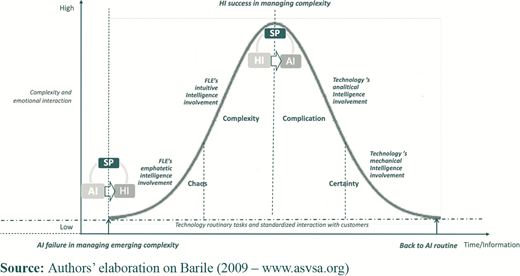
The failure of AI is made evident by a progressive complexification of the conversational problem characterized by an accelerated emotional arousal of the customer and the subsequent risk of breakdown and customers’ disengagement. At this point, it is critical to induce the shift to a FLE. The FLE intervenes by empathetically trying to recover the connectedness with the customer and create a positive emotional interaction. If the FLE is successful, the customers’ negative emotional arousal starts to slow down growth.
Subsequently, the FLE tries to intuitively find a way to reestablish a positive feeling relational context with the customer. If it is successful, the negative emotional arousal slows down faster up to the point at which the emotional connectedness is effectively reestablished. Interaction at this stage can still follow with the FLE; however, AI could make a more efficient means of managing information and knowledge. Once the resolution idea is well defined, the control of interaction will pass back to the digital technologies whose analytical intelligence can be used to formally codify the solution by managing and refining the practical aspects of the problem. So, now, the original problematic situation is fully under control.
The possible dynamic described by the curve can be easily understood using Huang and Rust’s (2018) “four intelligences” (4AIs) for explaining the Barile’s distinction between the four conditions of complexity in frontline interaction (4Cs). Our findings suggest that:
Mechanical intelligence capabilities are generally adequate to manage simple routinary service tasks by efficiently applying existing knowledge and solutions.
Analytical intelligence capabilities are necessary to manage more complicated tasks, i.e. problems characterized by a high variety and the necessity to process large amounts of data and information.
Intuitive intelligence capabilities are necessary to manage complex situations that require creative thinking capabilities for leveraging and dynamically recombining previous knowledge variety.
Empathetic intelligence capabilities are required to deal with the highest complexity of emotional dynamics, as they are emergent, unpredictable and subjectively interpreted, and involving humans’ deep-rooted values systems and strong beliefs.
Essentially, we can distinguish a more rational nature of mechanical and analytical intelligences and a more emotional nature of intuitive and empathetic intelligences.
On this basis, we can summarize the conceptual findings of our interpretative pathway through the AI-HI Complementarity Matrix (AI-HI CompMatrix). As illustrated in the following Figure 2, AI and HI can complement each other in frontline interaction by switching the control role through a “smart” combination of their knowledge based on the specific situation to manage.
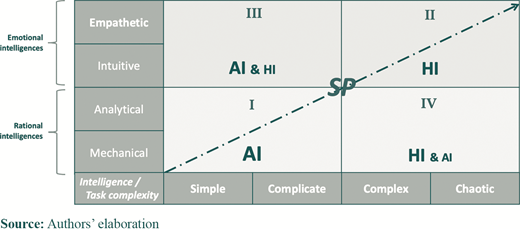
More specifically, the four H/A intelligences interplay by diverting the control to those that are the most appropriate to effectively manage interaction with the customer based on the specific relational situation of the moment:
Quadrant I: This quadrant refers to the situation in which artificial rational intelligence (AI), typically related to digital technologies, performs autonomously routine and generally standardized simple or at most complicated tasks for which the basic endowment with mechanical and analytical rational intelligences is adequate.
Quadrant II: This quadrant refers to the situation in which AI fails in managing an uncodified situation because it is not able to handle the emotional arousal of the customer; hence a HI, is required.
Quadrant III: This quadrant introduces situations in which possible empathetic and intuitive emotional intelligences of AI can be experimented in the management of simple or complicated situations where AI can activate the emotional potential of interaction under the simple “vigilance” of FLE.
Quadrant IV: This quadrant introduces situations in which the mechanical and analytical rational intelligences of humans (HI) supported by AI can be used to decipher the complexity of frontline interaction for analytics purposes and the production of new knowledge.
The proposed framework allows also to explain the situations of technologies-customer misalignment due to the technologies’ incapability to detect customer’s cognitive orientation. Indeed, based on general reasoning, while the discussed failure in managing customers’ negative emotions implies undergoing threats, risks and major problems, if digital technologies in frontline interactions fail in recognizing the arising of customer’s positive emotions, such failure is not expected to have a negative impact, although implying that opportunities may be lost to benefit from the situation or even to increase the positive emotional engagement of the customer.
4. Managerial and theoretical implications
Our research gives managers a view for supporting a deeper than technical reasoning about why, when and how to adopt and integrate digital technologies in customer service.
Leonardo Da Vinci argued that “simplicity is the ultimate sophistication.” The SP is a quite simple concept but also sophisticated to the point that it has not yet been implemented during automated service interactions. Service providers who can identify the AI/human-agent SP during a service conversation are able to revolutionize current considerations related to human-machine job replacement and establish new cocreation and collaboration logics in the direction of digital servitization (Barile et al., 2021a, 2021b; Sjödin et al., 2021).
This study supports firm-customer interactivity and promotes collaboration by preserving service quality and customer engagement in automated customer service to depict a “new” approach to KM (Zack et al., 2009; Ford et al., 2015; Ashok et al., 2016; Scuotto et al., 2017). It is a concrete strategic approach where emotion-related sociobiological processes are pushed forward for the sake of customer satisfaction.
An effective AI-HI collaboration based on the SP may enhance the service providers strategy of using mechanical/analytical AI when the emotional complexity is low. Service providers could use technologies endowed with AI to switch toward a FLE when the emotional complexity is high. This last important managerial implication also has an impact on service employees and customers. FLEs will not see their role diminished; rather, they play a key role in managing and resolving emotional issues; as a positive consequence, customers will be able to look at technologies with greater confidence.
In this context, the paper also supports the need to incorporate the SP into the CRM team. This step requires an understanding of:
the emotional complexity dynamics of interaction necessary to meet customers’ needs;
the potential of technologies-FLEs collaboration including its strengths and weaknesses;
the impact of the AI on customers and employees’ acceptance of digital technologies in frontline interactions;
the choice of the right FLE to work and collaborate with technologies; and
the trainings for both AI and FLEs since this environment is constantly evolving (Pick, 2017).
The major implication for employees of proposed reflections is that technologies endowed with HI in CRM will not steal jobs from FLEs, but they will definitively complement and change their work (Muro and Andes, 2015). Employees will be relieved of boring and repetitive tasks and be transitioned toward more complex ones that require creativity, empathy and emotional connectedness (Brooks, 2014).
The main implication for customers is an agile value cocreation (Sjödin et al., 2021) in which digital technologies support a “real” understanding of their real needs and emotions. Customers can appreciate that a technology is autonomously ready to divert conversation to an FLE when needed, without having to request it themselves.
5. Conclusions, limitations and future directions for the research
A discussion of the potential problems associated with the adoption of highly automated customer systems is presented in this paper, related to the current limited capacity of technologies to detect customer cognitive engagement and states during interactions. The conceptual reasoning developed in this study leads to embrace a view of complementarity in the management of the use of AI customer service. We attempt to contribute theoretically to the existing literature in several ways. Our approach embraces a systems view (Barile et al., 2012a, 2012b, 2016; Barile et al., 2015; Golinelli, 2010) that leads to recognize that it is important to dynamically assess when service must be accomplished by technologies and employees working together (Dorn et al., 2017; Murgia, 2016; Parasuraman and Colby, 2015; Shah, 2016). It is crucial to consider that the cognitive engagement arising from an interaction is due to a subjective and contextual dynamic that can be independent from the objective nature of the task. It is possible to encounter conversational problems even when carrying out a simple task. This is an aspect of general valence that should be duly considered in service management.
Furthermore, customers expect that human operators will continue to play an essential role in frontline encounters (De Keyser et al., 2019). FLEs are among the most relevant components of customer service systems; indeed, they are among the most frequent theme in service research (Donthu et al., 2022). Hence, reflection on the definitive AI/HI replacement is needed compared to a strategic collaboration (Barile et al., 2021a, 2021b; Bassano et al., 2020). The value cocreated between FLE and technologies offers valuable digital opportunities for servitization to create and capture new value (Autio et al., 2018; Kohtamaki et al., 2019). Also, our conceptual approach is useful in understanding the democratization of AI capabilities through the collaborative logics of AI-FLEs extendable to the entire organization (Sjödin et al., 2021). Moreover, the proposed view has the effect of engaging FLEs in accepting technologies and experimenting new capabilities and insights to enhance customer service. A key issue for implementing this type of collaboration and interaction between AI and FLEs is to build routines for collaborative application development aimed at improving interaction. Furthermore, an AI-HI collaboration approach can increase quality and effectiveness in managing conversational issues to engage the customer.
The study has several limitations related to the empirical test and to the generalizability of the proposed reflections that provide directions for future research. More work needs to be done for and in-depth understanding of the role of SP in influencing human technologies interactions and KM practices. We believe that the proposed approach could encourage fruitful future research on a wise adoption of robotics in customer service with both a cocreation and collaboration viewpoint.

