

Purpose
Knowledge-intensive entrepreneurial firms (KIE) strongly rely on scientific and strategic research and development (R&D) capabilities to achieve higher performance levels. Hence, the purpose of this paper is to disentangle the effects of scientific capabilities and strategic R&D on KIE performance; and how the constituent elements of these dimensions can be configured to generate conditions for high performance.
Design/methodology/approach
The authors’ empirical setting involves companies that submitted projects to the Innovative Research in Small Businesses (PIPE) program in Brazil. The authors then run partial least square structural equation modeling to verify how scientific and strategic R&D capabilities influence the performance construct. Second, the authors apply fuzzy-set qualitative comparative analysis to identify configurations that are equifinal in terms of generating superior performance.
Findings
Findings indicate a strong association between scientific capabilities and KIE performance. The configurational approach outlines the existence of multiple paths to success, but human capital stands as a core condition throughout estimations.
Practical implications
The authors’ assessment has implications for how KIE firms are managed according to their organizational profiles and trajectories. Also, it advances the authors’ comprehension on how entrepreneurship policies can better target these distinct profiles.
Originality/value
The authors’ analysis provides new evidence on the inherent complexity behind the generation of high performance in KIE when addressing their portfolios of knowledge-related capabilities. More than that, the authors were able to identify the existence of heterogeneous profiles that can equally lead to higher levels of performance.
1. Introduction
Entrepreneurial firms with high growth potential have been the focus of attention of academics, practitioners and policymakers interested in understanding how these companies operate and generate widespread impacts in economic systems (Liu et al., 2022; Vedula and Kim, 2019). Knowledge-intensive entrepreneurial firms (KIE) represent a core part of this phenomenon (Czarnitzki and Delanote, 2013; Fischer et al., 2022). KIE can be defined as new innovation-driven firms that generate, assimilate and deploy significant knowledge levels in their business activities, thus being responsible for the emergence of new products, processes, services and technologies (Malerba and McKelvey, 2020). As a result, these companies are not only embedded in entrepreneurial ecosystems, i.e. the contextual features that enable entrepreneurial activity in regions, they also play a critical role in building innovative capabilities that spill over to other agents (Acs et al., 2017; Gronning, 2014; Liu et al., 2022).
The success of such companies has triggered academic and policy interest in the “quality” (rather than quantity) of entrepreneurship supported by dedicated initiatives (Acs et al., 2017; Del Giudice et al., 2017; Vedula and Kim, 2019). Governmental programs have emerged virtually everywhere with the goal of promoting entrepreneurial endeavors that can boost economic transitions and improve market dynamism (Colombelli et al., 2020; Kantis et al., 2020). However, we still fall short in having a proper comprehension about the performance drivers of these firms – and how these drivers are combined at the micro-level. As a result, initiatives targeted at fostering KIE activity often present lackluster outcomes by failing to support successful businesses (Brown and Mason, 2014; Fischer et al., 2022; Shane, 2009).
What we know is that, in the current competitive environment, characterized by short innovation cycles, the performance of companies is linked to how knowledge is created and organized (Ferreira et al., 2020; Marques Júnior et al., 2020). As Cowling (2016, p. 576) puts it: “you can throw as much money as you like at a firm with no coherent innovation strategy, strategic commitment, or intentionality to innovation and little tangible is likely to happen.” This is very much in line with the broad notion of dynamic capabilities, i.e. the ability to “integrate, build, and reconfigure internal and external competences to address rapidly changing external environments” (Teece et al., 1997, p. 516). These capabilities involve the following:
sensing and shaping opportunities;
seizing them; and
sustaining performance through adaptation (Teece, 2007), thus leveraging firm-level competitiveness in complex and volatile economic contexts (Zahra et al., 2006).
Similarly, this debate can be attached to the notion of organizational ambidexterity, i.e. the sets of capabilities required for knowledge exploitation and exploration vis-à-vis the dynamic competitive environment in which innovative firms are embedded (Zhang et al., 2020). Yet, these conceptual notions still fall short in identifying which characteristics of firms spur higher performance levels in KIE. In fact, the complexity involved in management processes for innovative companies makes it difficult to understand this phenomenon (Audretsch et al., 2020). Thus, conspicuous gaps remain in our comprehension of how successful KIE operate and what are their main drivers of superior performance (Brown and Mason, 2014; Fischer et al., 2022).
On the one hand, scientific capabilities have been associated with competitive gains in terms of human capital, social capital and necessary skills to carry out state-of-the-art technological development (Hottenrott and Richstein, 2020; Murray, 2004; Toole and Czarnitzki, 2009). This forms the basis for the development of technologies and innovations (Bock et al., 2018; Paoloni et al., 2020; Temouri et al., 2020), and it can be essential to tackle the challenges related to innovation routines (Adams et al., 2016; Gimenez-Fernandez et al., 2020). Although not all KIE firms are science-based, such capabilities can be of value for any given entrepreneurial company aiming at expanding the knowledge frontier (Villani et al., 2018). On the other hand, scientific capabilities alone are likely to be insufficient for these firms to lay the grounds for becoming competitive (Toole and Czarnitzki, 2009). In this respect, strategic research and development (R&D) capabilities can be relevant complements to enhance performance in KIE firms by creating systematic processes that allow channeling organizational knowledge toward innovation (Abubakar et al., 2019).
Yet, these scientific and R&D attributes are multidimensional in nature. Plus, as recent research has empirically demonstrated, KIE firms present highly variegated profiles concerning such features (Fini et al., 2023; Salles-Filho et al., 2022). These conditions delineate a complex organizational background in terms of identifying the sources of performance in the context of innovation-oriented entrepreneurship. Accordingly, our overarching research question can be stated as follows: how do KIE firms combine scientific and strategic R&D capabilities to achieve higher performance? We start from the assumption that these two types of capabilities are not only complementary in promoting better performance but also that their components can be configured in different ways to achieve superior outcomes. Hence, our goals in this research are as follows:
to disentangle the effects of scientific capabilities and strategic R&D on KIE performance; and
to identify how the constituent elements of these dimensions can be combined to generate conditions for sustained positive outcomes.
Ultimately, we aim at contributing to the pressing debate on heterogeneous trajectories toward success in KIE firms.
Our empirical assessment is based on an exploratory analysis involving companies that submitted projects to the Innovative Research in Small Businesses (PIPE) program. This is a support program for KIE in the State of São Paulo, Brazil. This initiative is analogous to the Small Business Innovation Research (SBIR) Program in the USA, nurturing innovation-driven undertakings in entrepreneurial firms. We consider both awarded (142) and non-awarded (81) firms to minimize sample bias. This offers the opportunity of deepening our analysis by exploring in further detail how these two groups behave in a comparative assessment. Hence, beyond contributions to literature on firm-level assessments of KIE, our approach can also help to inform KIE policy. Our methodological strategy involves two analytical stages. First, we run partial least square structural equation modeling to verify how scientific and strategic R&D capabilities influence the performance construct. Second, we use inputs from these estimations to apply fuzzy-set qualitative comparative analysis (fsQCA) to identify configurations that are equifinal in terms of high-performance levels.
Our findings indicate a strong association between scientific capabilities and KIE performance. The predictive power of strategic R&D capabilities is enhanced for the case of PIPE grantees, indicating a successful selection process in terms of firm-level capabilities. More interestingly, the fsQCA configurational approach outlines the existence of multiple paths to success, although the level of human capital in companies is a core condition throughout estimations. These results highlight the heterogeneous nature of KIE firms and the existence of different configurations of capabilities that can lead to high performance. These novel additions to literature have implications for how KIE firms are managed according to their organizational profiles and trajectories. Also, it advances our comprehension on how entrepreneurship policies can better target these distinct profiles to promote systemic impacts arising from these firms. Ultimately, these findings contribute to literature by highlighting the critical role of Scientific Capabilities in generating higher performance in KIE, particularly those represented by qualified personnel. Furthermore, superior performance configurations underscore that R&D planning and management systems have – at best – a marginal role to play in granting KIE firms with better results. This indicates a predominant trend of more flexible companies based on effectuation logic.
After this introductory section, the rest of the article is structured as follows: Section 2 explores key concepts and elements associated with how Scientific and R&D capabilities affect KIE performance. Section 3 presents the methodological approach. Section 4 outlines the empirical results. Section 5 brings our discussions and derives implications of our assessment. Section 6 concludes with final remarks, limitations and avenues for future research.
2. Literature review
In this section, we address three topics of interest in our research. First, we dedicate attention to scientific capabilities and their relationship with performance in KIE. Second, we address the role of strategic R&D capabilities in bringing innovation into KIE operational routines. Third, we introduce the role of policy in shaping the conditions for these firms to emerge and thrive.
2.1 Scientific capabilities: cornerstone of knowledge-intensive entrepreneurial dynamics
Companies’ body of scientific knowledge can function as a lever for innovation, as this knowledge can result in the generation of new technologies, products and services (Bock et al., 2018; Paoloni et al., 2020; Tang and Murphy, 2012; Temouri et al., 2020). In the case of KIE, the accumulation of these capabilities is key to achieving superior performance. This is due to the innovative orientation of these organizations, an aspect that entails exploring the frontiers of knowledge domains (Adams et al., 2016; Agarwal and Shah, 2014; Andersson and Lööf, 2012; Hottenrott and Richstein, 2020). Accordingly, there is a need for KIE firms to continuously learn from complex technologies, so scientific capabilities can be useful also for increasing absorptive capacity and organizational learning (Secundo et al., 2017; Toole and Czarnitzki, 2009).
Scientific capabilities in KIE can be associated with some central elements. First, the education of the founding entrepreneur, the leader responsible for creating the innovative business. In this case, the higher the level of human capital and knowledge, the greater the chances of sustaining an innovation-driven culture in the company (Boccardelli and Magnusson, 2006; Marques Júnior et al., 2020; Protogerou et al., 2017). In this vein, scientific skills of entrepreneurs are associated with KIE firms’ research capabilities (Toole and Czarnitzki, 2009). Also, the founder’s training background enhances the use and development of critical technology for products, services and operations (Agarwal and Shah, 2014). Contributions arising from scientific competences of founders go beyond increasing firms’ human capital. They also add to the social capital by connecting the firm with scientific networks that can strengthen organizational capabilities (Murray, 2004).
Second, another critical element of scientific capabilities refers to a skilled workforce, i.e. the qualifications of the entrepreneurial team. Employees acquire and consolidate the necessary knowledge, promoting strategic thinking and creating competitive advantages (Cillo et al., 2022; Laihonen and Mäntylä, 2018; Venkitachalam and Willmott, 2017). These aspects have been linked to an increase in firm-level ambidexterity (Caputo et al., 2019), performance (Fischer et al., 2022; Gimenez-Fernandez et al., 2020) and growth trajectories (Colombo et al., 2010). Using a sample from SBIR, Audretsch et al. (2016) identify that academic human capital is more conducive to innovative activity in KIE firms than prior business experience. Plus, a highly qualified workforce enhances credibility to obtain access to finance by generating valuable market signals about the innovative potential of the firm (Madsen et al., 2008).
A third element that composes the core of technical knowledge refers to the origins of the entrepreneurial endeavor. In this case, academic spin-offs are likely to present stronger research capabilities and more intense embeddedness in knowledge transfer networks (Breschii et al., 2019; Oliveira et al., 2019). In this respect, companies founded by scientists translate scientific outcomes into marketable technologies (Aldridge and Audretsch, 2011; Feldman et al., 2005; Lockett et al., 2005). This can be particularly critical in the case of a country that demonstrates a striking concentration of technological competencies in academic institutions, such as Brazil (Fischer et al., 2019a, 2019b). Yet, Fischer et al. (2019a, 2019b, 2022) highlight that while these associations of scientific knowledge with the performance of KIE are relatively validated for the context of developed markets, insights on their dynamics within less mature business environments remain largely uncharted by literature.
Fourth, the proximity and linkages established by KIE firms with universities can be a valuable asset in terms of strengthening Scientific Capabilities. This happens because establishing networks with academic partners can grant these firms with easier access to cutting-edge knowledge and scientific infrastructure (Salavisa et al., 2012; Schaeffer et al., 2021). Such external knowledge sourcing can help shaping exploration and exploitation capabilities in entrepreneurial firms, thus enhancing their ambidexterity (Dezi et al., 2021; Vrontis et al., 2017). Also, within the entrepreneurial ecosystem domain, universities play the role of generators and disseminators of valuable knowledge that can spill over to KIE firms (Audretsch and Link, 2019; Colombo et al., 2010; Fischer et al., 2018a, 2018b). Along these lines, examples from the SBIR highlight that connections with universities increase the likelihood of market success (Link and Ruhm, 2009) and access to R&D grants (Guerrero et al., 2019).
However, potential contributions arising from scientific capabilities in KIE have often been referred as contingent upon the existence of business-oriented skills (Toole and Czarnitzki, 2009). In fact, KIE firms that remain deeply attached to scientific domains can present substandard market outcomes (Wennberg et al., 2011). Accordingly, a particularity of KIE is that it is usually restrained to an academic logic, without a deep comprehension of market dynamics and managerial practices (Villani et al., 2018). We now turn to strategic R&D capabilities, a dimension that comprehends the inclusion of assets, resources and skills that can help triggering innovation practices and routines in the firm.
2.2 Strategic research and development capabilities: routinizing innovation in knowledge-intensive entrepreneurial firms
While the relevance of scientific capabilities can be critical to generate higher levels of performance in KIE firms, they should be matched by strategic capabilities that can turn such assets into business routines, dynamic capabilities and ambidexterity (Cowling, 2016; Deeds, 2001; Dezi et al., 2021; Heisig et al., 2016; Thomas et al., 2020). This can be achieved through strategic decisions and deployments that facilitate the creation, sharing and transfer of the company’s knowledge base (Zack, 1999), aspects that we refer to as strategic R&D capabilities. These capabilities can play multiple roles throughout the initial stages of KIE firms: they enable the establishment of alliances, exploitation of external knowledge and new product development (Stam and Wennberg, 2009; Vrontis et al., 2017). In this regard, strategic R&D capabilities are expected to drive sustainable competitive advantage (Cabrilo and Dahms, 2018; Heisig et al., 2016; Scuotto et al., 2017).
Hence, the development of the innovation strategy must consider the business model adopted by the company and its integration with scientific capabilities (Cahen et al., 2016; Hahn et al., 2019; Katila et al., 2012; Soetanto and Jack, 2016; Symeonidou and Nicolaou, 2018). For this, the innovative behavior of the entrepreneur and employees must be incorporated into the company’s structure, thus increasing the interaction between the company’s technical, managerial and operational knowledge (Mukhtarova et al., 2019; Siepel et al., 2017; Teece, 2007).
However, how these capabilities translate into practice in the context of KIE firms remains an open debate. Some authors argue that KIE firms, particularly those that are science-based, rely more on “causation” logics [1] through implementation of formal planning. This is attributed to the planned process of transforming scientific results into marketable outcomes (Villani et al., 2018). On the other hand, others claim that successful entrepreneurial companies are oriented toward effectuation logics (Fisher, 2012; Sarasvathy, 2001).
In fact, empirical evidence seems to support the notion that KIE firms often rely on strategic improvisation to navigate their business opportunities – rather than establishing formal managerial processes (Baker et al., 2003). This allows these firms to achieve sufficient strategic agility to adapt to dynamic competitive environments (Del Giudice et al., 2022). Such conditions become particularly critical for projects with high levels of R&D intensity, as traditional planning approaches can fall short in providing the necessary flexibility for innovation to emerge (Brettel et al., 2012; Fisher, 2012; Frederiksen and Brem, 2017). This happens because “reflective” modes of entrepreneurial planning – which are based on careful evaluation of the context and possible scenarios - may stall the necessary experimentation (cognitive inflexibility) that a nascent firm requires to iterate its technologies (Gemmell, 2017). But we ought to highlight that this does not rule out the need for implementation of some level of formal planning. For instance, the adoption of knowledge management systems can optimize innovation-oriented processes, considering that these systems facilitate the productive integration of knowledge assets and business models (Cabrilo and Dahms, 2018; Magni et al., 2023). Ultimately, these structured forms of knowledge management can lead to higher levels of organizational ambidexterity, thus leveraging strategic R&D capabilities (Kaur et al., 2019).
2.3 Enabling knowledge-intensive entrepreneurial firm emergence and evolution: role of policy
It is hard to disentangle the emergence of KIE firms from the support of entrepreneurship policies. This is especially pronounced in ecosystems that lack maturity to offer private financial support for these firms (Fischer et al., 2018a, 2018b). This happens because of the intrinsic levels of information asymmetry of KIE vis-à-vis capital markets. Hence, with few exceptions, funding options for KIE firms are limited (Lerner, 2002), leading to the “valley of death,” a situation that “is broadly used to describe the lack of funding in transitioning technologies from laboratory to application” (Belz et al., 2021, p. 1476). This is a typical situation in which private actors present significant levels of risk aversion toward entrepreneurial endeavors. While the figure of risk-taking capitalists has become ubiquitous in the entrepreneurial discourse, the availability of such sources of funds remains scarce in several entrepreneurial ecosystems (Fischer et al., 2022).
These conditions have provided the background for public subsidies, thus addressing the need to support latent entrepreneurs and creating conducive conditions for technological development and exploitation (Cunningham and Link, 2021). Beyond the firm itself, the interest of policymakers in fomenting KIE is a function of the several (potential) positive impacts in terms of economic development that these companies entail (Colombelli et al., 2020; Kantis et al., 2020). Both the social and private gains arising from the operation of KIE can be deemed as significant drivers of market dynamism (Lerner, 2002). Public policy, in turn, bears the risk of these subsidies and enables access to funding lines for these firms.
Nonetheless, there is an inherent complexity in the process of selecting companies (Brown and Mason, 2014; Chatterji et al., 2014; Shane, 2009). This happens because the degree of uncertainty inherent to new ideas and technologies is extremely high (Audretsch and Link, 2012). Also, and somewhat interestingly, this complexity may even emerge from strategic options of entrepreneurial firms to deliberately conceal their knowledge assets for fear of leaking critical competitive resources (Caputo et al., 2021; Khelladi et al., 2022).
While positive impacts of KIE policy on firm-level R&D dynamics and, ultimately, on performance have been reported (Cowling, 2016; Fini et al., 2023; Giga et al., 2022; Hottenrott and Richstein, 2020; Lerner, 1999), substantial rates of business failure remain an issue of concern (Ayoub et al., 2017; Gicheva and Link, 2016). These risks put pressure on policymakers when deciding where funds should be allocated, creating incentives for making competitive bids as effective as possible. In this context, evaluating the available information on indicators of the knowledge capabilities of firms (in our case, scientific capabilities and strategic R&D capabilities), as well as the levels of performance obtained by these companies, can help in selection processes. This can generate valuable knowledge on how to guide improved competitive bids for awarding R&D subsidies. As previous assessments have demonstrated, this stage is critical in:
defining the impacts generated by the policy; and
strengthening the quality of entrepreneurship policies as market signals for private investors (Ayoub et al., 2017; Colombo et al., 2011; Lerner, 1999).
Notwithstanding, we still fall short in developing a deeper comprehension of the heterogeneity of subsidized KIE firms. Recent approaches have initiated a discussion on this topic (Fini et al., 2023; Salles-Filho et al., 2022), but not much has been said about the trajectories established by KIE firms to achieve higher performance levels. Beyond solely guiding selection processes, these features are key to understand the nature of KIE operations and help support their evolution according to the heterogeneous specificities.
3. Methodological approach
Our exploratory methodological approach is designed to address three core issues. First, the significance of effects arising from scientific and strategic R&D capabilities on the resulting performance levels of KIE firms, i.e. the extent to which these two constructs are effectively associated with firm-level performance. Second, we direct our attention toward understanding whether superior performance can be achieved through different configurations (or combinations) of capabilities. This analytical second step allows an inspection of co-existing heterogeneous trajectories that lead to KIE success. Third, we control for the existence of differences between firms that received public funds to engage in innovative activity from those that did not have access to such lines of finance. This third analytical element is of critical relevance to go beyond firm-level conclusions and offer inputs for entrepreneurship policy.
We first present information on our sample and data collection procedures. Next, we outline our conceptual model and analytical variables used to perform our tests.
3.1 Sample and data collection
Our sample was obtained through a survey applied to KIE firms with projects submitted to the PIPE Program (the acronym stands for Innovative Research in Small Businesses), a policy line from the Research Foundation of the State of São Paulo, Brazil. This initiative dates back to 1997 and it follows a similar structure to that of the Small Business Innovation Research (SBIR) program in the USA. The ultimate goal is to support entrepreneurial activity with high levels of knowledge-intensity and innovative potential (Fischer et al., 2022). The application process comprehends the following guidelines: companies cannot have more than 250 employees; projects must demonstrate adequate levels of human capital for execution; and a market opportunity for innovation-driven value (products, processes or services) that require R&D efforts should be clearly identified. These settings allow us to assess companies with explicit orientation toward entrepreneurial innovation [2], making it an adequate sample to address KIE dynamics.
Moreover, with a population of 43 million inhabitants, the State of São Paulo, Brazil, responds for about a third of the Brazilian GDP. This region comprehends the largest part of the Brazilian megalopolis, thus providing access to strong agglomeration economies – such as access to markets, business opportunities and connections with incumbents and support structures (Schaeffer et al., 2021). In addition, the State of São Paulo contains some of the leading universities and research institutes in Brazil, as well as substantial levels of technological activity (Alves et al., 2019). This has led to the emergence of thriving entrepreneurial ecosystems in the region (Fischer et al., 2018). For these reasons, the State of São Paulo stands for an interesting case in point to understand the behavior of KIE firms within a developing country context.
Questionnaires were developed and validated by the coordinators of innovation programs at the Research Foundation of the State of São Paulo and pre-tested. Questionnaires captured longitudinal information for cases based on:
the period prior to project submission considering a two-year average (t-2 and t-1);
a three-year window that covers the typical development timing of submitted projects (t0, t1 and t2); and
ex post results for a two-year average (t3 and t4).
Data collection took place in 2017/2018. Questionnaires were structured in an electronic platform hosted at the São Paulo Research Foundation (Fapesp) domain. One invitation and two reminders were sent to PIPE applicants with two-month intervals with the signature of Fapesp’s Scientific Director. The list of potential subjects comprehended projects submitted in the period 2006–2016. This allowed assessing how variables evolved after the application process for both awarded and non-awarded cases. A final sample of 142 accepted firms (out of 425 firms, thus composing a 33.4% response rate) and 81 rejected firms (out of 2,794 firms; 2.9% response rate) was obtained with complete information [3]. We tested for sample bias in terms of firm age, location and level of education of entrepreneurs. No significant differences were identified between respondents and non-respondents.
3.2 Analytical techniques and variables
The research combined symmetrical and asymmetrical techniques using a multimethod approach. The symmetric technique applied is the partial least squares structural equation modeling (PLS-SEM), an approach used to validate the theoretical relationships with a predictive perspective, analyze complex models with latent constructs and run multigroup analyses (Hair et al., 2022). In addition, the asymmetric approach involved fuzzy-set qualitative comparative analysis (fsQCA) developed by Ragin (1987). This technique provides more nuanced insights into the complex configurations and causal relationships involving the variables of interest (Rasoolimanesh et al., 2021). We used SmartPLS 3.0 (Ringle et al., 2015) and fsQCA 3.1b software to calculate and validate empirical tests.
The conceptual model of the research is shown in Figure 1 and represents the research objective dealing with the analysis of the relationship involving scientific capabilities, R&D capabilities and the performance of KIE firms. This model guides both stages of the analysis. First, our interest in the PLS-SEM analytical step resides in the association between capability constructs (scientific capabilities and strategic R&D capabilities) and the outcome construct of performance. The policy element is applied to develop a multigroup comparison. In this case, the necessary sample size was calculated using the G * Power 3.1 software (Faul et al., 2009), recommended for PLS-SEM (Hair et al., 2022). The minimum sample size calculated is 68 observations. As the sample consisted of 223 companies, it is suitable for estimations. Post hoc analyses indicate that a R2 greater than 4.19% can be considered significant.
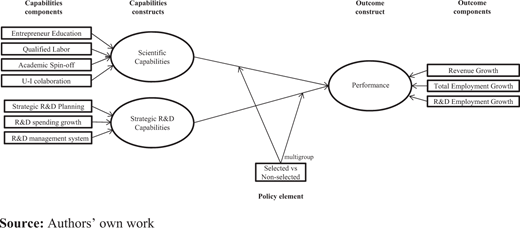
In the next step we dig deeper into these associations by addressing the causal configurations that lead to superior performance levels. This is a pressing issue in the field of KIE and related policies. As recent research has demonstrated (Fini et al., 2023; Salles-Filho et al., 2022), these firms often present highly heterogeneous profiles. Accordingly, they require fine-grained investigations that can offer a thorough comprehension of their features, trajectories and sources of impacts. To this end, we apply fsQCA, a technique designed to identify configurations of causal conditions that are associated with equifinal outcomes (Fiss, 2011; Greckhamer et al., 2008). For this approach, the scores of the latent variables extracted from the PLS-SEM were used for the construction of the outcome construct (performance), as suggested by Rasoolimanesh et al. (2021). The component variables of the scientific capabilities and strategic R&D capabilities constructs were used as causal conditions.
We identified three main qualitative points for the calibration, establishing the threshold for full membership, crossing point and non-membership (Ragin, 2008). The thresholds were established using the percentile method (Xie and Wang, 2020). Thus, the threshold for non-membership was set at the original value that covered 5% of the data values (fuzzy score = 0.05); the threshold for crossing points was established at the original value that covered 50% of the data values (fuzzy score = 0.50); and the threshold for full membership was set at the original value that covered 95% of the data values (fuzzy score = 0.95). Binary variables do not need to be transformed in fuzzy sets for fsQCA, so they were kept as either 0 or 1 (Pappas and Woodside, 2021). The values used to calibrate all indicators are presented in Appendix 2.
We now discuss the constructs and indicators used in our analysis to assess the conceptual model (Table 1).
Analytical variables
| Indicator | Description |
|---|---|
| KIE performance | |
| PERF1. Revenue growth | Compound annual growth rate (CAGR) of firms’ revenues1 |
| PERF2. Total employment growth | Compound annual growth rate (CAGR) of firms’ total employment1 |
| PERF3. R&D employment growth | Compound annual growth rate (CAGR) of firms’ employment in R&D1 |
| Scientific capabilities | |
| SC1. Entrepreneur education | Entrepreneur’s education level (0 - secondary education; 1 - tertiary education; 2 - master’s degree; 3 - doctoral degree; 4 - experience as postdoctoral researcher) |
| SC2. Qualified labor | Compound annual growth rate (CAGR) in the share of employees with tertiary education1 |
| SC3. Academic spin-off | Companies that identify themselves as academic spin-offs. Binary variable (1 if yes; 0 otherwise) |
| SC4. U-I collaboration | Formalized collaborative relationships with universities. Binary variable (1 if yes; 0 otherwise) |
| Strategic R&D capabilities | |
| RD1. Strategic R&D planning | Firms that include R&D and innovation explicitly in their strategic planning or business plans. Binary variable (1 if yes; 0 otherwise) |
| RD2. R&D spending growth | Compound annual growth rate (CAGR) of R&D spending1 |
| RD3. R&D management system | Adoption of project management systems (PMBoK, ICB/IPMA or similar). Binary variable (1 if yes; 0 otherwise) |
Notes:
Considering a three-year window. We adjusted the financial indicators to 2019 Brazilian Reais
First, the performance construct was formed by indicators that address companies’ dynamics in terms of revenue growth, total employment growth and the intensification of R&D employment. These variables provide a multidimensional perspective for addressing the outcomes of entrepreneurial firms (Audretsch et al., 2020; Autio and Rannikko, 2016; Colombo et al., 2010; Lanahan et al., 2021; Santarelli and Tran, 2013; Siegel and Wessner, 2012). This goes beyond previous attempts to look into configurations through an exclusive focus on revenue (Villani et al., 2018), a feature that may fail to capture the generation of competitive capabilities necessary to trigger long-term impacts in KIE firms (Deeds, 2001).
Second, following our literature review, the scientific capabilities construct is formed by four components, namely: entrepreneur education, qualified labor, academic spin-off and U-I collaboration. These indicators present a type of knowledge that is essential for the competitiveness and survival of the business (Adams et al., 2016; Agarwal and Shah, 2014; Fischer et al., 2022).
Third, the strategic R&D capabilities construct considers strategic R&D planning, R&D spending growth and existence of management systems applied to R&D. These indicators encompass the R&D management structure (Cabrilo and Dahms, 2018; Desouza and Awazu, 2006).
Summary statistics for all indicators are provided in Appendix 1.
4. Results
Following our two-stage analytical process, empirical results are reported separately for:
the PLS-SEM Approach; and
fsQCA estimations.
In the Discussions section, we combine the interpretation of our findings to derive implications for theory, practice and policy.
4.1 Partial least square structural equation modeling approach
For the PLS-SEM analysis, the criteria for formative constructs were considered to evaluate the measurement model, as the three constructs of interest are formative. Thus, convergent validity, multicollinearity and significance were assessed (Hair et al., 2022). Redundancy analysis determined the convergent validity by correlating the variables with a global indicator measure. For the three constructs, the values of the path coefficients were greater than 0.85, thus above the minimum threshold of 0.80 (Hair et al., 2022). Collinearity was assessed through the variance inflation factor (VIF). All values were below five, within the established range. Significance was analyzed using the bootstrapping technique, and the analysis of the external weights and external loads statistic indicates that all variables are significant. These results validate the formative constructs and demonstrate that no indicator needs to be removed from the analysis [4].
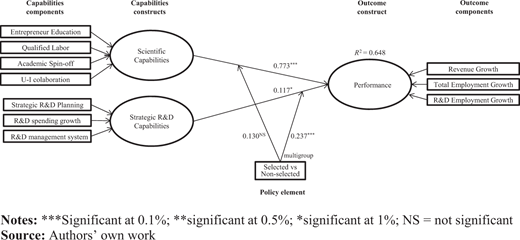
To evaluate the structural model, we first evaluate the collinearity of the relationships. For this, we assessed the VIF values for each subpart of the model, and all are below five, being within the established limit (Hair et al., 2022). Relationships were analyzed using the bootstrapping technique as well. The analysis of the two relationships showed Student’s t values above 1.96 (significance level = 5%), indicating significant values. Table 2 presents the coefficients of the structural model between the constructs.
Coefficients of the structural model
| Relationship | Sample mean | SD | t statistics | p-values |
|---|---|---|---|---|
| Scientific capabilities → KIE performance | 0.773 | 0.044 | 17.558 | 0.000 |
| Strategic R&D capabilities → KIE performance | 0.117 | 0.052 | 1.960 | 0.050 |
To assess the coefficient of determination (R2), we adopted the perspective that R2 values equal to 2% signal small effects, 13% refer to medium effects and above 25% comprehend large effects (Cohen, 1988; Faul et al., 2009). The KIE performance construct presented an R2 equal to 0.648, i.e. a large explanatory effect based on the chosen determinants. This is a key input to start validating our conceptual model. The multigroup analysis was used to test whether there are differences in relationships between KIE firms that participated or not in PIPE (Hair et al., 2022). The results (Table 3) show a difference in the relationship between R&D capabilities and KIE performance. The influence is more intense and positive in the companies that were awarded with PIPE grants.
Multigroup analysis
| Indicator | Path coefficients-diff (selected vs non-selected) | p-value |
|---|---|---|
| Scientific capabilities → KIE performance | −0.130 | 0.902 |
| Strategic R&D capabilities → KIE performance | 0.237 | 0.049 |
The initial assessment of our research model is shown in Figure 2. It indicates a much stronger association between scientific capabilities and resulting levels of performance than what is observed for the case of strategic R&D capabilities. As noticed, this relationship remains constant for awarded and non-awarded KIE firms. Notwithstanding, there is a significant increase in the strength of association between strategic R&D capabilities and performance for the case of PIPE firms.
4.2 Configurational perspective: the fuzzy-set qualitative comparative analysis assessment
Before analyzing sufficient conditions that can lead to high or low levels of KIE performance, we test the necessary conditions for the full sample and for the PIPE and non-PIPE samples. Results indicate that no condition can be deemed as necessary to achieve high performance, provided that no condition showed consistency and coverage level greater than 0.9 (Schneider and Wagemann, 2010). In carrying out the analysis of causal conditions, the frequency threshold was set at 2, and the consistency threshold was equal to or greater than 0.85 (Ragin, 2008; Schneider and Wagemann, 2010), allowing to reach the recommended value of 80% of the cases included (Ragin, 2008).
Tables 4, 5 and 6 show the results of the fsQCA analysis with the causal paths for the full, PIPE and non-PIPE samples. Tables present the intermediate solution, identifying each path’s central and contributing causal conditions. The classification as a central or contributing condition is made by a counterfactual analysis facilitated by the three different solutions produced (i.e. the complex, parsimonious and intermediate solutions) (Fiss, 2011; Ragin, 2008). The conditions appearing in the parsimonious solution are denoted as central conditions, while those appearing only in the intermediate solution are considered contributing conditions (Misangyi and Acharya, 2014).
Configurational paths for KIE performance – full sample
| Condition | Path 1 | Path 2 | Path 3 | Path 4 | Path 5 | Path 6 |
|---|---|---|---|---|---|---|
| SC1 | • | ∘ | ∘ | ∘ | ||
| SC2 | ● | ● | ● | ● | ● | ● |
| SC3 | • | • | • | • | ||
| SC4 | • | • | ∘ | • | • | |
| RD1 | ∘ | ∘ | ∘ | ∘ | • | |
| RD2 | • | ∘ | • | ∘ | ||
| RD3 | ∘ | ∘ | ∘ | ∘ | ||
| Raw coverage | 0.476 | 0.331 | 0.289 | 0.204 | 0.212 | 0.117 |
| Unique coverage | 0.095 | 0.068 | 0.042 | 0.040 | 0.021 | 0.031 |
| Consistency | 0.916 | 0.939 | 0.972 | 0.918 | 0.981 | 0.964 |
| Solution coverage | 0.711 | |||||
| Solution consistency | 0.914 |
Notes:
SC1: entrepreneur education; SC2: qualified labor; SC3: academic spin-off; SC4: U-I collaboration; RD1: strategic R&D planning; RD2: R&D spending growth; R&D management system; ● = core causal contributing condition (present); ∘ = core causal contributing condition (absent); • = contributing causal conditions (present); ∘ = contributing causal conditions (absent)
Configurational paths for KIE performance – PIPE sample
| Condition | Path 1 | Path 2 | Path 3 | Path 4 | Path 5 |
|---|---|---|---|---|---|
| SC1 | ∘ | ∘ | • | • | |
| SC2 | ● | ● | ● | ● | ∘ |
| SC3 | • | • | • | • | |
| SC4 | • | • | • | ∘ | |
| RD1 | ∘ | ∘ | ● | ● | ∘ |
| RD2 | ● | ● | ∘ | ● | |
| RD3 | ∘ | ∘ | ∘ | ∘ | |
| Raw coverage | 0.330 | 0.191 | 0.137 | 0.144 | 0.139 |
| Unique coverage | 0.097 | 0.030 | 0.023 | 0.029 | 0.017 |
| Consistency | 0.945 | 0.970 | 0.981 | 0.989 | 0.802 |
| Solution coverage | 0.496 | ||||
| Solution consistency | 0.903 |
Configurational paths for KIE performance – non-PIPE sample
| Condition | Path 1 | Path 2 | Path 3 | Path 4 |
|---|---|---|---|---|
| SC1 | • | • | • | |
| SC2 | ● | ● | ● | ● |
| SC3 | • | • | • | • |
| SC4 | ∘ | • | • | |
| RD1 | ∘ | ∘ | ∘ | |
| RD2 | ∘ | • | ∘ | |
| RD3 | ∘ | ∘ | ∘ | ∘ |
| Raw coverage | 0.202 | 0.424 | 0.357 | 0.321 |
| Unique coverage | 0.036 | 0.113 | 0.001 | 0.005 |
| Consistency | 0.945 | 0.924 | 0.970 | 0.967 |
| Solution coverage | 0.580 | |||
| Solution consistency | 0.917 |
The full sample results (Table 4) contain six paths that result in high levels of performance. Scientific capabilities’ indicators are included in all paths, emphasizing SC2 (qualified labor), a core causal condition in all paths. The indicators SC3 (academic spin-off) and SC4 (U-I collaboration) appear as contributing conditions in four paths and SC1 (entrepreneur education) in one. Regarding strategic R&D capabilities, RD2 (spending growth) appears as a contributing condition in two paths, RD1 (strategic R&D planning) in one path, and the absence (negation) of RD3 (R&D management system) appears as a contributing condition in four paths.
Such configurations are aligned with PLS-SEM explorations, but they add significant nuance to understanding the existence of heterogeneous configurational trajectories that can lead to enhanced outcomes. Nonetheless, the centrality of SC2 is noteworthy, and the levels of overlap across components and paths hinder the extraction of unambiguous profiles in the sample.
The exploration focused on the case of PIPE awardees is presented in Table 5. Again, there is a diversity of configurations consisting of five different paths. Again, in line with PLS-SEM analyses, we can perceive a more balanced picture between Scientific and Strategic R&D capabilities. SC2 is a core causal condition in four paths. SC3 is also present in four paths but with a more marginal impact (contributing causal condition). SC4 is present in three paths, and its absence appears as a contributing condition for path 5. SC1 is present in two configurations and its absence is perceived for Paths 1 and 2. Regarding the strategic R&D capabilities indicators, RD1 is a component of Paths 3 and 4 as a core condition, while RD2 is present in three paths also as a core causal condition. RD3 only appears as absent contributing causal conditions in four paths. What is particularly striking in these estimations is the apparent trade-off between strategic R&D planning (RD1) and R&D spending growth (RD2).
The non-PIPE sample presents similar results to the full sample (Table 6). Thus, we can notice a diminished relevance of strategic R&D capabilities across configurations. SC2 appears as the core causal condition across all four paths. SC3 appears as a contributing condition in four paths, SC1 in three paths and SC4 in two paths. Thus, all paths contain at least two indicators of scientific capabilities. Interestingly, Paths 2 and 4 contain all four components of scientific capabilities, composing profiles that can be attached to full-fledged science-based KIE. For strategic R&D capabilities indicators, only RD2 appears as a contributing condition present in path 2. RD1 and RD3 appear only as absent contributing conditions. Taken together with PLS-SEM multi-group analyses, this is an indication of the lack of maturity of this sample cohort when it comes to demonstrating more complex configurations in terms of complementary capabilities.
We now discuss these findings in light of previous literature to outline the main contributions that emerged from our empirical assessment.
5. Discussion
In this article, we have dedicated efforts to approach the performance drivers in KIE firms based on predictors associated with scientific and strategic R&D capabilities. Our interest went beyond simply comprehending the direct association between analytical constructs. In this respect, we delved into the heterogeneous configurations that can be formed to generate superior outcomes. To this end, we grounded our empirical assessment on data from awarded and non-awarded KIE firms that submitted grant proposals to the PIPE Program, an entrepreneurship support initiative taking place in the State of São Paulo, Brazil. From these findings we explore some key discussions and implications that arise from our research.
First, through the PLS-SEM analyses, some relevant results deserve closer inspection. Although the conceptual model was fully significant in the established associations between independent and dependent constructs, scientific capabilities present a much stronger predictive power than that associated to strategic R&D capabilities. Plus, the significance of the latter is exclusively attached to the case of companies with awarded projects. This finding is in conflict with prior literature (Villani et al., 2018; Wennberg et al., 2011). We should not take it as evidence that downplays the role of strategic R&D capabilities. Rather, it shows that our measures of such capabilities – largely based on causation logics – failed to capture strong effects in KIE performance. A plausible explanation for these findings can be attached to the dynamics of competitiveness in KIE firms which may be oriented toward more flexible ways of managing innovation (i.e. through fast adaption and pivoting). In this respect, the scientific capabilities can become an important input for organizational learning, thus feeding strategic R&D management with necessary absorptive capabilities. In this vein, further in-depth evaluations on the dynamics of business models (and their variety) in KIE firms stands for an exciting research avenue.
While these initial results can be deemed as relevant in their own right, the main contribution and novelty of our research resides in the exploration of heterogeneous configurations in KIE firms. The general appraisal from structural equations remains unaltered, but fsQCA analyses allowed a much more nuanced view on:
how KIE firms combine different resources to become more competitive; and
what are the pivotal elements that cut across high-performance configurations.
Our research underscored the co-existence of different firm-level trajectories with equifinal results. This is well aligned with recent contributions that address the issue of diversity in such entrepreneurial undertakings (Fini et al., 2023; Salles-Filho et al., 2022).
Surprisingly, our analytical exercises have pinpointed a relatively marginal role played by strategic R&D capabilities. Such conditions are particularly striking for implementation of R&D management systems. This variable is not only excluded from every path across distinct fsQCA estimations, but its absence is associated with increased performance. To understand this situation, we need to outline that the sample is mainly composed of very young (median age of firms is three years-old at the moment of project submission) and very small companies (median number of employees is 3 at the moment of project submission and 5 in the ex post period). From this, we can extract the notion that these are firms that (on average) lack organizational maturity. This might make their strategic capabilities much less pronounced than the scientific capabilities that create and sustain their knowledge intensity. This is very much in line with prior literature that emphasize these capabilities as the core source of innovation in KIE (Adams et al., 2016; Agarwal and Shah, 2014; Andersson and Lööf, 2012; Hottenrott and Richstein, 2020), as well as a pivotal tool to promote organizational learning along their respective evolutionary trajectories (Secundo et al., 2017; Toole and Czarnitzki, 2009). Notwithstanding, it is in contrast with the vital nature sometimes attributed to strategic R&D capabilities (Cabrilo and Dahms, 2018; Heisig et al., 2016; Scuotto et al., 2017).
Such features appear to suggest a dominant approach of effectuation logics in our sample (Fisher, 2012; Sarasvathy, 2001), but this might not always be the case. As exposed, two (out of five) paths for the awarded firms comprehend the formulation of strategic R&D planning, a typical causation approach. Interestingly, this indicator never coincides with configurations that include increases in R&D expenditures, highlighting a trade-off involving these variables across configurational paths. This might give some hints on the kind of strategic behavior (causation or effectuation logics) taking place in PIPE firms. But these discussions still fall short in explaining why there are differences in these relationships when comparing awarded and non-awarded firms. This takes us to the policy effects associated with such outcomes. Differences emerging from the PIPE versus non-PIPE comparison are likely a function of a well-designed selection process. As previous literature identified (Ayoub et al., 2017; Colombo et al., 2011; Lerner, 1999), such conditions not only enhance the quality of entrepreneurship being nurtured; they also enhance the quality of market signals.
Hence, while entrepreneurial grants alone are not enough to boost the necessary capabilities for KIE firms to evolve into competitive businesses (Meyer, 2003), they might lay the grounds for other sources of support to emerge. In this respect, we ought to observe for our sample that selected projects had lower incidence of private investments (16.3% vs 19.75% in non-selected firms) and lower median values (BRL 72,492 vs BRL 137,138.00) at the submission stage. However, even though the proportion of invested projects remained lower in the ex post period (18.3% vs 30.8%), the median value of investments was actually larger (BRL 239,769.00 vs BRL 121,082.00). We ought to remind that private investments are also sources of managerial competences (SØrensen, 2007), thus strengthening the organizational structure of invested firms. By generating high-quality market signals, PIPE might be acting as a lever for increasing firm-level ambidexterity. While we take these interpretations as tentative, they help explaining the different configurational dynamics taking place in our sample.
5.1 Theoretical implications
Our findings entail implications for scholars, managers and policymakers. First, fsQCA analyses allowed a much more nuanced view on:
how KIE firms combine different resources to become more competitive; and
what are the pivotal elements that cut across configurations and represent key pillars of performance.
In this respect, our research underscored the co-existence of different firm-level trajectories with equifinal results. Hence, our comprehension of the KIE phenomenon needs to better acknowledge diversity in how these firms operate and evolve. Isomorphic notions of how a successful KIE firm should look like is bound to neglect the fact that competitiveness can be achieved through different configurations of resources and assets. Drawing from benchmarks and eminent cases of entrepreneurial success can be misleading for managers. The observation of such heteromorphic conditions can be associated with the innovative nature of these firms and the initial stage of the life cycle of their respective organizational field (DiMaggio and Powell, 1983). Accordingly, firms in our sample likely adopt effectuation approaches (Fisher, 2012; Sarasvathy, 2001) that derive from contingency perspectives of each individual startup, i.e. strategic responses to environmental, managerial and performance elements (Luthans and Stewart, 1977). Interestingly, in practice and in theory, such nuances of knowledge management processes in new firms are often discouraged in favor of less diverse views on how entrepreneurial firms should operate. The Silicon Valley model of entrepreneurship is a good case in point (Audretsch, 2021).
5.2 Managerial implications
What is particularly striking for our sample is the fact that scientific capabilities are more critical than strategic R&D capabilities in driving performance. This is an interesting feature of our analytical exercise, and it highlights the criticality of academic knowledge in spurring competitiveness in KIE. Such elements provide critical knowledge for managers of KIE firms and those decision-makers involved with entrepreneurial ecosystems. In this respect, it must be highlighted that scientific capabilities are assets that cannot be internalized by firms easily. They face time-compressing diseconomies if they are to be developed from scratch (bootcamps will not be very useful here). Alternatively, if they are to be acquired in markets – for instance, by hiring qualified personnel – the challenge becomes one of tapping into the assets available in entrepreneurial ecosystems. Talent is concentrated in space, so it will be easier for KIE firms to form more qualified teams when sharing the positive externalities offered by these agglomerations (Acs et al., 2018; Alvedalen and Boschma, 2017). Similar conditions regarding human capital availability and vibrancy of entrepreneurial ecosystems have been previously identified in the Brazilian case (Alves et al., 2019; Fischer et al., 2018a, 2018b). Following these trends, KIE presents itself as a highly context-sensitive phenomenon (Ayoub et al., 2017; Colombo et al., 2010; Fischer et al., 2022). Accordingly, it is worth considering that more promising entrepreneurial endeavors are not likely to be found in peripheral locations. Hence, the capacity of KIE firms to connect with thriving ecosystems – an element that goes beyond its organizational boundaries – gains prominence as a potential source of superior performance. This might also help guiding selection processes in entrepreneurial policies, thus considering not only the firm/project per se but also its capacity to leverage on complementary resources that are available in applicants’ respective ecosystems.
5.3 Social implications
Also, from this perspective, entrepreneurship policy should be able to embrace heterogeneity in the characteristics of selected firms. This carries some relevant social implications, considering that our research generates in-depth insights to design policies and instruments to foster KIE activity. Our evidence suggests that selected firms seem to outperform non-selected firms, but the main issue is that awardees present more complete configurations in terms of scientific and strategic R&D capabilities. More importantly, however, by demonstrating variegated combinations of elements, the sample suggests that entrepreneurship policies could develop support programs for these firms based on their specific trajectories. Thus, by avoiding simple training programs that emulate strategies of archetypical startups, policymakers could enhance firm-level evolution, ultimately leveraging the societal impacts generated by KIE firms.
6. Concluding remarks
The growing interest in companies with high growth potential to drive economic development and value creation in entrepreneurial ecosystems has drawn increasing attention to the performance of KIE (Acs et al., 2017; Liu et al., 2022; Malerba and McKelvey, 2020). Through an exploratory exercise, our research contributes to understanding how scientific capabilities and strategic R&D capabilities combine to drive performance in these firms (Brown and Mason, 2014; Fischer et al., 2022). Additionally, the existing literature on the dynamics of knowledge management in KIE remains focused on developed markets (Mukhtarova et al., 2019). By addressing this phenomenon in an emerging country, we add novel evidence from entrepreneurial ecosystems that have yet to reach maturity. This seems particularly relevant considering that entrepreneurship policy requires evidence-based guidance that takes into account socioeconomic specificities. This is a way to avoid inadequate policy mimetism, i.e. when examples from highly dissimilar entrepreneurial ecosystems are appropriated without proper adjustments (Kantis et al., 2020; Mátyás et al., 2019).
In this regard, our analysis provided new evidence for a sample of KIE firms in Brazil through a multi-method approach. Findings underscore the inherent complexity behind the generation of high performance in KIE when addressing their sets of knowledge-related capabilities. More than that, we were able to identify the existence of heterogeneous patterns that can equally lead to higher levels of performance. Plus, by comparing cases that received policy support from those that did not, some interesting remarks that can help guiding such initiatives were outlined. This body of evidence adds to our still incipient knowledge on the diversity of KIE firms – and what this means for managing and supporting these organizations.
But our results are not without limitations. First, we only address two dimensions of capabilities, thus offering a limited perspective on the multifaceted nature of performance in KIE. Second, only companies that applied (selected and non-selected) to the PIPE Program were analyzed, which involves an intrinsic sampling bias. Third, our research did not allow capturing how these constructs are related from a long-term, evolutionary perspective. In this context, suggestions for future research include the following:
in-depth qualitative assessments on how knowledge capabilities in KIE are associated with competitive outcomes; and
the longitudinal research that allows gathering further evidence about the relationships between knowledge capabilities and performance and how they change over long periods of time; and, last, to dig deeper into the causes and nature of differences emerging in the configurations of companies that received policy support from those that did not.
These are key issues that deserve our full attention to have a more solid theory on KIE management and on initiatives targeted at nurturing these firms.
Gustavo Salati, Bruno Fischer and Dirk Meissner’s contributions to this article are based on the study funded by the Basic Research Program of the National Research University Higher School of Economics (HSE) and by the Russian Academic Excellence Project ‘5–100’.
Notes
“Causation rests on a logic of prediction, effectuation on the logic of control.” (Sarasvathy, 2001, p. 243).
Our analysis includes both approved and rejected proposals. Nonetheless, among the rejected projects, only those that were rejected by merit have been included; i.e. they are aligned with the evaluation criteria outlined above. This procedure allows us to have a good approximation of KIE firms. Even though the rejected group did not appear technologically promising to decision-makers, they still qualify as KIE.
Raw response rates were 46.3% for firms with approved projects and 18% for firms with rejected proposals. These numbers were significantly reduced due to missing information and inconsistencies in data.
This is also an important analytical input for fsQCA estimations.
References
Appendix 1
Summary statistics
| Indicator | Mean | Median | Minimum | Maximum | SD | Number of observations |
|---|---|---|---|---|---|---|
| PERF1 | 0.57 | 0.57 | −1.00 | 14.10 | 1.27 | 223.00 |
| PERF2 | 0.19 | 0.19 | −1.00 | 2.66 | 0.41 | 223.00 |
| PERF3 | 0.17 | 0.17 | −1.00 | 1.57 | 0.30 | 223.00 |
| SC1 | 2.83 | 3.00 | 1.00 | 4.00 | 1.04 | 223.00 |
| SC2 | 0.18 | 0.18 | −1.00 | 1.29 | 0.30 | 223.00 |
| SC3 | 0.13 | 0.00 | 0.00 | 1.00 | 0.33 | 223.00 |
| SC4 | 0.45 | 0.00 | 0.00 | 1.00 | 0.50 | 223.00 |
| RD1 | 0.74 | 1.00 | 0.00 | 1.00 | 0.44 | 223.00 |
| RD2 | 0.29 | 0.29 | −1.00 | 14.44 | 1.15 | 223.00 |
| RD3 | 0.57 | 1.00 | 0.00 | 1.00 | 0.49 | 223.00 |
Appendix 2
fsQCA calibration
| Indicators | Minimum | Maximum | Fuzzy scores | ||
|---|---|---|---|---|---|
| 0.05 | 0.5 | 0.95 | |||
| SC1. Entrepreneur education | 0.00 | 4.00 | 1.00 | 3.00 | 4.00 |
| SC2. Qualified labor | −1.00 | 1.29 | −0.21 | 0.18 | 0.67 |
| SC3. Academic spin-off | 0.00 | 1.00 | 0.00 | 0.50 | 1.00 |
| SC4. U-I collaboration | 0.00 | 1.00 | 0.00 | 0.50 | 1.00 |
| RD1. Strategic R&D planning | 0.00 | 1.00 | 0.00 | 0.50 | 1.00 |
| RD2. R&D spending growth | −1.00 | 14.44 | −0.75 | 0.28 | 0.99 |
| RD3. R&D management system | 0.00 | 1.00 | 0.00 | 0.50 | 1.00 |
| PERF. KIE Performance | −4.34 | 4.00 | −1.30 | 0.00 | 1.50 |

