We were very interested to read the study by Carpinteri et al. whereby they investigated scale effects in uniaxially compressed concrete specimens. The authors should be congratulated on their valuable article, bringing an important contribution to a very complex subject in concrete literature. To extend the treatment of the subject in question, the discussers wish to make the following comments.
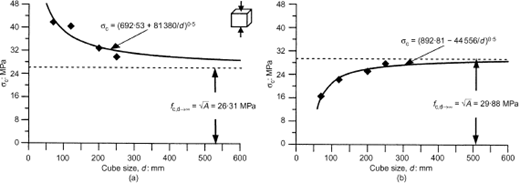
The analytical expression of multifractal scaling law (MFSL)1 seems to be also dependent on curing regime. The effect of curing regime on concrete compressive strength, taking specimen size into consideration, was displayed in Table 1 and Fig. 1 by using the MFSL.
As can be seen, for a standard curing regime (i.e. continuously cured in water at 20°C to age of compression testing), the measured compressive strength, σc, decreases with increase in the size of the cubes (Fig. 1(a)); whereas for 90 days at 20°C and 65% relative humidity (RH) curing condition, the measured compressive strength is observed to increase with specimen size (noting B < 0) (Fig. 1(b)).
This result can be explained by the fact that the thickness of the outer layer, affected by internal fissures resulting from drying, does not appear dependent on specimen size: their relative volume increases as the specimen size decreases.3
It is interesting to observe that the asymptotic value of compressive strength corresponding to cubes exposed to 20°C at 65% RH was computed to be 29·88 MPa which is somewhat higher than that of cubes kept continuously in water at 20°C.
In brief, measurement of compressive strength from large-size specimens may be independent of curing regimes.
The use of MFSL is promising for estimation of in situ concrete strength. From a sound physical point of view, an asymptotic value of the compressive strength for d → ∞ can be treated as the in situ strength of concrete. From Fig. 1(a), the asymptotic value of the compressive strength fc for d → ∞ is determined to be
which is equal to 75% of the strength of the standard 150 mm cube.
Reply by the authors
The aim of the authors was to stimulate the discussion of the size effects on the nominal compressive strength of concrete specimens. This is a very important topic, as building codes adopt the compressive test for evaluating the related strength as well as other material properties indirectly. Arioglu et al. took the opportunity to comment, and therefore we have to thank them sincerely.
They fronted the problem related to the curing conditions, which, especially at small size, play a fundamental role. In the paper by Soroka and Baum,3 cited in the contribution, the following considerations are pointed out
the effect of curing regime on cube strength is related to specimen size, and it is much greater in the smaller than in the larger specimens
the compressive strength is a bulk property, whereas curing affects mainly the quality of concrete outer layers
the thickness of the affected outer layers may be assumed to be independent of specimen size for a given curing regime
the effect of curing regime on measured compressive strength of concrete would decrease with an increase in size of the test specimen.
In evaluating the effect of specimen size, two opposite effects must be considered. The first one, namely the intrinsic effect of size represented by MFSL, is based on the different influence of material disorder by varying specimen size; according to which, strength is expected to decrease with an increase in size. The second effect is present when drying is involved, that is, when the hydration of concrete in the outer layers slows down and external cracking occurs. This effect provides an opposite trend.
For severe curing conditions, the poor quality of concrete in the outer layers plays a fundamental role for the apparent strength. The curing effect prevails with respect to the MFSL. In fact, a simple application of the MFSL, written in the explicit form
fc being the asymptotic strength for large specimens, gives a negative characteristic length lch = −50 cm, as reported by Arioglu et al., which physically represents a nonsense.
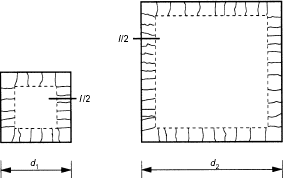
In this case a more appropriate and classical law can be derived in a very straightforward way. According to the previous hypotheses, let us consider a constant material strength, σ, independent of the cube size. If only the bulk of the cube is able to resist (Fig. 2), we must remove a constant thickness l/2 (outer layers) for any size. By considering two different cubes, for each one we can write
where Ae is the reacting cross-section (bulk). The peak load can be expressed as
The apparent strength σa, in the hypothesis of constant thickness of the outer layers, is as follows
whose limits, for d → l and for d → ∞, are respectively
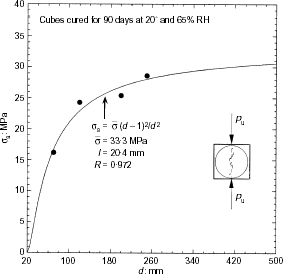
The previous relation can be used to fit the experimental values obtained by Soroka and Baum3 for a concrete made of Portland cement, with a nominal fly ash of 10%, and crushed limestone aggregate, with a maximum particle size of 19 mm. It can be seen (Fig. 3) that the curve fits the compressive strength data very well (R = 0·972), giving an asymptotic value for large specimens equal to σ = 33·3 MPa and a thickness of the affected outer layers equal to l/2 = 10 mm. This thickness has the same order of magnitude of the maximum particle size.
On the other hand, if we consider for the specimen bulk a strength variation according to MFSL, σ is no longer constant and σN should be considered. In this case, by substituting equation (1) into equation (4), we obtain the following law
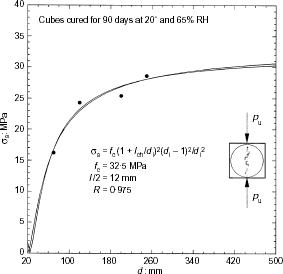
The fitting of the experimental data (Fig. 4) seems slightly better than the former (R = 0·975). The asymptotic strength value is in this case fc = 32·5 MPa, whereas a thickness of the affected outer layer of l/2 = 12 mm results. In Fig. 4 a comparison between the two different laws is given. It is possible to observe, however, that the curing effect is prevailing in this case and that the influence of material microstructural disorder plays a secondary role.
It is important to emphasize, in conclusion, that the MFSL is not a mere fitting that can be applied to any case. It can be used if the self-affinity hypothesis, assumed in Reference 1 is verified.