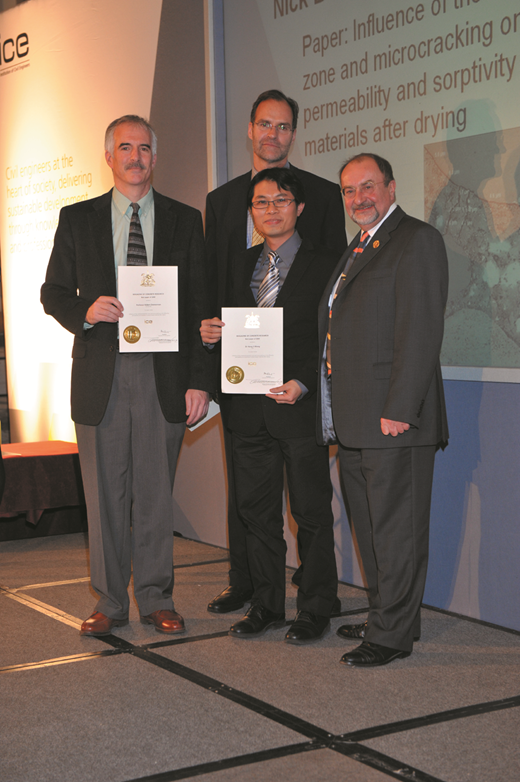
Every year, the editorial advisory board selects the best paper published in Magazine of Concrete Research. All papers published in Magazine of Concrete Research are eligible for this award.
On Friday 8 October 2010, ICE president Paul Jowitt presented the award for the best paper published in Magazine of Concrete Research in 2009, as selected by the editorial panel.
The Magazine of Concrete Research Prize was awarded to: Wong HS, Zobel M, Buenfeld NR and Zimmerman RW (2009) Influence of the interfacial transition zone and microcracking on the diffusivity, permeability and sorptivity of cement-based materials after drying. Magazine of Concrete Research 61(8): 571–589, doi: 10.1680/macr.2008.61.8.571.Fig. 1
Abstract
Available experimental investigations on the effect of the aggregate–paste ‘interfacial transition zone' (ITZ) on mass transport properties of cement-based materials appear to be ambiguous. While some studies have found a deleterious effect of the ITZ, results from others seem to suggest otherwise. The present study examines the relative influences of ITZ and microcracking on the oxygen diffusivity, oxygen permeability and water sorptivity, to further enhance understanding of the links between microstructure and transport properties. Specimens of several neat cement pastes, mortars and concretes were prepared and tested. Variables include water/cement (w/c) ratio (0·3 and 0·5), binder type (CEM I and CEM II with 8% silica fume), curing period (3 and 90 days), aggregate volume fraction (0–70%) and preconditioning temperature (50°C and 105°C). 105°C drying was adapted to induce microcracking. Backscattered electron microscopy and image analysis were applied to characterise the microstructure, in particular the microcracks. It was observed that in all cases, the transport properties of mortars decreased with increasing ITZ fraction. Permeability was far more sensitive to the presence of microcracking and changes in total porosity, compared with diffusivity or sorptivity. However, no critical threshold sand content linked to an ITZ percolation effect was found, even in the deliberately damaged samples. Concretes have about the same diffusivity and sorptivity, but significantly higher permeability than mortars with the same volume fraction of aggregate, despite a lower ITZ fraction. It is argued that the higher permeability of concrete is attributable to more microcracking, and because the microcracks and paste are less tortuous than the equivalent mortar. It is also shown that conventional permeability testing is affected by the sample thickness-to-maximum aggregate size ratio, which may be another factor explaining the disparity between the measured permeability of concretes and mortars.