This briefing note is the first in a series that will keep readers abreast of the work of the Institution of Civil Engineers' (ICE) maritime panel.
This note describes how the maritime panel contributes to the Institution of Civil Engineers' (ICE) knowledge-management process and the members of the panel and their areas of interest. The issues currently being addressed by the panel are outlined. These include: a review of flooding and coastal defence policy statements; consultation with government on a national infrastructure policy statement for ports; the establishment of a ‘lifed panel’ to examine marine renewable energy; development of a policy statement for the use of dredged material; and an ICE/Royal Institute of British Architects (RIBA) study of the management of coastal retreat and realignment.
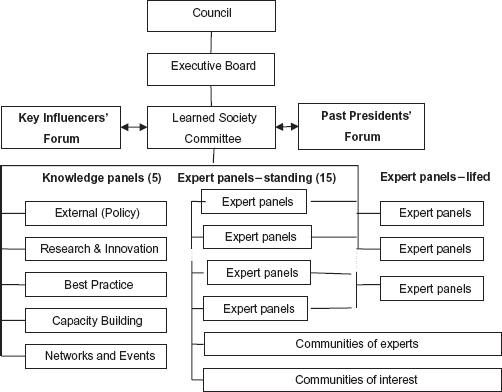
On 12 September 2007 the ICE maritime board became the maritime panel as part of the Institution's reorganisation of the management of its knowledge. Figure 1 describes the new organisation structure. The maritime panel is one of 15 standing expert panels that report to the learned society committee (LSC) chaired by the engineering policy and innovation vice-president of ICE. The LSC reports to the executive board and thence to the ICE council.
Five standing knowledge panels (external policy, research and innovation, best practice, capacity building, and networks and events) and a number of ‘lifed’ expert panels also report to the LSC. The knowledge panels have oversight of all of ICE's knowledge outputs and are responsible for planning and coordinating the delivery of these outputs in accordance with the ICE business planning process and for ensuring our knowledge outputs meet our expectations for quality and impact. The lifed expert panels will deliver specific knowledge outputs and will have a restricted life.
The final parts of the jigsaw are the communities of experts (CoE) and communities of interest (CoI) that will be formed by the standing expert panels. Membership of the CoEs will be by invitation and the CoIs will be open to all ICE members. The panel is currently formulating the terms of reference for the maritime community of experts and the maritime community of interest and the procedures and schedules for establishing these communities and then maintaining them. These activities are to be coordinated with the Institution to ensure that a consistent approach is adopted with other expert panels.
The maritime panel's areas of interest include: ports and harbours; coastal management; dredging; environment; waste; marine renewables; and offshore (including oil and gas activities).
On 14 October, Bill Schlegel of Jacobs chaired his last meeting of the maritime panel when he completed his three-year term of service. He is succeeded by Ben Hamer of Halcrow.
The members of the panel for the coming year are listed in Table 1.
The impact of the ICE flooding report was reviewed and it was concluded that it had received considerable publicity through the ICE website, national, regional and trade publications and national and local television coverage. As a result it was concluded by the panel and the ICE policy panel that it had been a success.
Ben Hamer is leading a joint ICE/RIBA study looking at managing coastal retreat and realignment. The project charter for this is to be developed in the coming weeks.
A lifed expert panel is planned for 2009/2010 to examine marine renewables. The terms of reference for this panel have been developed and submitted for ICE review. It is envisaged that the panel review will cover four main areas of energy generation including offshore wind, wave, tidal and tidal capture within the UK. Technologies will be reviewed together with the opportunities for their application and resources available to implement them. Finally a strategy review will be performed and recommendations made for the development of UK marine renewables.
The panel proposes to review, and if appropriate, update the policy statements on ‘flood and coastal defence’ and on ‘ports’.
It is anticipated that the UK government will issue for consultation a national infrastructure policy statement for ports in early 2009. The panel will start to identify its position to enable it to contribute fully to the consultation process.
The panel is in the process of developing the terms of reference for a position statement (policy) on the ‘use of dredged material’. Additionally, the panel has responded to both the Department for Environment, Food and Rural Affairs (Defra) consultation ‘Our seas – a shared resource’ and the Defra policy statement on appraisal for flood and coastal erosion risk management.
The chairman reported on the Vernon Harcourt prestige lecture which had taken place at ICE on 9 September 2008. The lecture had been well received and also included the presentation for the first time of the Vernon Harcourt prize. The prize winners Antony Drake and Peter Phipps received cheques for their paper ‘Cliff recession and behaviour studies, Hunstanton, UK’.1