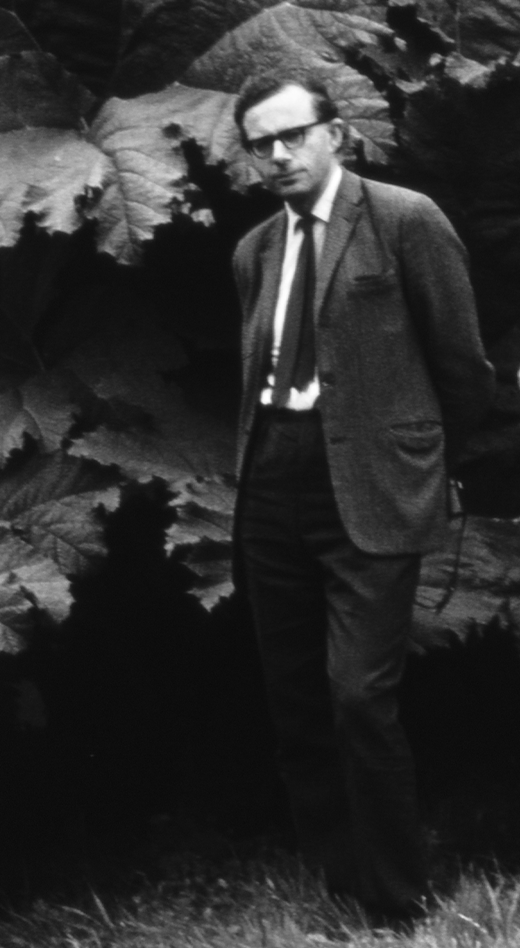
Sir Alan Muir Wood FREng, FRS who died on 1 February 2009, at the age of 87, was primarily recognised for his pioneering and innovative tunnelling design. However, he also made significant contributions to a number of disciplines including maritime engineering. He combined brilliant technical skills with a strong sense of practical reality and championed solutions to new engineering problems through the application of fundamental, scientific principles. He thus avoided the pitfalls of overly elaborate solutions which in his words ‘give an illusion of verisimilitude’.
Born in London on 8 August 1921, his father was an Admiralty civil servant and he consequently lived in a maritime environment in his early childhood in Malta and latterly in Chatham Naval Dockyard.
Following his degree in Mechanical Sciences at Peterhouse, Cambridge he continued his maritime connections by joining the Royal Navy in 1942 as an engineering officer. In 1946 he joined Southern Railways as an engineer and there he developed his geotechnical skills working on the stabilisation of landslides at Folkestone Warren. Using a practical scientific approach he developed a scheme based on an innovative solution of identifying different strata from the age of the fossils thus determining the sequence and extent of landslips, leading to predictions of further movements.
Sir Alan then joined the Inland Waterways Executive and established a research organisation. He also designed a hydraulics research laboratory from which he made a successful bid for the equipment of a ship testing tank used in the 1951 Exhibition.
He joined Sir William Halcrow and Partners in 1952, was taken into the partnership in 1964, and retired as senior partner in 1984. His early projects immediately thrust him into the design of watertight concrete tunnels for post office exchanges in Birmingham, Manchester and Oban. Many other challenging projects followed including the Potters Bar and Clyde Tunnels. Each project saw him pushing forward the envelope of innovation in different aspects of design. The cargo tunnel at Heathrow Airport has been described as his most influential design and a testament to his analytical skills and prior experience. Some engineers thought it would be ‘unbuildable’ due to the proximity of the roof of the tunnel to the ground surface. Conventional theory at that time dictated that the tunnel would need to be positioned at a much deeper level in order to prevent distortion of the unbolted precast concrete segments as well as unacceptable settlement. By optimising the design neither issue came to the fore and his reputation as an innovative tunnel designer was firmly consolidated. This approach was later named ‘observational design’ and, in this case, resulted in a construction cost that was less than half that of a traditional design.
It was also during the1960s that Sir Alan continued his work on coastal protection, principally on the south coast including revisiting cliff stabilisation at Folkestone Warren and coastal protection schemes at Shoreham-by-Sea, Lymington, Barton-on-Sea and beach stabilisation associated with Dungeness power station and adjacent coastlines. The last of these saw one of the earliest beach material recycling schemes: this has been ongoing for over 45 years! Control of beach movements around the power station frontage was realised by recycling shingle beach material from east to west by road transport, the volume of material required being determined on an annual basis. From time to time the alternative of a permanent fixed scheme was evaluated and found to be significantly more expensive. Thus, the Dungeness recycling project is a striking example of a sustainable coastal protection project; Sir Alan was a keen advocate of applying ‘soft’ coastal defence solutions in sympathy with dominant coastal processes rather than the ‘hard’ defence schemes that tended to constrain the natural coastal response, at a time when the latter was common practice. Indeed, it was not until the late 1980s that this approach was generally recognised for its ability to accommodate dynamic coastal environments. His keen involvement in coastal projects led him to write a textbook entitled Coastal Hydraulics (Muir Wood, 1969). As he saw it, tunnelling and coastal engineering were both emerging from pragmatism to science-based technologies, so this was a stimulating time for new developments. Coastal Hydraulics was one of the very few textbooks on coastal processes and engineering at the time and ran to a second edition, updated and co-authored by a Halcrow colleague and published in 1981.
Sir Alan combined his considerable knowledge of tunnelling and coastal processes through the design of the cooling water for Koeberg nuclear power station, north of Cape Town. Alternative schemes for the intake and outfall systems were investigated and included tunnels and a shore-based cooling water intake basin and adjacent outfall. The primary issue for the latter was evaluating the volumes of maintenance dredging that would be required on such an exposed coastline. He was also responsible for what remains the longest water conveyance tunnel in the southern hemisphere – the Orange Fish Tunnel which runs some 80 km diverting water from the Gariep Dam to the Fish River valley.
Throughout his career Sir Alan contributed to very many facets of a wide range of projects, principally involving major tunnelling elements. He had a long association of some 40 years with the Channel Tunnel, initially leading the British team carrying out studies commencing in 1958 and latterly spending 10 years on the Anglo-French Disputes Panel resolving issues between Eurotunnel and Transmanche Link. As well as maritime and tunnelling projects, his broad engineering ability resulted in him leading the design and investigation of a wide variety of engineering infrastructure including, for example, several power stations and desalination plants in the Middle East, solar energy for small-scale irrigation schemes and the stabilisation of spoil heaps. Sir Alan's skills as an expert witness and arbitrator continued to be in high demand after his retirement, due to his reputation as someone who could apply superb clarity of thought to the engineering and contractual issues and apply an even hand in the pursuit of the facts.
Sir Alan made very many significant contributions to the engineering profession. He was the second chairman of the British Tunneling Society (1973–1974, 1975–1976), the first Chairman of the International Tunnelling Association elected at the inaugural meeting in 1974 and thereafter was elected as Honorary Life President in 1977. He was President of the Institution of Civil Engineers 1977/1978 and appointed Knight Batchelor in 1982 for services to engineering. He was a Fellow of the Royal Society, the Royal Academy of Engineering and Imperial College, an Honorary Fellow of Peterhouse College, Cambridge and the University of Portsmouth as well as a visiting Professor at Bristol University. He received the James Clark Medal in 1994, the James Alfred Ewing medal in 1984 and the Institution of Civil Engineers Gold Medal in 1998.
His was a life dedicated to the advancement of knowledge in civil engineering and research. He wrote well over 100 articles, papers, books and lectures. His most recent book, entitled Civil Engineering in Context (Muir Wood, 2004) addresses his strong, and sometimes controversial, views gained through a lifetime of experience and the conviction that there is a need for the engineering profession to re-evaluate how design and construction is most effectively realised. His final paper (Muir Wood, 2009) was based on forces in masonry arches, as analysed in the nineteenth century and demonstrated his continued interest in applying fundamental principles to civil engineering design.
Sir Alan married in 1943, and is survived by Winifred, a highly accomplished mathematician, their three sons, David, Paul and Robert and eight grandchildren.
Chris A. Fleming