

N. W. H. Allsop, HR Wallingford and University of Southampton, UK
This paper presents interesting data on wave runup levels derived from small-scale hydraulic models and field measurements. The analysis presented in this paper, however, suffers a significant (indeed potentially critical) flaw in that use of dimensioned coefficients in the prediction equation for dimensionless runup (the authors’ equation (9)), implies substantial scale effects that are not supported by the data or by the analysis presented by the authors.
This effect may most conveniently be illustrated by considering an imaginary set of hydraulic model tests being used to predict wave runup levels on a range of possible rubble mound breakwaters. That is, after all, the main use of hydraulic model tests. Let us consider model tests being run with model waves of Hm0=0·1 m, a reasonable size of model waves and close to the model waves used by the authors in their tests.
Consider the use then of the authors’ equation (9) in predicting relative runup levels (Ru2%/Hm0) for a number of different armoured slopes subject to prototype waves varying from Hm0=1·0 m (as on a small inland reservoir), to Hm0=12 m (as on a rubble breakwater facing an open ocean). For the purpose of this analysis, wave steepness values between sm=0·01 to 0·06 have been included in the calculations, as have spectral widths between ε=0·4 to 0·65 (consistent with the range shown in the authors’ Fig. 8).
Relative runup values (Ru2%/Hm0) calculated using equation (9) for each combination of Hm0, sm, and ε have been compared with those calculated for Hm0=0·1 m, always with the same values of sm and ε.
A scale correction factor, Fscale, has been calculated as the ratio of Ru2%/Hm0 for the given (prototype scale) wave height to the value of Ru2%/Hm0 for Hm0=0·1 m. Values of Fscale have been plotted against wave height in Fig. 15, illustrating the unintended (and probably false) effect caused by the use of dimensioned coefficients in equation (9).
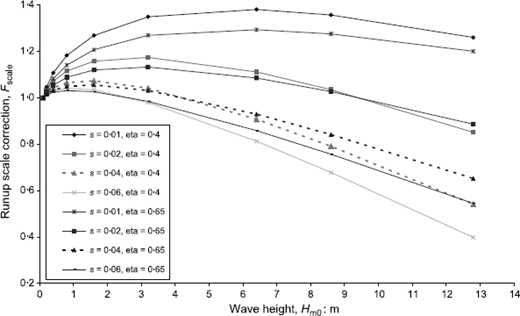
Use of the authors’ prediction equation in Fig. 15 implies that for armoured embankments on inland reservoirs, or other sheltered locations where wave heights may fall below Hm0=2 m, the runup level would be underpredicted by (fictional) small-scale tests, Fscale> 1. For low wave steepness values (sm=0·01 or 0·02) and both values of spectral width ε considered here, this apparent underprediction persists even for armoured slopes subject to large waves, Hm0=5–10 m.
In contrast, for typical storm wave steepness values (sm=0·04 or 0·06), the results of equation (9) suggest overprediction (Fscale< 1) relative to the small-scale tests. For larger wave heights (Hm0=5–10 m) the effect appears to be quite substantial, with equation (9) implying relative runup levels that are only 50–70% of those that would be predicted by the small-scale tests.
Over the main range of the Zeebrugge field measurements, the under-/overpredictions are comparatively small; perhaps why the errors were not obvious. Outside that range (Hm0=2–4 m) the errors become much more significant, particularly for typical storm steepness values, but also for low steepness conditions, sm≈0·01.
As a result of the critical flaw introduced into equation (9) by the use of dimensioned coefficients, the suggested prediction equation cannot be used for its intended purpose, guiding designers/owners on the likely hydraulic responses of armoured rubble slopes. This equation will give unintended (and unsupported) results for many realistic ranges of conditions, substantially masking the intended value of the results presented. It also suggests conclusions that are substantially different from those discussed by the same research team during the 2005 Breakwaters Conference.24

