

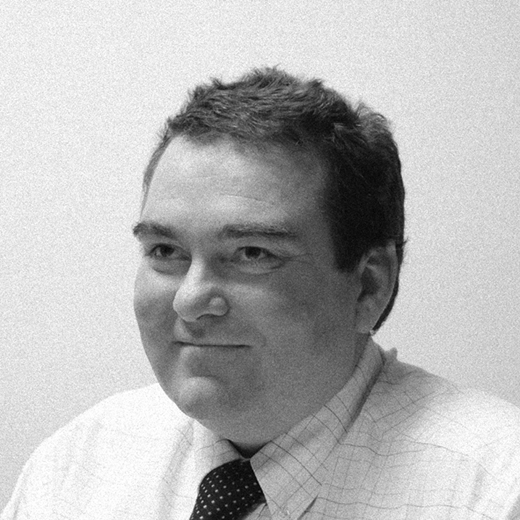
Phil Besley passed away on 30 April 2010 after fighting a 2-year battle against an inoperable brain tumour. During much of that time he continued to lead his coastal structures group at HR Wallingford, maintained contacts with project clients globally, and indeed co-authored for the ICE Breakwaters Conference.
He was born in Swansea, Wales, on 11 February 1964, winning his BSc at Dundee, where his affection for the world of coastal processes was confirmed. He stayed on at Dundee for his PhD research on ‘Eddies and Turbulence in Stratified Fluids’ as a research assistant under the supervision of Professor Peter Davies. From 1989 he continued his involvement with coasts and estuaries at HR Wallingford, working initially on problems of tidally driven siltation of sands and cohesive materials. His consultancy studies included sites in Wales, East Anglia and Hong Kong.
From 1992, Dr Besley worked on the design and testing of many coastal structures, with particular emphasis on wave overtopping. Site-specific work included schemes in Hong Kong (again), particularly the defences for the new Hong Kong Airport, in Italy, Malta, Kuwait, occasionally Wales, and supervising the model testing for that iconic structure the Burj al Arab hotel in Dubai.
On the research front, his major and long-lasting achievement was the compilation, testing and production of the first Wave Overtopping Manual (Besley, 1999), commissioned by the UK Environment Agency, but in truth written for coastal engineers worldwide. This manual consolidated research advances that Phil and others had made on the prediction of wave overtopping, and in the discharges that could be tolerated. He also published a number of papers supporting and extending his work on the Wave Overtopping Manual (Allsop et al., 2005; Besley and Allsop, 2000), and then assisted in the setting up of the project to compile the European manual EurOtop (Pullen et al., 2007).
Phil was a rather private man, generally content to support colleagues in their wider engagement in research and training. He maintained close links with key customers, particularly those involved in the design of rubble mound breakwaters armoured by the modern generations of concrete armour units, publishing (with Michel Denechere, CLI) guidance for designers on crest and toe detailing for armour layers at the 2009 Breakwaters Conference (Besley and Denechere, 2010). His involvement in the Channel 4 Time Team description of Liverpool docks (first shown in November 2008) allowed him to share his passion more widely when demonstrating a physical model of the first docks.
His friends and colleagues were much saddened by his untimely death, but Phil will be long remembered for his contributions to coastal research, to analysis and modelling studies, as a committed table tennis player and competitive golfer, and as a great admirer of the coastline of the Gower.
Phillip is survived by his wife June, son Lee, and stepchildren George and Gemma.

