

Papers published in Maritime Engineering are eligible for awards from the Institution of Civil Engineers. Papers from any of the ICE journals can be nominated for several awards. In addition, each journal has awards dedicated to their specific subject area.
On Monday 24 October 2011, ICE president Peter Hansford presented an award to the following paper published in Maritime Engineering in 2010. The editorial panel nominated their best papers and an awards committee chaired by Barry Clarke allocated the awards.
Halcrow Prize
The Halcrow Prize, presented for the best paper on maritime engineering, was awarded to: Harris JM, Whitehouse RJS and Benson T (2010) The time evolution of scour around offshore structures. Proceedings of the Institution of Civil Engineers – Maritime Engineering 163(1): 3–17, http://dx.doi.org/10.1680/maen.2010.163.1.3.
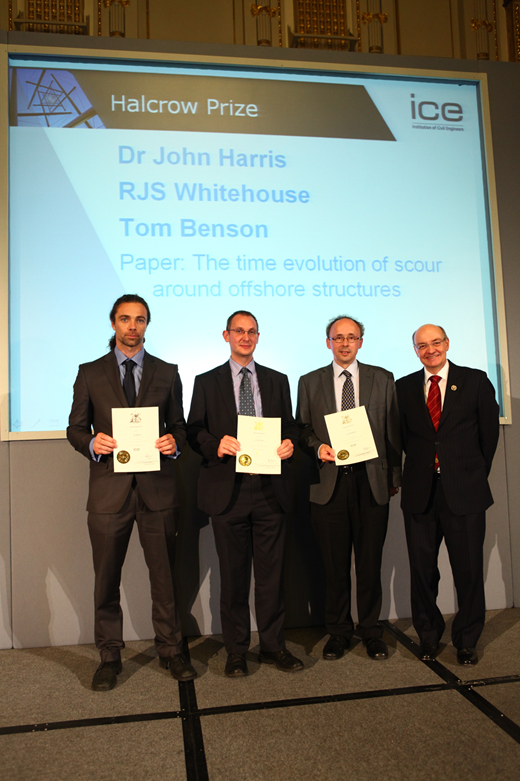
Halcrow Prize winners Tom Benson, John Harris and Richard Whitehouse with ICE President Peter Hansford
Halcrow Prize winners Tom Benson, John Harris and Richard Whitehouse with ICE President Peter Hansford
Abstract
This paper describes the development of an engineering model to predict the development of scour evolution through time around an offshore structure under current, wave and combined wave–current flows. The model has been tested against a range of data as well as being run for idealised tests. From the results of these tests issues with respect to scour prediction have been highlighted. In particular, the initial growth rate of scour appears to be too rapid based on the large-scale laboratory tests and tidal field data against which the model has been compared. Application of the model to a field-scale study has been completed which shows that in shallow water depths storm waves dominate the scour process. In deeper water depths, currents generally dominate even under storm conditions, although this will be dependent on the wave height and period and the actual water depth. The scour time evolution predictor (Step) model can be applied to scour assessment studies where there is a requirement to have an indication of the time-history of scour. The model clearly has a role in offshore wind turbine studies, but it is not limited to this sector and can be applied to bridge scour situations or other situations where scouring around monopile structures is an issue. Furthermore, if the scour at other types of structures or objects needs to be evaluated then provided the equilibrium scour depth and time-scale functions are available these can be implemented within the framework of the Step model.

