


Observations of nearshore waves are essential for coastal management, planning and operations. However, shallow water deployments often encounter breaking waves, causing anomalous measurements that are rejected during quality control. A new methodology for re-processing wave data containing breaking waves has been developed, utilising data from the National Network of Regional Coastal Monitoring Programmes of England, which operates 37 Datawell Directional Waverider MkIII buoys. Heave data affected by breaking waves are reviewed, anomalous heaves removed and the remaining data re-processed. Validation through a two-stage process confirms that re-processed wave parameters closely match those derived from the established Datawell processing and ensures strong agreement between parameters derived from shorter re-processed records and full-length data. Applying this new approach to all measured storm wave data, 7.3% (928.5 h) of storm wave data are recovered across the 37 sites. At some sites, the retention of additional storm wave data has considerable impacts on significant wave height (Hm0) return periods. At five sites, the 1 in 100 year return period increased by over 1 m. The enhanced dataset now includes more individual storm events and more complete records of storm events, providing a more robust foundation for coastal management and planning.
1. Introduction
Observational wave data are essential for Flood and Coastal Erosion Risk Management (FCERM), and wave buoys typically used for this purpose are strategically focused on shallow water measurements to generate long-term time series data. However, the deployment of these buoys in exposed coastal locations often results in encounters with breaking waves, leading to erroneous data in the heave records. Where these records are rejected during the standard quality control procedures, this results in gaps in storm event measurements. The National Network of Regional Coastal Monitoring Programmes (NNRCMP) of England operates a coastal wave buoy network comprising 37 Datawell Directional Waverider MkIII buoys to underpin FCERM. The data collected by the buoys are quality controlled by the Channel Coastal Observatory (CCO) (Mason and Dhoop, 2023) and made available by way of the coastal monitoring website (NNRCMP 2024) under the Open Government License.
This technical note presents a novel approach to re-process records corrupted by breaking waves, aiming to maximise data return, particularly during storm events. By re-processing the full archive of storm wave data measured by NNRCMP buoys, a substantial 928.5 h of previously unusable data – representing 7.3% of the total storm wave data – are recovered across the network.
The implications for risk management are significant. The enhanced dataset now includes more individual storm events and more complete records of storm events, providing a more robust foundation for the calibration and validation of modelling efforts and metocean analysis, informing coastal management and planning. In addition, at some monitoring sites, the re-processing introduces noteworthy outliers in significant wave height Hm0 measurements representative of particularly extreme storm events, resulting in consequential changes to the calculated return periods for those locations. These adjustments have the potential to influence future coastal infrastructure and risk assessment strategies.
2. Directional Waverider MkIII buoys
The Datawell Directional Waverider MkIII buoy is the industry standard for measuring ocean waves (Datawell, 2020). The buoy is spherical, with a diameter of 90 cm, with at its core an accelerometer mounted on a proprietary stabilised platform. This accelerometer measures the vertical accelerations of the buoy as it follows the motion of the sea surface. By integrating these accelerations twice, the buoy calculates the vertical displacements, or heave motions, which represent the sea surface elevation over time.
The buoy processes the raw acceleration data using a combination of low-pass and high-pass digital filters to eliminate noise and focus on the relevant wave frequencies. The resulting heave data are then used to derive various wave parameters through spectral and statistical analyses. However, breaking waves can distort the buoy’s measurements, necessitating robust quality control procedures.
3. Impact of breaking waves on measurements
When a buoy encounters a breaking wave, it experiences abnormal accelerations. Whether a buoy is cresting an incipient wave, exploding upward after being submerged by a spilling breaker, or entering a moment of free fall as it is thrown by a plunging breaker and subsequently re-enters the sea, all these movements result in large vertical and horizontal forces that distort the measurements resulting in erroneous heave data characterised by spikes and anomalous wave traces. Spectral analysis of such data typically shows excessive long-period energy, rendering standard wave parameter derivation inaccurate.
The effect on Datawell MkIII heave data transmitted by way of high -frequency (HF) radio signal is a characteristic ‘breaking wave signature’, typified by one or more individual large spikes followed by an exaggerated, elongated wave trace approximately 2 min later (Figure 1). The initial spike is caused by a disturbance to the buoy’s HF radio antenna (e.g. it tips into the water or momentarily stands at a right angle to the shore), resulting in a bad and unrepaired HF-transmitted data record. The elongated wave trace is the heave output from the very large anomalous accelerations processed by the buoy, recorded approximately 2 min later due to a filter delay that is inherent to the processing of the buoy. A digital finite impulse response filter with 1023 coefficients takes acceleration inputs sampled at 3.84 Hz and converts them to displacements at 3.84 Hz, but only keeps 1 in 3 outputs, resulting in a 1.28 Hz heave signal. The filter delay is half the filter length ((1023 − 1))/2/3.84 = 133.07 s, that is, approximately 2 min (Datawell 2022, personal communication).
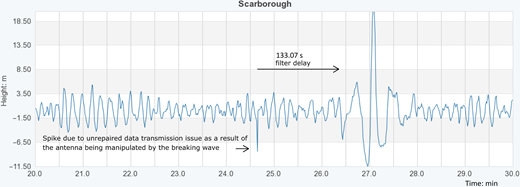
Heave data from the Scarborough Datawell Directional Waverider MkIII from 13 January 2017, 13:20Z to 13:30Z. The ‘signature pattern’ of a breaking wave is apparent in the data
Heave data from the Scarborough Datawell Directional Waverider MkIII from 13 January 2017, 13:20Z to 13:30Z. The ‘signature pattern’ of a breaking wave is apparent in the data
The spectral analysis of data corrupted in this way typically results in an excessive amount of long-period energy, peaking at around 22.2 s, which is not representative of the actual wave conditions (Figure 2). This leads to the derivation of inaccurate wave parameters, such as exaggerated significant wave heights and incorrect wave periods. Therefore, robust quality control procedures are needed to handle these affected records to ensure the integrity and reliability of the wave data.
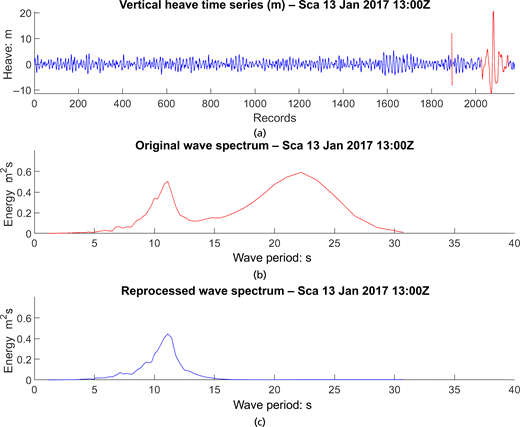
(a) Heave data from the Scarborough Datawell Directional Waverider MkIII from 13 January 2017, 13:00Z to 13:30Z, with wave traces flagged during quality control highlighted in red. (b) The original wave spectrum derived from the processing of the heave data, including those wave traces flagged in the QC process (Hm0 = 6.93 m). (c) The reprocessed wave spectrum derived from the heave data, excluding wave traces flagged during the QC process (Hm0 = 5.87 m). The energy in the spectra has been normalised
(a) Heave data from the Scarborough Datawell Directional Waverider MkIII from 13 January 2017, 13:00Z to 13:30Z, with wave traces flagged during quality control highlighted in red. (b) The original wave spectrum derived from the processing of the heave data, including those wave traces flagged in the QC process (Hm0 = 6.93 m). (c) The reprocessed wave spectrum derived from the heave data, excluding wave traces flagged during the QC process (Hm0 = 5.87 m). The energy in the spectra has been normalised
4. Typical quality control approach
The traditional approach applied by the CCO involved applying quality control flags to any wave parameters suspected of being affected by breaking waves. No parameters were removed from the data, allowing users to decide on their own quality control measures. However, where users remove flagged data from their analysis, this method led to significant data loss during storm events when breaking waves are most prevalent. Where users ignored the flags and included the erroneous measurements, this would skew their analysis.
5. New re-processing approach
The new approach involves removing only the portion of erroneous heaves from the raw data and re-processing the remaining data to produce accurate wave parameters (Figure 2). Fugro GB Ltd developed software to facilitate this process. This software replicates the Datawell spectral processing approach (Datawell, 2020: p. 45) used by the MkIII buoy but is optimised for shorter datasets, ensuring robust wave parameter estimation from incomplete records.
Storm wave data are inspected by a coastal scientist, who flags sections of the heave record that are to be ignored in the subsequent analysis. The remaining unaffected portions of the heave records are processed using Welch’s (1967) method. This entails subdividing the heave data into multiple overlapping subsamples. A window of 512 records with a 50% overlap is used, resulting in subsamples of approximately 400 s each. Each subsample is passed through a Hann filter to reduce spectral leakage and enhance the resolution of HF components. This is followed by a fast Fourier transform to convert the time-domain data into the frequency domain, producing a series of amplitude spectra. The amplitude spectra are then converted to the spectral energy density function, which involves considering the duration of the data collection burst to ensure accurate energy calculations. Wave parameters are derived from the spectral moments. In addition, a new ‘raw’ heave record and spectral file, both in standard Datawell format, are produced.
This spectral processing method differs from the approach taken in the MkIII buoy, which employs the Bartlett (1948) technique with eight windows of 256 records and no overlap (Datawell, 2020: p. 45). The Welch method was preferred because, knowing that a portion of the record may be removed from the analysis, it maximises the subsample length and thus provides a more robust spectrum from the available data. A second noteworthy difference is that, while the MkIII uses a 64-bin spectrum with variable steps, the CCO uses a 100-bin spectrum with equal steps for a more finely resolved spectrum. Overall, the CCO approach is very similar to the method used in the later-generation Datawell DWR4 buoy (Datawell, 2024).
6. Validation of the new approach
The validation of the new re-processing approach involved a two-stage process to ensure its accuracy and reliability. First, comparative processing is performed by contrasting wave parameters derived by a Datawell buoy with the same heave data processed using the Fugro software. This comparison is conducted using one full calendar year of quality-controlled data from 2021 from four NNRCMP wave buoy sites – Porthleven, Penzance, Perranporth and Bideford Bay. These sites are chosen due to their exposure to some of the largest wave action within the network and their known susceptibility to breaking waves.
Regression analyses show that the significant wave heights (Hm0) and zero-upcrossing periods (Tm02) derived from the Fugro re-processing software closely matched those obtained from the Datawell MkIII buoys at all four sites, with R2 values consistently above 0.960 (Figure 3 and Table 1). This high level of correlation confirms that the new approach accurately replicates the results of the established Datawell processing under non-breaking wave conditions. However, the zero-upcrossing period (Tm02) values derived using the new processing method are consistently approximately 10% lower than those obtained from the Datawell MkIII. This discrepancy is attributed to differences in the spectral processing techniques, with the new method using finer spectral bands and a consistent spectral band step.
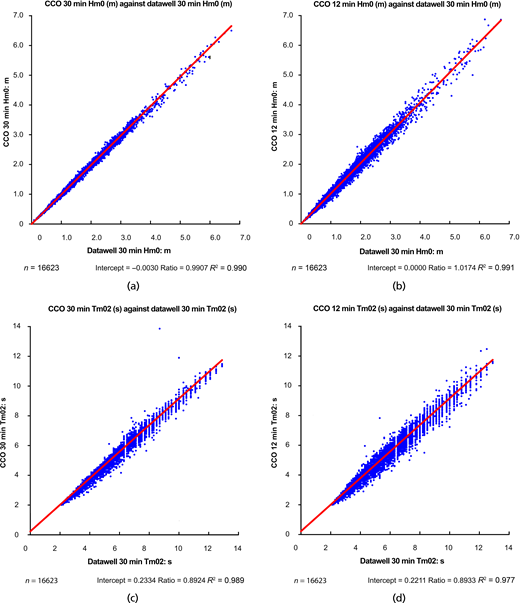
Regression analyses comparing one calendar year (2021) of data from the Bideford buoy; (a) significant wave height (Hm0) derived by way of CCO processing and by way of Datawell MkIII processing, (b) Hm0 derived from 12 min heave records by way of CCO processing and Hm0 derived from full-length 30 min heave records by way of Datawell MkIII processing, (c) zero-upcrossing period (Tm02) derived CCO processing and by way of Datawell MkIII processing, (d) Tm02 derived from 12 min heave records by way of CCO processing and Tm02 derived from full-length 30 min heave records by way of Datawell MkIII processing
Regression analyses comparing one calendar year (2021) of data from the Bideford buoy; (a) significant wave height (Hm0) derived by way of CCO processing and by way of Datawell MkIII processing, (b) Hm0 derived from 12 min heave records by way of CCO processing and Hm0 derived from full-length 30 min heave records by way of Datawell MkIII processing, (c) zero-upcrossing period (Tm02) derived CCO processing and by way of Datawell MkIII processing, (d) Tm02 derived from 12 min heave records by way of CCO processing and Tm02 derived from full-length 30 min heave records by way of Datawell MkIII processing
The intercept, ratio and R2 values resulting from the regression analyses comparing one calendar year (2021) of data from the Bideford Bay, Penzance, Perranporth, and Porthleven buoys. The regressions compare significant wave height (Hm0) derived from 30 min records by way of CCO processing and by way of Datawell MkIII processing (30 vs 30 min), and Hm0 derived from 12 min heave records by way of CCO processing and Hm0 derived from full-length 30 min heave records by way of Datawell MkIII processing (30 vs 12 min)
| Hm0 | Tm02 | |||
|---|---|---|---|---|
| 30 vs 30 min | 30 vs 12 min | 30 vs 30 min | 30 vs 12 min | |
| Bideford Bay | ||||
| Intercept | −0.0030 | 0.0000 | 0.2334 | 0.2211 |
| Ratio | 0.9907 | 1.0174 | 0.8924 | 0.8933 |
| R2 | 0.990 | 0.991 | 0.989 | 0.977 |
| Penzance | ||||
| Intercept | 0.0004 | −0.0090 | 0.0690 | 0.0425 |
| Ratio | 1.0019 | 1.0351 | 0.9322 | 0.9390 |
| R2 | 0.996 | 0.993 | 0.960 | 0.950 |
| Perranporth | ||||
| Intercept | −0.0183 | −0.0183 | 0.2568 | 0.2110 |
| Ratio | 1.0160 | 1.0479 | 0.9043 | 0.9114 |
| R2 | 0.972 | 0.972 | 0.967 | 0.949 |
| Porthleven | ||||
| Intercept | 0.0023 | −0.0304 | 0.2049 | 0.1722 |
| Ratio | 0.9880 | 1.0484 | 0.9010 | 0.9058 |
| R2 | 0.998 | 0.951 | 0.987 | 0.922 |
The second stage of validation involved progressively shortening the heave records from 30 min to as little as 12 min and comparing the derived wave parameters with those from the full-length records (Figure 3 and Table 1). The results demonstrate that even with reduced record lengths, the wave parameters remain robust, with minimal deviation from the full-length data. The R2 values in these comparisons across all four sites consistently exceed 0.922, indicating strong agreement between the re-processed shorter records and the full-length data.
Overall, the validation process confirms that the new re-processing approach provides accurate and reliable wave measurements, even when records are incomplete. The 10% difference in wave period values is to be expected when using a different processing approach and neither the outputs from the Datawell MkIII processing nor the CCO processing can be considered ‘correct’; rather, both are the results of a different processing approach. Therefore, the re-processed data still offer a reliable basis for wave monitoring and analysis.
7. Sensitivity analysis
A sensitivity analysis was performed to evaluate the variability introduced by the manual intervention required in the new re-processing approach when removing breaking wave records. Nineteen coastal process scientists with varying levels of wave analysis expertise from within the regional monitoring programmes re-processed the same six 30 min Datawell heave records. These records were selected from sites experiencing some of the highest wave activity and contained multiple breaking wave anomalies, providing ample room for interpretation.
The results showed that the variation in Hm0 due to subjective interpretation was between 6 and 15%. When considering only the four scientists with previous experience in wave processing, the maximum variation was reduced to 6%. Examination of the participants’ interpretations of the wave records indicated that the primary differentiator was the extent of data removal at the extremities of the large anomalous heave signals.
Overall, the sensitivity analysis confirmed that the new re-processing approach is reliable, even with the subjective element of manual intervention, supporting its integration into the CCO’s quality control procedures.
8. Updates to quality control procedures
The CCO has updated its quality control procedures to incorporate the new re-processing method. Now, all heave records with spectral significant wave heights exceeding the storm alert threshold – defined as the 0.25 years return period (Dhoop and Thompson, 2018) – are manually inspected for breaking wave patterns. Records containing anomalies are re-processed ensuring that at least 15 min of ‘good’ data remain. Although the validation exercise confirmed that heave records can be shortened to 12 min while still producing robust wave parameters, retaining at least 15 min of data follows the convention on minimum heave record length (Holthuijsen, 2010: p. 27). These re-processed data replace the original wave parameters in quality-controlled datasets, accompanied by a new quality flag (flag 6). The original data will remain available in the non-quality-controlled datasets.
9. Results of re-processing the storm wave data
All storm wave data, defined as Hm0 measurements exceeding the storm alert threshold of the 1 in 0.25 years return period, were re-processed with the aim of recovering as much data as possible. This effort covered data from the start of each buoy deployment until August 2023. From this point forward, the approach detailed in this technical note is applied as standard. Across the 37 wave buoy sites, 12,720 h of storm wave data were processed by two experienced coastal scientists, resulting in the recovery of 928.5 h of data, which represents 7.3% of the total storm wave data (Figure 4). Most data were recovered from sites with high wave exposure, which consequently measured the highest waves. The three sites most exposed to the Atlantic – Bideford Bay, Perranporth and Porthleven – stand out, contributing 54% of the total recovered wave data.
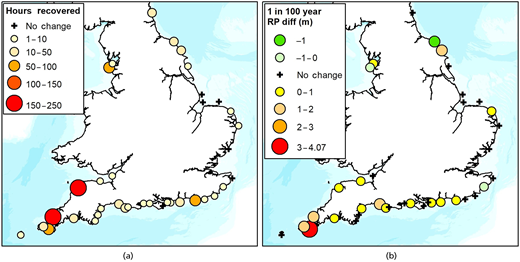
(a) The number of hours of data recovered at each wave buoy site. (b) The difference in significant wave height (Hm0) 1 in 100 year return periods at all wave buoy sites after the recovered storm wave data have been introduced to the time series
(a) The number of hours of data recovered at each wave buoy site. (b) The difference in significant wave height (Hm0) 1 in 100 year return periods at all wave buoy sites after the recovered storm wave data have been introduced to the time series
Within a single 30 min heave record, there are typically only one or two anomalous 2-min-long heave sequences, leaving on average 27 min of usable displacements that can be re-processed. The NNRCMP’s wave buoy network deliberately operates in shallow water, where the stage of the tide significantly impacts the wave heights that can be generated. At high tide, deeper water under the buoy allows higher waves to be measured, while at low tide, the buoy is in shallower water, increasing the likelihood of wave breaking and the introduction of anomalous data in the heave records. Breaking wave conditions are generally limited to the period around low tide, so the duration of breaking waves during a storm event is typically limited to a 1–4 h period.
Therefore, while measuring a storm event, the peak of the storm is only missed when the highest waves coincide with a tide low enough to cause breaking waves. However, even a single new storm peak that is an outlier can significantly impact the calculated significant wave height return periods for a site. Using the time series of spectral significant wave height (Hm0) measurements before and after re-processing of the heave records affected by breaking waves, return periods were recalculated.
The univariate extreme value analysis of spectral significant wave height (Hm0) was performed using a peaks-over-threshold approach with the threshold set at the 99.5th percentile and a 48 h storm separation window. This created a sample of independent and identically distributed observations. A generalised Pareto distribution was fitted to the sample, and parameter estimates were derived using the maximum likelihood method (Coles, 2001). Both the threshold and storm separation window are rules-of-thumb following NNRCMP standard practice to make the analysis more efficient while still providing reasonable parameters for the analysis.
At five sites – Porthleven, Perranporth, Scarborough, Penzance and West Bay – the 1 in 100 year return period increased by over 1 m (Figure 4). At Porthleven, the 1 in 100 year return period increased by as much as 4.07 m (from 8.02 to 12.10 m) due to the introduction of two significant outlier events representative of particularly extreme storms. This highlights the considerable impact that the re-introduction of data previously lost due to breaking waves can have on the understanding of the coastal wave climate under extreme conditions. At three sites – Whitby, Folkestone, and Cleveleys – a lower 100 year return period is calculated. This is the result of the removal of breaking wave signatures that had previously been interpreted as storm peaks and passed QC. Setting appropriate risk levels is an important exercise. If the risk is higher than formerly anticipated, the design standard of protections of a coastal defence asset may need to be increased. Conversely, if the risk has been over-estimated, more considerate design choices could be made, resulting in a saving in the whole-life-cost of coastal structures (Mockett and Simm, 2002).
10. Conclusion
The implementation of a novel quality control approach for storm wave data in the NNRCMP network of 37 Datawell Directional Waverider MkIII buoys, deployed in coastal locations in shallow water and therefore subject to breaking waves, has significantly enhanced the quality and completeness of wave measurements. The new approach involves removing erroneous heaves from the raw data and re-processing the remaining data to produce accurate wave parameters. This method was validated in a two-stage process: first, by comparing a year’s worth of re-processed non-breaking wave data with the original data from the MkIII buoy; and second, by progressively shortening the heave records from 30 min to as little as 12 min and comparing the derived wave parameters with those from the full-length records. The validation confirmed that the new method provides accurate and reliable wave parameters.
All storm wave data, identified by Hm0 measurements surpassing the storm alert threshold of the 1 in 0.25 years return period, were re-processed to recover as much data as possible. This effort included data from the start of each deployment up to August 2023. Across the 37 wave buoy sites, a total of 928.5 h of data were recovered, representing 7.3% of the total storm wave data. The majority of these data came from sites with high wave exposure, which typically record the highest waves.
The return periods for all sites were calculated using the original and re-processed data. At five sites – Porthleven, Perranporth, Scarborough, Penzance and West Bay – the 1 in 100 year return period increased by more than 1 m due to the inclusion of new significant outlier events.
The implications for FCERM are substantial. The enhanced dataset now encompasses a greater number of individual storm events and more complete records of these events, offering a more robust foundation for the calibration and validation of modelling efforts and metocean analysis, thereby better informing coastal management and planning. Furthermore, at certain monitoring sites, notable changes in the calculated return periods have been noted. These adjustments have the potential to significantly impact future coastal infrastructure planning and risk assessment strategies.
Acknowledgements
The CCO, as part of the NNRCMP, is funded by the Department for Environment, Food and Rural Affairs (Defra) through the Environment Agency. Jitze-Jan Devries, Tom Joosten and Eric Stoker of Datawell BV provided clarification on the breaking waves signature in the heave data and useful feedback and reflections on the Fugro approach to wave processing. Sarah Cockroft of Fugro GB Ltd project managed the development of the wave processing software. Isabel Kelly of Southwest Coastal Monitoring contributed to the refinement of the wave processing software. Annabella Ormerod at the CCO helped to assemble the raw heave data measured during storm events at the case study sites. The full CCO and Southwest Coastal Monitoring teams took time out of their schedules to participate in the sensitivity analysis experiment.

