

David Orr became the 143rd president of the Institution of Civil Engineers in November 2007. He gave his inaugural speech on 6 November, outlining his priorities for his year as president, including: promoting the value of civil engineering; ensuring that the public understands how high professional standards protect them in their everyday life; trying to give civil engineers more recognition so that the public appreciate how ordinary people achieve extraordinary things every day and make our society a better place in which to live.
One of my great professional interests has been the procurement of civil engineering works. It has taken me to my current role as director of central procurement for the Northern Ireland Civil Service, where I lead the procurement of construction works, supplies and services.
There are six key principles for the successful procurement and delivery of civil engineering projects. These are not new, and some are fairly obvious, but it is surprising how often they are forgotten, usually with serious results.
Let us start with the client. There is no doubt that the chances of a successful project are greatly enhanced by an informed client. For the larger clients, it is essential to have professionally qualified people on the client team.
An informed client knows the facts of construction life
the importance of proper planning and scope
realistic estimates
the need to select a contractor on quality and price
strong risk management
integrated client, design and construction teams
collaborative partnering.
All of these are embodied in Achieving Excellence in Construction, a road map for success developed by the Office of Government Commerce.1
It is no accident that the most successful projects–large and small–have been led by very competent and truly inspirational clients. So that is my first call: informed clients with in-house professionals as part of the construction team.
Next, clients must focus on the crucial first steps. The million-pound mistake is often made on day one, because of a poor brief or an inadequate estimate.
It is vital for the client to provide–or be helped to provide–a clear brief defining the project scope. The project team need to know precisely what their client is expecting. How can a project be successful if success is not defined?
And why are initial estimates frequently too low?
Quite simply, clients can become blind to the true cost of the work through haste, uncritical enthusiasm and lack of professional input. They come up with an unrealistically low initial estimate through a combination of insufficient costs for the known scope and omission of key items.
If the initial estimate is too low, projects become burdened with the perception that ‘costs have spiralled out of control’. But of course, the problem is often not real increases in cost; simply that the initial published estimate was so low it was never realistic in the first place.
The unwelcome outcome can be very tight cost control. Changes that would add value are suppressed, and an adversarial culture runs throughout the project. The Jubilee Line, Wembley Stadium and the Scottish Parliament building illustrate these issues and their effects.
Take the London 2012 Olympics. The original estimate for the core infrastructure and facilities was broadly correct, and has since stood up to scrutiny, but there were inadequate allowances for land and security, and no costs for the legacy works, VAT and contingencies.
So the initial estimate of £3 billion has now been increased to the more realistic figure of £9 billion, not because of higher costs on the known construction elements, but simply through the adoption of a more comprehensive and inclusive cost estimate now covering the full scope. The initial estimate was simply too low.
The answer is to employ experienced professionals at the outset to
develop the scope and avoid scope creep
allow for risk and uncertainty
most importantly, to avoid being bounced into declaring a cost until a robust estimate has been worked up.
The next principle is to consider the impacts.
It is a great art to balance the needs of the many against the interests of the few–but what does that mean?
When we create any public work, we do so for the benefit of the many people who will use the asset during the course of its working life. That same project could, however, badly affect a relative few: people who will lose their land, or neighbours affected by noise or visual intrusion.
So to balance the needs of the many against the interests of the few, we need full and open consultation on a range of options. That means considering the impact on the environment, as well as the impact on everyone who will use or be affected by the scheme.
When a preferred option is decided upon, it will often be tested by a statutory process, which, on many occasions, will mean a public inquiry to verify the proposals. That is right and proper, but it should not mean a guerrilla war in the courts and public inquiries, extending over several years–such as with Heathrow Terminal 5.
If we are to develop the infrastructure that this nation deserves, government must put in place a timely planning process for major schemes. First to confirm the strategic principle of the project and, after that is agreed, to assess the engineering options and their impacts.
But not all impacts are negative. When planning our projects we must always ask: ‘What other good might be done?’
With a little imagination, additional indirect benefits can be delivered without necessarily increasing the cost.
We look again to the London 2012 Olympics or to the Glasgow 2014 Commonwealth Games, where the focus is not just on the infrastructure to enable the games to take place, but also on the legacy when they are over.
Even on less high-profile projects, there is the possibility of doing social good. For example, in Northern Ireland, we ran a pilot to encourage contractors for large public contracts to recruit and train unemployed people; and it worked! Of the 51 people who were given this opportunity, 46 were still employed at the end of the scheme. This sort of approach is important in relation to the social aspect of our sustainability goals, and it can be achieved economically, efficiently and effectively.
So consider the impacts, and carefully balance the needs of the many against the interests of the few.
One of the great challenges for the public sector is that financial planning is short term–on a three-year timescale. Not much good when your project takes ten years from concept to completion. It is a recipe for stop-start programming, which is not only frustrating for the public but also wasteful of time and effort.
Privatisation or commercialisation of public services such as the water industry, the railways, and the energy sector, has allowed the introduction of longer-term investment strategies, and the use of public–private partnerships has helped. They allow both capital and ongoing maintenance commitments to be established at the outset of the contract and this translates into a unitary charge over the 25- or 30-year life of the project.
In Northern Ireland, the problem of short-term government budgets has been tackled by the creation of a Strategic Investment Board. One of its responsibilities is to set out a ten-year investment strategy for Northern Ireland, largely dealing with infrastructure needs. So now vital public works can be planned over a realistic timescale–an example that could well be followed by other governments.
Let us not, however, forget that capital investment is only the starting-point. We must follow through with proper maintenance of our ageing infrastructure–roads, bridges and water networks. It is a matter of professional ethics for civil engineers to insist that this is funded on a systematic and proper basis, not just the funds that are left when other demands are met. We want no bridge collapses here like those in Minneapolis (Fig. 1) or Montreal.
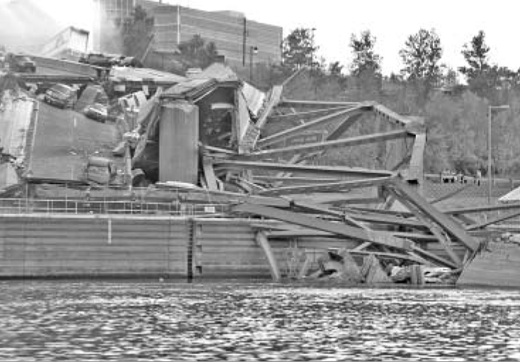
The collapse of the 40-year-old 1-35W bridge over the Mississippi River in Minneapolis, USA on 1 August 2007 killed 13 people (photo courtesy of Tim Davis, EIT, www.conphoto.net)
The collapse of the 40-year-old 1-35W bridge over the Mississippi River in Minneapolis, USA on 1 August 2007 killed 13 people (photo courtesy of Tim Davis, EIT, www.conphoto.net)
Good design is critical to the success of any construction project. Early investment in design will be repaid hundreds of times during the working life of the project. And creating good design is a key role for the profession.
Often good design is taken to be a building or structure that looks striking, or is innovative. But design quality is much more than style or appearance. It is a combination of three things.
Functionality–how successful is the project in achieving its purpose?
Impact–how does it contribute to the sense of place?
Build quality–how well does it perform in service?
Just as important is the need to communicate design ideas to the client and stakeholders during development. Here, we have been greatly helped by computer power. We can use software to help clients understand the design of a project so that everyone can be sure that the finished product is fit for purpose and will meet their needs.
Lastly, no civil engineering project is without risk, and the trick is to plan for it and manage it. An excellent way of managing risk is through independent peer review at various stages of the project, such as the Gateway Review Process of the Office of Government Commerce.2 It provides an independent, high-level review of the key risks facing a project and the actions to be taken.
The Institution has been proactive in risk management with its Partnering Guidance workshops recommendations3 and its contributions to RAMP4 and STRATrisk.5
All these approaches are being used on some of the largest projects around–schemes such as Crossrail and the Olympics–and will help to ensure successful delivery.
So I urge everyone in the construction team to be aware of risk and to manage it proactively.
These are my six key principles for excellence in procurement.
Perhaps the Institution's strongest contribution to excellence in procurement is in the NEC contract. This may have been developed by civil engineers but it has been proven to be a contract for much more than civil engineering. It is endorsed by the Office of Government Commerce, which has said that NEC meets the requirements of Achieving Excellence in Construction.1
One of the NEC's key principles is to encourage real partnering with integrated client, design and construction teams, and contract strategies which give incentives to good performance. It is widely used here in UK and across the world.
The latest version, NEC3, was launched in 2005 after ten years of informed industry feedback. It is making a huge difference to how the engineering and construction industries do business and how they run their projects: delivering on time and on budget and with closer cooperation–real partnership across the construction team.
Furthermore, when things do go wrong, the NEC's ‘no surprises' culture provides an early warning process, allowing all of the parties to focus on getting things back on course.
There follows a list that provides a few examples.
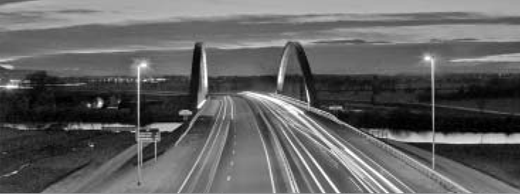
The Toome Bypass (Fig. 2), on the strategic route between Belfast and the north-west of Ireland, was my first experience of using NEC. When the bypass was opened in 2004 it was six weeks early and some 5% under the target cost.
The Channel Tunnel Rail Link is a massive £5·8 billion civil engineering project. With the help of NEC, it delivers passengers from Paris to St Pancras in 2 h 15 min and was completed in just over five years.
NEC is being used for truly innovative engineering projects such as the Halley 6 ice station in Antarctica. NEC3 will help manage the incredible construction challenges: the extreme climate, short summers and a moving ice shelf.
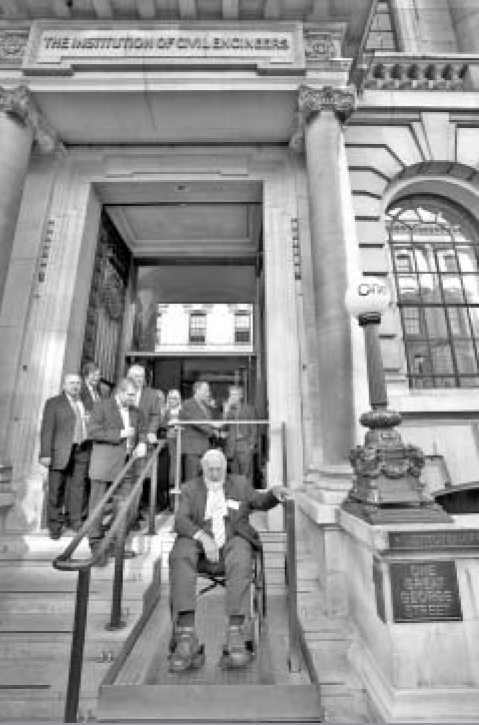
NEC can even be used successfully for small projects such as our innovative new wheelchair access at the front entrance of the Institution at One Great George Street (Fig. 3).
There is no doubt that the procurement of civil engineering works is one of the great success stories of the past ten years. So let us stand up for excellence in procurement. Let us work in partnerships and make full use of the talents and the capacities of our profession. There is no better way to deliver projects and delight our clients.

