1. Ten lessons for successful publishing in JMTM
It has been over 10 years since I began as Editor-in-Chief (EIC) of the Journal of Manufacturing Technology Management (JMTM). Since taking over, one editorial was published, and based on recent experiences, I thought that it would be helpful for authors to provide another editorial. The purpose of this editorial is to help authors with successfully publishing in JMTM. The information provided in this editorial is primarily based on the tracking and analysis of submissions to JMTM. The information is specific to JMTM. Nevertheless, over the years, I have communicated with EICs of other journals, for example, at conferences in “meet the editor” sessions, and I have often found that other EICs to a large degree have similar experiences. This editorial is set up as follows. In Section 2, I provide a general background about publishing, which is helpful to understand as a general background. Section 3 describes some of the changes that have occurred with JMTM in recent years, and Section 4 describes the review process. Sections 5 through 11 discuss stages in the review process and lessons for these stages. Finally, in Section 12, brief conclusions are formulated.
2. The foundations of publishing in a scientific journal
JMTM is a journal by Emerald, the publisher. In short, and the following may be cutting corners a bit, but I am trying to get a point across here: publishers are commercial entities. The publishing business model is focused primarily on generating revenue through the sale of journal subscriptions and readership, i.e. downloads. Many potential authors have, or seem to have, the implicit idea that (1) they did a good piece of research and thus (2) journals should be publishing that research. That, however, is not how this works because the key question is: does it make sense for the publisher to publish this piece of research? People are often surprised when they find out that initial submissions of what later became a Nobel Prize winning piece of work were rejected. From an EIC perspective, this is not surprising, and the reasons for this may have been that the submitted article didn’t fit in the scope of a journal and, related to this, that there was limited interest in the topic. With limited space available, EICs have to make decisions about what makes the most sense to publish.
With this in mind, what this requires from submitting authors is that they move away from the author perspective (I did the research, I wrote it down and now somebody ought to publish it) to a more publisher perspective (why would publishing this research make sense for the publisher and contribute to the publisher’s bottom line?) That bottom line relates to the purpose of the journal, which has to do with the portfolio of activities that a publisher is involved in. Publishing journals is only one of the activities that publishers may engage in, but they are often also engaged in other activities such as books publishing, data and publishing technology solutions. In terms of publishing journals, publishers have many journals so the specific role of a journal has to be understood. For instance, the publisher may have specific goals for a journal (and by extension goals for the editor-in-chief of that journal), such as the number of articles that should be published in a year, a desired acceptance and/or rejection rate, a certain improvement on the impact factor, as well as things related to timeliness such as time for review processes or time from submission to acceptance.
In the case of Emerald, in addition to the considerations listed above, it is also important that the research published in their journal program has demonstrable real-world impact. Emerald’s mission and values center on creating positive impact through research, education and sustainable practices. They strive to foster a fairer society, healthier lives and responsible management. Emerald is also actively exploring and supporting new and novel forms of research, including innovative content types and non-traditional research outputs. These factors are also considered when determining which articles are suitable for publication.
It is helpful to understand the publisher’s perspective.
3. The dynamics of the publishing environment for the journal
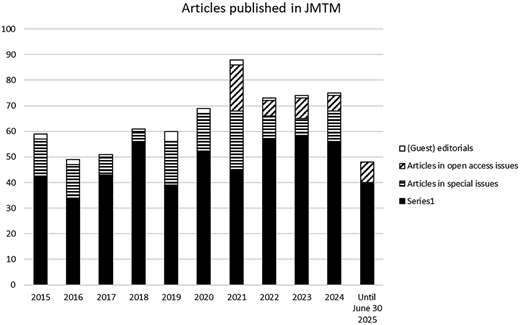
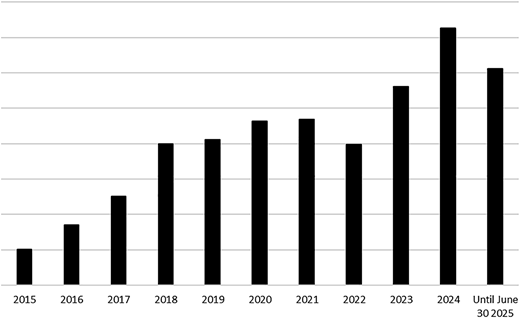
Publishers can have very different expectations for EICs, and there are many different types of journals with different orientations in terms of their scope. This includes what types of research, i.e. methods, are considered acceptable. Journals can also have very different expectations such as what typical articles look like (e.g. length of articles, number of references, etc.) How it is determined whether an article meets quality criteria also differs across journals such as through editorial review, single-blind review or double-blind review processes. Some journals have more emphasis on practical applications, while others are more oriented towards theory. The “size” of the journal also matters as well as changes over time. For instance, JMTM published roughly 60 articles per year between 2015 and 2019, and since then, it has published roughly 68 papers per year excluding articles published in open access issues (see Figure 1). Figure 2 shows the submission patterns for the last 10 years.
When combining these two figures, it shows that while the number of articles per year has remained relatively constant, i.e. space for articles has been relatively the same; the number of submissions has grown at a high rate. What this means is that there is more competition for space in JMTM. In other words, it has become harder for authors to get their manuscript accepted for publication in JMTM.
There are two main ways in which the submission and publication patterns have led to changes that affect authors.
The first is that the scope has become narrower. A cursory glance at the titles of articles published in, for instance, 2016 or 2017 reveals that the types of topics that were published in JMTM five or more years ago were much more diverse than they are currently. Over the years, with input from JMTM’s Editorial Advisory Board (EAB) and Emerald staff, the scope has been adjusted so that JMTM differentiates itself from the many journals that publish papers related to the management of manufacturing. Two adjustments were made in recent years due to increasing submissions:
A heavier focus on manufacturing. The vision for JMTM is to be the journal of choice for authors to publish on manufacturing. In the past, we have published, and we still do, papers in related areas such as supply chain management. However, we now require, more so than in the past, that articles are written for a manufacturing readership. This means that even if a study is on supply chain issues, we expect that in the manuscript the link to manufacturing is made and that the contribution to the theory is discussed in terms of manufacturing.
A heavier emphasis on empirical research, i.e. studies generally need to have empirical data. Mathematical modeling, simulation and operations research approaches are no longer included. Furthermore, studies based on methods such as the analytical hierarchy process, interpretive structural modeling (ISM), etc. are also no longer published. This is because these generally rely on just a few data points, which makes generalizing difficult, whereas we look for studies that have general applicability regardless of a specific context.
Journals operate in changing environments. What was acceptable in the past may no longer be acceptable. It is important to understand the scope of a journal and how it may be changing.
One of the best ways to determine the scope is to read some of the latest published regular issues. Scope statements may or may not have been updated on a journal’s website, but what is recently published provides the best insight into how that scope is practically implemented.
The second way in which the patterns in submissions and publishing affect authors is that the quality requirements for JMTM have become more stringent through a third adjustment:
A heavier emphasis on the contribution to theory. We expect more theory-oriented studies, which include theorizing that goes beyond the context of a specific study. Note, however, that we still expect that new theoretical insights have practical implications; otherwise, they are not considered very meaningful.
Over time, two specific requirements have been put in place for manuscripts to help with this higher requirement for the contribution to theory. Section 3.1 explains the type of discussions section that we require while Section 3.2 explains the quick value overview (QVO).
3.1 The discussion section
To facilitate a heavier emphasis on the contribution to theory, it is expected that submissions to JMTM contain three clearly separated sections: results/findings, discussion and conclusions. These three sections have different purposes and different orientations. Separating them helps to communicate to readers and reviewers what the study did and especially what the study contributes to the theory.
The results/findings section presents the findings of the study. These findings and/or results are typically presented within the context of a study, e.g. data and results for hypothesis testing. The orientation of this section is therefore where findings are presented and communicated.
Due to the emphasis on a theoretical contribution, the arguably most important section of the paper is the discussion section. This section comes after presenting the results/findings of a study. The purpose of the discussion section is to lift the study to a higher and more general level that goes beyond the context of the specific study. It, therefore, logically comes after the results/findings have already been presented. The discussion should make it clear how and what the study is exactly contributing such as what new theoretical insights are gained on the management of manufacturing. Basically, what this means is that the study should provide insight that better explains real-life phenomena in terms of the management of manufacturing than existing studies. This better explanation needs to be demonstrated and can come from:
The identification of new variables that play a role;
Better insight into relationships between variables;
The study explains previously existing conflicting findings in the literature, or
It is able to explain something that previous studies could not explain.
This means that the orientation of the discussion section is on theorizing, which is very different from the orientation in the results/findings section.
Because of this, it is expected that the discussion section:
Explicitly links back to the literature review;
Compares and contrasts the findings of the study with what has been previously found/published, and
It includes in-depth analysis such as not only looking at results of previous studies but also at the contexts of these studies, the methodologies applied, definitions used, etc.
When this theoretical discussion is well developed, it should help make it clear what the paper contributes to the theory on the management of manufacturing.
The conclusion section wraps up the paper. This includes mentioning the main theoretical contribution, the practical implications of this new theoretical insight, the limitations of the study and potential ideas for further research. It is generally expected that the new theoretical insight gained from the discussion section leads to implications for practicing manufacturing managers. Thus, it should be discussed what or how managers need to do things differently because of the newly gained theoretical insights.
3.2 The quick value overview
Over time we found that many authors are struggling with clearly identifying the contribution to theory that their study has and conveying this in the structured abstract format that many Emerald journals including JMTM use. To help with this, we came up with the QVO. The QVO “forces” authors to take a step back from their study and think about its most important aspects. It also should help potential readers to understand the core of what an article is about, i.e. what variables and relationships were studied and how the findings and/or results are different from previous studies. We have, therefore, incorporated the QVO as a complementary and different kind of summary that is placed between the structured abstract and the start of the article. This QVO addresses three things with these headings:
Interesting because:
Authors need to briefly state the topic of the paper and what is interesting about the study. For example, what is different about this study compared to other studies on that topic (what is novel)? Typically, the introduction section of the manuscript will have the type of information that can be used to formulate this part of the QVO.
Theoretical value:
Authors need to state what theoretical insights the study adds. In concrete terms, this means the relationships between different variables that were found. Authors can typically find this type of information in the manuscript’s results and/or discussion section from, for example, hypothesis testing. It is not always possible for authors to put all of the concrete findings in the QVO, but in that situation, they can state that the study found “for example …” For the examples, the authors should put in the most interesting relationships that provide new theoretical insight, such as those that conflict with the current literature, especially when the authors have good explanations for this deviation.
Practical value:
Authors need to state why it is useful for practicing managers to know about the study. In concrete terms, what should managers do based on the findings? Authors can typically find this type of information in the practical implication part of the conclusion section of the manuscript.
The size of the QVO can be up to approximately 200–250 words [1]. The point is to be concise and, especially for the theoretical and practical value, to provide a concrete and quick overview that shows why the article is valuable, i.e. worth reading. It should essentially attract and encourage people to read the article. It may be beneficial to include figures. Many QVOs are sent back to authors because they are not concrete enough. The following papers give a good sense of what we are looking for: Al-Swidi et al. (2024), Wang et al. (2024) and Liu et al. (2024).
4. The review process
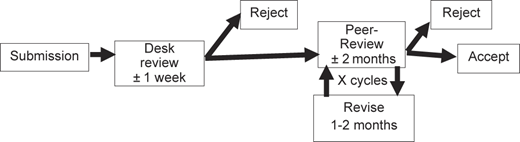
With the above in mind, let’s move to the process that manuscripts go through. This has the stages as shown in Figure 3:
Table 1 provides information on timelines. Small variations of this information occur between years, and Table 1 is based on the most complete calendar year, i.e. 2024. Although the average is provided for time from submission to acceptance, this varies quite a bit across manuscripts, and it is heavily dependent upon the number of revisions that are needed and how quickly authors submit revisions.
After a paper is accepted, it will go through a proofing process, and following this, the paper will be published online under EarlyCite articles or in the open-access issue if it is an open-access article. This process can take 1–2 months and involves, among other things, the checking of proofs. The time is dependent upon how many issues in the proofs need to be resolved and how quickly authors respond. An accepted article will generally be included in the 3rd or 4th issue that gets published following the acceptance of the manuscript. It depends on how many accepted articles are waiting to be published. Publication is based on the chronological order of acceptance. However, within a specific issue, papers can have a different order, as we often try to put papers of related topics together.
5. The desk review stage
The desk review stage is where the EIC and/or EIC team look at the submission to determine whether it should go into the peer-review process. Currently, the desk reject rate is roughly 80%. That means that only one in five submissions is moved into the peer-review process. Table 2 gives an indication of why papers are desk rejected.
For the papers that are desk rejected as out of scope, there are the following reasons.
40%: The paper is not about manufacturing, and the word “manufacturing” may not even occur in the manuscript (an example is a submission that is about marketing);
25%: The paper is or could be about manufacturing because generally data is collected from manufacturing companies but:
- –
It is not written for a manufacturing audience (for example it is oriented on supply chain management and contributes to the theory on supply chain management), or
- –
It is not about a general gap in the theory on manufacturing, but instead it is written for a specific industry or location (for example, a study that focuses on how to help manufacturing in a specific part of China).
- –
17.5%: Methods are used that are not, or are no longer, accepted by JMTM, see Section 3. Examples are simulation, mathematical modeling (operations research), analytic hierarchy process, ANP, DEMATEL, ISM, etc.
10%: The study is about technical aspects instead of management (for example, a study on specific milling characteristics).
7.5%: The study is about an application of existing theory (for example a method to help manufacturers with some issue but it is not clear how or if it contributes to theory and/or the application isn’t validated. The latter can for instance occur when a method is designed and applied, and in the findings, the method is implicitly assumed to work so that the results of the method are discussed instead of discussing the validity of the method)
For papers that are rejected for not having a clear contribution to the theory on manufacturing, these are rejected for the following reasons:
65%: The paper contains a discussion section, but this discussion shows that the study confirms what is already known.
35%: The paper does not have a discussion section as described in Section 3.1. A special group of papers that often falls into this category are papers that are literature reviews, i.e. the only method used is literature review. There has been an increasing number of literature review submissions. Most literature reviews provide descriptive statistics such as information on main authors, locations of authors, trends in topics, etc. While interesting, this type of data does not add to the theory on manufacturing. For JMTM, literature reviews need to be theoretical in character, see Dekkers et al. (2024) for advice.
For papers that have “writing issues,” these fall into the following categories:
80%: The paper is too long, i.e. it has more than 10,000 words.
10%: Author identifying information is left in the paper. JMTM uses a double-blind review process. This means that reviewers don’t know the identity of the authors, and authors don’t know the identity of the reviewers. What this means is that there should be no information in the manuscript that identifies the authors directly or indirectly. For instance, there should not be any acknowledgment in the manuscript for peer review. Instead, the ManuscriptCentral submission system used by JMTM gives submitting authors an opportunity to insert an acknowledgment during the submission process, which, if the paper ends up getting accepted, will then be inserted into the manuscript in the proofing stage. Another example is that authors should not reference their own work. We consider it poor form for authors to reference their own work; so if possible, it should be avoided altogether. If it is absolutely necessary to reference your own work – for instance, because the submission relates to findings in earlier work – then citing and referencing of the work needs to be done in such a way that reviewers cannot tell that it references work from the authors of the submitted manuscript because otherwise it violates the principles of the double-blind peer-review process.
8%: There are severe issues with grammar, spelling, etc.
2%: There are ethical concerns. Recently, this has received more attention and relates to issues such as Institutional Review Board (IRB) approvals, inappropriate use of artificial intelligence (AI), fake data or no approval from participants for the research. An example of the latter is where a case company is identified in the manuscript, but there is no evidence that the company approves publication. Note that this isn’t just about explicitly naming the company in the manuscript. It has to do with the ability to identify the company, which can also come from other clues; for example, an author whose affiliation is a company that is very likely the same as the case company.
The JMTM editors generally want recommendations of reviewers for the overall quality of the paper so that our desk review stage is not primarily focused on the determination of the quality of the paper. Desk rejection based on low quality is, therefore, the least likely. A desk rejection for poor quality occurs generally when there are very obvious flaws in the paper so that putting it in the review process would end up being a waste of time. An example of this is a relatively short paper, which is missing a literature review or clear research questions.
Although roughly 80% of the submissions are desk rejected, what the above discussion shows is that most of the desk rejections are preventable for authors. The desk rejections occur because authors submit work that simply doesn’t meet minimum requirements, because authors submit a manuscript that doesn’t fit in the scope or submit a manuscript that doesn’t follow the author guidelines. One of the reasons why this occurs is because in most instances authors:
First write a paper and then
Look around for journals to submit it to, and when a paper gets rejected by one journal, it gets submitted with minimal change to another journal.
For instance, we receive many submissions that were clearly originally meant for other journals. How do we know? Because in the cover letter, another journal is mentioned, or the formatting style is very different from JMTM – for instance, a two-column format, which is more typical for engineering journals. Or the citing style is different from JMTM – for instance, a numbered style instead of last name. Or the abstract doesn’t follow the mandatory JMTM structured format. Or keywords are mentioned in the manuscript with a Journal of Economic Literature (JEL) classification, whereas these are not in accordance with the JMTM keywords, and moreover, keywords should not be included as part of the manuscript for JMTM. These are just examples where authors clearly haven’t invested time in getting to know JMTM but seem to simply try to submit to multiple journals in the hopes that somebody will end up accepting it.
The following approach increases the probability of an acceptance:
First identify a journal that fits with the study and then
Write the article for that specific journal.
The reason this works better is because this approach has a much higher likelihood of fitting in the scope.
Furthermore, given the journal’s narrowing scope as discussed in Section 3, one way that authors can strategically align their submissions with JMTM’s priorities is with research on hot topics in manufacturing technology and management. This increases the relevance and appeal. It is also recommended that authors connect with JMTM’s community, such as following the journal online and by attending related conferences, e.g. EurOMA on operations management and the International Association for Management of Technology for more of a technology orientation. This can help to stay updated on trends in manufacturing and the journal’s scope. It also provides opportunities to network with editors, EAB members and reviewers. For instance, I sometimes attend “meet the editor” sessions at conferences, and this is an excellent opportunity for (potential) authors to engage in a dialog and gain insight into the latest developments for JMTM.
In some instances, the desk-rejected submissions can be improved and then resubmitted. Sometimes this may be relatively easy, for instance removing author identification, whereas at other times it may involve significant rewriting of the manuscript, for instance changing a paper that was geared towards supply chain management to a paper that is written for a manufacturing audience. The latter involves more than just inserting the word “manufacturing” here and there throughout the manuscript, because it generally also means that the literature review requires updating with manufacturing literature and the contribution needs to be in terms of the theory on manufacturing, which generally requires a substantial rethinking and rewriting. If desk-rejected papers are resubmitted, it is expected that this will be identified during the submission process by noting the paper ID of the earlier submission. It is also expected that the submission is accompanied by a cover letter, which describes what was changed considering the previous desk rejection decision.
6. Lessons from the desk review stage
Based on the reasons for desk rejection, i.e. Table 2, several lessons can be learned that will help increase the probability of passing the desk review stage.
Lesson one: Select an appropriate journal before you write the article and write the article for the specific target readership of that journal. If you started by writing an article and then tried to get it published somewhere, then look at your literature review and your list of references. The journals in which articles were published that are closely related to your study are potentially the best fit. Make sure that your manuscript fits in the scope such as the methods that you have applied. It should be noted that special issues can be different. These can deviate from the core of the scope of a journal. For instance, for some of JMTM’s special issues, methods that normally would not fall within JMTM’s scope are accepted. Nevertheless, special issues still fall in the broad topic area of manufacturing.
For JMTM, having collected data from manufacturing companies is not sufficient. The study should be embedded in the manufacturing literature, contribute to the theory on the management of manufacturing and the article should be written for a manufacturing readership. A potential signal that your manuscript does not fit in the scope is if there are no references to manufacturing journals, including JMTM [2]. For example, if the list of references mainly contains economic journals, then it is likely that the manuscript is about economics and not about manufacturing [3].
Lesson two: Make sure that the manuscript has a discussion section, which clearly communicates what the paper contributes to the theory of the management of manufacturing (what is new or novel?), see Section 3.1. Also, include the QVO in the paper, which will help with establishing the contribution, see Section 3.2.
Lesson three: Make sure that you follow the author guidelines, such as including the correct word count, that there is no author identifying information, that you follow a similar formatting style as is used by JMTM, including the structured abstract that should not include abbreviations, and that the manuscript is well written. For instance, excessive use of abbreviations can negatively impact the readability of the manuscript.
The JMTM author guidelines also provide policies on the use of AI that should be followed. For instance:
Copywriting any part of an article using a generative AI tool and/or large language model (LLM) would not be permissible, including the generation of the abstract or the literature review, for as per Emerald’s authorship criteria, the author(s) must be responsible for the work and accountable for its accuracy, integrity and validity.
The generation or reporting of results using a generative AI tool and/or LLM is not permissible, for as per Emerald’s authorship criteria; the author(s) must be responsible for the creation and interpretation of their work and accountable for its accuracy, integrity and validity.
The in-text reporting of statistics using a generative AI tool and/or LLM is not permissible due to concerns over the authenticity, integrity and validity of the data produced, although the use of such a tool to aid in the analysis of the work would be permissible.
Copy-editing an article using a generative AI tool and/or LLM in order to improve its language and readability would be permissible, as this mirrors standard tools already employed to improve spelling and grammar and uses existing author-created material, rather than generating wholly new content, while the author(s) remains responsible for the original work.
The submission and publication of images created by AI tools or large-scale generative models is not permitted.
Looking at articles that are recently published in JMTM can provide additional insight into the formatting style. The word count should not exceed 10,000 words and should be accurate. JMTM’s author guidelines explain how tables and figures should be counted. If you cannot write an article within this 10,000-word limit, then JMTM is not a good fit for your research. Papers are generally over 8,000 words, and if your word count is significantly below that, it is typically an indication of either a poor fit (for example, more technically oriented papers, see Section 5, tend to be shorter) or that the paper has an underdeveloped discussion section.
The article should have a relatively short and general title. Too much detail such as including the research method or the location in the title is not necessary, as readers can find this in the structured abstract. We previously found that for JMTM, more general titles tend to attract more attention than very specific titles, see Steenhuis (2019). At the end of the submission process, the system generates a PDF. Authors should always carefully check it to make sure that formatting, structured abstract, layout, etc. are all as they are intended. If things do not look okay, for example, figures are cut-off or layout issues appear, then remove the uploaded file, make changes to the original file and then upload the improved version. Take the time to get it right.
Lesson four: Include a cover letter and explain what the study is about and what it contributes to the theory on the management of manufacturing. If you cannot articulate in a short paragraph what the study contributes to the theory on the management of manufacturing, then this indicates that your submission is a poor fit or is underdeveloped.
7. The start of the review process
If a manuscript passes the desk review stage, then it gets assigned to an associate editor who manages the peer-review process. The associate editors will look at the manuscript such as the overall topic, the structured abstract and the keywords so that reviewers can be invited to review the manuscript. The most important reason why authors have to fill in keywords during JMTM’s submission process is because keywords are used for identifying reviewers who have a match. While some journals will publish papers where keywords are listed below the abstract and with, for instance, a JEL classification, this is not the case for JMTM, and keywords should not be part of the manuscript.
JMTM uses approximately 2,700 reviewers with expertise in a variety of areas. Therefore, JMTM uses three types of keywords to determine the best match of a manuscript and reviewers:
The first two keywords are subject keywords, i.e. what areas of manufacturing the paper is about;
The second two keywords are keywords for the context of the study, e.g. a developing country, and
The last two keywords are about methodology. Authors should select one keyword related to the method of data collection, e.g. a survey, and one keyword related to the method of data analysis, e.g. simple statistical analysis.
After the associate editors identify reviewers, they send them invitations to conduct the review. This invitation contains the structured abstract. Potential reviewers have an option to accept to do the review or to decline to do the review.
Many reviewers accept this invitation to do the review, but this is not always the case. What we have learned over time is that all reviewers are busy. A paper needs to be appealing to a reviewer to accept to do the voluntary and not financially compensated review [4]. This starts with the match in keywords between what authors identify as keywords and what reviewers identify as their expertise areas in terms of keywords. Additionally, the reviewers read the structured abstract within the invitation, and if the structured abstract is not appealing or convincing or has language issues, then many reviewers will decline to do the review. When that happens, the associate editors have to select other potential reviewers and go through a process of inviting additional reviewers. This usually causes delays with the review process. If reviewers agree to do a review and later on discover language issues with the manuscript, then this typically tends to heavily and negatively influence the reviewers’ views of the paper and lead to a reject recommendation.
Note that if we assume that a paper goes through two revisions and gets reviewed by two reviewers for each version of the manuscript, then six reviews will be used. In other words, when an author submits a paper that goes through the review process, then this author is relying on the voluntary help of others to get six reviews for the manuscript. Therefore, we expect that authors that submit papers to JMTM will also volunteer to review several submissions as well.
8. Lessons from reviewer invitation
It appears that once authors have a manuscript ready to submit, they tend to want to finish the submission process. However, in many instances, what they plan to submit is not aligned well with JMTM’s submission process. Both lessons five and six are warnings to not rush through the submission process.
Lesson five: Make sure that you select the best keywords. Authors don’t always select the best keywords. Sometimes this may be because initially they have their own keywords in mind, but these may not match with the keywords that JMTM has, and during the submission process, authors may not take enough time to go over the JMTM keywords. Another issue is that authors don’t follow instructions in terms of selecting one keyword for the data collection method and one for the data analysis method. It also appears that sometimes authors are “too deep” into their own research that they are not able to take a step back to figure out where their paper fits in the larger literature on manufacturing. Furthermore, note that if you cannot find good keywords to match the manuscript, then this is a signal that your paper falls outside the scope of JMTM.
Lesson six: Make sure that you have an appealing, structured abstract of high quality that is intriguing and, therefore, enticing for potential reviewers. This means that the abstract should clearly communicate what the paper is about and follow the guidelines in terms of the word count and that it expresses the conflict in the literature and its contribution. The abstract should be intriguing and/or interesting to a reviewer that is familiar with the field. If the study and its results seem mundane, well-known or boring, then potential reviewers will decline to do the review.
A mistake that some authors make is that the manuscript does not contain the structured abstract. The parts of the structured abstract need to be submitted during the submission process, but the structured abstract also needs to be in the manuscript. Additionally, sometimes manuscripts have an abstract, but this abstract does not follow the JMTM structure. During the submission process, which requires the structured form, authors then copy and paste parts of this non-structured format into the structure that is required during submission. This is rarely effective, typically leads to a poor abstract and shows that authors are not familiar with the author guidelines. It leads to a challenging situation for associate editors to find willing reviewers. The abstract should also be free of any type of language issue. If English is not your first language, then it is recommended that you have the entire manuscript, including the title and structured abstract, language edited.
9. The review process
Some key figures related to the review process are shown in Table 3.
What this means is that it is good news when you receive a revise decision after the first round because it means that the probability is high that the paper eventually gets accepted. The review process has the potential to be transformative. We frequently witness how, after two or three rounds of review, an initially borderline manuscript gets elevated into a high-quality, impactful paper – potentially one that ends up with significant citations.
There are two types of revision decisions. A major revision means that substantial improvements are required, and authors are given a two-month time period to fix the issues. A minor revision means that the changes that are required are estimated to take less work. Authors are provided with one month to complete a minor revision. Because we focus on timely publication of manuscripts, we generally do not provide extensions, and if we do, it is not for more than two weeks. The main reasons why papers get rejected during the rounds of the peer-review process are shown in Table 4.
Overall poor quality: This means that the paper has a range of issues, for example, a poor literature review, combined with a poor methodology, etc. These papers have so many flaws that revisions are considered not feasible.
No clear contribution: This means that the paper does not make a significant or novel contribution to the literature. There are several types of problems.
The contribution is not, or is poorly, communicated. In many cases this is caught in the desk review stage.
The study has a contribution that relates to the specific context and fails to bring this to a higher theoretical level. An example of this is an application-oriented study that uses existing theory and has consequences for a particular industry or country, i.e. advice, but that does not have a more general theoretical discussion. In many cases, this is caught in the desk review stage.
The study does not actually contribute much. This is related to the literature review, the identification of a gap in the existing knowledge and the design of the study.
- –
An example of this is a study where hypotheses are developed based on existing literature, which states the same thing. This isn’t meaningful, and the results of testing these hypotheses do not add any new or novel insight. These studies are often perfectly executed, but they are not all that meaningful. There needs to be conflict in the existing literature to come up with meaningful hypotheses.
- –
Another example is where authors use the flawed argument that studies have not been done in country X and, therefore, that a study should be done in country X. What most often happens is that these studies end up confirming similar results as studies in other countries. The problem with this approach is that it is not meaningful unless there is a theoretical reason to believe that the findings in country X are going to be different from what was found in other countries [5].
In both above instances, the root cause is a poor identification of a gap in the existing knowledge.
- –
The study may have a potential contribution, but the discussion is underdeveloped. The main issue here is that the discussion section is too superficial and there is not enough theorizing.
- –
An example is where in the discussion it is stated that the findings of the study agree with findings from some previous studies and conflict with some other previous studies. What is missing is a deeper discussion that reconciles the existing conflicting findings. Meaning that it should lead to new variables and/or relationships that can explain how some studies were able to find one thing while other studies were able to find something else.
- –
Another example is where authors found different findings in their context than what other studies found in other contexts, but, again, a deeper discussion is missing. If a particular industry or country leads to different findings than what is in the existing literature, then this implies that there is an industry-level or country-level variable that plays a role. This, therefore, requires that the discussion section delve into this type of variable and how that variable explains the different findings.
- –
Weak methodology: This means that the paper suffers from flaws with the methodology. This has to do with how variables were measured, the validity of the findings, etc.
Not enough improvement: This occurs when a paper gets rejected after a revision has been made. It means that the authors did not do a good enough job in improving the paper based on the review recommendations. If after the initial review round authors receive a revise decision, then this is good news. At this point, there is more or less a dialog between reviewers and authors. The reviewers have provided feedback, and now it is the authors’ turn to do something with this feedback. There are generally two situations in which not enough improvement occurs. First, the authors underestimate or misunderstand the comments and suggestions provided by the reviewers and, therefore, do not get the point, and thus, the revision is not good enough. Second, the authors ignored certain points that were brought up by the reviewers. JMTM generally sends manuscript revisions back to the initial reviewers that reviewed the manuscript. When reviewers see that their recommendations are not addressed, they tend to recommend rejecting the revision.
Other reasons for rejection include that it is underdeveloped (needs too much work) or ethics violations. For example, it is discovered that a manuscript has been submitted to other journals at the same time as it is under review at JMTM or there is data manipulation or the article is similar to work that is already published or copyrighted.
Table 5 provides insight into papers that eventually end up getting accepted. This shows that for the majority of manuscripts there are two or three revisions necessary before a paper is acceptable.
We generally do not go beyond a fourth revision, i.e. if the paper still needs work after that, it gets rejected.
10. Lessons from the peer-review process
Aside from critical flaws with the work such as methodological issues, there are two important takeaways from the rejections that happen in the review process, as identified in Table 4.
Lesson 7: Make sure that the study has a contribution to the theory and that this contribution is clearly communicated. Many authors fall short on this aspect. Reviewers after reading the manuscript wonder, “So what?” What many authors do is write a paper where they explain their study and their findings. They don’t connect back to the existing literature, see Section 3.1. What is critical for JMTM is that the discussion involves theorizing in terms of variables and relationships. The result of the discussion section should be that variables and relationships are discussed that can explain the findings in the current study as well as those from previous studies and that this explanation is new and non-trivial.
Lesson 8: Reviewers need to be able to assess the methodology. Therefore, the manuscript needs to explain and justify in sufficient detail how variables were measured. For instance, if a survey is used, then it is necessary to explain the design of the survey in detail. If a qualitative case study is used, then it is necessary to explain what the scientific criteria for such a study is and how the study met those criteria, etc.
Lesson 9: In the revision, authors have to address all of the issues raised by the reviewers and attach this to the front of the manuscript. The response is typically done in table form. In response, the authors should explain how they handled the comments and in which part of the paper. For instance, let’s say that a reviewer commented on the literature review and suggested another stream of literature that should be covered. The authors can then identify in their response whether they agreed with that recommendation and explain that due to this, they restructured the literature review section in the manuscript.
The response should not include a copy-paste of the text that was changed. This would make the response unnecessarily long and complex. Since changes in the text need to be tracked, the reviewers can see for themselves how the text was changed in detail. The response table therefore should contain all issues raised by each reviewer and provide an explanation for each issue so that the reviewer can quickly see what the author did with the suggestions that were provided.
Responding to reviewers does not mean that authors have to agree with the reviewers, but they should never ignore a comment. If authors disagree with certain reviewer feedback, then they need to explain this. Note also that sometimes it is not possible to agree with all of the feedback because different reviewers may have given conflicting advice. It is also important to remember that reviewers provide a recommendation to the editors. The decision is made by editors.
Lesson 10: Make sure that there are no ethical violations, etc. Do not submit similar work to different journals at the same time. Discuss whether something like IRB approval was obtained. Make sure that AI guidelines are not violated. If authors submit a manuscript that was previously presented at a conference (where copyrights were transferred and it is available), then they need to make sure that the submitted manuscript is significantly different from the conference paper.
11. Acceptance
When a manuscript gets accepted, then it means it moves away from the editorial team to other parts of the Emerald organization. These parts handle things such as the proofs. Two positions are relevant: the Journal Editorial Office (JEO), which perhaps confusingly is not the (assistant and/or associate) editors, and the Supplier Project Manager (SPM). The JEO deals with queries pre-acceptance and the SPM with post-acceptance. Their information can be found on the JMTM website (www.emerald.com/insight/publication/issn/1741-038x) under editorial team.
One topic that is brought up at times is that authors want to make changes to the authorship, for example, including an additional author. Per the author guidelines, Emerald uses a right first-time policy on this and generally no changes can be made to the list once submitted. If authors have made an error in the submission process, then they need to contact the JEO.
12. Conclusion
The purpose of this editorial is to help authors with publishing in JMTM. One of the key things that can help authors is to adopt a publisher’s perspective. Therefore, information was shared about the context of JMTM, e.g. number of articles that get published and recent developments in the scope. Information was then provided to show why papers are rejected and ten lessons were provided to help authors. Although JMTM has a relatively high overall rejection rate for submissions, much of this is preventable for authors. The information provided shows that many rejection decisions relate to (1) how a manuscript is submitted, i.e. authors need to take their time with the submission process; (2) whether it fits in the scope, i.e. authors need to do their homework on getting to know the journal, and (3) how things are communicated in a manuscript, i.e. authors need to make sure that there is a theorizing-oriented discussion section that communicates the contribution to theory. In other words, there are many things that authors can do to improve the probability that their submission ends up getting accepted.
Harm-Jan Steenhuis
Notes
This should be included in the manuscript word count. For JMTM, the total word count is not allowed to exceed 10,000 words.
Note that it is not required to cite and/or refer articles from JMTM in order to get published in JMTM. However, if the topic is within the scope of JMTM, there is a high probability that there are other papers published in JMTM on that topic that might be relevant, so citing papers that are published in JMTM is not unusual. In those situations of relevant publications, connecting with the ongoing discussions in JMTM, especially if references are recent, such as the last 2–5 years, can be appropriate.
Due to the title that contains Manufacturing Technology Management, in recent years, the emphasis in scope has been “manufacturing management,” which also encompasses “manufacturing technology management.” We have sometimes also published papers on “technology management,” but in most cases still look at the connection with manufacturing and authors that submit pure technology or innovation management papers are generally recommended to submit to a more technology and/or innovation management journal.
However, reviewers are granted access to Emerald publications, which can be a benefit.
Essentially if for a different country different results are expected that have not yet been observed in the existing literature, then this implies that there is a country-level variable. This means that the argument for the study should include a discussion of this country-level variable.