This study investigates how design-driven innovation (DDI) evolves when enabled by 3D printing technology (3DPT), examining how actors, innovation processes, and outputs are reconfigured across traditional maker contexts (Fab Labs) and digital platform-based settings.
This qualitative multiple case study examines four Italian firms using 3DPT across traditional and digital contexts. Data were collected through 19 semi-structured interviews, complemented by secondary sources, and analyzed using Verganti's DDI framework.
The findings identify four elements of DDI enabled by 3DPT: (1) broader actor networks involving firms, designers, makers, and consumers; (2) on-demand, co-creative processes combining digital design and craft practices; (3) highly customized products characterized by aesthetic value, functional variability, and new meanings; and (4) a perceived low environmental impact associated with localized, low-volume production, waste reduction, and biodegradable materials. Together, Fab Labs and digital platforms form a complementary tradidigital configuration of DDI.
This study extends DDI theory by conceptualizing a tradidigital configuration that integrates traditional Fab Labs and digital platforms within 3D printing-enabled innovation.
Quick value overview
Interesting because: Design-Driven Innovation (DDI) has helped firms develop products with new meanings for decades. However, the increasing use of 3D printing is changing how products are designed, developed and brought to market. Although DDI and 3D printing technology (3DPT) have both attracted considerable scholarly attention, they have largely been investigated independently. Previous research on DDI has primarily focused on physical contexts, providing limited understanding of innovation in hybrid physical–digital environments. This study explores how DDI evolves when enabled by 3DPT.
Theoretical value: The study extends Design_Driven Innovation theory by explaining how DDI evolves in response to 3DPT. It proposes a Tradidigital Design-Driven Innovation Framework, showing that traditional and digital innovation contexts coexist and complement each other, reconfiguring actor networks, innovation processes, product characteristics and sustainability.
Practical value: Firms should view 3DPT as a strategic enabler of Design-Driven Innovation rather than solely as a manufacturing technology. Managers can leverage the complementary strengths of Fab Labs and digital business platforms to support product development, commercialization and customer engagement. A tradidigital approach also provides both individual consumers and business customers with multiple opportunities to discover, customize and purchase innovative products through complementary online and offline channels, enhancing flexibility, value creation and competitiveness.
1. Introduction
The digital revolution has transformed product innovation, design, and manufacturing through emerging technologies (Rindfleisch et al., 2017; Stanko and Rindfleisch, 2023), with many firms adopting platform-based business models (Rangaswamy et al., 2020). Despite these developments, how design-driven innovation (DDI) processes unfold in digital contexts remains poorly understood, particularly when new actors and collaboration are involved (Verganti, 2011; Magistretti et al., 2021; Gemser et al., 2024).
Existing research has largely focused on technological advances or market-oriented innovation, offering limited insight into how design-driven innovation balances creativity, technology, and value co-creation in digital environments (Verganti et al., 2020). This gap is increasingly relevant as emerging technologies reshape the roles of designers, firms, makers, and consumers (Nambisan et al., 2017; Stanko and Rindfleisch, 2023).
To address this gap, this study examines how DDI evolves in the digital era through the use of 3D printing technology (3DPT). We analyze four Italian firms adopting 3DPT across traditional maker contexts (e.g. Fab Labs) and digital platform-based settings.
Although 3D printing gained visibility during the Covid-19 pandemic, its development spans several decades, originating with early additive manufacturing technologies and later expanding through open-source initiatives that democratized access and fostered experimentation (Hull and Gabriel, 1986; Malone and Lipson, 2007; Bowyer, 2011). By enabling rapid prototyping, customization, and complex geometries, 3DPT supports new forms of localized and on-demand production (Dayanç and Karacoç, 2023; Kongprasert and Nguyen, 2024). However, existing studies primarily emphasize technological efficiency, while its role in design-driven innovation remains underexplored (Boretti, 2024).
In this context, traditional Fab Labs foster craft-based co-design and localized production (Troxler, 2016; Mortara and Parisot, 2016), whereas digital business platforms mediate distributed innovation by connecting designers, makers, and consumers (Cusumano et al., 2019; Rangaswamy et al., 2020). Yet, how DDI unfolds across these contexts, and how 3DPT shapes actors, processes, and outputs within them, remains poorly understood (Friesike et al., 2019; Gemser et al., 2024).
Accordingly, this study examines how 3DPT reshapes the key elements of Verganti's DDI framework across actors, innovation processes, outputs, and traditional and digital innovation contexts.
2. Theoretical background
This study builds on Verganti's Design-Driven Innovation (DDI) framework (Verganti, 2003, 2008), which conceptualizes innovation as the creation of new product meanings through design, in dialogue with technology and markets. Rather than focussing solely on functional or technological improvements, DDI emphasizes new meanings that reshape how people interpret and use products.
Recent research has extended this framework by showing how digital transformation and digital manufacturing technologies, such as 3D printing, reshape innovation processes (Stanko and Rindfleisch, 2023; Nambisan et al., 2017), while expanding the roles of users and communities in design discourse (Magistretti et al., 2021; Artusi et al., 2024).
Within this context, 3D printing technology (3DPT) is more than a manufacturing technology: it enables new design practices, actor relationships, and innovation outcomes. It may also support more localized and sustainable production models, although its environmental benefits remain unclear (Matos and Jacinto, 2018; Weller et al., 2015).
2.1 Design-driven innovation: core concepts and key challenges
Design-driven innovation (DDI) was originally conceptualized as a design-based strategy aimed at creating radical product or service innovations by generating new product meanings, rather than responding primarily to technological advances or market pull (Verganti, 2003, 2008; Dell’Era and Verganti, 2009). Collaboration with designers enables firms to develop distinctive offerings that redefine consumer interpretations and create competitive differentiation (Verganti, 2009).
Verganti's framework conceptualizes DDI along three key dimensions—the innovation process, the actors involved and their interactions, and innovation outcomes, characterized by aesthetic appeal, functionality, performance, and meaningfulness (Kotler and Rath, 1984; Verganti, 2003, 2009).
Central to this perspective is the notion of design discourse, defined as a community of interpreters engaged in the exploration and legitimation of new product meanings (Krippendorff, 2005; Verganti, 2009).
The DDI process unfolds through three macro-phases—listening, interpreting, and addressing—which describe the exploration, development, and diffusion of new meanings (Dell’Era and Verganti, 2009; Verganti, 2009). Although more detailed models have been proposed, they converge in emphasizing the iterative and non-linear nature of design-driven innovation (Acklin, 2010).
Within this perspective, design extends beyond user-centred or human-centred approaches, which may be insufficient to foster radical innovation (Norman and Verganti, 2014). Designer creativity and firms' interpretative capabilities therefore play a central role.
While Verganti's framework has shaped design-driven innovation research, recent studies have extended it to new organizational and technological contexts. Rather than considering professional designers as primary drivers of meaning innovation, recent research recognizes that new product meanings can emerge through the contributions of multiple organizational actors, including entrepreneurs, users, engineers, and external partners (Verganti and Shani, 2016; Artusi et al., 2024; Kubo and Sato, 2024). This evolution aligns with a practice-based view of innovation as emerging from interactions among actors, artefacts and organizational routines (Nicolini and Monteiro, 2017; Jacobs and Cambré, 2020).
While the original DDI perspective emphasized designers' interpretative capabilities over user needs, recent studies suggest that early user involvement can complement meaning creation and improve innovation outcomes when integrated into the design process (Magistretti et al., 2021). Another extension concerns the relationship between technological advances and meaning innovation. Verganti (2011) conceptualizes this interaction through the notion of technology epiphanies, whereby emerging technologies enable firms to envision and materialize radically new product meanings.
Alongside this technological perspective, growing attention has been devoted to the environmental dimension of design-oriented innovation (Gal, 2019; Matos and Jacinto, 2018). Although absent from the original DDI framework, sustainability is increasingly recognized as a source of innovation opportunities shaping new product meanings and value propositions.
Despite these theoretical advances, research has largely examined design-driven innovation, additive manufacturing technologies, and sustainability as separate streams of inquiry. Consequently, limited attention has been devoted to understanding how DDI, 3DPT, and sustainability jointly contribute to the creation of new meanings in digitally enabled innovation contexts, highlighting an avenue for future research.
2.2 The impact of digital transformation on innovation: the 3DPT
The impact of digital transformation on innovation processes has attracted growing scholarly attention, as digital technologies increasingly reshape business models and innovation logics (Tidd and Bessant, 2020; Rindfleisch et al., 2020; Stanko and Rindfleisch, 2023; Verhoef et al., 2021). Digital innovation can be defined as the creation of new or altered market offerings, processes, or business models enabled by digital technologies (Nambisan et al., 2017). Beyond influencing innovation outcomes, digital technologies also affect how innovation processes unfold, for instance by shortening development cycles, enhancing customer feedback integration, and accelerating prototyping activities (Holmstrom, 2018; Magistretti et al., 2021).
Within this broader transformation, digital manufacturing has emerged as a distinct and increasingly relevant domain of innovation research due to its role in reshaping product development, empowering user innovation, and enabling new business models (Rindfleisch et al., 2017, 2019; Stanko and Rindfleisch, 2023). Among these technologies, 3D printing technology (3DPT), or additive manufacturing (AM), exemplifies the transformative potential of digital manufacturing. By producing objects through the layer-by-layer deposition of materials from digital models, 3DPT enables rapid prototyping, product customization, on-demand production, and the creation of complex geometries that are difficult to achieve with traditional manufacturing techniques (Despeisse et al., 2017; Gal, 2019; Boretti, 2024).
3DPT also reconfigures the role of consumers, who increasingly act as prosumers by participating in design and production activities (Ritzer and Jurgenson, 2010). Access to digital design files allows users to customize and modify products, blurring traditional boundaries between firms and consumers and contributing to the democratization of innovation (Rayna and Striukova, 2016).
Overall, 3DPT offers several advantages for innovation, including speed, flexibility, customization, and localized production. At the same time, it introduces challenges related to quality consistency, intellectual property protection, material constraints, and the development of appropriate design and manufacturing capabilities (Ford and Despeisse, 2016; Rayna and Striukova, 2021).
2.3 Design-driven innovation with 3DPT: between traditional contexts and digital business platforms
3DPT initially developed within traditional maker contexts such as fab labs, makerspaces, and local workshops. Fab labs emerged in the early 2000s as open-access environments equipped with digital fabrication tools, enabling localized, hands-on experimentation combined with global knowledge sharing (Gershenfeld, 2005). These spaces support individuals, start-ups, and SMEs in prototyping and on-demand production, typically serving both B2C and B2B contexts (Troxler, 2016; Mortara and Parisot, 2016). Innovation within fab labs is largely driven by peer-to-peer collaboration and iterative experimentation, positioning them as early ecosystems of design-driven innovation.
More recently, 3D printing has increasingly migrated toward digital platforms. As in many other industries, additive manufacturing has been integrated into platform-based business models that support distributed design, production, and exchange (Cusumano et al., 2019; Rangaswamy et al., 2020). However, limited attention has been devoted to how designers, entrepreneurs, and consumers interact on such platforms, or to how digital technologies reshape design-driven innovation processes in these settings (Friesike et al., 2019; Rayna and Striukova, 2021). On digital platforms, 3D printing can stimulate innovation by enabling users to remix existing designs or generate new ones, fostering collaborative value creation through access to digital model repositories and low entry barriers (Rindfleisch et al., 2017; Friesike et al., 2019).
Although prior studies have treated fab labs and digital platforms as distinct innovation environments, little is known about how localized, on-demand co-creation logics of fab labs interact with platform-based models. A dual perspective spanning both contexts is therefore essential to understand how design-driven innovation unfolds with 3DPT. Building on the existing literature, 3DPT-enabled innovation is expected to extend Verganti's (2009) DDI framework through broader participation through makers and digital infrastructures, more on-demand and digitally coordinated innovation processes, customized outputs, and greater attention to sustainability due to localized and on-demand production.
Accordingly, this study addresses the following research question.
How is design-driven innovation using 3D printing technology characterized—specifically in terms of the stages of the innovation process, the actors involved, and the types of outputs generated—across traditional maker contexts (e.g. fab labs) and digital platforms, as perceived by key stakeholders?
3. Methodology
3.1 Research design and case selection
This study adopts a qualitative multiple case study approach (Yin, 2018) to examine how design-driven innovation unfolds in small firms using 3D printing technology (3DPT). The case study method is suitable for theory building in emerging research areas (Eisenhardt and Graebner, 2007) and has been widely applied in prior research on design practices (e.g. Dell’Era and Verganti, 2007, 2009). Following Yin (2018), four Italian small firms were selected: two Fab Labs representing traditional maker contexts and two digital platform-based business models.
The two Fab Labs represent traditional maker contexts, whereas the two digital cases are commercial B2C platforms characterized by strong designer and consumer involvement. All selected firms met four inclusion criteria: (1) engagement in product innovation through 3DPT in the context of digitalization; (2) operation across traditional and/or digital contexts; (3) involvement in B2C markets, with some also active in B2B; and (4) availability of accessible information on founders and collaborators.
Case selection was validated by one practitioner and one academic specializing in 3D printing and innovation studies. Their assessment confirmed the suitability of the selected cases. Empirical saturation was achieved as additional exploratory interviews with organizations sharing similar characteristics did not generate substantially new themes or practices. Table 1 provides a brief description of the selected companies.
3.2 Data collection
Information was collected through 19 semi-structured interviews with key informants, complemented by website analyses, a webinar, and photographs of 3D-printed products to support data triangulation. Interviews were conducted with entrepreneurs, designers, makers, and customers in traditional and digital contexts enabled by 3DPT. The interviews were grounded in Verganti's DDI framework (Verganti, 2003, 2008, 2009) and explored three main dimensions: the actors involved in innovation, the stages of the innovation process, and the characteristics of the resulting outputs.
Interviews were adapted to respondents' roles. Interviews with founders, designers, and makers focused on four main topics: (1) the business, including its origin, core characteristics, and the key actors involved; (2) the stages of the product innovation process enabled by 3D printing technology (3DPT); (3) the interactions among designers, makers, firms, and other actors throughout the innovation process; and (4) the key attributes of the innovative outputs developed through 3DPT. Customer interviews focused on three main topics: (1) the experience of purchasing 3D-printed products, including interactions with business actors; (2) the motivations underlying purchase decisions; and (3) perceptions of the key attributes of the innovative outputs acquired.
Interviews were conducted between October 2024 and August 2025, lasted approximately 60 minutes, and were carried out in Italian. Table 2 provides a detailed overview of the data collection, including interviews, respondent roles, interview dates and durations, and secondary data sources.
In the Results section, the four cases are referred to as Company 1 (C1), Company 2 (C2), Company 3 (C3), and Company 4 (C4). Interviewee codes indicate the company and respondent role (E = entrepreneur, D = designer, M = maker, C = client).
All interviews were recorded, except for the last two brief interviews with Company 3's co-founders and were transcribed and translated into English for analysis. Secondary data triangulate and corroborate the interview findings (Woodside and Wilson, 2003; Gioia et al., 2013).
All participants provided informed consent prior to the interviews and were assured of anonymity and confidentiality. In accordance with applicable national regulations, formal Ethics Committee approval was not required for this non-clinical qualitative study. All data were handled in compliance with applicable data protection regulations.
3.3 Data analysis
We conducted a theory-informed qualitative content analysis inspired by the Gioia methodology (Gioia et al., 2013). Rather than adopting a purely grounded theory approach, the analysis was guided by sensitizing concepts derived from Verganti's Design-Driven Innovation (DDI) framework. This approach enabled us to examine the applicability of the DDI framework to 3D printing while identifying potential theoretical extensions.
The analysis followed an iterative three-step coding process (Brinkmann and Kvale, 2014; Corbin and Strauss, 2015; Gioia et al., 2013). First, first-order concepts were derived from the interview transcripts using informant-centric language and corroborated with secondary data. Second, these concepts were compared across interviews and cases and grouped into second-order themes capturing recurring patterns and underlying meanings. Finally, aggregate dimensions were developed by relating the emerging themes to sensitizing concepts derived from Verganti's DDI framework while allowing additional dimensions to emerge inductively from the data.
Interview transcripts were independently coded by the researchers. Categories were iteratively refined through constant comparison across interviews, cases, and secondary data (Corbin and Strauss, 2015; Eisenhardt and Graebner, 2007). To enhance analytical rigour, the researchers developed detailed case descriptions integrating interview data with websites, a webinar, and photographs of 3D-printed products, supporting cross-case comparison and corroborating the emerging findings.
4. Results
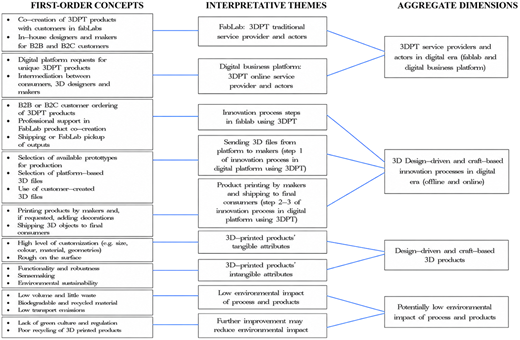
Our findings identify four constitutive elements of design-driven innovation enabled by 3D printing technology (3DPT): (1) actors and innovation contexts, (2) the design-driven and craft-based innovation process, (3) the characteristics of 3D-printed products, and (4) the perceived environmental impact of processes and products (Figure 1).
Figure 1 presents the progression from representative first-order concepts to second-order themes and aggregate dimensions.
Several shared practices emerged across both Fab Labs and digital platform cases, particularly the combination of localized co-creation and craft-based experimentation with digitally mediated coordination and distributed production.
The following sections (4.1–4.5), present the four aggregate dimensions and the cross-case comparison, supported by illustrative quotations. Some exemplary quotes related to the study's first-order concepts are provided in Supplementary TableA1.
4.1 Traditional Fab Labs and digital business platform: origin and actors
The two Fab Labs (Companies 1 and 2) operate offline through co-creation with mainly local clients, whereas the two start-ups (Companies 3 and 4) rely on digital business platforms connecting designers, makers, and consumers to develop 3D-printed products. Both platforms connect makers directly with consumers. Company 2 is a specialized Fab Lab supporting people with disabilities through highly customized 3D-printed products developed with an external design studio. The digital platforms aim to democratize 3DPT by connecting consumers with nearby makers. Company 3 originated during the Covid-19 pandemic producing mask holders and visors before evolving into a digital platform. As a co-founder stated:
We are young co-founders driven by a passion for digital technologies, each equipped with distinct software development, marketing, finance, and operations skills. Together, we have pioneered a specialized e-commerce platform designed to produce 3D-printed objects for end consumers (C3-E1).
One founder of company 4 specified:
Our mission is to uphold the human touch in digital craftsmanship and foster connections between designer creativity, digital craftsmanship, and consumers seeking unique, eco-friendly objects (C4-E2).
In company 3, designers are directly involved, allowing consumers to print objects by selecting from prototype photos. In the company 4, designers are indirectly involved, with 3D models available on the platform and links to open-source sites for customer downloads. Platform owners specialize in niches such as tabletop gaming, jewellery, and interior design. Designers are 3D modelling experts or enthusiasts, whereas makers are 3D printing specialists, some operating Fab Labs. Consumers mainly seek unique, personalized products in terms of shape, colour, material, and Made in Italy. One consumer described a customized 3D-printed object:
[…] I had a lamp printed with fluorescence inserted in the centre. The layering process paused to introduce fluorescent liquid. Not all manufacturing processes can modify a product mid-production (C3 -C).
4.2 Design-driven and craft-based innovation process with 3DPT
The innovation process in both Fab Labs and digital platforms starts with a customer request for a customized object and ends with its production and delivery. In traditional Fab Labs, the innovation process takes place offline and typically follows three main steps: (1) it begins with customer contact; (2) clients and Fab Lab staff co-create the 3D file, prototype, and/or final product; and (3) the finished object is delivered to the customer.
Across both Fab Labs, respondents described the innovation process as centred on customized 3D printing, prototyping, and co-development projects carried out in close collaboration with clients. As company 2 explained
We carry out ad hoc, customized design processes through collaboration with an interaction design studio, with a focus on co-design and disability support (C2 -E).
In both Fab Labs' clients (in B2B context) and customers (in B2C context) actively cooperate with designers and makers to design and print the desired products. As one client of company 1 explained “We co-created a prototype for a component of a new kitchen in collaboration with a designer and a FabLab, and physical interaction played a crucial role in the design process” (C1-C).
In company 2 a client highlighted that: “We offer specialized products for people with disabilities, such as a support device designed to facilitate the use of pens and markers. To this end our team works with Fab Labs, designers, and makers, applying a co-design methodology aimed at social innovation”. (C2-C).
In the two digital platforms all innovation process steps occur online.
In company 3, the process involves three steps: (1) the customer chooses among prototypes made available by designers and selects a maker; (2) the designer sends the 3D files to the maker; and (3) the maker prints the object and sends it to the consumer. As one founder explained:
Before allowing customers to select a product to be printed in 3D, designers in our database publish photos of their prototypes. It is important to show customers the final physical product and not a rendering (C3-E3).
In the other platform, customers select 3D models made available by the platform, select the maker, and send the files to the selected maker (step 1); then the maker prints the object and ships it to the consumer (step 2).
This innovative process follows an “on-demand” approach. One case features active participation from designers, who are 3D modelling experts or enthusiasts. In the other case, product innovation is indirectly guided by design, with 3D models from experts made available on the platform. These business models are flexible, as one respondent specified:
3D models are made available for free on the platform and online; this is an open-source world (C3-D1).
We found that consumers actively participate in the innovation process by selecting the shape, material, colour, and maker of the product through a platform ranking. They can also request specific decorations. Makers contribute creatively by making technical changes during printing and enhancing the product in post-production, such as smoothing surfaces or painting. This process is both design-driven and craft-based due to the involvement of manual dexterity.
As explained by one founder of digital platform (company 3):
Makers can add elements to the products, finishing them with decorations, and using traditional material. The tactile experience of the material such as the painting or adding other decorations is important and allows the creation of unique objects and value. (C3-E3).
4.3 Design-driven and craft-based 3D products
In all four companies, the final outputs are very similar because the products are co-designed with designers and 3D printed. We named these products “design-driven and craft-based 3D products” because they result from an innovation process led by designers and 3D printed by makers who refine them. As one founder explained:
These objects are made using additive techniques that create layers. Printing customized objects in various shapes, colours, materials, special geometries, and gap-filling is possible. Makers can use ecological materials or semi-professional resin printers. Resins can turn to metal and are highly resistant materials with high elasticity (C3-E4).
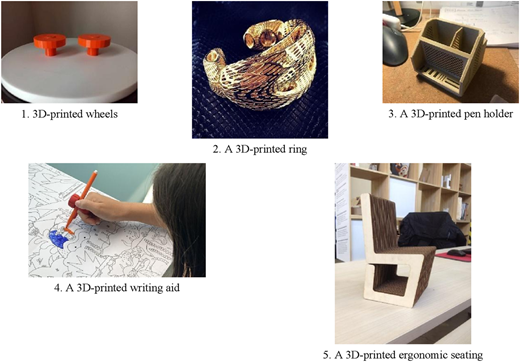
These products can be personalized with rough surfaces, allowing makers to freely decorate them by hand (e.g. material, colour, finishing) as shown in Figure 2. In this respect, one maker explained:
There are two kinds of 3D-printed objects: one kind is characterized by robust and functional objects, generally components, made with strong materials such as nylon and specific printers. The robustness of the object may depend on how much the product is filled inside, and if it is filled to 100%, the object becomes solid and heavy. The other kind of objects consists of decorative items, such as lamps. These products are less functional, performance-oriented, and robust (C3-E1).
Company 1 explained:
Sometimes we glue together parts created through 3D printing, such as an innovative motorcycle windshield. We also once printed a university logo onto t-shirts, transforming the file from 2D to 3D. These kinds of projects are simply not achievable using traditional manufacturing methods. (C1-E2).
Some respondents highlighted the potential to create unique and original products with new meanings, as expressed by one maker of company 3:
A 3D-printed writing aid, co-designed with designers, makers, and people with motor disabilities, characterized by customizable ergonomic forms and lightweight materials. The innovation lies primarily in the meaning attributed to the object: not a standardized medical aid, but an inclusive everyday object that promotes autonomy and participation, transforming the user into a co-author of the project and redefining the relationship between technology, the body, and society. (C3-M1)
In the Fab Labs, there is close collaboration with industrial designers, which means that the objects produced are often imbued with new meanings linked to product innovation:
We created a lightweight, adjustable, and washable 3D-printed writing aid to help children with complex neurological disorders write and draw independently. What makes the object revolutionary is not only its technical features, but the new way it enables the act of writing: it transforms writing from a mediated, assisted activity into a personal and autonomous one (C4-E).
4.4 Potentially low environmental impact of process and products
When we asked respondents to describe the key attributes of innovative outputs created with 3DPT, all of them freely expressed opinions related to the potential environmental impact of products and processes. Interestingly, all respondents agree that 3DPT has a minimal environmental impact, largely due to its low production volumes (e.g. 50–100 pieces) and waste-reducing, on-demand manufacturing process. As one founder of a Fab Lab explained:
3DPT enables production in small batches, resulting in a smaller environmental impact compared to mass production. These design products are targeted to specific market niches that cannot meet the logic of mass production. Hence, the logic of 3DPT is intrinsically sustainable. Outputs can be produced with 3DPT only when there is demand, and it. The waste is negligible! [ …] It also allows money to be saved when prototyping, as the same product can be modified thanks to a file change! (C1-E1)
Another factor contributing to the potentially low environmental impact of these products is the growing use of biodegradable and recyclable materials, as highlighted by one founder:
The little impact of 3DP technology on the environment is connected to the material, Polylactic Acid (PLA), which is a widely used biodegradable and recycled material, and some are made with corn or tomatoes. However, the greener the material, the less robust and performing the product is (C1-E2).
Respondents also highlighted that some 3D printers are energy-efficient and can operate on 100% solar power, while the platforms' geolocation contributes to reducing transportation-related emissions by connecting consumers with nearby makers.
However, respondents also acknowledged some environmental challenges, which varied depending on the printing technology and materials used. As one Fab Lab designer explained:
Most of the materials contain plastics that are not easily recyclable. Even PLA can vary between batches, with different properties, meaning the printed objects often can’t be recycled together. Moreover, 3D printing generates a lot of waste and consumes as much electricity as a typical household (C1-D).
Although respondents generally perceived 3D printing as environmentally sustainable, they also noted that small businesses relying exclusively on 3D printing face limited economic sustainability, while further improvements in material regulation and recycling practices are needed.
4.5 Cross-case comparison
The comparison between Fab Labs and digital business platforms shows some differences in the way design-driven innovation develops through 3D printing technologies. In Fab Labs, customers, designers, and makers interact mainly in a physical environment through co-creation activities. In digital business platforms, interactions are primarily mediated by digital technologies, while designers and makers may operate in different geographical locations.
At the same time, several common elements emerged across the cases. In both contexts, 3D printing technologies support the development of highly customized products and enable the involvement of customers in the innovation process. Moreover, relationships among consumers, designers, and makers play a central role in product development, while design-driven and craft-based outputs emerged in both organizational contexts. Environmental aspects, including reduced material waste and small-batch production, also emerged across both Fab Labs and digital business platforms.
The comparison further highlights that, despite the different modes of interaction characterizing the two contexts, similar innovation patterns emerged. In both Fab Labs and digital business platforms, consumers, designers, and makers interact throughout product development, contributing customized design-driven and craft-based outputs.
5. Discussion and conclusions
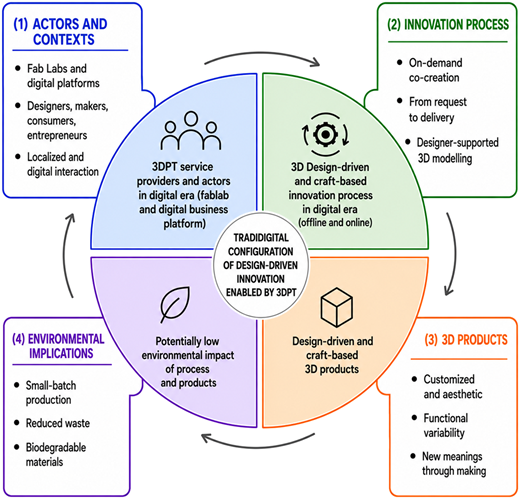
This study examines how Design-Driven Innovation (DDI) operates in the digital era when enabled by 3D printing technologies. Drawing on four Italian firms operating in Fab Labs and digital business platforms we show how DDI processes, actors, and outputs are reconfigured in digitally mediated manufacturing contexts. The findings identify four interrelated elements: (1) the innovation contexts and actors involved (Fab Labs and digital platforms), (2) design-driven and craft-based innovation processes enabled by 3DPT, (3) the distinctive characteristics of design-driven and craft-based 3D products, and (4) the perceived environmental impact of these processes and outputs. Together, these elements form an emergent conceptual framework (Figure 3) that extends the traditional DDI perspective by integrating digital manufacturing technologies and sustainability considerations.
The framework presented in Figure 3 extends the traditional DDI model (Verganti, 2003, 2009) and shows the role of 3DPT in shaping actors, processes, and outputs in both physical and digital contexts. This is consistent with previous studies on technology epiphanies and the role of digital technologies in design practices (Verganti, 2011; Verganti and Shani, 2016).
A first major shift concerns the contexts and actors through which DDI unfolds (Element 1). Unlike the original DDI framework, which emphasizes firms embedded in relatively stable networks of interpreters, the cases analyzed here operate within Fab Labs and digital business platforms that function as innovation intermediaries. These contexts enable interactions among entrepreneurs, 3D designers, makers, and customers through 3DPT. While our findings confirm the continued importance of expert actors in shaping product meanings, they also extend Verganti's framework by showing that DDI in 3DPT-enabled contexts unfolds through broader actor networks, in which 3D modelling experts, makers, platform intermediaries, and consumers actively participate in meaning creation and product realization. This finding aligns with recent research suggesting that industrial designers are not always the sole initiators of design-driven innovation and that multiple actors contribute to meaning creation (Verganti and Shani, 2016; Kubo and Sato, 2024; Artusi et al., 2024; Gemser et al., 2024).
A second shift relates to the nature of the innovation process (Element 2). While traditional DDI typically unfolds through exploratory activities within designer networks followed by concept development and market diffusion (Verganti, 2009), the models observed in this study are fundamentally on-demand. Nevertheless, they retain the three core macro-phases of listening, interpreting, and addressing (Dell’Era and Verganti, 2009; Verganti, 2003, 2009). Listening is closely connected to direct customer requests; interpreting occurs through the development of 3D models and design solutions tailored to specific needs; and addressing is realized through immediate production and delivery via Fab Labs or platform-coordinated makers. A key difference lies in the role of consumers, who actively participate in shaping innovation from the outset rather than merely adopting new meanings ex post (Dell’Era and Verganti, 2009; D'Ippolito, 2014). Moreover, 3DPT and handcrafted finishing by makers introduce craft-based elements into an otherwise digital innovation process, reflecting broader shifts in digital manufacturing and platform-based innovation (Friesike et al., 2019; Stanko and Rindfleisch, 2023). Thus, our findings confirm the core logic of Verganti's DDI process while showing how 3DPT makes the process more on-demand, co-created, and craft-based.
The third element concerns the characteristics of design-driven and craft-based 3D products (Element 3). These products combine core attributes traditionally associated with design outputs, such as aesthetic appeal, functionality, and meaningfulness, with new affordances enabled by 3DPT (Kotler and Rath, 1984; Verganti, 2003; Luchs and Swan, 2011). Advances in materials and printing technologies enhance robustness and performance, while customization, complex geometries, and opportunities for manual finishing differentiate these products from mass-produced alternatives.
Our findings confirm the centrality of meaningfulness in DDI outputs while showing how 3DPT extends meaning creation through customization, new geometries, and craft-based refinement.
Finally, the framework highlights a fourth element related to the perceived environmental impact of processes and products (Element 4). Respondents associated the sustainability of 3DPT with demand-driven production, limited batch sizes, reduced material waste, and the use of biodegradable materials. Localized production through Fab Labs and digital platforms may further reduce transportation-related emissions. These perceptions are consistent with previous studies suggesting potential environmental advantages of additive manufacturing (Weller et al., 2015; Gal, 2019; Faheema et al., 2024). At the same time, respondents acknowledged that environmental outcomes depend on material choices, printing technologies, and energy consumption. Unlike the previous elements, this finding extends Verganti's original DDI framework, where sustainability considerations remained largely implicit. Our findings suggest that environmental considerations are becoming increasingly relevant in DDI enabled by 3DPT.
Our findings further suggest that DDI enabled by 3D printing technology (3DPT) develops through what we define as a “tradidigital” configuration, where traditional Fab Labs and digital business platforms complement each other. Fab Labs mainly support local experimentation, physical co-creation, and craft-based activities, while digital platforms facilitate coordination and distributed production by connecting makers and consumers in different locations (Cusumano et al., 2019; Rangaswamy et al., 2020). In this configuration, Fab Labs provide a physical context in which actors can interact and develop product meanings, while digital platforms extend these interactions beyond local boundaries. Thus, 3DPT does not replace traditional innovation contexts but connects them with digital ones, creating new opportunities for collaboration, customization, and product development.
Figure 3 should thus be interpreted not only as representing the four constitutive elements of DDI enabled by 3DPT, but also as illustrating how their interaction gives rise to a tradidigital configuration in which traditional and digital innovation logics coexist and jointly shape design-driven innovation processes.
Taken together, these findings extend Verganti's framework through broader actor networks, on-demand processes, new modes of meaning materialization, and sustainability considerations.
5.1 Theoretical and practical implications
5.1.1 Implications for theory
First, this study extends design-driven innovation (DDI) theory by introducing the concept of tradidigital DDI, showing that design-driven innovation unfolds through complementary physical and digital innovation configurations rather than mutually exclusive environments. This reconceptualization extends Verganti's framework (2003, 2008, 2009) to digitally mediated manufacturing contexts in which Fab Labs and digital business platforms complement each other. In doing so, the study advances recent work on digitalization and innovation (Cantamessa et al., 2020; Verganti et al., 2020; Holmstrom, 2018; Agostini et al., 2019) by showing that digital B2C marketplaces not only streamline innovation processes but also enable DDI to extend beyond product innovation towards process and business model innovation (Spanjol et al., 2024). Second, the study extends DDI theory by reconfiguring the actor networks through which innovation unfolds. The findings suggest a shift from networks of interpreters (Verganti, 2009) toward more fluid and platform-mediated constellations in which 3D modelling experts, makers, customers, entrepreneurs, and designers contribute to meaning creation and product realization. This shift extends recent developments in DDI that that emphasize distributed actor participation (Verganti and Shani, 2016; Kubo and Sato, 2024; Artusi et al., 2024; Gemser et al., 2024).
Third, the analysis contributes to the literature on design outcomes by showing how additive manufacturing reshapes the materialization of meanings within DDI. Design-driven and craft-based 3D products combine traditional design attributes—such as aesthetics, functionality, and meaningfulness (Luchs and Swann, 2011; Verganti, 2009)—with distinctive features enabled by additive manufacturing, including customization, complex geometries, and handcrafted finishing. 3DPT extends the materialization of meanings through hybrid digital–craft production practices. This finding reinforces the role of tradition and craftsmanship as sources of value within digital innovation processes (De Massis et al., 2016; Holmquist et al., 2019; Messeni Petruzzelli and Savino, 2014).
Fourth, the study contributes to the literature on the environmental implications of DDI by showing that sustainability-related considerations increasingly become embedded in how actors evaluate and enact DDI enabled by 3DPT.
Rather than establishing a direct causal relationship between DDI and sustainability outcomes, the findings indicate that demand-driven production, reduced material waste, and localized manufacturing are perceived by actors as potentially contributing to a lower environmental impact and therefore as relevant evaluative dimensions within digitally enabled innovation processes. These insights align with research on digital manufacturing and sustainable innovation (Holmstrom, 2018; Faaehma et al., 2024; Kongprasert and Nguyen, 2024; Oduro et al., 2022).
Finally, by jointly examining digitalization and sustainability within design-driven innovation, this study integrates two streams of literature that have largely evolved separately within DDI research. The findings suggest that digitally enabled DDI involves not only the reinterpretation of product meanings, but also new evaluative concerns related to production models, resource efficiency, and localized manufacturing. In this sense, the study extends recent work exploring the intersection between digital innovation and sustainability (Appolloni et al., 2023; Annosi et al., 2020; Gal, 2019; Stanko and Rindfleisch, 2023).
5.1.2 Implications for practice
This study offers several managerial implications for Fab Labs and digital business platforms. Managers should view traditional Fab Labs and digital platforms as complementary innovation models fostering collaboration among designers, makers, and customers while developing complementary capabilities in software development, marketing, and customer relations. Fab Labs and digital platforms benefit from diversified organizational structures. Fab Labs should strengthen collaboration with designers and external innovation partners, while platform-based ventures can enhance value creation by enabling multiple forms of customer co-creation, including the commissioning, customization, and direct upload of 3D design files.
Designers and makers should continuously invest in technical and creative skills to support on-demand, customized production, combining digital design with local craftsmanship. Although 3D printing is perceived as having a relatively low environmental impact, practitioners should further strengthen sustainability by using recyclable materials and designing durable products. Customers, in turn, can actively contribute by favouring eco-friendly solutions and supporting local makers.
Finally, policymakers and educational institutions should adopt a broader ecosystem perspective when supporting innovation enabled by 3DPT. Support initiatives should recognize the interdependence among Fab Labs, digital platforms, designers, makers, entrepreneurs, and customers. Financial incentives, training programs, and consultancy services can help strengthen the interactions among these actors and foster the development of sustainable and design-driven entrepreneurial ventures.
5.2 Limitations and future research
This exploratory study has several limitations. First, the qualitative analysis focused on a limited number of actors across four traditional and digital firms. Future studies could include a broader range of actors and examine how tradidigital innovation configurations emerge across different organizational settings. Second, the study is situated in the Italian context. Comparative research across different countries would help assess the generalizability of the findings, particularly given the role of local traditions and creative cultures in shaping design-driven innovation.
Third, future research should investigate customer motivations for purchasing 3D-printed design objects and examine how artificial intelligence may reshape the roles of designers, makers, and consumers in co-creation processes.
Finally, future research should examine the environmental and social implications of 3D printing–enabled innovation across the product lifecycle, including issues of sustainability, inclusivity, and access to customized products (Matos and Jacinto, 2018; Gal, 2019). Both qualitative and quantitative approaches would help advance this research agenda.