

1. Innovation management in a digital world
Introduction
Digitalisation causes a complete paradigm shift of production and innovation options. In the new wave of digitalisation, innovation systems and management of technology (MoT) face new challenges. Digitalisation understood as the use of digital technologies to change a business model and provides new revenue and value-producing opportunities. “Digitisation is the process of changing from analog to digital form”, as Gartner states[1]. Digitalisation processes accelerate the need for innovation and for innovating faster. We live in the middle of ubiquitous and mobile supercomputing, ubiquitous presence of internet technologies everywhere, e.g. neuro-technological brain enhancements, genetic editing, robotic applied for instance in all kinds of production, in surgery, in space research and in car driving. Digital technologies are capturing all aspects of life nowadays. This momentum of change will continue to strengthen in the next decade. Driven by ever faster data connections, the miniaturisation of sensors and processors as well as intuitively operated devices with new application functions, networking pervades all areas of everyday life. In the emerging Internet of Things (IoT), physical objects communicate and interact with their environment. The Industry 4.0 approach entails new business models especially for small- and medium-sizes enterprises (SMEs) (Müller, 2019). Advances in the field of artificial intelligence allow the analysis and interpretation of huge amounts of data in real time and enable powerful automation solutions. Robots find optimal solutions even for highly complex tasks, without human intervention. Trends in the context of digital transformation are “digital networking in everyday life”, “new opportunities with Big Data”, “establishment of the IoT (Internet of Things) paradigm”, “breakthroughs in artificial intelligence and robotics” and “vulnerability of critical infrastructures”. The consequences for end users and consumers are a challenge. Engaging the customers and consumers into the development of the front-end phase of the digitalised service processes is very important for the success of the services (Saulina, 2019). Hyper-connectivity is expanding fast, while physical-digital integrations, IoT, smart home tech, big data, augmented and virtual reality, and machine learning are changing our entire systems of living and thinking”[2]. The developments in the block-chain technology contribute significantly to this digitalisation and to the creation of new business models.
Digital transformation is the rapid growth of digitalisation and is called the fourth industrial revolution (Schwab, 2016). The first industrial revolution covers the mechanisation, which considers the process replacing agriculture with industry as the foundations of the economic structure of society from the end of the eighteenth century to the beginning of the nineteenth century. The second industrial revolution initiated the emergence of new sources of energy, such as electricity, gas and oil with leaded to combustion engines for instants and to completely new production systems as envisioned by Taylor and Ford at the end of the nineteenth century. The third industrial revolution is characterised by the appearance of nuclear energy, the rise of electronics with transistor and microprocessor, the increase of telecommunications and computers, and in industry the high-level automation in production with programmable logic controllers and robots. This fourth industrial revolution is, however, fundamentally different. It is characterised by a range of new technologies that are fusing the physical, digital and biological worlds, impacting all disciplines, economies and industries, and even challenging ideas about what it means to be human (Schwab, 2016). The resulting shifts and disruptions mean that we live in a time of great promise and hazards.
The world has the potential to connect milliards more people to digital networks, dramatically improve the efficiency of processes and even manage assets in ways that can help regenerate the natural environment, potentially undoing the damage of previous industrial revolutions. Industrial Internet of Things (IIOT) technology enables perpetual connectivity with customers. Key factors for new products or design such as value proposition and change in demand or expectation are available in no time (Seetharaman et al., 2019).
However, experts rise also concerns that organisations might be unable to adapt to this revolution, flooding our lives and societal, cultural, economic system and the industries. Governments could fail to employ and regulate new technologies to capture their benefits. Shifting power will create an important new security concern. Inequality may grow and societies fragment. The consequences for various territories with old traditional and heavy industries create big challenges. The innovation processes and the new business models are being revolutionised. There are discussions whether robots or intelligent machines will innovate in the future (Botha, 2019). Since digitalisation affects all our life in production, business, education, health system, at home, it is discussed in many different contexts, in conferences, by policy makers also in relation with funding strategies. Among others, International Association for Management of Technology (IAMOT) offers a platform for discussing digitalisation in the context of innovation and technology management. Therefore, IAMOT2017 Conference emphasised on digitalisation in the context of MoT and innovation management. Selected contributions of the conference are chosen for this special issue, which discusses the context of innovation management and technology management with digitalisation in industry or customer relation, with Industry 4.0, with digitalisation and business models, or with innovation via robots.
2. Method and summary of the papers
The special issue contains eight papers. They contribute to the fields of innovation management and MoT with an emphasis on aspects of digitalisation. Müller (2019) and Rachinger et al. (2019) discuss business models in relation with digitalisation. Seetharaman et al. (2019) and Walwyn et al. (2019) deal with industry and digitalisation (IIOT and energy). Monteiro et al. (2019) and Saunila et al. (2019) expound the problems of customer engagement in digital environment. Tambo and Filtenborg (2019) works out how IT4IT framework (see footnote 3) is linked to MoT; and Botha (2019) discusses whether intelligent machines will be capable to innovate in the future. Table I gives an overview of all eight articles about the core idea of the paper, the research questions, the applied methodology of the analysis, the main results, shortly about the contribution to MoT, and a classification for this analysis.
Overview of the papers in the special issue
| Core idea | Research questions | Methodology of the analysis applied in the article | Main results | Contribution to management of technology (MoT) | Grouping | ||
|---|---|---|---|---|---|---|---|
| 1. | Müller, J. M. | Business model innovation, SME, strategies for Industry 4.0; Industry 4.0 is expected to significantly transform industrial value creation | Which specific characteristics regarding user and provider perspectives of Industry 4.0 exist in small- and medium-sized enterprises towards Industry 4.0-triggered business models? | In-depth expert interviews within the three most important German industry; the results allocate business model implications through Industry 4.0 to the Business Model Canvas | Insight into manufacturing-SMEs-Industry 4.0 and their business model; industry 4.0 and the nine building blocks of the Canvas Business Model; differentiation between providers and users technology --> 25% of the investigated SMEs are providers of Industry 4.0 technology, 75% of the SMEs in the study are users | Industry 4.0 is a core technology in the context of MoT. How to cope with such technologies and how to improve innovation and business with and in Industry 4.0 are core topics of MoT | Business model innovation |
| 2. | Rachinger, M. | Digitalisation and its influence on business models | (1) How does digitalisation influence a firm’s business model? (2) How do firms cope with the digitalisation of their business model? | Qualitative interviews in the automotive and media industry related to the available literature | The media as well as the automotive industry perceive pressure and opportunities of digitalisation regarding business model innovation. Opportunities of digitalisation optimise the business model innovations; Internal trigger for digitalisation is the process optimisation, external trigger to use these technologies in their value creation process | Digitalisation in connection with business model innovation (BMI) is discussed in two articles, a thematic focus of innovation management and also an MoT topic, since digitalisation is used for management of technology in a broader sense | Business model innovation |
| 3. | Seetharaman, A. | Control the physical world, including the machines, industrial facilities, and frameworks that characterize cutting-edge technology; Industrial Internet of Things (IIOT). Value creation | (1) What are the values that the IIOT can bring to manufacturing firms? (2) What are the prerequisites for the journey towards IIOT adoption? (3) Which factors can augment the adoption process? | Data are collected from 203 respondents predominantly from emerging economies, specifically India and SEA. Most of the participants are working professionals. Structural equation modelling (SEM) was applied for analysis | IIOT- connectivity, big data, advanced analytics, and application development; IIOT provides high level of synergies between the 4 Ms of manufacturing, namely man, machine, material, and method. One of the key expectations from IIOT technology is that it will empower people by supplying on-time and relevant information to identify the cause and effect relationship → help in improved decision making regarding various aspects of manufacturing, such as scheduling and resource optimisation | IIOT needs MoT and MoT gets input from IIOT, IIOT provides high level of synergies between the 4 Ms of manufacturing, namely man, machine, material, and method | Industrial Internet of Things |
| 4. | Walwyn, D. | Building hydrogen economy through digitalisation and niche experimentation | How South Africa can act to support a new hydrogen-based technological innovation system (TIS) to meet the goals of 2DS (2°C Scenario)? | Mixed methods approach; (1) secondary data analysis to build a profile of South Africa’s present energy system; (2) stakeholder survey of the emerging hydrogen economy | Digital technology applications for the integration of various sources of energy (wind, solar, coal, nuclear, gas and fuel cell); use of such technologies is essential; South Africa | Managing energy-generating technology by use of digital technologies is a contribution where digitalisation improves and accelerates innovation and business opportunities | Industry, energy |
| 5. | Monteiro, T.A. | Managing the digital consumer; customer engagement behaviour (CEB) in digital environment; cases from Brazil and Spain | (1) How can the use of technology improve the perception of the business by the consumer? (2) How can it be transformed into a source of competitive advantage by the companies? | Survey, data collection, analysis and structure via Technology Availability Index (Techqual); determine a person’s predisposition to use a technology (four dimensions: optimism, innovation, discomfort. insecurity) | Consumer attitudes at the time of purchase, reflecting their real intentions, influences their post-purchase behaviour; important is the influence of consumer involvement - continuous commitment on the part of the consumer to thoughts, feelings and behavioural responses to products or services → strategies for SMEs; no significant difference on consumer behaviour in Brazil and Spain | Digital technologies and consumers - strategies for SMEs → MoT and the end users | Customer engagement behaviour (CEB) in digital environment |
| 6. | Saunila, M. | Customers’ engagement in digital service processes; customer engagement behaviour (CEB) in digital environment. Value creation t | Which factors affect the customer engagement behaviour in digital environment? | Qualitative single-case study; customer-based, firm-based, and context-based factors; the case: a company providing streaming TV services, market leader in Finland with hundreds of millions in revenue and tens of thousands of customers | Customer engagement differs among different phases of the digital service process; engagement during the front-end phase of the process is important; customer-based and context-based factors during the back-end phase | Managing the customers engagement in digital service processes is managing technology → MoT | Customer engagement behaviour (CEB) in digital environment |
| 7. | Tambo, T. | Digital services governance; managing the business of IT; a value chain-based IT operating model and reference architecture | How should the IT4IT™ framework be interpreted as a management of technology framework, with respect to the dualism of IT as both innovation driver of the business, but also IT as focal in development and operational resources spend in the organisation? | Analysis of the IT4ITTM framework for management of technology (MoT); literature study; case analysis | IT4IT framework supports value creation; using value streams will align IT better with manufacturing and services | IT4IT framework is linked to MoT framework | MoT |
| 8. | Botha, A.P. | Possible future evolution of innovation from a human-only initiative, to human-machine co-innovation, to autonomous machine innovation and to arrive at a conceptual mind model that outlines the role of innovation regimes and innovation agents. Value creation | Will intelligent machines in future have the capability to innovate? | Concept paper where a theoretical “thought experiment” is done, using future thinking principles and data that originates from the literature | A conceptual mind model is developed to facilitate a better understanding of complexity at the edge of innovation where intelligent machines will emerge as innovators of the cyber world. It was found that innovation will gradually evolve from a human-only activity, to human-machine co-innovation, to incidences of autonomous machine innovation, based on the growth of machine intelligence and the adoption of human-machine partnership management models in future | Future thinking methodologies for technology management and innovation processes are useful for anticipating and estimating implications; future thinking methods provide approaches for being prepared | Future thinking |
The applied methodologies are mainly of explorative character such as case studies, interviews, stakeholder survey and questionnaires. Only one article is a concept paper which deals with the future of innovation and whether machines will do this (Botha, 2019). Find here a short description of each of the eight articles.
Müller (2019) investigates business model innovation (BMI) in relation to SMEs, strategies for Industry 4.0. Industry 4.0 is expected to significantly transform industrial value creation. This article develops answers to which specific characteristics regarding user and provider perspectives of Industry 4.0 exist in small- and medium-sized enterprises towards Industry 4.0-triggered business models. The paper gives insight into manufacturing-SMEs-Industry 4.0 and their business models. Industry 4.0 and the nine building blocks of the Canvas Business Model. They work out the differentiation between providers and users’ technology. They find that 25 per cent of the investigated SMEs are providers of Industry 4.0.
Rachinger et al. (2019) discuss digitalisation and its influence on business models. They try to find answers to how does digitalisation influence a firm’s business model, and how do firms cope with the digitalisation of their business model. They investigate two cases, automotive and media. The media as well as the automotive industry, perceive pressure and opportunities of digitalisation regarding BMI. Opportunities of digitalisation optimise the BMIs. The internal trigger for digitalisation is the process optimisation. External trigger uses these technologies in their value creation process.
Seetharaman et al. (2019) analyse the technological change through IIOT, the control of the physical world, including the machines, industrial facilities, and frameworks that characterize cutting-edge technology through digitalisation. Answers to the following research questions are developed:
What are the values that the IIOT can bring to manufacturing firms?
What are the prerequisites for the journey towards IIOT adoption?
Which factors can augment the adoption process?
A main result is that IIOT provides a high level of synergies between the four Ms of manufacturing, namely, man, machine, material and method. One of the key expectations from IIOT technology is that it will empower people by supplying on-time and relevant information to identify the cause and effect relationship which will help in improved decision making regarding various aspects of manufacturing, such as scheduling and resource optimisation.
Walwyn et al. (2019) cover the topic concerning building economy in the energy sector through digitalisation and niche experimentation. They develop answers to how South Africa can act to support a new hydrogen-based technological innovation system (TIS) to meet the goals of 2DS (2°C Scenario). One of the core results are that digital technology applications are necessary for the integration of various sources of energy (wind, solar, coal, nuclear, gas and fuel cell). The use of such technologies is essential for South Africa.
Monteiro et al. (2019) ask how to manage the digital consumer. They investigate the customer engagement behaviour (CEB) in digital environment and analyses cases from Brazil and Spain. They look for answers to how can the use of technology improve the perception of the business by the consumer and how can it be transformed into a source of competitive advantage by the companies. Some main results are that the consumer attitudes at the time of purchase reflect their real intentions and influence their post-purchase behaviour. The influence of the consumer involvement, the continuous commitment on the part of the consumer to thoughts, feelings and behavioural responses to products or services are important. From these findings, strategies for SMEs could be derived. There is no significant difference on consumer behaviour in Brazil and Spain.
Saunila et al. (2019) investigate customers’ engagement in digital service processes and CEB in a digital environment. They answer the questions which factors affect the CEB in digital environment. A main finding is that customer engagement differs among different phases of the digital service process. The engagement during the front-end phase of the process is important. She works out customer-based and context-based factors during the back-end phase.
Tambo and Filtenborg (2019) ask the following question: How should the IT4IT™ framework[3] be interpreted as an MoT framework, with respect to the dualism of IT as both innovation driver of the business, but also IT as focal in development and operational resources spend in the organisation? While conducting an analysis of the IT4ITTM framework for MoT, a literature study, and a case analysis they found that the IT4IT framework supports value creation and uses value streams will align IT better with manufacturing and services.
Botha (2019) discusses the possible future evolution of innovation from a human-only initiative to human-machine co-innovation. Will intelligent machines in the future have the capability to innovate? Botha develops a conceptual mind model, which is developed to facilitate a better understanding of complexity at the edge of innovation where intelligent machines will emerge as innovators of the cyber world. It was found that innovation will gradually evolve from a human-only activity to human-machine co-innovation. Incidences of autonomous machine innovation are outlined based on the growth of machine intelligence and the adoption of human-machine partnership management models in future.
3. Meta-analysis and comparison of the papers
The umbrella over all these eight articles is “innovation management” and “MoT”. Various aspects of innovation management or concepts of MoT are discussed. Their links and contributions to MoT and innovation management are the following (see also Table I):
Industry 4.0 is a core technology in the context of MoT. How can we cope with such technologies and how to improve innovation and business with and in Industry 4.0 are core topics of MoT.
Digitalisation in connection with BMI is discussed in two articles, a thematic focus of innovation management and also an MoT topic, since digitalisation is used for MoT in a broader sense.
IIOT needs MoT, and MoT as well as innovation management gets input from IIOT because IIOT provides a high level of synergies between the four Ms of manufacturing, namely, man, machine, material and method.
Managing energy-generating technology by use of digital technologies is a contribution where digitalisation improves and accelerates innovation and business opportunities.
The investigation of CEB in digital environment provides important aspects also for strategies of SMEs and the end users. Thus, these findings are intrinsic for MoT and innovation management.
Managing customers engagement in digital service processes is MoT and, therefore, contributes to MoT and innovation management concepts.
The analysis of the IT4IT framework and the MoT framework, and the findings contribute directly to MoT and innovation management.
Future thinking methodologies for technology management and innovation processes are useful for anticipating and estimating implications; future thinking methods provide approaches for being prepared.
Value creation plays an important aspect in six of the eight articles: especially the both contributions, where business models are discussed, nevertheless also in the papers about Industry 4.0 and IT4IT linked to MoT concept, in the article about the future of innovation by machines, and in one discussing CEB.
The presented articles here discuss aspects of Industry 4.0, or IIOT, or digitalisation of all processes from idea creation to the success of products in the market, or digitalisation and the consumers and provide some insight into the ongoing research. However, the deluge of knowledge creation and innovation in the context of digitalisation can only be touched slightly with these considerations.
4. Conclusion and future research
Organisations have to innovate in order to succeed over time. A fast-growing part of innovation comes directly from the latest digitalisation tools. Many resources and a good deal of attention are directed to the further development of methods, processes, tools, etc. around digitisation. New products and services in all other industries, operation flow, industrial facilities, work organisation, and, of course, business models have been dramatically impacted by digital technologies. For staying competitive new work skills are required.
The influence and change coming from the digitalisation waver are disrupting almost every industry in all processes starting with innovation, in production, in running the business as well as management. The impact of digitisation is tremendous and is seen in all industries bringing about a disruption of existing business models through new technology. Thus, businesses today have to open up their minds to innovation and continuous learning. In the modern world, customers are better informed and are clear about their expectations. There is a definite shift towards individualised products and services as well as a unique customer experience.
Digitalisation, however, faces big challenges. A machine, a sensor is not able to recognise for instance a cat at a glance. It needs many labelled pictures. Building trust, which might be expressed by ensuring robustness, fairness, explicability, lineage of the data and results, needs still a lot of effort.
The digital transformation and the fourth industrial revolution interlocks various technologies, such as biotechnologies, nanotechnologies and quantum computers (Schwab, 2016). Digitalisation combines and even merges more than ever all aspects of an innovation system, comprising universities and research organisations, industry, government, civil society and media, or even the environment. The far-reaching systemic change calls for improved and joint action in the innovation system, in the economic system, in society, in political action. The approach of the Quintuple Helix might support the development of the general welfare of society and, consequently, of the economy. Carayannis and Campbell have worked out the Quintuple Helix approach, besides others (see Campbell and Carayannis, 2017; Carayannis and Campbell, 2009; Carayannis and Campbell, 2010) (Figure 1).
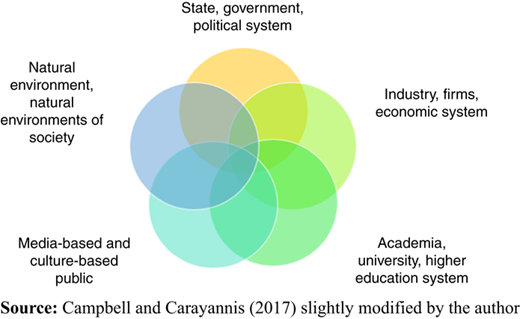
Paradigm shifts within industries require a new socio-technical system to be created, with a different supporting infrastructure. Niches shaping new technological paradigms may be expected to move through certain stages. These factors constitute a sequence of S-curves or waves, with the historical industrialisation as the First Deep Transition (see Schot and Kanger, 2018). All innovation systems, all economy systems worldwide have to cope with this transition.
A lot of research is going on the creation of a knowledge base for a comprehensive understanding of what digitalisation does with the whole innovation system, with industry, with the whole economic system and with the whole society. And much research is further needed to understand and to develop models for making it tangible in industry, government and society.
Notes:
[ii] www.z-punkt.de/en/

