Papers published in Municipal Engineer are eligible for awards from the Institution of Civil Engineers. Papers from any of the ICE journals can be nominated for several awards. In addition, each journal has awards dedicated to their specific subject area.
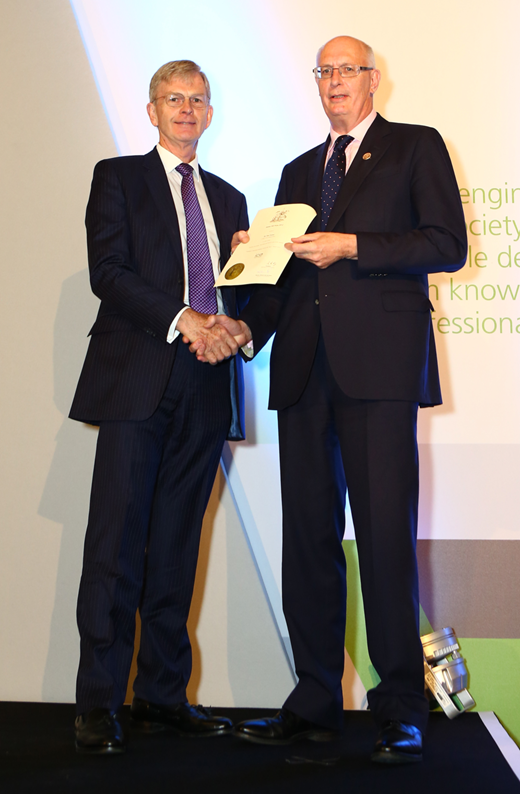
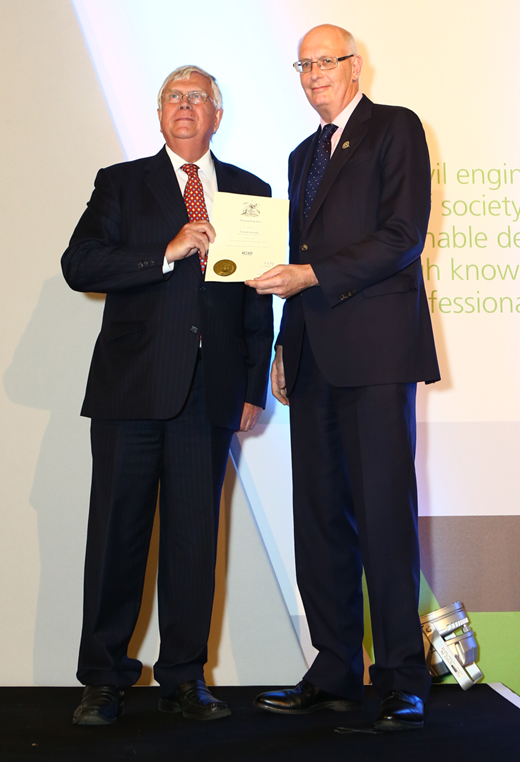
On Friday 18 October 2013, ICE president Barry Clarke presented awards to the following papers published in Municipal Engineer in 2012. The editorial panel nominated their best papers and an awards committee chaired by David Balmforth allocated the awards.
James Hill Fund Award
The James Hill Fund Award, presented for the best paper on a municipal engineering subject, was awarded to Evans (2012).
Abstract
Food waste is the most difficult waste fraction of household waste to manage because it is wet and putrescible. It becomes odorous and it attracts flies and scavengers. When it sticks to other wastes, it reduces the yield of dry recyclables. Home composting has the benefit of proximity but many are unwilling or unable to practise it. Source segregation and storage for kerbside collection and treatment works for many households but not for all, participation is especially low among households in flatted properties. The in-sink food waste disposer (FWD) is used extensively in Australia, New Zealand and the USA but it has been relatively underutilised in Europe. Using data from the published literature, the global warming potentials for landfill, incineration and centralised composting were calculated to be respectively +743, +13 and −14 kgCO2e/t food waste; anaerobic digestion was approximately −170 kgCO2e/t food waste irrespective of whether the food waste is delivered by truck or by FWD and the public sewer. Surahammar in Sweden has provided a unique opportunity to assess the impacts of FWD at community scale and compare them with results from laboratory studies and field trials. Over 14 years, FWD installation went from zero to 50% of households voluntarily; 4-weekly influent monitoring data from the wastewater treatment works of the town show that biogas increased by 46% but flow (water use) and chemical and biological load did not change significantly.
Overseas Prize
The Overseas Prize, presented to the best paper on a subject connected with works carried out outside the British Isles, was awarded to Younger et al. (2012).
Abstract
Sustainable development is an essential objective for all governments, whether tasked with leading a fully industrialised country or grappling with the challenges faced by developing countries. Efforts to deal with some of the major issues of the world that have loomed over the past few decades such as water and sanitation and poverty, the scale of which has primarily resulted from very large population growth over the past half century, have generally failed. This is particularly noticeable in the fast industrialising countries of Asia and in parts of Africa. In more recent times, it has been recognised that resolution of poverty problems really only succeed if the people requiring assistance are directly and fully embraced in the solutions needed, along with the approaches and procedures adopted to tackle the problems. In this paper, details are presented of the approach taken to respond to the aspirations of a desperately poor community of 15 000 in a remote area of Bali, Indonesia, with difficult access, and raise it to a situation of sustainable development. In the beginning the elders of the community prioritised education for their children as a means of providing for a better future. Before the children could respond properly, serious health issues had to be addressed, and this meant taking a long-term and holistic view with a matching schedule of parallel infrastructure and social programmes, and full participation of the community. This privately funded integrated development is now in its eleventh year, and the many challenges and solutions to achieve sustainable development are described. The project provides many lessons for adaptation, and is already providing selective assistance elsewhere.