The theory and practice of action planning embodies one simple but powerful ethos: to do something big, one starts with something small and one starts where it counts. One builds from small, often simple beginnings, on the ground with those who have a stake in the outcome, and with others—politicians, planners, engineers, architects—in whom society entrusts a broader public and moral purpose to serve our interests and safeguard futures. As one builds, one creates opportunities for change, progressively discovered and based in ‘knowingin-action’—on knowledge and experience derived from everyday practice and from those who think about doing something while doing it.
1. INTRODUCTION
To these small beginnings, with all their practical objectives of improving housing, health, education, are attached strategic aspirations—promoting social integration and gender equality, reducing dependency, unlocking resources, sustaining livelihoods and eliminating poverty. Much of the development discourse today seeks to find the means to give practical expression to these strategic ideas—to invent new theories and practices to meet these goals. With some exceptions, few projects, whatever their success on the ground, have triggered the necessary reforms which enable successes to be scaled up effectively. Most, it seems, have served as palliatives in the context of overall demand—something visible and politically expedient but without strategic consequence to the larger order of reforms which are urgently needed to ensure wider benefits.
The critique of Community Action Planning (CAP), (action planning incorporating community participation), and the small beginnings it represents, has centred on its inability to go to scale. Interventions are typically discrete, with a strong focus on the practical needs of individual communities. The result, argue critics, is a series of ad hoc interventions designed to solve local problems but which fail to engage the big agendas. Nor have these interventions influenced significantly the thinking, behaviour or organisation of professional bodies or urban institutions, despite years of work and the plethora of books, projects and conferences. While the language of development theory does embody new ideals, it is more articulate about what needs to be done, although not much structurally has changed so far. A new cycle of critique and awareness is underway but this has yet to shape a new orthodoxy for development practice.
What then are the constraints to moving forward? What assumptions and contradictions get in the way of linking local level CAP to urban, regional or national level strategic action plans (SAPs) and in ways which maintain local needs and aspirations at the core of our search? What are the practical characteristics of SAPs?
2. STRATEGIC SETTING
2.1. The context of constraints
In pursuing the strategic agenda, whether it be UNCHS' Habitat's 10 good policies for better cities, or the ACP/EU objectives for urban development,1 development practitioners, non-governmental organisations (NGOs) and governments will continue to face severe constraints which should be viewed as a context for, rather than an obstacle to, strategic action planning.2 Working to remove or alleviate the impact of these constraints will be a priority in both the medium and long term. The main areas of concern are set out in the following.
Urban population growth is inevitable and will place increasing demands on already strained supply of housing, services and utilities. Nearly one-half of the world's population live in cities and the UN predicts that this will rise to three-fifths by the year 2030. Ninety four percent of this growth will be in the major cities of Asia, Latin America and Africa. Urban growth in Africa is the fastest in the world, rising 5·9%–10·5% per year. During 1990–2025 African cities may need to absorb 575 million new inhabitants—more than the current total of Africa. Overall, the urban population of the world is expected to nearly double within the next 25 years and will reach five billion people.3
Urban productivity will continue to be constrained by inadequate infrastructure provision, overly restrictive regulatory frameworks, the incapacity of local governments to deliver and manage urban programmes in cost effective ways, and the weakness of financial systems—particularly in relationship to the informal economy.
Political instability or conflict continues to place severe limitations on the ability of urban institutions to intervene effectively in the urban system or to implement development plans.
Governments will continue to face severe resource constraints, particularly those that are debt-laden and undergoing structural adjustment. A review by the International Monetary Fund (IMF) of 19 low-income countries which have undergone structural adjustment found that their current account deficits averaged 12·3% of GDP before adjustment and 16·7% in the most recent year and that their external debt had grown from 451% to 482%.4
Tied aid places limitations on economic growth and places further resource constraints on sustainable development. Tied aid results in developing countries paying prices on average of 15% above market rates. This excess price is a direct subsidy to exporters in OECD countries and runs to more than $2 billion a year—nearly 4% of DAC aid.5 Furthermore, donors will prefer to invest in programmes which offer the least risk, therefore denying essential innovations which may be needed to reach those with the least resources.
Poverty is likely to increase as a result of growth-oriented policies. While there has been progress in tackling poverty (life expectancy has increased on average by 50%, infant mortality has been halved, access to utilities, services and housing has increased) it is, nevertheless, stagnant at best while actual numbers in poverty are rising. The poor continue to be seen as a liability rather than a social asset. Commercial considerations continue to take precedence over sustainable development in decisions on aid. Inappropriate technologies based on availability in donor countries rather than actual need, unequal terms of trade, all strengthen dependency relationships, augment poverty and often result in environmental degradation.
The poor continue to have a limited capability or willingness to pay for services, utilities and housing. Evidence is emerging that the poor reduce their use of services if their perception of quality/price trade-off suffers.
Gender and other inequalities (age, disability, ethnicity, and class) are significant in cities, particularly in relation to access to credit, houses, jobs, education, health care, transportation, water and sanitation.
Limitations to community participation will predominate where the influence of power, authority, and gender inequalities are likely to remain great. Critique today suggests that tyranny, not justice or empowerment, is systemic to most participatory planning and that ‘local knowledge far from determining planning processes and actions is often structured by them’.6 In a recent study, CARE International commissioned research in six sites around the world (Cape Town, Cochabamba, Delhi, Dhaka, Lima and Lusaka) to gauge the status of participation in local decision-making. Its conclusion was not encouraging. ‘While several countries had enacted progressive legislation regarding participation, in almost all cases, examples of real participation were hard to find. Fixed attitudes, low capacity and limited budgets within local authorities often leave participation as an add-on luxury rather than as a basic right or legal obligation’.7
2.2. The context of assumptions and contradictions
Those who rightly advocate more emphasis be given to strategic agendas in development projects make assumptions about processes which are questionable and full of contradictions.
First, there is the assumption that there exists a political will nationally and internationally for strategic change and for longer-term sustainability. This is doubtful at the best of times. Most city mayors and national politicians are elected, if they are at all, on promises which brought them votes and which have to be delivered during their tenancy. Most face endemic crises—political, social or economic. In this sense, the practical business of meeting urgent needs visibly takes precedent over longer-term global objectives which they will see as having few immediate political pay-offs.
Second, advocates of the bigger strategic agendas assume that development professionals are willing or capable of engaging and influencing the strategic agenda—that indeed, it is within their remit to do so. But practitioners, like politicians, seek measurable outputs and usually achieve these within the terms of their contract. Their principal business, after all, is to keep their business going. To them, change is risky because often it demands challenging conventions within the same institutions that pay their fees. Affecting structural change to meet global agendas may distance them from host clients and entails stepping ‘into the unknown—embarking on routines that cannot be completely pre-planned’.8 Much easier, they say, to stick to projects and leave innovation to others (academics) who can afford to absorb the risk of getting it wrong.
Third, advocates assume that ordinary people are willing, given the chance, to spend time and energy shaping what they see as other people's agendas which the poorest generally, are not. They see these longer-term objectives as intangible to be of immediate benefit to their daily lives. Evaluations indicate that the top priority for the poorest is survival, followed by security and then quality of life. Most poor households value hardware and products over the software or the process that strategic agendas demand. The question is, how to mobilise the collective resources of ordinary people through networks and alliances so that the implicit strategic value of their daily small-scale and creative efforts can be recognised, understood and applied more widely. There is no better example of this than that of the early work of Turner and others with respect to shelter. Fundamental changes in the supply and management of housing were sparked by recognition of people's own resources to solve their own housing problems, leading to equally fundamental shifts in paradigms and policy.
The fourth assumption has to do with today's principal strategic goal for development, at least as espoused by all major agencies, to redress the inequalities which perpetuate poverty. The characteristic causes of poverty, are low income, few assets, poor diet, limited access to services, minimal autonomy, low dignity and low personal security. The result is that the poor have a low ability to contribute to or benefit from economic growth, nor to cope with the stresses and shocks internal and external to their families and communities. This, in turn, results in higher risks or disability and death. The few assets that they do hold are difficult to convert into income, goods or services, because of prevailing laws of entitlement, restricted markets, poor knowledge and physical capacity, unequal power relations within and between households and communities, and the absence of a favourable economic or political climate. And yet, as Georg Simmel pointed out as early as 1908,9 ‘… it becomes clear that the fact of taking away from the rich to give to the poor does not aim at equalising the individual positions and is not, even in its orientation, directed at suppressing the social differences between rich and poor … The goal of Assistance is precisely to mitigate certain extreme manifestations of social differentiation so that the social structure may continue to be based on this differentiation’. It is unsurprising, therefore, that where on the one hand more access to land, investment in housing, services and utilities for the poor is advocated, at the same time these assets are undermined and access is restricted-through reduction in welfare and public investment, encouraged by structural adjustment, market liberalisation and debt. Examples are plenty and worldwide.
Finally, it is recognised today that development cannot be organised and conducted along sectoral lines, not least in cities. Housing is intrinsically linked to employment, to health, to credit and to much needed land reform. Water and sanitation are linked to health education, environmental management, income generation and so on. Both have as much to do with building livelihoods and reducing vulnerabilities as they do with delivering services. In a similar way, the search for solutions cannot follow strict disciplinary routines. No single discipline, whether engineering, planning, medicine, economics, or architecture can explain the full range of circumstances which impact development. And yet, integrated or cross-sector programmes will be difficult to implement if urban institutions remain sectorally structured as mostly they are.
Those institutions themselves will, in turn, be internally organised or led along disciplinary lines. Most housing departments, for example, will have their structural engineers, estate managers, and architects grouped discretely, and sometimes not in the same building. These divisions are further reinforced by demarcation between those who determine policy, who often occupy the upper floors of departments and those who design programmes. All will compete for authority and money.
The need to improve communication and coordination between sectors, between disciplines and between policy and practice remains an important strategic objective.
2.3. Strategic action planning characteristics
How then should we define SAP, given the context of constraints and assumptions identified above? Overall, and in the most general sense, SAP will be judged against its capacity to create an environment which both facilitates work at the local level and, at the same time, values its impact city-wide and regionally. In this sense, the objectives and routines of CAP and SAP are at once easy to differentiate and yet synergetic (Table 1).
The objectives and routines of CAP and SAP
| Community action planning (CAP) | Strategic action planning (SAP) |
|---|---|
| Problem and opportunity driven | Reform driven |
| Small in scale/local impact | Large in scale/urban or regional impact |
| Complementary/local level | Complementary/urban or regional levels |
| Achievable actions/practical | Desired actions/developmental |
| Participatory | Participatory |
| Best practices | Best practices |
| Tangible outputs | Tangible outcomes |
While CAP processes are driven by problems that need resolution at the local level, SAP seeks to change the structure of controls which inhibit access to resources and to expand the boundaries of possibilities so that new ground rules can be written and new opportunities discovered to take advantage of the latent resource of community to realise their productive potential and to expand the impact of local programmes. SAP is, therefore, inherently reform driven. These reforms define ‘policies (planning) as the art of creating new possibilities’10 expressed in new institutional arrangements, new partnerships, new criteria for problem solving, new wisdom—not just ‘horse-trading’. True reform involves, therefore, change which is as much moral and ethical, not just technical or institutional.
Experience on the ground suggests urgently needed reforms in at least three areas. First, there will be reforms to entitlement, which guarantee rights to those who do not own land, or are illegal settlers, or disenfranchised minorities. Entitlement is often enshrined in political or cultural norms which inhibit access to credit, land, voting or services and will be most difficult to reform. Second, there will be reforms to legislation which inhibit innovations in partnerships through, for example, community contracting or which deny local organisations legal status. Third, there will be reforms to standards and regulations which render housing, resources, services and utilities unaffordable or inappropriate and which, therefore, accentuate poverty. Do legal regulations impose restrictive taxes on employment? Are these barriers to essential resources?
Further, CAP argues for interventions which are small in scale and whose impacts can be felt locally and immediately—a school house, a water line, flood prevention measures, effective fire-fighting procedures, for example. The purpose of SAP is to build on these small beginnings and to expand the scale and impact of programmes. In this respect, there are four intrinsically related components of scale. The first, and most obvious, is size. These include projects and programmes, for example, for urban or regional level flood protection, sewage treatment plants, municipal water projects or waste recycling which are legitimately big. The second component of scale is incrementalism—programmes and projects which start small and are proliferated additively. In Sri Lanka, for example, CAP programmes began in Colombo and in villages as small experimental initiatives to develop and test ideas and methods and to look to their institutional and other implications. Staff of the National Housing Development Authority, with communities, were trained in these methods. A horizontal transfer of CAP know-how enabled communities to train other communities that undertook further programmes. As the programme grew in scale, some 600 Community Development Councils were formed country-wide. In Colombo, these were institutionalised into the Housing and Community Development Council which, through its elected members, gained formal representation on the City Council. They were integral to the structure of the Council's decision-making process. In this way, a network emerged for disseminating knowledge, building awareness, empowering grass-roots organisations and so helping to mainstream local initiatives.
Networks or federations are a third component of scale and often gain regional and international status. Examples are today many and growing—The Peoples' Dialogue, the Asian Coalition of Housing Rights, Slum Dwellers' International, and Solidarity for the Urban Poor Foundation in Cambodia, among others.
A fourth component of scale, and separately, a key characteristic of SAP is complementarity. Complementarity has the dual function of being both practical and strategic. Practical because with any first intervention there will be complementary programmes that ensure its success and continuity. A water project might, for example, be coupled with health training, or a water-borne sewage system will need to guarantee a supply of water. Strategic, because to build on these small initiatives and maximise their impact is positive.
In one example, clean water was typically one component of a large upgrading programme prioritised by a community, following an Action Planning workshop. The practical or secondary cause of inadequate water supply could not have been simpler to diagnose—not enough standpipes, low water pressure and poor maintenance. It became clear, however, that the primary or strategic cause included lack of ownership, poor management, lack of cooperation between community members and the water authority, and dependency of people on the local authority whose services were already strained supplying water to the better-off sections of town.
In response and to ensure the efficient and sustainable operation and maintenance of existing and some newly installed facilities, a water trust had been formed comprising largely those who typically manage water—women. The trust was contracted by the water authority to ensure the proper maintenance of the facility—to agree affordable tariffs and collect charges from community members. Two complementary programmes were identified to ensure the proper functioning of the facility in ways that enhanced the enterprise. The first, to train trust members in simple procedures of accounting and book-keeping, and looking to invest surplus to the benefit of the community. The second is the household management of water in the interest of managing this resource effectively and improving health.
In time, after paying the water authority and the operation and maintenance costs, small surpluses accumulated and these were used to subsidise the less prosperous and begin to build a community fund. A further series of complementary programmes emerged with income adding starters from the trust's funds invested in community-wide benefits, for example a local enterprise making and repairing carts for collecting garbage, and a local rickshaw converted to a small ‘school bus’ to gain access into parts of the settlement where the official school bus could not pass. The success of the project encouraged the water authority to expand the programme to other poor neighbourhoods. Networks of trusts emerged and a federation was formed to exchange know-how and information, to advocate the cause of small informal enterprises, and to negotiate subsidies and charges. These initiatives and small savings increased the capacity of local groups to negotiate with public authorities, enhanced the financial and social assets of community, and raised the status and power of community organisations through collective management skills and extended networks and alliances.
Complementarity in all these respects offered much needed outputs but also tangible, more qualitative outcomes at all levels. What started as an example of best practice—best because initiatives were tailored to fit the specific circumstances locally—generated as well best principles—moral rules guiding personal, professional and institutional conduct, a set of basic or general truths which by definition are transferable.11 The focus on outcomes and on best principles both are key characteristics of SAP.
3. CONCLUSION
With SAP, planning will need to deal at the interface between often conflicting demands, priorities, time horizons, scale of operation, and vested interest of people and organisations. A balance in roles and responsibilities, taking into account the key characteristics identified above and set in the context of constraints and contradictions that populate the development discourse, needs to be struck between
sector specific and intersectoral interventions
project planning (local/urban) and strategic planning (urban/regional/national)
secondary or direct impact on problems (immediate) and primary impacts (medium-term/long-term)
hardware development (water, sanitation, housing) and software or process development (capacity building, resource and environmental management, institutional reforms, regulatory reforms)
local and municipal responsibilities against national and regional responsibilities
spatially specific interventions (settlements, neighbourhoods, cities) and system specific interventions (investment plans, finance, productivity).
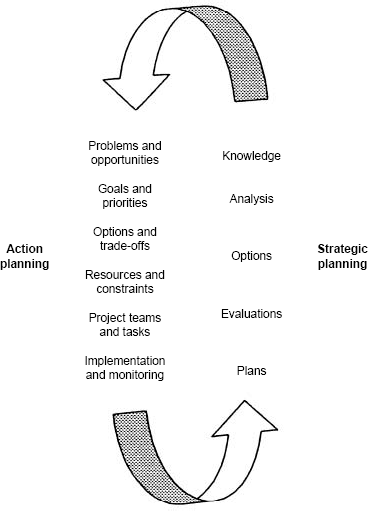
Finally, planning routines today still favour a policy design - project development cycle on the continued assumption that ‘good’ policies make good projects and programmes. Information gathering, needs assessments and programme evaluation remain dominantly a top-down process conducted by ‘outsiders’. Information/lessons learned at the local level inform strategic planning on an ad hoc basis at best. In reversing the cycle and building local capabilities in project design implementation and management—self-assessment of needs, participatory appraisal, community action planning—are important tools. Both the project cycle itself, as well as relationships between stakeholders need to be re-thought. Figure 1 illustrates the project cycle.