

By employing the innovative approach of community participation, road building and maintenance can more successfully meet the needs of the target population. To this end, WSP International Management Consulting has pioneered new and practical ways of involving local communities by promoting their ‘ownership’ at each stage of the project cycle—planning, design, construction and maintenance. This paper describes how, in Uganda, this innovation has proved itself, taken root and entered the mainstream.
1. INTRODUCTION
WSP International Management Consulting (WSPimc) has pioneered new and practical ways of involving local people and communities, not just in the construction of roads, but in their planning, management and maintenance. This has meant, not only that the roads more closely meet the needs of their target populations, but that they are maintained regularly after construction.
By establishing that roads can be ‘owned’ by the people who build, use and look after them, it is possible to start to reverse the decades-long waste of resources that have been invested in African highways by aid donors and governments: decades in which roads have steadily deteriorated until, in some cases they have had to be replaced from scratch–sometimes more than once–at enormous capital cost.
The thrust of our approach, which we have developed in close collaboration with our clients Department for International Development (DFID), is that a new road should as far as possible be a locally owned resource, rather than one provided by a remote Ministry of Works. To achieve this, it has been necessary to turn some conventional methods of cost-effective highway engineering on their heads, and involve local people, with little or no technical knowledge, in each stage of the project cycle–planning, design, construction and maintenance.
2. THE PROJECT
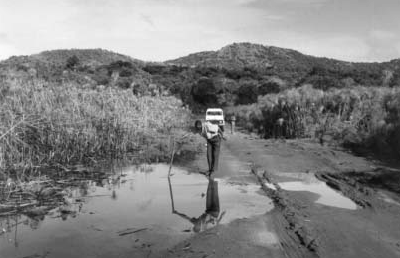
The Western Uganda Road Maintenance Capacity Building Project, funded by DFID and the Ugandan Government, started in June 1996 and is currently due to finish in 2001. Its core output is the rehabilitation of 1600 km of gravel road with its associated bridges and culverts. For Uganda it is one major element of a nationwide multi-donor programme to re-equip the country with a modern highway infrastructure after the depredations and neglect of the last 20 years (Fig. 1). For the consultants, it is a successful example of the use of construction and social development techniques which we have recently developed on projects in Asia and elsewhere in Africa.
This is, essentially, a capacity building project, and as such the social dimension assumes pivotal importance in creating a context of informed public participation within which the highway engineering work is carried out.
3. THE APPROACH: COMMUNITY PARTICIPATION
Previously, community participation in infrastructure projects was often limited to awareness-creation programmes in the post-construction period. More recently, the consultants have been among the pioneers of community participation in infrastructure development in which communities play a vital role from project conception, through planning, priority-setting and design, to implementation and–most crucially–into operation and maintenance.
WSPimc's experience in helping organisations and groups around the world to manage changes to their operating environment has shown that those affected must be involved in the process. This requires a mechanism for good communications so that those involved can develop a sense of ownership of any plans made, which encourages their commitment to its successful implementation. However, there was no avenue for discussions between the community in Western Uganda and the Ministry of Works, Housing and Communications (MoWHC), whose culture was that of a monopoly supplier in which there was no place for public consultation.
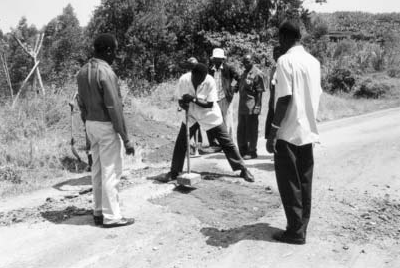
In this project, the consultant's engineering team identified the road rehabilitation and maintenance technologies that would most effectively provide employment opportunities for the population (Fig. 2). But it was the role of the consultant's social development team to introduce and explain to the communities the range of their potential involvement in the planning, design, implementation and maintenance of the project, and in doing so to assess the communities' willingness to participate. The team also opened discussions with local councils, NGOs and churches, to encourage them to act as partners in development, along with the Ministry, the formal owner of the road project.
As part of the social development process, the consultants investigated activities that would allow women to develop their potential and increase their contribution to the economy. A gender analysis, to highlight the differences in the male and female social roles, illustrated the constraints faced by women in participating in developmental activities. Project construction and maintenance work was then planned in such a way as to minimise the effects of these constraints and, where possible, open new employment avenues for the marginalised role of women as this can have a direct impact on the welfare of families in the rural communities.
Training needs were also identified, particularly for training that would directly support community involvement in the project, and hence the project's sustainability. Training in the planning and management of this new type of project was given to MoWHC staff, and to local council representatives. Technical and managerial training was also given to small local contractors to improve their knowledge and skills in the commercial, technical and management aspects of undertaking road improvement contracts.
4. ROADS COMMITTEES: SUCCESSFUL AGENTS OF CHANGE
In order to pull together, and institutionalise the myriad initiatives of consultation and cooperation between the Ministry and representatives of the local people, the consultants set up project-specific road committees (RCs) at sub-county level. These were chaired by the equivalent of a district councillor, and consisted of the chairpersons of all of the village and parish councils within the zone of influence of the road, two women's representatives, one youth representative and representatives of transport companies. Also co-opted were officials from other relevant ministries (e.g. the district forest officer, if the road passed through a forest).
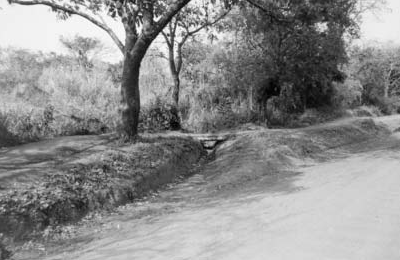
The Ministry and the consultant's staff conducted one-day workshops with all the RCs to introduce the coming road project and to discuss its implications for them: for example, employment opportunities; land required for road reserves; access to borrow pits; the importance of drainage; road safety. Site visits, hosted by the Ministry, were then made along the alignment with RC representatives and the contractor. The first visit was made prior to construction, and later visits were made during and following completion. These visits enabled local people to propose, and achieve, minor amendments to design and layout (Fig. 3). This might, for instance, include provision of parking space next to a roadside market.
The site visits also helped contractors in their relations with the community from which much of their labour would come, and also assisted in locating sources of road building materials. And they were beneficial to the Ministry which could be seen as more responsive and accountable to local residents who are government tax payers and who are increasingly aware of that fact.
During the course of construction, the consultants held a series of road impact workshops for RCs and the Ministry. Assessing and publicising the positive economic and social changes brought about by the road reinforced an understanding in local communities of the importance of maintaining the road. Local leaders became more proactive in the matter and liaised more confidently on road maintenance management with the Ministry.
Consciousness of the benefits of road construction was extended, through these workshops, to an understanding of the way benefits were distributed. Clearly, villages further away from the alignment derived less immediate benefit from improved transportation on the main road. The response of some village communities was to improve their access to the main road through funding and constructing their own community access roads, using skills developed on the project. This brought the benefits of improved transportation into the remoter areas and improved their access to the services they valued (e.g. health clinics and schools).
5. BENEFITS AND PROSPECTS
The process of consultation between Ministry, consultants and local community, with the RCs as the main focus of consultation and feedback, has led to an open, developing project, which has changed during the course of implementation, the better to respond to local needs on a long-term basis.
The proportion of sustainable labour-based, as opposed to foreign dependent machine-based, construction work has increased. The number of women employed in construction has increased radically, and has now reached 30%. These changes have increased the incomes of local people, and have given large numbers of women the beginnings of financial autonomy.
There have been improvements in project design: parking to serve markets, minor alignment changes, construction of additional village roads linking communities to the main road.
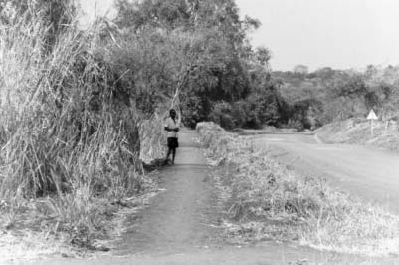
The number of children walking to school was increasing as a result of the British Government's support for Universal Primary Education in Uganda and a potential problem arose when it was realised that the number of accidents involving children on the project's newly improved, and hence faster, roads was escalating. Road safety, and awareness of its importance, therefore became a significant component of the project and has improved substantially. This included a programme of training in schools and the use in schools and public places of posters and flip-charts showing common traffic hazards faced by children. This has led to an increased provision of footpaths beside the main road, constructed by the community using local resources, segregating pedestrian and motorised traffic at danger spots such as sharp bends, schools and roadside markets (Fig. 4).
The road committees have also served as evidence to the community of devolved governance in Uganda, allowing and encouraging local people's involvement in making decisions which affect their environment–once the preserve of central government alone.
Initially sceptical, the Ministry–who did not appreciate the concept of the public as the client for their services–has now adopted the new approach. It has seen how a project can be improved at the planning and design stages, facilitated at the construction stage, and sustained by better maintenance throughout its life if the public are treated as partners in it. Accordingly, the Ministry has now directed that road committees be established and resourced throughout Uganda and the consultants have been engaged to train their district engineers in how to set up RCs and work with them.
By providing resources to facilitate community participation, the government was able to ensure that the scheme was not seen simply as a means of passing on responsibility. The scheme was viewed as good governance in the devolution of the decision-making process. The main problem in the implementation of the scheme was finding an appropriate mechanism for communication between the community and the government ministry that held responsibility. The road committees initiated and run by the consultants provided a way of ensuring that this communication took place. These proved such a success that they are being implemented as an ongoing method for communication, each party finding a benefit in their continued operation.
The innovation has proved itself, taken root, and entered the mainstream.

