

Since the late 1990s, many of the larger French cities have been showing keen interest in tramway systems, partly because the public have a much better perception of trams than buses. Therefore one of the challenges for the Irisbus design team was to develop a vehicle which had the on-road flexibility of a bus but the style and image of a tram. It would offer a high quality of ride at a lower capital cost. The outcome was the CIVIS transport system which is based on a totally new vehicle fitted with the Siemens Transportation Systems optical guidance. A transport system with the new vehicles can be installed for a third of the cost of a tramway of comparable capacity. There is minimal disruption to streets while necessary infrastructure, such as raised kerbs and the guidance marking on the road surface, are installed. This paper describes the design of the new optically guided vehicles, the associated infrastructure, manufacturing details, and current and future scenario for their operation.
1. INTRODUCTION
It is widely recognised that bus routes can benefit by being converted into quality bus corridors with dedicated lanes and traffic-light priority. This applies to major routes within mediumsize cities with populations of 150 000–300 000, or routes connecting suburbs of larger cities (populations over 300 000). These routes usually carry from 1000 to 3000 passengers per hour and per direction at peak hour.
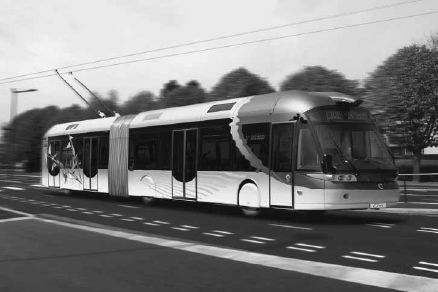
Since the late 1990s, many of the larger French cities have been showing keen interest in tramway systems, partly because the public have a much better perception of trams than buses. Therefore one of the challenges for the Irisbus design team was to develop a vehicle which had the on-road flexibility of a bus but the style and image of a tram. It would offer a high quality of ride at a lower capital cost. The outcome was the CIVIS transport system which is based on a totally new vehicle fitted with the Siemens Transportation Systems optical guidance (Fig. 1). A transport system with the new vehicles can be installed for a third of the cost of a tramway of comparable capacity. There is minimal disruption to streets while necessary infrastructure, such as raised kerbs and the guidance marking on the road surface, are installed.
2. PASSENGER COMPARTMENT
This section describes the main design elements of the new CIVIS system. The main entrance doors are electrically operated. The twinleaf doors open outwards and sit very close to the side of the body. One of the benefits of the optical guidance system is that the bus-stop kerbs can be specially profiled, and buses can park so close to them that there is practically no gap. However, for non-optically guided vehicles, there are the usual options of kneeling suspension and ramps.
Internally, the new vehicle is very spacious. There is good visibility for passengers through the large main side windows. Additionally, several skylights located in the roof along the vehicle provide natural light inside, through which passengers can appreciate the architecture of the city. Because there is no conventional axle, the low floor height is maintained between the rear wheels. (See Fig. 2.)
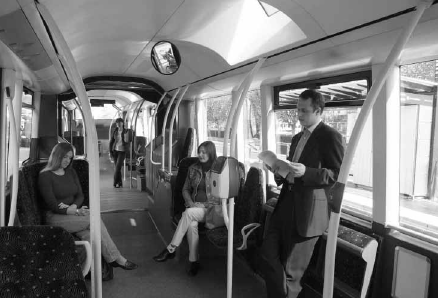
Life on board, featuring integral low floor, wide aisle, bright windows, skylights
Life on board, featuring integral low floor, wide aisle, bright windows, skylights
The driver can either be located in the conventional manner, offset to one side of the vehicle, or the front end can be extended to provide a tram-style central driving position. This will only work with fare collection systems that do not need to be supervised by the driver, but styling of this option is more akin to a tram than a bus.
3. ACCESSIBILITY
Siemens Transportation Systems, who developed the optical guidance, is a partner of the new vehicle programme. The optical guidance system works as follows: a camera, mounted on the front of the vehicle, follows parallel intermittent lines that are painted on the road surface and automatically controls the steering.
The system is extremely accurate. The new vehicle can be parked within 5 cm of a kerb that is compatible with the floor height of the vehicle. This means that passengers can get on and off the vehicle very quickly, minimising the time spent at stops. It is also an ideal arrangement for those in wheelchairs, mothers with buggies, and other users who are not fully mobile (Fig. 3).
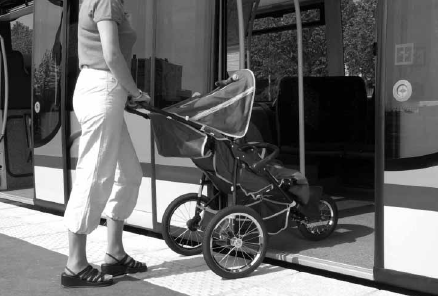
The guidance system is used principally to park the vehicle close to the kerb, but can also help the vehicle to ride smoothly on bends without noise or vibrations and therefore provide comfort to passengers. The driver can override the system at any time, for instance in an emergency, when another vehicle encroaches into the path of the bus.
The guidance system is optional. When it is not fitted, the vehicle is known as CRISTALIS.
4. INFRASTRUCTURE
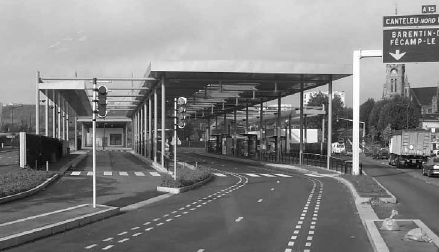
Recent French projects are designed on a ‘façade-to-façade’ concept. This urban design includes pedestrian areas, parking facilities, bike track, dedicated lanes and planting, with traffic-light priority and fully equipped stations instead of bus stops.
Thanks to the accurate docking, the station platform can be raised up to 27 cm (or 21 cm when the vehicle is kneeled), to provide accessibility to every user. The load-bearing capacity of the track is designed as for conventional heavy-duty bus lanes. The position of the dotted lines representing the guided track is precisely calculated to provide optimum comfort according to speed and radius in curves. The dots are painted on the tarmac with conventional road paint. (See Fig. 4.)
The cost of a comprehensive CIVIS transport project based on the new vehicles is £3–5 million per kilometre, including rolling stock, guidance, dedicated lanes, stations, information system, overhead lines and substations when applicable.
5. ELECTRIC DRIVELINE
Irisbus has developed an electric drive axle using electric motors from Alstom that produce a peak power of 80 kW, installed within special wheels designed by Michelin. The tread of the extra-wide super-single tyre is narrower than the combined width of normal twin tyres on a drive axle. This enables the electric motor to fit right inside the hub, giving a wide interior gangway, with more than enough room for wheelchair users or for people to pass each other in the area between the rear wheels: 860 mm in the new vehicle instead of 550 mm in a bus.
The new vehicle uses two electric hub motors on a normal two-axle vehicle. On an articulated model, there are two motors on the drive axle of the front unit, and another two on the trailer axle.
Because they run on public roads, the optically-guided version and non-guided version comply with construction and use regulations, like all other city buses. Two substantially different types of drive systems are available.
Most of the early non-guided vehicles were ordered in trolleybus configuration with overhead power supply. This version can be provided with an auxiliary engine driving a generator, so that the vehicle can move off-wire in a depot or divert round roadworks. The second option is a diesel-electric drive system. A 225 kW Iveco Cursor engine, to Euro 3 emission standards, powers a generator that provides current to the Alstom wheel hub motors.
6. MANUFACTURING
The chassis of each vehicle receives a full anti-corrosion immersion treatment (cataphoresis). The body structure is modular, with the two sides, front and rear ends, and roof all constructed as separate sub-assemblies. They are built complete with glazing and wiring and late in the production process, bolted to the chassis and to each other. The structural members are of stainless steel. The main side framing is very substantial, partly because of the integral low floor architecture and partly because most of the ancillary services are carried at roof level. One of the features carried over from the conventional bus range is the use of main side panels made of a fibreglass material. The lower panels are easy to remove for repair in the event of minor bumps and scrapes.
The vehicle factory is based at Rorthais in the mid-west of France, near to Nantes. The company has also built a test track next to its main entrance. The main oval track is nearly 1 km long, and equipped with overhead wiring. There are also test gradients and curves in the central area.
7. WHERE IS IT IN OPERATION?
CIVIS optically guided buses have been ordered for, or are already operating in, several locations.
In 2003 the city of Clermont-Ferrand, in France began operating six diesel-electric CIVIS with central drive. These will supplement the six guided Agora articulated buses, which have been in operation since 2001.
Ten diesel-electric CIVIS are being delivered to Las Vegas, USA to operate a rapid transit route opening in the spring of 2004.
The Agglomeration of Rouen, France started using the Irisbus system two years ago by developing dedicated lanes for two new vehicles (pre-series) and 38 guided Agora articulated buses. To date, the guided vehicles have clocked over 3 million km with 2·5 million dockings in guided mode. In the mean time, between 2001 and 2003, patronage increased by 25%. The project named TEOR (Transport Est–Ouest Rouen) will be extended to 2006 in the city centre, with the addition of more guided vehicles.
The City of Bologna, Italy has also chosen the new vehicle to create a comprehensive public transport network based on the fully electric version: 49 vehicles serving 69 stations on 25 km. The total cost is €144 million or £4 million/km for a system much cheaper than light rail and less risky than rail-guided competitors.
The Irisbus transit system is also fully approved by the French Department of Transport for both the new vehicles and guided Agoras and for both clients Clermont-Ferrand and Rouen. The ‘authorisation to operate’ was granted in each case after inspection of the safety studies and tests carried out by Irisbus and Siemens TS.
8. THE FUTURE
To date, 200 vehicles using the electric driveline and hub motors are either in service or on order, 140 of which are optically guided.
The need for such systems will increase during the coming years because
financing tramway lines becomes difficult with decreasing state subsidies
congestion and lack of space mean converting bus routes in quality bus corridors is an affordable target
electric power provided by a twin overhead line is cleaner, and uses proven technology.

