

1. INTRODUCTION
This introductory commentary provides an insight into the issues facing the future of major sporting events, the communities that host them and the key stakeholders who bring the vision to life.
The technical application from a wide variety of industry sectors must be harnessed in order to deliver a successful major event and inevitably achieve a positive impact from an economic, social/cultural, infrastructure and environmental perspective for the host city, region or country. In so doing it is the long term strategy of the host that each partner to that process should be cognisant of.
The process of bidding, planning and hosting modern major events is complex. Major events are dynamic projects that contain inherent risks which few other large-scale projects encounter and many of these need to be dealt with concurrently. This is not to say that projects of regional and national significance do not face the same or a similar risk profile to that of a local organising committee (LOC), rather the immovable time-bound nature of such events provide a continual external pressure which the LOC must adhere to and tailor its decision-making around.
2. EVENT STRATEGY
Very few cities in the world have truly understood the extraordinary benefits that such events can provide. Perhaps the real issue in this relatively new industry sector of major/mega events lies with the lack of longitudinal data on how the successful cities, regions and countries have thought about their major event strategy.
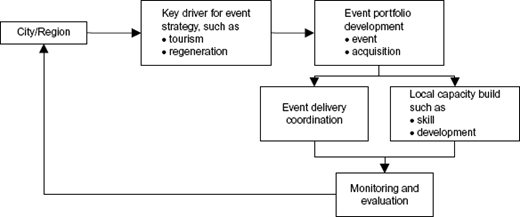
An event that runs in isolation provides limited long-term benefits to the host. In contrast a well-structured and thought through event strategy, if realistic, can help to achieve key outcomes that policy makers endeavour to implement longitudinally. Therefore a holistic event strategy should look to address the process depicted in Fig. 1.
Anecdotal evidence suggests that many cities that bid for major events tend to do so in isolation of their medium- and long-term objectives and as a result two key outcomes typically arise.
Long-term benefits, normally termed legacy, do not materialise.
In many cases, the event itself does not meet community expectations.
The core rationale given invariably relates to budget constraints. However the issues are far more complex with the time-bound pressures imposed on the LOC, often taking precedent over adequate strategic planning in order to provide these two aforementioned outcomes. It is this strategic planning throughout the bid phase that poses the greatest risk to this niche global sector.1 The key is in developing a strategy which the community can engage with, provides long-term benefits both socially and economically, and can cope with a visitation spike throughout the event period itself. It is during the bid phase that the community has its greatest input to the planning phase and therefore what budgetary resources are required. Once an LOC is established the community consultation process has limited impact on major event planning as operational deliverables are already established.
It is important to reflect on how the civil engineering community can help to address this situation and how, as a profession, it can influence the communities in which engineering work is undertaken, ensuring that major events can be utilised to their maximum effect.
2.1. Case studies
The following two case studies provide context on how each have addressed their respective long term event strategies
a city with a population of 4 million, located in Australia
a city located in the northern hemisphere with a similar population.
2.1.1. Case 1: Melbourne, Victoria, Australia
Australia is a regional and isolated country with vast travel times required from its nearest international port. All cities in Australia therefore are constantly looking for ways to create ‘destination’ travel opportunities and differentiate themselves from one another. One city that has successfully established this through major events is Melbourne, Victoria.
When Melbourne embarked on its events strategy in the late 1980s it began to lead the way in bidding for, and ultimately hosting, major international events. Melbourne's unsuccessful bid for the 1996 summer Olympic Games spawned the creation of a separate events company wholly owned by the Victorian government. This company had a defined remit to bid for and acquire events that would provide direct tourism impact and international exposure for Victoria.
It was decided that a mixture of annual ‘blockbuster’ events was required along with a mixture of other ‘one-off’ opportunities; Victoria now plays host to the annual tennis grand slam, Formula 1 grand prix and other regular blockbuster events.
In order to support this tourism strategy a consolidation of the city's infrastructure was undertaken. This developed a ‘whole of government’ approach to hosting such events. Over the subsequent 15 years Victoria has seen investment in transportation infrastructure including air, rail, light rail and roads, sporting and community infrastructure and security monitoring, all of which have contributed to the long-term sustainability of the state's destination agenda.
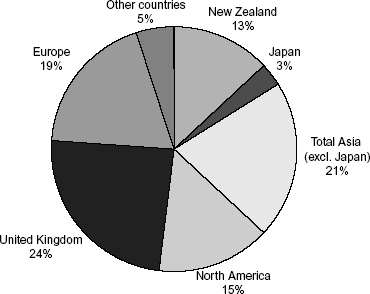
A study undertaken by Tourism Victoria for the year ending December 2005 indicates the significance of major events to the state.2 Approximately 281 000 international visitors travelled to Victoria for major events in 2005 accounting for almost 10 million bed nights, representing 21% of all international visitors to the state. Domestic event visitation represented a further 3·8 million bed nights.
A picture of the international visitor breakdown is detailed in Fig. 2.
Overall Victoria used major events to achieve its tourism destination objectives through the hosting of major events, with these events contributing significantly to the civil infrastructure of the city as a whole and its reputation as one of the world's leading event cities.
2.1.2. Case 2: Manchester, north-west England, UK
Greater Manchester is similar in population to Victoria but does not face the same destination issues that Australia faces. Whereas Manchester was once a prominent boom town of the Industrial Revolution it slumped into a long period of decline. The city has leveraged its events strategy as a centrepiece for regeneration throughout the city centre and surrounding communities, and like Melbourne has also benefited from related tourism.
Manchester was also an unsuccessful bidder for the 1996 summer Olympic Games, and again for the 2000 games. From this bid experience the city, like Melbourne, initiated a long-term event strategy that would facilitate the creation of opportunities for social, and therefore civil, infrastructure regeneration.
With the successful bid for the 2002 Commonwealth Games, the opportunity to regenerate what is now known as SportCity provided the impetus for the city to initiate its long-term event strategy. As the brainchild of Sir Howard Bernstein, the chief executive officer of the city, Manchester has seen great improvement in its airport, a new train station and excellent sporting and leisure facilities as a result of its long-term event strategy. Importantly all are commercially viable as stand-alone business units.
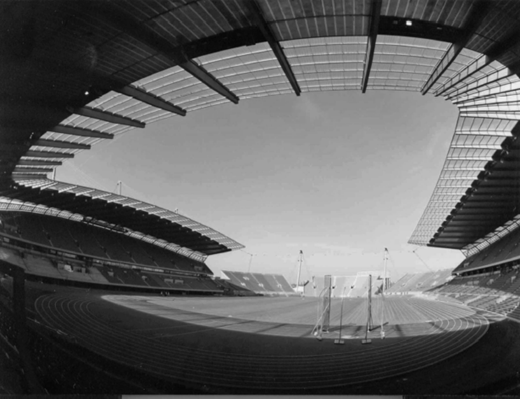
Bernstein understood that he needed to engender a culture of partnership within the city and Greater Manchester in order for the regeneration to be successful. Through partnerships with the airport authority, Manchester City Football Club and the University of Manchester, the city has not only created a catalyst for physical regeneration it has also focused on sporting and cultural events that help to ensure social regeneration. Throughout the planning phase of these sporting facilities particular attention was given to the financial viability and therefore usage/programming in the long term. Following the 2002 Commonwealth Games the main athletics stadium was converted to a football stadium in which Manchester City remains the long-term tenant (Fig. 3) and the University of Manchester and the city council jointly own the aquatics centre to ensure maximum community usage.
Following the 2002 Commonwealth Games in Manchester the main athletics stadium was converted to a football stadium (photo courtesy University of Manchester)
Following the 2002 Commonwealth Games in Manchester the main athletics stadium was converted to a football stadium (photo courtesy University of Manchester)
3. CONCLUSION
These are two clear examples of a successful major events strategy that has been carefully planned and executed by policy makers. While the environments and context vastly differ, with the cities being almost a world apart, there are two clear and consistent themes to their success
each major event was only a step on the way to achieving their end point
their end goal was very clear and focused.
Both have now benefited from major civil infrastructure works that are sustainable policy-driven strategies in the long term, and much can be learnt from further exploring these two case examples.
The civil engineering community can and in many cases already does play a significant role in the master planning for such strategies. In particular the civil engineering community helps ensure that major projects can be constructed on time and within budget, and contributes to the design of major infrastructure development to ensure sustainable usage and high environmental standards for beyond the event delivery window, helping maximise the overall legacy benefits.

