Nothing begins with science; it all begins with stories (Sinclair and LaPlante, 2019)
Introduction
As I began to write this, I had just returned from a two-week European holiday that confirmed my personal dislike for mass and over-tourism. This may be difficult for an events and tourism academic in a business school, but that's my truth! I saw my discomfort reflected in protests against mass tourism in popular destinations like Venice, Paris and Porto, where I too had been. There has also been a growing reaction against short-term rentals that I have also used, mass tourism and overtourism (Milano et al., 2024). So, I'm part of the problem, but hopefully part of the solution.
As I reflected upon my own personal tourism experiences, some questions came to mind,
How do my teaching and research of tourism, hospitality and events (THE) impact my personal THE choices and experiences, and vice-versa?
How has the academy explored their own THE experiences as themes like co-creation, codesign and memorable personal experiences have grown in importance in the literature? (Elshaer and Marzouk, 2024)
Another influencing factor upon my reflections is that I had some doctoral students exploring using autoethnography in part because they were natural storytellers and reflective but also because their own personal work experiences are rich in data relevant to their research foci. To support their journeys, I was looking for resources to help guide their reflective journeys.
Thus, this article provides a beginner's guide to autoethnography for those interested in beginning to critically and reflexively explore their personal experiences. This addresses the “what”, “why” and “how” of autoethnography, followed by a creative synthesis of an autoethnographic journey represented by a map. To further demonstrate the “how”, I will use a technique I used in my doctoral thesis (Dickson, 2003) to differentiate my reflections from the extant research and theory and to “invert” the hegemony. I do this by putting my reflections in the more dominant left-aligned text, with the “theory” subordinated by being right-aligned. This may help with seeing the “conversation” you are having with the literature, almost like the script from two actors in a play.
However, given what triggered these reflections, I firstly want to understand how common it is to see autoethnography used in THE research in contrast to some common quantitative methods that were chosen for illustrative purposes.
What I observe about the bulk of THE research has little about the personal, especially of the author, and more about mass or collective tourism experiences. To interrogate my observations, I conducted a brief systematic review before delving into the depths of autoethnography.
A brief systematic review
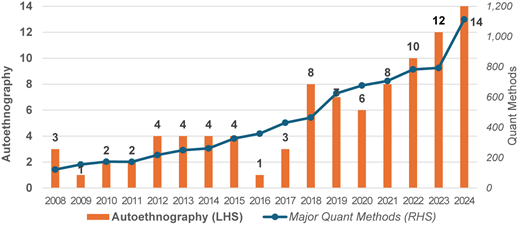
A Google Scholar search of publications from 2008 to 2024 (where 2024 was the last full year) revealed 736 publications that referred to autoethnography anywhere in the article and where the sources included tourism, hospitality or events in the title (Table 1). The search string was “autoethnography” (source: tourism OR source: hospitality OR source: event). To explore the use of popular quantitative methods, the following search string was used ((“factor analysis” OR regression OR segmentation OR “discrete choice” OR “structural equation”) (source: tourism OR source: hospitality OR source: event)). In stark contrast, this search revealed over 22,700 publications.
To narrow the search, a Scopus document search of the fields, article titles, abstracts and keywords was conducted of documents with the same search terms (Table 1 and Figure 1). The search query was ((SRCTITLE((tourism OR hospitality OR event)) AND TITLE-ABS-KEY (autoethnograph*) AND LANGUAGE (English)) AND PUBYEAR >2007 AND PUBYEAR <2025).
This search revealed 124 documents. Most were articles (n = 89, across 33 journals), followed by book chapters (n = 27) and then books (n = 3). The majority originated from Australia (n = 35), the UK (n = 24) and then the USA (n = 19). In contrast, the broader quantitative methods terms identified with this search query ((SRCTITLE ((tourism OR hospitality OR event)) AND TITLEABS-KEY (“factor analysis” OR regression OR segmentation OR “discrete choice” OR “structural equation”) AND LANGUAGE (English)) AND PUBYEAR >2007 AND PUBYEAR <2025) revealed 8,243 documents. Limiting the search to journal articles revealed 93 using autoethnography and 7,634 using some common quantitative methods (Table 1).
Focusing on the journal articles, Figure 1 demonstrates the sustained growth in the use of this selection of quantitative methods (chosen for illustrative purposes). When compared to the more erratic, though slowly increasing, growth in the use of autoethnography, there is a similar trend that reflects the growth in THE titles, but quantitative methods still dominate.
Autoethnography: what, why and how
What is autoethnography?
Having looked at the use of autoethnography, it makes sense to unpack what we understand autoethnography to be. The following shows the evolving understandings and the variety of uses.
Autoethnography is a blend of the auto (self), the enthno (culture) and the graphy (research/writing), where the emphasis across these three may vary between autoethnographies (Banks and Banks, 2000; Ellis and Bochner, 2000).
The ”auto” emphasises the researcher’s voice and experiences (Bali, 2020), not in any self-indulgent way, but rather to help to understand the “enthno” or socio-cultural. With a socioecological frame in mind, as the researcher looks at their micro, or their self, their aim is to explore the interconnections with the meso and/or the macro (Bali, 2020; Adams et al., 2021).
Something that may confuse those new to autoethnography is that it has been variously referred to as a paradigm, a methodology and a method. For those seeking to employ authoethnography and be convincing to potential readers, reviewers and examiners, it still remains important to be clear about your “ologies” and where your research is situated (Rehman and Alharthi, 2016; Brown and Dueñas, 2020).
As autoethnography has evolved it has been considered an epistemology (Wall, 2006), a methodology (e.g. Cooper and Lilyea, 2022; Tarisayi, 2023; Doan and Darcy, 2024) and a qualitative research method (e.g. Chang, 2008; Teoh et al., 2023; Trifan et al., 2024; Orel, 2024). Further, it has also been referred to as a paradigm (e.g. Allen, 2015; Kafar, 2021), a process, and a product (e.g. Ellis et al., 2011).
Through reading more recent autoethnographic research, you see a growing array of research questions. Examples from THE include,
How is an Asian solo male travelling mobility conceptualised? (Tham, 2020, p. 458)
How might a man and woman outdoor leaders' perceptions of an outdoor adventure education backcountry excursion resemble or differ from one another? (Kennedy and Parker, 2023, p. 4)
What is the role of culture in co-created transformative experiences? (Teoh et al., 2023, p. 4)
Autoethnography's continuing evolution has also resulted in many more approaches (Hughes and Pennington, 2017). Of these, my Ph.D. would now be referred to as evocative.
In 2011 Doloriert and Sambrook (2011) noted three epistemological positions that autoethnography has taken: an emotional evocative and interpretivist position, an analytical realism, and finally a postmodern political radical, or polemical, approach (see also Atherton, 2023). Adams and Hermann (Adams and Herrmann, 2020, p. 3) also noted a variety of approaches that reflect the various epistemological positions identified by Doloriert and Sambrook (2011), “analytical, evocative, critical, performance, indigenous, blackgirl, community, collaborative, exo-autoethnography, Black feminist, auto-archeology, autocritography”. Further, Hughes and Pennington suggest additional types of autoethnography including, co-constructed, community, critical co-constructed, estrangement, interactive interviews, interpretive, meta and mini. (Hughes and Pennington, 2017)
Given the above, I do not just refer to autoethnography as a method. Apart from being an oversimplification, it is also because autoethnography has evolved the data sources that inform the method selection and have also expanded from the individual (or self-data), often using journaling or field and memory work, through to many other methods and sources.
O'Hara (2018, p. 16) noted that “data” may also include “diaries, blogs, podcasts, or drawings”. This means that autoethnographies may use a mixture of methods, quantitative and qualitative, data sources, and analytical methods, not just reflexive writing or narrative inquiry (Herrmann, 2022; Neil, 2023).
Why autoethnography?
Tarisayi (2023, p. 58) says that the strengths of autoethnography include “thick insider descriptions … access to obscured social worlds; disrupting colonial research power hierarchies; [and] fostering researcher reflexivity”. As a method and methodology this may also contribute to a broader drive to make transparent, and move beyond, the researcher’s privileges and biases that are often linked to the dominant colonial and Western research traditions (Wilson and Hollinshead, 2015; Tarisayi, 2023).
My autoethnographic “turn” began around 2000 as I struggled to pin down my doctoral research frame and methods. I was exposed to the possibility that my lived experience, my own voice, could be part of my research, part of my journey (Ellis and Flaherty, 1992). But how to make one person's story, the “auto”, be made an acceptable approach for a doctoral thesis?
At that time, autoethnography was just emerging in social science research, only beginning to be accepted, especially guided by Ellis and Bochner (2000) in the “survival guide” for new qualitative researchers, Denzin and Lincoln's Handbook of Qualitative Research (2000). But how do I start?
How to do autoethnography?
In autoethnography the researcher needs to remain focused upon the three parts, the “auto” or I; the “ethno” or socio-cultural context; and the “graphy” or final autoethnographic product (Cooper and Lilyea, 2022).
From my own adventure in my autoethnographic learning journey, I would first recommend reading a range of examples in different styles, voices and diverse topics. As you do, write/record, reflect and write/record again to practice and develop your own autoethnographic method, voice and style, e.g.
How do you feel as you read, listen to, or look at autoethnographies? Note your emotions and thoughts. Let yourself be open and raw. Later you may edit this for others to see.
What stories of your own come to mind as you read autoethnographies?
What do you think is guiding your reaction to these stories, e.g. your cultural background, your academic disciplinary training, your emotional energy today? Consider your “positionality” (e.g. Gani and Khan, 2024).
From your reading, which autoethnographic approaches do you feel most interested in pursuing?
Note when, where and how your reflections come to mind to reveal your preferences regarding time and place. How can you recreate these “spaces” to facilitate and enhance your reflective processes?
Also, start unpacking and interrogating your research question, e.g.
What has triggered my interest in this research topic? e.g. work, a learning experience, other research …
What do I find interesting about this research topic?
What other questions come to mind as I reflect upon this topic/journey?
For those new to autoethnography, a place to start may be to reflect upon your own work. An example for teachers, researchers and academics could be,
What internal/external influences are shaping my teaching and/or research?
Don't wait to start recording your thoughts. Unlike a typically academic piece, your “data collection” begins straight away (even before you formally began) via your own thoughts, reflections and writing. This may occur as you watch a movie, read an article, listen in a conference, talk with friends and in many other places and spaces where your thinking, reflecting and learning are triggered.
At first, when I had no idea what I “should” write, or where it would go, my writing and reflections were stilted, often feeling forced. Then I began to link those reflections to extant research as one data source and then also unstructured interviews with colleagues. This helped to explore the second aspect of the autoethnography, the “ethno” or the broader social and cultural meaning.
At times, these other data sources were accessed months, if not years later (the joys of a part-time Ph.D.). Slowly, a story or narrative about the broader meanings began to emerge. To draw these ideas and themes together, I used a mind map, a visual tool, that helped me literally see other potential connections between themes that I was missing as I read my written words.
A side note on what it means to be reflexive
As a student, facilitator, teacher, lecturer and researcher, I know that not everyone is naturally able to reflect upon their experience. Some reflect easily, while others really struggle. Reflection goes to another level of challenge when, as autoethnographers, you have to be reflexive. However, often people use reflexive and critical reflection interchangeably (D'cruz et al., 2007).
Koopman et al. (2020, p. 1) suggested that reflexivity is the “process of a continual internal dialogue and critical self-evaluation of researchers” positionality … [that compels the researcher] to confront the choices we make regarding the research question, the people we involve in the research process, and the multiple identities that we bring and create in the research setting.
For me, being reflective and reflexive doesn't happen on demand. I need to be in the right mood and physical space and with enough “brain space” for different ideas to rattle around and make connections. Stress and busyness are terrible for my reflections, as are quiet spaces like libraries. However, when the time is right, ideas flow more freely. In my Ph.D. journey, I was recording thoughts and reflections in a handwritten journal, but often thoughts would come to mind while I drove (not so good for handwriting!). Voice memos didn't work for me, but I know they work for others. Typing also wasn't great for me because I'm not a touch typist, and I was constantly going back to edit the words, which stopped the ideas rather than letting thoughts flow, hence handwriting. Handwritten journals also allowed me to draw models or figures, to go back and make more notes and to reflect as I wrote. I still use handwritten journals, as I like the visual and kinaesthetic aspects of writing and note-taking.
As in other research, just collecting data is not enough. Analysis and synthesis are essential. How you analyse it will depend upon the type of data, such as coding of text, thematic analysis, visual images, etc. (e.g. Leung, 2021; Maydell, 2010; Cooper and Lilyea, 2022). As a beginner's guide, it is beyond the scope of this article to expand more. However, your reading of autoethnography examples will also give insight into how to analyse your data relative to the methods you choose.
Thus, my simple definition of reflexive is reflections upon your reflections, for example,
What is there about the timing and context of my reflections that makes reflecting seem easy for me in certain times, spaces and places?
In my Ph.D., this question led me to literature on urban geography.
How do I walk my talk to encourage reflection and reflexivity in and with colleagues and students?
How can I help co-create a safer space in my classes (e.g. socially, psychologically, academically, etc.) to support students trying to find their own reflective voice?
The “graphy”
Autoethnographies have always provided space for many ways to summarise and synthesise one's work. Thus, the final product, text or the “graphy” can be quite creative.
Autoethnographic “texts” may include, “short stories, poetry, fictions, novels, photographic essays, personal essays, journals, fragments and layered writing, and social science prose”. (Ellis and Bochner, 2000, p. 739). Recently, other autoethnography products have included art, podcasts and performances (Osvath, 2021; Neil, 2023).
Despite the unlimited opportunities, often you will see this as being more written words. This may reflect that the academy is still often dominated by the written word. But surely there is room for more innovative and creative ways, especially as we see the creative potential demonstrated in the expanding body of creative works posted online and in social media.
For me, when I did my Ph.D., I was exposed to the idea that the qualitative researcher may be a “bricoleur or maker of quilts who uses the aesthetic and material tools of his or her craft, deploying whatever strategies, methods, or empirical materials are at hand” (Denzin and Lincoln, 2000, p. 4). This triggered an idea of being more creative in my final “graphy”.
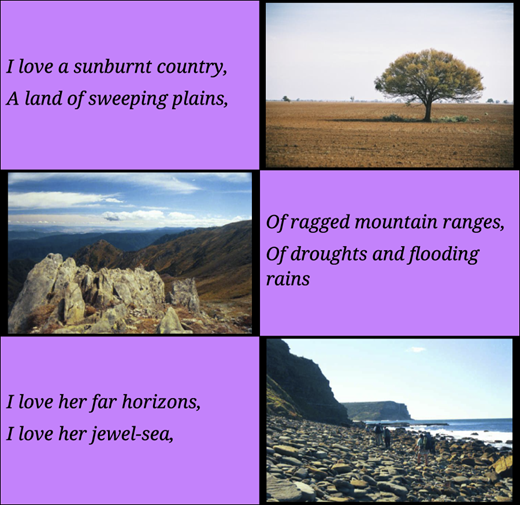
While my own Ph.D. journey of exploration and reflection included interviews, reflecting upon visual images in key documents/texts and a survey of university students (Dickson, 2003). My final product drew upon Dorothea Mackellar's poem My Country, whose words about her home country of Australia resonated with my insights on the “ethno”. I intertwined Mackellar's words with my own reflective photos, or visual data, taken over my Ph.D. journey that had spoken to my experience of reflective spaces and places across my learning journey (for example, see Figure 2).
Why not autoethnography?
In some ways, research located in more positivistic paradigms is personally easier, as the researcher can avoid revealing anything about herself. Autoethnography, in contrast, is not for the faint-hearted. It is based upon the researcher/writer being vulnerable, expressing emotion and, at times, self-disclosure that could be personally or professionally challenging (Pace, 2016; Holam Jones et al., 2013; Ellis, 2004). The researcher moves between being the object, subject and researcher. As such, you may choose to moderate what you reveal about yourself, but in doing so, do you risk sharing important “data” that helps support your insights and conclusions?
Further in an academic context if writing for peer reviewed journals or a thesis or class assignment, you are opening yourself up for criticism. While the final autoethnographic product is not actually you, the fact that you are revealing yourself through the final product, means any criticism can still hurt. This is also important when mandating autoethnographic or reflective activity for students (Doloriert and Sambrook, 2011).
Conclusion
In 1974, Zweig reminded us that the word adventure comes from the Latin, ad venio, which means “whatever comes” (Zweig, 1974). Thus, by definition, the outcome is unknown, much like a research journey (Dickson, 2004). So, as I conclude, another observation from my holiday comes to mind. The various commercial GPS apps I was using didn't always give the right directions or may not be have been able to adapt to some circumstances like “canyons” between tall buildings, roadwork detours and travelling down narrow country roads. These made for one adventure after another!
This is like the fact that the many research “guidebooks”, classes and articles don't always provide you with the answers you want about how to do your research now. Thus, how can I summarise an autoethnographic journey in a way that honours and models autoethnography, especially the more creative opportunities, but is still of use to new and emerging autoethnographers?
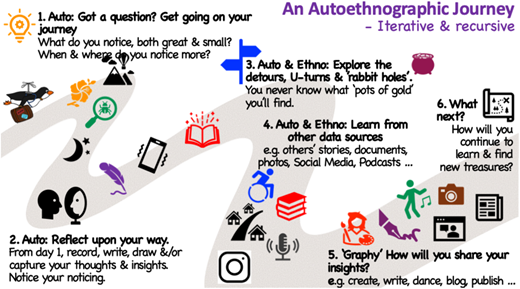
For those who know me, I often resort to images or models reflecting the visual preference in my learning, reflection and synthesis. I also have a tendency to use metaphors. I see using autoethnography, from learning about it and doing it, is like a journey. So, to draw together my thoughts and advice for those starting on their own autoethnography journey, rather than being a straightforward and uncomplicated journey, it may have many side roads, detours, attractions and rest stops along the way. So, here is a “map” that may help you orient yourself, then set a plan and then replan along your research journey … (see Figure 3).
The author thanks Kelly, Joseph and Rick for trusting her on their journeys.