This paper aims to explore the complexities of creating adaptive space in a healthcare system to develop integrated care programmes. It draws on the author’s experience as a senior clinical leader to analyse how adaptive processes emerged within a national reform initiative.
An analytic organisational autoethnography was undertaken, using multiple data sources including contemporaneous journals, organisational documents, artefacts and reflective dialogue with colleagues. Data were analysed abductively, using Arena and Uhl-Bien’s four dimensions of adaptive space (discovery, development, diffusion and disruption) as a guiding framework.
The analysis demonstrates how adaptive space was created through intentional bridging of clinical and operational domains, cultivation of knowledge-broker roles and development of relational connections within and beyond the organisation. These adaptive processes were fragile, contingent and often resisted, yet enabled innovation to surface and spread. The study shows how leadership practices of reflexivity, positional negotiation and boundary work shaped outcomes.
This paper contributes to debates on complexity leadership and organisational ethnography by offering a rare insider account of leading integrated care reform. It advances theoretical understanding of adaptive space as a dynamic social process and demonstrates the methodological value of analytic autoethnography for capturing the interplay between personal experience and organisational transformation.
Introduction
Healthcare systems are increasingly conceptualised as complex adaptive systems (CAS), characterised by non-linearity, emergent behaviour, and dynamic interdependence (Kannampallil et al., 2011; Rusoja et al., 2018; Churruca et al., 2019; Carroll, 2021). While complexity theory offers a compelling lens, its application in healthcare often remains superficial, with Greenhalgh and Papoutsi (2018, p. 1) cautioning that many “embrace the theme of complexity in name only and fail to engage with its underlying logic.” A key challenge lies in identifying organisational conditions that enable adaptability and learning (Carroll et al., 2023).
One such condition is the creation of adaptive space: a relational and temporal domain at the interface between operational demands and entrepreneurial exploration (Arena and Uhl-Bien, 2016; Uhl-Bien and Arena, 2018). Adaptive space allows novel ideas to surface, be tested, and diffuse, thereby fostering organisational adaptability. Although well described in management scholarship (Arena, 2018; Schulze and Pinkow, 2020), there is limited empirical research on how adaptive space is intentionally created and sustained within healthcare systems.
Healthcare reform in Ireland provides a particularly rich context. The Irish health system, shaped by a contested history of state, church, and professional influence (Barrington, 1987; Wiley, 2005), has been repeatedly restructured. In 2006, the Health Service Executive (HSE) launched a major transformation programme (Drumm, 2006, 2011), which included the establishment of the Clinical Strategy and Programmes Division (CSPD) to design and implement clinical and integrated care programmes (CSPD, 2015). Despite early progress, systemic change remained elusive, hindered by political, fiscal, and organisational constraints (Burke et al., 2014). In 2012, I was appointed as National Director of CSPD, tasked with revitalising the programme in the midst of these challenges.
This paper uses analytic organisational autoethnography (OAE) to examine how adaptive space was created during this period. By reflexively analysing my own leadership experiences, supported by multiple data sources, I seek to generate an understanding of how personal narratives intersect with broader organisational and cultural dynamics of change. The guiding research question is:
How can the lived experiences of a senior healthcare leader explain the processes through which adaptive space is created, and what does this reveal about the organisational and cultural dynamics of change in complex health systems?
This study contributes to three overlapping literature. Firstly, it advances complexity leadership theory by offering empirical insights into adaptive space in healthcare reform. Secondly, it extends the ethnographic study of organisations by demonstrating the value of autoethnography for examining leadership from within. Thirdly, it enriches the field of integrated care by highlighting the leadership practices and conditions that support system-level innovation.
Methods
Research approach
This study utilises analytic organisational autoethnography (OAE) (Anderson, 2006; Herrmann, 2021). Autoethnography is a qualitative approach that systematically analyses personal experience to reveal cultural and organisational phenomena (Ellis et al., 2011; Chang, 2016). OAE focuses specifically on the interplay between the individual and the organisation (Sambrook and Herrmann, 2018; Doloriert and Sambrook, 2012). Analytic autoethnography was chosen to ensure methodological rigour, balancing personal narrative with theoretical engagement. I followed Anderson’s five features of analytic autoethnography: (1) complete member researcher status, (2) analytic reflexivity, (3) visible narrative presence, (4) dialogue beyond the self, and (5) commitment to theoretical contribution.
Unlike descriptive autoethnography, the analytic orientation enabled me to examine my own leadership experiences not as isolated stories, but as data through which broader organisational dynamics could be theorised.
Research context
The study took place in the Irish Health Service Executive (HSE), the national body responsible for public healthcare delivery. Between 2012 and 2018, I served as National Director (ND) of the Clinical Strategy and Programmes Division (CSPD). My remit included developing clinical and integrated care programmes (ICPs) across clinical domains and aligning these with operational divisions. This role placed me at the intersection of design, strategy, and implementation, within a contested and politically charged system. For non-Irish readers, the HSE was formed in 2005 and provides publicly funded health services for Ireland. It was created by the centralisation of regional health boards and has undergone recurrent reforms amidst financial austerity and persistent capacity pressures (Burke et al., 2014; Wiley, 2005).
Data collection
Data were drawn from multiple sources spanning my six-year tenure as ND:
Personal journals: eight reflective journal books completed between 2012–2018, documenting reflections after meetings, events, and strategic decisions.
Organisational documents: including meeting agendas and minutes, policy papers, annual reports, service plans, job descriptions, and public communications.
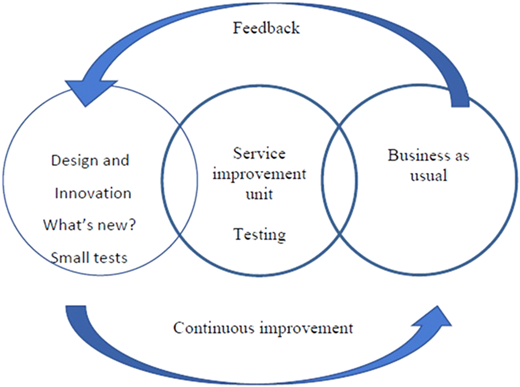
Artefacts: such as workshop sketch notes, infographics, diagrams, and presentation slides. One schematic drawn on a whiteboard in my office was reconstructed and is reproduced as Figure 1.
Media outputs: including newspaper articles and internal newsletters referencing CSPD programmes.
Dialogue with colleagues: informal follow-up conversations (2019–2021) with 6 former colleagues to confirm interpretations of key events and to conduct member checks.
This triangulation of data enabled me to move beyond reliance on memory and to embed personal experience within organisational records.
Data analysis
I used Arena and Uhl-Bien’s 4Ds framework of adaptive space; discovery, development, diffusion, disruption (Arena, 2018; Uhl-Bien and Arena, 2018), as a structural analytical scaffold. Within each domain, I identified critical incidents, decisions, and relational dynamics. Analysis proceeded abductively (Peirce, 1997; Shani et al., 2019): iterative cycles of moving between data, theory, and reflection, generating provisional interpretations, and testing them against both literature and conversations with colleagues.
An example: when my journals recorded tensions between clinical and operational priorities, I revisited organisational reports and minutes from that period, analysed them through the lens of “discovery connections,” and then compared these with theories of organisational ambidexterity (Stelzl et al., 2020). This abductive process allowed situated reflections to be linked with broader theoretical debates.
Reflexivity and positionality
As ND, I occupied a dual position: simultaneously insider (leader embedded within CSPD) and outsider (later academic analyst). This positionality afforded privileged access to organisational processes but also posed risks of bias. To mitigate these, I:
Engaged in sustained reflexive journaling, interrogating my own assumptions, frustrations, and emotions.
Conducted member checks with colleagues to validate key interpretations.
Maintained awareness of power relations, acknowledging how my leadership role shaped both the data generated and its subsequent interpretation.
This reflexive stance aligns with Finlay’s (2002, 2017) call for multiple reflexivities and Le Roux’s (2017) criteria of subjectivity, resonance, credibility, and contribution.
Ethical considerations
Ethical approval was granted by the Higher Education Research Ethics Committee at my institution (LS-E−21–59-Carroll). Many documents and artefacts were public; where individuals were involved, pseudonyms were used. I shared draft reflections with former colleagues to ensure accuracy and minimise harm. Following Ellis and Bochner’s (2000) guidance, I balanced authenticity of narrative with respect for confidentiality. As the primary protagonist, I chose not to mask my identity, recognising both the risks and value of transparency.
Results
From the outset, I had a strong sense of what I hoped to achieve during my time as National Director. I was acutely aware that while I needed to articulate a clear vision, that vision would likely evolve over time. What I had not anticipated was the degree to which multiple, often competing, operational priorities would create demands on the programmes. My early reflection notes captured how the clinical programmes were being “pulled in many different directions,” and how I needed to “engage the tension without being pulled apart.” I became increasingly conscious that unless the work of the Division addressed the pressures my operational colleagues were under, it would be perceived as a discretionary activity, “a nice to have rather than a must do.”
One of my earliest analytic reflections was that the organisation lacked a shared sense of purpose. Senior colleagues approached the programmes through very different lenses, almost all rooted in operational or political urgency rather than system-wide innovation. I recall standing at the whiteboard in my office, drawing three interlocking circles in an attempt to represent what I wanted to build: a system in which clinical design, operations, and innovation were not discrete activities but interdependent forces. At the time, it felt like a small, personal act of meaning-making. In retrospect, that simple sketch foreshadowed much of what followed. My memory of this moment was later confirmed when I rediscovered the original artefact among my papers; it is reproduced here as Figure 1.
In my journal from that period, I repeatedly returned to the idea that innovation in the organisation was episodic rather than intentional. New ideas appeared irregularly and without a mechanism for review, testing, or adoption. I wrote about the need to be able to notice these emerging ideas, provide some form of protection for them, and then find ways to translate what worked into routine practice. Without this, innovation would remain peripheral rather than transformative.
Analysis of material from early stakeholder workshops reinforced my personal sense that design and delivery were deeply misaligned. The phrase “disconnect between clinical design and operations” appears verbatim in one of the early reports and echoed what I was experiencing daily. At a leadership level, I came to see a form of organisational ambidexterity deficit: an inability to hold improvement and delivery in the same field of vision. I described this in my notes as a “chocolate box approach” to innovation, a pattern of reacting to crises, political controversies, and media events rather than shaping a coherent strategy. Much of the organisation felt caught in what I called “a cycle of despair,” an emotional state characterised by fatigue, defensive decision-making, and a deep scepticism about the possibility of meaningful change.
What struck me most forcibly at this stage was not a lack of intelligence or commitment among colleagues, but a loss of belief that the system could be different. The weight of past restructurings hung over every conversation. History, I realised, was not in the past. It was in the room. And my first task as a leader was not structural reform but restoring the possibility of imagination.
Discovery connections
Discovery connections are those that create conditions for exploring new ideas and possibilities by linking people who might not normally work together. In my early reflections, it was immediately clear that this kind of connection was weak within the organisation. Structurally, divisions sat alongside one another, but relationally they were distant. Meetings were frequent, but they functioned largely as mechanisms for information exchange rather than sites of curiosity, challenge, or creative thinking.
I remember leaving one early leadership meeting with a strange sense of emptiness. Everyone had spoken but nothing had shifted. In my post-meeting notes, I wrote about the absence of genuine dialogue and the illusion of collaboration. People were busy, but they were not connected in any meaningful way. I began to realise that if change was to emerge, it would not come from another formal meeting, but from deliberately altering who met whom, and why.
My response was to work laterally as much as vertically. Drawing on my diaries, emails, and calendar entries from that period, I can see the pattern now: a sustained attempt to deliberately rearrange the social architecture of the organisation. I organised events and meetings that brought together clinicians, middle managers, senior leaders, and external contributors around what I described at the time as “pain points;” trauma, patient flow, and integrated care. These were not abstract topics; they were sites of pressure and vulnerability where operational reality and reform ambition collided.
One particular remark stayed with me: “Clinicians don’t understand the business of health.” It was said casually, almost as an indisputable fact. I wrote about it that night, less in anger than in sadness. It felt less like an observation and more like a boundary. In response, in partnership with a postgraduate training body, we developed an action learning course designed not to train people in management, but to create space where clinicians could see the system from multiple vantage points. The feedback from those who attended revealed something unexpected: relief. As one participant wrote in an email, “It really allowed us to be creative … to step away from the day-to-day firefighting and really think.”
Alongside this, I became increasingly convinced that translation mattered as much as innovation. New ideas entered the system constantly, but without people who could act as interpreters between professional worlds, those ideas stalled. I therefore created new knowledge broker roles, formally embedding clinical advisers and group leads into divisional leadership structures. On paper, these were integration roles. In practice, they were emotional labour. These individuals lived daily in the tension between strategic aspiration and operational demand, and not all of them found that space comfortable. I often described the role, in my own private writing, as learning to stand “between order and chaos” without falling into either.
One of the hardest lessons I learned during this phase was that power did not reside where the organisational chart suggested it did. I spent long hours with people whose titles implied influence but who were strangely unable to decide anything. Over time, I began to invest my energy differently, learning who mattered to whom, who really shaped narratives, and whose absence from a meeting was more telling than anyone’s presence. Leadership, I learned, was less about authority and more about listening to the silences.
Despite moments of frustration, something subtle began to shift. Where there had once been caution, there was now curiosity. Where there had been defensiveness, tentative engagement emerged. These changes were slow, fragile, and often invisible in formal reporting. But they were real. And they were the first signs that something new might yet be possible.
Development connections
Development connections are those that enable ideas not just to surface, but to be tested, shaped, and strengthened through practice. By this stage, I had discovered that identifying promising innovations was rarely the problem. The harder task was creating the conditions in which those ideas could survive long enough to prove themselves. My fieldnotes from this period are threaded with frustration: so many “good ideas” passed through the system, only to evaporate when they met operational reality.
What gradually became apparent was that innovation only gained traction when it intersected with a lived operational pain point. Ideas that addressed visible pressure travelled; others sank without trace. I spent countless hours in meetings and on phone calls trying to align what I was seeing abroad or in small pilot sites with what mattered locally. Often, it felt like two conversations were happening at once. On one side, a system hungry for transformation; on the other, a system exhausted by trying to survive.
One entry in my journal describes my growing realisation that I had misunderstood how change would happen. I initially believed that a persuasive business case, if carefully constructed, would be sufficient to move people. Experience taught me otherwise. I encountered what I came to think of as “cognitive dissonance at scale”, deeply held assumptions that were not easily displaced by logic or evidence. In one programme, progress stalled for months not because the work was flawed, but because the idea simply sat too far outside what people believed was possible.
Failure, I learned, was not something the organisation knew how to handle. Conceptually, people embraced the language of learning and improvement. In practice, “failing fast” as per DiPiro and Chisolm-Burns (2013) was interpreted as simply failing. Feedback was viewed with suspicion, and evaluation was perceived as threat rather than resource. When I commissioned external evaluations, colleagues questioned my judgement. I made a note one evening that the idea of a learning organisation “existed in words but not in deeds.” Trying to introduce experimentation into a culture that equated failure with exposure was emotionally draining, and often lonely.
This tension became sharper as leadership changed around me. Over the course of my time in role, there were four different National Directors for acute hospitals, each bringing distinct priorities and expectations of the programmes. Just as relationships settled, they fractured again. I wrote repeatedly about the wearying repetition of making the same case, re-explaining the same arguments, re-building the same fragile alliances. Sustaining enthusiasm in that context required effort I had underestimated.
Protecting small innovations from premature judgement became one of my most important strategies. Funding, however, presented a continual challenge. Securing resources for testing required repeated negotiation with operational divisions, and I often found myself advocating more than leading. In one particular initiative, I pushed back when the operational boundary of a pilot was expanded too quickly. My instinct was that dilution would be fatal. When the project later succeeded in its original setting but failed in the expanded one, I felt both vindicated and deflated. Being right did not undo the damage.
Yet not all stories were bleak. When operational leaders aligned with innovation, the effect was striking. In those moments, ideas did not merely survive, they flourished. Small pilots became accepted practice, and an alternative way of working began to feel credible. On several occasions, I caught myself thinking, almost with surprise: “so it is possible.” Those moments sustained me more than any formal performance metric.
What emerged over time was a more sober understanding of development as slow, uneven, and emotionally charged. Progress was rarely linear. Some days felt like momentum; others like regression. But beneath the apparent chaos, something was shifting. The system was not transforming all at once, but it was learning to move.
Diffusion connections
Diffusion connections concern the conditions that allow ideas to travel, not just within small pockets of innovation, but across an organisation. By this phase, my attention had shifted from igniting change to sustaining and spreading it. The question was no longer whether innovation was possible, but whether it could survive beyond the places where it first took root.
Physical space became one such lever. I wanted to offer something resembling a shared home for the work, a place that might foster informal conversations, shared identity, and the kind of social proximity that formal structures rarely create. We converted a building to enable colleagues from different programmes and divisions to work alongside one another. In principle, it felt right. In practice, it was more complex. The location proved difficult to access, and the reality of hot-desking undermined the sense of belonging I had hoped to foster. Some colleagues found the space energising; others felt displaced. It was my first clear reminder that space is never neutral, it amplifies whatever already exists beneath the surface.
Technology offered another route. Virtual connectivity promised to collapse distance, and when the technology worked, the effect was powerful. Seeing one another, not just hearing voices, changed the quality of engagement. But the platform was unreliable, and frustration travelled as easily as information. Still, people appreciated the effort to create presence across geography. I also used recordings when I could not attend meetings in person, trying to remain visible in a system that rarely paused.
Information flow required constant attention. I turned my office wall into what I thought of as a living surface, diagrams evolving in pen and marker, ideas sketched and reworked, visitors invited to comment or challenge. Newsletters, emails, and shared platforms became ways to keep work in circulation. Yet, even here, I noticed the limits of transmission. Sharing information did not guarantee understanding. Being informed was not the same as being aligned.
Headspace mattered as much as infrastructure. I established monthly individual meetings with each member of my senior team, carving out protected time to think, reflect, and make sense of what was unfolding. We celebrated small wins and confronted stagnation. At the same time, I attended fortnightly leadership meetings across programmes, which gradually began to feel heavy. I found myself wondering whether the size of the enterprise had begun to exceed its ability to remain coherent. Growth created reach, but also distance.
Energy, I learned, travels faster than policy. At this point, we were fortunate to have an exceptionally vibrant Chief Information Officer. His optimism was infectious. His use of visual storytelling was strategic, not decorative. I admired the ease with which he navigated influence through networks rather than hierarchy, and I learned from both his confidence and his generosity. Together, we challenged traditional channels of communication and adopted a more visible and public style of leadership. At times, I operated on instinct more than permission, “seek forgiveness, not approval” quietly becoming a working rule.
I tried to repurpose celebration as strategy. I nominated colleagues for awards, wrote letters of recognition, and highlighted success in newsletters. Not everyone welcomed this attention. Some bristled at being singled out; others bloomed under acknowledgement. I noted: “You win some; you lose some.” Diffusion, I realised, is emotional as much as it is technical.
Beyond the local system, I encouraged research as a form of spread. Supporting conference presentations, publications, and doctoral work allowed ideas to travel beyond the organisation even when internal interest lagged (Collins et al., 2019; Darker et al., 2018; Lang et al., 2017; Shaw, 2020; Power et al., 2017). Senior leadership, however, remained preoccupied with budgets and headcount. I found myself increasingly aware of the divergence between what academics value and what organisations reward. Yet I also saw how external recognition energised the programmes themselves. Success became its own broadcast mechanism.
By the time I left the role, a tipping point had begun to form. Investment came more easily than before. Some pilots matured into national programmes. The irony, of course, was that much of that success lay beyond my direct involvement. But diffusion rarely looks like ownership. It looks like disappearance into practice. And perhaps that is the truest mark of success.
Disruption connections
Disruption connections are those that challenge entrenched patterns and unsettle assumptions about how work is done. From the outset of my role, I understood that generating movement would require more than quiet influence; it would also demand visible challenge. One of my earliest acts as National Director was to issue a provocation in the form of a document and presentation titled Transforming our Healthcare System: Seven Priorities for Transformation. It was not presented as a manifesto, but as an invitation to re-imagine what was possible. I socialised it first with colleagues privately, inviting critique before presenting it formally. The intention was not to impose change, but to signal that stasis was no longer acceptable.
Much of what followed involved working across organisational boundaries that were both formal and cultural. Testing and spreading innovation required constant negotiation with operational leaders and careful translation of ambition into language that could survive political scrutiny. I spent considerable time making the case for investment to the Department of Health, often in contexts where financial control and accountability overshadowed longer-term transformation. I became acutely aware that innovation needed allies in places of authority if it was to endure.
Communication became another site of disruption. I learned quickly that quiet success was vulnerable. If no one knew what we were doing, it could easily be undone. So I became deliberate in my efforts to increase visibility: presentations, meetings, narratives circulated strategically. I remember thinking at one point: “If everyone is talking about it, it becomes harder to kill.” These were not publicity exercises; they were acts of protection.
I also began to leverage influence from outside the system. Certain individuals and organisations carried symbolic authority that no internal voice could match. I invited them in intentionally, not as celebrities, but as catalysts. When recognised international figures spoke about integrated care, something shifted in the room. Their presence reframed the work from local experiment to legitimate movement. A large national conference brought senior figures and Department representatives together in one space. I wanted the system to see itself as part of something bigger, something in motion.
Late in my time as National Director, one remark crystallised what I had been grappling with all along. An interim senior leader said to me: “You’re a great ideas person, you’re just not very good at implementing.” The words landed sharply. Not because they were true, but because they revealed a worldview that could not see what I had been doing at all. Implementation, in that framing, meant directive control. What I had been practising, influencing, protecting, stabilising, translating, did not count as leadership. In that moment, I realised that the work I valued most was invisible to those who equated leadership with command.
That comment did not wound so much as clarify. It confirmed what I already suspected: that our ways of understanding leadership were too narrow for the work we were attempting. It also confirmed my decision to leave. Not in anger, but in recognition that my work, as I understood it, could no longer be done from where I stood.
Discussion
Healthcare systems are widely understood as complex adaptive systems (Plsek and Greenhalgh, 2001; Plsek and Wilson, 2001; Snowden and Boone, 2007; Greenhalgh and Papoutsi, 2018; Braithwaite et al., 2018). Within this framing, organisational change is not a linear process of implementation but an emergent, relational and often contested endeavour requiring constant sensemaking and adaptation (Weick et al., 2005; Uhl-Bien and Arena, 2018). This study contributes to that body of work by providing an empirically grounded account of how adaptive space was created, negotiated and sustained within the Irish healthcare system through everyday leadership practice. Using analytic autoethnography (Anderson, 2006) and Arena and Uhl-Bien’s 4Ds framework (Arena and Uhl-Bien, 2016; Arena, 2021), the findings reveal how leadership unfolded as relational, emotional and political labour rather than as linear execution of strategy.
Adaptive space as relational accomplishment rather than structural design
Arena and Uhl-Bien conceptualise adaptive space as the interface between entrepreneurial and operational systems, where new ideas are generated, tested and scaled (Arena and Uhl-Bien, 2016; Arena, 2021). The findings in this study demonstrate that this “space” is not a discrete organisational unit or innovation structure but is enacted through relationships, negotiation and continual boundary work. Across the 4Ds; discovery, development, diffusion and disruption, adaptive space emerged not as a singular intervention but as a pattern of practices: convening unfamiliar actors, brokering trust across professional silos, protecting fragile innovations from premature evaluation, and deliberately leveraging influence beyond formal hierarchies. This supports wider critiques that complexity leadership cannot be reduced to structures or toolkits, but must be understood as dynamic, social and contested work (Uhl-Bien and Arena, 2018; Rosenhead et al., 2019).
In this sense, adaptive space is shown here not as a managerial overlay but as a fragile relational achievement. What sustained momentum was not the existence of programmes themselves but the continuous work of holding connections in the face of political uncertainty, organisational fatigue and shifting senior leadership. This reframes adaptive leadership less as “driving change” and more as holding conditions for emergence, an orientation consistent with complexity theory’s emphasis on enabling constraints rather than control (Snowden and Boone, 2007; Plsek and Wilson, 2001).
Discovery and development: surfacing novelty while working against organisational gravity
The discovery phase revealed that generating new ideas was not the principal challenge; enabling curiosity within a system dominated by operational urgency was. The deliberate creation of cross-boundary interactions, leadership development initiatives and knowledge broker roles functioned as mechanisms to interrupt habitual patterns of interaction. These findings echo Long et al.’s (2013) synthesis highlighting the importance of brokers and boundary spanners in mobilising knowledge and enabling innovation across organisational divides.
However, development emerged as the most emotionally charged phase. While much literature emphasises experimentation as vital to learning systems (Weick et al., 2005; Lyng et al., 2021), this study shows how deeply incompatible that orientation can be with cultures shaped by risk aversion, political accountability and media scrutiny. The tension between innovation rhetoric and operational fear of failure aligns with findings from Haring et al.’s (2022) systematic review, identifying conflict between exploration and stability as a persistent feature of health system reform. The study adds empirical texture to this tension by showing how protection of “tests of change” required active leadership intervention rather than passive endorsement.
Diffusion: why spread is emotional, not technical
Diffusion is often treated as a technical challenge of scale and standardisation. The findings here challenge that view. Spread depended less on formal governance mechanisms and more on emotion, identity and narrative. Visibility functioned not merely as communication but as protection; celebration acted as social glue as much as recognition. This aligns with research on adaptive capacity, which highlights the role of relationships, reflexivity and informal interactions in sustaining organisational learning (Fagerdal et al., 2023; Lyng et al., 2021).
Interestingly, physical and digital infrastructures did not guarantee coherence. Shared space sometimes fostered connection, sometimes alienation. Technology enabled participation but did not ensure belonging. These findings reinforce critiques of techno-centric reform narratives and highlight the primacy of relational infrastructure in integrated care implementation (Hughes et al., 2020).
Disruption: leadership as political and interpretive work
The disruption phase most clearly exposed the political nature of adaptive leadership. While complexity leadership theory often foregrounds emergence, this study demonstrates that emergence does not occur in a neutral field. It unfolds within power structures, budgetary constraints and professional cultures that privilege predictability over possibility. The deliberate use of symbolic authority, external voices and narrative framing illustrates how disruption requires legitimacy as much as innovation. This resonates with integrated care literature emphasising the role of leadership in negotiating professional identity, interdependence and institutional trust (Hughes et al., 2020).
The closing exchange, being characterised as “good at ideas but not implementation,” reveals a widespread but narrow view of leadership equated with command and control. This moment crystallises a deeper epistemic divide: between leadership as instruction and leadership as enabling context. That distinction is rarely captured in formal evaluations but is central to understanding why transformation efforts succeed or fail.
Theoretical and methodological contribution
The primary theoretical contribution of this study is empirical: it operationalises adaptive space as lived organisational practice rather than abstract metaphor. While prior literature conceptualises adaptive space as an enabling condition (Arena and Uhl-Bien, 2016; Arena, 2021), this study shows what that condition looks like in action, how it is assembled, defended and sometimes lost.
Methodologically, the paper contributes to organisational ethnography by demonstrating the value of analytic autoethnography in accessing leadership practice that is rarely visible through interviews or document analysis alone (Anderson, 2006; Orel, 2024). Rather than presenting autoethnography as anecdote, the study uses abductive reasoning to connect lived experience to organisational theory (Shani et al., 2019), offering a mode of inquiry suited to the ambiguity and non-linearity inherent in healthcare reform.
Limits and reflexivity
As an autoethnography, this account represents one situated perspective. It does not claim generalisability, nor does it seek to offer prescriptive solutions. Its contribution instead lies in analytical resonance: the capacity to reveal often-hidden leadership labour and invite re-examination of taken-for-granted assumptions about change. The dual position of insider and analyst inevitably shaped access, interpretation and emphasis. However, the use of multiple data sources and member checking strengthened credibility (Le Roux, 2017) and reduced the risk of retrospective rationalisation.
Conclusion
This study set out to examine how the lived experience of a senior healthcare leader could reveal the processes through which adaptive space is created within a complex health system and what this reveals about organisational and cultural dynamics of change. Through analytic autoethnography and the application of Arena and Uhl-Bien’s 4Ds framework, the findings demonstrate that adaptive space did not emerge from formal structures or policy initiatives alone but was assembled through everyday leadership practice: relationship-building, negotiation across boundaries, protection of fragile innovations, and the deliberate use of narrative, visibility, and influence.
The study shows that creating adaptive space is not a technical activity but a relational and political accomplishment. Leadership, in this context, was enacted not as command or compliance, but as continuous interpretive work, holding tension between innovation and operations, resisting premature closure, and sustaining commitment under conditions of uncertainty and institutional constraint. This extends existing work on complexity leadership by grounding adaptive space in the lived realities of healthcare reform and by making visible forms of labour that are rarely named in formal accounts of change.
Methodologically, the study demonstrates the value of analytic autoethnography as a mode of inquiry capable of illuminating dimensions of leadership practice that are otherwise inaccessible. By combining personal narrative with abductive reasoning and theory-informed analysis, the paper contributes to organisational ethnography by showing how insider research can generate analytically rigorous and organisationally meaningful insight, rather than mere reflection.
This account does not claim generalisability, nor does it offer a blueprint for reform. Its contribution lies instead in analytical resonance: the capacity to surface patterns, tensions, and dynamics that others may recognise in their own settings. In doing so, it invites leaders, policymakers and researchers to rethink how change unfolds in practice, and to attend more carefully to the relational and cultural work required to sustain transformation in complex systems.