


Advances in technology and the COVID-19 pandemic have fundamentally altered the ways in which we behave and interact in our daily lives. However, organizational ethnography arguably still falls short in adequately portraying the hybrid nature of work as performed and experienced by employees in contemporary organizations.
“Traditional” participant observation has been adapted to accommodate this new reality through digital and remote ethnography, and there is an ongoing conversation in ethnographic research which is concerned with what can constitute the “field” in fieldwork. Based on my own fieldwork experiences, I propose a research approach I call organizational hybrid ethnography – a combination of in-person and remote organizational ethnography – and explain how it differs from other forms of technologically mediated ethnography.
I argue that compared to purely remote observations, the hybrid ethnographer is better positioned to not only experience firsthand the office environment and explore the questions it raises for hybrid working but also to establish trust with participants when interacting with them in person. Likewise, compared to purely on-site observations, I contend that the hybrid ethnographer gains a more holistic experience and more closely captures work dynamics when occasionally observing through videoconferencing.
Hybrid is increasingly how work is organized, and a central quest for the ethnographer is to try to simulate and relate to the experiences of research participants. Organizational hybrid ethnography enables the organizational ethnographer to provide a more authentic account of the participants’ work lives in modern organizational settings.
Introduction
Technological advances have enabled adaptations of “traditional” participant observation, proliferating under the umbrella terms of virtual ethnography (Hine, 2017) and digital ethnography (Hjorth et al., 2017; Pink et al., 2016) – “ethnography for the 21st century” (Forberg and Schilt, 2023, p. 4). The ongoing trend of conducting qualitative research with the aid of technologies was further accelerated by the COVID-19 pandemic, as researchers found themselves in a pickle amid lockdowns and social distancing (e.g. Forberg and Schilt, 2023; Góralska, 2020; Lobe et al., 2020; Rahman et al., 2021). Accordingly, there is a conversation within ethnographic research about what can constitute the “field” in fieldwork – a conversation refueled by the pandemic (Dumont, 2023; Eggeling, 2023; Howlett, 2022; Parsons et al., 2022). A related debate exists about whether serious ethnography requires “being there” and “being then” (Postill, 2017), as “the gold standard” of in-person interaction has evolved into a more nuanced understanding of computer-mediated interaction (Hine, 2005). Additionally, the duration and continuity of fieldwork have also been challenged through approaches like “patchwork ethnography” (Günel et al., 2020), “propportune ethnography” (Sambrook et al., 2024), and “rapid ethnography” (Halme et al., 2016; Vindrola-Padros and Vindrola-Padros, 2018). As such, there is a “tension between change and continuity – between adapting ethnography to current-day workplace and institutional settings and retaining the crafts(wo)manship from which much of its academic status derives” (Verver et al., 2024, p. 137).
Another current debate, which has implications for organizational ethnography, concerns hybrid work. Some post-pandemic studies of organizations, work life, and management propose that hybrid working arrangements, where employees alternate between working at the office and working from home or some other location, have many positive effects for employees and few downsides for employers (e.g. Angelici and Profeta, 2024; Barrero et al., 2023; Choudhury et al., 2024). For example, one recent study found that hybrid work increases employee retention without compromising performance (Bloom et al., 2024), and another article concluded that “culture, collaboration, and innovation are only at best weakly correlated with the place of work (and probably not correlated at all)” (Gibson et al., 2023, p. 10). However, other studies show that hybrid working arrangements can also produce negative impacts, as the boundaries between work and family are blurred, work–life balance becomes more difficult to manage, and gender inequalities might be strengthened (e.g. Alfano et al., 2024; Li et al., 2025; Powell and Craig, 2015). Accordingly, Mazmanian et al. (2013) have argued that hybrid work can reduce the ability to disconnect from work and result in an autonomy paradox where “the ‘work anywhere’ promise quickly translates into the ‘work everywhere’ problem” (Empson, 2021, p. 1384, emphases added).
Currently, major companies such as Amazon (Jassy, 2024) and JPMorgan Chase (Jones, 2025) are pushing back on hybrid work, citing the ability to maintain a stronger culture, facilitate easier collaboration, and foster more effective innovation when everyone is at the office full time. Still, around 100 million employees in Europe and North America alone work in a hybrid way (Bloom et al., 2024), so whether based on research findings or managerial beliefs, shifting remote work policies in organizations can have significant consequences for millions of employees. This underlines the need for further exploration of hybrid work to fully understand its impacts, and organizational ethnography is well positioned to do so.
But despite the increasing use of various technological tools for conducting ethnographic research and the increased popularity of hybrid work, organizational ethnography arguably still falls short in adequately portraying how work is negotiated, performed, and experienced by employees in contemporary organizations (Akemu and Abdelnour, 2020). Many questions related to hybrid work remain underexplored, such as: What strategies do employees use to integrate work demands into their everyday lives at home? How are the boundaries between work and private life drawn? How are the possibilities and conditions of hybrid working negotiated between employees and their superiors? Which groups of employees succeed in leveraging the advantages of hybrid working, and which groups face an increased burden from it?
To address this gap in organizational ethnography and develop opportunities to investigate these questions up close, I propose a research approach I call organizational hybrid ethnography – a blend of in-person and remote organizational ethnography which accommodates for research participants alternating between working in the office and remotely. It integrates some elements of its closest methodological relatives into a related but nevertheless unique approach. I discuss how organizational hybrid ethnography differs from (1) “traditional” ethnography, which relies on physical co-location in the field; (2) remote ethnography, which studies the field from a distance either in real-time or retroactively; (3) digital ethnography, which considers the internet as the research field; and (4) video ethnography, which often focuses on moment-by-moment analysis of video recordings. Compared to purely remote or virtual observations, I argue that the hybrid ethnographer is better positioned to not only experience firsthand the world of the office as an independent sphere of observation and explore the questions that this sphere raises for hybrid working, but also to establish trust and rapport with participants during in-person interactions, which helps with subsequent remote observations via videoconferencing (cf. Hall et al., 2021; Parsons et al., 2022). Likewise, compared to purely on-site observations, I contend that the hybrid ethnographer gains a more authentic and holistic experience of participants’ work lives and more closely captures work dynamics in modern organizational settings when occasionally observing through videoconferencing (see Akemu and Abdelnour, 2020). I draw from my own research conducted before and during the pandemic as an example of how organizational hybrid ethnography could be conducted. My central message is that as hybrid working arrangements are becoming increasingly crucial for organizations and their employees, it is equally crucial that ethnographic research of these organizations and employees becomes hybrid as well.
The remainder of this article is structured as follows: First, I discuss the fundamental paradigm of ethnographic fieldwork and explore how the understanding of the “field” has recently evolved. Then, I compare and contrast various forms of technologically mediated ethnography, including previous conceptualizations of hybrid ethnography. Finally, I outline what I consider organizational hybrid ethnography to be and present my own research as an example, before offering some concluding remarks on why organizational hybrid ethnography is needed.
The essence of ethnography?
The central tenet of ethnography has long been extended participant observation, which typically has meant at least a year’s physical stay in the field (e.g. Hammersley, 2006; Jeffrey and Troman, 2004; Sanday, 1979; van der Waal, 2009). More than 5 decades ago, Wallace (1972, p. 469) outlined the “fieldwork paradigm” by painting a picture of what comes to mind whenever thinking of ethnographic research: “Whether accurately or not, one thinks of Franz Boas stepping off the boat in an Eskimo village with his suitcase in hand, preparing for a long stay in residence. This image is the paradigm.”
This deep immersion into participants’ realities and the detailed “thick descriptions” of their cultures (Geertz, 1973) are undoubtedly hallmarks of ethnography. However, the ethnographic community has recently proposed that deep immersion does not necessarily require physical presence (e.g. Dumont, 2023). The impact of video and other digital technologies on social science research designs has been growing steadily in recent decades (Hjorth et al., 2017; LeBaron et al., 2018), and ethnographic research is not an exception to this rule: Following Hine’s landmark book Virtual Ethnography (Hine, 2000), several different applications of ethnography have emerged that focus on researching interactions that happen online or are technologically mediated, such as video ethnography (Llewellyn and Hindmarsh, 2013; Smets et al., 2014; Watson and Lupton, 2022), netnography (Kozinets, 2020), social media ethnography (Postill and Pink, 2012), appnography (Cousineau et al., 2019), and remote ethnography (Postill, 2017). Among the specific research methods that utilize new technologies are interviewing through videoconferencing tools such as Zoom (e.g. Archibald et al., 2019; Oliffe et al., 2021) and diary studies using instant messaging applications such as WhatsApp (e.g. Clark et al., 2022; Humphries et al., 2022).
Thus, the notion of the “field” in fieldwork has been extended from the field as a physical location to a fieldsite – whether physical, virtual, or both – and “being there” is increasingly giving way to “being aware” (Eggeling, 2023). A decade ago, Smets et al. (2014, p. 11) asked: “Where do ethnographers have to be, when, for how long, and with whom to ‘be there?’” Since then, further advances in technology, coupled with the growing fragmentation and complexity of organizations and enhanced by the pandemic, have fundamentally altered the ways in which we behave and interact in our daily lives. This transformation underscores the importance of altering our research methods as well, as Howlett (2022) argues:
Although the differences between a person’s online and offline presence must be recognized, the divide is now less stark as more of our ‘real lives’ (including both our work and social engagements) are happening virtually … Though neither face-to-face nor mediated approaches offer a total picture of the sites and people we study technology now very much allows us to embed ourselves in other contexts from a distance. In this way, knowledge produced through digital research is no longer as particular, or ‘partial,’ as it was previously, and is arguably even more valid … (Howlett, 2022, pp. 395–396.)
What is more, while most proponents of ethnography hold that deep immersion can only be achieved through rigorous fieldwork, a closer examination of many classic accounts that spell out the nature of ethnographic research reveals that they do not particularly highlight physical presence as a necessity for this immersion either. For example, Spradley (1980) explains that at its very core, ethnography simply aims to understand life from the native’s point of view, and Sanday (1979, p. 527) elaborates that an ethnographer tries to achieve this by becoming “part of the situation being studied in order to feel what it is like for the people in that situation.” According to Van Maanen (1979, p. 539), “ethnographers believe that separating the facts from the fictions, the extraordinary from the common, and the general from the specific is best accomplished by lengthy, continuous, firsthand involvement in the organizational setting under study.” Therefore, he maintains that undertaking ethnographic research entails that the researcher “actually goes out beyond the ivory towers of employment and comfort to live with and live like those who are studied” (Van Maanen, 2010, p. 242). I believe that this understanding, feeling what it is like, and being involved is precisely wherein lies the essence of ethnography: The starting point of this paper is that the ethnographic paradigm of extended presence in the field ultimately aims for contextual understanding and simulating the experiences of research participants. And increasingly, physical presence can – or even should – be complemented with virtual presence via technologically mediated ethnography (Akemu and Abdelnour, 2020; Parsons et al., 2022), which I now turn to.
Forms of technologically mediated ethnography
Ethnographic methods are flexible, so there exist a variety of closely related yet distinct technologically mediated research approaches, which I will map and briefly review below. Although the boundaries of these approaches are somewhat blurred, the key distinction, in my interpretation, is how the notions of the “field” and “being there” are understood; this understanding dictates the specific data collection methods associated with each approach. Based on different understandings of what constitutes the field and how the researcher relates to it, I categorize the various approaches into three main types of technologically mediated ethnography: video, digital, and remote. They are presented in Table 1 below, alongside “traditional” and hybrid ethnography.
The typology of technologically mediated ethnographies
| Approach | “Field” | “Being there” | Primary source of data | Key characteristic |
|---|---|---|---|---|
| Traditional ethnography | Physical | Paramount | In-person observations | Lengthy, continuous, firsthand participatory involvement in the setting under study |
| Video ethnography | Physical | Not required | Video recordings | Fine-grained, moment-by-moment analysis of interactions through recorded video data |
| Digital ethnography | Virtual | Virtually | Online texts | Studying cultures and communities online, e.g. on message boards and social media |
| Remote ethnography | Physical | No, by definition | Online observations | Observing without the researcher being present in the setting under study |
| Hybrid ethnography | Physical and virtual | Offline co-location and online co-presence | In-person observations and videoconferencing | Simulating participant realities by alternating between in-person and remote observations |
Source(s): Author’s own work
Video ethnography
In video ethnography, researchers analyze recorded video data from the physical field (e.g. Smets et al., 2014; Watson and Lupton, 2022). They may pause, slow down, and rewind the recordings, and generally go back to them at any point in time (LeBaron et al., 2018). A specific type of ethnography that especially benefits from having recorded video data is microethnography – “fine-grained, moment-by-moment analysis of what people say and do” (LeBaron and Christianson, 2021, p. 133). An example of a microethnography that utilizes video recordings is Llewellyn and Hindmarsh’s (2013) study of customer service work at a ticket counter. However, a potential drawback of video ethnography is the obtrusiveness of the video camera, which might lead to inauthentic actions or self-portrayals; “participant awareness of media technology has the potential to elicit both a sense of agency and self-consciousness in the wake of their knowing that they are participating in an ethnographic video” (Gregory, 2020, p. 7).
Demonstrating the interplay between different technologically mediated approaches to ethnography, Watson and Lupton (2022) recount how, at the onset of the pandemic, they transitioned from analyzing videos they recorded while visiting their research participants in person to recording and analyzing Zoom call videos filmed by the participants themselves. While the authors describe this shift as “rapidly adjust[ing] from in-person to remote ethnographic methods” (p. 2), my interpretation is that their approach leans more towards video ethnography than remote ethnography, as they also state that the approach “was founded on methods which centre the video camera within the research encounter, to capture a visual record” (p. 3). Thus, this study also exemplifies the proliferation and blurred boundaries of technologically mediated ethnographic research due to the various labels associated with it.
Digital ethnography
Ethnography that considers the internet as the research field is most commonly referred to today as digital ethnography (e.g. Forberg and Schilt, 2023; Hjorth et al., 2017; Pink et al., 2016), although terms such as virtual ethnography and online ethnography (Hine, 2000) as well as netnography (Kozinets, 2020) are also used to a lesser extent. Digital ethnography focuses on interactions occurring on online platforms such as message boards, blogs, and social media; Kozinets (2020) emphasizes community and culture, while Góralska (2020, p. 47) explains that digital ethnography can be understood as “a method used to study societies and cultures in the digital space – on the Internet, online, without a necessity to travel.” Accordingly, the digital field “can comprise anything that the web is made of – texts, videos, images, platform infrastructures, user behaviors, social relations, or an information network” (Góralska, 2020, p. 47). Social media ethnographies specifically examine self-presentations, interactions, communities, and collective action in social media (e.g. Wang and Liu, 2021), whereas appnographies (e.g. Cousineau et al., 2019) extend digital ethnographies to include the use of mobile applications, integrating them into the broader scope of digital ethnographic research.
Remote ethnography
Studying a culture from a distance – whether live or retroactively – for example via social media, recordings, live streaming, and/or email is referred to as remote ethnography (Postill, 2017). Clark et al. (2022, p. 376) defined remote ethnography as “the observation of human interaction in the natural world without the researcher being present.” In their study of consumer behavior, they collected diary data from participants through WhatsApp in the form of text, photos, and videos. Similarly, Humphries et al. (2022, p. 1558) also used WhatsApp to “become immersed in the daily working lives” of hospital doctors and “gain insights into the workplace without meeting them face-to-face or visiting their workplaces.”
In another instance, Yavo-Ayalon et al. (2022) combined recorded video and GPS tracking to develop a method of remotely observing and interviewing people who were walking on the streets of their neighborhoods. Their goal was to “see, hear and analyze the space in as-close-as-possible-to-embodied experience, without having to be physically present on site” (Yavo-Ayalon et al., 2022, p. 1). Further, Postill (2017) vividly describes a tense scene involving a religious protest during a university lecture – despite watching it on YouTube from home the next day. These examples highlight once again the blurring of boundaries within the categorizations of technologically mediated ethnography, as they combine video, mobile apps, and remote observations.
Conceptualizations of hybrid ethnography
Use of the term “hybrid ethnography” precedes this article, but previous research has offered various interpretations of what constitutes the “hybrid” in hybrid ethnography. For example, Seim (2024, p. 135) views a hybrid approach as a “deliberate mixture of participant observation and observant participation.” He conducted a two-stage ethnography, initially acting as “a fly on the wall” to shadow his research participants, and subsequently “went native” by working alongside them as a salaried employee himself. Thus, his definition of hybrid was a combination of observing and participating in the physical field.
Perhaps the more common view of hybrid ethnographies, however, suggests that the “hybrid” refers to living everyday life both online and offline, and ethnographic research employing the online–offline hybrid approach focuses on the blurring of the digital life and the real life (Jordan, 2009). For instance, Liu (2022, p. 4) contends that hybrid ethnography “reconceptualizes the notion of the field from physical or virtually bounded places to more or less mixing, interconnected virtual and physical settings.” An illustrative example of this is provided by Gabriels and Bauwens (2014), who studied how participants’ experiences in a virtual world through their avatars intersected with their lives in the actual world.
COVID-19 prompted a “hybridization” of events previously held in person, which in turn transformed the nature of event ethnographies. For example, Schulte-Römer and Gesing (2023) reflected on how to study events such as academic conferences, workshops, and trade fairs in the absence of in-person interactions, and Cocco and Bertran (2021) examined how a devoted community participated in a religious festival simultaneously online and offline during the pandemic. In Cocco and Bertran’s (2021, p. 118) account, one example of the hybridization of the religious event was when “a singer and a local illustrator posted a video on Facebook of illustrations inspired by the festival, moving to the sound of the traditional prayers dedicated to Saint Efisio and encouraging the local community to collectively chant from their balconies.”
This concept of “hybrid event ethnography” was popularized in the field of ethnomusicology by Przybylski (2020), who developed a model for analyzing contemporary expressive culture and cultural events, such as concerts and art exhibitions, through both online and offline ethnography. According to her methodology, an individual attendee capturing part of the event (e.g. taking a photo or recording a video on their phone) and sharing it on social media can simultaneously be considered “as audience, content maker, and distributor, all at once” (Przybylski, 2020, p. 6). Thus, offline refers to the ethnographer attending a live event in person, while online involves shifting through the content created during the event and shared by its attendees. Accordingly, Przybylski (2020, p. 12) notes that the object of inquiry “may be any aspect of expressive culture, including music, dance, film, theatre, or other types of performance.” However, it is arguably an approach that is difficult to integrate into the organizational research context, and therefore, a distinct conceptualization of organizational hybrid ethnography is justified.
Organizational hybrid ethnography
According to Moore (2011, p. 324, emphases added), ethnography in organization studies refers to “a research process in which the researcher’s own experiences, as observer and/or participant in the organization, form the core of the methodology.” Parsons et al. (2022) state that it is necessary to reconsider how to observe organizational life when participants are working at least partially remotely. One of the few examples of adapting organizational ethnography to a hybrid realm in this way is Alcadipani and Cunliffe’s (2024) study of an investigative police force, where smartphones and WhatsApp were integral to the work of police officers. They discovered that with the inclusion of the ethnographer into a WhatsApp group used by members of the organization for both professional and personal communications, their research field spread across physical and online sites. As a result, work and research relationships were extended, the boundaries between work and non-work activities became blurred, and the ethnographer was tempted to become involved 24/7. Advocating for hybrid ethnography as a form of deep immersion in the field, Alcadipani and Cunliffe argue that it provides invaluable insights into modern work. They caution, however, that “we cannot assume that online content represents what is experienced on the ground, and therefore an ethnographer’s face-to-face (co-located) presence is important in generating rich, thick data around the lived experience of work” (Alcadipani and Cunliffe, 2024, p. 689).
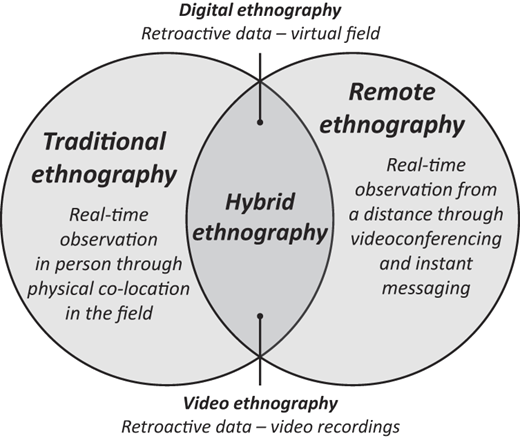
While Alcadipani and Cunliffe (2024) primarily explore how hybrid ethnography impacts the ethnographer and what are its pros and cons, my focus in this article is on why it is important for organizational ethnographers to engage in it. I propose organizational hybrid ethnography as an essential research approach for studying hybrid work in organizations. Simply put, the “hybrid” in my conceptualization of hybrid ethnography involves on-site observations when research participants are working in the office and remote observations when they are working remotely. I define organizational hybrid ethnography as observational fieldwork that combines in-person observations (traditional ethnography) with live videoconferencing through remote teamworking tools such as Zoom and Microsoft Teams (real-time remote ethnography). In addition, the hybrid approach may also include elements such as online chat messages (digital ethnography) and video recordings (video ethnography). This conceptual framework is illustrated in Figure 1 below.
A research example
My own research serves as an illustrative example of organizational hybrid ethnography. In 2019, I set out to conduct traditional ethnographic fieldwork about a major organizational transformation within the financial sector – the organization in question was interested in having someone study how this change progressed. Given that organizational (culture) changes are typically lengthy processes rather than one-off events, the company acknowledged the need for longitudinal, possibly ethnographic, research to effectively capture the transformation as it unfolded. I assumed the role of a project ethnographer, invited by the Chief HR Officer (CHRO) of the case company to observe and document the change from an outsider’s perspective. The CHRO, as an “internal elite sponsor” (Welch et al., 2002, p. 617) for my research, was of crucial importance in granting me access and facilitating my ability to conduct the study. However, it is important to clarify that despite this high-quality and effectively unrestricted access, I was not employed by the case company at any point during the research project.
In early 2020, like so many others (e.g. Hendrickx and Picone, 2024; Liu, 2022; Parsons et al., 2022), I was compelled to adjust my fieldwork design at the onset of COVID-19 as “ethnographic fieldwork [was] quarantined” (Kuiper, 2020, p. 301). I had just completed the first round of observations when my research participants had to transition to an online work environment and work remotely from home. I was also confined to my home and laptop and had to develop an alternative to “being there” at the office with my research participants. This led me to extend my research field into Microsoft Teams, where I could continue “being there” – only the “there” was now a virtual space instead of a physical space. Therefore, I shifted from offline co-location to online co-presence (Beaulieu, 2010; Howlett, 2022). Importantly, I had been able to build trust and rapport with my research participants in person before this shift, which made rich data collection during remote fieldwork possible (cf. Hall et al., 2021; Parsons et al., 2022).
As time went on and my research participants alternated between office work and remote teamwork in response to the ebb and flow of the pandemic waves and accompanying restrictions, I was also alternating between in-person observations on site and remote observations via live videoconferencing. In total, I collected data over 17 months in four rounds: before the pandemic (November 2019–February 2020), in the middle of the transition to remote work (May 2020–June 2020), and after the pandemic situation had been prolonged (October 2020–November 2020 and January 2021–March 2021). I conducted a total of 140 days of ethnographic observations, comprising 80 days of on-site observations and 60 days of remote observations through participating in virtual team meetings on Microsoft Teams.
Insights from my organizational hybrid ethnography
Although the mode of my observation was mandated by the pandemic, it still provided valuable insights for ethnographers studying modern organizations where work is performed in hybrid ways. For example, a peculiar aspect of remote observations was that as long as different teams in my case company were not organizing their virtual meetings at the same time, I could always observe them within the same day. This allowed me to compare and contrast the teams on a daily basis, which made their similarities and differences more explicit to me. The benefits of this “multi-team” approach can be taken into account when designing studies that utilize organizational hybrid ethnography.
One key finding from my own research was that the proverbial “water cooler talk” was absent during remote work periods – there were fewer organic interactions and less serendipity, as videoconferencing greatly restricted team interactions compared to in-person settings. Essentially, remote meetings could not substitute for team co-location as employees were trying to make sense of the organizational change. The magnitude of this difference in informal interaction became more evident to me when I was also alternating between remote and in-person work, and I see being able to clearly identify this difference as one advantage of organizational hybrid ethnography.
While other studies (e.g. Viererbl et al., 2022) have identified similar challenges with remote teamwork, I also observed that this lack of interaction limited my own ethnographic “visibility.” I was only a tiny speck on the corner of my participants’ laptop screens, and as I mostly remained a silent observer during their meetings, they rarely spontaneously talked to me. It also had implications for the data I could collect: Attending all virtual meetings was impossible because team members would occasionally forget to invite me to them. This contrasted sharply with the physical presence in an office setting, where I was always invited to meetings and frequently included in casual conversations and offhand remarks during them, such as: “Hey, I bet our gibberish reduces the scientific value of your research, right?”
On the other hand, remote observations allowed for a more unobtrusive researcher presence, making it easier for me to be “a fly on the wall” during remote team meetings. On multiple occasions, my research participants seemed to not remember that they were being observed and were surprised to hear me speak, a scenario which would never occur when we were at the office. Depending on the situation and the research objectives, these instances might increase the likelihood of obtaining more “uncensored” data and offer an interesting comparison between interactions when the team is fully aware of the ethnographer’s presence and when they are not.
Another key finding from my research was that engagement was generally lower during remote meetings compared to in-person meetings. In-person meetings often featured several lively conversations happening simultaneously, whereas remote meetings were more structured, typically allowing only one conversation at a time – and it was often akin to a monologue. Therefore, the dynamics of the teams changed in virtual meetings, resulting in informal and invisible hierarchies as team members settled into roles such as spokesperson for an issue, facilitator of meetings who allocated turns to speak, or passive (non-)listener. A related observation was that team leaders exerted more control, delegated tasks less frequently, and engaged in more micromanagement when teams were working remotely. When we returned to the office, the hierarchies all but disappeared and engagement was again high. The ability to compare team dynamics in co-located and distributed settings is another unique advantage of organizational hybrid ethnography. It can provide valuable insights into how to organize teamwork in the hybrid realm, such as determining which tasks are best performed when co-located and which issues are more effectively discussed in virtual meetings.
Finally, one key finding from my research was that constant virtual meetings were, in one word, exhausting (see also Nurmi and Pakarinen, 2023; Shockley et al., 2021). When I interviewed team members virtually as part of my research, I was initially apologetic, aware of how much time they already spent in virtual meetings even without me booking the little time they had left to spare. However, the interviewees consistently described these more informal situations as “therapeutic conversations” and “opportunities to vent out frustrations” regarding the meeting overload they were experiencing, attesting to the fatiguing effects of too many virtual meetings. I also experienced firsthand the stark contrast between observing the reinvigorating in-person team meetings at the office and the drowsiness of staring at my laptop screen for hours while listening to people conversing through my headphones during remote observations, which offered further ethnographic insights into the world of hybrid work.
The bottom line of organizational hybrid ethnography
A crucial aspect of my ethnographic research was that I was experiencing work largely under similar circumstances as my research participants. I contend that the question of whether or not the researcher is physically “there” is somewhat beside the point, and efforts should instead be focused on one of the primary concerns of ethnography – which in my view is, by whatever means necessary, to try to “live with and live like those who are studied” (Van Maanen, 2010, p. 242). I therefore immersed myself in the hybrid field to try to capture the experiences of the employees I was observing (Dumont, 2023). For example, I experienced being able to meet people only through videoconferencing, I sometimes communicated merely through emojis in a chat, and occasionally I had to work at the kitchen table – all situations that my research participants were at times forced into as well. I also witnessed firsthand the blending together of work and free time: I organized interviews while on a winter vacation with my family, I embraced the example of one employee being on an exercise bike during team meetings, and I kept my camera on or off according to what the other meeting participants were doing, which dictated whether I could multitask or not. I also experienced the joy of one team finally meeting in person in the summer of 2020 after several long months of isolation, and I understood the health concerns of another team because they were not allowed to work remotely in the fall of 2020 when the second wave of the pandemic hit – I was in the office with them. In essence, the claims of authenticity and plausibility for my hybrid organizational ethnography stem from “the experience of taking close to the same shit others take day-in and day-out” (Van Maanen, 2011, p. 220) in hybrid form.
It appears that other scholars agree with Van Maanen’s assertion that the ethnographer’s central quest is to try to simulate, relate to, and understand the experiences of research participants. For example, Eggeling (2023, p. 1344, emphases original) notes that although her methods of observing and interviewing had to be adjusted to the computer screen or the phone, “doing ethnography was ultimately about showing interest, engaging empathetically, and committing (over) time.” She further describes these attitudes as “the backbone of fieldwork,” instead of physical presence in the field. In another example, Howlett (2022, p. 396) observes that “digital platforms now enable the spaces where participants live much of their lives, and therefore, where much research must be initiated.” Similarly, Góralska (2020, p. 47) asks: “Why should we not go online and do some digital ethnography, given that so many people are stuck at home just like we are?” Taking one step further, Postill (2017, p. 67) simply remarks that “we use whatever technical means will help us gain insights into the lives and deeds of our research participants.” And finally, Hendrickx and Picone (2024), in their reasoning for adopting a hybrid approach to their newsroom ethnography, write:
Just as it puts additional burdens on newsroom workers to juggle newsroom and chat discussions and decision-making protocols, the same applies for ethnographic researchers who need to be present everywhere, physically and virtually, in order to successfully know how contemporary newsrooms operate. (Hendrickx and Picone, 2024, p. 854.)
They set out to conduct an ethnography of a newsroom change in early 2020 but had to suspend their on-site observations after five weeks due to the pandemic. When they were finally allowed to continue several months later, another wave of the pandemic interrupted their observations once again. This time, however, Hendrickx and Picone engaged in remote observations: “rather than suspending our observations for the second time, we undertook the final three weeks of the second round of the field study completely remotely, just like most of [the newsroom’s] workers” (p. 847). They observed meetings via Microsoft Teams, interviewed participants, and followed conversations on chat applications, resulting in a hybrid ethnography – “the study of combined on-site and remote workings” (p. 841).
Conclusion: why we need organizational hybrid ethnography
While a global pandemic is hardly anything anybody would wish for, the silver lining for researchers was that it forced us to adapt – or update – our research designs and methods to the digital age. Difficulties of continuing in-person research prompted qualitative scholars to become methodological innovators par excellence; for example, Lupton’s (2021) crowdsourced document lists an abundance of specific innovative methods that researchers used during the pandemic, including mobile apps, photo sharing, and re-enactment videos.
But barring another pandemic and the accompanied hodgepodge of social distancing rules that might come and go, why do we need organizational hybrid ethnography? As researchers, we will never experience our research participants’ daily lives exactly as they do, and any ethnographic insight will always be an incomplete interpretation of “reality” (Fine, 1993; Fine and Shulman, 2009). A virtual meeting is likely to be experienced differently by the ethnographer and the employees – even if “some of their experiences are my experiences too” (Van Maanen, 2011, p. 227) – since, depending on the role of the ethnographer, the employees are potentially subject to different requirements of action and impression management due to their work roles. I realize that it is all the more difficult to stay close to participants when observing remotely, with known limitations such as poor online connections, inability to see anything except what is presented in through the camera lens, and difficulties in conveying emotions through the laptop screen (e.g. Archibald et al., 2019; Hall et al., 2021; Humphries et al., 2022; Parsons et al., 2022). Additionally, when work moves home, the circumstances become rather personalized depending on the living arrangements and family situations of each individual employee – and no-one is likely to have the exact same experience, least of all the researcher. Nevertheless, an important aspect of my research was that through hybrid ethnography, I was able to reach this same level of personalization of working conditions as the employees I observed. This allowed me to better understand and relate to their unique experiences, as I have outlined above.
To be clear, this article does not advocate for abandoning the cornerstone of organizational ethnography – immersion through “being there” physically in the office and observing employees in person – in favor of moving to a digital-only field. The value of ethnography lies not only in experiencing the field but also in the collection and triangulation of a wide variety of data types, such as observations, casual conversations, planned interviews, and documents. In organizational hybrid ethnography, the main purpose of interacting in the office is not merely to establish the trust and rapport which help with subsequent remote observations via videoconferencing – rather, the office is still an essential sphere of observation and data collection in its own right. For example, when present in the office, observations, conversations, and interviews can provide insights into how the working world at home integrates with the office or how the conditions of hybrid working are negotiated within the organization. In these conversations or interviews, the hybrid ethnographer can address digital events in which they have participated (such as virtual team meetings) or about which they know of (such as chat discussions or online posts).
Organizational ethnography “is bound to adjust to the evolving nature of work” (Verver et al., 2024, p. 137), and as work is likely to evolve towards hybridity, ethnographic research must keep up with the times (Parsons et al., 2022). As digital technologies are pushing organizational boundaries into the private lives of organizational members, organizational ethnography might even necessitate conducting observations at participants’ homes (see, e.g. Hochschild, 1997). Indeed, Watson (2011, p. 205) proposed that it would be useful to “replace the question ‘what is ethnography?’ with the question ‘how might we most helpfully use the concept of ethnography to enable us to do more worthwhile research in the organization and management studies field?’” As one answer, I propose that organizational hybrid ethnography is the best way to research hybrid work, and that embracing the hybrid form ensures organizational ethnography can maintain its relevance and authenticity even as organizations and work itself are transforming.
According to Westney and Van Maanen (2011, pp. 604–605), “we need more ethnographic work that delves into the work and life of the managed.” Hybrid work is increasingly what “the work and life of the managed” in contemporary organizations is about, and organizational hybrid ethnography is therefore vital for authentic and fruitful organizational research (Akemu and Abdelnour, 2020), especially at the employee level. Hybrid observations enable the organizational ethnographer to “live with and live like those who are studied” (Van Maanen, 2010, p. 242) – even as “those who are studied” are increasingly not physically co-located every day.
The author would like to thank Rebecca Piekkari and Aina Brias Guinart for their valuable feedback on an earlier version of this article.

