


As digitalization changes work and organizations, the ethnographic research field and fieldwork become more complex. In this paper, we discuss the advantages and challenges of digital ethnography, drawing on insights from our study.
We reflect on our experiences using digital ethnography to study the use of digital technology in informal workplace learning within a knowledge work context. The research topic and setting posed methodological challenges, which we addressed through digital ethnography.
The paper provides novel insights for studying a modern workplace, where physical and digital environments intertwine. The main focus of this research was on digital environments; however, with digital ethnography, we can capture a holistic perspective on knowledge work. We describe how we constructed the fluid and emergent research field in interaction with the target organization and its staff, collecting versatile data. Through examples from our fieldwork, we illustrate how we used method triangulation to capture the multisitedness of work. We also reflect on the challenges encountered, such as in relation to access and ethical considerations. We argue that digital ethnography is a particularly suitable methodology for researching modern knowledge work and its environments.
The paper demonstrates how digital ethnography can be used to study modern workplaces, where digital environments play a significant role, thereby expanding its uses in workplace research. We suggest that by viewing workplaces – and, thus, research fields – as phygital, a combination of physical and digital, we can transcend the online-offline dichotomy and adopt a more holistic perspective.
Introduction
Digitalization has transformed work organizationally, interpretatively, spatially and temporally (Symon et al., 2021). Modern work involves various forms of digital technology, and workplaces have become more fluid, hybrid and multi-located places that include both online and offline settings. As work and workplaces have become more dispersed and complex, ethnographers face further challenges in being co-present with their informants across various physical and digital spaces, as well as understanding their research subjects’ practices and interactions (Akemu and Abdelnour, 2020; Alcadipani and Cunliffe, 2024; Liu, 2022). Organizational ethnographers need to commit to being present and engaged with everyday local actions and interactions across different work situations and interact with people who are part of these situations to understand the relational and processual nature of the social reality of work (Skovgaard-Smith, 2024). This requires employing a combination of methods to engage with workplaces’ physical and digital settings. As Becker and Roessingh (2024) argue, multisitedness becomes essential in understanding modern, dispersed work, both methodologically and empirically. The researchers need to engage with multiple, relevant spaces and strive to understand how informants experience multisitedness of their work across various flexible environments.
In this article, we discuss the advantages and challenges of using digital ethnography to conduct studies in complex work environments of knowledge workers, presenting examples from our ethnographic research. Our methodological approach draws on the work of Pink et al. (2016) and Hine (2015) and is grounded in the understanding that digital technology is deeply embedded in everyday life, work, society and human existence. Our research focused on studying the use of digital technology in informal workplace learning and developing digital methods for studying this phenomenon in an acknowledged work context. Digital ethnography proved to be the most suitable methodology for this research process. First, ethnographic methods allow for in situ and multidimensional analysis of work practices, technology use and learning processes in real workplace settings (Littlejohn and Margaryan, 2014; Lemmetty et al., 2022), thereby yielding insights needed to answer our research questions. Second, the research topic, namely informal learning and digital technology, posed a methodological challenge to which digital ethnography provided solutions. Informal workplace learning is often unconscious and takes place as a by-product of work (Eraut, 2004), resulting in changes in individuals’ competencies, knowledge, skills, performance and attitudes (Cerasoli et al., 2018). At the same time, it is social and linked inherently to the workplace as an organizational and social context (Watkins et al., 2018). Because it involves invisible, internal processes within an individual’s mind that are not directly observable, informal learning is challenging to capture and study.
Similarly, the use of digital technology has become invisible, as it is embedded in our everyday lives and has become so mundane that many of its aspects go unnoticed (Hine, 2015). As Pink et al. (2016, p. 49) describe, digital technology involves “activities that are so routine and mundane that they are often unremarkable and embedded into the flow of day”. Symon et al. (2021) point out that, paradoxically, as digital technology makes work invisible, it also makes it more visible through online activities recorded in digital environments. Digitalization of work increases the amount of data visible and available about people and organizations, leading to a phenomenon that Leonardi and Treem (2020) call “behavioral visibility.” Although this kind of data offers numerous research opportunities, researchers must consider carefully how the data are generated and what the data truly represent. Therefore, researchers need to use digital environments to capture and understand work-related activities while being reflective about the data they can access and how accurately it represents the phenomena studied.
As we have noted, the topic of our study posed methodological challenges because informal learning and the use of technology are often unnoticed and mundane. Therefore, neither directly asking participants about it nor only observing in the workplace would have been suitable for obtaining sufficiently useful information, as the digital plays a prevalent role in knowledge work, and work is conducted and experienced through it. Employing digital ethnography to study everyday activities and interactions in digital workplace environments provided a more relevant approach. Digital ethnography enabled us to immerse ourselves in these environments, capture participants’ perspectives and collect diverse data that provided a rich picture of how digital technology is used. The researcher’s digitally mediated presence in the digital field site was crucial. However, this did not exclude the importance of the physical environments, as we demonstrate.
Digital ethnography
Various ethnographic approaches have been developed to better address research questions related to studying the digitalized world. Digital ethnography, i.e. online ethnography or netnography (see Paoli and D’Auria, 2021), and hybrid ethnography (see Alcadipani and Cunliffe, 2024; Liu, 2022) have emerged as innovative ethnographic approaches for studying people’s activities in the digital world. Current uses of digital ethnography involve combining various methods, digital devices, infrastructures and data forms to create rich, comprehensive research material that blurs the boundaries between qualitative and quantitative methods, numbers and narratives and exploration and explanation (Paoli and D’Auria, 2021). Different approaches to digital ethnography can be taken, and they vary in how they perceive the interconnection of online and offline (Grigoryan, 2024; Paoli and D’Auria, 2021). In the contemporary world, nearly all ethnographic studies involve the digital to some degree. As Grigoryan (2024) pointed out, ethnography is a process-oriented approach to studying sociocultural practices, and as everything today inevitably is connected to the digital, this has led to a paradigm shift in the epistemology of ethnography.
Digital ethnography provides flexible opportunities for collecting rich data. It offers an unobtrusive method for observing mundane aspects of everyday life and complementing the researcher’s observation with the perspectives of informants (Hine, 2015). Being online provides new ways to observe and interact with participants, such as through email or instant messages (Nardi, 2016; Kulavuz-Onal and Vásquez, 2013). However, data collection can be time-consuming and diverse skills are required to obtain and manage versatile data (Hammersley and Atkinson, 2019). Technical skills are necessary, as are sensitivity and reflexivity. It is crucial to reflect on how digital technology affects how both researchers and subjects exist and operate in the world and what kinds of data can be obtained from this (Hine, 2015; Pink et al., 2016).
The ethnographic field is a construct co-created by both the researcher and the participants. In digital ethnography, the field is fluid and emergent, requiring creative adaptations of the ethnographic method (Hine, 2015). “Being in the field” in ethnographic research entails collecting data, further developing the initial research question and processing analytical ideas (Hammersley and Atkinson, 2019). In digital ethnography, digital technology mediates “being in the fieldwork” as researchers experience fieldwork and interact with participants, for example, by engaging with digital spaces, platforms, materials and meetings (Pink et al., 2016; Horst, 2016). As a methodology, digital ethnography allows researchers to immerse and participate in the digital environments of the study, constructing knowledge through different forms of interaction mediated in and through digital technology (Hine, 2015; Horst, 2016). However, digital ethnography is not confined to online settings but allows researchers to move between online and offline sites (Hine, 2015).
Digital ethnography has so far been little used for studying workplaces and workplace learning. However, it holds significant potential to develop research methodology in this field further (Paoli and D’Auria, 2021; Lemmetty et al., 2022). In the following sections, we describe how we applied digital ethnography to study the use of digital technology in informal workplace learning and reflect on the advantages and challenges encountered.
Methodological insights and findings of the phygital workplace as a research site
Whereas earlier research on workplaces has often focused on their physical spaces, digital environments now play an increasingly significant role in contemporary workplaces and thus deserve greater attention. The focus of our study was not on physical workplace settings or online communities, which often have been studied using digital ethnography, but rather work and a work community that exists in both physical and digital environments. One of the key insights of our ethnographic study was recognizing how work seamlessly integrates the physical and digital elements. This interplay highlights the workplace as being phygital (see Figure 1), which originally was a marketing term describing the blend of digital and physical experiences but is now used more widely to illustrate how digital technologies are transforming and intertwining with the physical world (Del Vecchio et al., 2023). This provides a novel perspective from which to view different phenomena, such as work and learning. The phygital concept enables us to approach “being in the field” and informants’ experiences more holistically.
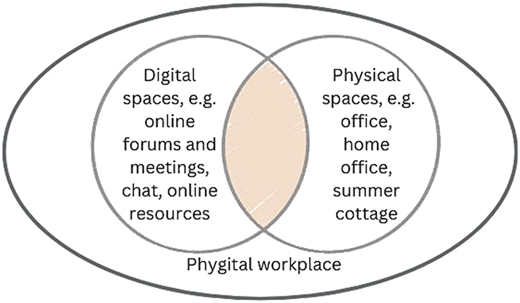
We conducted digital ethnography in one workplace, collecting data during the years 2021–2022. The target workplace was one unit of a public sector training organization in Finland comprising 70 staff members. The first author was responsible for the fieldwork. The work in the target organization was distributed to two offices in two locations, as well as remote work from home or, in some cases, other locations, such as a summer cottage. Part of the data collection took place during the COVID-19 pandemic lockdown when all staff worked remotely. As distributed and remote work were already common practices in this workplace, the pandemic situation did not change their work as significantly as it did in some other workplaces. Digital environments were a natural part of the staff’s everyday work and enabled collaboration and social interaction in this kind of distributed work context. The focus of this study was on digital environments; however, to acquire a more comprehensive understanding of the workplace, the main author also spent two days at the workplace office spaces to observe and meet the staff in person.
We set out to the field with a broad research question: to study how digital technology is used in informal workplace learning and how it can support learning. Engaging with the work environments, observing activities and conversing with informants provided us with a wealth of information about everyday work in the target workplace. With this accumulating understanding, we refined the research questions for the sub-studies, focused on identifying digital work practices that promote informal workplace learning (Karhapää et al., 2023) and producing accounts of the complex digital environment of knowledge work to reflect how it can expand or restrict informal workplace learning (Karhapää et al., 2024). The fieldwork conducted in this phygital workplace provided us with valuable insights.
Being an ethnographic researcher in a phygital workplace
In our study, the fieldwork comprised the researcher engaging with selected digital workplace environments and interacting with the staff. Gaining access is one of the first challenges that an ethnographer faces, and accessing organizations’ digital environments can be difficult. As Mazzetti (2016, p. 311) observes, entering an organization is not about gaining short-term access, “but rather asking an organisation to commit to a more long-term and more intensive (and perhaps intrusive) relationship”. In our study, the contacts that the researcher established through previous collaboration with the workplace assisted in gaining access, which needs to be negotiated and often renegotiated along the way. In the present study, entering the various digital environments required first negotiating with the gatekeepers, managers and employees. The work community discussed the research together before admitting the researcher.
The digital work environment was not a single space that the researcher could enter, which made access a complex process. Instead, it encompassed various digital platforms, groups and online discussions. The researcher could not gain access to all of them, and for those that were accessible, separate permission was required for each. Entering the digital environments of the workplace and collecting data required careful ethical consideration. The new ways of “being in fieldwork” raise ethical concerns about the sites and boundaries of research (Horst, 2016). The researchers needed to consider how and which online environments to enter, as well as how to take field notes from diverse online environments, determine what data are ethically sustainable to use, obtain informed consent and ensure the informants’ anonymity. Entering the workplace’s shared online forums and meetings was relatively straightforward, but the digital environment also encompassed various private groups and conversations, as well as external environments used for more personal purposes, such as social media. The researcher could not access these directly due to ethical and privacy issues.
Technological skills are a requirement for researchers heading into the digital field. In our study, the first author, responsible for the fieldwork, was already familiar with both the work context and the digital technology used in the target workplace, which proved to be an asset. This facilitated understanding and working in the field.
The initial fieldwork phase involved mapping and constructing the field for the study. The first task was identifying the types of online environments the staff used in their work and work-related learning. The researcher agreed with the managers to participate in an online meeting to introduce the study to the work community. One of the managers added the researcher to two Yammer forums, which were the primary digital environments for internal discussion and social interactions at the time. These became the entry points into the field and data collection. As the research progressed, interviews and informal discussions provided additional insights that helped the researcher identify other relevant research environments. For example, an interviewee discussed a Teams chat discussion thread that played an important role for many employees. The thread was related to new software, which altered their work and elicited numerous problems. In the thread, the staff discussed and solved these problems together. This interview excerpt demonstrates how the informant suggested that the thread might be of interest to the researcher and provided useful information about their use of technology:
But if you want this informal learning and such that the use of technology promotes, then our Teams [group chat], because it’s so active because people are desperate [laughter] and information is transferred constantly in there, and it isn’t based on any guidelines, but on asking from others – help; what should we do? It started during the most acute [name of the new software] week, and it just continued from one such meeting, and there’s constant discussion, so it could also be quite interesting.
This interviewee also informed the researcher about a person from whom she could request access to observe the chat thread. After gaining access, the researcher informed the group of her presence and observation process by posting in the thread. The researcher also sought to participate in online meetings, a regular part of the staff’s daily work. However, to do so, she first needed to find suitable meetings through information gathered from observations of online forums or interviews and then request a link to join.
The gatekeepers of the organization and the staff generally expressed positive attitudes towards the research, which made entering and being in the field easier. The researcher’s presence in digital environments was noted but did not seem to affect staff behavior, i.e. they continued their everyday work and interactions normally. On some occasions, they joked about the researcher’s presence in the context of their own actions, as this excerpt from field notes while observing online meetings demonstrates:
The presenter noted that there was an issue with Mentimeter, as she could only display one slide at a time. She turned off the sharing, made some adjustments and remarked that, of course, this happens right when the researcher is present. Laughter of participants.
The researcher usually remained in the background while observing in digital environments. One exception to this was the virtual coffee breaks held during the COVID-19 lockdown, which provided opportunities to meet colleagues and conduct informal conversations. During these gatherings, participants often invited the researcher to join conversations, either to inquire about the research or discuss other topics. The following excerpt from the field notes describes the researcher’s feelings:
Just like in the previous virtual coffee breaks, I felt included as one of the people. I am not an outsider as a researcher, but one of the group. They ask how I am doing, how the research is progressing and in turn, I ask them how they are doing.
Emotions are part of an ethnographic study, and the researcher may experience various feelings during the process (Mazzetti, 2016). This also applies in digital fields. For example, there was uncertainty when the researcher entered the digital environments in terms of how the staff would react and how to participate, collect valuable data and identify what is relevant regarding informal workplace learning. While technology-mediated interaction often lacks many elements, such as fully seeing people’s facial expressions and gestures, digital technology enables new ways to express emotions and opinions through reaction features. These were a natural part of interactions within the workplace under study. Observing them provided useful information for the researcher. The reaction functions also served as a means to communicate with the researcher, as this excerpt from the field notes demonstrates: “I informed in the chat that I was observing as a researcher, received five likes and one laughing emoji in response”.
Collecting and analyzing the data
We collected data over two years, which included several periodic data collection phases. This long data collection period provided a chance to observe everyday work practices and notice changes in digital technology, along with their impact on work practices and, consequently, on informal workplace learning. The data we collected comprised observations, semi-structured interviews, informal conversations with the staff and participant diaries in which they reflected on their everyday use of digital technology and learning. A more detailed description of the data is provided in Table 1.
Research data
| Type of data | Data collection period | Number of pages |
|---|---|---|
| Observations: | ||
| March 2021–September 2022 | Field notes: 24 pages and two screenshots |
| March 2021–December 2022 | Field notes: 44 pages and three screenshots |
| 23 November 2022 and 29 November 2022 | Field notes: five pages |
| 15 interviews (14 individual interviews, one group interview with the management team) | February 2021–December 2022 | 176 transcript pages |
| Seven participant diaries (Word documents) | Two weeks during March 2022–June 2022 | 35 pages of text and pictures |
Digital ethnographers can study informants’ online activities and be co-present with them in the digital research setting in two ways (Akemu and Abdelnour, 2020; Kulavuz-Onal and Vásquez, 2013). First, the digital environment can provide archival data in which informants’ actions are documented so that the researcher can revisit them later. Second, the researcher can participate and observe activities and processes taking place in real time. We used both approaches; thus, the researcher could obtain important information about what was happening in the target organization, see how the discussions proceeded and benefit from the method’s flexibility. The researcher engaged with the digital work environments by regularly reading selected online forums and chat discussions later or in real time. Participating in online meetings and other informal gatherings provided real-time observational data. Online meetings provided multichannel interactions, in which the researcher had to follow written and spoken interactions (Kulavuz-Onal and Vásquez, 2013). The reaction buttons in Teams, emojis and pictures further increased the multiformity of communication.
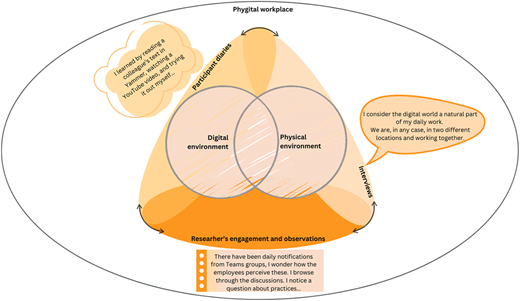
We used method triangulation (Hammersley and Atkinson, 2019) to gain a better understanding of the participants’ perspectives and activities that were not visible through observation alone. The interviews, participant diaries and informal discussions complemented the researcher’s observations, providing us with deeper insights. Observing the digital environment can leave out much relevant information about people’s behavior. For example, researchers observing online forums can see only activities that become visible there, such as writing or using reaction functions. Actions such as reading or actively following information on various channels remain invisible; therefore, method triangulation was essential.
As we explained, informal learning in digital environments is a challenging phenomenon to capture and study. Doubts and uncertainty surfaced at the beginning of the fieldwork, e.g. how would the researcher identify instances of informal workplace learning in the digital environments? The researcher entered the digital fields, began to follow the interactions there and wrote down her observations, preparing to adjust the method if necessary. One observation soon provided the researcher with confirmation and helped her develop the method – a Yammer discussion in which an employee asked whether they have an electronic evaluation form in shared use. She received an answer from a colleague with instructions on how to use the shared form, to which she replied, “This was the best lesson of the day; it makes things so much easier. A BIG thank you!” The conversation was very mundane, yet essential, as the researcher reflected in the field notes:
I would not have considered the learning perspective in this seemingly mundane question if the message writer had not mentioned it. However, for the person asking the question, receiving a ready-made template for their own use will certainly save work hours and effort, as they do not have to create the form themselves. Therefore, it is important information for their work.
The researcher emailed the employee, asking whether she could use a screenshot of this conversation. The employee replied, granting permission and reflecting her learning: “I remember this now, and indeed, it’s rare for a matter to be resolved so quickly just by asking (utilizing shared understanding and experience). The learning aspect here was that I learned how the old, previously used method had changed to a new one, and it connected to the right context for me”. This experience helped clarify the focus of the observation and confirmed that it was essential to combine the researcher’s observations with the interviews and diaries.
We conducted the interviews online. Thus, it was essential to consider how the medium affects the nature of the interview (Kulavuz-Onal and Vásquez, 2013). We used Microsoft Teams for the interviews, a platform the participants use daily and are thus familiar with. Therefore, interactions during the interviews were easy and natural. The interviewees were selected from all job positions in the workplace, including training officers, secretaries and managers, with both newcomers and more experienced employees interviewed. The researcher contacted the staff via online forums and emails to ask for volunteers to participate in the interviews. The researcher had predefined themes that guided the interviews, but otherwise, the discussions proceeded openly, allowing the interviewees to discuss their work and use of digital technology freely. The interviews became more in-depth as the research process progressed. Initially, they were used to map out the types of digital environments related to work and how the researcher could gather information about people’s activities within them. Later, they delved deeper into discussing significance and impact of digital technology on people’s activities and learning.
The interviews complemented the researcher’s observations. For example, the researcher and the informant examined online discussion threads together, with the researcher asking the informant to explain their reactions and perspectives. During some interviews, the researcher asked the informant to provide their perspective on the digital environment, such as what their Teams looked like and what kinds of chat discussions they had. Through the informant’s descriptions, the researcher could get a glimpse into digital environments that she could not access directly and, thus, obtain information without compromising privacy or confidentiality. In addition to arranged interviews, the researcher had informal discussions with the staff to receive information from them, such as by asking for more information via email or when meeting with them.
Furthermore, the diary method complemented the researcher’s observations, thereby providing the participants’ situated perspectives and contributing to the overall analysis of the use of digital technology in informal workplace learning. Diaries were collected from volunteer employees (n = 7). The researcher informed the work community about the collection of diaries and volunteers signed up using an online form, from which the researcher collected the necessary background information and permissions. The writing period was kept relatively short (two weeks) to alleviate the burden on participants, and guidelines for writing the diary were short and open-ended. The guidelines are available as supplementary material. The participants reported and reflected on their everyday learning and the use of technology in their diaries. The informants could provide short “snippets” of information during their workday at times that best suited them and as many times as they wanted during the two weeks they kept the diaries. The participants could include pictures, such as screenshots, to enrich the text and provide more detailed contextual information. The diary entries were written as online Word documents shared with the researcher. This allowed for easy access and fluent use for both the participant and the researcher, enabling interaction. The researcher timed an intensive observation period to the diary-writing period and used the opportunity to ask for more information or reflection about an event or online discussion observed by using the comment function in the online document.
Digital diaries are particularly suited for gaining insights into digital work practices and participants’ reflections on their learning (Jarrahi et al., 2021; Pöysä et al., 2003). In our study, the quality of diaries varied in terms of how much information about informal learning they provided. Some informants reflected more deeply on events and activities during the workday, while others wrote very briefly and quite mechanically about what they were doing without any deeper reflection. What kinds of activities the participants linked to informal workplace learning and how they recognized their learning also varied. Whereas for some, it largely related to seeking information online, others recognized how they learned, for example, in online meetings by listening to or observing others by following online discussions. The diaries alone would not have provided sufficient data to study informal workplace learning, but combined with other methods, they enriched the data. The following excerpt from the researcher’s field notes demonstrates how the researcher could combine her observations with the diaries:
[One of the staff] shared an announcement about an upcoming ThingLink training. The post received 4 likes and one comment about a conflicting meeting. This message and the training have been noted and reported in [a participant’s] diary. She immediately started considering how to use this tool and initiated discussions about it.
An excerpt from the diary reveals the reactions that this short announcement about training caused:
[One of the staff] had recommended a ThingLink training on Yammer. I checked the link to see what it can do. I got excited thinking that the promised presentation [to collaborators] could be done using this tool. I put forward the suggestion on Teams and Yammer to see if it catches on. I signed up for the recommended training.
Merely examining the announcement on the online forum would have provided very little information. The post had received only a few likes, and if its impact had been measured based only on this easily datafied information, it would not have seemed to exert much of an effect. However, the reflections in the diary revealed that this post caused many reactions, including interest and actions to learn more, excitement about new possibilities and discussions with colleagues.
In addition to observing in the digital environments, the researcher spent two days in the workplace observing and conversing with the informants face-to-face. This added to the holistic understanding of the workplace and the use of digital technology. The informants’ physical environment was not limited to the office space but was more versatile, including home offices and summer cottages. Although these locations were out of the researcher’s direct reach, the participants provided information about them during interviews or online meetings that the researcher observed. For example, one interviewee described her work environment at home, highlighting the importance of having a proper working environment and equipment:
[I] invested in buying two monitors, my own docking station and all the necessary equipment so that my home working conditions are better than at the office. […] My situation is that my child has moved out, but I have two furry assistants who sometimes interrupt my meetings when they start communicating with the squirrels in the yard. However, I have my own office, it would be a different situation if I had to share it with the family and if you would have only the kitchen corner.
Another interviewee talked about digitalization’s significance and role, including how it allows work tools and tasks to function flexibly, thereby also blurring the line between work and personal life:
At home, I have a functional workstation with the screens and all the gadgets. I also have Teams and work email on my personal phone because if I need to book something for the kids, like dentist appointments or other things, I have to put it in the work calendar. I don’t want to open my work computer just for that, and it doesn't bother me in terms of managing my life to have these on my personal phone.
Hybrid meetings, in which some staff attended from a meeting room and others remotely from their computers, created new phygital spaces. It made the work environment even more versatile and created new possibilities but also challenged practices, as this excerpt from the researcher’s observations in the workplace reveals:
Before the meeting, people start gathering in the break room and from there, chatting, they move to the meeting room. The leader opens the event and gives the floor to the first speaker. The first speaker asks for thumbs-up reactions from those online, but is told that those present in the room cannot see them. The technology does not yet support hybrid meetings, nor do the practices in all respects. Those present focus on listening, one has a laptop open, some with a phone or a pen and notebook. Two are knitting. Another one opens a laptop, and one occasionally uses a phone.
The information gathered about the various working environments demonstrated how fundamentally the digital is connected to the physical. Digital technology always is used in some physical space, and that space’s conditions can affect the experience of the digital. This applies to informants as well as researchers in phygital fields.
By being in the field, the researcher developed a holistic understanding of the workplace and its environments and practices. Following the fieldwork, a detailed analysis of the rich and versatile data provided us with more detailed answers to our research questions. As Hammersley and Atkinson (2019) point out, no formula for analyzing ethnographic data exists, as it is an explorative process in which analytical ideas develop from the beginning of data collection. This involves abductive reasoning by moving back and forth between data and theory to identify patterns or themes. Therefore, it was essential for the researcher to document her reflections and evolving understanding in a research diary, which helped us keep track of the research process and develop analytical ideas. We used Atlas.ti software to manage and analyze versatile data. With Atlas.ti, we coded the data and linked the three different types of data together, for example, the observations of the researcher and the reflections of an informant. Method triangulation assisted us to capture and analyze the multisitedness of work and learning (see Figure 2).
Challenges and limitations of digital ethnography for researching a phygital workplace
The previous sections demonstrated the opportunities that digital ethnography provided for studying knowledge work in its versatile environments. However, the methodology also entails challenges and limitations that we will examine next.
Ethnography aims to study a chosen community from within and understand its perspective (Hammersley and Atkinson, 2019). This requires building a confidential relationship with participants, and researchers need to consider how they can ensure confidentiality and anonymity for participants and the organization. While digital ethnography provided an opportunity to collect rich, multimodal data, ethical and privacy aspects restricted data collection, requiring careful consideration and adherence to established procedures. As we explained, gaining access required negotiation with the work organization and individual workers about each digital environment or group the researcher wanted to enter. In some cases, access was denied. An example was a team chat discussion to which the researcher requested entry. The team discussed the request and decided that their discussion’s content often was related to their customers; thus, they opted to protect these customers’ privacy by denying the researcher access. In other cases, the researcher excluded digital environments or groups suggested by informants because these groups included collaborators from other organizations who had not been informed about the research.
A researcher conducting ethnography in a digital field has several opportunities to record their observations. In digital environments, field notes might even seem to “write themselves” when “participants natively produce field notes”, for example, by writing in an online forum (Nardi, 2016). Capturing data in a screenshot or copying the text from an online forum into field notes records not only the text but also time stamps, emojis, use of reaction functions and the overall nature of the environment. This can be useful information, but in our study, the researcher decided to gather data mainly by writing field notes herself to minimize collecting personal data or an organization’s confidential data. Thus, the researcher determined what information was needed and was ethically acceptable to collect. In the field notes, the researcher copied links to original conversations on digital platforms, which enabled the researcher to return and check details if necessary. The researcher collected some screenshots but asked permission from those involved to use them.
The researcher’s online presence is another aspect to consider: How to be visible in digital environments, or can the researcher remain an invisible observer? Ethnographic data can be collected by “lurking” offline or online; however, we decided to conduct overt research to gain and maintain the trust of the organization and staff (Hammersley and Atkinson, 2019). Presence in online environments remains easily unnoticed unless one engages in activities that make one noticeable, such as writing in a forum or a chat. When a researcher joins an online discussion forum for a more extended period to observe it, the members of this online community might forget about the researcher’s presence. As new members join, they may not receive information about the research. To announce and remind members about the researcher’s presence online, she occasionally posted reminders about the research in the online forum she observed.
Technological barriers can cause problems in the fieldwork, and the rapid change in digital technology poses a challenge for the researcher to keep up, adapt their research accordingly and update their skills. During our research, we noticed technological changes in the target workplace. New technology was introduced, and the use of digital technology changed. For example, Microsoft Teams was adopted, and some activities and discussions were moved there from Yammer, which was, until then, one of the main elements of the digital field. As the researcher noticed that the discussion in Yammer was not as active and that the informants often mentioned Teams, she began finding out how to extend the digital field to this new platform. This involved negotiating entry with managers and informing the staff, and it required the researcher to familiarize herself with this new environment and adapt the fieldwork accordingly.
Furthermore, managing and analyzing the data can be challenging. The data can be versatile, multimodal and accumulate in large amounts – one critical feature of today’s ethnography – and it can be demanding (LeCompte and Goetz, 1982; Hammersley and Atkinson, 2019). How the researcher filtered this accumulating data while collecting it was crucial. The researcher focused on gathering information relevant to the research questions. This approach integrated data collection, analysis and reflection.
An ethnographic account that produces knowledge about the phenomenon investigated is always a construction involving selection and interpretation by the researchers (Hammersley and Atkinson, 2019). Achieving absolute validity and reliability is an impossible goal for any research model, but various strategies can be used to reduce threats. This has also become a significant source for one of the defining features of today’s ethnography – its multimodality (LeCompte and Goetz, 1982). Triangulation – i.e. using multiple sources, methods and perspectives – is essential when reflecting on results.
The multisitedness of work in the target workplace posed a challenge. It is impossible for a researcher to be present in all locations of a modern work environment, which is dispersed across several physical and digital spaces. Consequently, the researcher must find accessible sites for participation and augment their understanding of other environments that lie beyond their direct reach through information obtained from the study’s participants. While digital ethnography proved effective for our study, hybrid ethnography, in which a researcher also engages more with the physical locations of work, may be a more suitable methodological choice when the research interest is focused equally on both physical and digital elements of the work or workplace.
Concluding reflections
In this article, we illustrated how digital ethnography served as a methodology for studying modern knowledge work that takes place predominantly in digital environments. We began by explaining how we approach the workplace as a phygital environment, in which various digital and physical environments are combined. We set out to our research field – one workplace – to study how digital technology is used in informal workplace learning. While our primary focus was to engage with digital environments, it became evident during the study that the workplace is a complex environment in which digital and physical environments are interconnected. Digital environments form a crucial element of contemporary knowledge work. However, digital technology is always used in a physical space, whether it is an organization’s office space, a home office, a cafeteria or some other place. As Grigoryan (2024, p. 19) notes, “We should not forget that online practices do not exclude offline experiences and that both the ethnographer and the study participants physically exist in offline spaces”. Therefore, approaching the workplace with a holistic and multisite perspective is essential. By approaching workplaces – and, thus, our research field – as being phygital, we can transcend the online-offline dichotomy and adopt a more holistic perspective.
We discussed constructing the fluid and emergent research field and collecting the diverse data, illustrating how we used method triangulation to implement multisitedness and gain a better understanding of the participants’ perspectives and activities not visible through observation alone. Finally, we reflected on the challenges and limitations of digital ethnography, which include gaining access, ethical and privacy concerns, the amount of work required and the necessary technical skills. Even though it is a methodology that requires considerable work, the benefits are notable. Figure 3 depicts digital ethnography’s multidimensionality as a methodology, including points that can be associated with both advantages and challenges in phygital sites.
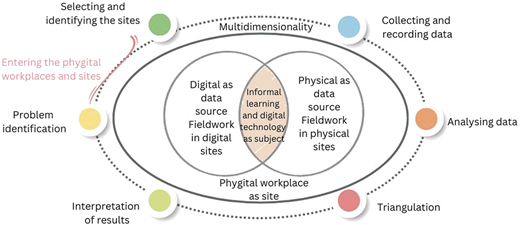
As modern work has become dispersed to various spaces, digital ethnography not only can deal with epistemological changes, such as how to capture data from these spaces, but also can help understand ontological shifts related to redefining work and the workplace. By using multiple methods – i.e. observations in digital environments and the physical workplace, interviews and participant diaries – we were able to implement multisitedness methodologically and empirically, as Becker and Roessingh (2024) suggest. Our approach acknowledges multisitedness not only from the researcher’s perspective but also as experienced by the informants. Through digital ethnography, we established co-presence within the dispersed field and captured the multisitedness more holistically. At the core of our research was a commitment to understanding the informants’ local everyday lives, essential for organizational ethnographers studying modern dispersed work, as highlighted by Skovgaard-Smith (2024). By combining the researcher’s observations with the informants’ perspectives, we could understand how work is spatially scattered and the interactions and relationships are formed and maintained not only in physical settings but also in digital environments of work.
Digitalization of work necessitates developing research methods for studying work and workplaces. To study modern workplaces, different ethnographic approaches, such as digital or hybrid ethnography, are beneficial. Digital ethnography often has been used to study online communities, but it is not limited to this, as our study demonstrated. It is broadly applicable to researching the impacts of digital technology on people’s lives, and it can be used to study communities that have both digital and physical dimensions, such as modern workplaces. Implications for future ethnographic research on workplace contexts, based on the insights gained from our study, include recognizing that workplaces have both physical and digital elements that often are intertwined. Thus, researchers studying a workplace should consider both dimensions.
In conclusion, flexible and explorative digital ethnography can serve as a methodology for studying modern workplaces and understanding their complexities. It enables capturing everyday mundane activities and the meanings behind them. For instance, it can provide information about the effects of digital technology on work, about work processes, practices, people’s experiences and organizational culture and produce a holistic understanding of a workplace as a phygital environment. Digitalization and datafication provide large amounts of data through which researchers and organizations can study and evaluate work-related activities (Leonardi and Treem, 2020). However, many aspects of human experience remain invisible and are not so easily datafied. We argue that digital ethnography can offer valuable insights by integrating data from digital environments with people’s perspectives and is, therefore, particularly suitable for studying contemporary workplaces.
Funding: This research was funded by The Finnish Cultural Foundation.
References
Supplementary material
Karhapää, A. (2025). The guidelines for writing a diary. Zenodo. https://doi.org/10.5281/zenodo.14898576.

