

To further develop research methodologies for multi-species ethnographic fieldwork, based on researcher's experiences with multi-species fieldwork in private wildlife conservancies in South Africa and inspired by San tracking techniques.
Reflections on methodological lessons learnt during multi-species ethnographic fieldwork in South Africa. The approach is rather “Maanenesque” in telling various types of tales of the field. These tales also implicitly show how all-encompassing ethnographic fieldwork and its accompanying reflexivity are; there is never time for leisure in ethnographic fieldwork.
That developing fieldwork methodologies in multi-species ethnographic research confronts researchers with the explicit need for and training in multi-sensory methods and interpretations, inspired by “the art of tracking” of the San.
Comes up with a concrete suggestion for a sequence of research methods for multi-species ethnography based on the trials and tribulations of a multi-species ethnographer's experiences in South Africa and inspired by San tracking techniques.
Introduction
The consequences for the research practices of an organisational ethnographer (cf. Yanow and Geuijen, 2009), trained as a social and cultural anthropologist, of following the scientific evidence showing that human and animals only differ in degree and not in kind (Andersson Cederholm et al., 2014; Wels, 2015) are quite remarkable and challenge a deep-rooted anthropocentrism in the social sciences. ‘The social’ and ‘sense making’ in our research, which we silently considered the superior and exclusive domain of humans, must now be expanded to include and integrate non-human animals [1]; we have to find ways to figure out ‘(h)ow humans and animals co-constitute the world’ (Hamilton and Taylor, 2017, p. 2, italics in original) and challenge the ‘(c)olonial logics of hierarchizing non-human life’ (Kirbis, 2020, p. 1). Vinciane Despret explains how fundamental this ‘species turn’ (Kirksey and Helmreich, 2010, p. 545), this paradigm shift towards inclusion of non-human animals is as follows: ‘For a long time, it has been difficult for animals not to be stupid [bêtes], or even very stupid. […] The literature today, in our time of rehabilitation, is pulling them [animals] out of their relative obscurity in the same way as it prepared the case of all those who made the animal into a soulless machine’ (Despret, 2016, p. 7). Despret suggests here that, in most corners of human-animal studies, the Cartesian human-animal binary may no longer need to be problematized, but the critique still needs to be taken to its ultimate conclusion; that is to say, the human-animal binary must be ‘done away with’ (cf. Calarco, 2008, p. 147). This is not to say that humans and animals are the same, or that their experiences and sense making processes can simply be equated: ‘To say that two things are comparable is not to say that they are identical’ (Row, 2016, p. 35). But banishing our feelings of human superiority may help us to see, hear, and understand our non-human other better and in very particular ways, because as Michael Foley observes: ‘The price of superiority is blindness, deafness and ignorance’ (Foley, 2012, p. 172). In that sense, the ‘species turn’ can be seen ‘as a form of resistance’ (Hamilton and Taylor, 2017, p. 82). But what are the methodological consequences of challenging this ‘problematic of power’ (Hamilton and Taylor, 2017, p. 3) of human superiority and including non-human animals as fellow sense makers, alongside humans, in organisational ethnographic fieldwork? What are the methodological challenges in ethnographying non-human animals?
There is good reason to be explicit and reflexive about this methodological transition. Since my PhD, in 2000, I have been researching processes of organisational cooperation and conflict in the private wildlife conservation sector in South and southern Africa. During my research, non-human animals, i.e. wildlife, were a constant in the organisation, but they never featured in my empirical data from the field, or in my analysis and publications. Only in 2013, after many years of catching up on reading academic and other texts on human-animal relations, did I dare to start publishing on human-animal relations in my own right (Wels, 2013). In an article for this journal in 2015, I auto-ethnographically reflected on my intellectual trajectory and ‘animal turn’ to try and integrate non-human animals in my ethnographic research and what that meant for re-evaluating my earlier publications on private wildlife conservation in Africa, especially my PhD thesis (Wels, 2015). From 2015, I actually tried to redesign my organisation ethnographical fieldwork in private wildlife conservancies in South Africa towards a multi-species approach. For example, in addition to the familiar humans in my fieldwork, I attempted to include non-human animals as fellow sense making, sentient beings. In my case and context of private wildlife conservation, it meant that I was granted access to a private wildlife conservancy in South Africa that rehabilitates and ‘rewilds’, white lions [2]. In 2016, I spent an initial period of three months in the field trying to train and practice myself in what it means to study animals, in this case white lions, alongside humans. I had no previous experience, for instance, with how to find the lions in the bush in the first place. In this conservancy, this was done with telemetry as the mature lions and lionesses are all collared. But even with the help of telemetry it proved to be much more difficult to get visuals of them than National Geographic documentaries suggest! And if you do find them and get visuals of them, what next? In other words, how to systematically observe and record what you (think you) see, hear, and smell? Then, following the research trajectory sequence, how do you interpret and make sense, in a more theoretical way, of your empirical data? How do you interpret sense making capabilities to these lions? And how do you integrate this with the empirical data on that other key species in this multi-species ethnography, humans? Fieldwork in 2016 was followed by more visits to the white lions in subsequent years, during which time I continued my methodological (re)training. A first chapter based on this fieldwork appeared in a book on ‘sentient conservation’, in which I tried to bring together multi-species empirical data on white lions, research methodologies and theory (Wels, 2018). The introductory chapter to the book makes clear that, like Calarco (2008), this volume's editors ‘do away with’ the distinction between humans and animals and that ‘(n)ature conservation in southern Africa is a phenomenon which is characterised by an interplay between Capital, understanding of Morality, and forms of Militarism, that are all dependent upon the shared subservience and marginalization of animal and certain groups of people in society’ (Gewald et al., 2018, pp. 3-4, italics added). No distinction or hierarchy is made between humans and animals in processes of power abuse, violence and exploitation (cf. Rust and Taylor, 2016, p. 653).
In this article, I endeavour to show how I try to find answers to some of the methodological complexities of adjusting conventional human-centred fieldwork approaches in organisational ethnography towards a multi-species ethnography (i.e. including non-human animals as sense making actors and agents alongside humans in organisations, cf. Hamilton and Taylor, 2012, 2017 [3]; Locke, 2017 [4]). My answer, based on reflecting on my own process of transition as a result of my ‘species turn’ in organisational ethnography, is (1) suggesting what I label as a ‘multi-species ethnographying sequence’, akin to the well-known ‘empirical cycle’, based on an analogy between San tracking skills and ethnographic fieldwork and, following from this first point, (2) the incredible amount of field training and experience it requires to even start mastering tracking/multi-species ethnography [5].
In order to explain the fieldwork and the analogy, to get a sense of ‘tracking as literacy, analysed through conventions of storytelling, involving participant observation in the field …’ (Tomaselli and Grant, 2019, p. 191), I narrate on the nitty-gritty of multi-species ethnography' in the field (bush), trying to track lions in order to observe them, and I will also share some of my more general experiences tracking ethnographic data on non-human animals. For this paper, I will limit my focus to non-human animals and consciously omit my ethnographic fieldwork on the human animal in this conservancy.
Ethnographic fieldwork [6]: the ‘art of tracking’ [7]
With strong social-Darwinist disdain and ruthlessness, European imperialists and colonialists have always looked down upon the San in southern Africa, from the day the newcomers arrived on the shores of southern Africa (Gordon and Sholto-Douglas, 2000). Nevertheless, Louis Liebenberg (1990a) argues that it is amongst these oldest inhabitants of the region (if not the world) [8] that science originated, as a result of their incredibly sophisticated tracking techniques in the bush [9]. According to Tomaselli (2017) the San could only survive and make a living because of their multi-species orientation. With a sense of irony he writes: ‘While the bodies of knowledge and associated bodies of practice relating to multi-species ethnographies are relatively new in the Western academic enterprise, they have, of course, a long history amongst indigenous people who relied on their knowledge of the environment and fauna and flora, the seasons, climate, and astronomy, for their survival and livelihoods’ (Tomaselli, 2017, p. 9). Just imagine a San hunter following a spoor [10], based on all his (women do not hunt in San society) senses – smell, sound, sight, touch and taste – and, while following the spoor, i.e. finding various bits and pieces of evidence ( ‘data’) that literally give a sense of direction and where to find the animal, he must constantly interpret these findings and hypothesise about where the animal can be found. The ability ‘(t)o interpret tracks and signs trackers must project themselves in the position of the animal in order to create a hypothetical explanation of what the animal was doing’ (Liebenberg, 1990a, p. v, italics added). The hunter's hypotheses and tracking skills are confirmed (or not) when, ultimately, he finds the animal (or not).
I concur with Liebenberg's overall argument that the San hunter is acting in ways that, nowadays, we call scientific: The perfection of his tracking skills (multisensory observations), by ‘becoming with’ [11] the animal he is tracking down, complemented by a solid knowledge and understanding of the (individual) animal's behaviour, and, finally, a combination of strong imaginative, interpretive, and logico-deductive capabilities (taken together here as reflexivity). Only by deploying all three elements of this ‘scientific’ approach will the hunter find the animal and thus prove his earlier hypotheses to be right (or wrong) about where the animal may have gone. This sequence can also be used for doing multi-species ethnography, the ‘multi-species ethnographying sequence’ or in short ‘OBR’ (i.e. Observations, Becoming with, Reflexivity).
Reading this argument so far it may be quite easy to follow, but to illustrate and prevent that ‘the skilled practices are trivialized’ (Tomaselli and Grant, 2019, p. 194) and getting a feeling and appreciation for the complexities of San tracking/hunting with concrete examples, we return to Liebenberg. First of all, tracking requires, next to detailed observational skills, very refined interpretive skills. Liebenberg opens his book on tracking as follows: ‘According to a popular misconception, nature is ‘like an open book’ to the expert tracker and such an expert needs only enough skill to ‘read everything that is written in the sand’. A more appropriate analogy might be that the expert tracker must be able to ‘read between the lines’. Trackers themselves cannot read everything in the sand. Rather, they must be able to read into the sand. That is to say, to interpret tracks and signs, trackers must project themselves into the position of the animal in order to create a hypothetical explanation for what the animal was doing’ (Liebenberg, 1990a: v), ‘(…) where they [the animals] would have gone were they [the trackers] the animals’ (Tomaselli and Grant, 2019, p. 196). Tracking and ‘becoming with’ is not strictly empirical, since it also relies heavily on the tracker's imagination, just like everyday science is not only a product of objective observation of the world through sensorial perception, but also requires serious human imagination, analogous to how tracking is the product of combining empirical data with human resourcefulness. A creative hypothesis does not await discovery in the outside world, but springs in the human mind. As it is unlikely that many people in our urbanised and ‘modern’ (Western) world still have an active knowledge of tracking, I want to take the reader on a short journey to try and metaphorically ‘become with’ a tracker and achieve a sense of ‘embodied empathy’ (Aaltola, 2018) for the incredible complexities of the art of tracking. Moreover, I hope to demonstrate that these complexities simultaneously tell us something about the complexities of multi-species ethnography. To do this, I will present various spoors from books on tracking and imagine what it would mean if the uninitiated had to track them in a real bush situation. I will subsequently reflect on what this could tell us about doing multi-species ethnographic fieldwork [12].
The complexities of tracking: some examples
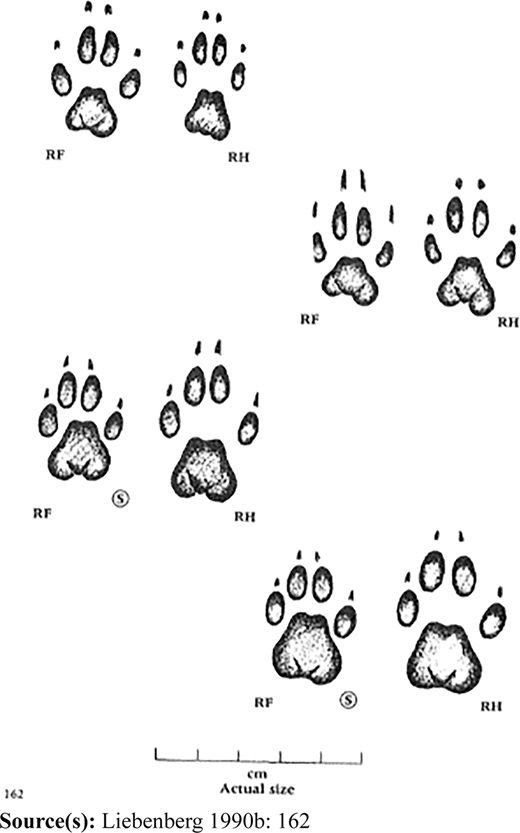
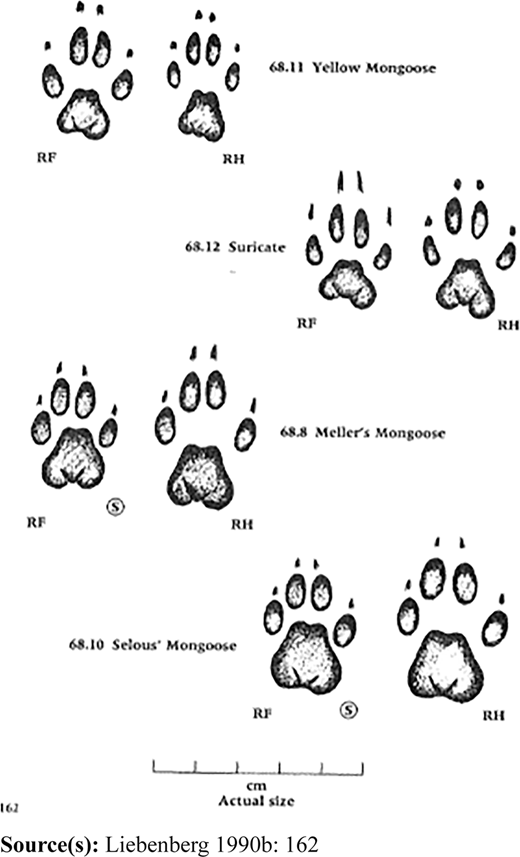
From the many spoor examples available, I have selected the following visual spoor (based on Liebenberg, 1990b [13]) of an animal many people like to see in the southern African bush, a mongoose. Not a mongoose in general or as a general label, but distinct specific sub-species of mongoose, like the Yellow Mongoose, the Selous Mongoose, the Meller' Mongoose or the cute Meerkat (suricate). Here, I present just their spoor, without further labelling, because in the bush there is no indication, label or text written next to the spoor (see Figure 1). Can you tell the various subspecies of mongooses apart?
If I now present the spoor with the names of different types of mongoose next to it. Is that helpful? For me, it is not especially useful (see Figure 2).
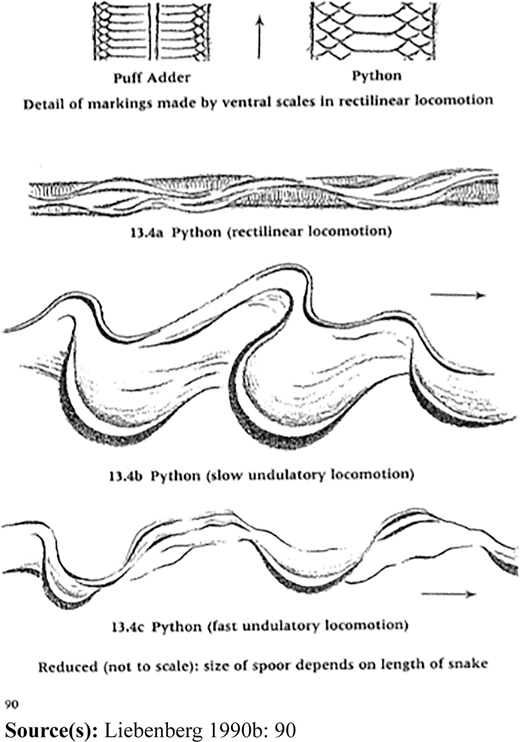
But we are still just ‘warming up’ to the complex art of tracking. Next, take a look at a more difficult track, a snake spoor (see Figure 3).
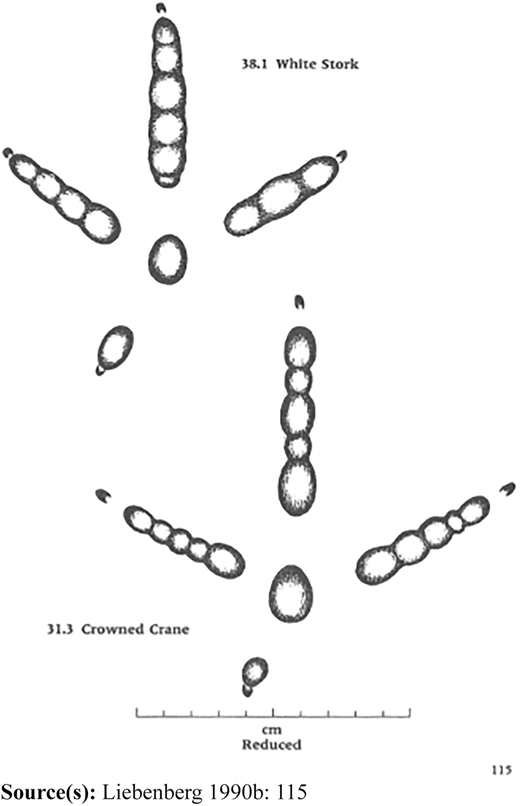
Or we can try to distinguish two different species of birds on the basis of their spoor, the white stork and the crowned crane (see Figure 4).
Finally, let us take an example close to my own fieldwork: lion spoor (see Figure 5).
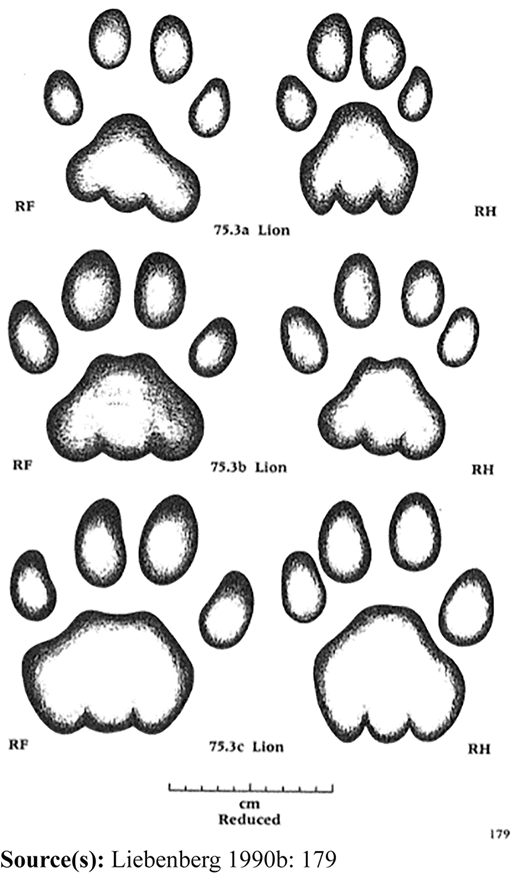
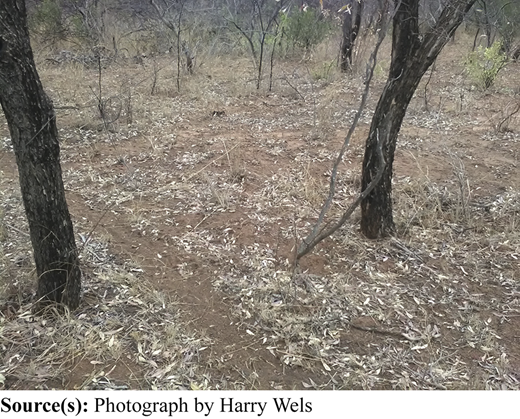
To demonstrate how incredibly complex tracking is, let us not forget that we are only dealing here with the visible spoor that you can see on the ground and not the other sensorial parts of spoor like smell, hearing or touch! In other words, there is no other sensory information interfering with your concentrated effort to read this visual spoor in its isolation on a piece of white paper, i.e. not in the confusing and distracting context of the actual bush. Like Tomaselli and Grant (2019) would argue, what is presented so far has been armchair wisdom only and what it requires in the multi-species ethnographic context is the sense and experience of ‘being there’, a textured earthiness. The visual spoor that I present here tells us nothing of, for instance, the age of the spoor, which can inform the tracker whether it is even worth the effort to try and follow it (because if it is too old, why bother?). But perhaps the biggest layer of complexity is that we rarely come across spoors that are in such a complete and undisturbed state as they are presented here on paper! Look at the following two photographs and imagine yourself in an endless savannah landscape somewhere in southern Africa (see Plate 1 and 2).
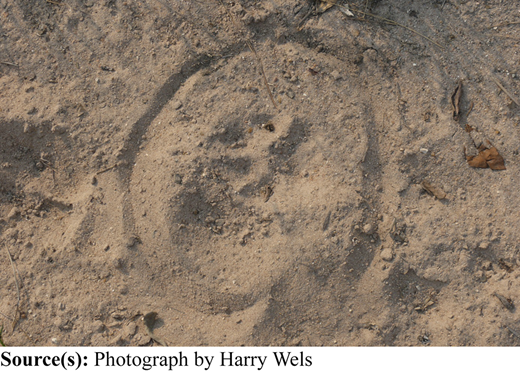
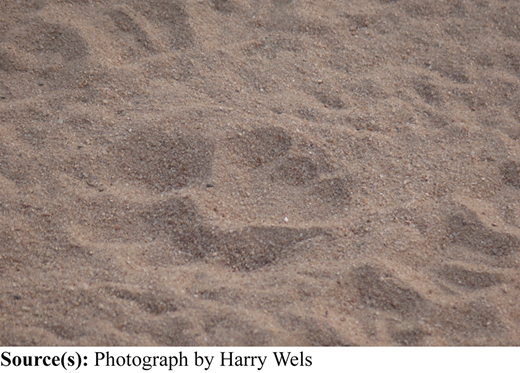
In real life, a spoor does not present itself as a perfect illustration on a page; most of the time, it is an incomplete piece of data amongst a plethora of other spoors (data) – all affected by wind, time and moisture – to be picked up by the tracker in the diverse spaces of a landscape where the tracking takes place.
Given that I identify strongly as a multi-species ethnographic fieldworker, I can testify that tracking in the context shown in the above, still rather simple, examples, can be taken as a metaphor for (multi-species) ethnographic fieldwork in a number of ways: in terms of its patchiness and its need for endless (re)interpretations of the spoor; as a metaphor for hypothesising about which direction to take; in the way that it is based on knowledge, experience, patience and perseverance; and the frustrations that come from it being incomplete. Ultimately, however, and after you ‘connect the dots beyond the available evidence’ (Tomaselli and Grant, 2019, p. 196), it is about the catharsis of finding the animal, or, in the case of (multi-species) ethnographic fieldwork, a particular understanding of combined and shared human and non-human social realities. When sufficiently trained and executed, the interrelated tracking skills of observation, ‘becoming with’, and reflexivity, distinguished above, may lead to a successful ‘data hunt’. Let us now take a closer look at each of these skills in turn, tell fieldwork stories about them (cf. Hamilton and Taylor, 2017, p. 38, a storytelling these authors later in the book call ethnography's ‘concentrated strength’, p. 175, italics in original) and what they can teach us about the practices of ethnographic fieldwork.
Tracking skills: observation
When ‘doing ethnographic research’ (Geertz, 1973) in organisations, social and cultural anthropologists usually engage in the method of ‘participant observation’ – among humans. It has become a distinctive trademark of the anthropological research approach (DeWalt and DeWalt, 2002). ‘Being there’ (Watson, 1999) and a ‘deep hanging out’ (Geertz, 1998) are considered essential for this methodology when searching for understanding of particular human social and cultural life worlds. Until 2015, my own fieldwork was based on this almost axiomatic orthodoxy in anthropological research, which had worked for me, in the sense that I could get publications out based on my fieldwork in private wildlife conservation organisations in southern Africa. It worked also in the sense that the MA and the PhD theses that I wrote were recognised as of sufficient academic quality to award me the subsequent scientific titles. Thus, when I started to ‘hang out’ with lions in 2016, I was confident I was a ‘pro’, because I had frequently done this in the past and with proven academic results. But when I switched to multi-species ethnography and specifically to lions' sense making and their relations to humans, I discovered that I had underestimated the imbalance in my application of the particular method of participant observation (among humans) over the years: I had applied a lot of participation, but devoted far less systematic attention to the observation part of the method. It showed that my ‘participation’ was so anthropocentric and logo centric – i.e. focused on participation through verbal and written exchanges among humans – that any ‘observation’ was more in name than in actual systematic practice. I wrote ‘observations’ down in diaries, but when I re-read them now, they are rather impressionistic and sketchy, lacking a systematic plan. This approach worked as long as I stuck to fieldwork amongst humans, as I could hide my lack of systematic observational skills behind a lot of words and participation. But now that I was trying to find ‘methodologies without words’ (cf. Dalke and Wels, 2016; Safina, 2015; Wels, 2012) in order to be able to study non-human animals in organisations. I was confronted with the fact that, without words, my ‘hanging out’, ‘being there’, ‘doing ethnography’ and ‘participant observation’ felt rather poor.
From 2016, then, I had to sharpen my observation skills. I was bolstered in my attempts by a most helpful book, Nippert-Eng's (2015) Watching Closely. Two particular aspects of this book chimed with my own situation. Firstly, the author argues that many observational skills can be developed by practicing ‘watching closely’ animals in a zoo, especially gorillas. While Nippert-Eng does not explain why gorillas in particular are a good species to (train to) observe, she rightly tries to move beyond the anthropocentrism in the social sciences, given the scientific evidence showing the differences between humans and animals only in degree, instead of being in kind [14]. The second reason for my enthusiasm for the book was that it provided nine observation exercises and, as I was about to embark on a three-month sabbatical in the field, among the white lions in South Africa, it was the perfect opportunity to actually do the exercises, rather than just read them.
In addition to guidance from an academic book, I got many helpful suggestions and lessons to improve my observations from various people that were raised in the African bush and who had spent their entire lives observing (and participating in) the veld and its animals. These lessons were not all received during the course of the specific fieldwork period in 2016. I received this valuable advice from various, mostly non-academic, people over years of fieldwork in South and southern Africa, always in the context of watching wildlife (in touristic contexts) or patrolling wildlife areas with Anti-Poaching Units (APU, see for instance Plate 7). Below, I want to explore the complexities of observation in relation to three particular lessons I received and to briefly link these lessons conceptually to two of our three key skills: ‘becoming with’ and ‘reflexivity’.
Lesson 1. Observing is about patience: birds in a tree
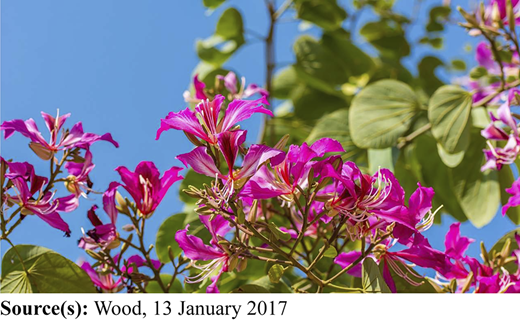
Sitting on a veranda on a citrus farm somewhere in Mpumalanga Province. In front of that veranda stands a tree, a Bauhinia, popularly known as the Hong Kong orchid tree (Bauhinia blakeana). It is a beautiful tree, not endemic to South Africa, and it is blossoming with bright pink flowers (see Plate 3).
I hear a lot of birds in it, from sugar birds to bee-eaters and grey louries, and out of the corner of my eye, I see them all moving around, but the moment I look at the tree straight on, to see them better, I don't see them anymore. After a while, I turn my eyes and attention again to my host, to continue our conversation. Leon [15], who observes me as well, tells me, ‘Harry, you are far too impatient to see anything if you continue like this’. Leon explains to me that if you want to see the birds you must watch for a longer period of time, because, initially, when you turn your eyes to them, all the birds will sit very still and give you the impression they are not there. They actually prefer not to be seen, as that is always the safer option. That is why people need to track animals, birds included, in general in order to find them. They usually don't want to be found. Philosopher René ten Bos (2008, p. 10) writes about ‘the tension between animals that want to hide themselves and people that want to expose them’ [16]. Leon explains that ‘if you keep your eyes on the tree for longer, you will see it come alive’. The proof of the pudding is in the eating, so we keep our eyes on the tree and after some 30 seconds we see some movement in the far left corner, a bird moving from one branch to another. After another few seconds, we see something happening in the middle of the tree, a bird going for the nectar of one of the delicious flowers. In the seconds and minutes that follow, the tree basically comes alive with birds and, within a matter of minutes, it has transformed before our eyes into a bird moving spectacle.
Lesson 2. Imagining what is to come: ‘Reading’ the bush
Each time I visit a wildlife area with Leon it is a steep learning curve. In 2017, we go on a drive through Kruger National Park and have lunch at Lower-Sabie camp, bordering and overlooking the Sabie River. Leon draws my attention to the other side of the river where a group of elephants is approaching the water to drink. On a sandbank in the river there are two buffaloes. Leon tells me to watch, in particular, how the group of elephants relates to these two buffaloes, who are basically blocking their access to the river: ‘The matriarch leading the group will send a young bull to chase them away. He can prove himself and the situation is settled.’ A couple of minutes later, a young bull appears and walks towards the buffaloes. He adopts an intimidating posture with his head held high and his ears flapping. The buffaloes know that it is time to leave and the bull joins the rest of the group after a job well done. Some half an hour to 45 min later, Leon again draws my attention to the river, but this time to another group of elephants approaching the water. They take the same route as the first group of elephants, who are now happily playing in and around the water. ‘Watch how the matriarch of the first group will lead her group away, while the second group waits their turn.’ About five or more minutes later, this is exactly what happens.
Seven years earlier, Leon demonstrated his mastery at ‘reading the bush’ in a contextual manner, ‘reading between the lines’ in Tomaselli and Grant's take on ‘tracking as literacy’ (2019, p. 195), revealing his upbringing and lifelong exposure to the bush. Driving slowly along a dry riverbed in Kruger National Park, Leon suddenly manoeuvres the car to the right side of the road, closer to the river bed. ‘What do you see?’ I ask expectantly. ‘Nothing, but all the impala's on the other side of the river are so intensely staring at one place that I suspect there might be something around, maybe a predator.’ He parks the car at the river bed, switches off the engine, and after a couple of minutes two young male lions come out of the bush, just in front of where Leon has parked his car, the one lion keeping a good eye on what might have followed them (see Plate 4).
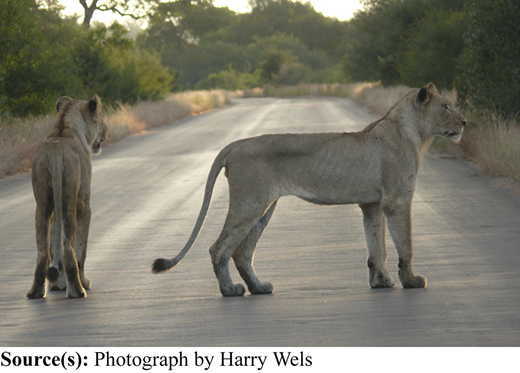
Leon looks at the scene and, like a tracker, hypothesises: ‘OK, they are at an age that they are becoming a nuisance to the pride, especially when the pride is feeding, so they have probably been chased away by one of the older males, who will probably follow them shortly, to make sure that they have really gone.’ Guess what happened? (see Plate 5).
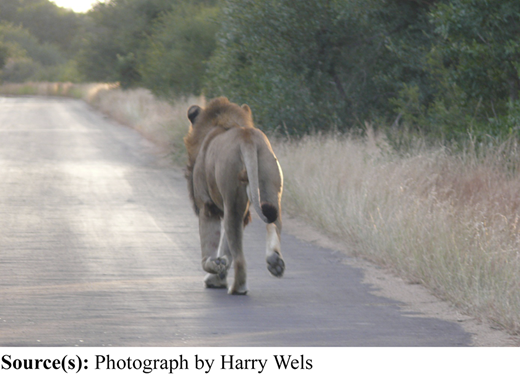
Just minutes after Plate 4 above: mature male lion chasing away the two young male lions (who ran into the veld to the left of the photo)
Just minutes after Plate 4 above: mature male lion chasing away the two young male lions (who ran into the veld to the left of the photo)
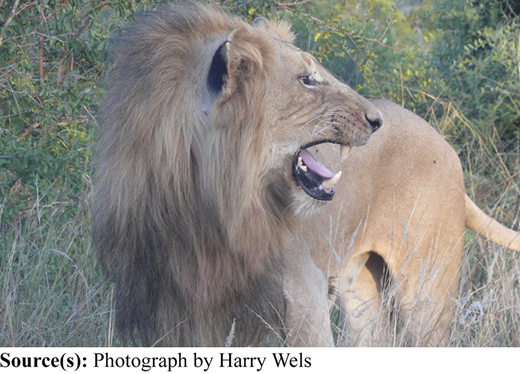
We observe the youngsters running into the bush with the older male following them. Hypothesis confirmed. End of lesson in observation and hypothesising? No! Leon explains that young male lions often become a nuisance around a kill, forcing their way in. He expects that it won't be long before the older male returns, to go back to the kill. He adds that that this may also have been why the impalas were so focused –they were looking at a fresh kill, perhaps even one of their own. Leon looks to where the lions have gone into the bush and parks his car a bit further from our initial position, where he expects to see the older male reappear. Approximately seven minutes later, the older male returns, as predicted, and crosses the road in front of us, so close that I could hardly get his frame in a picture anymore. He actually passes the car so closely that his manes brush the side of the car. And in that way that we make interpretations and estimations about fellow humans, in our eyes he looked confident and satisfied with himself, which, of course, tells us nothing about how this male lion ‘really’ feels (cf. De Waal, 2019) (see Plate 6).
Is the above not too anecdotal? Is it not too subjective in a document that pretends to be an academic text? Is our final sentence of the previous section not an unscientific way of putting it? This is a difficult issue and, to attempt to grope for an answer, we can turn to Gay Bradshaw, who argues that with the falling away of the human-animal distinction, it is time for a ‘new pedagogical model, one that reinstates subjective experiences as a legitimate source of data in partnership with science's accumulated wisdom. The two are, after all, intrinsically compatible since objectivity is merely a collectively agreed-on subjectivity’ (Bradshaw, 2017, p. xxiii, italics added). Bradshaw bases her work on trans-species psychology on these shared subjectivities between human and non-human animals and, specifically, in a study that argues that, just like humans, elephants can suffer from Post-Traumatic Stress Disorder (PTSD), and can be treated for it with similar therapies that are developed for human animals: ‘(t)rans-species psychology allows us to imagine – without undue anxiety about anthropomorphism – what it might be like to walk in elephant ‘shoes’ and experience what these awesome herbivores might be thinking and feeling, in much the same way that we think about ourselves and other people’ (Bradshaw, 2009, p. 18, italics added). As a consequence, ‘we learn that psychiatric diagnoses fit across species’ (Bradshaw, 2009, p. 112).
Lesson 3. Where are the snares? ‘Snare sweep’ patrols
In this ‘agreed-on subjectivity’, I received other lessons in observation from various members of the Anti-Poaching Unit (APU) of the Global White Lion Protection Trust (GWLPT) at the Mbube Game Reserve, bordering the R40 road that leads many tourist towards the Orpen Gate of Kruger National Park, some 40 km down the road. As the Mbube Reserve is close to the R40 and the neighbouring village of Acornhoek, poaching is a permanent threat to the extent that the GWLPT has divided the property into a ‘lion’ and ‘lion-free’ zone, the latter being the buffer for the lion zone. This lion-free zone is patrolled and checked in various ways. In addition to regular patrols by car, the guards check Mbube for snares in so-called ‘snare sweeps’. Hlulani and Ntwanano [17] granted me the privilege of joining them on various snare sweeps. The following is a report of one of their patrols. While walking ‘in line’ (see Plate 7), I ask them if they can explain to me how they exactly look for snares? I ask this question having walked alongside them and almost getting trapped in a snare, before seeing it myself (see Plate 8).
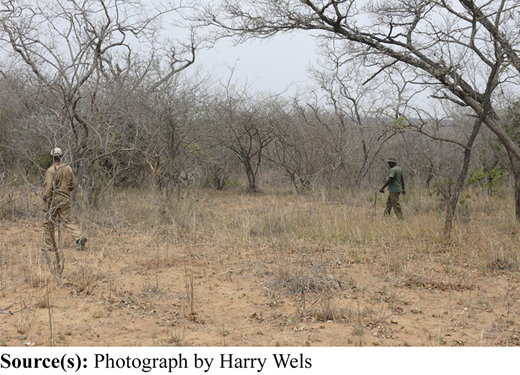
See the snare? ‘Where hunting is based on stealth, trapping is based on deception’ (Olsen, 2012, p. 143)
See the snare? ‘Where hunting is based on stealth, trapping is based on deception’ (Olsen, 2012, p. 143)
This at least gives them a good laugh before they explain to me that you must train your eyes not to look at or in the bush, but through the bush; you have to look through the veld with ‘long eyes’, in the way Myburgh describes San hunters explaining to him how they looked for spoor in the bush (2013, p. 65). This is what I tried to learn and I pretend to have made some progress, at least to the level that, at some stage during my stay, I could show them a snare that I found without their guidance. But there was so much more to learn than simply finding the snares. For instance, there is also the way you move through the bush without falling or hurting yourself. Despite considering myself relatively fit, I could not keep up with the speed at which Hlulani and Ntwanano walked through the bush (while simultaneously looking for snares with ‘long eyes’). And it was not so much the speed, a result of half-running instead of walking, but rather a sort of ‘sliding’ through the bush as if they had used some sort of lubricant to get through. Trying to keep up, I felt more like Piper, a research assistant, who describes her first months in the Democratic Republic of Congo trying to follow bonobos through the rain forest: ‘For the first few months […] I was very frustrated with how clumsy I was in the field (think drunken, blind elephant tripping every two steps); this made me feel inept and quite insecure about my abilities as a researcher’ (Alcayna-Stevens, 2016, p. 840). In other words, before getting into a position to start ‘collecting’ empirical data on non-human animals in the wild, you obviously need to habituate yourself physically to the field. ‘Becoming with’ non-human animals is not only an imaginary or intellectual process, it also requires physical adaptations to wild physical circumstances. Thus far, I had trained myself to adapt physically and to know ‘how to behave in’ the (semi-)office spaces of private wildlife conservancies, the primary physical spaces in which many of the managers of the conservancies spend most of their lives. That was of little help keeping up in the bush with the people responsible for the primary processes of animal care and protection.
Tracking skills: ‘becoming with’ and reflexivity
The observational skills described above facilitate what Donna Haraway (2008) conceptualised as ‘becoming with’. The concept speaks powerfully to the interrelatedness of sentience. According to Haraway (2008, p. 25, italics in original), ‘becoming with’ is best described as ‘the dance of relating’, in ways that Barbara Smuts only became ‘baboon literate’ when she entered into, ‘and [did] not shun, a responsive relationship’ (Haraway, 2008) with baboons.
‘Becoming with’ and the tracking/hunting skills of the San (and other indigenous groups around the world) revolve around an embodied empathy, which is at the heart of scientific thinking and reasoning about the complexities of interrelatedness. In the documentary The Great Dance, on San hunting, it says ‘tracking is like dancing’ (italics added). The documentary shows that tracking and hunting is a ‘dance of relating’ (Haraway, 2008, p. 25) with the animal they are pursuing; that, in their tracking and hunting practices, ‘relating’ is the process in which observation (of the spoor), deep knowledge (of animal behaviour and the natural environment in which it lives) and hypothesising (about the direction of the animal) are brought together in reflexivity, a practice that, ultimately, ‘makes the connection’ [18]; in essence, these are the steps and trajectory of doing ethnographic fieldwork. In the words of Paul John Myburgh, who has ‘become with’ the San group in which he lived for seven years:
The blood spoor in the sand [after the animal is shot with a poisoned arrow] […] with real hunger as a motive it follows that a wounded animal seldom, if ever escapes a Bushman hunter. Their ability to search for, to find and to follow the faintest of signs in such vast and difficult terrain, is unparalleled. It is more than the following of footprints in sand, more than broken grass and blood spots, more than just physical signs […] it is to listen with your fingertips and look with your feet […] it is a feeling in the body that calls to the animal's life-body and you follow these feelings in yourself as much as you follow the animal […] and in this way, predator and prey, you come together in sacrifice and redemption (2013, p. 92).
A description akin to what, in Sheldrake's conceptualisation, would be called ‘morphic resonance’, a ‘hypothetical transfer of memory’ (Sheldrake, 2017, p. 6). And in the same spirit, Despret (2016, p. 32) frames Haraway's ‘dance of relating’ as ‘a certain dimension of self-consciousness, no longer as a cognitive process but as an interrelational process’. This relatedness is not between ‘strangers’, but between ‘companions’, as Despret (2013, p. 44) emphasises. Our relatedness in the world is inevitable, because our lives are interdependent, human and non-human; we cannot have agency ourselves and ascribe it to non-human animals (McFarland and Hediger, 2009; Colling, 2018) without relating to other agencies (or agencement as Despret conceptualises it). In the words of Latour (in Despret 2013, p. 44): ‘To be a subject is not to act autonomously in front of an objective background but to share agency with other subjects that have also lost their autonomy’ [19]. Latour's (2005) (together with Michel Callon and John Law) Actor Network Theory (ANT) ‘… has provided a counterweight to hegemonic humanism’ (Hamilton and Taylor, 2017, p. 165), not only by recognising actants in non-human animals, but also in objects and concepts [20].
‘Becoming with’ white lions?
Do I dare to claim that I accomplished this ‘becoming with’ in the field? Did I really copy/practice ‘becoming with’ in the ways that San trackers practice it? Did I ‘enter the mind of the tracker’ (cf. Song, 2013)? NO! I did not manage that at all if you imagine ‘becoming with’ as an end result, a product, something you have achieved when finished, a skill that you can master once and for all. But my intellectual trajectories around ‘becoming with’ have certainly engendered a multi-sensory awareness of sentience that has quite radically changed the way I train myself in the art of multi-species ethnography.
Elsewhere, I have already reflected more extensively on my initial research results and encounters with the white lions (Wels, 2018). In that chapter, I hinted in note 143 (Wels, 2018, p. 92) at something that I am keen to train and develop further in my research. In that note, I refer to the beautifully reflexive and sometimes hilarious book by Charles Foster (Foster 2016) on his attempts at ‘becoming with’ some iconic animal species of the British Isles in multi-sensory ways, the badger, the fox, the otter, the red deer and the swift. Foster ate earthworms with badgers, slept with urban foxes during daytime under scrubs in the city, and scavenged dustbins with them at night, and he joined a red deer herd that was being hunted. Foster took ‘becoming with’ rather literally. My ‘participant observation’ amongst the white lions in South Africa – from a car, with binoculars, and with tea and biscuits on the passenger seat – can only be labelled as a ‘becoming with lite’ compared to Foster's fieldwork. Foster's approach stands in a tradition of researchers taking ‘becoming with’ wild animals as far as possible, by living amongst them in the wild (see also Hamilton and Taylor, 2017, pp. 117-120). Examples are Barbara Smuts (2001) living amongst baboons in Kenya, Shaun Ellis walking with wolves (2009), and Charles Russell co-existing with wild bears (in Bradshaw, 2017). What I argue in this article aims to live up to the ideal of how Smuts' work describes her trajectory of ‘becoming with’ (which, as far as I know, at the time of Smuts' research, had not yet been coined by Haraway) by creating ‘intersubjective space’ (Smuts, 2001, p. 304) and by developing ‘a language of bodies and sounds and movements that preceded the spoken word and that tends to speak the truth, where words might lie’ (Ibid). Resonating with Liebenberg and Myburgh's texts, Smuts suspects that ‘reciprocal understanding of this kind between people and at least some of our non-human neighbours were common during our time as hunter-gatherers’ (Smuts, 2001, p. 302). Reaching that ‘intersubjective space’ [cf. ‘becoming with’] was an experience that affected her identity deeply (Smuts, 2001, p. 299), as already my ‘lite version’ has affected mine.
Tentative conclusions
Bearing in mind my rather ‘speciesist’ upbringing in the social sciences (cf. Wels, 2015), this article explores what it takes to operationalise a ‘sentience turn’ in doing multi-species ethnography. How do you reject or ‘unlearn’ (cf. Olsen, 2012) human-only fieldwork reflexes that were honed over a lifetime of fieldwork in rather anthropocentric organisational ethnography? How do you adapt to fieldwork practices taught and trained in the social sciences that were silently based on human exceptionalism? How do you co-construct and track empirical data with non-human animals in multi-species ethnography? In this article, I have tried to approach these questions from various angles. After acknowledging that scientific research has provided enough convincing evidence by now to show that we can ‘do away’ with the human-animal distinction in researching social realities, I took two angles to explore what this levelled playing field might mean for multi-species ethnographic fieldwork. One angle is examined through the lens of how the San in southern Africa explain and practice tracking the animals they hunt for their subsistence. The way this is explained follows the same steps and trajectory seen in ethnographic (scientific) research and reasoning: gathering data, interpreting / reflecting on them; hypothesising about what is the next step, etc. until the answer to the research question is found, or, in the case of the San, their reasoning proves right and they find the animal they are after. Hence Liebenberg (1990a, b) argues that the art of tracking is the origin of science. From the second angle, inspired by Haraway, I argued that the core of San tracking skills are observation, ‘becoming with’, and reflexivity. I labelled them as ‘multi-species ethnographying sequence’ or ‘OBR’. In the remainder of the article, I focused on the lessons I received in the field on observation and some of its complexities and how these observations are intertwined with ‘becoming with’ and reflexivity. That seems to be suggesting a methodological way forward in multi-species ethnography. But at the same time and in the remainder of the article I warn against setting our hopes too high for achieving any form of mastery of these skills (see also note 5). Nonetheless I concur with Hamilton and Taylor (2017, p. 126) that ‘… there is a clear value in consciously decentring human beings and their utterances as the prime source of ethnographic data’.
I could not have written this article if I had not felt empowered by the scientific advances that encourage us to do away with human exceptionalism and the human-animal binary. I concur again with Hamilton and Taylor (2017, p. 79) that it is especially ‘… ethnography [that] holds much promise for investigating multi-species settings’. Acknowledging shared sentience and a level playing field between human and non-human animals (cf. Kirbis, 2020) rocked me fundamentally and in many ways, ranging from my food habits to my academic work on conservation, to being human, to my pets and how I think about issues of multi-species social justice (cf. Celermajer et al., 2020). Be that as it may, but focusing on trying to include animals in my organisational ethnographic work on private wildlife conservancies in South Africa also made me realise that I had become rather sloppy about the complexities in my ethnographic field work amongst humans; that I increasingly went for words only, the easiest ethnographic data we can get in our over-saturated text-world of social and other media; that I treated the sensory and physical aspects of fieldwork far less systematic and consistent ways than words; that I had lost touch with the sentient nature of our sense making, including in the organisational configurations in which we as humans spend so much of our time in life. Realising that humans, I, share this sentience with animals (and plants) implies that we also share our sense making capabilities, no matter if they are expressed in words or otherwise, in hiding or in plain view. Accepting shared sentience and sense making as my point of departure for doing multi-species ethnography made me explore the original tracking skills that early hunters and gatherers developed to make sense of animals and the natural world which they shared with each other, in similar ways that animals (and plants) make sense of those same natural environments; shared sentience implies shared sense making in shared and emerging ecosystems (cf. Kirksey, 2015). Doing multi-species ethnography is about tracking the various multi-sensory spoors of these sense making processes, in organisations and elsewhere.
The draft article benefitted greatly from various rounds of detailed comments and suggestions from Dr. Frans Kamsteeg, for which I am hugely grateful. In a further and more formal stage the article has benefitted greatly from remarks and very constructive suggestions from two anonymous reviewers, for which I am equally thankful!
Notes
Also including other non-human sentient beings like plants. The sense making capacities of plants have long been underestimated, if not fully neglected (Mancuso, 2017; Coccia, 2019) but are now increasingly added to the “sentience turn” in many disciplines. In this article, I limit myself to non-human animals.
A topic courageously taken up by the Journal of Organisational Ethnography, from its very first edition in 2012!
In this article, Locke describes his research on elephants and how one particular elephant, Sitasma, is ‘teaching’ him and ‘even elephantizing [him] a little’ (2017, p. 364). See also on ‘ethno-elephantology’, Locke (2013).
To make strategic use of this publication to raise this point: A required time for multi-species ethnographic fieldwork which in current neo-liberal academia is hardly, if at all, possible anymore (Donskis et al., 2019).
‘Fieldwork’ in the ethnographic tradition refers to research in a ‘naturalistic setting of everyday life’ (http://anthropology.iresearchnet.com/ethnographic-fieldwork/, accessed 21 April 2020). More specifically, fieldwork refers here to organisational contexts and ‘naturalistic’ (see quote) also includes here, in addition to the offices and other more conventional organisational spaces, the African bush in which the lions live: Merging the disciplinary concept of ‘field’ with the Afrikaans word ‘veld’, as in ‘Bushveld’ in the official definition of the World Wide Fund for Nature: ‘The Bushveld is a sub-tropical woodland ecoregion of Southern Africa named after the term veld’ (https://en.wikipedia.org/wiki/Bushveld, accessed 21 April 2020).
In the sense of the verb meaning to follow ‘detectable evidence (…) that something has passed’ Merriam-Webster. (n.d.). Track, In Merriam-Webster.com dictionary, accessed April 9, 2020, from https://www.merriam-webster.com/dictionary/track.
www.nytimes.com/2016/09/22/science/ancient-dna-human-history.html?_r=0, accessed 25 July 2017.
This is no way meant to reduce the San to their tracking skills, or to represent and portray the San in any way as ‘the ultimate other’ (Barnard, 2007, p. 20), as has been the case repeatedly throughout the history of the anthropological discipline (Ibid.) and in cultural tourism (Tomaselli, 2012). For this article, I highlight their tracking skills to support my argument on fieldwork methodologies in ethnography that include non-human animals.
‘In the narrowest sense of the word ‘spoor’ simply means ‘footprint’, but in tracking it has much wider meaning, including all signs found on the ground or indicated by disturbed vegetation. Tracking also involves signs such as scent, urine and faeces, saliva, pellets, feeding signs, vocal and other auditory signs, visual signs, incidental signs, circumstantial signs, blood spoor, skeletal signs, paths, homes and shelters. Spoor are not confined to living creatures. Leaves and twigs rolling in the wind, long grass sweeping the ground or dislodged stones rolling down a steep slope leave their distinctive spoor’ (Liebenberg, 1990a, b, p. 111).
Cf. Haraway (2008), a form of intersubjectivity (‘more than one, less than two’ according to Haraway, 2008, p. 244), or in terms of Aaltola ‘embodied empathy’: ‘our somatic capacity to express and read mindedness […] a state of perception: one immediately perceives the mental states of others on account of the expressiveness of the body’ (2018, pp. 103-108). The concept of ‘becoming with’ is explored in more detail from page 15
I give these examples in this paper without any pretension that I am a skilled tracker myself!
See for a concise version of his 1990 book, Liebenberg, 1992.
Not everyone agrees with Nippert-Eng's positioning, though. Les Gofton, writes scathingly in the Times Higher Education Supplement (https://www.timeshighereducation.com/books/review-watching-closely-christena-nippert-eng-oxford-university-press) that ‘Nippert-Eng ignores both the real differences between animal and human subjects, and the kinds of data that can actually be gathered to offer insight and explanation. But in a text where an encounter between Kwan and one of the main females, Joan, is rendered as a victory for gorilla sisterhood over chauvinism, this may not be unexpected’ (my italics). However, what Gofton believes are the ‘real’ differences between humans and non-human animals is not revealed in the article. I had hoped that I finally get a definitive answer to this question from Gofton, but in vain. He ends his review by ridiculing Nippert-Eng's positioning in typical anthropocentric style by writing: ‘Happily, I was able to conduct a telephone interview with the three individuals concerned to verify Nippert-Eng's analysis. Kwan argued that the account misrepresented what he claimed to be his new, more enlightened relationship with his mates. The females involved denied that any such change had occurred in what they described as ‘typical mountain gorilla sexism’.’ This logocentrism, as if only words ‘verify’, dovetails perfectly with the reviewer's anthropocentrism.
Fictive name.
In the Dutch original (Ten Bos, 2008, p. 10): ‘[…] de spanning tussen dieren die zich willen verbergen en mensen die ze willen blootstellen.’
Fictive names.
Documentary, The Great Dance. A Hunter's Story (2000), Directors Craig and Damon Foster.
From Latour's, 2013 Holberg Prize lecture: ‘Which Language Shall We Speak with Gaia?’, http://www.bruno-latour.fr/node/501, italics added by Despret.
Latour and Haraway are intellectually obviously kindred spirits (cf. Harman, 2014), but it falls outside the scope of this article to articulate this topic further.

