The infrastructure sector significantly influences economic growth and societal development. Procurement organization can therefore shape infrastructure procurement performance over both short and long time horizons. This study aims to examine how four structural variables, centralization (where procurement authority and responsibilities reside), specialization, participation and standardization, shape infrastructure procurement activities within public organizations.
The authors conducted a qualitative multiple-case study of nine Finnish municipalities, using 19 semi-structured interviews with infrastructure procurement actors and analysis of municipal strategy documents. Interview data were coded abductively and compared across cases.
This study identifies distinct operational and strategic performance effects associated with structural choices in procurement organization. The findings reveal differences in the relevance of structural variables depending on whether operational or strategic goals are pursued. Centralization supports operational procurement process effectiveness (e.g. procedural support and consistency), but it is less consistently linked with strategic performance in infrastructure procurement. By contrast, standardization and participation are closely connected to strategic performance, particularly through life-cycle integration across planning, construction and maintenance. The findings also indicate that structural variables operate through interdependencies rather than in isolation.
The findings offer practical guidance to public infrastructure practitioners by highlighting the importance of structural design choices in procurement. Emphasizing strategic, life-cycle-oriented procurement can benefit public organizations, particularly within the infrastructure domain.
Research on procurement organization in local government has largely emphasized operational outcomes and centralization choices. This study distinguishes operational versus strategic performance effects of multiple structural variables in municipal infrastructure procurement and highlights participation as central to life-cycle-oriented procurement.
1. Introduction
Public procurement is widely recognized for its role in delivering societal value through cost-efficient and high-quality goods and services (Grandia and Meehan, 2017; Patrucco et al., 2024). Procurement organizations can therefore shape public institutions’ performance (Glas et al., 2017; Patrucco et al., 2019b). The infrastructure sector, in particular, contributes substantially to economic growth and societal development (Singh et al., 2022). This study examines procurement organization through structural variables that capture where procurement authority and responsibilities reside (i.e. centralization), how expertise is arranged (i.e. specialization), how routines and documentation are specified (i.e. standardization) and how internal actors are involved in procurement-related decision-making (i.e. participation). These variables are often discussed jointly as parts of broader organizational configurations rather than as isolated procurement decisions (Plaček et al., 2020). However, investigations into the structural organization of procurement and its performance effects remain scarce in the public procurement literature (Patrucco et al., 2021, 2023), particularly in infrastructure procurement. Studies adopting an organizational perspective also tend to emphasize operational performance criteria such as cost-efficiency (Patrucco et al., 2019a; Richter et al., 2019). This study broadens the scope by incorporating strategic considerations, specifically life-cycle value creation, into procurement performance analysis within infrastructure settings.
Organizational aspects of procurement have attracted considerable attention in private sector literature (Schneider and Wallenburg, 2013; Bals et al., 2018), with particular focus on the distinction between centralized and decentralized procurement arrangements (McCue and Pitzer, 2000). Additional structural variables, including specialization and formalization, have also been identified as significant (Moretto et al., 2022). Despite growing interest in public procurement research (Thai, 2015), organizational dimensions within this domain remain underexplored (Patrucco et al., 2019a; Patrucco et al., 2021). Existing literature has begun to address specific topics such as implementing strategic objectives across organizational archetypes (Glas et al., 2017), examining size-related organizational forms (Glock and Broens, 2013) and identifying factors influencing procurement department structures (Hallberg, 2025). These debates connect to organization design arguments about matching structural choices with coordination demands and strategic objectives, suggesting that performance effects are context dependent rather than universal (Rodriguez-Plesa et al., 2022).
Procurement organizational structure has frequently been studied through the lens of contingency theory (Rozemeijer et al., 2003; Bals et al., 2018; Glock and Broens, 2013). However, contingency perspectives in public procurement remain relatively uncommon, and much research assumes universal applicability without adequate consideration of contextual differences. Calls for specifying contextual nuances are increasingly frequent (Patrucco et al., 2019a), recognizing that structural procurement variables may yield different performance outcomes across contexts (Richter et al., 2019). This study explicitly focuses on infrastructure procurement, a context characterized by project-based operations, inherent project complexity and significant life-cycle considerations. These characteristics influence coordination demands and, in turn, how procurement can be structured. There are some studies in related project contexts emphasizing project organizing (Curlee, 2008; Moretto et al., 2022; Santos and Lopes, 2025), including work that links centralized coordination arrangements and proximity-based arrangements (e.g. co-location and shared routines) to improved collaboration and communication in project environments (Aspeteg et al., 2025). However, infrastructure procurement is also governed through permanent organizational structures on the buyer side, and the question of how municipalities, which are permanently responsible for infrastructure assets, organize procurement across repeated investments and life-cycle stages has received limited attention. The interconnected life-cycle phases of infrastructure procurement, i.e. planning, construction and maintenance, necessitate coordination among numerous actors (Estache and Iimi, 2011; Lindfors et al., 2025), making the organizational design of the public buyer organization particularly critical. Furthermore, despite the infrastructure’s inherent project orientation, public organizations must also implement sustainable organizational arrangements beyond individual projects to achieve long-term infrastructure goals (i.e. strategic performance). These strategic dimensions have previously been identified as important yet underinvestigated research areas (Zhu and Mostafavi, 2017).
To address these gaps, this study examines the following research question (RQ):
How do structural variables of procurement organization shape strategic and operational performance in infrastructure procurement?
We define operational performance as procurement process effectiveness, i.e. achieving desired organizational goals (van Weele, 2018). Consistent with van Weele’s distinction between purchasing effectiveness and efficiency, our operational performance focus is on effectiveness. We define strategic performance as the effective management and enhancement of infrastructure life-cycle value. This distinction reflects the longitudinal nature of infrastructure assets and the interdependence between planning, construction and maintenance decisions. Our operationalization of strategic performance is specific to infrastructure procurement and does not aim to capture the full range of strategic objectives relevant to municipal procurement across other categories. We return to this scope condition in the limitations section. Building on this two-dimensional performance view, we move beyond earlier work that primarily emphasized operational-level benefits by considering both enabling and hindering performance effects of procurement organizational design. To do so, we adopt the structural framework proposed by Bals et al. (2018) to examine how procurement organization structures shape outcomes across infrastructure life-cycle stages in a project-based environment. In addition, we draw on the strategy-structure alignment perspective, which suggests that performance depends on how well structural choices support the strategic objectives pursued by the buyer organization (Defee and Stank, 2005; Galbraith and Kazanjian, 1986; Miles and Snow, 1978).
A further contextual contribution of this research lies in its focus on local governance, specifically municipalities. Procurement in local government organizations has gained increasing scholarly attention (Thai, 2015; Patrucco et al., 2017), and green public procurement in infrastructural works has been studied at the municipal level (Stuijts et al., 2025). However, evidence on the organizational design of municipal procurement in infrastructure contexts remains limited, despite the strong technical content of infrastructure purchasing and the need for integration across life-cycle phases. Municipalities are also a useful setting because they retain long-term responsibility for infrastructure assets even when delivery is organized through projects. Drawing on a qualitative multiple-case analysis across nine Finnish municipalities, this study provides insights into how structural variables may enable municipal procurement departments to shift from primarily administrative roles toward more strategically influential organizational functions.
2. Literature review
2.1 Characteristics of infrastructure procurement
The infrastructure sector is characterized by substantial complexity (Eriksson et al., 2019; Eriksson et al., 2023; Matinheikki et al., 2021) and typically involves extended project life cycles (Soomro and Zhang, 2016; South et al., 2018). Infrastructure operations are also inherently project-based (Rosander, 2022), with limited opportunities for repetition because individual projects are often unique (Larsson et al., 2014). These features create distinctive procurement challenges. In particular, high project complexity requires procurement approaches that can be adapted to project-specific technical and contextual conditions (Regan et al., 2015).
Prior research on infrastructure operations commonly adopts a project-level analytical perspective (e.g. Eriksson et al., 2019; Basso and Ross, 2018). While this perspective is useful for understanding procurement choices and outcomes within individual projects, it may not fully capture procurement’s role as a permanent organizational function, especially when the focus is on performance effects that span multiple projects and unfold over time (Korhonen et al., 2023; Lindfors et al., 2025). Public organizations, therefore, face an organizational design challenge: they must establish procurement structures that support immediate project delivery while also enabling broader, longer-term objectives. Existing research further suggests that infrastructure procurement is often fragmented into functional silos, which restricts collaboration and limits interaction among the actors and organizations involved (Patrucco et al., 2023; Liljeroos-Cork and Laitinen, 2024).
2.2 Performance implications of procurement organization
Previous research suggests that organizational factors in procurement can improve operational performance and can also support broader goals, including social and environmental outcomes (Glas et al., 2017; Patrucco et al., 2019a, 2024). At the same time, the literature provides limited insight into how procurement organization supports public value creation when value depends on decisions made across the infrastructure life cycle. To address this gap, our study distinguishes between short-term operational benefits and long-term strategic benefits related to life-cycle value.
We examine operational performance through the lens of procurement process effectiveness (Lindfors et al., 2025; Malacina et al., 2022), which captures immediate outcomes associated with procurement activities. Typical indicators of procurement process effectiveness include quality, delivery reliability and cost-efficiency. Patrucco et al. (2021) adopt a similar operational perspective in their study of how structural variables (specifically centralization, standardization and digitalization) affect procurement performance in public organizations. Their findings indicate that centralization and digitalization positively affect procurement process outcomes.
Strategic performance, in contrast, is conceptualized here as the ability to create and sustain infrastructure life-cycle value (Patrucco et al., 2023; Liljeroos-Cork and Laitinen, 2024). Public organizations bear responsibility for the full infrastructure life cycle, encompassing planning, construction, maintenance and operation phases (Hartmann and Ling, 2016). Although “value-in-use” is central from the infrastructure user’s standpoint (Hartmann and Ling, 2016), this study focuses on the life-cycle value generated for infrastructure owners, that is, organizations accountable for long-term infrastructure management. From this perspective, coordination across life-cycle phases is central, especially because these phases typically involve multiple suppliers. Research on project-based contexts, including infrastructure, has emphasized that effective management and coordination of supply networks are critical for achieving project objectives (Gosling et al., 2015; Wong et al., 2016; Aspeteg et al., 2025). Strategic performance, however, also requires attention to decisions and organizational arrangements that connect phases over time and extend beyond the boundary of any single project to support sustained organizational effectiveness (Korhonen et al., 2023).
2.3 Framework for the organization of procurement activities
Research on procurement organizational structures has frequently drawn on contingency theory (e.g. Rozemeijer et al., 2003; Bals et al., 2018; Glock and Broens, 2013). From a contingency perspective, organizational structures reflect environmental characteristics and associated coordination demands (Ford and Slocum, 1977). Procurement research has also applied a range of other theoretical lenses when examining how procurement is organized and managed, including transaction cost economics, open systems theory, the resource-based view, information processing theory, agency theory, experience curve theory and game theory (Glock and Hochrein, 2011). Across these perspectives, a shared concern is how organizations allocate decision authority, organize expertise and establish coordination mechanisms so that procurement can meet performance objectives under different conditions.
In public procurement, there is continuing debate about how governmental procurement activities should be structured (e.g. Taylor, 2014; Similä and Mwesiumo, 2024). Private sector procurement research has also examined organizational aspects and structural variables, but studies that focus explicitly on procurement structural design choices remain relatively limited. Two influential frameworks operationalize procurement organization in terms of structural variables. Bals et al. (2018) categorize structural variables (micro-level characteristics) into five dimensions: centralization, formalization, specialization, standardization and participation. Glock and Broens (2013) propose four structural dimensions: centralization, formalization, specialization and hierarchical position. Much of the discussion around structural variables has centered on identifying configurations that align with organizational strategy (see e.g. Patrucco et al., 2021 and Dimand and Neshkova, 2024), reflecting the idea that procurement structures are shaped by the strategic objectives organizations pursue and the coordination challenges they face. This emphasis on strategy-structure alignment provides a useful basis for examining how specific structural variables relate to procurement performance in infrastructure contexts.
In this study, we primarily draw on the organizational frameworks proposed by Bals et al. (2018) and Glock and Broens (2013) and focus on four structural variables: centralization, specialization, standardization and participation. These variables capture core design choices about where procurement authority resides, how procurement-related expertise is organized, how routines and documentation are specified and how organizational members participate in procurement-related decision-making. While both Bals et al. (2018) and Glock and Broens (2013) also discuss formalization, we focus on standardization as the structural attribute most directly tied to defined routines and documentation in procurement practice, and we prioritize participation because it is central to coordination across infrastructure life-cycle phases. Glock and Broens (2013) hierarchical position dimension is not included in the present analysis because our research question centers on structural variables that shape coordination and performance within infrastructure procurement work, rather than the formal placement of the procurement unit in the broader hierarchy.
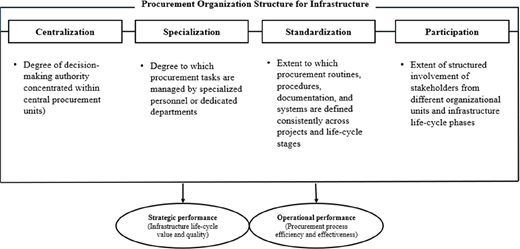
Within the infrastructure procurement context, these four structural variables can be understood as follows (see also Figure 1). Centralization refers to “the degree to which authority, responsibility, and power are concentrated within an organization or buying unit” (Johnston and Bonoma, 1981, p. 148). In infrastructure procurement, centralization concerns whether key procurement decision authority and responsibilities are concentrated within central procurement departments or distributed across infrastructure line units and project-facing units responsible for different infrastructure life-cycle phases (e.g. planning, construction, maintenance). Centralization has received considerable attention in the procurement literature (Johnson et al., 2014; Tchokogué et al., 2011). In the infrastructure procurement context, higher centralization (understood as the authority and responsibility concentrated in central procurement units) can support cost savings and control but may also increase organizational complexity and hinder responsiveness at the point of project execution (Keränen, 2017; Patrucco et al., 2021; Wang et al., 2020). Witzell (2019) identifies a broader trend toward centralizing procurement in the public sector. Yet, centralization may not align well with the specialized and context-specific demands of complex infrastructure projects, especially when centralized procurement is organizationally distant from technical infrastructure units. Plantinga et al. (2020), for example, show how centralized procurement departments that are disconnected from operational infrastructure units can struggle to replicate innovative procurement models effectively. At the same time, the project management literature points to collaboration-related benefits associated with centralized arrangements. Centralized information systems have been linked to improved communication and problem-solving (Santos and Lopes, 2025), and a centralized project management office can support collaboration through standardized processes and communication structures (Curlee, 2008). Thus, prior research seems to suggest that centralization can improve coordination and procedural control under certain conditions, but its performance implications in infrastructure procurement depend on how centralization is implemented and how it connects to technical expertise and cross-phase coordination.
Specialization is “the degree to which purchasing activities are conducted by specialized departments, committees, and skilled personnel” (Glock and Hochrein, 2011, p. 158). In infrastructure procurement, it captures the extent to which municipalities maintain dedicated procurement professionals and specialized technical expertise needed to manage the complexity and regulatory demands of infrastructure projects. Specialization is relevant because procurement decisions often require both procurement competence and deep technical knowledge tied to infrastructure life-cycle work. Specialized roles and units can support higher-quality procurement processes when expertise is available and accessible to those preparing and executing procurements. At the same time, specialization can reinforce functional silos when expertise is segmented across planning, construction and maintenance units without adequate integrative mechanisms. This makes specialization closely linked to participation and standardization, which shape whether specialized knowledge is shared and applied across life-cycle phases.
Standardization refers to “the degree to which organizational activities or organizational routines are precisely defined” (Glock and Hochrein, 2011, p. 158). In infrastructure procurement, this typically involves uniform procurement procedures, document templates and consistent routines to support efficiency, transparency and compliance across the extended life cycle. Standardization generally has positive implications in infrastructure procurement because it provides clearly defined and uniform routines, standardized documentation and procedures, contributing to improved procurement effectiveness, transparency and efficiency (Pemer and Skjølsvik, 2016). Standardization is also particularly relevant in infrastructure settings because procurement relies on information continuity and well-managed handovers across life-cycle phases. Shared templates, routines and documentation practices can support consistent communication and knowledge transfer across planning, construction and maintenance, where procurement decisions often have long-term consequences.
Participation is “the extent to which various organizational members are involved in decision making” (Johnston and Bonoma, 1981, p. 148). In infrastructure procurement, it relates to structured cross-functional engagement involving planning, construction and maintenance units so that technical knowledge and stakeholder perspectives can be integrated across the life cycle. Participation is highly relevant in municipal infrastructure procurement, where effective coordination among internal units is often necessary to connect procurement choices to long-term infrastructure objectives. Active participation increases the likelihood that procurement decisions incorporate diverse expertise and practical knowledge across phases and supports life-cycle management of infrastructure projects (see Liljeroos-Cork and Laitinen, 2024). In this sense, participation functions as a structural mechanism that can connect specialized knowledge and standardized routines to strategic, life-cycle-oriented performance.
These structural variables provide a basis for examining how procurement organizational structures influence strategic (i.e. life-cycle value) and operational (i.e. procurement process effectiveness) performance outcomes in infrastructure procurement. Although both frameworks (Bals et al., 2018; Glock and Broens, 2013) offer useful perspectives, we primarily adopt Bals et al.’s (2018) approach because it explicitly emphasizes participation, which is central in infrastructure procurement where coordination across multiple life-cycle phases is a recurring organizational challenge. In addition, given the distinct technical and managerial requirements associated with planning, construction and maintenance phases, specialization is also expected to play an important role in procurement performance.
3. Research methodology
3.1 Data gathering
This study adopted a qualitative multiple-case study methodology to investigate organizational variables and their implications for procurement performance in infrastructure procurement. A multiple-case design is well-suited for theory elaboration in contexts where prior research is limited and where the objective is to develop explanations that remain closely grounded in empirical evidence (Ketokivi and Choi, 2014; Baxter and Jack, 2008). Qualitative methods also support careful examination of potentially complex interactions between structural variables and procurement performance, including performance effects that may emerge with time lags (Gummesson, 2000).
Case selection followed principles of theoretical sampling with the aim of supporting analytic generalization within the specific context of municipal infrastructure procurement. The empirical investigation included nine municipalities distributed across the major regions in Finland and spanning different organizational sizes, proxied by the number of inhabitants (Table 1). A single-country setting reduces confounding variation related to legislation and broader institutional conditions and supports comparability across cases. Municipalities were selected because public procurement research has increasingly addressed local government procurement (Parker and Liddle, 2024), while organizational design questions related to infrastructure procurement in municipalities remain less developed. The present study therefore focuses on how these organizations structure procurement work across infrastructure life-cycle stages.
Primary data were collected through semi-structured interviews. In total, 19 interviews were conducted in fall 2022 across the nine municipalities. Two interviews were conducted in eight municipalities and three interviews in one municipality, reflecting differences in how infrastructure procurement responsibilities were distributed across roles. Informants held complementary positions directly related to infrastructure procurement, such as construction manager, project manager, procurement specialist and procurement manager (see Table 2). Informants were selected because of their involvement in infrastructure procurement and their understanding of how procurement interacts with the infrastructure life cycle. The interview themes (detailed in the interview protocol reported in Appendix 1) focused on procurement organization, cross-functional integration and the role of procurement across infrastructure life-cycle stages. The set of informants covers different life-cycle interfaces, with strong representation from the construction phase, which is closely connected to both planning and maintenance.
Secondary data were collected by reviewing and analyzing strategy documents from the case municipalities. Finnish municipalities are required to prepare a municipal strategy under the Municipalities Act (Kuntalaki 410, 2015). The municipal strategy must be drawn up for each municipal council term, which lasts four years in Finland. The strategy outlines long-term objectives and financial goals and is based on an assessment of the municipality’s current situation, anticipated changes in its operating environment and their implications for municipal performance. It also specifies procedures for evaluation and monitoring. These documents, therefore, provide an organization-level account of strategic priorities and planned activities. In this study, we analyzed these strategies with a focus on strategic infrastructure goals and the planned activities through which municipalities intend to achieve them. The strategies are public and available online. We retrieved them from each municipality’s website. The search was conducted in June 2023, and the strategies used in this study cover 2021–2025. The strategies do not follow a single prescribed template and are often presented as a single document describing several strategic topics.
3.2 Data analysis
An abductive analytical approach was adopted, with the aim of developing empirically grounded insights through iterative movement between data and theory rather than using the data only to confirm an existing framework (Dubois and Gadde, 2002). The analysis began with iterative open coding of the interview transcripts (Ellram, 1996) using Atlas.ti. In this first stage, we coded informants’ descriptions of procurement organization and their accounts of how organizational features enabled (or hindered) procurement performance in infrastructure procurement.
In the next stage, the initial codes were regrouped in relation to the structural variables presented in Section 2.3. We then identified coded segments that captured links between these structural variables and performance outcomes. In line with the performance conceptualization developed in Section 2.2, immediate procurement process effectiveness was treated as operational performance, whereas strategic performance encompassed infrastructure life-cycle value creation and integration across planning, construction and maintenance phases. Secondary-level codes that captured performance-related mechanisms such as information management, information flow and quality- and cost-related considerations were retained and linked to the two performance dimensions when they were clearly tied to an operational or strategic outcome. Appendix 2 provides an excerpt of the coding with quotations illustrating each identified connection between a structural variable and a performance outcome.
Secondary data (municipal strategy documents) were analyzed to identify stated strategic infrastructure objectives and planned activities. First, we extracted infrastructure- and procurement-related objectives and their associated implementation activities. Using Excel, we clustered these elements to identify recurring strategic themes. All cases included a sustainability orientation, while differences emerged in the extent to which innovativeness and accessibility were emphasized. Based on these differences, municipalities were categorized into three groups reflecting these strategic emphases.
The interview analysis also explicitly considered both positive and negative performance implications of the structural variables. Rather than separating positive and negative effects in advance, we coded performance-relevant segments in an open manner and then interpreted whether the described effect was enabling or hindering. For example, we coded instances where low levels of standardization contributed to weaknesses in information management processes. We also identified cases where multiple structural variables co-occurred in the same textual segment, using Atlas.ti query tools to support systematic identification of such co-occurrences. This step supported interpretation of how structural variables operate together in practice rather than as independent design choices.
The cross-case analysis followed a structured comparison logic (Eisenhardt and Graebner, 2007). To preserve case-level meaning, coded segments were first organized by municipality to develop a within-case understanding of how procurement organization was described and how performance effects were reported in each setting. Within each municipality, we compared accounts from two to three informants. When informants described the same structural variable-performance link in similar terms, we treated the observation as reinforcing. For example, in Municipality 2, both informants linked participation to strategic performance in a similar way, emphasizing early participation of construction for planning as a key for stronger integration across the life-cycle phases, reinforcing the observation. When informants linked the same structural variable to performance through different mechanisms, we treated the observation as complementary. For example, both informants in Municipality 9 linked standardization to strategic performance, one highlighting the importance of regular inter-phase meetings in enhancing information flow across infrastructure life cycle, and the other emphasizing the impact of using building information modeling (BIM) in increasing collaboration between different life-cycle phases. We also reported case-specific observations that emerged in a single interview, which provided relevant insight into the procurement organization and performance. These within-case observations then provided the basis for cross-case comparisons aimed at identifying similarities and differences across municipalities. Cross-case differences were examined in relation to variation in strategic objectives (based on the strategy-document analysis) and contextual characteristics such as municipality size (number of inhabitants) and geographic area. Within each municipality, we also examined whether informants’ accounts diverged on the structural variables and their performance implications. In the topics studied, informants’ observations within a given municipality were aligned.
4. Results
4.1 Strategy goals and activities
Table 3 summarizes the strategic infrastructure goals identified in the municipal strategy documents for each case organization. Based on the emphases in these documents, each municipality is assigned a descriptive label. The table also reports the implementation activities explicitly linked to these strategic goals.
Across all cases, municipalities identified sustainability and sustainable development as core strategic goals. These sustainability objectives were largely consistent, with recurring themes such as reducing transportation emissions, promoting sustainable construction practices, guiding land use planning and strengthening infrastructure life-cycle management. Municipalities 3 and 9 also explicitly linked procurement practices to achieving their sustainability targets.
Accessibility and innovation were less consistently emphasized. Accessibility goals were particularly prominent in municipalities located in more remote regions (Cases 5, 6 and 8), where strategies focused on strengthening public transportation networks and regional logistics infrastructure. Innovation-related strategic goals were most explicit in Municipalities 2 and 4, which emphasized smart technological solutions, including digital traffic management and electric transport infrastructure.
To support subsequent cross-case comparisons, we grouped municipalities into three strategic profiles based on their strategy-document emphases. Sustainable municipalities (Cases 1, 3, 7 and 9) emphasize sustainability as the primary strategic focus; this group includes municipalities of different sizes and geographic locations. Innovative and sustainable municipalities (Cases 2 and 4) emphasize both innovation and sustainability, although the two cases differ in other contextual characteristics. Accessible and sustainable municipalities (Cases 5, 6 and 8) combine sustainability with a pronounced accessibility focus; within this group, Municipalities 5 and 6 particularly stress accessibility in connection with their remote geographic locations.
4.2 Structural variables impacting operational performance
Table 4 summarizes the relationships identified between the structural variables and operational performance impacts in the interview data, together with enabling conditions and hindering factors. These relationships were established through the coding process described in Section 3.2: coded segments were retained when informants explicitly linked an aspect of procurement organization (centralization, specialization, standardization or participation) to an operational performance effect (procurement process effectiveness). The “Sources of observations” column is included to support traceability to the empirical data (municipalities and interviewee codes); it should not be read as a quantitative indicator of effect strength.
Interview evidence indicates that the degree of centralization is linked to operational performance mainly through procedural support and process consistency. In several municipalities, procurement specialists in centralized procurement units provided support for procurement procedures and assisted with tendering when needed. At the same time, these city-wide procurement units typically lacked infrastructure-specific expertise. As a result, decentralized infrastructure units retained the technical competencies required for procurement execution. In some municipalities, centralized procurement units did not conduct tendering for individual infrastructure projects; instead, they focused on developing and managing framework agreements. In these cases, infrastructure specialists contributed technical knowledge and defined procurement specifications, while centralized procurement units handled procedural aspects of tendering. Given the complexity of infrastructure projects, infrastructure units often held the deepest project-specific knowledge. Centralization therefore functioned primarily as operational support, while operational performance improvements depended on effective coordination and clear division of roles between centralized procurement and technical infrastructure units.
Specialization was associated with improved operational performance when information transfer worked well between specialized units. Units specializing in distinct infrastructure life-cycle phases can develop efficient ways of working, but operational performance issues arise when information flow is disrupted. Interviewees described fragmentation into functional silos among planning, construction and maintenance units, which made information exchange a key condition for operational effectiveness. For example, informant M21 highlighted how combining planning and construction within one organizational unit could improve procurement effectiveness by strengthening information sharing:
These things would go more smoothly if planning and construction were in the same service. So, we used to have the building and infrastructure side in one and we had the construction service. Then it was divided, and in the building side planning and construction went to the same service, but in the infrastructure side did not, so the reorganization was a bit of a mess at that point, in my opinion.
Standardization also emerged as important for operational performance through streamlined information transfer, more efficient scheduling and resource allocation, reduced costs, consistent procedures, standardized documentation and harmonization of procurement activities. Adequate information flow and knowledge exchange from planning to construction supported scheduling of project procurement activities. Interviewees described how standardized models, common procurement templates and regular meetings improved operational efficiency. M41 described this as follows:
It has gone in a better direction, that we have a common model, documents, we go through things together in these weekly meetings, that it has improved that side.
Standardized procedures for programming infrastructure projects from planning through construction were also described as beneficial for schedule optimization. While separate planning and construction units created challenges for such optimization, they were also discussed as a setting in which scheduling routines could be further developed. In addition, within the context of category management, standardized processes, clearly defined organizational roles and consistent responsibilities were described as supporting procurement execution. Effective category management was linked to consistent application of procurement procedures by project managers and a uniform interpretation of agreements across projects, contributing to procurement process efficiency.
Participation was also linked to operational performance through several mechanisms that depend on cross-functional interaction. Interviewees associated participation with improved procurement process quality, better process harmonization and scheduling and stronger decision-making through broader input from specialized staff. Procurement quality and process harmonization were described as improving when unit managers participated in procurement processes prepared by technical experts and engaged in detailed discussions and document cross-checking during procurement preparation. M41 described this as follows:
The person who’s going to draw the project, they’re going to let us read it and go through these things. We have weekly meetings where we all get together. And there, if someone has a big question, we can go through it, or we can go through it alone with me. And then when the papers are ready, so then they are really cross-read by others, so that nothing is forgotten, so to speak. But let’s just say that I myself am in some way always involved, but otherwise goes a little then on a case-by-case basis.
Interviewees also described how dialogue between planning and construction units supported process optimization, particularly when framework agreements established in one phase were applicable to subsequent phases. Early cooperation among construction, maintenance and other relevant units (such as water distribution companies) was described as supporting coordinated scheduling across infrastructure life-cycle stages. Participation was also associated with decision-making quality in choices such as in-house production versus external tendering, contributing to procurement process effectiveness. Informants emphasized that aligning procurement tasks with specialized expertise and engaging procurement specialists early to support technical experts contributed to improved procurement outcomes.
4.3 Structural variables impacting strategic performance
Table 5 summarizes how the analyzed structural variables relate to strategic procurement performance, together with enabling conditions and hindering factors identified in the qualitative analysis. As in Section 4.2, the relationships reported in the table were established through the coding process described in Section 3.2: segments were retained when informants explicitly linked an aspect of procurement organization (centralization, specialization, standardization or participation) to strategic performance outcomes, defined here as infrastructure life-cycle value management and life-cycle integration across planning, construction and maintenance. The “Sources of observations” column is included for traceability to the empirical data; it should not be interpreted as a quantitative measure of effect strength.
Our analysis did not show a consistent association between procurement centralization and strategic performance. Given that strategic performance is defined as life-cycle value management and integration across life-cycle phases, interviewees tended to describe centralized procurement primarily in terms of short-term procedural support and procurement process effectiveness rather than as a driver of life-cycle outcomes (see Section 4.2).
The relationship between specialization and strategic performance was more nuanced, depending largely on the extent and quality of communication and information transfer. Specialization supported strategic performance when specialized knowledge and skills from different life-cycle phases were brought into dialogue and used across phase boundaries. When inter-unit interaction was limited, specialization instead contributed to functional silos and knowledge loss. Regular coordination meetings across planning, construction and maintenance were described as an effective way to strengthen information flow and reduce silo effects, whereas exchanges relying mainly on formal documentation tended to maintain separation between units and weaken life-cycle integration.
Standardization was linked to strategic performance through information continuity across life-cycle phases. Interviewees connected higher standardization with improved information management, regular inter-phase meetings, the use of shared information systems and databases and more systematic collaboration around BIM. For example, regular inter-phase meetings were described as strengthening information flow compared with reliance on document-based handovers. Standardized information-sharing routines between stakeholders responsible for different life-cycle phases (e.g. utilities providers for electricity and communications) were also described as supporting strategic objectives.
At the same time, the cases differed substantially in the degree of standardization, particularly in information management practices. When standardization was low, interviewees described tacit knowledge and information losses at the interfaces between life-cycle phases, with the consequences becoming more pronounced when personnel changes occurred and relevant information did not carry over into subsequent procurement and delivery work (M12). Low standardization was also linked to communication gaps among project stakeholders (e.g. contractors, supervisors, project managers), which created misunderstandings about design rationale and practical solutions. Remote work arrangements were described as intensifying these gaps in settings where information-sharing practices were not sufficiently standardized. Interviewee M82 provided an illustrative example:
Our maintenance department does some green work and I do bridge renovations, and there have been instances during remote work period that our maintenance department has not known which bridges will be renovated in the next few years. There have been cases where they have gone to do plantings on some bridge ramps last year and this year, they are going to renovate the whole bridge, and then the bushes there are ruined. A bit of this kind of blundering has happened, at least in my experience, which might not have happened otherwise.
Several cases pointed to the importance of organization-wide information management systems that cover the full infrastructure life cycle from planning through construction and maintenance. For example, interview accounts indicated that a common database integrating information across planning, construction and maintenance could strengthen life-cycle information flow. In Municipality 3, planning and construction functions were integrated within a single unit while maintenance was separate, and information exchange depended largely on a public asset management register. In this type of arrangement, standardized information storage and retrieval practices were described as central to sustaining life-cycle information continuity. Similarly, standardized quality and information management plans were described as supporting the documentation, preservation and transfer of relevant information across life-cycle phases.
Interviewees also described BIM as having potential to support life-cycle cost optimization by improving collaboration across project phases, particularly when maintenance considerations were incorporated from the outset. However, defining precise information requirements for BIM projects was described as difficult because of the risk of information overload for maintenance units. This observation points to the importance of identifying which life-cycle management data are essential and ensuring that these data are transferred in a structured way into organizational databases that can support long-term asset management.
Participation had the strongest and most consistent links to strategic performance, primarily through its role in integrating planning, construction and maintenance. Proactive involvement of maintenance in early planning phases emerged as particularly important. Interviewees emphasized that early participation by maintenance personnel, including input regarding practical constraints, resource needs and design implications, supported more sustainable and workable life-cycle outcomes. Where maintenance feedback was provided mainly after project completion, improvements were described as relying on trial-and-error learning rather than early problem prevention. Interviewee M22 illustrated the challenges created by limited participation:
Often there are those kind of planning decisions, that when we deliver the new street to the maintenance department, there are almost always comments on why this has been done this way, and then we are told that once it has been designed, we must do it according to what has been designed. So I would say that there is room for improvement in the discussion.
Organizational arrangements that supported proximity and integration among planning, construction and maintenance were described as strengthening participation and collaboration and, in turn, strategic outcomes. Conversely, organizational boundaries, for example, situations where infrastructure services were partly delivered through separate public utilities, were described as limiting collaboration and reducing life-cycle integration even when standardized information management practices were in place. This evidence suggests that standardized information systems alone were not sufficient. Participation and inter-unit collaboration remained necessary to translate information continuity into life-cycle outcomes.
Finally, interviewees described BIM-based projects as potentially reducing the effects of procurement silos when they were paired with active cross-phase participation. Active involvement of construction and maintenance in early planning phases was associated with more innovative and practically workable infrastructure designs. In larger projects, construction project managers were described as participating in planning discussions and jointly developing design guidelines with colleagues from different life-cycle phases. In addition, participation by both construction and maintenance units in urban planning processes was described as strengthening life-cycle performance outcomes. Category management practices were also described as requiring high levels of cross-unit participation: procurement development teams coordinated procurement categories, identified opportunities for shared goals and supported joint decision-making and collaborative project planning across unit boundaries when selecting infrastructure projects intended to maximize strategic effectiveness.
4.4 Contextual differences between cases
Table 6 summarizes how the structural variables were linked to operational and strategic performance across the three municipality clusters identified from the strategy documents: sustainable municipalities (Cases 1, 3, 7 and 9), innovative and sustainable municipalities (Cases 2 and 4) and accessible and sustainable municipalities (Cases 5, 6 and 8). The table is intended to support cross-case comparison by indicating where interview accounts contained explicit links between a structural variable and a performance dimension. The interviewee codes are included for transparency and traceability, and they should not be interpreted as a quantitative measure of effect strength.
Across the three municipality clusters, participation was linked to both operational and strategic performance. In the accessible and sustainable municipalities (i.e. Cases 5, 6 and 8), strategic performance links in particular were described through participation that connected planning, construction and maintenance work, which aligns with the emphasis on life-cycle integration discussed in Section 4.3. Standardization was also linked to both operational and strategic performance across clusters. According to the interview data, standardization often functioned as an enabling condition for coordination and information continuity, which helps explain why it was reported in connection with strategic performance across different municipal strategic profiles.
Specialization was linked to performance primarily in one municipality (i.e. Case 1) categorized as sustainable (strategic and operational performance) and in one (i.e. Case 2) innovative and sustainable (operational performance). In these cases, specialization was considered valuable when it supported expertise-based decision-making and when information transfer across units was maintained. By contrast, centralization was associated with operational performance but not with strategic performance across all clusters. According to our interviewees, centralization was mainly described as supporting tendering procedures and procurement process consistency rather than life-cycle outcomes.
4.5 Relations between structural variables
Our analysis also indicates interconnections among the structural variables examined. These interconnections help explain why structural variables did not operate as isolated design choices in the municipalities, but instead shaped performance through how authority, expertise, coordination practices and participation were combined.
The most consistent interconnection in the interviews concerned centralization and specialization. In many municipalities, specialization appeared through clear departmental boundaries, differentiated roles and phase-specific competencies, while centralized procurement units were described as having more limited infrastructure-specific expertise. In practice, this meant that technical knowledge and infrastructure-specific competencies tended to remain within specialized decentralized units rather than shifting to centralized procurement units. Interviewee M71 described this logic as follows:
Procurement needs and their identification is at the (infra) service departments and service line level to be done. The substance expertise is right at the heart, when procurement is put out to tender, the definition of the procurement, that what is the object of the procurement.
In addition, the interviews suggest that specialization supported strategic performance most clearly when it was paired with high participation. Specialized knowledge located in planning, construction and maintenance units contributed to life-cycle outcomes when these units engaged in information exchange, collaboration and cross-functional involvement, rather than relying on unit-specific work and formal documentation alone.
A further interconnection was observed between participation and standardization, particularly in information management practices. Higher participation was often supported by standardized routines such as regular cross-unit meetings and consistent use of shared databases or ERP systems. These standardized practices facilitated communication and supported information exchange across life-cycle phases, strengthening the conditions for strategic management of infrastructure life cycles.
5. Discussion of results and main contributions
This study examined how structural variables (i.e. centralization, specialization, standardization and participation) influence strategic and operational performance in municipal infrastructure procurement. Compared with the private sector procurement literature, the public procurement literature has devoted less sustained attention to procurement organizational design, and prior studies have often emphasized operational efficiency (Patrucco et al., 2021; Richter et al., 2019) while paying less attention to strategic performance, particularly in infrastructure settings (Basso and Ross, 2018; Lindfors et al., 2025). By differentiating operational performance (procurement process effectiveness) from strategic performance (infrastructure life-cycle value and life-cycle integration), the study clarifies how structural choices relate to both short-term process outcomes and longer-term life-cycle outcomes.
A first implication of our results concerns centralization. In earlier procurement research, centralization is commonly associated with operational efficiency gains (Richter et al., 2019; Patrucco et al., 2021). In project environments, centralized arrangements have also been linked with collaboration-supporting mechanisms, for example, through centralized information systems and coordination structures that standardize communication and problem solving (Curlee, 2008; Santos and Lopes, 2025). In our municipal infrastructure cases, centralization was primarily described as supporting operational work (e.g. tendering procedures and framework agreements), whereas clear links to strategic, life-cycle-oriented outcomes did not emerge. One interpretation, consistent with the interview data, is that infrastructure procurement involves high complexity and project specificity (Estache and Iimi, 2011; Regan et al., 2015), while centralized procurement units may be organizationally and substantively distant from infrastructure-specific expertise. In this setting, centralized coordination can support procedural control, but life-cycle value depends on how well procurement decisions incorporate technical knowledge and connect planning, construction and maintenance. This aligns with prior observations that misfit between procurement structure and strategy can constrain innovation-oriented outcomes (Ateş et al., 2018), and that procurement arrangements may be less effective for broader societal aims if organizational mechanisms do not support the required forms of collaboration and expertise integration (Furneaux and Barraket, 2014). The evidence therefore suggests that centralization alone is not a reliable route to strategic performance in municipal infrastructure procurement. Where collaboration benefits exist, they appear to depend on accompanying coordination mechanisms and access to technical expertise rather than on centralization as such (Curlee, 2008; Santos and Lopes, 2025).
Specialization showed a more conditional relationship with performance. In our cases, specialization supported operational and strategic outcomes when it enabled access to relevant expertise and when information flowed effectively across planning, construction and maintenance. When information transfer was limited, specialization was associated with silo effects that constrained life-cycle integration. This pattern is consistent with work emphasizing that the performance effects of structural characteristics vary with context (Richter et al., 2019). Our results further indicate that specialization’s strategic relevance was most visible in municipalities with sufficient resources to maintain specialized roles and to support coordination across specialized units, particularly in sustainability-focused settings.
Standardization and participation emerged as the structural variables most consistently linked to both operational and strategic performance. Standardization was connected to operational improvements through shared routines, consistent documentation and predictable procurement processes. It was also linked to strategic performance through information continuity and coordination across life-cycle phases, including practices related to shared databases and BIM-based information management. This pattern contrasts with earlier findings that emphasized standardization primarily as an operational performance driver in public procurement (e.g. Patrucco et al., 2021) and suggests that, in infrastructure procurement, standardization can support strategic outcomes when it stabilizes information transfer and handovers across phases. Participation complemented these effects by enabling early and continuous cross-functional input, particularly by connecting maintenance and construction expertise to planning decisions, thereby supporting life-cycle integration. The combination of standardization and participation appears especially important in infrastructure procurement contexts characterized by complexity and multiple actors (Liljeroos-Cork and Laitinen, 2024; Lindfors et al., 2025), where strategic performance depends on cross-phase coordination rather than on isolated project outcomes.
In infrastructure procurement, centralization is associated primarily with operational process effectiveness, while strategic, life-cycle-oriented performance depends more on how specialization, standardization and participation were combined to support knowledge integration and coordination across life-cycle stages.
5.1 Theoretical contributions
This study contributes to public procurement and infrastructure management research by strengthening theory on how procurement organizational structure relates to performance. Prior work has tended to emphasize short-term operational efficiency and has given less attention to strategic performance outcomes, including life-cycle management considerations (e.g. Patrucco et al., 2019a; Lindfors et al., 2025). By explicitly distinguishing operational performance from strategic performance and by grounding this distinction in infrastructure life-cycle integration, the study clarifies that structural variables can have different performance implications depending on which performance dimension is foregrounded. This extends earlier work on procurement structure and performance (e.g. Richter et al., 2019; Patrucco et al., 2021; Dimand and Neshkova, 2024) by showing that structural variables associated with operational gains do not necessarily translate into life-cycle-oriented outcomes in infrastructure contexts.
A second contribution concerns how structural variables operate together. Rather than treating centralization, specialization, standardization and participation as independent levers, our results show interdependencies between them, particularly the way specialization requires integrative mechanisms to avoid silo effects and the way participation is often enabled by standardized routines and information practices. This advances the application of contingency thinking in procurement organization research (e.g. Bals et al., 2018; Moretto et al., 2022) by providing empirically grounded insight into how configurations of structural variables shape both operational process outcomes and strategic life-cycle outcomes.
A third contribution lies in the municipal infrastructure setting. Research has called for closer examination of local government procurement organizations (Parker and Liddle, 2024), and municipal procurement is often characterized as administrative with limited strategic involvement. Our findings refine this view by identifying structural arrangements (especially participation supported by standardization) that can strengthen the strategic role of procurement in infrastructure life-cycle management. This adds to ongoing discussions of procurement organization in local governments by showing how strategic influence is enabled through concrete organizational mechanisms rather than assumed to follow from formal structures alone.
5.2 Policy and managerial implications
The findings have direct implications for municipal managers responsible for infrastructure procurement and for policymakers shaping procurement guidance.
First, managers should evaluate what centralization is expected to accomplish. Centralization can improve procedural consistency and provide support for tendering and framework agreements, which can strengthen operational performance. At the same time, when centralized procurement is separated from infrastructure-specific expertise, it may weaken the integration of technical knowledge into procurement decisions that affect long-term life-cycle outcomes. A practical implication is to use hybrid arrangements in which centralized units concentrate on procedural expertise and governance while infrastructure units retain technical responsibility and remain closely involved in specification development and supplier-facing decisions that affect life-cycle performance.
Second, municipalities that pursue ambitious sustainability and innovation goals should treat specialization as a resource that requires active coordination. Specialized expertise in planning, construction and maintenance can improve procurement quality and support life-cycle objectives but only if mechanisms exist for information transfer and joint decision making. Managers can support this by establishing regular cross-unit planning routines, structured handover practices and joint reviews of procurement documentation across life-cycle phases.
Third, managers should institutionalize participation as an early-stage practice rather than as late-stage feedback. The evidence indicates that early involvement of construction and maintenance perspectives during planning supports life-cycle integration and reduces avoidable rework and downstream problems. Participation is easier to sustain when it is embedded in routines (e.g. regular cross-unit meetings, shared review processes) and when roles in procurement preparation and decision making are explicitly defined.
From a policy standpoint, procurement guidance that targets infrastructure performance should give explicit attention to standardization and participation as enabling conditions for life-cycle value creation. Policies that promote shared information management practices (including BIM-related routines where relevant), standardized documentation and handovers and regular inter-unit coordination can support strategic outcomes by reducing information loss across life-cycle phases. At the same time, policies should avoid implying that increased centralization is a general solution for strategic performance; where centralization is pursued, policy guidance should emphasize how centralized units connect to technical expertise and to cross-phase collaboration practices.
5.3 Limitations and future research directions
This study has several limitations that suggest opportunities for further research. First, the findings are based on nine Finnish municipalities, which constrains generalizability across institutional and regulatory environments. Research in additional national and regional settings could test whether similar patterns between procurement structure and performance hold under different governance and regulatory conditions.
Second, the study relies primarily on qualitative interview data, which reflect informed perceptions but not direct objective measurement of performance. Future studies could combine qualitative insights with quantitative indicators or administrative performance data to strengthen empirical triangulation and to examine how structural variables relate to measurable outcomes over time.
Third, the empirical design included a limited number of interviews in each municipality. While the informants were selected for their roles in infrastructure procurement, additional respondents in each case could capture further perspectives, including those from finance, urban planning or political decision-making roles that shape procurement constraints and objectives.
Fourth, strategic performance is operationalized as the effective management and improvement of infrastructure life-cycle value, which fits the longitudinal and interdependent nature of infrastructure assets. At the same time, strategic performance in municipal procurement can include a wider range of objectives and measures beyond infrastructure procurement and beyond life-cycle value as defined here. Future research could examine additional strategic dimensions and explore how procurement organization supports strategic value across broader municipal purchasing portfolios.
Finally, the study focuses on structural organizational variables. Further research could examine how other organizational factors, such as organizational culture, governance systems, leadership approaches and political dynamics, interact with structural variables in shaping procurement performance.
Funding
This research is funded by ProDigial research program.
References
Appendix 1. Interview themes
A1. Interviewee background
This section covered the interviewee’s job description, role and experience related to infrastructure procurement, and required competencies in the current position.
A2. Procurement organization and decision authority
This section covered roles of staff members in procurement within the organization, the organization of infrastructure procurement, selection criteria for personnel involved in procurement, tasks and involvement of personnel, responsibilities in procurement preparation, decision-making (e.g. who decides, at what stage and based on what information), roles in procurement management and life-cycle considerations in procurement planning.
A3. Cooperation, coordination and information flow across the life cycle
This section covered means used to ensure sufficient information flow between stages of the infrastructure life cycle (e.g. routines, meetings, shared systems and proximity or co-location arrangements where relevant), dialogue and cooperation in procurement between internal actors (e.g. procurement, finance and infrastructure or asset management), how organizational arrangements affect procurement success and external constraints affecting procurement productivity and effectiveness in the infrastructure sector (e.g. market and supplier conditions, regulatory constraints and interface issues).
A4. Procurement management, performance and evaluation
This section covered management of infrastructure procurement in the organization, management of supplier relationships, criteria and measures for successful procurement and post-procurement evaluation practices.
A5. Challenges and best practices
This section covered challenges in managing procurement and supplier relationships and management practices that promote achievement of procurement objectives and success.