Introduction
Fiscal governance is ultimately a human process. Whether citizens rank spending priorities, public managers interpret accounting data or elected officials enforce fiscal rules, decisions emerge from judgment under uncertainty (Kahneman and Tversky, 1974; De Bondt and Thaler, 1995; Gigerenzer and Goldstein, 1996). These judgments are shaped by attention, framing and emotion as much as by calculation. Over the past decade, a growing body of research in behavioral public administration and behavioral public finance has revealed that systematic cognitive patterns, rather than random error, underlie much decision-making in the public sector (Grimmelikhuijsen et al., 2017; Bhanot and Linos, 2020). Yet these behavioral insights remain fragmented across budgeting, accounting and performance management (see Anessi-Pessina et al., 2016; Mohr and Kearney, 2021; Overmans, 2024). This special issue brings them together under the integrative theme of Behavioral Public Budgeting.
The purpose of this introduction is not to summarize individual contributions in this special issue but to articulate how behavioral research and behavioral thinking can reframe the study of fiscal governance. The articles in the special issue span diverse contexts and methods, ranging from experiments on citizens' framing effects in participatory budgeting and budget simulations to issues of information sequencing and learning, to analyses of how fiscal rules shape officials' reasoning and compliance behavior. Collectively, they show that behavior is not noise in fiscal systems but an integral part of how these systems function.
At the citizen level, recent work demonstrates how framing and initial fiscal positions influence engagement and budget preferences (Afonso and Mohr, 2024; Mohr and Afonso, 2024). Within public sector budgeting, randomized survey-based field experiments show that non-financial performance and accrual-based cost information affect budget officers' assessments (Kuroki and Motokawa, 2022) and that behavioral “nudges” can influence decisions (Kuroki and Sasaki, 2023; Afonso and Mohr, 2024). Studies across governance contexts indicate that such mechanisms are likely not specific to cultures but depend on how organizations and institutions structure decisions (Tuxhorn et al., 2022). At the institutional level, emerging research on accounting and fiscal frameworks illustrates how formal rules and information systems both constrain and evoke behavioral responses (see McDonald et al., 2024).
Together, these studies converge on a central puzzle: how cognition and institutional design interact in shaping fiscal behavior. The articles in this issue argue that heuristics such as loss aversion, anchoring and framing systematically and predictably influence individual decision-making and that understanding how institutional embedding and structuring of choice environments can also affect individual and collective decisions. We believe that understanding individual cognition and actual institutional environments can enhance both theory and practice. By linking individual judgment, collective deliberation and structural design, the special issue positions behavior not as a deviation from rational governance but as its organizing mechanism.
Behavioral turn in fiscal governance
Public budgeting and accounting were long discussed in a rationalist ideal. Classical theories, from early performance budgeting to contemporary fiscal rules, presumed that decision-makers objectively evaluated alternatives and selected those that maximized efficiency or value for money (Key, 1940; Lewis, 1952; Markowitz, 1952). In practice, fiscal decisions occur under bounded information, political pressure and competing values (Simon, 1944; Wildavsky, 1964). Under such conditions, reasoning is adaptive and heuristic rather than fully optimizing (Gigerenzer and Goldstein, 1996).
This insight marks the behavioral turn in fiscal governance. Building on Simon's (1944, 1991) notion of bounded rationality, behavioral economics and psychology have shown that people use cognitive shortcuts to simplify complex problems (Kahneman and Tversky, 1974). These heuristics produce predictable deviations from normative rationality. In fiscal contexts, they explain recurring patterns: politicians anchor on previous allocations, citizens resist visible losses and managers overweight salient costs relative to abstract benefits (e.g. Kuroki and Sasaki, 2023; Overmans and Grimmelikhuijsen, 2025).
Behavioral public administration has expanded the study of cognition and decision-making into government settings, showing that bounded rationality, social framing and accountability pressures influence how public servants perceive risk, responsibility and fairness (Battaglio et al., 2019). Yet core functions of public administration, i.e. budgeting, accounting and performance management, have remained peripheral to the behavioral agenda. The contributions in this special issue address that gap by treating behavior as an inherent part of fiscal systems rather than as a disturbance to be corrected.
A growing body of research demonstrates that fiscal reasoning depends not only on what information is available but also on how it is presented and interpreted. Experimental studies show that cost information, performance data and accounting formats shape how managers and officials prioritize and justify spending (Kuroki, 2022; Kuroki and Motokawa, 2022). In participatory and digital budgeting contexts, the framing and starting points of simulations have been found to influence both the intensity of citizen engagement and the direction of their budget preferences (Afonso and Mohr, 2024; Mohr and Afonso, 2024). Likewise, research on information systems in public finance reveals that accounting categories and fiscal labels guide attention and influence decisions (Afonso and Mohr, 2024; Overmans and Grimmelikhuijsen, 2025). Across these settings, the design of the decision environment appears to matter as much as the effort individuals invest in deliberation.
Recognizing and identifying these mechanisms requires reconsidering what counts as rationality in fiscal governance. Decision-making rarely follows a single economic logic. Rather, it reflects multiple and coexisting rationalities: economic, political and incremental (Thurmaier and Willoughby, 2001). Each defines “good budgeting” differently, emphasizing efficiency, legitimacy or procedural justice. What might appear irrational from an economic standpoint can be adaptive within an institutional context. Anchoring on previous allocations, for instance, can stabilize expectations and sustain incremental adjustment, while sensitivity to losses can safeguard legitimacy by avoiding visible harm to specific groups.
This plural conception of rationality resonates with the notion of “ecological fit”: the alignment between reasoning and the environment in which it occurs (Todd and Gigerenzer, 2012). From this perspective, fiscal instruments such as budgets, accounting classifications and fiscal rules function as behavioral architectures: they channel attention, shape comparisons and cue justification. The behavioral turn in fiscal governance, as reflected in this special issue, moves beyond identifying cognitive biases. It seeks to understand how cognition and institutional design, interact with public financial management structures and how decision environments can be designed to enhance accountability, participation and fiscal performance.
Multi-level framework for behavioral budgeting
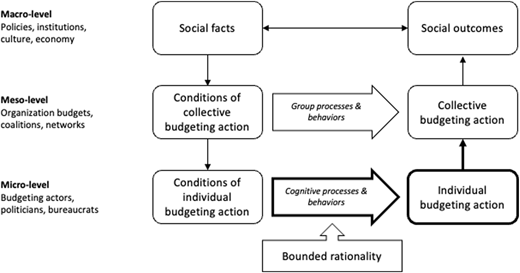
Understanding fiscal decision-making requires attention to the interaction between individual cognition, collective processes and institutional design. Building on the multi-level behavioral model proposed by Overmans (2024), this framework conceptualizes fiscal governance as an interconnected system of judgment, deliberation and design. It distinguishes three analytical levels (micro, meso and macro, see Figure 1) that together capture how behavioral mechanisms operate and interact across the architecture of public budgeting and accounting.
At the micro level, individuals such as politicians, managers or citizens make judgments under uncertainty. Their reasoning relies on heuristics that simplify trade-offs, such as anchoring to existing allocations, framing options as losses or gains, or mentally categorizing funds by purpose (Overmans and Grimmelikhuijsen, 2025). Experimental studies consistently show that such shortcuts produce systematic, predictable effects on budget judgments legitimacy, or guide fairness considerations (for an overview across fields see Mohr and Kearney, 2023). The micro level captures how cognitive processes and information design interact in shaping fiscal preferences and perceptions of value for money.
The meso level concerns the collective arenas in which fiscal choices are explored, negotiated, justified and communicated. Deliberation, sequencing and participation determine how individual judgments aggregate into collective outcomes. Studies of citizen engagement in budgeting demonstrate that framing effects can scale up through group processes: how issues are ordered or presented affects which trade-offs become salient and which are sidelined (Afonso and Mohr, 2024). Group deliberation can moderate or amplify individual biases, depending on whether settings foster open exchange or reinforce conformity (Mohr and Davis, 2023). Behavioral dynamics at the meso level, therefore, determine whether collective decisions amplify, offset or reinterpret individual heuristics.
At the macro level, institutions provide the formal structure within which fiscal behavior unfolds. Fiscal rules, accounting systems and performance frameworks define not only incentives but also what is cognitively visible and normatively defensible. They influence how decision-makers perceive risks, justify actions and allocate attention (McDonald et al., 2024). Institutions act as behavioral architectures: they channel reasoning, frame comparisons and define what counts as “good behavior”. Macro-level designs can amplify biases for instance, when rigid fiscal rules foster short-termism) or mitigate them as in the case of accounting systems that enable reasoned deliberation and accountability.
Across these three levels, feedback (Thaler and Sunstein, 2009; Tuxhorn et al., 2019) connects cognition, coordination and design. Micro-level biases shape meso-level learning, negotiation and justification, which over time may be institutionalized at the macro level. In turn, institutional routines and budget formats condition how individuals think and deliberate. This recursive relationship underscores the behavioral nature of fiscal governance: it is not only about how much is spent but also about how decisions are perceived, justified and collectively reproduced.
The papers in this special issue
The contributions in this special issue illustrate how behavioral mechanisms manifest across the micro, meso and macro levels of fiscal governance. While differing in focus and context, they share a concern with how cognition, interaction and institutional structures jointly shape fiscal reasoning and outcomes. Each contribution occupies a distinctive position in this behavioral architecture. Together, they form a coherent picture of fiscal decision-making as an embedded cognitive process rather than an abstract optimization exercise.
At the micro level, Li et al. (2026) examine how cognitive biases shape the budget preferences of ordinary citizens participating in budget experiments in the Chinese context. This study replicates the experimental design by Overmans and Grimmelikhuijsen (2025), which was originally conducted among Dutch municipal budget officials, but applies it to a general public sample in China, which they relate to participatory budgeting. As in the original study, they test multiple cognitive mechanisms, including anchoring, herding, mental accounting and loss aversion. Their findings show that public budget decisions in the Chinese context are significantly influenced by anchoring effects, herding behavior and gain framing. By contrast, they find no statistically significant evidence for mental accounting or loss aversion. These results suggest that some behavioral effects may be robust across settings, while others remain context- or subject-dependent. The study therefore underlines the importance of replication across institutional and societal contexts.
Also at the micro level, Flink et al. (2026) incorporate partisan heuristics into the analysis of framing effects. They examine how partisanship shapes citizen evaluations of K-12 school district performance and financial management. The study finds broad cross-partisan agreement that above-average student test scores improve overall district evaluations and that internal financial mismanagement negatively affects fiscal management evaluations, regardless of party. At the same time, important partisan differences emerge. Democrats more readily connect organizational performance to fiscal management evaluations and assign the lowest financial ratings to personnel cuts. Republicans respond more positively when a deficit is attributed to external state funding cuts, while Independents respond more negatively when internal mismanagement is identified as the cause. Notably, no cutback strategy significantly affected overall performance evaluations across partisan groups. The authors conclude that partisanship shapes citizen evaluations of financial management more strongly than their overall performance evaluations. This reinforces the broader point that public financial management is embedded in a wider political context.
A different micro-level dynamic is explored by Multhomi (2026), who examines how sequencing shapes fiscal decision-making in online budget simulations. Building on a growing body of behavioral research on resident engagement in the budget process, particularly through tool such as Balancing Act, the paper investigates whether the order in which citizens complete a budget simulation and reveal their preferences affects the alignment between their stated goals and their actual resource allocations. Using a between-subjects experimental design, the study compares two sequences: the default of goal setting followed by budget allocation and an alternative sequence in which participants allocate resources before articulating their goals. Contrary to expectations, the alternative sequence produced stronger decision alignment. Participants who completed the budget-balancing exercise first allocated more resources to the priorities they subsequently identified. Multhomi (2026) interprets this finding in the light of anchoring effects and bounded rationality, suggesting that confronting fiscal trade-offs first sharpens participants' awareness of cost implications before they identify priorities. The study concludes that neither sequence is universally superior, but that sequencing should be matched to the practical aim of the exercise: the default sequence is more suitable when the objective is to identify public priorities early in the process, whereas the alternative is more suitable when the aim is to encourage fiscally grounded choices. The study shows clearly that sequence matters for budgetary outcomes.
Finally, at the micro level, Overmans (2026) examines whether debiasing interventions influence budget judgments among politicians and civil servants. Using a survey experiment, the study compares three intervention types, generic, realistic and innovative, across two judgment phenomena that are central to public budgeting: anchoring and loss-framing. The findings show a differentiated pattern. Anchoring effects remain strong across all conditions, with none of the interventions reducing their influence. In the loss-framing experiment, effects are more limited overall, but the realistic intervention is associated with lower allocations relative to the bias-only condition. The study shows that debiasing in public budgeting does not produce uniform effects and that intervention effects may depend on how closely prompts connect to familiar decision contexts, consistent with an ecological view of judgment in budgeting.
At the meso level, the study by Sarmento da Silva et al. (2026) addresses how budget practitioners learn to use cost information and cost models. Despite legal mandates and the potential value of such information, municipal public managers often have limited familiarity with cost information and its practical application. To address this gap, the authors designed and tested an experiential training course for municipal managers in Brazil. They compare three formats across 33 participants: a traditional lecture as control condition, problem-based learning (PBL) and storytelling. Using a quasi-experimental design, the study finds that the course as a whole improves participants' understanding of cost information, thereby confirming the value of experiential learning. No statistically significant differences are found between the three course formats, although the PBL group reports highest perceived knowledge and engagement. Practically, the study offers a tested model for training public managers in the use of cost information. Theoretically, it extends accounting education theory by applying experiential learning theory to a non-accounting professional audience and by showing that professional learning environments can shape financial decision-making.
At the macro level, Sedmihradska and Arltova (2026) examine how Czech municipalities adjusted debt and savings management in response to a numerical debt rule introduced in 2017. This rule required local governments to keep debt below 60% of their average annual revenues or face mandatory repayment and potential suspension of shared tax revenues. Using a sharp regression discontinuity design that compares 676 municipalities with debt ratios near the threshold, the authors test three phases of behavior: pre-rule, anticipatory and post-rule, drawing on blame avoidance theory and the behavioral model of the budgetary process. The findings support all three hypotheses: before the rule existed, no significant behavioral differences were observed between municipalities just below and just above the threshold, suggesting that the debt limit itself was economically arbitrary. After the rule was announced but before enforcement began, municipalities slightly above the threshold reduced their savings in anticipation of possible consequences, indicating blame avoidance even in the absence of active sanctions. After the rule took effect, municipalities just below the threshold actively reduced debt and savings to avoid crossing the limit in subsequent years. Notably, these behavioral changes appear to have been driven primarily by reputational concerns and the desire to avoid being publicly labeled fiscally irresponsible rather than by fear of immediate financial penalties, which were rarely applied in practice. The study shows how institutional thresholds can shape behavior through anticipatory and reputational mechanisms and demonstrates the value of quasi-experimental approaches for identifying macro-level behavioral effects.
Taken together, these studies populate the behavioral landscape of fiscal governance. At the micro level, heuristics, social cues and efforts to structure reasoning shape financial judgments and evaluations. At the meso level, learning processes influence how fiscal reasoning develops in practice. At the macro level, institutions and rules shape the incentives, categories and expectations that structure behavior at lower levels. By connecting these layers, the special issue shows that fiscal behavior cannot be understood by isolating individuals from their institutional environments. Behavioral public budgeting instead offers a systems perspective that situates cognition within the collective and institutional realities of public finance and highlights how the design of decision environments can enhance both judgment and accountability.
Common threads and emerging insights
Across the contributions, several common patterns emerge that together define the behavioral logic of fiscal governance. First, behavioral mechanisms are systematic and predictable. Heuristics, such as framing and sequencing, influence financial decisions and evaluations across roles and settings, from citizen budget participation to managerial decision-making. At the same time, the studies suggest that as we move from micro-level decision-making environments to more public and institutional settings, socialization and perceptions of other become increasingly important in shaping behavior. Fiscal governance is therefore not only about individual judgment but also about decisions that must be perceived, justified and collectively reproduced.
Second, information design matters as much as information content. Studies in this issue and beyond show that how fiscal data are formatted, labeled or ordered can alter both choices and behavior. Whether through cost-accounting structures, digital interfaces or participatory tools, these design features channel attention and frame what decision-makers consider relevant. Improving fiscal reasoning therefore requires not only better data but also better presentation and structuring of that data.
Third, institutions shape cognition. Fiscal rules, accounting systems and performance indicators do not merely constrain choices; they actively structure how reasoning unfolds. They define what is visible and defensible, creating the cognitive boundaries within which officials, administrators and citizens interpret efficiency, fairness and responsibility. In this sense, behavior is institutionalized. The studies further show that fiscal rules operate as cognitive signals: even in the absence of strict sanctions, they guide behavior through reputational and blame avoidance dynamics. Behavior is thus reproduced through rules and categories that stabilize expectations across actors and time.
Fourth, rationality in fiscal governance is layered and linked. Economic, political and incremental rationalities coexist and interact. Efficiency, legitimacy and stability are not competing goals but interdependent logics that define the conditions under which decisions are made. What appears irrational from one perspective may be functional within another.
Finally, behavior is designable. The evidence points to a shift from bias detection to context design. Behavioral mechanisms are responses to environments in which decisions are made. This opens a practical and normative agenda: rather than attempting to make decision-makers perfectly rational, public institutions can be designed to align with how people actually think, deliberate and justify their choices. This moves the field from documenting behavioral inconsistencies to embedding behavioral insights in the architecture of fiscal governance.
Future research
Future research on behavioral public budgeting and fiscal governance should move from conceptual fragmentation toward theoretical and methodological integration. The contributions in this issue, and the wider body of work emerging in behavioral public administration and behavioral public budgeting, suggest several priorities for the next phase.
A first step is to sharpen the theoretical foundations of what counts as rational behavior in fiscal governance. In this special issue, we have deliberately cast a wide net to demonstrate that integration across micro, meso and macro levels is both possible and necessary in public budgeting research. Behavioral research must further clarify the relationship between cognitive mechanisms and institutional logics that define budgeting. Rather than contrasting behavioral and rational models, scholars should examine the conditions under which heuristics and bounded reasoning contribute to “good”, which is legitimate and prudent, fiscal decision-making. The concept of ecological rationality (Todd and Gigerenzer, 2012) offers a useful bridge, emphasizing how reasoning strategies perform better when they fit the informational and institutional environment in which they occur. Understanding such fit can help explain when biases are adaptive and when they become dysfunctional.
A second direction lies in connecting budgeting more explicitly with accounting and financial performance management. Accounting systems do not merely record financial outcomes; they shape how attention and justification are distributed within public organizations. This shaping effect is amplified when financial information is combined with non-financial performance measures and other control systems that influence how activities are interpreted, evaluated and legitimized (Anessi-Pessina et al., 2016). Earlier work shows that such information affects how managers and organizations are assessed and held to account (Reck, 2001). In addition, Van Der Kolk et al. (2019) demonstrate that different elements of management control systems, including cultural, personnel and action controls, influence behavioral motivation and performance at the micro level, rather than operating solely through formal incentives. Emerging work in behavioral accounting further shows how financial information shapes attention, interpretation and justification in decision processes (Baekgaard et al., 2016; Kang et al., 2025). Embedding these insights into behavioral budgeting can deepen understanding of how fiscal and accounting information becomes meaningful and actionable.
Third, methodological innovation is critical. Randomized controlled trials will continue to play an important role in isolating micro-level mechanisms, but behavioral effects at meso and macro levels require quasi-experimental and natural experimental designs, longitudinal data and comparative approaches. Combining experimental precision with field realism helps link individual cognitive processes to institutional contexts. Conducting experiments in differing contexts, as the study by Li et al. in this issue, shows how context may mediate micro-level processes. Cross-national and cross-sectoral comparisons can further reveal how institutional arrangements amplify or mitigate behavioral tendencies. In short, experiments and quasi-experiments are important for determining many behavioral causal effects that can then be tested across institutional contexts.
Fourth, behavioral research should pay closer attention to time. Fiscal behavior is dynamic, and biases evolve through learning, experience and accountability feedback. Processes such as discounting, temporal framing and adaptation deserve greater analytical attention, particularly in studies of long-term investment, sustainability and intergenerational trade-offs (Jacobs, 2016; Kuroki and Sasaki, 2023).
Finally, the field should develop a stronger design orientation. The goal is not to increase individual rationality but to build decision environments that align with how people actually think and deliberate (Thaler and Sunstein, 2009). Tools such as data visualizations, structured reflection and accountability framing can be tested as ways to support more balanced reasoning. This design-based approach connects behavioral science with institutional reform and makes research directly relevant to treasuries, audit offices and governments seeking to strengthen fiscal judgment and public trust. Together, these directions move the field from diagnosing bounded rationality to cultivating designed rationality: a research agenda focused on institutions that make good reasoning possible.
Concluding remarks
The behavioral perspective on fiscal governance reveals a public sector that reasons within, not outside, its institutional boundaries. Budgets, accounting systems and fiscal rules and procedures do not merely document or constrain decisions. They shape how people perceive value, risk outcomes and fairness. Understanding these processes requires seeing behavior not as a distortion but as the organizing principle of fiscal life.
The studies gathered in this special issue, together with parallel work in psychology, public administration and behavioral economics and finance show that cognition, context and coordination are inseparable. Behavior in fiscal settings is structured, patterned and designable. It follows institutional cues, social norms and informational architectures that can be studied and improved.
Behavioral public budgeting represents more than a thematic convergence. It marks a conceptual shift. It combines the analytical rigor of public finance, the institutional sensitivity of public administration and the experimental imagination of behavioral science. The challenge now is to translate these insights into the design of fiscal governance systems that not only balance budgets but also enable reasoned, legitimate and participatory decision-making.