The purpose of this study is to examine how the sequencing of budget simulations influences the alignment between priority goals and budgetary decisions. Drawing on behavioral perspectives, the study posits that two simulation sequences—goal setting to budgeting (default) and budgeting to goal setting (alternative)—shape individuals' budgetary responses, particularly the proximity between a program's total cost and the corresponding budgetary allocations.
This study employs a quasi-experimental research design using Balancing Act modules that enable participants to articulate their priority goals and corresponding resource allocations. Adult Americans (aged 18 and above) were recruited through an online crowdsourcing platform and randomly assigned to treatment conditions to complete the task. The analysis—based on descriptive statistics, independent sample t-tests, and OLS regression models—provides supporting evidence regarding the role of simulation sequencing in shaping decision alignment.
The findings indicate that the sequence of the simulation facilitates decision alignment, with alignment being comparatively stronger under the alternative sequence. Moreover, the results demonstrate that participants' budget-balancing strategies—particularly the ways in which their allocation choices unfolded during the simulation—significantly contribute to this alignment.
The study offers valuable insights by demonstrating how the sequencing of budget simulation tools can promote participatory outcomes such as decision alignment, preference consistency, and consensus building. Integrating such tools into budgeting processes can foster more meaningful and informed public engagement. Importantly, the study provides a proof of concept for both researchers and practitioners to further test and refine these approaches in practice, thereby contributing to the advancement of theories in behavioral public budgeting.
Introduction
Local governments around the world are increasingly experimenting with online-based budget simulations to enhance citizen engagement in budgetary decision-making processes. Research indicates that tools such as Balancing Act have been adopted by civic leaders to gather public input that can inform governmental budget decisions (Mohr and Afonso, 2024; Kavanagh et al., 2023; Liao, 2023). Through these platforms, the public learn about government budgetary processes, express interests for preferred programs, and make tough budget trade-offs under fiscal constraints (Pinto, 2022; Yarbrough, 2021; Perry, 2018). This has stimulated growing scholarly interest in understanding citizen budgetary preferences, choices, and responses (Afonso and Mohr, 2024; Mohr and Afonso, 2024; Tuxhorn et al., 2019, 2021a, b).
Drawing from behavioral perspectives, the prevailing research has advanced important frameworks for analyzing and predicting individuals' behavior responses. For instance, traditional survey-based simulations that ask participants to indicate their preferences for increasing or decreasing government spending and revenues have contributed to frameworks for examining “free-lunch” tendencies, whereby individuals express demand for expanded public services while simultaneously preferring lower taxes (Simonsen and Robbins, 2000; Welch, 1985). Moreover, online-based surveys facilitated the development of frameworks for assessing budget interactivity, trade-offs, and real-time fiscal consequences (Bonica, 2015; Robbins et al., 2004, 2008; Tanaka, 2007). More recently, the advent of online-based budget simulators has further advanced to the concepts of choice architecture and the budget starting position as essential frameworks shaping individuals' budgetary preferences (Afonso and Mohr, 2024; Mohr and Afonso, 2024; Tuxhorn et al., 2021a, b).
Innovations in Balancing Act modules provide valuable opportunities for examining individuals' behavior responses when the tools are used sequentially. Several efforts by municipal governments to engage residents simultaneously in planning and resource allocation (Pinto, 2022; Yarbrough, 2021; Perry, 2018) are grounded in the understanding that budgetary decisions and processes unfold across multiple stages (Thurmaier and Willoughby, 2001), thereby requiring the strategic integration of citizen engagement processes (Ebdon and Franklin, 2006; King et al., 1998). However, there are limited empirical tests examining the behavioral outcomes of sequential decision-making in budget simulations (Muthomi, 2026). Building upon prevailing studies, this research therefore explores the sequencing of budget simulations as a framework for assessing the alignment of individuals' decisions. Specifically, the study leverages Balancing Act's capacity to examine how sequential budget simulations influence decision alignment between citizens' priority goals and resource allocation.
The overarching research question addressed in this study is: Does budget simulation sequencing influence the alignment between citizens' priority goals and resource allocation? To answer this question, the study employs a quasi-experimental research design using Balancing Act's priority-setting and budget-setting modules that enable participants to submit their priority goals and budget allocations. Decision alignment is assessed based on the extent to which participants allocate sufficient resources to meaningfully support their stated priority goals.
The findings, based on a sample of adult Americans (18 years and above), provide empirical support for the role of simulation sequencing in facilitating decision alignment. Specifically, alignment is comparatively stronger when the simulation begins with budgeting followed by goal setting (the alternative sequence), relative to the reverse or default sequence. Moreover, the results demonstrate that participants' budget-balancing strategies—particularly the ways in which their allocation choices unfold during the simulation—significantly contribute to this alignment. These findings are interpreted through behavioral perspectives, highlighting sequential budget simulation as a potential framework for advancing research in behavioral public budgeting. Additionally, the results provide practical insights for practitioners on how participatory tools such as Balancing Act can be integrated into public budgeting processes.
An overview of citizen participation in budgeting processes
The broader literature on citizen participation addresses Key (1940) longstanding budgeting question of “on what basis shall it be decided to allocate X dollars to program A instead of B?” by emphasizing the need for governments to consult their citizens. However, budgeting itself is a complex process. It entails established procedures that are normatively and instrumentally designed to demonstrate government policy priorities, primarily through the examination of organizational resource use, costs, accomplishments, and future needs (Lee et al., 2021; Rubin, 2020). As part of decision-making processes, budgeting procedures unfold across multiple stages and involve various actors who play vital roles in aligning policy goals with fiscal resources, thereby facilitating the effectiveness and achievement of government initiatives (Thurmaier and Willoughby, 2001).
Accordingly, numerous citizen participation frameworks advanced in the literature recognize the need for their strategic integration throughout the budgeting process. For instance, studies advocate that governments should begin by identifying the public's priority needs early in the process, particularly before developing a budget proposal (Ebdon and Franklin, 2006; King et al., 1998). Other frameworks underscore the importance of providing readily accessible and affordable access to relevant information, as well as multiple participation opportunities, thereby minimizing time, cost, and physical proximity barriers and enhancing citizens' ability to influence final budgetary decisions (Kim et al., 2022; Muthomi and Thurmaier, 2021; Roberts, 2004, 2015). Moreover, frameworks such as participatory budgeting emphasize the institutionalization of engagement models that empower citizens to directly allocate a portion of public funds, thereby shifting resources to better align with community's priority goals (Calabrese et al., 2020; Gilman and Wampler, 2019; Miller et al., 2019; Shybalkina, 2022; Shybalkina and Bifulco, 2019; Wampler, 2000, 2012; Wampler and Touchton, 2017).
Empirically, studies provide supporting evidence that the integration of citizen participation frameworks into budgeting processes yields numerous positive outcomes, including increased citizen satisfaction and trust in government, greater willingness to participate, enhanced transparency and accountability, and strengthened government legitimacy (Afonso, 2017, 2021; Ebdon, 2002; Hong and Cho, 2018; Johnson et al., 2021; Muthomi and Thurmaier, 2021; Sinervo et al., 2024; Yang and Pandey, 2011; Zhang and Yang, 2009). More recently, research has shifted toward examining how citizen participation practices can be integrated into budgeting processes to promote social equity (Kuenneke and Scutelnicu, 2021; Lofton and Martínez Guzmán, 2026; Martínez Guzmán et al., 2025; Taylor et al., 2025).
Balancing Act simulation tools provide valuable opportunities for fostering effective and meaningful citizen participation in budgeting processes, thereby generating a range of participatory outcomes for both governments and their residents. These simulations foster information symmetry by presenting program costs, performance outcomes, and benefits that enable the public to make informed decisions. Similarly, they increase the intensity of engagement by requiring participants to confront difficult trade-offs in balancing local government budgets. Moreover, the tools empower participants to directly adjust revenue and spending decisions based on their preferences, priority needs, and willingness to pay (Adams, 2022; Afonso and Mohr, 2024; Mohr and Afonso, 2024; Tuxhorn et al., 2019, 2021a, b). Consequently, these simulations generate a range of participatory benefits, including educating citizens about public finance, increasing awareness of government policies and decisions, promoting budget transparency, and enhancing data-informed decision-making (GFOA, 2025; Kavanagh, 2020; Kavanagh et al., 2023; Liao, 2023; Polco, n.d.). The current study leverages Balancing Act's capacity to integrate citizen participation with budgeting processes to examine how sequential budget simulations influence the alignment between citizens' priority goals and resource allocation, thereby extending initial findings that suggest potential consistency in individual preferences (Muthomi, 2026).
Behavioral perspectives in budget simulation
Behavioral theory has been extensively applied to examine individual and collective budgeting responses (Mohr and Kearney, 2021; Overmans and Grimmelikhuijsen, 2025). Studies recognize that individuals often deviate from purely rational decision-making when expressing their preferences or choices (Battaglio et al., 2019; Kahneman and Tversky, 1979; Levin et al., 1998; Tversky and Kahneman, 1974). A prevailing attribute identified in the literature concerns the role of salient informational regarding budgetary programs, costs, benefits, and performance outcomes in shaping individuals' responses (Bullock and Fernald, 2005; Faricy and Ellis, 2014; George et al., 2017; Harwood et al., 1991; Kerler et al., 2012; Limbert and Bullock, 2009; Litton, 2023; Nielsen and Baekgaard, 2015; Robbins et al., 2004).
Another attribute concerns individuals' preexisting cognitive capabilities and structures—such as values, ideologies, and heuristics—that bias how information is received, processed, and acted upon (Baekgaard et al., 2019; Cantarelli et al., 2023; Chong and Druckman, 2007a, b; Overmans and Grimmelikhuijsen, 2025; Tuxhorn et al., 2019; Van der Voet and Lerusse, 2024). An additional attribute relates to the amount of attention individuals devote to information (Baekgaard et al., 2016; Padgett, 1980). This factor is particularly important in budgeting contexts, as limited attention influences whether individuals make small or substantial changes to fiscal allocations (Afonso and Mohr, 2024; Flink, 2018; Mohr and Afonso, 2024).
Corresponding research utilizing Balancing Act simulation tools has contributed to the development of frameworks for analyzing and predicting behavioral patterns. Two prominent frameworks—choice architecture and the budget starting position—offer important insights into individuals' fiscal attitudes and balancing strategies. The choice architecture framework underscores the role of different choice contexts in shaping individual fiscal attitudes (Afonso and Mohr, 2024; Mohr and Afonso, 2024; Tuxhorn et al., 2021a, b). For instance, Tuxhorn et al. (2021a) operationalize choice contexts as distinct approaches to presenting spending and revenue decisions either separately (singular) or jointly (holistic). The authors find that, compared to expenditure-only choices, individuals' spending attitudes differ significantly when they are provided with choices concerning both sides of the budget. However, individuals' revenue attitudes remain stable regardless of whether the choice context includes only taxes or both spending and taxes. The authors conclude that individuals exhibit stable revenue attitudes, whereas their spending attitudes are sensitive to the context in which budgetary choices are presented (Tuxhorn et al., 2021a).
In another study, Tuxhorn et al. (2021b) operationalize choice contexts by providing a holistic and comprehensive set of information on government expenditures and revenue options required to address a deficit situation in order to test the “something for nothing” hypothesis. Consistent with prior empirical research, the authors show that participants' budget-balancing strategies involved both cutting certain spending items and increasing selected taxes. Moreover, they find broad consensus in support of increasing taxes on the very wealthy, although a significant minority of participants were willing to raise their own taxes to sustain higher levels of spending. The authors conclude by underscoring the importance of holistic budgetary choices in shaping individuals' coherent fiscal decisions (Tuxhorn et al., 2021b).
Building upon the choice architecture framework, Mohr and Afonso (2024) advance the concept of the budget starting position as an influential framework shaping individual budgetary responses. The authors operationalize the budget starting position as initiating the simulation in a balanced, deficit, or surplus condition, and hypothesize that these different starting positions will influence participants' engagement with the simulation, their budgetary preferences, and their budget-balancing behavior. The findings provide supporting evidence across the measured indicators, leading to the conclusion that different starting positions generate multiple behavioral responses in budget simulation engagement (Mohr and Afonso, 2024).
In a follow-up study, Afonso and Mohr (2024) examine how nudges influence participants' efforts to reduce ending balances in surplus or deficit simulations. The authors posit that nudges can be incorporated into choice architecture frameworks to correct potential errors frequently observed in budget simulations. The findings corroborate prior empirical evidence that large ending surpluses often result from simulations that begin in a surplus condition. Moreover, the study reveals that nudged participants significantly reduced their final budgetary surplus compared to non-nudged participants (Afonso and Mohr, 2024).
More recently, scholars are examining how structured and unstructured choice architectures shape individuals' budgetary responses. The central emphasis concerns the layout of available options: a structured choice architecture presents comprehensive and complex budgetary options for both taxes and expenditures, whereas an unstructured choice architecture lacks such detailed options (Mohr et al., 2025; Waller, 2025). Another emerging framework examines the consistency with which individuals express their preferences when they are first asked to prioritize programs and subsequently to allocate resources to those programs within a budget simulation exercise. The study shows that, although instances of inconsistency are common, preference consistency is associated with participants' sustained support for their favored programs, their commitment to ensuring adequate resource allocation, and, to some extent, their willingness to finance those programs (Muthomi, 2026).
Study hypotheses
As in many decision-making processes, budgetary decisions unfold sequentially, such that earlier actions and choices often influence subsequent ones (Thurmaier and Willoughby, 2001). In behavioral public budgeting, research further suggests that initial information presented to decision makers produces significant anchoring effects, thereby shaping subsequent choices (Overmans and Grimmelikhuijsen, 2025). For example, information regarding a program's costs, benefits, and performance outcomes has been shown to influence individuals' budgetary preferences and decisions (Mohr and Kearney, 2021; Robbins et al., 2004; Simonsen and Robbins, 2000).
In the context of budget simulation, recent research examining the consecutive use of Balancing Act's priority-setting and budget-balancing modules finds evidence of potential anchoring effects, resulting in alignment between individual priority goals and allocation choices (Muthomi, 2026). Given the emphasis that Balancing Act is an effective tool for fostering public engagement (Mohr and Afonso, 2024), the sequence in which its modules are employed can provide insight into whether the public is capable of aligning their decision. Unlike previous research, which examined only a single sequence—beginning with goal setting followed by budget allocation (Muthomi, 2026)—the current study also investigates the reverse sequence.
The sequence of goal setting followed by budget allocation forms basis of the default hypothesis. This sequence is reinforced by the citizen participation literature, which emphasizes that authentic participation occurs through a bottom-up approach in which public input is solicited early in the process—prior to budget development—thereby increasing the likelihood that it will inform final policy outcomes (Ebdon and Franklin, 2006; King et al., 1998). Applied to Balancing Act, local governments seeking public input during budgeting may first identify citizens' priority goals to inform the development of a budget proposal. The priority-setting module is well suited for this purpose, as it exposes participants to relevant information about budgetary programs. Subsequently, local governments may engage the public in reallocating resources to their previously identified priority goals while accounting for competing budgetary demands. The budget-balancing module facilitates this task by introducing revenue and expenditure constraints that participants must reconcile (Adams, 2022). Thus, if participants are attentive to their priorities, we expect that they will allocate resources in accordance with initially stated goals. Consequently, this sequence should produce alignment between priority goals and budgetary allocations.
The alternative sequence of budget allocation followed by goal setting, although not commonly utilized in real-world settings, can further enhance our understanding of participants' decision alignment. Prevailing budget simulation research has primarily focused on the budget-balancing module to highlight behavioral responses across different contexts (Afonso and Mohr, 2024; Mohr and Afonso, 2024; Tuxhorn et al., 2019, 2021a, b). Similarly, practitioners increasingly rely on the budget-balancing module to achieve various participatory outcomes for governments and their residents (Kavanagh et al., 2023; Liao, 2023; Perry, 2018; Pinto, 2022; Yarbrough, 2021). This emphasis reflects the view that the module is a primary tool for assessing and understanding public preferences, with comparatively limited attention devoted to how different modules can be integrated to foster additional participatory outcomes.
Despite this limitation, the alternative sequence initially exposes individuals to complex budgetary trade-offs, thereby enhancing their understanding of the cost implications of their choices. However, due to the inflexibility of adjusting program allocations within the priority-setting module (Muthomi, 2026), individuals are compelled to make careful consideration within the budget-balancing module (Adams, 2022). Therefore, if participants are attentive to their priorities, we expect that they will allocate resources to program's goals they want implemented. Similarly, this sequence should produce alignment between budgetary allocations and priority goals.
Reflecting on the above thesis, the study tests the following hypotheses:
Compared to the alternative sequence, participants in the default sequence will allocate resources to a greater extent in accordance with their priority goals.
Compared to the alternative sequence, participants in the default sequence will exhibit greater decision alignment.
Research methods
Scholars have increasingly emphasized the need for behavioral and experimental research to advance our understanding of public budgeting and financial management. In particular, recent work has called for the development of complex experimental designs to examine how individuals respond to fiscal tradeoffs and how variations in the presentation of budgetary information influence decision-making outcomes (Mohr and Kearney, 2021; Mohr and Davis, 2023). Responding to this call, the present study employs a quasi-experimental research design to examine the alignment of participants' decisions within a simulated local government budgeting context. The experiment was structured as a vignette with four treatment conditions [1] and utilized two Balancing Act modules — a priority-setting module and a budget-setting module — to collect respondents' priorities and allocation choices.
Participants were instructed to assume that they were residents of a hypothetical jurisdiction, River City, whose City Council was seeking public input to guide the development of its annual budget. To enhance relevance of the budgetary context, a list of ten programs, including their names, descriptions, approximate costs, and anticipated benefits, was randomly selected from municipal budget documents. The programs spanned policy areas such as affordable housing, climate justice, community health, public safety, and justice department initiatives. The selected programs were evenly divided between initiatives with capital expenditures (i.e. program funding) and those involving recurring expenditures (i.e. vacant positions). Moreover, the total cost of capital programs was set at $12.5 million, while the recurring programs totaled $3.5 million [2].
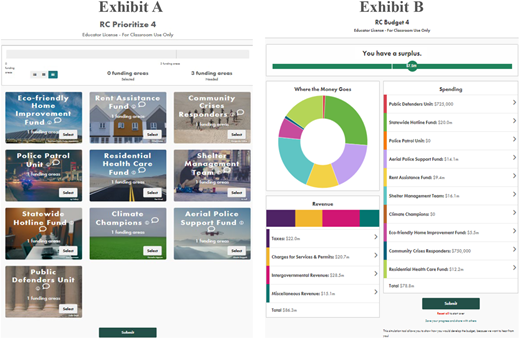
Figure 1 illustrates the simulation setup within the priority-setting (Exhibit A) and budget-balancing modules (Exhibit B). In Exhibit A, participants were limited to selecting three programs as priorities and were not permitted to adjust program costs. In contrast, Exhibit B allowed participants to adjusting both spending and revenue allocations using structured options. On the spending side, participants were provided five options for modifying the budget (i.e. postpone, allocate one-quarter, one-half, three-quarters, or the full amount of the requested funding). On the revenue side, participants were given three options for both property and sales tax (i.e. maintain tax rates or increase them by 0.1% or 1%).
The literature underscores that initiating a budget simulation with a surplus weakens participants' propensity to make difficult trade-offs and induces auto-correction or status quo–oriented behavioral responses (Mohr and Afonso, 2024). Although the initial budget balance in this study was set at a $7.5 million surplus, potential limitations were mitigated by requiring participants to fund at least three programs of their choice and to balance the budget by considering both spending and revenue options. These conditions shifted the budget from a surplus to a deficit, regardless of whether participants chose to support only capital programs, only recurring programs, or a combination of both.
The experimental procedure began with participants accessing the survey through an anonymous Qualtrics link. Two attention-check questions were embedded at the beginning of the survey instrument to ensure participant attentiveness. Following these checks, participants were introduced to a hypothetical scenario describing a citizen participation initiative in which they were invited to share their budgetary preferences using budget simulation tools. To facilitate a sequential transition from one simulation to the next, participants were informed that the budget exercise consisted of two consecutive stages for submitting their input. Upon completing the first stage, a hyperlink to the second stage was embedded on the submission page, enabling participants to proceed seamlessly to the subsequent simulation module. Tracking and verification of participants' budgetary priorities and allocation choices were facilitated through a unique completion code, which each participant was required to enter prior to final submission. After completing the simulation tasks, all participants responded to a set of post-simulation survey questions designed to collect demographic information. This experimental procedure was preregistered with the Open Science Framework (OSF) prior to data collection.
Participants were recruited through the CloudResearch platform. Prior studies recognize CloudResearch for its capacity to generate demographically balanced samples by applying predefined quota criteria. The platform also employs robust internal verification protocols to detect potentially fraudulent responses and to flag respondents who complete surveys at abnormally rapid speeds (Deslatte, 2020; Chandler et al., 2019). To qualify for participation, an IP address locator was enabled to restrict access to individuals within the United States. Participants were also required to be at least 18 years of age. Table 1 summarizes the demographic characteristics of the sampled study participants. On average, participants completed the survey in 12.20 min and were compensated $1.75 for their time and effort.
Study variables and analytical approach
The primary dependent variable is decision alignment. Drawing on the premise that budgetary decisions unfold across multiple stages, we expect individuals' earlier choices to influence, or be reflected in, their subsequent decisions. In the context of a sequential budget simulation, decisions are considered aligned when there is close proximity between a program's total cost and the participant's corresponding budgetary allocation. Accordingly, the study constructs the decision alignment variable using a percentage-difference approach (Muthomi, 2026), calculated using the following formula;
Where B1, B2, and B3 is the actual amounts participants allocated to their priority programs within the budget-setting module, while P1, P2, P3 is total amount associated with the priority programs selected within the priority-setting module. This measure produced percentage scores ranging from 0 to 1, where a score of 0 indicates perfect alignment and a score of 1 indicates complete misalignment.
The independent variable is the sequence of the simulation, coded as a dummy variable in which 1 represents the default sequence and 0 the alternative sequence. It is hypothesized that participants in the default sequence will allocate resources to a greater extent in accordance with their stated priority goals than those in the alternative sequence (H1). It is also hypothesized that participants in the default sequence will exhibit greater decision alignment than those in the alternative sequence (H2).
The study hypotheses were empirically tested using descriptive statistics, independent-samples t-tests, and OLS regression models. First, descriptive statistics were used to summarize the amounts, in US dollars, that participants allocated to their priority goals within the budget-setting module. Second, an independent-samples t-test was conducted to examine whether the amounts allocated to priority goals differed significantly between the default and alternative simulation sequences. Third, decision alignment values were regressed on the sequence variable and subsequently on budget allocation strategies to further assess participants' budgetary responses across the two simulation sequences. The budget allocation variable was constructed as a categorical measure indicating whether participants postponed the allocation or allocated one-quarter, one-half, three-quarters, or the full amount of the requested funding.
Findings
Table 2 summarizes participants' budget allocations to their priority goals [3]. Overall, total allocations within the alternative sequence (sum = $646,125,000) exceeded those in the default sequence (sum = $533,000,000), with mean allocations of $4,550,000 (95% CI: $3,960,000–$5,140,000) and $3,700,000 (95% CI: $3,250,000–$4,150,000), respectively. These patterns are largely consistent across the budgetary programs, with two exceptions. First, participants allocated $11 million more to the Residential Health Care Fund under the default sequence than under the alternative sequence. Second, allocations to the Aerial Police Support Fund totaled $9 million in both simulation sequences. Notably, the Statewide Hotline Fund Program received no allocations, despite being identified as a priority goal.
Table 3 presents the results of the independent-samples t-tests. Contrary to Hypothesis 1, the overall amounts allocated to priority goals were significantly greater in the alternative simulation sequence than in the default sequence, t(266) = 2.266, p < 0.05. A closer examination of program-level results indicates that statistically significant differences emerged only for the Police Patrol Unit, t(276) = 2.306, p < 0.05, and the Public Defenders Unit, t(206) = 3.257, p < 0.001. Despite these mixed findings, the results provide partial support for a reversed interpretation of Hypothesis 1. Specifically, compared to the default sequence, participants in the alternative sequence allocated resources to a greater extent in accordance with their stated priority goals.
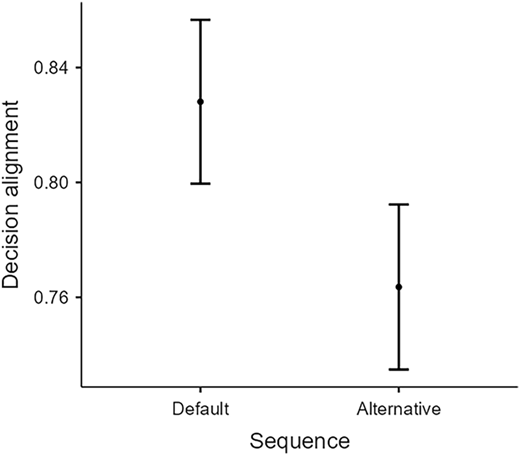
Table 4 presents the OLS regression results for the primary study variables. The coefficients are negative and statistically significant, indicating that, compared with the alternative sequence, the default sequence decreased participants' decision alignment by 0.064. Stated differently, the findings suggest that the alternative sequence increased participants' decision alignment by 0.064 relative to the default sequence. Figure 2 graphically illustrates participants' decision alignment across the two simulations. In the default sequence, participants' decisions were closer to 1 (mean = 0.828), signifying greater misalignment. In contrast, in the alternative sequence, decision alignment values were relatively farther from 1 (mean = 0.764), suggesting that this sequence produced comparatively better alignment.
Table 5 further elaborates on how participants' decision alignment was achieved through different budget allocation strategies across the simulation sequences. Using the decision to postpone allocation as the reference category, participants strategically allocated one-quarter, one-half, three-quarters, or the full amount to their priority goals. The coefficient estimates for both the default and alternative sequences indicate that individuals' budgetary choices significantly contributed to decision alignment, with larger allocation proportions associated with greater alignment outcomes. Collectively, the results provide empirical support for a reversed interpretation of Hypothesis 2. Specifically, compared to the default sequence, participants in the alternative sequence exhibited greater decision alignment.
Discussion
As municipal governments continue to simultaneously use simulation modules to collect public priority goals and fiscal preferences during budget development, it is important for scholars and practitioners to understand how different sequences influence participants' ability to align their decisions. This experiment demonstrates that both the default sequence—goal setting followed by budget allocation—and the alternative sequence—budget allocation followed by goal setting—play an essential role in shaping individuals' goals and budget alignment, with alignment being comparatively stronger under the alternative sequence. These results are consistent with behavioral mechanisms associated with anchoring effects (Overmans and Grimmelikhuijsen, 2025), while also reflecting limitations of individual attention and bounded rationality (Baekgaard et al., 2016; Padgett, 1980). The findings support the notion that individual choices often evolve throughout the process, thereby affecting the consistent expression of preferences (Muthomi, 2026). Moreover, individuals' cognitive and psychological processes contribute to both rational and seemingly random decision-making patterns, leading participants to express both homogeneous and heterogeneous preferences (Soguel et al., 2020).
Fundamentally, the observation that participants applied varying budget-balancing strategies to support their priority goals is consistent with empirical findings on behavioral responses in budget simulations (Afonso and Mohr, 2024; Mohr and Afonso, 2024; Robbins et al., 2004; Simonsen and Robbins, 2000; Tuxhorn et al., 2019, 2021a, b). Moreover, these strategies underscore the critical role of structured choices in facilitating individual decision-making when confronting difficult budgetary trade-offs (Mohr et al., 2025; Waller, 2025). While most participants allocated one-quarter of the required program funding, a smaller proportion allocated one-half, three-quarters, or the full amount (see Table A1 in Appendix). Participants also demonstrated a willingness to balance their budgets by increasing revenue options (i.e. property and sales taxes), although this dimension was not formally analyzed in the current study.
The findings of this study should not be interpreted to suggest that either simulation sequence is inherently superior. Rather, what matters is how the sequences are strategically integrated into budgeting processes. Previous research underscores that sequential budget simulation can facilitate individual preference consistency (Muthomi, 2026), thereby helping to reconcile diverse—and at times conflicting—interests among budget stakeholders (Franklin and Ebdon, 2004). If the intended purpose is to identify public priority goals to inform the development of a budget proposal, then the default sequence may be most appropriate, with the caveat that participants may not always align their allocation decisions with their initially stated goals. Conversely, if the objective is to ensure that participants develop a clearer understanding of the fiscal implications of their decisions before identifying priority goals for implementation, then the alternative sequence may be more suitable, as it appears to facilitate stronger decision alignment, even though participants may still express inconsistent preferences. In essence, the sequencing of budget simulations represents an evolving framework that scholars and practitioners can adapt and refine in pursuit of specific participatory outcomes.
The insight that individuals may exhibit chunking or status quo behavioral responses represents an important limitation of budget simulations (Mohr and Afonso, 2024). For example, the observation that most participants opted to reduce program spending by postponing allocations or selecting the minimum option (i.e. one-quarter funding) can be interpreted as indicative of chunking behavior. Additionally, approximately four participants displayed status quo tendencies by allocating resources to fewer programs than required, thereby avoiding the task of balancing a deficit budget. Scholars emphasize that such responses constitute potential decision-making errors that require corrective mechanisms, such as nudging participants toward more accurate preference expression (Afonso and Mohr, 2024; Kuroki and Sasaki, 2023). Accordingly, future research should incorporate nudges to assess the extent to which participants conform to the requirements of sequential simulation tasks.
Beyond behavioral considerations, this study also contributes to theories of citizen participation that emphasize the strategic integration of participatory processes into policy and budget decision-making (Ebdon and Franklin, 2006; King et al., 1998; Miller et al., 2019). Specifically, budget simulation modules underscore the importance of designing participatory processes with clearly articulated outcomes for both governments and their residents (Kavanagh et al., 2023; Liao, 2023). Within a sequential framework, budget simulations can extend citizen participation theory by explicitly linking procedural design to participatory outcomes such as decision alignment, preference consistency, and consensus building (Franklin and Ebdon, 2004; Muthomi, 2026). Moreover, these simulations have the potential to strengthen the budget-policy nexus (Thurmaier and Willoughby, 2001) by informing budget formulation in light of public priority goals and guiding implementation strategies based on the fiscal trade-offs residents are willing to accept.
However, the timing between goal setting and budget allocation presents a potential procedural challenge for sequential budget simulations in real-world settings. Individuals' initial priorities may change or be forgotten during the interval required to analyze and integrate public input into subsequent budgeting phases, thereby reducing the likelihood that later decisions will reflect earlier choices. In addition, some participants may withdraw from subsequent stages of budget engagement, thereby losing the opportunity to link their decisions across stages. One potential way to address this challenge is for public administrators to establish resident cohorts committed to consistent participation throughout the budgeting process (Muthomi, 2026).
Lastly, the evolving landscape of budget simulation tools provides researchers with valuable opportunities to design experimental studies and test hypotheses in budgeting, accounting, and public finance (Mohr and Kearney, 2021; Mohr and Davis, 2023). Balancing Act, in particular, has demonstrated considerable potential for understanding and predicting citizen behavior with respect to budgetary preferences. Its application in this study is innovative in that it enables participants to identify priority goals and allocate resources in a sequential framework. Future research can further leverage the integration of additional Balancing Act modules, such as the taxpayer receipt tool (Polco, n.d.), to determine how information on tax utilization shapes individual budgetary preferences and decision outcomes.
Conclusions
This exploratory study suggests that the sequencing of budget simulations can facilitate alignment between individuals' priority goals and allocation choices. In a budgeting context, such alignment is demonstrated when participants allocate sufficient fiscal resources to meaningfully support their identified priority goals. The fact that participants tend to match their stated goals with corresponding budget allocations indicates a tendency to avoid “free-lunch” behavioral responses (Simonsen and Robbins, 2000; Welch, 1985). Notably, participants do not necessarily demand increased services alongside reduced taxes. Rather, evidence suggests they are often willing to forgo the full benefits of their preferred goals and to raise revenues up to the level they consider acceptable or optimal (Muthomi, 2026; Tuxhorn et al., 2021b). In this way, sequential budget simulations encourage more fiscally grounded preference expression by linking aspirations to their corresponding financial trade-offs.
The study offers a proof of concept that requires further empirical testing, thereby advancing sequencing as a useful framework that researchers and practitioners can employ to generate diverse participatory benefits and to further develop theories of behavioral public budgeting. Fundamentally, Balancing Act simulation tools provide innovative avenues for examining the behavioral mechanisms that shape individuals' budgetary preferences, choices, and decisions.
Appendix
Number of participants allocating resource to priority programs
| Program | Sequence | Postpone | A quarter | A half | Three-quarter | Full |
|---|---|---|---|---|---|---|
| Community crises responders | Default | 99 | 18 | 14 | 2 | 11 |
| Alternative | 91 | 17 | 19 | 6 | 9 | |
| Climate champions | Default | 128 | 2 | 3 | 2 | 9 |
| Alternative | 116 | 10 | 6 | 3 | 7 | |
| Shelter management team | Default | 115 | 26 | 3 | – | – |
| Alternative | 118 | 19 | 3 | – | 2 | |
| Police patrol unit | Default | 115 | 4 | 8 | 9 | 8 |
| Alternative | 93 | 9 | 13 | 15 | 12 | |
| Public Defender unit | Default | 138 | 3 | 2 | – | 1 |
| Alternative | 120 | 4 | 12 | 4 | 2 | |
| Statewide hotline fund | Default | 144 | – | – | – | – |
| Alternative | 141 | 1 | – | – | – | |
| Aerial police support fund | Default | 141 | 3 | – | – | – |
| Alternative | 139 | 3 | – | – | – | |
| Rent assistance fund | Default | 122 | 11 | 3 | 5 | 3 |
| Alternative | 108 | 18 | 13 | 1 | 2 | |
| Eco-friendly home improvement fund | Default | 129 | 15 | – | – | – |
| Alternative | 127 | 13 | 1 | – | 1 | |
| Residential health care fund | Default | 102 | 38 | 4 | – | – |
| Alternative | 106 | 31 | 4 | – | 1 |
Note(s): Default sample = 144, alternative sample = 142
Notes
The experiment employed a 2 × 2 vignette design comprising two factors: budget format (program-based versus line-item) and simulation sequence (goal setting–to–budget allocation versus budget allocation – to – goal setting). However, this manuscript focuses exclusively on the line-item budget format and the simulation sequences.
A brief description was provided for each budgetary program. Recurring programs were characterized as ongoing activities requiring continued support, whereas new programs were defined as initiatives necessitating the establishment of a new mandate. While the starting balance for new programs was set at $0, their budgetary requests and allocation options were aligned with existing program needs to ensure comparability. For example, the budget request for the two vacant-position programs designated as new — namely, the Police Patrol Unit and Climate Champions — was set at $3.5 million.
Analyzing the combined datasets produced identical patterns in participants' budgetary allocations (not included in the current study). The OLS regression also yielded similar results, although with lower explanatory power and weaker R2 values (Adjusted R2 = 0.009).