


Populist parties and actors now govern various countries around the world. Often elected by the public in times of crises and over the perceived failure of ‘the elites’, the question stands as to how populist governments actually perform once elected, especially in times of crisis. Using the pandemic shock in the form of the COVID-19 crises, our paper poses the question of how populist governments handle the pandemic. We answer this question by introducing a theoretical framework according to which populist governments (1) enact less far-reaching policy measures to counter the pandemic and (2) lower the effort of citizens to counter the pandemic, so that populist governed countries are (3) hit worse by the pandemic. We test these propositions in a sample of 42 countries with weekly data from 2020. Employing econometric models, we find empirical support for our propositions and ultimately conclude that excess mortality in populist governed countries exceeds the excess mortality of non-populist countries by 8 percentage points (i.e., 98%). Our findings have important implications for the assessment of populist government performance in general, as well as counter-pandemic measures in particular, by providing evidence that opportunistic and inadequate policy responses, spreading misinformation and downplaying the pandemic are strongly related to increases in COVID-19 mortality.
Introduction
The COVID-19 pandemic poses an unprecedented challenge for many governments around the world. We focus on this challenge and the government responses to it by addressing the question: How are populist governments handling the pandemic? Specifically, how does the response of populist governments differ from non-populist governments and are populist governments less successful in containing the pandemic?
In answering these questions, we add to the growing political economy literature on the effect of different government types on pandemic responses. While an increasing number of publications is concerned with the comparison between democratic and autocratic regimes (e.g., Alon et al., 2020; Cepaluni et al., 2020; Stasavage, 2020), contributions addressing the effect of populist governments are still scarce. The few existing studies either focus on single cases (e.g., Smith, 2020), lack a rigorous theoretical basis for empirical analyses (e.g., McKee et al., 2020; Williams et al., 2020), or only address policies implemented at the onset without addressing their effectiveness (e.g., Kavakli, 2020).
We make two contributions. First, we develop a comprehensive formal model, directly linking populism to specific types of pandemic responses, and model populist governance with a pandemic shock. Second, we empirically analyse the propositions of our model in a sample of 42 developed and developing economies with novel data on government response from the Oxford COVID-19 Response Tracker (Hale et al., 2021), citizen behavior from Google COVID-19 Mobility Reports (Google, 2021), and the country-specific severity (excess mortality) of the pandemic.
Our formal model proposes two distinct but interconnected mechanisms on why the pandemic response and severity systematically differ between populist and non-populist governments. First, populists present themselves by definition as the embodiment of the will of “the people” (see Urbinati, 2019). Consequently, the policies enacted by populist governments tend to be “quick-fixes”, characterized by simple solutions for the short term (Edwards and Dornbusch, 1991). Populist governments are thus less likely to implement far-reaching and targeted measures to contain the spread of the virus. Second, populist governments tend to advocate anti-scientific attitudes, which are rooted in an ‘anti-elite’ populist discourse (Mietzner, 2020). Citizens subject to these anti-scientific views are less likely to take the virus seriously and comply with public health recommendations (Gollwitzer et al., 2020).
Our theoretical model shows how a country becomes populist. Then, it goes on to analyse the strategic interaction between the state and citizens in the context of a pandemic, fully incorporating the interdependence of public and private behavior actions in the context. For example, lockdowns only work if the citizenry also engages in social distancing. A populist government’s response to a pandemic may be more muted and delayed, in which case citizens also exercise less caution. From this theoretical framework we derive the following three propositions: First, a populist government’s policy response is lower than that of conventional governments. Second, the public effort to contain the pandemic is higher in non-populist led countries, as the citizens are not subject to regular anti-scientific messages from the government. Third, the government’s policy response and the citizen’s effort jointly determine the severity of the pandemic’s course. From this follows that the pandemic is likely to run a much more severe course in populist governed countries.
We test these propositions using a sample of 42 developed and developing countries of which 11 are populist governed. We analyze systematic differences in policy responses as well as citizen behavior, and link these differences to a higher excess mortality in populist governed countries, as theorized. Following our theory, we differentiate between two types of response variables: Pandemic response (i.e., government policies, citizen behavior) and excess mortality. This allows us to gain new insights into how government responses and public efforts differ across populist and conventional-led countries and how this difference amplifies the severity of the pandemic. We find that populist governments are indeed less invested in implementing targeted policy responses to reduce the spread of the pandemic. As theorized, citizen mobility is also higher in populist-led countries. Taken together, we find that excess mortality is about 8 percentage points higher in populist when compared to conventional countries. Based on this we can conclude that excess mortality is about twice as high (i.e., 98%) in populist governed countries than in non-populist governed countries.
This paper proceeds as follows: “Literature Review” outlines the relevant literature on the pandemic performance of countries as well as on populist governance and political institutions more generally. The theoretical foundation of our argument is presented in the “Theory” section. In the “Data” section we introduce the data used to empirically test the propositions derived from the theory and provide first descriptive insights. The “Estimation” section presents the estimation models, results and robustness checks. The paper ends with a “Conclusion” section.
Literature Review
Since the onset of the COVID-19 pandemic, a growing amount of literature has addressed the question of how different regime types perform in countering the spread of the virus. While it is widely believed that democracy is positively correlated with public health (Besley and Kudamatsu, 2006; Hall and Jones, 2007; Justesen, 2012; Patterson and Veenstra, 2016; Wigley and Akkoyunlu-Wigley, 2017), implementing policy measures to counter a rapidly spreading and unknown virus is different from gradually building an infrastructure that prevents certain health conditions. Against this back drop and motivated by the success of the Chinese Government in countering the pandemic the question has been raised whether autocratic countries like China perform better in countering the COVID-19 pandemic.
Concerned with the onset of the pandemic, several contributions show that democratic countries have been hit especially hard by the pandemic, leading some to suggest that autocratic regimes are somewhat more capable of quick responses to clear and present dangers (Alon et al., 2020; Cepaluni et al., 2020; Norrlöf, 2020; Stasavage, 2020). Nonetheless, additional studies have shown that although democracies have been hit more severely by the pandemic in terms of infection rates, deaths rates are significantly lower in democratic countries (Karabulut et al., 2021). This can be explained by the fact that democratic governments although reluctant to close schools or radically limit freedom of movement and assembly (Cheibub et al., 2020; Sebhatu et al., 2020) are more able to deal with shocks to public health as the health care systems are stronger. Further, the lag in response time is — if anything — largely constrained to the very onset of the pandemic (Bayerlein and Gyöngyösi, 2020).
Concerned with the pandemic response and performance of countries, Bosancianu et al. (2020) show that (1) state capacity, (2) political institutions, (3) political priorities, and (4) social structures are the four central features that capture the pandemic performance of countries and governments better than a simple division between autocracy and democracy. While many contributions have weighed in on the discussion of autocratic versus democratic pandemic response, contributions concerned with populist governments and their pandemic response have been rather scarce (see for some notable exceptions see e.g., Bayerlein and Gyöngyösi, 2020; Gollwitzer et al., 2020; McKee et al., 2020; Mietzner, 2020; Smith, 2020; Williams et al., 2020; Wondreys and Mudde, 2020). The necessity of analyzing the performance of populist governments is however of key importance as the outlined features that determine pandemic performance are closely related to populism.
Previous research has shown that populist governments contribute to a reduction of state capacity and democratic accountability (Cachanosky and Padilla, 2019; Rode and Revuelta, 2015). Strongly related to this is institutional decay under populist rule, which weakens the political institutions and coincides with a decline in economic performance that further limits state capacity (Funke et al., 2020). Contributions have further shown that a special component of institutional decay under populist rule is limiting media freedom and independent journalism (Kenny, 2020). Media and press freedom again has been shown to be strongly correlated with public health as people can receive independent information about health and how to protect them against diseases (Wigley and Akkoyunlu-Wigley, 2017).
Apart from state capacity and political institutions, several contributions have shown how political priorities shift under populist rule. This shift is inevitably linked to the populist rhetoric according to which the populist is the embodiment of the will of “the common people” who enforces this will against “the corrupt elite” (Mudde, 2004; Urbinati, 2019). In their seminal contribution on the economics of populism, Edwards and Dornbusch (1991) have shown that populist governments are mainly interested in short-term solutions and ‘quick fixes’ that provide ‘the people’ with what they want and not what is economically reasonable or sustainable. These unsustainable policies are a major contributing factor to the often observed economic decline under populist rule (Dovis et al., 2016). Analyzing the pandemic response of populist governments, the few existing studies have shown that the observed ill-economic performance of populist governments can also be transferred to the pandemic response in that most populist governments downplayed the severity of the virus, suggested unfounded quick and short term fixes, and strongly avoided regulations like wearing masks or limiting private interaction (Clark and Patty, 2021; McKee et al., 2020; Smith, 2020).
While the enactment of unsound policies mostly relates to ‘the people’ component of the populist rhetoric, as the policies are aimed at providing what is popular with ’the people’ and not what is reasonable, the ‘anti-elite’ component is often present in the rejection of scientific evidence with populist governments regularly attacking scientific evidence, especially if it contradicts their reasoning (Kennedy, 2019; Mietzner, 2020). Several contributions have shown that populists in government and opposition have frequently and systematically taken anti-scientific positions over the course of the COVID-19 pandemic (McKee et al., 2020; Williams et al., 2020; Wondreys and Mudde, 2020).
Naturally, if the public perceives scientific evidence as untrustworthy and the risk of the virus as marginal, compliance with health recommendations is expected to be low. Concerned with the effect of this non-compliance with health regulations, Gollwitzer et al. (2020) show that physical distancing is higher in U.S. counties with high vote shares for the Democratic Party and low consumption of conservative media, while conservative U.S. counties show higher mobility that leads to higher infection rates and COVID-19 fatalities. Similar findings come from Barrios and Hochberg (2020), who show that the risk perception of COVID-19 is moderated by partisan bias. Concerned with European countries, Ansell et al. (2021) show that regional populist support is correlated with reduced social distancing compliance.
An additional component that is strongly related to government performance and the populist rhetoric is the societal structure of a country, especially in terms of polarization as well as income and health inequality (Allcott et al., 2020; Ansell et al., 2021). As previous contributions have shown that inequality is strongly correlated with health and comorbidities in general (Durevall and Lindskog, 2012; Leigh et al., 2009; Wilkinson and Pickett, 2006), it is no surprise that inequality is also related to higher COVID-19 fatality rates (Abedi et al., 2020; Bambra et al., 2020; Patel et al., 2020).
Concerning inequality, research has shown that populists — although often claiming to target the reduction of inequality — hardly reduce inequality and more than often worsen inequality (Funke et al., 2020; Pierson, 2017). Inequality is again strongly related to health and the ability to comply with public health recommendations concerning the COVID-19 pandemic, with wealthy people being able to ‘afford’ social distancing (Adams-Prassl et al., 2020; Ansell et al., 2021). In a similar manner, populism thrives in times of polarization and increases polarization through the divisive populist rhetoric (De la Torre and Ortiz Lemos, 2016; Silva, 2018). Societal division is again related to poor performance in health crises due to scapegoating attempts and unwillingness to work together in countering health risks (Lieberman, 2009).
The literature review shows that many features associated with populist governments are frequently associated with low public health infrastructure and reduced performance in countering public health crises, suggesting that populist governments might systematically mishandle the COVID-19 pandemic. While this suggestion is evident based on the literature review, contributions addressing the effect of populist governments are still scarce. The few existing studies either focus on single cases (Smith, 2020), lack a rigorous theoretical basis for empirical analyses (McKee et al., 2020; Williams et al., 2020) or only address policies implemented at the onset without addressing their effectiveness (Bayerlein and Gyöngyösi, 2020; Kavakli, 2020). Thus, we extend the previous literature by (1) developing a comprehensive formal model that directly links populism to specific types of pandemic responses and (2) testing the propositions of our model in a global sample of 42 countries on a weekly basis for the year 2020.
Theory
We proceed by developing a model of populism. Our model features the demand and supply of populist politics and thereby allows us to identify equilibria. This first part of the model maps the political environment shaping populist and conventional countries. It explains and highlights long-term developments. After laying out the conditions for populism, we introduce a shock (the COVID-19 pandemic). We then study how the public and politicians in a given setting react to such a shock during the first year. The first part of the model determines the political environment (populist or conventional). We presume this state remains in the second part of the model. In other words, no political changes occur in the second state of the model. We thus examine the short-term, in our case the first year of the pandemic. We then analyze how the shock affects equilibria in populist and non-populist political systems. The role played by the public and the politicians are highlighted in our model. Both actors play key roles in how societies respond to the pandemic and thus, jointly, determine the probability of a more or less severe course of the pandemic. We derive a set of propositions from our model, which are empirically tested later in the paper.
The Demand And Supply For Populism
The Demand Side
Society has a total population, N, which can be decomposed into two groups A and B, with individuals from group A, who may support a populist politician. This group derives utility from group identity and the provision of group specific public goods.1B, represents the globalist or cosmopolitan segment deriving their identity from a cosmopolitan perspective. Society is unequal so that the median income (YM) is lesser than the mean income, YN.2 The distribution of the two groups is given by nature, but can be influenced by circumstances, demographic changes and so on; at any given moment we postulate that ρ is the population weight of A type individuals, and 1 - ρ represents the proportion of B type persons. Individuals also derive utility from their identity (Akerlof and Kranton, 2000), self-image (Boulding, 1956), and actions related to their identity.
Any individual citizen faces two possible states of the world, which he can only influence via voting and political supportive behavior. In one, offered by politician A, appealing to group A, the voter potentially sacrifices his individual economic interests so as to promote group identity related action, which could include the provision of the group specific public goods (θA). A populist politician or political faction then enables the emergence of this state of the world via a vector of policies, and presumably further enriches the already rich, but permits some nationalistic identity policies and gestures, such as restrictions on immigration, Brexit and the proscription of Muslims in India. In that event, identity trumps economic interests. In another state, B, enlightened self-interest or homo economicus prevails. In this state, the economic interests of the majority or median voter (Downs, 1957), as traditionally understood in political economy, are realised along with the universal provision of public goods. Public goods include education and health expenditure, club goods encompass nationalistic policies. The former should assist in mitigating the effects of the pandemic on excess mortality, as well as its economic impact on unemployment.
We may, therefore, characterise the expected utility of a representative median individual (i), who may belong to either of the two groups, as:
In state A, which is the preferred outcome of the median voter with probability ρ, individual incomes are related to societal median income (YM), which is less than mean income (YN). The supporters of the populist government are less concerned with redistribution. They are content with median income, fewer public services, etc., as long as nationalistic ideologies are pursued. The liberal individual, on the other hand, is not content with that and therefore prefers a further redistributive government. Once such a government is elected, individuals get higher income YN. The second term, θA is a group specific vector of public goods, which is rather like a club good, defined by Cornes and Sandler, 1996 in that is non-rivalled but excludable in nature. This includes a variety of nationalistic, anti-immigrant, anti-minority policies, but less public health and education expenditure than in alternative states. The final term, IA, refers to a vector of identity based actions, discussed in Akerlof and Kranton, 2000, as well as Murshed, 2011. In the context of the pandemic this can include denying its existence, attending right wing protests, eschewing face masks and so on. For members of the more liberal group, their utility typically will be in terms of individual income corresponding more to societal mean income (YN), implying greater redistribution, a public good that is available to the entire population (θN), as well as liberal behavior (IB). Such behaviour would include, for example, compliance with social distancing rules. The second term on the right-hand side of (1) is indicative of B group utilities, and 1 − ρ is the probability of the median voter falling into that group. The universal provision of public goods would leave society better prepared for any health emergency, such as a pandemic.
To incorporate elements of the psychology of choice, we apply aspects of prospect theory to the expected utility framework above, following Tversky and Kahneman (1974) and Kahneman and Tversky (1979). Individuals assign decision weights to each prospect in their universe of choices. The decision weight depends, not just on its likelihood or probability but also its desirability in the decision maker’s mind. A more worthy prospect is assigned a greater decision weight. Hence, mental framing is crucial to this process. A voter may be more pre-disposed to supporting populism because of their identity, age, life experiences and so on. A relatively deprived voter who is precariously employed in the context of dwindling social protection may have a greater preference for the populist/nationalist outcome. This choice will, however, also be based on messages sent out by rival politicians
In equation (2) above the decision weights are denoted by w which reflects pre-disposition (wA for populism), but the probability of support for populism also depends on the message (a) sent out by populist politicians. Similarly, the non-populist prospect depends both on predisposition (wB) its probability and messaging, b, from more conventional politicians.3 Thus, we have made support for populism or liberalism a function both of pre-disposition4 and electoral messaging.
S represents the cost of processing messages, a and b, from the populist and conventional politicians respectively, equivalent to a signal extraction problem, involving discernment costs. The parameter ϕ reflects this cost of processing political messages from different politicians, and the relative size of this parameter varies across the two groups or individual type; in general 0 < ϕ < 1.
Equilibrium individual choices involve maximizing equation (2) with respect to a and b, and arranging them in terms of marginal benefit equal to marginal cost for a representative individual yields:
In equation (3) the marginal ‘benefit’ of the signal is on the right hand side, with the marginal cost on the left hand side. The benefit depends both on predisposition (wA or wB ) and message (a, b). In other words, type A individuals are pre-disposed to supporting populism because of their identity, age, life experiences and so on. Also a powerful populist message, when constructed in simple terms, unlike a more complex expert opinion, can spread like a virus, irrespective of its veracity. The right-hand sides of equation (3) indicate the cost of processing populist and non-populist messages. If the cost of processing the populist message (a) is low, then ϕ → 0, as is the case for the type A individuals, who are likely to support the populist. For them, the cost of processing the (more sophisticated) message, b is high. Exactly, the converse line of reasoning holds for the type B (liberal) individual for whom ϕ → 1 and the marginal benefit of the liberal political campaign message [(1 − ρ)] b is high, as is the decision weight for this outcome (wB ).
Supply Of Populism
Populist policies cannot materialise without their being offered, or supplied, by politicians. The next step, therefore, is to describe political competition. Let us characterise this as the rivalry between a politician or party drawn from group A and one from group B. The former, who is the populist, utilises a populist message (a), and the latter a conventional message (b). Although both politicians want to enrich themselves personally, the politician from group B, proposes more inclusive policies; whereas the politician from the populist group emphasises identity, and the fact that the group’s interests will go further, even though it will immiserize the poor even more. The populist and non-populist messages themselves are not detailed policy pronouncements but are composed of metaphors that encourage certain types of voting behavior. We turn now to the objective functions (V ) of the two politicians:
Here the probability of the identity based outcome (ρ) promoted by politician, A, is enhanced through populist message (a), and the probability 1 – ρ of the alternative is increased via conventional messages (b). The cost functions associated with these messages are given by A and B in equations (4) and (5) respectively. The W parameter indicates pay-offs to the politician from the A and B groups (denoted by a superscript); the subscripts indicate who is in power, for example indicates the pay-off to A when B is in power, when he is in power, and so on. Pay-offs in power are greater than when out of power. When in power there is a political rent from government (YG) less the cost of supplying the public good (θ) plus an additional vector of other policy goals, M for the populist and N for the liberal politician. When out of power, the politicians receive a smaller political rent (Y).
The politicians of the A and B group, respectively maximize their value functions with respect to the strategic variables, a and e in equations (4) and (5) respectively leading to the equating of marginal benefits and costs:
Equations (6) and (7) determine the optimal amounts of messages sent out by the rival politicians. The equilibrium outcome in favor of, or against, populist politics, favored by group A, and the corresponding politician who is a supplier of that vector of policies, depends upon the demand for populism in favor of identity based outcomes (IA) being a majority. Whether it is a majority is influenced by the supply of messages (a) from the populist politician based on (6) above, and how it influences voter behavior in equation (3). If the median voter is pre-disposed towards populism, they find the marginal benefit of the populist electoral message powerful, and has a corresponding low marginal cost of processing the message relative to the rival liberal message, a populist electoral victory will prevail in the equilibrium. Note, that the income of the median voter is lower in the populist outcome, as is the provision of public goods.
Public-Private Interaction In The Context Of A Pandemic
Once the pandemic strikes, it is worthwhile looking at a stylised model of mainly non-cooperative behavior between the government (G) and the citizenry (P). We postulate two states of nature: one (L) with fewer infections (with an infection rate, r < 1) and low mortality, and the other state (H) is associated with greater mortality and higher infections, r > 1. Their probabilities are defined as π and 1 − π, respectively. This probability π(g, e) is affected by an action (g) by the government and effort (e) on the part of the public. Examples of the former include the speed with which lockdowns are imposed, the rigor of the lockdown, test-tracing regimes; instances of the latter include social distancing behavior and the wearing of face masks. Even the more cynical and plutocratic (sometimes populist) governments are compelled in to action by health capacity constraints. Actions and efforts are the ‘strategic’ or behavioral variables employed by the government and private citizenry during the pandemic. We postulate that the probability of the less virulent version of the pandemic (L), π increases with the input of action and effort by both government and private citizens, hence there is an inter-dependence between actions and efforts in lowering the impact of the pandemic.
The government’s expected utility (UG) may be denoted as:
where YG L and H denote ‘pay-offs’ in the low and high state of the pandemic. The pay-offs are greater in the low-state of the pandemic, both for the governments and the public.
C is the cost function of undertaking the action, g, which diminishes the chances of a more virulent pandemic, but these actions entail a cost, for example in terms of both expenditures, as well as foregone revenue and rents. Also, πg > 0, but πgg < 0;5 there are diminishing returns to actions in terms of lowering the chances of a virulent pandemic. Both Cg > 0 and Cgg > 0, costs of actions to mitigate the pandemic rise monotonically.
Similarly, for the public (P ):
Where, D is the disutility from the risk of infection, the representative private agent receives median income (YM ), which is lower when the pandemic is more severe due to reduced employment opportunities, E is the cost of effort, e, which increases the probability of a less severe pandemic, π. The cost of effort depends on whether citizens are exposed to populist or non-populist messages.6 The cost of citizen effort is higher in populist countries where the government regularly propagates anti-scientific messages a (b = 0), that is, In non-populist countries, however, government messages b provide scientific explanations for why citizens should exert efforts and as such the perceived cost of citizen effort will be smaller than in populist countries, that is, . Also, e > 0, but πee < 0, Ee > 0, and Eee > 0.7 Pay-offs include not just a pecuniary component, but also a measure of the psychic costs of bereavement, as well as the disutility of confinement during lockdowns which lower the severity of the pandemic.
Both the government and private individuals maximise the benefit of their action and efforts to lower the severity of the pandemic bearing in mind the cost of actions and efforts. They equate marginal benefits and marginal costs from equations (8) and (9) to arrive at:
and
The choices described in equations (10) and (11) refer to generic outcomes for both government and public. A populist government will derive less marginal benefit from measures to reduce the impact of the pandemic and a higher marginal cost Cg than a conventional government. Thus, the individual equilibrium choice of g will be smaller for populist governments. Similarly, the individual equilibrium choice of e will be smaller for the people in a populist country (Eea), because the cost of exercising effort is greater.8
In Section A in the online Appendix,9 we derive linear reaction functions for both sides (government and public). It follows, that the reaction functions are positively sloped if πge > 0, implying that the two strategies are complements (as in Figure 1). Thus if the government increases its actions, the public respond in the same direction. We, however, also allow for the possibility that πge < 0, the choice variables are strategic substitutes, and the reaction functions could therefore slope downwards (Figure 2). This is when either sides attempts to free ride on the other.
When strategies or actions and efforts to reduce pandemic severity for the government and private citizens are complements (Figure 1), it means that both sides respond symmetrically to changes in the behavior or strategies of the other side. In other words, an increase in actions by the state is also matched by a rise in efforts by the public; the converse is equally applicable. In this context, a spike in the infection rate r from equation (8)10 will shift the government reaction function outwards along the public’s reaction function with a new equilibrium at point K indicating more strategic actions and efforts by both government and public. As already indicated, for the public it means more private preventative measures adopted such as social distancing and so on in response to government lockdown. In the case of populist led governments with greater lockdown aversion, this response may, however, be delayed and the magnitude of the shift could be smaller if the actions undertaken by the state are less rigorous with more muted and short-lived lockdowns. This implies that the new point K (not drawn), is somewhere to the left and below the point indicated in Figure 1, with less preventive behavior on the part of both government and individuals.
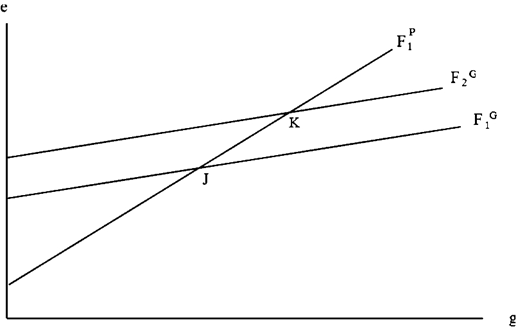
Government response and citizen effort are strategic complements.
Government response and citizen effort are strategic complements.
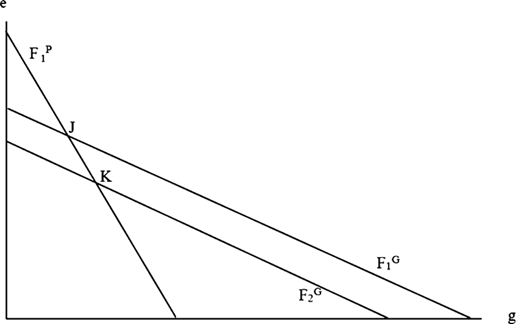
Government response and citizen effort are strategic substitutes.
Government response and citizen effort are strategic substitutes.
In Figure 2, pandemic effect influencing actions and efforts by the government and public respectively are substitutes, meaning that one side’s actions or efforts at lowering the probability of more lethal pandemic leads to a diminution of efforts or actions by the other side; admittedly a rarer possibility. We illustrate a case where the government’s pay-off from pandemic prevention diminishes after a rise in the disease transmission rate, say due its excessively plutocratic nature, aversion to lockdowns and a myopic view of the economy-health trade-off. The government reaction function actually moves down along the public reaction function with a new equilibrium at K, where the public response has so greatly attenuated its prudential efforts that the state, even a populist run government with a strong lockdown aversion, is compelled to respond by increasing its actions in the face of such irresponsible private behavior, and an unacceptable high rate of infection, as well as mortality, relative to prevailing medical capacity. This may help explain the late, but more prolonged, lockdowns, such as in the UK.
While Figure 2 is theoretically possible, our empirical analysis below in Section 5 provides general empirical support for the relationship portrayed in Figure 1. That is to say, we find more compelling evidence for a complementary relationship between the government’s policy and the citizens’ behavior.
Propositions Derived From The Theoretical Model
In summary, our theoretical model illustrates how choices on the government (g) and public side (e) determine the probability of a more (1 − π) or less severe (π) course of the pandemic.
There is a dynamic between the public and the politicians which we model as the supply and demand of populism. In the first part of the model, supply and demand conditions determine whether a country is led by a populist or conventional party. This part of the model frames the different political contexts, distinguishing populist and conventional countries. In the populist setting, the citizenry is constantly exposed to populist messaging (a), in turn creating a less scientific/fact-based environment.
Building on this first part of the model, we introduce a pandemic shock. The two types of politicians (populist and conventional) produce two types of policy responses. The public, in turn, behaves differently in the two policy environments. From this part of the model, we derive the following propositions:
Populist governments are less invested in far-reaching policy responses to contain a pandemic shock.
In a populist political environment, citizens are less likely to exert high effort to limit the spread of the disease.
The severity of the pandemic is jointly determined by citizen effort and government policy response.
From propositions 1–3 it follows that pandemic fallout will be worse in populist governed countries.
Data
The propositions of our formal model are analyzed in a sample of 42 developed and developing countries of which 11 are governed by populists. The main variables of interest to our analysis are excess mortality, government policy response, and citizen mobility. The following sections provide an overview of the data and operationalization and give first descriptive insights on variable specific differences between populist and non-populist governments.
Sample
Our aim is to create a worldwide sample of major developed and developing economies. We start by including all current OECD members. To include major emerging economies and broaden the geographic coverage, we also included the BRICS countries in our sample. While including more smaller emerging economies might lead to additional insights, the sample is restricted due to data limitations especially regarding excess mortality. In total our sample covers 42 countries.11 The time frame of our analysis is limited to 2020 and for some variables the coverage is truncated at the beginning and the end of 2020. Our unit of analysis are country-week observations.
Populist Governments
In order to code the populist governments in our sample, we follow Mudde (2004, p. 543) and define populism as a thin ideology that considers society to be “separated into two homogeneous and antagonistic groups, ‘the pure people’ versus ‘the corrupt elite’, and which argues that politics should be an expression of the volonté générale (general will) of the people”. Based on this definition we followed the coding of the PopuList project by Rooduijn et al. (2019) to code populist governing parties. For the countries not included in the PopuList and countries with presidential systems, we followed Funke et al. (2020) to code populist governments. We code a government as populist if the PopuList identifies a governing party as populist or the country’s leader is classified as populist (e.g., Donald Trump in the USA) by Funke et al. (2020).
Using this approach, we identify 11 populist governed countries in our sample. These are: Brazil, the Czech Republic, Hungary, India, Israel, Mexico, Poland, Slovakia (since 03/20/2020), Turkey, the UK and the USA. In all but one case, the populist governments have been in power since the beginning of the year. Table A1 in the online Appendix lists all the leaders in our sample, the party they belong to, and their time in office in 2020. Except for Slovakia, countries are either populist or non-populist governed for the entire period of analysis. The sample countries — subdivided into populist and non-populist governments — are displayed in Figure 3.
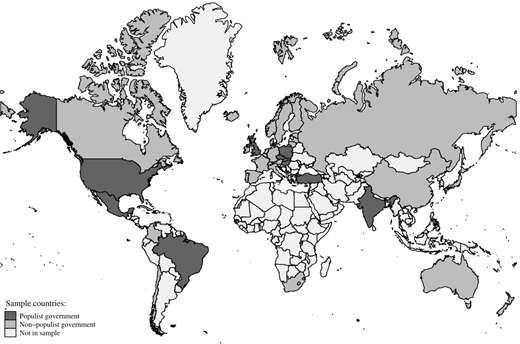
Populist and non-populist governed countries in the sample
Populist and non-populist governed countries in the sample
Excess Mortality
We measure the severity of the pandemic by using the country specific excess mortality (ExMort). Checchi and Roberts (2005), define excess mortality as the number of fatalities that occur additionally to the deaths that would have been expected under normal conditions, or, as the WHO puts it, “mortality above what would be expected based on the non-crisis mortality rate in the population of interest. Excess mortality is thus mortality that is attributable to the crisis conditions. It can be expressed as a rate (the difference between observed and non-crisis mortality rates), or as a total number of excess deaths.”12 Using excess mortality has been proven to be an adequate and less biased measure of pandemic severity (Rivera et al., 2020). Based on the definition we calculate the excess mortality as follows:
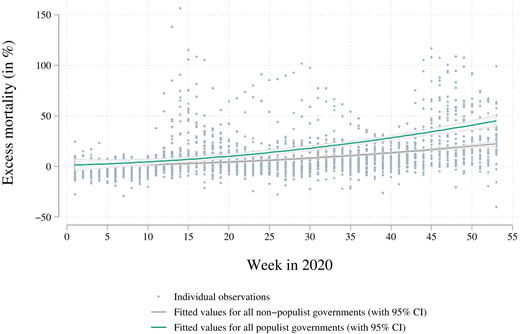
Average excess mortality during 2020 with fitted values
Average excess mortality during 2020 with fitted values
where the excess mortality (ExMort) is the percentage point deviation of the total deaths recorded in a given week (TotalDeaths) from the expected deaths (ExpectedDeaths). The expected deaths are calculated by using the average deaths of the last (available) 5 years.
We draw the total and expected deaths for the weeks of 2020 from various sources listed in Table A2 in the online Appendix. The table also indicates the coverage and periodicity. For 40 our 42 sample countries we retrieved mortality data. The countries missing are India and China. In the remaining countries the data is available on a weekly basis except for Russia and Japan. In these two cases we calculated the weekly average from the monthly data. For Turkey the data only covers the weekly mortality in Istanbul as no data was available for the rest of the country.
The values of the excess mortality variable in the sample range from −40 to 156.3 with an average excess mortality of 10.46 and a standard deviation of 20.74. In the sub-sample of non-populist governed countries the average excess mortality for 2020 is 8.17. Moving from non-populist to populist governed countries this number more than doubles to 17.62. This difference in means is also statistically significant when employing a two-sample T -test. To analyze the scores across time, Figure 4 plots the excess mortality for the weeks of 2020.
The figure plots the individual excess mortality (light blue circles) as well as the quadratic fitted mobility aggregated by populist (green) and non-populist governed (grey) countries. Around the fitted lines a 95% confidence interval is plotted. The figure shows that the average excess mortality in populist governed countries is systematically higher than in the non-populist governed countries. The mortality difference is not statistically significantly before week 15 of 2020. Nonetheless, after week 15 the excess mortality increases in populist governed countries while — although increasing — it is comparatively smaller in non-populist governed countries.
Policy Response
We measure the government policy response to the COVID pandemic with the data from the Oxford COVID-19 Government Response Tracker (Hale et al., 2021). The database provides detailed information on (1) containment, (2) health and (3) economic policies with 20 specific sub-categories of policy responses. Further, the database also gives aggregated indices of policy responses. Since we are interested in the specific government response to contain the pandemic and protect the population, we employ the “containment and health index” (ContainHealth), which gives an aggregated response value for the containment and health policies.13 The index ranges from 0 (no measures taken) to 100 (all measures taken).
While the index from the Oxford COVID-19 Government Response Tracker provides an extraordinary basis for the analysis of government responses, it is important to note that some governments have used the pandemic to implement undemocratic policies that solidify their institutional power and are not aimed at countering the spread of the virus (Lührmann and Rooney, 2020; Maerz et al., 2020). When comparing the policy response of populist and non-populist governments, we indeed find that while the policy response of non-populist governments is dependent on the positive test ratio, that is, the spread of virus, the policy response of populist governments is indifferent to the spread of the virus and significantly lower at high positive test ratios (see Figure A1 in the online Appendix). This is further supported by the finding that populist governments — on average — display higher government response scores (see Figure A2 in the online Appendix), although at the same witnessing a higher excess mortality (see Figure 4). If the index was correctly measuring the real policy response, this would mean that countries with a stronger response also see higher excess mortality rates.
Based on this, we argue that using the policy response index without further adjustment creates the risk of including policy responses not aimed at protecting the public against the pandemic, but at consolidating government power. We account for this problem by including the data from the V-Dem Pandemic Backsliding Project (Kolvani et al., 2020). From this we use the index on the “Pandemic Violations of Democratic Standards” (PanDem), which gives the extent to which the respective pandemic policy responses violate democratic standards for quarters of 2020. To create a weekly measure we matched the PanDem index with the last week of every quarter and interpolated the values in-between. The index ranges from 0 (no violations) to 1 (maximum violations). To combine the policy response and pandemic backsliding measure we normalized the PanDem index to range from 0 to 100. We then subtracted this measure from the ContainHealth index.14 The resulting measure (RealResponse) gives us the real government response to the pandemic that only includes the policies directed at protecting the public against the spread of the virus and not the policies enacted to undermine democratic institutions.
The values of the policy response variable in our sample across the entire period of analysis range from 0 to 87.33 with an average policy response value of 42.74 and a standard deviation of 23.19. In the sub-sample of nonpopulist government the average policy response score is 44.39. In the populist government, this average policy response score is with 37.62 about 6.8 points lower. This difference in means is also statistically significant when employing a two-sample T -test. To analyze the values of the government policy response in greater detail and across time, Figure 5 plots the policy response for all weeks of 2020.
The figure plots the individual scores (light blue circles) as well as the quadratic fitted response aggregated by populist (green) and non-populist governments (grey). Around the fitted lines a 95% confidence interval is plotted. The figure shows that the average policy response score of populist governments is systematically lower than the response of non-populist governments. While the response is similar in the beginning of 2020, the policy responses diverge after week 10, with non-populist governments implementing more policies aimed at pandemic containment and protection of the population. This difference is statistically significant after week 10.
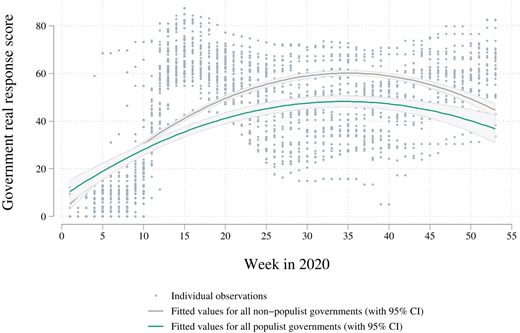
Average policy response with fitted values
Average policy response with fitted values
Citizen Behavior
We measure the citizen behavior by utilizing the comprehensive data from the Google Mobility Report (Google, 2021). The report is broken down by location and shows how the number of visits to places like grocery stores and parks has diverged from the baseline between February 7 and December 31, 2020. The baseline is the median mobility value of the 5 weeks from January 3 to February 6, 2020. We combine the daily mobility data from the various sub-categories into a one weekly citizen mobility average. This gives us the weekly citizen mobility in 2020 as a percentage point divergence to the pre-pandemic baseline period of 2020.
Nevertheless, the citizen mobility is contingent on the actual spread of the virus. Therefore, citizen mobility has to be placed into context with the actual spread of the virus. In doings so, we very clearly find that citizen mobility is higher in populist governed countries at similar infection rates (see Figure A3 in the online Appendix), although the absolute mobility score hardly differs between populist and non-populist governed countries (see Figure A4 in the online Appendix). From this follows, that citizen mobility cannot be just interpreted in absolute terms but has to be assessed in relative terms, that is, in relation to the respective spread of the virus.
We address the necessity to account for the infection rate by combining the mobility data with data on the positive test ratio from the Our World in Data database (Roser et al., 2020). We use the positive test ratio to control for underestimating the virus spread by only using the relative or total number of infected persons without accounting for the number of tests conducted. Based on this, the relative mobility (RelMobility) is calculated by first normalizing the citizen mobility to range from 0 (total reduction in mobility) to (100 no reduction in mobility). Second, we multiplied this normalized variable with the positive test ratio and normalized it again to generate the relative mobility (RelMobility). The data is missing for China and Iceland.
The values of the public mobility variable in the sample range from 0 to 100 with an average relative mobility score of 12.73 and a standard deviation of 15.52. In the sub-sample of non-populist government the average relative mobility is 10.29. In comparison to this, the average mobility score in populist governed countries is almost twice as high with a score of 20.12. This difference in means is also statistically significant when employing a two-sample T -test. To again analyze the scores in detail and across time, Figure 6 plots the mobility for the weeks of 2020.
The figure plots the individual scores (light blue circles) as well as the quadratic fitted mobility aggregated by populist (green) and non-populist governments (grey). Around the fitted lines a 95% confidence interval is plotted. The figure shows that the average mobility in populist governed countries is systematically higher than in the non-populist governed countries.
Similar to the policy response the citizen mobility is not significantly different between the two groups in the beginning of 2020. However, while the mobility drops in the non-populist governed countries especially in the middle of 2020 the relative mobility increases in populist governed countries over the course of 2020. This difference is statistically significant after week 15.
In sum, the descriptive evidence in this section supports our three central theoretical considerations on differences between populist and non-populist governed countries. First, populist governed countries have implemented less policies to contain the pandemic and protect the population. Second, citizen mobility has been higher in populist governed countries in 2020 although we specifically account for the spread of the virus in the respective countries. Third, excess mortality is comparatively higher in populist governed countries.
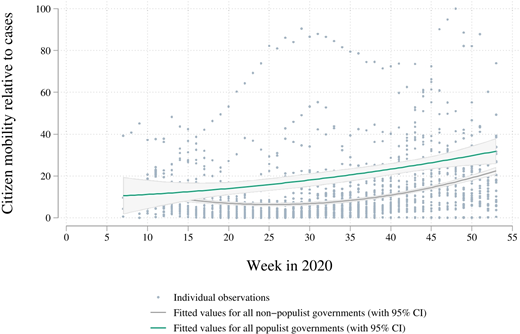
Average mobility during 2020 with fitted values
Average mobility during 2020 with fitted values
Estimation
Moving beyond the purely descriptive evidence we run several econometric models to assess the correlation between populist governance and our three main variables of interest: Excess mortality, policy response, and citizen mobility. Our main analysis consists of four regression models. In the first three models we regress the three variables of interest on the populist governance dummy variable. The response variables are respectively adjusted for pandemic backsliding as well as the positive test ratio as described above. To analyze how the policy response and citizen mobility are again correlated with excess mortality, the fourth set of regression models uses the real policy response and relative citizen mobility as explanatory variables to predict the correlation between these variables and excess mortality. The following sections describe the main and control variables used in the analysis and provide details on our estimation methods.
Variables
The three main variables of the analysis are excess mortality, government policy response, and citizen mobility. Based on the descriptive findings, the policy response is again corrected by accounting for pandemic backsliding, and citizen mobility is expressed in relative terms to the spread of the virus, that is, positive test ratio. Our strategy to control for any biases is twofold. First, we employ combinations of time and region fixed effects with various types of robust standard errors. For the region fixed effects we use the V-Dem classification of the world in six political regions (Eastern Europe and Central Asia, the Middle East and Northern Africa, Latin America and the Caribbean, Sub-Saharan Africa, Western Europe and North America, as well as Asia and Pacific) (Coppedge et al., 2021).15 Second, we drop the region fixed effects and include several control variables. The control variables can be grouped in six categories.
The first set of control variables centers around a country’s exposure to the pandemic. We include a country’s KOF globalization index (Gygli et al., 2019) as well as the trade to GDP ratio (World Bank, 2021) to control for the correlation between globalization and the spread of the virus (Farzanegan et al., 2021). Second, we control for a country’s capability in countering the pandemic by including the V-Dem electoral democracy score (Coppedge et al., 2021) and the GDP per capita in constant US$ (World Bank, 2021). Third, the health expenditure per capita in US$, physician density per 1,000 citizens, and nurses per 1,000 citizens are included to account for the health infrastructure (World Health Organization, 2018).
Fourth, we control for economic and health inequality by including the middle 40% pre-tax national income share (Alvaredo et al., 2018), the Gini index (World Bank, 2021), and V-Dem health inequality score (Coppedge et al., 2021). Fifth and last, we account for country specific vulnerability by including population density measured by the people per sq-km, population aged 65 and above, and the percentage of population with completed secondary education (World Bank, 2021), as well as the cardiovascular death rate, the diabetes prevalence in population, and the percentage of male smokers (Roser et al., 2020) to control for comorbidities. For all the control variables we included the values of the last available year before 2020. Due to this approach, all control variables are constant for individual countries across the weeks of 2020.
Method
Since our main variables are normally distributed and we expect a more or less linear relationship between the variables, we estimate the correlation between the variables by running OLS-regression analyses. We account for the panel-like structure in our data by including week fixed effects. As we assume our sample to be rather heterogeneous, we employ robust standard errors to account for heteroscedasticity. Our baseline model is defined by:
where Y is the respective response variable i in country c in week w that is regressed on the populist dummy Populist in the same period of time. Additionally, with χ a vector of the described control variables j in the given week w is included, as well as a term denoting week (λ) fixed effects and region (γ) fixed effects (with ω and κ as their respective coefficients) if the control variables are not employed.
Additionally, we also run a combined model that includes the relative mobility and pandemic response variables as explanatory variables and solely regress the excess mortality on these explanatory variables. The explanatory variables are lagged by 4 to 8 weeks, as previous research has shown that increased infections rates are correlated with increased deaths rates with a lag of 20 to 63 days, that is, 4 to 8 weeks (Chrusciel and Szybka, 2021; Testa et al., 2020). With this model we are able to assess how the variables that we assume to be correlated with populist governance — policy response and citizen mobility — are again correlated with excess mortality. The baseline model is defined by:
where ExMort is the is the country c and week w specific excess mortality that is regressed on an i weeks lagged policy RealResponse and citizen RelMobility variable. Again, week (λ) fixed effects are included but now instead of region fixed effects we employ country fixed effects (ρ) (with ω and κ as their respective coefficients). We can now move from region to country fixed effects because our explanatory variables are not dummy variables like in the previous models and because country fixed effects allow us to control for any unobserved differences between countries that might affect the correlation of interest.
Results
The results of the first regression analysis are displayed in Table 1. In this analysis the corrected policy response is regressed on the populist government dummy. The first model reports the coefficient of the bivariate regression without any fixed effects or robust standard errors. The negative coefficient indicates that the pandemic policy response score is lower in populist governed countries. This negative correlation is also statistically significant. Using robust standard errors in the second model does not change this result.
Populist governments and policy response.
| Dependent Variable: Government Policy Response (RealResponse) | |||||||
|---|---|---|---|---|---|---|---|
| (1) | (2) | (3) | (4) | (5) | (6) | (7) | |
| Populist | −6.778∗∗∗ | −6.778∗∗∗ | −8.590∗∗∗ | −8.590∗∗∗ | −8.590∗∗∗ | −8.590∗∗ | −5.129∗∗∗ |
| (1.25) | (1.22) | (0.75) | (0.82) | (0.84) | (3.35) | (1.44) | |
| Constant | 44.394∗∗∗ | 44.394∗∗∗ | −2.394 | −2.394∗∗ | −2.394∗∗ | −2.394 | −78.287∗∗∗ |
| (0.62) | (0.62) | (1.94) | (1.03) | (1.04) | (2.41) | (12.13) | |
| Observations | 1,849 | 1,849 | 1,849 | 1,849 | 1,849 | 1,849 | 1,321 |
| R2 | 0.016 | 0.016 | 0.765 | 0.765 | 0.765 | 0.765 | 0.761 |
| Robust SE | No | Yes | No | Yes | Yes | Yes | Yes |
| Region fixed effects | No | No | Yes | Yes | Yes | Yes | No |
| Week fixed effects | No | No | Yes | Yes | Yes | Yes | Yes |
| Jackknifed | No | No | No | No | Yes | No | No |
| SE clustered by country | No | No | No | No | No | Yes | No |
| Control variables | No | No | No | No | No | No | Yes |
Notes: (Robust) standard errors in parentheses
∗∗∗p < 0.01,
∗∗p < 0.05,
∗p < 0.1.
In the third model region and week fixed effects are introduced to the model without robust standard errors. Using region fixed effects raises the size coefficient slightly. This is not surprising as region specific factors impact a countries performance in the pandemic and since the pandemic unfolds in waves and learning effects occur. The fourth model reintroduces the robust standard errors, which slightly raises the standard error but has no effect on the statistical significance.
The fifth model controls for individual outliers by jackknifing the standard errors. With this, the standard errors increase — speaking for the heterogeneous nature of the sample — while the coefficient nonetheless remains statistically significant. In the sixth model, we switch to clustering the standard errors by countries in order to control for the fact that our sample is not drawn randomly and because the treatment effect, that is, populist governance, might arguably vary between countries. Clustering the standard errors increases the standard error of the coefficient substantially but without rendering the coefficient statistically insignificance. The last model introduces the full set of control variables that are displayed in greater detail in the online appendix. Taken together, the first analysis concerned with the government policy response supports our expectation that populist governments have employed less policy measures to protect the population against the pandemic.
The results of the second regression analysis are displayed in Table 2. In this analysis the relative citizen mobility is regressed on the populist government dummy. The different models follow the same combination of fixed effects and corrected standard errors as the previous regression analysis. In line with our expectation, the coefficient of the first model indicates as positive correlation between populist governance and relative citizen mobility.
Similar to the previous analysis the size of the coefficient changes when including region and week fixed effects in the third model. The statistical significance of the coefficient is also not affected by using robust, jackknifed or clustered standard errors in the remaining models. In the last model, again the full set of control variables is included. Including the control variables substantially increases the coefficient. The results strongly support the second proposition of our model, according to which we expect higher citizen mobility in populist governed countries.
The results of the third and last of the bivariate regression analysis are displayed in Table 3. In this analysis the excess mortality is regressed on the populist government dummy. Again, the same combination of fixed effects and robust standard errors is employed. The first model reports a positive and statistically significant coefficient. From this follows that excess mortality is positively correlated with populist governance. Similar to the previous findings, the size of the coefficient slightly changes when including region and week fixed effects. The fifth and sixth model with jackknifed and country clustered standard errors do not report differences in terms of statistical significance although again jackknifing and especially clustering increases the standard error substantially. The last model uses the full set of control variables, leading to a small drop in the size of the coefficient and an increase in the size of the standard errors but without losing statistical significance. In conclusion, the last of the bivariate regression analyses supports our expectations that excess mortality is higher in populist governed countries.
Populist governments and citizen mobility.
| Dependent Variable: Citizen Mobility (RelMobility) | |||||||
|---|---|---|---|---|---|---|---|
| (1) | (2) | (3) | (4) | (5) | (6) | (7) | |
| Populist | 9.826∗∗∗ | 9.826∗∗∗ | 11.607∗∗∗ | 11.607∗∗∗ | 11.607∗∗∗ | 11.607∗∗∗ | 19.545∗∗∗ |
| (0.88) | (1.19) | (0.86) | (1.12) | (1.15) | (3.85) | (2.89) | |
| Constant | 10.292∗∗∗ | 10.292∗∗∗ | 6.687 | 6.687 | 6.687 | 6.687 | 9.272 |
| (0.44) | (0.34) | (6.29) | (13.21) | (17.43) | (14.89) | (22.90) | |
| Observations | 1,527 | 1,527 | 1,527 | 1,527 | 1,527 | 1,527 | 1,233 |
| R2 | 0.075 | 0.075 | 0.382 | 0.382 | 0.382 | 0.382 | 0.401 |
| Robust SE | No | Yes | No | Yes | Yes | Yes | Yes |
| Region fixed effects | No | No | Yes | Yes | Yes | Yes | No |
| Week fixed effects | No | No | Yes | Yes | Yes | Yes | Yes |
| Jackknifed | No | No | No | No | Yes | No | No |
| SE clustered by country | No | No | No | No | No | Yes | No |
| Control variables | No | No | No | No | No | No | Yes |
Notes: (Robust) standard errors in parentheses
∗∗∗p < 0.01,
∗∗p < 0.05,
∗p < 0.1.
Moving beyond the bivariate regressions analyses, the fourth analysis regresses the excess mortality on the weekly lagged policy response and citizen mobility. The results of this fourth regression analysis are displayed in Table 4. The first model reports the coefficient for the four weeks lag. The coefficient of the response variable is negative and statistically significant, indicating that the policy response is negatively correlated with excess mortality. Hence, if the policy response is low, excess mortality is high. Contrary to this, the coefficient of the mobility variable is positive and statistically significant. From this follows that high relative mobility is correlated with high excess mortality. However, it is important to underscore that the relative mobility also includes the positive test ratio, which naturally correlates with excess mortality. Nonetheless, the correlation with the relative mobility is of importance as the relative mobility is low even if positive test ratios are high as long as absolute mobility is low. The remaining models use additional week lags with both variables lagged up to eight weeks. Although varying in size the coefficients remain statistically significant across the models and do not change their signs.
In sum, these findings indicate that both relative mobility and the government policy response are correlated with excess mortality as expected. With this finding the last link of our theoretical model is supported empirically; on the macro-level we found populist governance is positively correlated with excess mortality. The micro foundation of this theorized mechanism has found support in the negative correlation between populist governance and policy response as well as the positive correlation between populist governance and citizen mobility. Lastly, we were able to show that lower policy responses and increased citizen mobility are again correlated with higher excess mortality, empirically supporting the theorized causal relationship between populist governance and excess mortality.
In order to assess whether the found statistically significant correlations are also relevant in substantial terms, we estimate the marginal effects. We calculate the marginal effects for the real policy response and relative citizen mobility between the 10th and 90th percentile based on the model on which the variables are lagged by six weeks. The results are displayed in Figure 7. The upper figure again shows the negative correlation between government response and predicted excess mortality. If the policy response increases by 45 points (2 standard deviations) the predicted excess mortality decreases by about 10 percentage points (0.5 standard deviations).
Populist overnments and excess mortality.
| Dependent Variable: Excess Mortality (ExMort) | |||||||
|---|---|---|---|---|---|---|---|
| (1) | (2) | (3) | (4) | (5) | (6) | (7) | |
| Populist | 9.446∗∗∗ | 9.446∗∗∗ | 8.121∗∗∗ | 8.121∗∗∗ | 8.121∗∗∗ | 8.121∗∗∗ | 7.354∗∗ |
| (1.05) | (1.24) | (1.09) | (1.23) | (1.25) | (2.46) | (3.15) | |
| Constant | 8.174∗∗∗ | 8.174∗∗∗ | −5.900∗∗ | −5.900∗∗∗ | −5.900∗∗∗ | −5.900∗ | −62.772∗∗∗ |
| (0.52) | (0.47) | (2.97) | (1.68) | (1.70) | (2.98) | (17.54) | |
| Observations | 2,045 | 2,045 | 2,045 | 2,045 | 2,045 | 2,045 | 1,437 |
| R2 | 0.038 | 0.038 | 0.318 | 0.318 | 0.318 | 0.318 | 0.344 |
| Robust SE | No | Yes | No | Yes | Yes | Yes | Yes |
| Region Fixed Effects | No | No | Yes | Yes | Yes | Yes | No |
| Week Fixed Effects | No | No | Yes | Yes | Yes | Yes | Yes |
| Jackknifed | No | No | No | No | Yes | No | No |
| SE clustered by country | No | No | No | No | No | Yes | No |
| Control variables | No | No | No | No | No | No | Yes |
Notes: (Robust) standard errors in parentheses
∗∗∗p < 0.01,
∗∗p < 0.05,
∗p < 0.1.
Excess mortality with relative mobility and policy response.
| Dependent Variable: Excess Mortality (ExMort) | |||||
|---|---|---|---|---|---|
| (1) | (2) | (3) | (4) | (5) | |
| L4.RealResponse | −0.121∗∗ | ||||
| (0.05) | |||||
| L4.RelMobility | 0.761∗∗∗ | ||||
| (0.06) | |||||
| L5.RealResponse | −0.166∗∗∗ | ||||
| (0.06) | |||||
| L5.RelMobility | 0.624∗∗∗ | ||||
| (0.06) | |||||
| L6.RealResponse | −0.209∗∗∗ | ||||
| (0.06) | |||||
| L6.RelMobility | 0.475∗∗∗ | ||||
| (0.06) | |||||
| L7.RealResponse | −0.219∗∗∗ | ||||
| (0.06) | |||||
| L7.RelMobility | 0.332∗∗∗ | ||||
| (0.06) | |||||
| L8.RealResponse | −0.215∗∗∗ | ||||
| (0.06) | |||||
| L8.RelMobility | 0.198∗∗∗ | ||||
| (0.07) | |||||
| Constant | −11.507∗∗ | −11.558∗∗ | −12.551∗ | −11.123 | −8.580 |
| (4.93) | (5.82) | (7.31) | (9.82) | (11.86) | |
| Observations | 1,130 | 1,102 | 1,073 | 1,044 | 1,015 |
| R2 | 0.638 | 0.610 | 0.594 | 0.579 | 0.570 |
| Country Fixed Effects | Yes | Yes | Yes | Yes | Yes |
| Week Fixed Effects | Yes | Yes | Yes | Yes | Yes |
| Robust SE | Yes | Yes | Yes | Yes | Yes |
Notes: (Robust) standard errors in parentheses
∗∗∗p < 0.01,
∗∗p < 0.05,
∗p < 0.1.
In comparison, the lower figure shows the positive correlation between citizen mobility and excess mortality. The figure shows that an increase by 30 points (2 standard deviations) leads to an increase in predicted excess mortality of about 15 percentage points (0.75 standard deviation). From this follows that both variables are correlated with excess mortality in substantial terms.
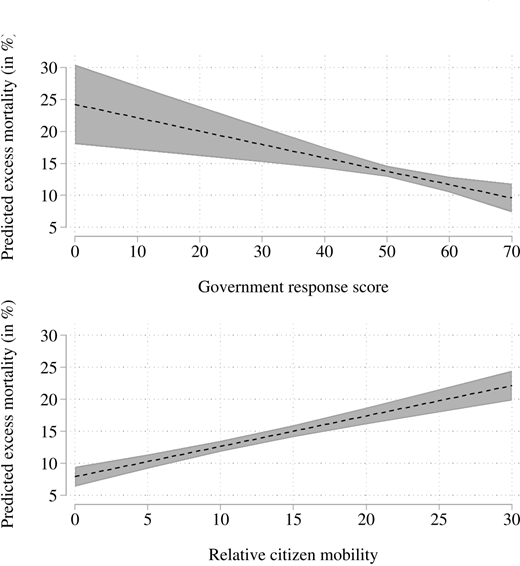
Marginal effects for mobility and response
Marginal effects for mobility and response
At last, we also calculate the marginal effects of populist governance on excess mortality. The employed model is the simple bivariate regression displayed above (see Table 3) with week and region fixed effects and robust standard errors. The predicted marginal effects are displayed in Figure 8. The figure shows that changing from non-populist to populist governance is associated with a predicted excess mortality increase by about 8 percentage points (0.4) standard deviations.
In conclusion, the empirical analysis provides statistically significant and substantially relevant support for the theoretical propositions of our formal model. We show that excess mortality is ceteris paribus on average 8 percentage points higher in populist governed countries (i.e., 98%) when compared to non-populist governed countries. Further, we were able to show that populist governments display lower policy response scores and higher citizen mobility, which again are both correlated with higher levels of excess mortality. Based on this, we conclude that the analysis supports the mechanism that links populist governance to excess mortality as well as the micro foundation of this relationship via policy responses and citizen mobility.
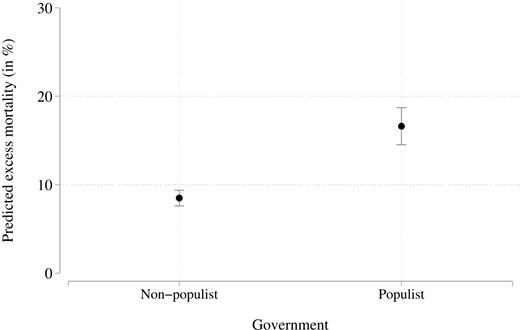
Marginal effects for populist governments
Marginal effects for populist governments
Robustness Checks
The robustness of our empirical results are assessed by running additional regression analysis that utilize different operationalizations, control variables, and models. First, we re-ran the regression analysis concerned with the policy response of populist governments with control variables as well as with and without robust standard errors and week fixed effects (Table A3 in the online Appendix). The size and statistical significance of the coefficient remains rather stable across the different model specifications. The last model in the regression table is identical to the model shown in the main section but now gives a detailed overview over the coefficients of the employed control variables.
Further, we also ran regressions that include the control variables instead of the country fixed effects for the relative citizen mobility and the excess mortality (Tables A4 and A5 in the online Appendix). Both regressions provide similar and robust results with exception to the last two models concerned with citizen mobility, in which the coefficient strongly increases. This finding underscores that running country fixed effects greatly controls for the between country variation. From this we conclude that our models are not affected by our operationalization and the employment of region fixed effects. At last, we also ran additional marginal effects models that use the four and eight weeks lag models (Figure A5 and Figure A6 in the online Appendix). The results are quite similar with minor differences in the strength of the predicted effect.
Additionally, we also re-ran the regression used to calculate the predicted excess mortality in populist and non-populist governed countries with the control variables (Figure A7 in the online Appendix). Including the control variables has no effect on the statistical significance of the predicted marginal effects and only slightly increases the size of the predicted marginal effect for non-populist governance. In line with the previous robustness checks, this again supports the findings of our main analysis.
Conclusion
This paper investigates the question how the response to the COVID-19 pandemic differs between populist and non-populist governments. Specifically, we study whether populist governments are more or less likely to contain the pandemic. We develop a theoretical model of the supply and demand of populism that explains under which conditions countries are led by populist vs. non-populist parties. In the second part of our theoretical model we introduce a pandemic shock and illustrate how government response and public effort affect the probability of the pandemic running a (less) severe course. Based on this model we provided two mechanisms as to why populist governments mishandle the pandemic.
First, populist governments are less likely to implement long-term and unpopular policies but are rather prone towards short-termed quick fixes. Second, we reasoned that populist governments influence the behavior of citizens not only through specific policies but also through means of communication about the severity of the pandemic. We argued that populist governments will advocate anti-scientific positions and downplay the severity of the pandemic. Citizens exposed to this are less likely to take the virus seriously and comply with public health regulations.
Based on our model, we formulated the propositions that (1) the policy response to counter the pandemic is lower in populist governed countries, (2) the citizen effort is lower in populist governed countries, and (3) the severity of the pandemic is jointly determined by citizen effort and government policy response, leading to the expectation that populist governed countries are more affected by the COVID-19 pandemic. The propositions of our formal model were tested with several empirical models in sample of 42 developed and developing countries on a weekly basis between the first and last week of 2020 that included 13 populist governed countries.
First, we analyzed the correlation between populist governance and policy response and found that — in line with our propositions — populist governments exhibited lower policy response scores. The policy response scores in our analysis were corrected with the V-Dem pandemic backsliding scores. Second, we found a positive correlation between populist governance and citizen mobility indicating that citizen mobility has been higher in populist governed countries. In our models, we used the relative citizen mobility, which accounts for the respective spread of the virus with the positive test ratio. Third, we analyzed the correlation between populist governance and excess mortality with the result that excess mortality is higher in populist governed countries when controlling other factors. Fourth, we provided evidence that policy responses and citizen mobility are both correlated with excess mortality, underscoring our answer as to why excess mortality is higher in populist governed country. Fifth, we calculated the marginal effects of our regression analyses and provided evidence that excess mortality is ceteris paribus about 8 percentage points (i.e., 98%) higher in populist governed countries. In conclusion, the empirical analysis comprehensively supported the propositions of our theoretical model.
Although our paper followed a rigorous approach and employed several robustness checks, we want to point out that our paper does not follow a casual identification strategy. Rather, we provide a comprehensive correlation analysis of the micro foundation of the causal mechanism proposed in our theoretical model. With additional country and pandemic specific data, our analysis could be extended with a causal identification strategy via the synthetic control method (Abadie et al., 2015).
Besides this methodological extension our analysis provides several connection points for future research. Additional analyses should also include the subnational level as especially federal countries can show strong within country variance if the federal government or state government are populist (Rivera et al., 2020). This sub-national level can also be analyzed in greater detail using case studies or other qualitative approaches to work out an in-depth playbook of the populist pandemic response (Smith, 2020). Also, future analysis should analyze whether populist governments struggle to build and uphold expertise on the government worker level. Recent research has shown that disaster response is negatively affected by extreme government ideologies due to the arising incompatabilities with expert opinions of government workers (Clark and Patty, 2021).
Further, data is already available on how measures have been taken back over the course of the pandemic (Hale et al., 2020b) and how governments differ in their vaccination efforts (Hale et al., 2020a). Based on our analysis, it is reasonable to assume that systematic differences between populist and non-populist governed countries will again emerge. Finally, several governments have used the pandemic to consolidate power and undermine democratic institutions (Kolvani et al., 2020; Maerz et al., 2020), with early evidence giving reason to specifically focus on populist governments, when analyzing the determinants of autocratic backsliding (Bayerlein and Gyöngyösi, 2020).
Despite the remaining questions and discussed limitations, our paper provided first evidence as to how and why populist governments mishandle the pandemic. We showed that populist policy responses to the pandemic have been insufficient and that citizen mobility in populist governed countries is systematically higher. This leads us to the conclusion that populist governments — on average — have sadly done a poorer job in protecting the population against the COVID-19 pandemic. As a silver lining, we nonetheless found that citizen mobility is a crucial component in countering the pandemic successfully. Therefore, the lack of an adequate government policy response can be counteracted when citizens overcome the populist polarization and anti-scientism, and counter the pandemic in a joint effort.
We consider both left-wing and right-wing populist groups. Identity, which is featured in our model, serves to distinguish populists from ‘globalists’ or elites with all forms of populism arguably being nationalist in one way or the other (Taguieff, 1995).
This does not mean that income is distributed evenly across individuals.
We distinguish between a populist message a and a non-populist message b. Conventional (mainstream) politicians, although not averse to soundbites and catchphrases, tend to project more measured arguments, which for many members of the public feel like tedious expert arguments. In contrast, populists tend to broadcast unscientific, simple solutions to complex problems.
The pre-disposition argument is related to the cultural explanation for the support for populism outlined in Norris and Inglehart (2019).
We use the following notation for first and second derivatives: and .
If a > 0 ⇒ b = 0 and vice versa.
Eee is the generic second derivative of the cost of effort with respect to effort in either a populist or non-populist setting. The cost of effort increases monotonically in either case.
For a given level of effort e∗, Eea > Eeb ≥ 0.
Analytically speaking the infection rate, r, enters the (exogenous) pay-offs of the government utility in equation (8); the exogeneity of the parameter causes a shift in the reaction function (rather than movements along it). As the infection rate does not directly enter into the public’s utility function in equation (9), the public’s reaction function does not move.
Sample countries: Australia, Austria, Belgium, Brazil, Canada, Chile, China, Colombia, the Czech Republic, Denmark, Estonia, Finland, France, Germany, Greece, Hungary, Iceland, India, Ireland, Israel, Italy, Japan, Latvia, Lithuania, Luxembourg, Mexico, the Netherlands, New Zealand, Norway, Poland, Portugal Russia, Slovakia, Slovenia, South Africa, South Korea, Spain, Sweden, Switzerland, Turkey, the United Kingdom and the United States.
Definition by WHO, see https://www.who.int/hac/about/definitions/en/.
In detail, the index includes information on 14 indicators: school and workplace closing, canceling of public events, restrictions of gatherings, closing of public transportation, stay at home requirements, restrictions of internal movement, international travel controls, public information campaigns, testing policies, contact tracing, facial coverings, vaccination policy, and protection of the elderly.
Due to data limitations this adjustment can only be made after week 13 of 2020. Before that the unadjusted policy response is used.
The dichotomous populist measure only changes in one country (Slovakia) during 2020. Therefore, we employ region rather than country fixed effects (as the country fixed perfectly describe the populism dummy except for the one case).

