


New apartment buildings offer potential relief from high housing costs, but they encounter significant local opposition. Using a vignette survey experiment, we explore why citizens oppose the construction of apartment buildings. We find limited evidence that this opposition stems from concerns over congestion or out-group bias. Citizens tend to oppose taller buildings irrespective of whether they attract more or undesirable residents. Instead, opposition to apartment buildings seems to be driven by local preservationism. Respondents do not think that tall buildings fit into their predominantly low-rise neighborhoods. To substantiate the importance of preservationism, we zoom in on projects that were proposed near another apartment building. Here, respondents agree that apartment buildings fit in and they oppose them less. These results may help explain why cities sprawl rather than densify, and why it is difficult to build affordable housing in expensive cities.
If “cities are primarily labor markets” (Bertaud, 2018, p. 19), then access to this labor market is governed by whether one can find somewhere to live in and around this city. Across the world, access to some of the most productive cities — those with the best job opportunities — has been limited by rising housing costs, forcing people to commute for longer distances or opt for cheaper, less productive jobs (Hoxie et al., 2023), reducing overall prosperity (Hsieh and Moretti, 2019) and increasing regional inequality (Ganong and Shoag, 2017).
One way to lower housing costs and increase access to the city is to build more apartment buildings. The decision to do so is in the hands of local governments, who control housing supply through zoning and permitting (Fischel, 2015). However, using detailed data on local government hearings and policy discussions, a number of studies have found that such densification projects often face intense local opposition from citizens (Einstein et al., 2020; Sahn, 2022; Yoder, 2020). Moreover, using conjoint experiments, researchers have found that, across very different contexts, citizens exhibit a strong preference for single-family homes over apartment buildings. (Trounstine, 2021; Wicki and Kaufmann, 2022; O’Grady, 2020). In this article, we build on these findings by exploring which features of apartment buildings make them unpopular. In doing so, we hope to further our understanding of why citizens oppose new apartment buildings.
We identify three features of apartment buildings that might explain citizen opposition. First, they house more people, and citizens may therefore be concerned that apartment buildings will lead to congestion of public goods. Second, citizens might think that apartment buildings attract less well-off citizens or minorities, who they want to keep out of their neighborhood (Trounstine, 2009; Danielson, 1976). Third, citizens might dislike apartment buildings, because they change the physical character of their neighborhood. Most neighborhoods are primarily comprised of single-family homes, so local preservationism should go hand in hand with a strong opposition to apartment buildings.
To adjudicate empirically between the importance of these different potential explanations, we use a factorial vignette survey experiment with approximately 13,000 Danish respondents. Each respondent is asked whether they support or oppose a hypothetical development project in their local area which varies in its type, size, and height. We place this proposed development somewhere within 10 km of the respondents’ homes and show respondents an individually tailored map of where the proposed development is going to be built. We couple this experimental data with detailed administrative data on the built environment in the respondents’ local area, allowing us to record the height of other buildings near the proposed development.
We identify a strong aversion to taller buildings. Seven-story developments face about twice as much opposition as a one-story development. The overall size and type of the development have negligible effects. As such, citizens are equally (un)enthusiastic about social, rental, and owner-occupied housing. The number of square meters the project takes up at ground level also has limited effects on opposition. Moreover, respondents don’t believe that tall buildings will cause much more congestion or attract undesirable residents. Instead, respondents believe that tall buildings do not fit into their neighborhood.
To explore whether these concerns reflect preservationism or a more general belief that tall buildings never fit into any neighborhood, we exploit our detailed knowledge of the built environment near the proposed developments. We show that if the project is proposed near one or more five-story buildings, then building height matters much less. It is only when tall buildings break the mold of a low-rise neighborhood that respondents dislike them. Taken together, these results suggest that citizen opposition to apartment buildings is primarily driven by a sincere desire to preserve the physical character of their neighborhood.
This pattern of opposition might explain several salient features of urban politics. First, the strong preservationism, and associated backlash against densification, might explain why cities tend to sprawl rather than densify. Over time, however, the constraint of commute times makes sprawl infeasible. Instead, new housing need to take the form of apartments. Our findings suggest that these developments face intense public opposition and. Consistent with this, there has been a slowdown in housebuilding as suburbanization has made way for densification (Glaeser et al., 2005). Finally, opposition to high-rise buildings might explain why it is so difficult to build affordable housing in expensive cities. Even if citizens like the idea of affordable housing in their neighborhoods, they may not be willing to accept that these take the shape of high-rise buildings, and it is hard to build housing that is low-rise and affordable due to the high cost of land.
Our findings carry somber implications for those who seek to alleviate housing costs through densification. They are likely to encounter significant public opposition, which cannot be mollified solely by addressing concerns over congestion or by mitigating out-group animosity. It is the very physical presence of tall apartment buildings that citizens oppose. Nevertheless, we end our article with a tentative discussion of how developers, activists, and policymakers might take local preservationism into account when contemplating densification projects.
Three Reasons Why Citizens Might Oppose Apartment Buildings
Prior work has consistently found that citizens prefer less dense developments, choosing single-family homes over apartment buildings (Wicki et al., 2022; Trounstine, 2021; Hankinson and de Benedictis-Kessner, Justin. 2022; O’Grady, 2020). Understanding why citizens are more likely to oppose apartment buildings is complicated by the fact that apartment buildings differ from single-family homes along several dimensions. First, they can accommodate more residents. Second, they attract a different type of residents, because of lower housing costs. Third, they are usually taller than single-family homes, making them noticeable from greater distances, especially in otherwise low-rise neighborhoods. Each of these features might engender citizen opposition.
More People: If citizens have a general aversion towards more people in their local area (Fischel, 2001), then it makes sense that they prefer single-family homes to apartment buildings, simply because an apartment building is larger and serves more people than a single-family home. That is, opposition might be tied to the number of people the project attracts, and since apartment buildings attract more people than single-family homes, citizens might oppose them more.
Different People: Independent of how many people they attract, it could be that apartment buildings attract a type of resident that citizens don’t want in their neighborhood. Land use politics is often conceptualized as a politics of exclusion, where the well-off majority uses zoning to exclude poor people and underprivileged ethnic or racial minorities (Danielson, 1976; Trounstine, 2018; Sahn, 2021). We know that the housing costs per unit are lower for apartments than for single-family housing, especially in areas where land prices are high. Therefore, opposing apartment buildings makes sense if you want to keep out low-income groups.
Taller buildings: Opposition to apartment buildings could also have less to do with who lives in them, and more to do with the buildings themselves. Citizens arguably select areas based in part on their preference for the neighborhood’s aesthetic, and the longer they live in a place, the more they may acculturate, developing a preference for how the area currently looks and feels. This local preservationism translates into an opposition towards apartment buildings because most people reside in neighborhoods without apartment buildings. While a third of Americans and almost half of all EU citizens live in apartments, more people are housed within each apartment building than within each single-family home, meaning that most buildings tend to be single-family homes (Eurostat, 2021). For example, in Denmark, one-third of the population lives in apartments, but multi-story apartment buildings are less than 5% of the housing stock.1 Therefore, if people want to preserve the physical character of their neighborhood, then, for most people, this means opposing apartment buildings. Moreover, even for the minority who live in areas where there are apartment buildings, it is less clear that preservationism will lead to a strong preference for apartment buildings over single-family homes. In a low-rise neighborhood, a single large apartment building will be visible throughout the neighborhood, but adding a single-family home will not change how a high-rise neighborhood looks and feels.
One explanation that is missing from this list is that citizens oppose apartment buildings because they lower local home values more than single-family homes (Fischel, 2001). Yet the reason we have not included this explanation separately is that we believe it is embedded in the three explanations laid out above. As such, citizens’ aversion to developments that attract more residents, undesirable residents, or that stick out from the existing built environment might be partly or completely driven by their belief that these developments will lower home values. Moreover, it is hard to think about ways that residents’ concerns over home values might affect opposition to apartment buildings separately from how the apartment building changes who lives in the neighborhood or how it looks. Nevertheless, we do think it is interesting to understand whether opposition to apartment buildings is based on first-order concerns, i.e., over how this building will change the neighborhood, or second-order concerns, i.e., how this change might affect home values. In our analysis of citizen opposition to apartment buildings, we will therefore also engage with this question.
It is hard to know from existing studies which features of apartment buildings underlie citizen opposition. For one, previous work tends to use a conjoint set-up where respondents are forced to choose between housing projects. When choosing between single-family homes and apartment buildings, respondents might reasonably infer that apartment buildings will lead to more housing, conflating opposition to apartments with opposition to more housing in general.2 More generally, existing studies cannot speak to whether opposition to apartment buildings is driven by the height of the building, the size of the project, or the type of people who tend to live in these buildings because these features are not varied independently of each other. One exception is Trounstine (2021) who use the expected income and racial composition of a new housing development as a set of conditions in the conjoint task. She finds that these factors have a limited impact on support for the housing development, which aligns with what we find below.
Experimental Design
We examine the empirical viability of our three different explanations for citizen aversion to apartment buildings using a vignette survey experiment. Here, respondents are presented with a hypothetical development project that vary along a number of different dimensions. We designed this experiment with an eye to overcoming three methodological challenges. First, to accurately measure opposition to different types of developments. Second, to distinguish opposition to apartment buildings from opposition to more housing, and from opposition to the kind of people who might live in apartment buildings. Third, to gauge whether respondents are preservationists, in the sense that they care about whether the development stands out from the existing built environment.
Sample
Respondents were recruited from Statistics Denmark’s population registry, giving us access to their home addresses. We use this information to construct a map of their neighborhood and to get information from the Danish Building and Housing Registry (BBR) on the built environment in their neighborhood. We recruited 200 participants from each Danish municipality, except the two largest municipalities, where we included 500 and 1000 respondents respectively. This approach ensures diverse representation across various types of neighborhoods. In our analyses below and all reported results, we weigh the results to take the unequal probability of participation between municipalities into account. Recruitment was conducted by the survey company Epinion which contacted respondents using their government-issued email address “E-boks”, which you are required to check regularly. Participation in the study was encouraged through a lottery offering 10 vouchers, each valued at 1,000 DKK (approximately 135 EUR). In total, we gathered 28,850 survey responses, achieving an overall response rate of 27 %. This data collection was pre-registered at https://osf.io/6qjyf, however, the analyses we present below were not pre-registered. In the analyses below we only use a subset of the data, leaving us with an effective sample of 13,040 respondents. In particular, we discard respondents exposed to hypothetical development that were too different from housing developments, and respondents who were not presented with complete information about the location of the development. In Online Appendix A we present more details on the omitted conditions. It is important to note that exclusion is solely based on which treatment category you were randomly assigned to (i.e., respondents are missing at random).
Treatments
We randomly varied information about the height, type, size, and location of the hypothetical project across respondents. The exact wording of the vignette and the level for each attribute is presented in Table 1. We include different types of projects to gauge whether citizens are particularly attuned to who will live in these projects, including projects that attract those who are less well off (i.e., social and rental housing) and that attract those who are better off (i.e., offices and owner-occupied housing). Note that we include both housing and commercial developments, which allows us to see whether tall housing developments are treated differently from tall commercial developments. We also include both the height and the size of the development. This allows us to distinguish citizens’ views on taller housing projects, that stick out, from projects that simply include more units. A concern is that citizens might not notice or understand both the size and height attributes. To alleviate this concern we use the terms stories and square meters, which is the way that the size of construction projects and homes are typically communicated in the Danish context by realtors, developers, and the government. Further assuaging these concerns, we find that both the number of stories and the square meter size of the project influence whether respondents believe the project will create more congestion. We present this analysis below and in Figure 3.
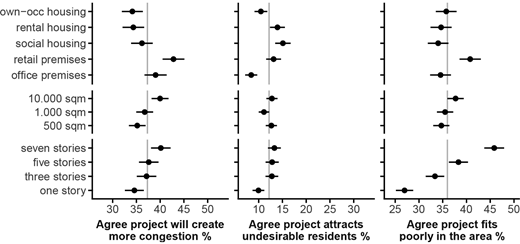
Beliefs about the effects of the development on the local area across the type, size, and height of the development.
Beliefs about the effects of the development on the local area across the type, size, and height of the development.
Experimental conditions.
| The city council is considering whether to allow construction of [project type] on a plot of land in the municipality. It will be a construction project covering [size] square meters and have [height]. The project will be located at the red dot in the map below. [The construction site will be about [X] km from your home.] |
| Type of project | Size of project | Height of project | Distance |
|---|---|---|---|
| a. social housing | a. 500 | a. one story | 1–10 km |
| b. owner-occupied housing | b. 1,000 | b. three stories | |
| c. rental housing | c. 10,000 | c. five stories | |
| d. retail | d. seven stories | ||
| e. offices |
To manipulate the location, we provided the respondents with an individually tailored map of the area where the project was located. Figure 1 shows an example of such a map. To create the maps, we picked a random spot within 10 km of the respondents’ home address as the site of the development project. To ensure realism, we excluded placements outside the respondent’s municipality, in the ocean, on lakes, or on sandbars off the coast.3 We centered each map around the location of the proposed development, zoomed out so that the map covered an area of 8 × 8 km, and created a red dot with a radius of 300 m around the location of the hypothetical development. Half of respondents also received a prompt directly informing them about the approximate distance between their home and the project, however, since results do not differ across this condition, we omit it from subsequent analyses.
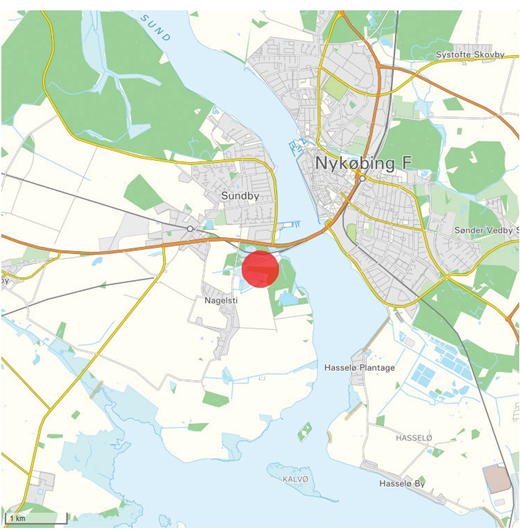
By mapping the approximate site of the development project, we can determine whether a proposed tall apartment building was placed near other existing tall buildings. To do so, we use the BBR registry which includes geographic coordinates and detailed information about all buildings in Denmark. For each respondent, we isolated the buildings that existed within the red dot where respondents were told the project was to be located (an area of 282,743 sqm. or roughly 55 football fields). Based on this information, we constructed an indicator variable of whether there was at least one apartment building that was at least five stories at this location.
Outcomes
Following the presentation of the projects to the participants, we asked them about their stance toward the project with the question: “Do you support or oppose the proposed development project?” The degree of opposition to the project was measured using a seven-point Likert scale from strongly oppose to strongly support. Respondents could also answer “don’t know”. Note that this way of measuring opposition sidesteps some of the issues in prior work which relied on citizens deciding on pairs of development projects. In our setup, anti-housing citizens can reject both apartments and single-family homes alike and are not forced to prefer any development projects. In our analyses, we use a dichotomous version of this variable indicating whether respondents oppose or do not oppose the project. This approach makes it easier for us to interpret the results and prevents situations where transitioning from “for” to “predominantly for” a project might be misconstrued as increased opposition.
In addition to this outcome variable, we also asked respondents to agree or disagree with a set of statements about what would happen if the municipality permitted the construction project. These include “The project will increase congestion”, “The project will attract people to my neighborhood I wish to avoid”, “The project would not fit well into the area”, and “The project would decrease the price of my home”. These questions map onto the different explanations for why citizens might oppose apartment buildings, and we use these questions to understand how our treatment worked, further contextualizing the effect on the main outcome variable. Similarly to the main outcome variable, we dichotomize these variables in our analyses, focusing on the proportion who agree with the statement. Descriptive statistics on all variables can be found in Online Appendix B.
Results
Figure 2 shows the share of respondents that oppose the proposed project across its type, size, and height. Concerns over height dominate. Seven-story buildings face about twice as much opposition as one-story buildings. A difference in the share that opposes the project of 18.4 percentage points (CI 15.5-21.2). Conversely, the square meter size has negligible and non-statistically significant effects. Project type also has limited effects. There is no difference between offices, owner-occupied, rental, or social housing. However, retail premises do face more opposition than the other project types. Understanding exactly what makes retail different from office space or owner-occupied housing is beyond the scope of this article, however, anecdotal evidence from responses to an open-ended question asking respondents to explain their opposition seems to suggest that people are concerned about whether new retail would out-compete local businesses.4
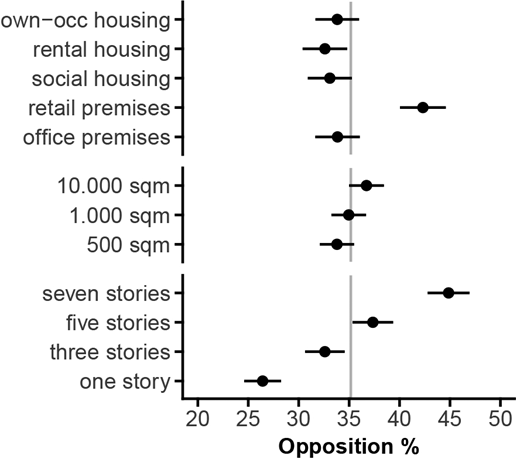
Opposition across the type, size, and height of the development.
Opposition across the type, size, and height of the development.
The relative importance of height over the type or size of the development, suggests that apartment buildings are unpopular because they are tall. Not because they attract more residents or a type of resident that people want to avoid. If the number of residents mattered, then it should have made a difference whether the project was 500 or 10,000 m2 . If the type of resident mattered, it should have made a difference whether the development was social housing or owner-occupied housing. Yet these things made little or no difference to citizen opposition. Consistent with the notion that height matters independently of whether the project attracts undesirable residents and independently of the overall size of the development, we find no interaction between the number of stories and project type or between the number of stories and the square meter size of the project. We present these analyses are in Online Appendix C.
Could it be that height is viewed as a strong proxy for the number and type of residents over and above the type and square meter size of the development? We explore this in Figure 3, where we look at respondents’ beliefs about whether the new development will increase congestion and attract undesirable residents. Respondents do believe that larger projects will increase congestion. This is true for both the development size and the number of stories. This suggests that respondents did recognize that a development with more square meters would lead to more people in their neighborhood. Yet as was evident from Figure 2, this only translates into opposition when the number of stories increase. Citizens also believe that rental and social housing will attract more undesirable residents than owner-occupied housing and office premises. However, when it comes to the effect of building height on attracting undesirable residents, only one-story buildings stand out. There is no difference between three and seven-story buildings in terms of how many undesirable residents citizens believe they attract, but, as is clear from Figure 2, there is a sizeable difference between opposition to three and seven-story buildings.
These results confirm that citizens dislike apartment buildings because they are tall, not because of how many or what type of people will live in them. Above we suggested that such an aversion to tall buildings might stem from a desire to protect the existing physical environment of their neighborhood. Most people live in neighborhoods with no or few tall buildings. A preservationist sentiment could thus translate into a fairly general opposition to taller buildings. Consistent with this, the last panel of Figure 3 shows that citizens tend to believe that tall buildings do not fit into their neighborhood. Conversely, larger projects seem to fit in about as well as smaller projects. And in terms of project type, citizens only single out retail as having a poor fit with the neighborhood.
If opposition to tall buildings is in fact driven by a preservationist sentiment, then opposition should disappear when the tall building is placed near other tall buildings. Here, a tall apartment building will not break the skyline and deviate from the status quo. We explore this possibility in Figure 4, where we analyze development projects conditional on whether they were placed in areas that already had at least one 5+-story building.
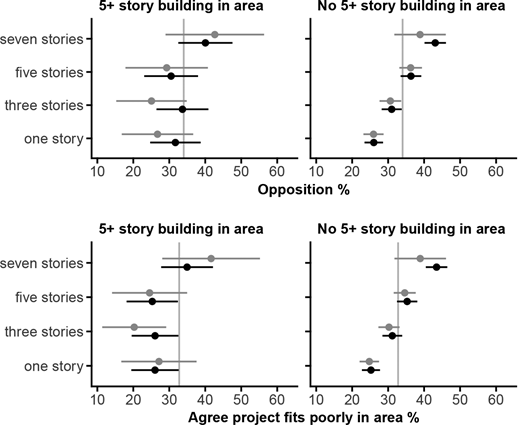
Opposition and neighborhood fit across the height of the project for areas where there is at least one 5+ story building and areas with no 5+ story buildings.
Opposition and neighborhood fit across the height of the project for areas where there is at least one 5+ story building and areas with no 5+ story buildings.
As expected, we find that five-story buildings are as popular as three-story or one-story buildings in areas with at least one five-story building. In these areas, respondents also think that five-story buildings fit in just as well as three or one-story buildings. That is, respondents are not always more opposed to taller buildings. It is only when these buildings stand out from the existing build environment that they are opposed. As such, the effect of changing the height of the proposed development from one to five stories on the share of respondents who oppose the project is 11 percentage points (p ≈ 0.04) lower when the project is proposed near one or more five-story buildings.
The probability that the proposed project was located near a five-story building varies across respondents. For instance, this probability is higher near city centers and lower in more rural areas. This means that the difference we identify in Figure 4 might depend less on the project being placed near other five-story buildings, and more on individual-level differences between respondents in how much they tolerate tall buildings. This is not necessarily a problem, but it does mean that there are two slightly different ways to interpret our findings. One is that citizens oppose tall buildings unless they are built near other tall buildings. The other is that the citizens oppose tall buildings unless they have selected into areas where it is likely that a new development will be placed near a tall building.
To try and distinguish between these possibilities we apply inverse probability weights to our moderator — i.e., we adjust for the underlying probability that each respondent was assigned a project that overlapped with a five-story building. (See Online Appendix D for more details on how we calculated these probabilities.) By applying these weights we sieve out any selection effects, and any remaining differences in the effect of height can be attributed to whether the project was located near a five-story building, not underlying differences between respondents. We present these weighted estimates in Figure 4 as well. As is evident, applying these weights does not change the overall picture. Height remains only weakly correlated with opposition in areas with one or more five-story buildings. However, the weighting procedure is costly in terms of statistical power. The confidence intervals become larger. As a result, we cannot identify a statistically significant interaction effect between building height and the presence of one or more five-story buildings.
Overall, this leaves us with some uncertainty as to exactly why citizens are less likely to oppose taller buildings if they are proposed in areas with other tall buildings. Our results point in the direction that all types citizens will be more accepting of tall buildings if they are built near other tall buildings, however, we cannot say this with sufficient statistical certainty. Therefore, it remains possible that it is partly a selection effect, i.e. that those who choose to live in areas with more apartment buildings are also more accepting of them.
Finally, we want to note that seven-story buildings remain more unpopular in areas with one or more five-story buildings. This makes sense as they still break with the status quo. 7+-story buildings are also extremely rare in Denmark (less than 0.1% of the total housing stock), so they will tend to stand out no matter what. In Online Appendix E, we zoom in on the small number of places where the hypothetical project was located near an existing seven-story building. Here, seven-story buildings seem to face less opposition.
Alternative Explanations And Concerns Over Home Values
We identify no differences in how respondents evaluate social housing and owner-occupied housing. Could this be due to concerns over social desirability? That respondents simply do not want to signal distaste for out-groups? This might be true, however, it is difficult to square with the fact that respondents also did not dislike private rental housing, which does not have the same connotations. Moreover, if respondents were burdened by concerns over social desirability, it is striking that respondents are willing to admit that they believe social housing will attract “undesirable residents”. Finally, the factorial design should limit the importance of social desirability concerns. Previous studies of the placement of new housing have argued that the bundling of treatments in the factorial experiment lowers social desirability bias (Hankinson, 2018, p. 479). This is supported by experimental evidence, which shows that social desirability bias is significantly reduced in factorial experiments as the bundling of attributes allows respondents to explain away their preferences with reference to non-sensitive attributes (Horiuchi et al., 2022).
Another concern relates to informational equivalence across the different conditions (Dafoe et al., 2018). For instance, in the mind of some respondents, tall residential buildings may be inextricably linked with drab social housing projects built in the 60s and 70s. Thus, when we compare low-rise and high-rise buildings, respondents might imagine very different looking buildings. If this was the case, however, we would expect some non-linearities in opposition, as certain heights were associated with particularly unpopular types of construction. However, the effect of height is remarkably linear.
Finally, economic concerns may be a central second-order explanation for people’s opposition to apartment buildings. However, when we asked the homeowners in our sample whether they thought the project would lower the value of their homes only about 6% thought so. In addition, taller developments did not lead to widespread concerns over home values. Social housing did create such concerns, but as was shown above this did not carry over to more opposition. We present these analyses in Figure 5.
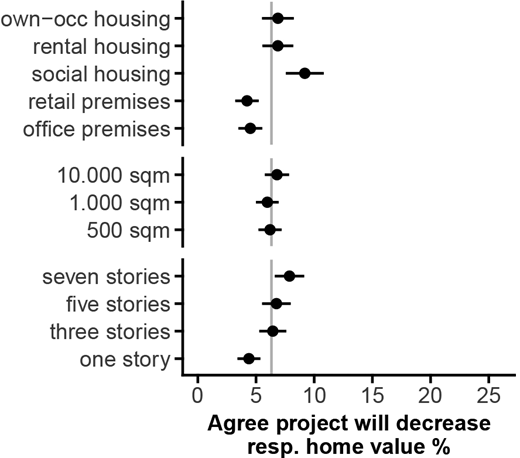
Beliefs about the effects of the development on home values across the type, size, and height of the development.
Beliefs about the effects of the development on home values across the type, size, and height of the development.
A central comparison in the literature on citizen opposition to local development projects is between the attitudes of homeowners, for whom wealth is tied to the demand for living in their local community, and renters (see e.g.: Fischel, 2005). A key challenge with this comparison is that it is subject to selection bias. For one, homeowners tend to live in single-family homes, while renters are much more likely to live in apartments. Nevertheless, we report the opposition across project heights for homeowners and non-homeowners in figure 6. Considering the challenges with selection, it is remarkable how similarly the two groups respond to differences in the height of the development projects. Changing the height from one to seven stories thus increases the opposition to the project among homeowners by 20.8 percentage points (CI 17.3-24.2) and among non-homeowners by 14.5 percentage points (CI 8.6-20.3). Thus, while renters and owners differ, most of the effect persists even for respondents with a limited personal economic stake in the local housing market.
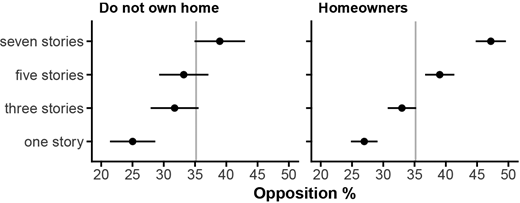
Opposition across height for homeowners and non-owners.
Opposition across height for homeowners and non-owners.
Taken together, our analyses do not seem to suggest that opposition to apartment buildings are driven by concerns over home values. The strength of the relationship between building height and opposition among renters, and the very small number of homeowners who believe the project will affect their home value, suggest that some other concern dominates. Perhaps, simply a strong status quo preference for how your own neighborhood looks and feels.
Conclusion
This study has explored why new apartment buildings face more intense local opposition than new single-family homes. Using a vignette survey experiment we discovered a strong aversion to taller buildings, with seven-story developments facing about twice as much opposition as one-story developments. At the same time, we find limited evidence that citizens are more likely to oppose rental or social housing compared to owner-occupied housing and office buildings. The overall project size also has limited importance. This suggests that citizens dislike apartment buildings primarily because they are tall, not because of how many or what type of residents they attract. Citizens also tend to think that tall buildings fit poorly into the neighborhood. They do not say the same about large projects or projects that attract less well-off residents. Moreover, we found that when a project was placed near other tall buildings, citizens were much less likely to oppose taller developments.
These results suggest that citizen opposition to the siting of apartment buildings in their neighborhood is rooted in a general aversion to changes in the physical character of their neighborhood. This form of local preservationism translates into a relatively general aversion to apartment buildings, because most neighborhoods are low rise, and here apartment buildings will tend to stand out.
These findings might help explain why cities tend to sprawl rather than densify, and why densification efforts in the US and Europe face intense opposition. Our findings also turn some of the established wisdom on opposition to affordable housing on its head. Traditionally, political observers have interpreted opposition to affordable housing as a reflection of an aversion to poor people and minorities (Tighe, 2010; Danielson, 1976). However, based on our findings it is more likely that opposition to affordable housing reflects a fear that affordable housing means high-rises, and high-rises clash with neighborhood character. This is also consistent with findings from Mummolo and Nall (2017) and Trounstine (2018), who show that holding the type of housing constant, people in fact tend to prefer housing for the poor and the middle class. In real life, of course, most social housing is developed as high-rises and most owner-occupied housing is single-family homes, and therefore the latter is more popular than the former.
While these findings do not provide an easy guide for how to make housing more affordable, our study might provide some insight as to what type of multi-story development projects might face less opposition. Let us for instance say that a city is considering building apartments on a vacant lot in the already dense city centre or near transit in the suburb. Here, our findings suggest that the vacant lot in the already dense area engenders less opposition because it breaks less dramatically with the physical character of the neighborhood, and/or because those who live in the city center tend to be more accepting of high-rises.
Finally, a potential avenue for future research could be to explore whether developers and architects can design more dense housing that citizens believe fit into the existing built environment. This is obviously not easy, but our findings suggest it might be worthwhile to explore whether it is possible.
Acknowledgements, Funding And Data
We want to thank Martin Bisgaard, Chris Elmendorf, Karoline Kolstad, Laura Kettel, Anthony W. Orlando, Christian Redfearn, Rasmus Skytte as well as participants at the USC Political Economy Of Housing conference and the Behavioral Citizen Workshop at the University of Copenhagen for valuable comments and feedback. We thank Marc Sabatier Hvidkjær for diligent research assistance. This research is supported by the Carlsberg Foundation, grant CF21-0205 and is part of the ERC Project POLICITY (Grant. no. 802244). Replication data can be found at https://doi.org/10.7910/DVN/1ZPAKL. The data collection was approved in accordance with Aarhus University’s Research Ethics Committee (IRB).
This is based on data from our own analysis of the BBR registry.
One exception is a study by Marble and Nall (2021) which uses a within-subject comparison to show that both liberals and conservatives have a stronger preference for single-family housing.
The absence of mountains in Denmark made it unnecessary to avoid cliffs and mountainous terrain.
Authors translations of a couple of these open-ended answers: “We don’t need it and it will mean the death of the local supermarket that is here”, “The good commercial life in the city must be protected”, “Pulling revenue away from local businesses - it’s going to be like Sweden”.

