Placemaking, a multidisciplinary field in spatial planning, focuses on creating inclusive public spaces that promote community well-being and belonging, incorporating social, cultural and historical aspects to shape a place’s identity. This study aims to explore the theoretical evolution of social placemaking globally and within South Africa, focusing on its potential to restore and empower communities affected by Apartheid’s socio-spatial legacies.
A qualitative approach was adopted, using case study research in Marabastad, Kroonstad, Free State Province (SA). Data were collected through semi-structured interviews, non-participant observations, participatory sessions and unstructured interviews. Thematic analysis was used to analyse these diverse data sets.
The findings reveal a dialectical process of unmaking and re-making in Marabastad. Apartheid-era forced removals disrupted collective identity and dismantled social and cultural infrastructures, leaving a landscape marked by trauma and fragmented memory. Unknowingly, residents actively engage in everyday placemaking practices rooted in care, ritual and shared memory, illustrating efforts to reclaim space and rebuild belonging. Despite ongoing challenges related to social tensions and democratic transformation, community-driven proposals demonstrate the potential of placemaking to move from disintegration towards restoration, positioning social placemaking as a vehicle for cultural resilience, inclusion and spatial justice.
The study highlights the need for planning approaches that centre lived experience, cultural continuity and local agency. It advocates for socially responsive placemaking strategies that acknowledge historical injustices while enabling communities to co-create inclusive, resilient and future-oriented spatial identities.
This study contributes to the debate on social placemaking in SA by focusing on a historically marginalised and lesser-studied community. Through the integration of theoretical insights with grounded local experiences, it reframes placemaking as a socially and historically situated process – emphasising the interconnections between memory, identity and community-led spatial restoration in post-Apartheid contexts.
1. Introduction and background
Placemaking is a multidimensional conceptual process that co-creates unique spaces and empowers people (Duconseille and Saner, 2020, p. 139; Ellery et al., 2020, p. 69; Schneekloth and Shibley, 1995). It is a collective or individual intervention that contributes to creating places that fosters a sense of belonging (Beza, 2016, p. 245; Boeri, 2017, p. 2; Hunter et al., 2016, p. 2; Najafi et al., 2022, p. 2). Space is often understood as universal, value-free and objective (Madanipour, 1996, p. 24), while place is seen as a pause, contextual, value-laden and a subjective experience that adds meaning to geographical location (Tuan, 1977, 1979). Interventions may include design, renovation, upgrading and maintenance (or a combination of these) of spaces to places that incorporate community values (Eckenwiler, 2016, p. 1944; Hyler, 2013, p. 362; Madanipour, 1996; Tuan, 1977, p. 6; Tuan, 1979).
While the various dimensions of placemaking – physical (Maretto et al., 2020; Marsden, 2013; Marsden and Farioli, 2015), psychological (Abusaada and Elshater, 2021; Ehret and Hollett, 2016; Toolis, 2017) and economic (Kelly et al., 2017; Lew, 2017; Loh, 2019) – has been widely explored, social placemaking has received less attention. Social placemaking, also known as culture-based placemaking, involves understanding the cultural landscape before creating change (Lara, 2018). It involves guiding the design of public spaces, allowing local communities to express their culture, ethnicity and heritage (Thomas, 2016, p. 13). This process fosters diversity, identity, familiarity and pride, contributing to a shared experience for residents and visitors (De Vito et al., 2022, p. 243). An inclusive process is non-negotiable in social placemaking to fully realise this shared experience.
Inclusivity in social placemaking is a community-driven process (Jacobsen, 2009, p. 461; Karacor, 2014, p. 256; Rios, 2009, p. 93; Thomas et al., 2015, p. 77) requiring the active collaboration of professionals, local governments, non-profit organisations, communities, activists and individuals. Non-profit organisations, such as the New York City-based Project for Public Spaces, that encourages place-led initiatives to promote synergy between public spaces and communal use [Project for Public Spaces (PPS), 2019] and Placemaking Europe, – which facilitates collaboration among European placemakers (Laven et al., 2019, p. 136) – play pivotal roles in facilitating inclusive placemaking initiatives globally. An inclusive placemaking process holds several social advantages for communities:
the design promotes cultural relevance and identity by incorporating historical and social characteristics, fostering a sense of belonging and pride within the local community (De Vito et al., 2022, p. 243);
the preservation of local heritage involves transforming existing spaces to celebrate and enhance the local environment, emphasising the spatial and environmental aspects of the heritage (Wu, 2023, p. 1);
the concept of connection to the past, encompassing symbolic, natural and cultural aspects, while also considering the present and future (Csurgó and Megyesi, 2016, p. 437); and
social cohesion (Pastak and Kährik, 2021, p. 824; Schemschat, 2021, p. 5) and diversity recognition in communities can reduce tension and conflict, leading to more harmonious interaction among residents (Akbar and Edelenbos, 2021, p. 9; Dash and Thilagam, 2023, p. 11).
Practitioners involved in placemaking must actively respect and engage with local specificities rather than imposing externally defined solutions, ensuring interventions resonate with community identities and aspirations (Jordaan et al., 2008, p. 105; Koopmans et al., 2017, p. 154; Lew, 2017, p. 448; Newman, 2016, p. 389; Thomas et al., 2015, p. 74). While studies demonstrate placemaking’s potential, there remains a need for more context-sensitive research to deepen understandings of how social placemaking can contribute to transformation and belonging in postcolonial and post-Apartheid environments. The value of placemaking has been demonstrated across diverse contexts, further emphasising its potential as a tool for community empowerment and resilience.
Placemaking has been studied in a variety of contexts, illustrating its role in shaping resilience and community identity across diverse settings. For example, placemaking has enhanced urban resilience in Christchurch following the 2010 and 2011 earthquakes in New Zealand (Brand et al., 2019, p. 157), served as a tool for slum upgrading and informal settlement improvement in Latin America (Fuentes and Pirzkall, 2020; Vilar and Cartes, 2016), and facilitated participatory approaches to neighbourhood regeneration in Ikageng, Potchefstroom, South Africa (Strydom and Puren, 2013, 2014, 2016). These studies highlight how placemaking extends beyond physical interventions, reflecting the cultural, social and historical dimensions that underpin community-led practices.
Spatial planners prioritise placemaking (Hague and Jenkins, 2005, p. 8), as confirmed by South African Council for Planners’ listing of it as one of its core competencies [South African Council for Planners (SACPLAN), 2014, pp. 23–24]. This paper explores social placemaking in South Africa (from a planning perspective) for a number of reasons:
SA, a democratically young country since 1994, still grapples with the legacy of Apartheid. This include spatial and social disintegration resulting from the Group Areas Act of 1950 (Act no 41 of 1950), that enforced racial segregation and the forced relocation of non-white populations;
forced removals in communities led to social disruption, aiming to create homogeneous groups based on racial grounds;
social disruption and disintegration due to a strong influence of Modernism in spatial planning and design, on the built environment; and
SA being known for its diverse and multicultural society (Bollaert, 2019, p. 29).
This multi-culturalism is highlighted by the nickname for the country as the “Rainbow Nation” – term coined by the late Archbishop Desmond Tutu – (Tutu, 1999). Considering the multiculturalism and a high urbanisation rate of 67.85% (O’Niell, 2023) in SA, it is anticipated that urban areas are increasingly becoming cultural melting pots (Landman, 2019; Makakavhule and Landman, 2020). Public places in urban areas provide increased opportunities for people from diverse cultural and social backgrounds to interact (Integrated Urban Development Framework (SA) 2016, p. 94; Rawhani and Middelmann, 2023, p. 3535).
Guided by a scoping review of recent literature, this study foregrounds seven key themes – placemaking, social identity, invented tradition, shared history, cultural heritage, political dimensions and coloniality – as central lenses for conceptualising social placemaking within historically marginalised South African communities. These themes underpin the theoretical framing and guide the empirical focus on Marabastad as an explorative case study in this paper.
Therefore, the main question is How do we conceptualise social placemaking in a South African context? Firstly, this paper aims to contextualise the theoretical evolution of social placemaking. A second step is to reflect on explorative case study of Marabastad township in Kroonstad, SA, demonstrates forced removals of pre-1994 Apartheid legislation, despite minimal political protest, highlighting the traumatic upheaval experienced during these relocations (Moloi, 2012, 2015). Marabastad represents an example of “the unmaking of a place” and provides an opportunity for social placemaking. Collectively, the purpose of the research was to develop a contextualised understanding of social placemaking in a SA context, an area of research that has up until now not been fully developed in spatial planning in SA.
2. Theory
The theory of placemaking, and more specifically social placemaking, is multifaceted and deeply rooted in spatial, cultural and political discourse. While placemaking is often framed as a design-led strategy for enhancing public spaces, it is increasingly seen as a socially constructed and contested practice that reflects broader issues of identity, history and inclusion. This section integrates the phases of social placemaking, revisits the four traditional dimensions of placemaking and situates both within broader academic debates on social construction and identity. This is achieved through the acknowledgement of important conceptual frameworks, including Anderson’s (1983) – Imagined Communities – and Hobsbawm and Ranger (1983) – Invented Traditions. This section further outlines the findings from a recent scoping review of contemporary academic literature.
2.1 Placemaking
An integrative literature review (ILR) by Strydom et al. (2018), informed the empirical research. This ILR, spanned over four decades (1975–2017) and considered peer-reviewed publications from both the Global North (GN) and South (GS). The ILR revealed four interconnected dimensions of placemaking (see Figure 1):
The physical dimension focuses on the tangible environment – architecture, landscape and infrastructure. Interventions include urban greening, spatial layout design and public furniture that contribute to environmental quality and liveability (Afonso, 2017; Vásquez and Knott, 2014; Wesener et al., 2020).
The social dimension is concerned with societal customs, governance and socio-political dynamics that shape spatial practices. It incorporates the influence of tradition, power relations and cultural norms in how spaces are negotiated (Burgess, 1979; Nejad et al., 2020; Pendlebury and Porfyriou, 2017; Samadhi, 2001).
The psychological dimension attends to the emotional and cognitive experiences of place. This involves place attachment, memory and meaning that impacts on how individuals interact with and interpret their environments (Abusaada and Elshater, 2021; Devine-Wright, 2022; Friedmann, 2007 and, 2010; Jirón et al., 2016; Lew, 2017; Strydom and Puren, 2016, p. 1260).
The economic dimension focus on the ability of placemaking to stimulate investment, tourism and branding. It includes both place-led development and the commodification of local identity for economic gain (Lak and Kheibari, 2020, p. 54; Pitria and Andari, 2023, p. 178; Shibley, 1998; Yigitcanlar et al., 2016). This dimension also includes the lack of funding for potential interventions and maintenance (Coaffee, 2013).
For academics and professionals aiming to use planning to advance justice, belonging and transformation social context has emerged as being especially important across these dimensions. In this regard, social placemaking has evolved as a subfield deserving of focused exploration.
2.2 Social placemaking
The literature on social placemaking reveals a conceptual shift from static, design-led interpretations of space to dynamic, negotiated processes of identity construction and social interaction. This evolution can be traced through four phases: context-sensitivity, inclusivity, restoration and an integrated approach.
Context-sensitivity emphasises the importance of understanding the local cultural and historical context before intervening in public space. Burgess (1979) and Day (1992) argue that planners and designers should recognise and respect local traditions and spatial narratives. However, as Schneekloth and Shibley (2000) caution, consultation needs to be a part of co-production rather than being tokenistic. Promoting social justice and facilitating community involvement are at the heart of inclusivity (Lepofsky and Fraser, 2003, p. 130; Schneekloth and Shibley, 2000). In this case, planners work with inhabitants and cultural informants (e.g. implicit beliefs and values including religion, sacred places and heritage conservation practices) to design spaces that represent a range of lived experiences (Cilliers et al., 2015, p. 360; Coaffee, 2013, p. 329; Hou and Rios, 2003; Lew, 2017; Vasquez and Knott, 2014).
Restoration highlights the potential of placemaking to respond to inequality, trauma and exclusion. In the GS, placemaking is used as a tool for resilience and recovery, promoting social bonds and healing through spatial narratives (Friedmann, 2010; Lombard, 2014; Samadhi, 2001). Social bonds among stakeholders assist the decision-making process and contributes to the solution-finding for social challenges (Wen, 2015, p. 8). Traditional practices, customs, belief systems and political attitudes influence initiatives and outcomes (Shinde, 2012). These context-specific initiatives assist in the activation of social restoration (Vásquez and Knott, 2014, p. 326).
Integration positions placemaking as an iterative process of negotiation and meaning-making. This approach redefines professionals as facilitators who support inclusive and context-specific dialogue (Toolis, 2017; Strydom et al., 2018). Placemaking is seen as a vehicle for democratic change towards empowered and enabled citizenry (Shibley et al., 2003; Strydom et al., 2018; p. 166). Active negotiation with stakeholders is crucial for transforming spaces in daily environments (Toolis, 2017, p. 194; Thomas et al., 2015, p. 83). Negotiation unlocks inclusivity and respect for diversity (Rios and Watkins, 2015, p. 217). This final phase blends all previous social placemaking phases.
This progression affirms that social placemaking is not merely about constructing physical space but about cultivating shared meaning, relational belonging and democratic engagement.
2.3 Thematic insights from the scoping review
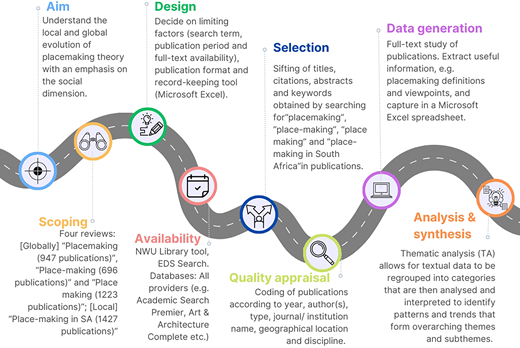
A scoping review of literature published between 2021 and 2025. Sixty five review articles were screened, and 36 publications were selected for further analysis. This review identified seven dominant themes in social placemaking: “placemaking”, “social identity”, “invented tradition”, “shared history”, “cultural heritage”, “political” and “colonial”. These themes were examined to align the theoretical framework with contemporary debates, supporting the study’s conceptual foundations.
2.3.1 Placemaking.
Placemaking emerges as a central theme across a wide range of academic contributions, particularly in the context of participatory urban design, campus planning and post-disaster recovery. The reviewed literature foregrounds the role of community involvement, collaboration and user-centred spatial practices in the (re)production of place (Geekiyanage et al., 2021; Lopes Balsas, 2023, p. 8). For instance, Agrawal and Yadav (2021) explored how Indian university campuses are deliberately designed to promote placemaking, aligning architectural elements with cultural and pedagogical values to foster a sense of belonging. Similarly, Semeraro et al. (2021) highlight the placemaking potential of urban agriculture, noting that such practices extend beyond food production to create multifunctional social spaces that stimulate community interaction and cultural continuity. This thematic thread emphasises the importance of both tangible design interventions and intangible social processes (Qiu et al., 2022, p. 15) in shaping the identity and inclusivity of urban environments (Singh et al., 2023, p. 4; Qi et al., 2024).
Sewell and Warnaby (2025) expand on this evolving understanding by demonstrating how omni-temporality underpins placemaking in Colchester, illustrating how layered temporalities enable communities to sustain and rework place identities over time. This resonates with the importance of collective memory and historical practices in shaping spatial belonging, which is central to understanding social placemaking.
2.3.2 Social identity.
The construction and negotiation of social identity within spatial contexts is a recurring concern, particularly in relation to youth, migrants and marginalised populations (Buyannemekh, 2024, p. 124; Rudman and Aldrich, 2022, p. 4). Social identity is portrayed as inherently relational, contingent on both spatial belonging and symbolic representation (Kayisu et al., 2024, p. 18; Lundberg et al., 2024, p. 6). Butler (2021), for example, explores the experiences of rural youth in Australia, illustrating how identity is mediated through local geographies and historical narratives. Similarly, Albers et al. (2021) focuses on refugee integration through the lens of place identity, arguing that spatial familiarity and cultural referencing are critical for fostering emotional security and community cohesion. The literature collectively suggests that urban and institutional spaces are not merely passive settings but active roleplayers in the affirmation or contestation of individual and group identities.
2.3.3 Invented tradition.
The theme of invented tradition interrogates how rituals, symbols and spatial practices are reconstituted to serve new sociocultural or institutional purposes (Lin and Andersson, 2023, p. 197; Mourato and de Wit, 2022, p. 568; Qiu et al., 2022, p. 13). Drawing on Hobsbawm and Ranger’s foundational concept (1983), the reviewed studies reveal how modern spaces – such as university campuses or multicultural urban districts – often simulate or adapt traditional forms to establish continuity, legitimacy or cohesion. Agrawal and Yadav (2021) note the replication of colonial-era planning models in Indian higher education campuses, suggesting a deliberate evocation of authority and heritage. In a different vein, Butler (2021) observes how urban youth reinterpret tradition through street performance and music, blending historical reference with contemporary cultural expression. These examples highlight the constructed nature of tradition and its role in both stabilising and reimagining identity in space.
2.3.4 Shared history.
Shared history functions as a connective thread between individuals and place, often manifesting through collective memory, narrative and symbolism (Singh et al., 2023, p. 17; Wyatt and Rossetti, 2024, p. 494). The literature reflects a growing recognition of how urban spaces can encode and reflect communal pasts, particularly in relation to migration, colonisation and post-conflict transformation (Rezeg et al., 2025, p. 26). Akbar and Edelenbos (2021) describe how public spaces are strategically framed as sites of shared memory, where layers of historical identity are actively negotiated. Butler (2021) similarly highlights the role of shared history in enabling urban youth to forge a sense of belonging amidst multicultural or transient settings. This theme reveals the significance of memory work in spatial planning and placemaking, pointing to the importance of inclusive historical representation in urban development processes.
2.3.5 Cultural heritage.
Cultural heritage – incorporating both tangible artefacts and intangible practices – is central to processes of identity formation, resilience and spatial continuity (Bo and Abdul Rani, 2025, p. 11; Malaila et al., 2021, p. 89; Najafi et al., 2022, p. 525). The reviewed contributions explore how heritage is mobilised in diverse contexts, including post-conflict reconstruction, migration and youth engagement. Albers et al. (2021) argue that placemaking strategies designed for refugees often rely on cultural referencing to promote familiarity and psychological well-being. Similarly, Butler (2021) investigates how young people in urban Australia interact with heritage sites as backdrops for performance, thereby asserting cultural relevance and ownership. The theme also gestures towards the intergenerational transferring of values and the evolving interpretations of heritage in the face of social change, displacement and urban transformation.
2.3.6 Political.
Spatial practices and urban development are deeply political, structured by networks of power, governance and resistance (Keleg et al., 2022, p. 232; Singh et al., 2023, p. 7). The literature reviewed in this theme addresses both overt and latent forms of spatial politics, from participatory planning frameworks to contested access to public spaces. Akbar and Edelenbos (2021) explore collaborative governance mechanisms in placemaking, noting how network-building facilitates stakeholder inclusion and reduces conflict. Concurrently, Butler (2021) documents youth resistance to spatial exclusion in urban areas, emphasising the right to the city as a core principle in contemporary urban politics. These examples demonstrate that space is not neutral; rather, it is continuously produced through political struggle, negotiation and mobilisation.
2.3.7 Colonial.
The enduring impact of colonial legacies on contemporary spatial practices is a critical theme across several of the reviewed studies. The literature identifies how colonial urban forms, institutional structures and epistemologies continue to shape planning paradigms and access to space (Lategan et al., 2025:2; Yan et al., 2024, p. 18). Butler (2021) offers a sharp critique of how global capital and urban development remain tethered to colonial patterns, particularly in the global South. Similarly, Agrawal and Yadav (2021) show how colonial-era planning models are reinterpreted in modern Indian universities, often without adequate localisation. This theme speaks to the need for decolonising planning practice and pedagogy by recognising and challenging Eurocentric spatial norms, while affirming local knowledge systems and indigenous agency.
2.4 Imagined communities and the construction of spatial identity
Building on the seven key themes identified in the scoping review – placemaking, social identity, invented tradition, shared history, cultural heritage, political dimensions and coloniality – this section connects these to the theoretical frameworks guiding this study. This alignment strengthens the conceptual foundation for understanding social placemaking in historically marginalised contexts such as Marabastad.
Placemaking, as conceptualised in this study, is not limited to design-led interventions but is a socially situated, negotiated process embedded in collective memory and everyday practices. Anderson’s (1983) concept of imagined communities is instrumental in understanding how social identity and shared history shape placemaking. Communities, even when dispersed or displaced, sustain belonging through shared narratives, symbols and rituals that collectively reimagine their spatial identities. This is critical in post-Apartheid contexts where the reclamation of place is intertwined with identity repair and community restoration.
The theme of invented traditions (Hobsbawm and Ranger, 1983) underscores how rituals and cultural practices are reconstituted to serve contemporary needs, providing continuity and stability in the face of spatial and historical disruption. Such practices are evident in the community-driven initiatives observed in Marabastad, where residents use storytelling, renaming and cultural celebrations to reclaim ownership and rebuild community identity, thereby actively engaging in placemaking as a tool for restoration.
Shared history and cultural heritage further underpin the process of placemaking, where communities draw on intergenerational memory and cultural practices to sustain social ties and strengthen spatial belonging. Sewell and Warnaby (2025) notion of omni-temporality reinforces the understanding that placemaking operates across layered temporalities, enabling communities to draw on the past while reimagining their futures.
The political and colonial dimensions are crucial in contextualising placemaking within South Africa’s socio-spatial realities. Placemaking practices are deeply political, engaging with questions of power, resistance and governance, while colonial legacies continue to shape urban spatial patterns and planning paradigms. Recognising these dimensions foregrounds the need for socially responsive, context-sensitive approaches that acknowledge the historical injustices embedded in the landscape while facilitating inclusive, community-led processes of spatial reconstitution.
Together, these theoretical perspectives frame placemaking as a cultural act of social construction deeply embedded in identity, memory and power relations. They inform the methodological choices of this study, guiding the exploration of how communities such as Marabastad enact social placemaking in everyday practices. By explicitly aligning the scoping review’s key themes with these theoretical lenses, this study foregrounds the interplay between theory and practice in advancing placemaking as a tool for community restoration and spatial justice in post-Apartheid South Africa.
3. Research design: methodology, design and methods
This third section aims to provide an overview of the approach, research design, data generation methods and data analysis that was used.
3.1 Methodology
The study adopts a qualitative methodological approach due to its flexibility and ability to align with the study’s aim to explore social placemaking as it manifests through lived experiences, identity construction and community interaction. Qualitative research enables the exploration of context-specific narratives, offering insights into how place is socially produced and negotiated (Bloomberg and Volpe, 2016; Leedy et al., 2019, p. 228). This interpretive approach was deemed appropriate to understand the role of social placemaking as a restorative tool in a historically marginalised South African community (Kumar, 2019, p. 18; Merriam and Tisdell, 2016, p. 152; O’Leary, 2017, p. 8).
3.2 Presenting the case: Marabastad, Kroonstad (Free State province of South Africa)
The following section describes (i) the case, (ii) unit of analysis and (iii) research context of the case study.
i. The case
This study focuses on social placemaking in SA, specifically Marabastad, Kroonstad. This community, marked by forced removals and political resistance, offers a unique site for understanding how identity, memory and spatial belonging intersect (Yin, 2014; Merriam, 2009; Stake, 2006). This case represents a unique example of urban black political protest and resistance in the second half of the twentieth century. The study contributes to spatial planning in SA by exploring aspects that can be considered in restoring places through social aspects. It illustrates the dimensions of social placemaking (unit of analysis).
ii. The Research Context
This subsection explores the macro- and micro-context that informs this case study.
3.2.1 Macro-context: historic development of human settlements in SA.
South African human settlements were historically arranged based on social and economic functions, influenced by Apartheid ideology. The Apartheid Group Areas Act (Act no 41 of 1950) created socio-spatial imbalances due to its segregated urban environment planning (Clark and Worger, 2016, p. 46), forcing many communities to relocate to monotonous urban settings (Van Leynseele, 2013, p. 44). Since SA entered democracy in 1994, the re-imagination of the socio-political, spatial and economic context has been emphasised (Sisk, 2017, p. 75), but socio-spatial and economic scars remain visible in local communities, despite the end of Apartheid almost three decades ago (Strydom and Puren, 2016).
3.2.2 Micro-context: Marabastad, Kroonstad.
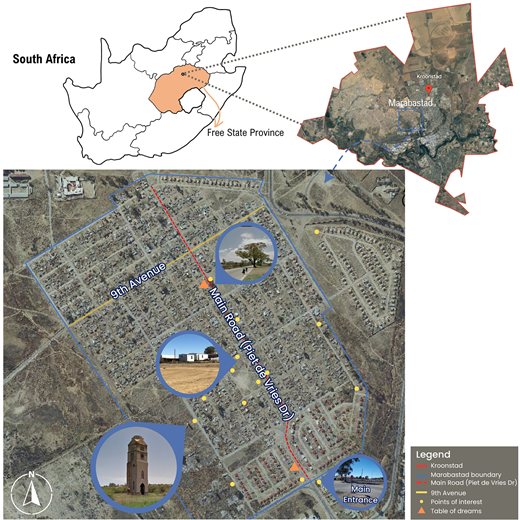
The spatial frame for this case study is the demarcated area of Marabastad as illustrated in Figure 2. Marabastad is part of the Moqhaka Local Municipality.
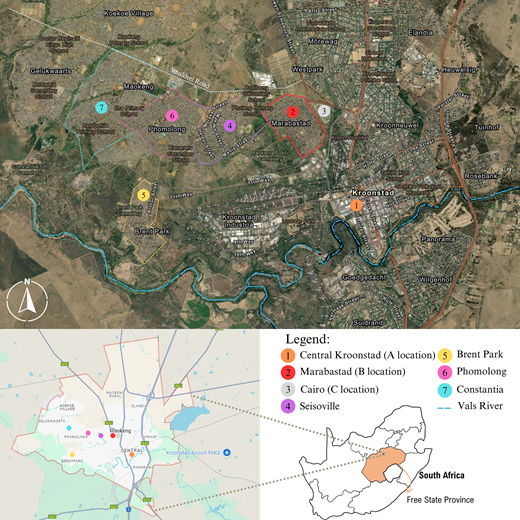
Kroonstad, a city in SA, gained municipal status in 1875 (Serfontein, 1990) and soon after, African families settled in Central Kroonstad (“A location” in Figure 3). By the early 1900s, non-white residents were relocated northward (Moloi, 2015, p. 9). Marabastad, known as “B location”, grew significantly between 1920 and 1930, housing a diverse population of black and mixed-race residents. Segregation led to the establishment of “C” and “D” locations. In 1950, the Group Areas Act enforced racial segregation, leading to the development of new neighbourhoods, i.e. Seisoville, Phomolong and Brent Park (see Figure 3).
Residents, who were relocated to Brent Park (during the late 1970s and early 1980s), chose to demolish their homes instead of receiving government compensation (Kentridge, 2013, p. 141). With the democratic turn in SA (1994 onwards), socio-spatial integration became possible. Marabastad, underwent a reblocking process. Reblocking is an approach used to reconfigure densely situated shacks in informal settlements, often guided by community-drafted spatial development frameworks (South African SDI Alliance, 2014). In Marabastad, this process was necessary to reshape its layout, which proved challenging due to the high number of returnees that were previously forcibly removed (Botha, 2018, p. 137). This highlights Marabastad’s uniqueness and the potential for exploring the social dimension of placemaking.
3.3 Research methods
This section elaborates on the research process and methods that informs this case study:
Community entrance
This study benefits from the connections made with the local community during earlier research visits as a gateway to the community because it is a component of a wider study that focuses on Marabastad as a unique place in SA.
Participant sampling
This study used convenience and critical sampling methods, focusing on participants who were easily reachable for the researcher, as per the guidelines of Holloway and Wheeler (2013, p. 139).
Research methods
Four research methods were used to study social placemaking in Marabastad, each offering unique advantages in gathering comprehensive insights (see Table 1). Semi-structured interviews provided flexibility, while non-participant observations offered behavioural insights and visual documentation. Inclusive participatory sessions (inspired by Chang, 2020) encouraged collaboration, while unstructured face-to-face interviews provided expertise. The combination of these methods ensured a comprehensive understanding of the social dimensions of placemaking in Marabastad. Thematic analysis (TA) was used to group textual data into categories, identifying patterns and trends that form overarching themes and subthemes (Braun and Clarke, 2017, p. 742).
Trustworthiness
This study uses multiple data sources to present findings from a single case study, enhancing data triangulation and trustworthiness (Gray, 2014, p. 37; Klenke, 2016, p. 6; Willig and Stainton-Rogers, 2017, p. 341). This triangulation contributes to the data’s ability to provide insights into the research question, thus enabling it to inform placemaking in spatial planning in a South African context.
3.4 Ethical considerations
The research proposal and ethics risk assessment were presented to the North-West University (NWU) Faculty of Natural and Agricultural Sciences Ethics Committee (FNASREC). The associated risk was considered minimal. This implied that the NWU Senate Committee for Research Ethics (NWU-SCRE) granted its permission for the research study in question under ethics no. NWU – 01553–20-A9.
4. Findings: the unmaking and re-making of community in Marabastad
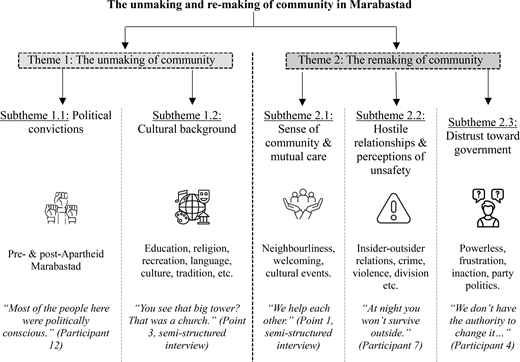
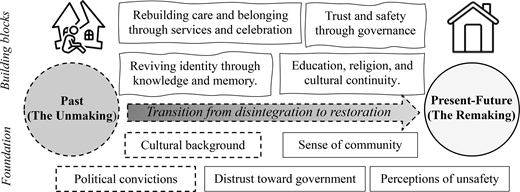
This section outlines the main findings from the integrated data set, revealing a narrative arc that shifts from the unmaking of community – through loss, forced removals and social fragmentation – to the re-making of community through shared cultural practices, identity and resilience (Figure 4). These themes emerged consistently across observations, interviews and participatory engagement, indicating Marabastad’s persistent social imagination as well as its historical trauma.
4.1 The unmaking of community: displacement, disconnection, and loss
This theme explores how the concepts of shared history, social identity, cultural heritage and coloniality manifest in the context of forced removals and the subsequent unmaking of place.
Participants consistently referenced the historical dislocation of residents and the enduring psychological impact of forced removals in Marabastad. The once-strong sense of place as belonging was profoundly disrupted – physically, socially and emotionally. These disruptions fractured the community’s fabric and left behind complex feelings of nostalgia, trauma and fragmentation. This process of spatial and social fragmentation aligns with what Friedmann (2010) and Lombard (2014) discussions of spatial trauma within the Global South, illustrating the restoration phase of social placemaking where communities navigate loss while seeking pathways towards healing. The dislocation described by participants also resonates with the notion of coloniality in spatial practices (Butler, 2021), reflecting the persistent structures of exclusion and marginalisation shaping contemporary urban experience.
For many, Marabastad was more than a geographical location – it was a place steeped in memory and meaning. As Participant 9 reflected, “because this place, really for us, it’s got history, because as well our mothers and our grandfathers started to stay here.” This anchoring of personal and collective identity in the physical landscape was deeply intertwined with the trauma of removal. Although the physical area remains, the social and emotional connections that once animated it have been weakened. Participant 4 lamented, “they were sharing so many things, religion, education, what, ne? But today there’s nothing like that,” while Participant 2 noted, “you know, it is still there, but not at that rate [culture of caring]. But, you can still feel it, ja, you can feel it or you can see it.” These recollections express a nostalgic tension between a vivid memory of what once was and the fractured, fragmented present. As participants recounted memories of shared spaces and traditions, these narratives reflect Anderson’s (1983) concept of imagined communities, where belonging is sustained through collective memory and symbolic connections to place, even after physical displacement.
The disruption of social identity forms the core of this theme. Participants often described how social identity in Marabastad has been shaped not only by shared heritage but also by ongoing change. As Participant 4 observed, “but sometimes you’ll find that now when people come with different type cultures, ultimately they have now […] form their own culture.” This reflects how identity remains fluid and adaptive, while still drawing strength from deep-rooted communal traditions.
4.1.1 Subtheme 1.1: political convictions as informative of social identity.
Marabastad’s social identity has been fundamentally shaped by a legacy of political awareness, resistance and the collective trauma of Apartheid. Participants spoke of the community’s longstanding political consciousness – rooted in daily life, leadership and family history. Participant 12 stated, “[…] most of the people here were politically conscious,” underscoring how activism and awareness were once central to community life.
Several participants referenced well-known political figures who emerged from the area. Participant 4 proudly noted, “Mr [Reverend] Mahabane was coming from here,” adding, “Ivy Matsepe-Casaburri, Terror [Patrick Lekota] […] and Pallo Jordan,” a sentiment echoed by Participant 12. These names serve as symbolic markers of Marabastad’s contribution to the national political narrative and reinforce how political engagement formed a key dimension of social identity.
This political legacy, however, is inseparable from the harsh realities of forced removals and racial classification under the Group Areas Act. Participant 9 recounted, “because you had within a family those who were classified as coloured and those who were classified as Africans,” a legal distinction that often tore families apart. The psychological and emotional toll of this separation was further emphasised by Participant 7, who reflected, “it was a sad moment because we have to lose our families […] they tried to chase us out and we lose this attached of Marabastad … that family thing were broken and that society were broken.” The trauma of displacement was also captured in recollections of the physical destruction of homes and spaces: “they were very upset because they had to leave this,” shared Participant 2, while Participant 9 added, “it’s an old place […] when our grandmothers were removed here […] all this place was supposed to be dismantled.”
Although these events occurred during the pre-democratic era, they continue to influence how identity, belonging and justice are understood in Marabastad today. Post-Apartheid legislative reforms introduced new freedoms, but also created social pressures. Participant 5 observed that “since the lifting of these influx control regulations [legislative change], people have had the freedom to move as they please […] the people coming from farms […] they now move into the township.” While these shifts represent a significant change in spatial mobility, they also contributed to a perceived dilution of shared values and a growing unease around social cohesion.
Taken together, these reflections suggest that Marabastad’s social identity is not static. It is deeply political – formed through both struggle and adaptation – and is continuously shaped by the tension between historical continuity and contemporary transformation.
4.1.2 Subtheme 1.2: cultural background of Marabastad.
The cultural background of Marabastad – rooted in the practices of education, religion, language, sport and tradition – formed a vital foundation for the area’s pre-removal identity. These cultural practices did not only provide structure and meaning to daily life; they also served as mechanisms of cohesion, resistance and pride.
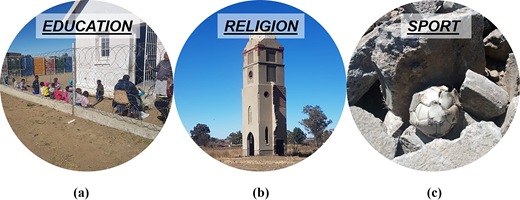
Education was repeatedly described as a cornerstone of community life. Participant 4 explained that “the culture of education […] because the people here used to like education,” was central to Marabastad’s social fabric before forced removals. This emphasis on learning was not only historical but aspirational; Participant 7 affirmed, “we make sure we educate them, because education is one better weapon,” underscoring the continued value placed on knowledge as a means of empowerment and resilience [see Figure 5(a)].
Religion was another important pillar, providing moral guidance and uniting residents through shared values and rituals. As Participant 4 put it, “the moral aspect, it’s a thing which brings people together, that we share. And the moral aspect, where do you get it? You get it now from the churches.” Even though many churches were destroyed during removals, their remnants remain etched into the landscape and memory. Pointing to the past, a semi-structured interviewee (Point 3) described, “you see that […] big tower […] there was a church, ne. It was […] Methodist Church,” while another noted, “in Marabastad the churches were broken down” (Point 13). These fragments of the built environment serve as enduring symbols of a once-cohesive moral community [see Figure 5(b)].
Sport, particularly football (soccer), was described as an essential space for communal interaction and identity formation. Participant 2 explained, “Marabastad was a place of schools, sports, the entertainment […] our togetherness also is shown by virtue of one section of Marabastad has a football team, the other section has a football team. During the weekends, they start competition.” These local competitions were more than games – they were moments where bonds of pride and unity were reaffirmed through ritualised community interaction [see Figure 5(c)].
Beyond these formal cultural institutions, everyday practices such as language, music and dance further enriched Marabastad’s cultural landscape. Participants described unique linguistic blends such as Flaaitaal and Tsotsitaal – “a mix of Afrikaans, Sesotho and other languages” (Participants 4 and 7) – which emerged organically through community interaction. These languages reflect the fluidity of identity and cultural creativity within a historically marginalised context. Music and dance also held expressive and political functions. Participant 6 shared, “music I think has always been something big in Marabastad,” while Participant 7 added, “because, the more you dance, you dance the […] you communicate the language of what was happening.” Even informal spaces like shebeens (drinking establishment) were deeply cultural, as Participant 7 described: “shebeens is a place where you sell beer […] was only beer, sorghum beer.” These establishments were sites of social exchange, storytelling and cultural continuity.
Together, these elements form a layered and dynamic cultural identity that was actively lived and transmitted across generations. While Apartheid policies fragmented these networks, the memory and symbolic weight of these cultural practices remain strong today. They continue to shape how Marabastad residents relate to their history, their neighbours and the possibilities of place re-making in the future.
4.2 The re-making of community: cultural resilience and everyday social practices
This theme demonstrates how placemaking, invented traditions and community-led cultural practices contribute to the re-making of identity and belonging, illustrating the potential for socially driven placemaking to address historical disruption and spatial injustice.
Despite the historical displacement and the erosion of many communal structures and places, the findings reveal evidence of a social reconstitution in Marabastad. This re-making of community is not a return to an idealised past, but rather a complex process of adapting, improvising and negotiating new meanings of belonging and placemaking. Community members are actively engaging in everyday practices of care, solidarity and cultural expression that sustain a sense of identity amidst ongoing change and challenge. These practices reflect the integration phase of social placemaking, where new meanings of belonging are negotiated amidst historical displacement with the work of Toolis (2017) and Strydom et al. (2018) on iterative placemaking processes.
4.2.1 Subtheme 2.1. Sense of community and mutual care.
Many participants reflected on enduring values such as solidarity, neighbourliness and shared responsibility, suggesting that while formal institutions of community may have weakened, these values persist informally and adaptively. One resident (Participant 4) recalled the Zulu proverb “Umuntu ngumuntu ngabantu”, translating to “people are people through other people”, to express the belief that communal care remains fundamental to life in Marabastad. This ethos of mutual support was further illustrated by a participant who explained that “not too much of bad things happened because the community around here looks after one another,” (Point 8, semi-structured interview) while another simply said, “we help each other” (Point 1, semi-structured interview).
Neighbourliness remains a significant form of social cohesion. Participant 2 recalled that “everybody, almost everybody, knew his or her own neighbour,” adding that “one would not be afraid to approach his or her neighbour […] if there’s a need.” This neighbourliness is often seen during communal rituals, such as traditional feasts: “We have feast activities […] where we say thanks to our ancestors. Maybe I’ve got a new job, a new car, whatever, and I’ll slaughter a cow or a sheep, and everybody, in fact I’m not inviting, everybody who passes there and sees in my yard there is, gets in” (Participant 2). These rituals reinforce community ties and a sense of togetherness, expressed by the same participant in the phrase, “we have our togetherness”. Rituals and cultural expressions in this sense, can be seen as examples of invented traditions (Hobsbawm and Ranger, 1983), where communities consciously reconstitute cultural practices to anchor identity, continuity and belonging in spaces previously disrupted by forced removals.
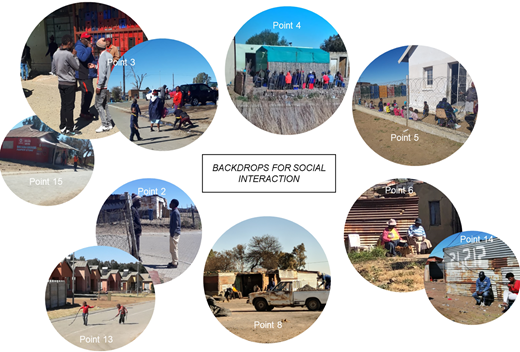
Participants also noted that Marabastad retains a welcoming spirit towards outsiders. “When you walk in the area, you will find that the people are friendly, they are not hostile [towards guests]. They are friendly,” remarked Participant 5. Participant 2 similarly stated, “the spirit is still there – you can feel it. People greet, they help. Maybe not like before, but still.” While acknowledging changes in social dynamics, Participant 10 noted efforts to sustain communal bonds: “We are not as close as before, but we try. Sometimes there are fun days, and people come together.” These events and informal interactions serve as important mechanisms for reinforcing social identity and resilience within a changing social landscape. Figure 6 highlights the various backdrops for social interactions (non-participant observations).
4.2.2 Subtheme 2.2. Hostile relationships and perceptions of unsafety.
Alongside narratives of solidarity, participants also described rising tension and division within the community – particularly between long-term residents and more recent arrivals. These insider–outsider dynamics often manifested as distrust and suspicion, undermining the social cohesion described in the previous subtheme. As Participant 9 explained, “you had this seemingly close-knit society, but under the surface, you can see the differences that will always surface at one point or another.” One interviewee observed that “if you’re from outside, they kind of like recognise you faster, because it’s a small location and we kind of like know each other” (Point 6, semi-structured interview).
There were particularly hostile attitudes expressed towards foreign shop owners and rural migrants, who were frequently blamed for introducing drugs and crime into the area. Participant 8 stated, “these shops are foreigners’ shops where our children get all the drugs […] they are the people who brought the drugs here, they are the killers,” and continued, “the worst part of it, these people who are coming from outside [rural areas/immigrants], living here… their behaviour is just next to animals.” Such views reflect deep anxieties about perceived threats to local norms and safety, and they underscore how fragile and contested the process of community re-making can be.
Concerns about personal safety, particularly after dark, were a recurring theme. “At night you won’t survive outside”, warned Participant 7, and Participant 8 noted that “nowadays, this is the most dangerous place to go, especially at night.” Substance abuse was also linked to increased violence, as Participant 6 described: “At later stages, everyone can start to fight with each other […] when the alcoholic beverages turns you into a lion.” These accounts suggest that the social re-making of place is being undermined by material conditions that limit social interaction and heighten insecurity.
4.2.3 Subtheme 2.3: distrust toward government and political paralysis.
A third barrier to the re-making of community is a widespread distrust of government institutions. Participants shared a strong sense that local authorities are unresponsive to community concerns. As Participant 7 expressed, “Marabastad to get to, my experience is that you have to fight first. With the superior of local government […]” Participant 8 added, “even when we report things, it feels like it goes nowhere,” while Participant 12 concluded that “the municipality is not listening. We speak, but nothing changes.”
This disillusionment has undermined not only trust in formal governance, but also residents’ willingness to engage in collaborative initiatives. Participant 7 reflected, “if we come together now, we say: people, let’s do this thing. Politicals are going to say: from which party are you?” Political factionalism thus becomes an obstacle to grassroots placemaking efforts, turning even local mobilisation into a site of contestation.
Residents also described feeling powerless in the face of bureaucratic structures. “We don’t have the authority to change it,” said Participant 4, “because the authority now is from the municipality or whatever.” This perceived lack of agency reinforces feelings of marginalisation, further disconnecting residents from participatory planning processes and weakening the potential for sustainable community-led development.
4.3 The Re-making of place: community-led social change interventions
In the dynamic and evolving context of Marabastad, the community’s lived experiences of social fragmentation, cultural resilience and contested identity have inspired a set of locally grounded social change interventions. These ideas – articulated by participants during interviews and participatory engagements – reflect both a response to historical injustices and an aspirational vision for social restoration. Rather than external, imposed solutions, these proposed interventions emerged organically from the community itself, offering practical, context-specific strategies for inclusive and sustainable placemaking. Figure 7 illustrates the themes, subthemes (foundation), coupled with the building blocks required to transition from disintegration to restoration through social interventions.
4.3.1 Subtheme 3.1: reviving identity through knowledge and memory.
The importance of memory, heritage and political consciousness featured prominently in participant narratives. Residents expressed a desire to revive lost traditions and reconnect younger generations with Marabastad’s political and cultural roots. One proposed intervention was the creation of dedicated spaces for transferring knowledge, where elders could engage youth in dialogue around their shared past. Participant 3 suggested that, “If our kids can […] go to political school, they should be told, now and then, now and then encourage, and then maybe they’ll revive that legacy, that legacy won’t die.” This proposal directly responds to the erosion of political awareness noted in earlier findings and exemplifies an attempt to bridge generational divides.
In addition to reviving political identity, participants proposed the commemoration of historical sites as a way of reanimating the physical and symbolic landscape of Marabastad. Specific streets and former landmarks were mentioned as potential anchors of memory. Participant 10 noted, “Ninth Avenue […] strong connection route […] cultural-historically it can be very valuable… Let’s make this a memorial lane.” These acts of symbolic reoccupation were seen as essential for restoring a collective sense of belonging while simultaneously legitimising new community efforts towards placemaking.
4.3.2 Subtheme 3.2: education, religion, and cultural continuity.
Building on this revitalisation of identity, participants emphasised the enduring importance of education in empowering youth and strengthening the community’s future. Several pointed to gaps in the current education system and proposed the development of additional schooling infrastructure. Participant 5 argued, “In addition to schools, there is a need for preschool, for crèches,” while Participant 7 stressed that, “They must know how to write and how to speak […] and they have to have a certificate. Whereby they can open door for them everywhere.” These statements underscore education not only as a tool for economic upliftment, but as a deeply rooted cultural value inherited from earlier generations.
Religion was also framed as a central aspect of community resilience. Participants expressed the need to re-establish places of worship as spaces of moral and spiritual grounding. As highlighted in previous sections, churches played a foundational role in shaping community values prior to forced removals. Their restoration is directly linked to Subtheme 2.1: Sense of community, as such spaces are vital in re-establishing intergenerational continuity and collective purpose.
4.3.3 Subtheme 3.3: rebuilding care and belonging through services and celebration.
A prominent cluster of interventions focused on the restoration of community care. These included calls for clinics, elderly facilities and programmes that support emotional and physical wellbeing. This was often framed through the lens of traditional caring systems that had eroded over time. Point 8 (semi-structured interview) remarked, “Not too much of bad things happened because the community around here looks after one another,” while Point 1 added simply, “We help each other.” These expressions of mutual care highlight both the presence and strain of social support structures, underscoring the importance of revitalising them through dedicated services.
Equally important were proposals to foster a renewed sense of celebration and social bonding through cultural events. Participants spoke enthusiastically about annual functions, sports competitions and community performances that had the potential to re-knit social ties. Participant 6 elaborated, “For this event in September […] there will be soccer, there will be netball and […] a talent competition. And a Mr and Miss Marabastad […] it’s just to lift the spirits and bring in a culture.” Such events were viewed not just as leisure but as deeply symbolic acts of community restoration.
4.3.4 Subtheme 3.4: building trust and safety through inclusive governance.
While interpersonal care remains a strength of Marabastad, institutional trust is far more precarious. Many participants expressed frustration with local governance, echoing Subtheme 2.3: Distrust toward government. Participant 12 captured this sentiment, stating, “The municipality is not listening. We speak, but nothing changes.” In response, residents advocated for more participatory decision-making and collaborative governance mechanisms that would empower them to shape their environment. Participant 7 suggested, “For us to sustain these challenges, we have to work together and make sure that we better these people’s lives,” while Participant 6 added, “Because you cannot govern a place if you do not know what is going there and where the people came from.”
Finally, issues of crime and personal safety were described as urgent by many informants. Participants called for local safety patrols, anti-substance abuse education and campaigns to reduce violence. These were rooted in real fears. As Participant 8 explained, “The worst part of it, these people who are coming from outside [rural areas/immigrants], living here […] their behaviour is just next to animals.” While this view reflects deep-seated anxieties and insider-outsider tensions, it also signals the need for inclusive strategies that can reconcile conflict and foster communal safety.
5. Discussion
This paper set out to explore how social placemaking is conceptualised and enacted within the South African context, using Marabastad in Kroonstad as a case study. Anchored in the theoretical lenses of imagined communities (Anderson, 1983) and invented traditions (Hobsbawm and Ranger, 1983), the study reveals how communities subjected to forced removals engage in practices of spatial remembrance and symbolic reconstitution. The findings extend placemaking theory by illustrating how restoration and integration unfold through everyday memory practices, cultural rituals and neighbourly care within a context of coloniality and spatial injustice (Butler, 2021).
The unmaking of Marabastad through Apartheid-era removals violently disrupted spatial belonging, dismantling physical structures while eroding intergenerational memory and communal rituals. This aligns with the restorative phase of social placemaking identified in Global South literature, where spatial trauma remains an open wound (Friedmann, 2010; Lombard, 2014). As one participant noted, social identity remains influenced by “certain backgrounds”, reflecting how cultural lineage and political exclusion shape belonging.
Nevertheless, the re-making of place is evident in practices such as storytelling, ritual observance and cultural celebration, which serve as tools of cultural continuity and social cohesion (Hobsbawm and Ranger, 1983). These practices resonate with Anderson’s (1983) notion of imagined communities, as residents re-anchor themselves within contested urban spaces through shared narratives and symbolic claims.
Despite these practices, Marabastad’s reconstitution remains incomplete and contested. Values of care and neighbourliness coexist with concerns around safety and political marginalisation, illustrating the negotiated and uneven nature of placemaking (Akbar and Edelenbos, 2021; Toolis, 2017). This affirms that social placemaking is not a linear recovery, but a dialectical process marked by both fragility and resilience.
Residents’ proposals to reclaim space, including infrastructure improvements and renaming areas, reflect a transformation from memory to a sense of ownership. These aspirations, grounded in cultural practices, indicate that inclusive and context-sensitive planning must begin with community-led visions rather than externally imposed ideals (Coaffee, 2013; Strydom et al., 2018).
These findings highlight the interplay between theory and practice, demonstrating how communities use everyday practices to resist erasure and reclaim belonging, thereby addressing spatial and historical injustices through socially driven placemaking.
In light of these findings, this study positions social placemaking as more than a method of spatial improvement; it is a transformative planning tool for post-Apartheid restoration and identity repair. By illustrating how everyday rituals, community events, shared memories and contested narratives drive meaningful change from within communities, the research challenges conventional, design-led planning approaches.
Future research could explore how socially embedded placemaking processes may be scaled or integrated into municipal policy, or examined through comparative studies in other post-displacement communities across SA. Further exploration could also investigate intersections with climate resilience, informal urbanism and intergenerational trauma, expanding the understanding of placemaking as a critical instrument for spatial justice.
Ultimately, Marabastad is both a landscape of loss and a site of possibility. Its social placemaking processes demonstrate that identity is shaped through a combination of planning interventions, community memory practices and, culturally embedded local actions. This case therefore provides a grounded example for understanding the dynamics of unmaking and re-making in historically marginalised spaces.
6. Conclusion
This study conceptualised social placemaking within the South African context by tracing its theoretical evolution and examining its expression through the case of Marabastad, a community shaped by Apartheid-era forced removals. Through synthesising international theory, a scoping review of recent literature and context-specific empirical research, the study advances a contextualised understanding of social placemaking as both a response to spatial and historical disruption and a forward-looking process of community reconstitution.
For planners aiming to include lived experiences into post-Apartheid spatial transformation, this case study offers a groundbreaking, context-sensitive addition to the understudied topic of social placemaking in SA. By linking global theories of identity construction with community-based practices in Marabastad, the research positions placemaking as a dialectical process of unmaking and re-making, where memory, cultural continuity and social agency shape the production and reclamation of place. This perspective moves beyond conventional, design-led interpretations, expanding the theoretical scope of social placemaking while providing practical guidance for planners working in postcolonial and post-Apartheid contexts.
The study highlights the need for planning approaches that are inclusive, locally informed and sensitive to historical complexity. In contexts where spatial injustice remains deeply rooted, social placemaking can function as a platform for community partnership, cultural affirmation and the pursuit of long-term spatial justice, emphasising the article’s contribution.