The purpose of this paper is to address the question: which leisure activities are relatively low carbon and conducive to high levels of subjective wellbeing? Underlying this question is the premise that to combat climate change, carbon emissions must be radically reduced. Technological change alone will not be sufficient: lifestyles must also change. Whereas mainstream strategies generally address the challenge of reducing carbon emissions through reviewing consumption, approaching it through the lens of how we use our time, in particular, leisure time, may be a promising complementary avenue.
The paper brings together three areas of research that are hitherto largely unlinked: subjective wellbeing/happiness studies, studies on how we use our time and studies on low-carbon lifestyles.
The paper shows that low-carbon leisure activities conducive to high subjective wellbeing include social activities such as spending time in the home with family and friends, and physical activities that involve challenge such as partaking in sports. However, depending how they are done, some such activities may induce high carbon emissions, especially through travel. Therefore, appropriate local infrastructure, such as local sports and community centres, is required, along with facilities for active travel. Policymaking developed from a time-use perspective would encourage investment to support this.
Win–win opportunities for spending leisure time engaged in activities conducive to high subjective wellbeing in low carbon ways are identified. This is done by bringing three research topics together in a novel way.
1. Introduction
Climate change is, arguably, the greatest threat to current western lifestyles, and in 2015, 195 nations adopted the first-ever universal, legally binding global climate agreement to put the world on track to tackle the problem (European Commission, 2016)[1]. To achieve the agreed goal to limit global warming to well below 2°C will require radical reductions in carbon emissions, and while advances in technology undoubtedly have an important part to play, technological change alone will not be sufficient (Capstick et al., 2014; Gough, 2017; Jackson, 2017). Lifestyles will also need to change substantially, particularly those in affluent societies: this is likely to mean that consumption and consumption growth are themselves curtailed. While this may be an enormous challenge for many reasons, it does not necessarily mean that individual wellbeing will be adversely affected. Evidence shows that, after a certain point, there is no strong link between an individual’s carbon emissions and subjective wellbeing (Andersson et al., 2014). This invites the prospect that that we could live better by consuming less and emitting less (Jackson, 2005).
An important component of lifestyles is how we use our time: whereas mainstream strategies generally address the challenge of reducing carbon emissions through reviewing consumption, approaching it through the lens of changes in time use may be a promising complementary avenue (Røpke and Godskesen, 2007; Wiedenhofer et al., 2018). This is for two key reasons. First, different uses of time generally have different types of consumption associated with them, and it is consumption that gives rise to carbon emissions. Second, the way in which people spend their time is associated with their subjective wellbeing. Of particular relevance here is discretionary time, which we refer to here as leisure time, which makes up around 5.7 h/day of an average UK adult’s time (Druckman et al., 2012). Understanding the relationships between use of leisure time, subjective wellbeing and carbon emissions can provide new insights into approaches to developing and promoting sustainable lifestyles, characterised by low environmental impact and high subjective wellbeing.
This short paper thus addresses the question: which leisure activities are relatively low carbon and conducive to high levels of subjective wellbeing? It does so by bringing together three areas of research that are hitherto largely unlinked: subjective wellbeing/happiness studies, studies on how we use our time and studies on low-carbon lifestyles.
Sections 2 and 3 explore the relationships between consumption and time use, and subjective wellbeing and time use, respectively. Section 4 brings these themes together and Section 5 concludes with a brief discussion of policy implications and areas for further research.
2. Understanding consumption and time use
Whether it be commuting to work or having a conversation with friends over a cup of tea, most ways in which we spend time involve some form of consumption, and thus give rise to carbon emissions (Jalas and Juntunen, 2015).
The interconnection between time use and consumption can be explored through practice theory. According to practice theory, time and consumption are integral, intertwined inputs through which practices are carried out (Shove, 2009). Thus, for instance, the practice of showering involves use of soap, water and a towel, and also time set aside to perform the practice.
One use of practice theory is to shed light on carbon emissions and time use associated with public infrastructure. For example, it can be used to explore the carbon emissions associated with building and maintaining the infrastructure required to support the practice of commuting (cycleways, roads and railways), as well as the carbon emissions arising from the individual-level consumption involved in the practice (burning of automobile fuel) (Shove, 2009). In particular, practice theory can be used to explore how carbon emissions are influenced by time-use patterns adopted within a practice, such as the number of hours over which rush hour is spread (Shove, 2009). Another use of practice theory is to explore the carbon emissions associated with cultural and religious events (Shove et al., 2009). For example, Christmas involves the practice of shopping for gifts, family gatherings and consumption of special foods (Belk and Miller, 2001).
However, while time use and consumption can be viewed as intertwined inputs, they have some very different characteristics. First, time use has a fundamentally egalitarian property: the time available to any individual is, in principle at least, heavily constrained. Each individual has only 24 h per day, however rich or poor they are (Jalas and Juntunen, 2015). This contrasts starkly with the almost limitless differences in the levels of consumption that individuals are able to carry out, with the gap between the richest and poorest growing rapidly in recent decades (Piketty, 2014; Sayer, 2015): such inequality is a key cause of mental health disorders and related low subjective wellbeing (Wilkinson and Pickett, 2009; World Health Organization and Calouste Gulbenkian Foundation, 2014). In practice of course, despite its basic egalitarian property, inequalities in time use do arise (Jalas, 2002; Minx and Baiocchi, 2009; Goodin, 2010; Jalas and Juntunen, 2015). We can, for instance, identify people who are “time poor”, exemplified by single working parents, who often feel harried while they juggle their responsibilities as lone carer and provider (Nussbaum, 2011). The relationships between inequalities in income, consumption, time use, subjective wellbeing and carbon emissions are a fertile area for further research; however, this is outside the scope of the current paper.
The second difference of note is that while money can buy many different types of goods and services interchangeably, time has different properties depending on various personal physiological and social factors (Reisch, 2001). Personal autonomy in setting one’s own pace of life, and the sequence and timing of events is important (Goodin, 2010). Do events occur at the right time of day, week or season according to personal and natural rhythms? By ignoring, or attempting to override the circadian rhythms that govern our bodies, we risk damaging health and subjective wellbeing (Reisch, 2001). For example, in current “hurried” lifestyles, many people are sleep deprived, eat too fast, socialise little, exercise little and drive and sit in traffic too long (Schor, 2010; Davis, 2013). Moving from consideration of physiological to social factors, an important property is synchronization of free time with the time constraints of significant others (Southerton, 2003), for example to be able to carry out duties such as collecting children from school, and enjoy leisure time together. Furthermore, continuity of time – whether time is available in fragmented portions or continuous stretches – is also significant. Reisch (2001) notes that whereas many women’s leisure time is traditionally punctuated by needs of caring for children (collecting from school, providing meals), men’s leisure time is generally available in more continuous stretches, so that they can, for example, play a game of golf.
To conclude, this section has explored the similarities between, and different properties of, consumption and time use. In the next section the literature on how different uses of time (and in particular, leisure time) may be conducive to high subjective wellbeing is reviewed.
3. What type of activities may lead to high subjective wellbeing?
Subject wellbeing is a complex concept that can be defined and measured in many ways (Diener and Suh, 1997; Caan, 2016). It is seen as the subjective component of quality of life and includes several components including positive and negative affect, overall life satisfaction and satisfaction with domains (Diener et al., 1999; Diener, 2000). It generally refers to a person’s subjective experience of their life overall as well as cognitive evaluations and emotional responses to specific life domains (e.g. work, relationships and leisure; Diener et al., 2003). Subjective wellbeing is associated with a range of factors including good health, having a job, an adequate income and social contact as well as meaningful political engagement (Diener, 2000; Ryan and Deci, 2001; Diener et al., 2003; Csikszentmihalyi and Csikszentmihalyi, 2006; Dolan et al., 2008).
There is also increasing evidence of a link between subjective wellbeing and leisure, although this relationship is complex, depending on context and opportunities, and differs between individuals (Brajša-Žganec et al., 2011). Robinson and Martin (2008), for instance, examined data from the US general social survey data between 1972 and 2006. The study found that happier people are more active, socialise more with relatives and friends, go to church more often, engage in more sex, spend more time reading newspapers and spend less time watching television. Negative relationships with television viewing have also been found by others (Buijzen and Valkenburg, 2003). And there is significant evidence that subjective wellbeing is higher among those who are more physically, socially and cognitively active (Ryan and Deci, 2001; Dolan et al., 2008; Kim et al., 2012).
Based on a review of literature on the link between leisure and quality of life in Asian, Middle Eastern and indigenous contexts, Iwasaki (2007) concluded that although this link is culturally varied, four major pathways can consistently be identified. They propose that leisure consistently contributes to quality of life through the experience of positive emotions, by supporting positive identities and self-esteem, by creating social and cultural connections and through learning and human development. Similarly, Brajša-Žganec et al. (2011) suggest that leisure is important for subjective wellbeing because it can help people meet their goals and needs, helps them build social relationships, experience positive emotions and acquire new skills and knowledge.
Rodríguez et al. (2008) suggest that there are two main theories that help explain why and how leisure may be related to subjective wellbeing: the activity theory and the need theory. The first suggests that greater frequency and intimacy with activities is associated with greater wellbeing (Lemon et al., 1972). The second is associated with Self-Determination Theory, which proposes that wellbeing is achieved through satisfaction of three basic psychological needs: autonomy, competence and relatedness (Ryan and Deci, 2001). Engagement with leisure activities that help satisfy these needs will contribute to greater wellbeing. Their research found the strongest support for the needs fulfilment theory.
Although there is no agreed classification of leisure activities in relation to wellbeing, Stebbins (2006) makes a distinction between casual and serious leisure. Engaging in the first results in short-term pleasure. The second is challenging and complex but contributes to longer-term wellbeing (Heo et al., 2013). Along similar lines, Csikszentmihalyi (2004) makes a distinction between activities that cost psychic energy (reading a complex book and volunteering) and can help build psychological capital, and those that require little effort and can help restore energy (relaxing in front of the television). More engagement with the former supports longer-term wellbeing through the experience of flow (Csikszentmihalyi and Csikszentmihalyi, 2006; Isham et al., 2018).
Taken together, the literature on leisure and subjective wellbeing suggests that there are certain types of activities that are associated with greater subjective wellbeing. These are activities that involve physical and mental activity (and challenge), social contact through which people can satisfy basic psychological needs, and contribute to personal growth.
4. What types of leisure activities induce high subjective wellbeing and are also low carbon?
In this section, we discuss types of leisure activities that are conducive to high subjective wellbeing while being low carbon. We first introduce the concept of a “carbon footprint”, which are the carbon emissions that an individual is responsible for. An individual’s carbon footprint is composed of emissions due to:
- ▪
Household energy use (including emissions from gas burnt for space and hot water heating, and electricity used for lighting, powering household appliances such as washing machines and electronic gadgets such as computers).
- ▪
Burning petrol and diesel in private vehicles.
- ▪
Energy used along supply chains producing goods and services purchased (i.e. “embedded” emissions). This includes emissions associated with, for example, the production of cars, computers and food at each stage of their lifetimes: from extraction of raw materials, processing, manufacture, distribution, and retail, to end-of-life disposal (European Commission, 2015).
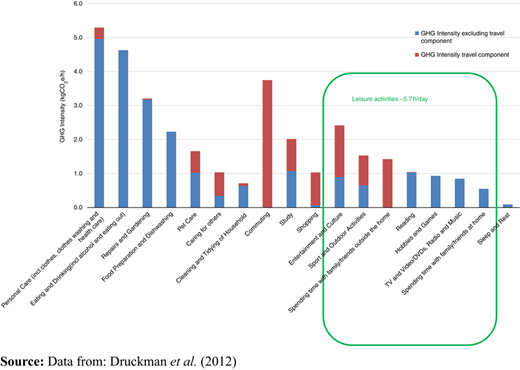
Using this footprinting approach, we can compare which activities are high carbon, and which are relatively low carbon. Figure 1 shows the carbon intensity of various uses of time in terms of greenhouse gas emissions per hour (kgCO2e per hour) (Druckman et al., 2012). Of particular interest to this paper are leisure activities, as these are discretionary; they are grouped on the right-hand side of Figure 1. Leisure activities account for, on average, 5.7 hours per day, and activities involving travel (such as entertainment and culture) are generally more carbon intensive than those that do not (such as spending time with family/friends at home). Similar results are shown by De Lauretis et al. (2017), Jalas and Juntunen (2015), Aall et al. (2011) and Minx and Baiocchi (2009), while Wiedenhofer et al. (2018) adapt Druckman et al.’s (2012) data for their analysis.
Which specific activities should be categorised as leisure is, of course, debatable: shopping (0.8 h/day), food preparation and dishwashing (0.7 h/day), repairs and gardening (0.3 h/day) and pet care (0.1 h/day) can also contain elements of leisure time – and often do. However, they have been excluded from our classification as they are not entirely discretionary for most people. Also, it is worth noting that subjective wellbeing is not derived from leisure activities alone. Indeed work outside the home and housework can both be important contributors to subjective wellbeing (Haworth and Lewis, 2005; Diener et al., 2010), but often do not have the same discretionary nature as leisure activities.
Combining information in Figure 1 with literature on subjective wellbeing gives an indication of which leisure activities can be low carbon and conducive to high subjective wellbeing. For example, subjective wellbeing is supported by activities which involve social contact, such as conversing with friends and family in and around the home. Longer-term subjective wellbeing is, in particular, supported by engaging in sports and other goal-orientated activities that involve physical and mental activity, and hobbies and games which, as with sports and other goal-orientated activities, can involve challenge and social contact. Further examples include reading challenging books and singing in choirs which can induce feelings of flow and competency (Csikszentmihalyi, 1997).
Of course, while many of these activities are ostensibly low carbon, they can also be done in high carbon ways (Isham et al., 2018). In particular, when engaging in serious leisure, ambitions may rise, leading to involvement in, for example, national or international events and thus increased travel (Bedford et al., 2011). This will increase the carbon intensity of such activities, especially if flights are involved (Wynes and Nicholas, 2017).
5. Concluding remarks
This paper has shown that activities such as spending time at home with friends and family, singing in choirs and partaking in sports are examples of low-carbon activities that are generally conducive to high subjective wellbeing. However, depending how they are done, such activities may induce high carbon emissions, especially through travel. Therefore, appropriate local infrastructure is required, such as provision of local sports and community centres, along with systems that facilitate active travel (walking and cycling). To complement this, long-distance travel, especially that involving flights should be discouraged. However, policies addressing aviation are notoriously challenging to implement (Obergassel et al., 2015). Nevertheless, this paper indicates that, on a local scale, policymaking developed from a time-use perspective could support investment in infrastructure that encourages low-carbon leisure activities (Wiedenhofer et al., 2018) that are conducive to high subjective wellbeing. Moreover, there is evidence that engagement with these types of activities is associated with a reduced focus on material goals and greater environmental concern (Gatersleben et al., 2018). This points to the possibility of a virtuous circle through which the choice of leisure activities might indirectly support future pro-environmental policymaking.
While this paper has given some indication of the types of low-carbon activities that are generally conducive to high subjective wellbeing, more research is required to support policymaking. For example, we need to explore ways to overcome the barriers to financial strategies, such as taxes on aviation and personal transportation fuels, and investment in active travel and local community infrastructure. This research will share a common agenda with the sustainable urban planning and sustainable transport communities, and while the findings of this paper will inform and strengthen the case for it, the research itself does not need to take a specifically time-use perspective. That being said, undertaking more research from the time-use perspective to give a more detailed, fine-grained understanding of the types of activities that should be encouraged would enable more specific recommendations to be made. To complement this, more research is also required to support behaviour change policies. For example: what are individuals’ current perceptions of activities with regard to what makes them happy, and also the environmental impact of specific activities? To what extent are these aligned with the findings of the academic research? Could raising awareness of the relative carbon and theoretical subjective wellbeing associated with activities be useful in encouraging greater uptake of low carbon activities? What other methods could be used to encourage greater uptake of low-carbon activities that are shown by academic research to be conducive to high wellbeing? And how might any successful methods found be transferred from the individual level to bring about societal change?
To support this research agenda, more detailed, regular time-use surveys are required. These should be designed with both assessment of environmental impact and subjective wellbeing in mind. Such surveys need to be of sufficient sample size to enable an understanding about how effects vary across gender, age, socio-economic group, ethnicity and geographical location; they also need to be frequent in order to assess change over time. When coupled with information on the financial impacts concerning choices in leisure activities, this would facilitate a better understanding of how people make decisions that balance happiness, carbon emissions and monetary expenditure. Such understanding will help in developing strategies to steer people towards low-carbon leisure activities that promise high subjective wellbeing. For instance, the data may suggest that parkruns[2] are an example of low-carbon activity than brings about high subjective wellbeing for city dwellers, whereas joining a local choir may be a better low carbon option for bringing about high subjective wellbeing for rural dwellers.
With evidence from this research agenda, the prospects for increasing the uptake of low-carbon leisure activities that are conducive to high subjective wellbeing will be improved, and through these a positive contribution to the advancement of more sustainable lifestyles may be achieved.
Notes
Since the agreement, Donald Trump, President of USA, has stated that the USA will withdraw from it. However, this will not be legally possible until November 2020 (Figueres et al., 2017).
Parkruns are organised, free, weekly, timed 5 km running events held in local public parks (Parkrun.org, 2018).