This paper aims to deepen the understanding of the marketing process and practices taking place during the initial stages of the company development, by revealing the distinct entrepreneurial marketing process and mix resulting from the entrepreneurs’ decision-making process.
Using the critical incident technique, the study analyzes 146 marketing decisions made by entrepreneurs. The resulting marketing activities are aligned in a process and compared with the mainstream managerial marketing process.
The results provide the basis for an entrepreneurial marketing framework with four phases: product creation – product–market fit – market expansion – refocus. An entrepreneurial marketing mix is also proposed, consisting of productisement, people and proof of value.
While the managerial marketing process is well established, the entrepreneurial marketing process remains largely uncharted. The framework provided contributes to identifying the main marketing concerns and understanding how the marketing process is implemented by entrepreneurs in the earlier phases of the firm. Practical suggestions are offered regarding the marketing operations of the new firms and the critical marketing aspects to consider.
Introduction
It is nothing new that every company that wants to stay in business must engage in some kind of marketing behaviour (Carson, 1985). However, not every theory, process or tool offered by conventional marketing fulfils the needs of the entrepreneurial context or is achievable with the available resources (Becherer and Helms, 2016; Hills et al., 2008). The literature on marketing principles and process is better suited to larger firms operating in more stable business environments than to small or new entrepreneurial firms trading in highly uncertain scenarios (Gilmore et al., 2012; Hultman and Hills, 2001). For example, it has been argued that the traditional four Ps do not adjust properly to the entrepreneurial context, but the knowledge about how this framework is affected by the context needs to be developed (Hansen et al., 2020). The misalignment between traditional marketing principles and the entrepreneurial context was the basis for this study. Given these are traditionally two separate research fields with little cross-disciplinary fertilization (Lam and Harker, 2015), there is considerable potential for theoretical and empirical work to advance knowledge about the dynamics between entrepreneurship and marketing (Hansen et al., 2020; O’Cass and Morrish, 2016).
Championed by Hills (1987), researchers have explored the intersection between marketing and entrepreneurship through the entrepreneurial marketing (EM) concept, also often referring to small business marketing, over the past 30 years (Carson and Gilmore, 2000a; Hansen et al., 2020; Stokes, 2000a). The definitions of the EM concept are diverse, but the following one, proposed by Hills and Hultman (2011), encompasses several components recurrently underlined within the EM literature: “It is a spirit, an orientation as well as a process of passionately pursuing opportunities and launching and growing ventures that create perceived customer value through relationships by employing innovativeness, creativity, selling, market immersion, networking, and flexibility” (p. 10).
The growing interest in EM has been geared by the purpose of promoting the growth potential of small and new entrepreneurial firms, which are important catalysts of economic and social advancement, particularly in developed countries, knowing that entrepreneurship is largely about doing marketing (Gilmore et al., 2020; Hansen et al., 2020). Although important research has examined EM dimensions and strategies (Becherer and Helms, 2016; Morris et al., 2002; Pane Haden et al., 2016), proposing EM models (Jones and Rowley, 2009, 2011), offering measures for EM (Eggers et al., 2020; Sahid and Habidin, 2018) and assessing some of its effects (Rezvani and Fathollahzadeh, 2020), the knowledge about what characterizes the EM process and practices and its differences to the mainstream managerial marketing (MM) process, also referred to as traditional or administrative marketing, remains limited (Hills et al., 2008; Hills and Hultman, 2013; Whalen et al., 2016). A review of studies about marketing activities in small and medium‐sized enterprises by Bocconcelli et al. (2018) revealed that there is a relevant research gap concerning the specific marketing practices of these companies, showing that there is a distance between the theoretical bases of the existing studies and the small firm’s actual marketing behaviour and practices. As such, several questions remain unexplored (Hansen et al., 2020; Hills and Hultman, 2013; O’Cass and Morrish, 2016).
This paper responds to calls for further research on EM to extend marketing thought beyond conventional managerial cannons (Ahmadi and O’Cass, 2016; Kraus et al., 2012; Miles et al., 2015; Most et al., 2018), by answering the following research question: what are the distinctive aspects of the EM process and practices? The study targets entrepreneurs from 42 entrepreneurial knowledge-intensive, technological and science-based companies, which typically develop their activities in highly dynamic environments and are most likely to implement EM practices (Becherer and Helms, 2016; Zhu and Matsuno, 2016). By analyzing 146 marketing decisions, the study specifically examines how the EM process unfolds within their specific context and explores the roles of well-established marketing practices, such as planning, market research, segmentation, positioning and the marketing mix, within it. By addressing these topics, the paper aims to deepen understanding of the EM concept by describing the process through which it is implemented. The basis is an in-depth study that uses the critical incident technique (CIT) to collect rich contextualized data about marketing decisions by entrepreneurs based in Portugal, an innovation-driven country that has been promoting entrepreneurship as an engine for development and economic recovery (Rodrigues and Franco, 2021; Sá and Pinho, 2019). An EM framework that is distinct from the traditional MM process is developed.
In the next section, the literature review is presented. Then, the methodology is described, followed by the presentation and discussion of the findings. Lastly, a conclusion and implications and future research avenues are presented.
Entrepreneurial marketing distinctiveness
The mainstream marketing management theory proposes a marketing process that includes:
market research to analyze the market and understand customer needs and wants so that market opportunities can be identified and exploited;
the design of a customer value-driven marketing strategy and plans, involving marketing segmentation, targeting, differentiation and positioning; and
planning, to create an integrated marketing programme, including all decisions about the marketing mix (Kotler and Armstrong, 2017).
However, there are several differences between marketing as it is practised by small and entrepreneurial firms and this traditional marketing model (Hills et al., 2008).
EM is opportunity-focused, but it is less concerned with opportunity discovery and exploitation than it is with creating opportunities through creative insights that go beyond the current customer, products and business boundaries (Morris et al., 2002; Mort et al., 2012; Sadiku-Dushi et al., 2019). Within a creation perspective (Alvarez and Barney, 2005), EM makes little use of marketing planning and formal marketing intelligence (Coviello et al., 2000; Jones et al., 2013a).
Although the EM process may not be ignited by the discovery of market needs, the entrepreneurial marketer is fully committed to meeting customer requirements, using creativity and innovation to achieve this outcome (Hills et al., 2008). EM revolves around customer intimacy, which is the basis for discovering new resource combinations that offer value (Mort et al., 2012). This intimacy is founded on an in-depth knowledge of the customers’ requirements, developed by marketers on a personal basis, by spending time with the customers and by cultivating personal networks rather than through formalized processes (Jones et al., 2013a, 2013b; Jones and Rowley, 2011; Resnick et al., 2016).
Studies indicate that EM is less concerned than MM with long-term strategies to meet pre-defined objectives, and that interactions and contingencies play an important role in determining the actions taken (Sarasvathy, 2001). Business development and marketing objectives often personify the entrepreneur’s personal goals, preferences, personality, relationships, unique skills and capabilities (Hills et al., 2008; Resnick et al., 2016; Weerawardena et al., 2019). As such, entrepreneurs use fewer metrics to measure market performance (Coviello et al., 2000). They also rarely implement commonly recommended marketing practices, such as market segmentation. A “bottom-up” targeting process may be preferred, through which they incrementally expand the firm’s client base from a few customers that were served first (Stokes, 2000b). Although this approach is also a recommended traditional marketing practice, it may not follow the classic diffusion of the innovation model, in which a small existing market is served first, as it often involves the enactment of new markets or substantial changes in existing ones (Branstad and Solem, 2020).
As companies evolve and the entrepreneur’s experience of the marketplace accumulates, the marketing function also changes (Hills and Hultman, 2013). Thus, EM is sometimes framed as the marketing of small firms, which later will grow to embrace the tools used by so-called professionally run marketing functions (Kotler et al., 2008). EM can, therefore, be defined as marketing in context, meaning that entrepreneurs’ marketing behaviours are contingent on the uncertainty and fast-changing conditions and may follow different patterns, depending on the challenges they face (Carson and Gilmore, 2000a; Peterson, 2020).
Research shows that EM also differs from MM in terms of the marketing mix, with entrepreneurs and small firms’ owners pragmatically adapting the concept to reduce its complexity and fit their unique resources, capabilities and circumstances (Carson and Gilmore, 2000b). EM tends to focus primarily on promotion and selling (Hills et al., 2008). The relational nature of the entrepreneurial process also means that people (the fifth P) assume higher relevance in the EM mix (Kolabi et al., 2011; Zontanos and Anderson, 2004).
Methods
Data collection
Data were collected through qualitative interviews, assuming an interpretivist perspective (Denzin and Lincoln, 2011), an approach that is appropriate, given the study’s aim and the level of development of knowledge on the area. Accordingly, researchers are encouraged to adopt research designs that further the understanding of the topic by uncovering insights that quantitative methodologies overlook, within the still-emerging EM field (Toghraee et al., 2017; Whalen et al., 2016).
Data were collected using the CIT (Flanagan, 1954). This qualitative interview procedure focuses on occurrences considered significant by the participant to explore how such occurrences were managed, as well as their perceived cognitive, affective and behavioural effects, which allows grasping the psychological prerogatives underlying humans’ actions (Chell, 2004; Chell and Pittaway, 1998). The technique is considered a sound and well-tried way to collect and analyze complex data about triggers and influencing factors regarding some particular phenomenon (Münscher and Kühlmann, 2016). CIT has been extensively used in services marketing (Gremler, 2004) but also in other fields, such as entrepreneurship (Chell and Pittaway, 1998; Klyver et al., 2020), and EM, in particular (Stokes, 2000b).
To design the CIT research process, Gremler’s (2004) procedural recommendations, derived from an extensive review of 141 CIT studies’ best practices, were followed, comprising: the statement of the research problem and the methodological approach; the design of the CIT study, including the definition of what constitutes a critical incident and the unit of analysis; the definition of criteria to select the cases to be studied and the sampling procedure; the preparation of the data collection instrument and the definition of the interviewing procedures; and the delineation of the data analysis procedures.
Previous studies, particularly within the entrepreneurship field, use different terms to refer to critical incidents during the interviewing process, such as life or death decisions, events or decisions with significant impact, surprising and challenging events (Stokes, 2000b; Taylor and Thorpe, 2004). In this study, the interviewees were asked to identify and describe any situation or event that had a significant positive or negative impact on the development of their business. What was considered positive and negative for business development was later explored. The description of each incident created the opportunity to explore the decision-making process that such events entailed and the practices that were subsequently implemented.
On average, interviewees reported between three and four incidents during the interviews that ranged from 23 to 110 min, with an average length of 45 min, resulting in 161 critical incidents obtained from 42 face-to-face interviews with Portuguese entrepreneurs. Following Gremler’s (2004) recommendation for data purification, only the incidents that met the criteria of being a marketing-related decision were analyzed, with reference to widely used literature within the marketing field (Kotler and Armstrong, 2017; Kotler and Keller, 2016). The marketing decisions reported by the interviewees were ranked in five categories, :new product development and introduction”; “sales and commercial approach”; “promotion”; “marketing strategy and planning” and “internationalization”. Adding a new product to the portfolio, choosing a specific distribution channel, partnering with a brand ambassador and entering a new foreign market are examples of decisions included in such categories that resulted in marketing practices. Reported decisions related to other business areas were classified into three categories, “human resources”, “business strategy and operations” and “funding”. Reinforcing the production team, changing facilities and attracting an investor are examples of critical incidents included in these categories that were not considered to be specifically marketing-related. Fifteen incidents failed to fall into the first category and were removed from the analysis, leaving a total of 146 usable incidents.
Profile of the sample
EM behaviours may not be limited to small young companies (Kilenthong et al., 2016), with some studies examining them inside larger companies (Zhu and Matsuno, 2016). However, the focus here is on the practices of the owners of new and small firms, operating in highly uncertain environments, as one of the reasons for the need to advance the current knowledge about EM is based on the difficulty for entrepreneurs running these firms to implement the mainstream marketing process. Entrepreneurs were selected purposively based on the age, size and industry of their firm. The first selected firms had been in business for six years or less, which has been suggested as the maximum age for a company to be considered a start-up or a new venture (Zahra et al., 2017). However, during data collection, differences in the decision-making process and practices were detected between entrepreneurs of newly established and slightly older companies. Entrepreneurs from companies that had been operating for more than six years were, therefore, subsequently included to explore these differences. Following the legal definition of small enterprises as set out in the European Commission Recommendation 2003/361/EC (6 May 2003), the study considered only companies employing under 50 people and with the annual turnover not exceeding EUR10m.
Lastly, knowledge-intensive, technological and science-based companies were selected, a type of firm that has also been the focus of previous research on EM (Jones et al., 2013a; Jones and Rowley, 2009). Such companies typically develop their activities in turbulent, fast-changing and unpredictable environments, with research suggesting that entrepreneurs facing greater external challenges and operating in highly dynamic business environments are most likely to use EM practices (Becherer and Helms, 2016; Zhu and Matsuno, 2016). The first interviewees were selected from the researchers’ contacts, and the rest of the sample was selected by applying the snowball technique. The specific characteristics of the sample do not allow the generalization of the results, although conclusions may be extended to similar contexts and conditions.
Forty-two company owners were sampled. The criterion of data saturation is often recommended to determine purposive sample sizes (Guest et al., 2006). The sample size was considered adequate because theoretical saturation was achieved at the 25th interview, at which point, 93 useable incidents had been identified with 72 codes applied. However, 17 further cases were added to strengthen the emerging patterns and information was gathered on 53 additional marketing-related decisions.
Roughly, 71% of the companies owned by the selected entrepreneurs had been established less than six years, with a mean of 4.5 years. There were 6.8 employees on average, with a mean turnover of EUR210,955. The industries ranged from digital technologies, biotechnology and consultancy and business services, to engineering, advanced textiles and geology. Male entrepreneurs constituted 88.1% of the sample, which is consistent with previous studies, indicating a greater male involvement in entrepreneurial activities in different economies (Lockyer and George, 2012). Participants had an average age of 34.7. All held a higher education degree, with 23.8% educated to PhD level, which might be explained by the fact that some of the companies are academic spin-offs. Only 21.5% had been educated in economics and management, with the majority holding degrees in technical subjects, such as informatics, engineering, biology, chemistry or physics, which is in line with previous research focusing on knowledge-intensive firms, in which entrepreneurs tend to be technical specialists rather than marketing experts (Jones et al., 2013a).
Data analysis and coding
A content analytic approach was performed (Gremler, 2004). This technique allows making replicable and valid inferences from, in this case, recorded speech, which is an important form of reliability (Krippendorff, 2018). Codes were organized into first-order categories, representing marketing practices, and refined further into second-order categories, which were compared and consolidated to identify themes and dimensions, describing the stages of the EM process, its main foci and the pattern of their relationships (Gioia et al., 2013; Saldaña, 2015). Intercoder reliability was assessed to ensure the quality and credibility of the data analysis (Lombard et al., 2002). A reliability subsample of 17 incidents involving 119 coding decisions taken from the total sample of 146 incidents and 913 coding decisions made by the primary researcher was selected and coded independently by a second researcher. Both Cohen’s kappa and Krippendorff’s α presented reliability scores that were above 0.70 for all variables, which meets the criterion of 0.70 often used for exploratory research (Lombard et al., 2002). Although there are no standards for these measures, the rule of thumb indicates that substantial agreement is reached when values are above 0.61, and almost perfect agreement is reached at above 0.81 (Landis and Koch, 1977).
Findings and discussion
Based on both EM and MM literature, marketing practices derived from the critical decisions were categorized as entrepreneurial or managerial. Features not currently reported in the EM literature were classified as EM or MM by assessing the level of coherence with one of the approaches. As expected, the majority of the decisions (91, representing 62.3%) were associated with EM practices. However, 55 decisions (37.7%) were based on practices consistent with MM. The next sub-section describes the EM practices and contrasts them with tasks that matched the ones described in MM literature.
The entrepreneurial marketing process
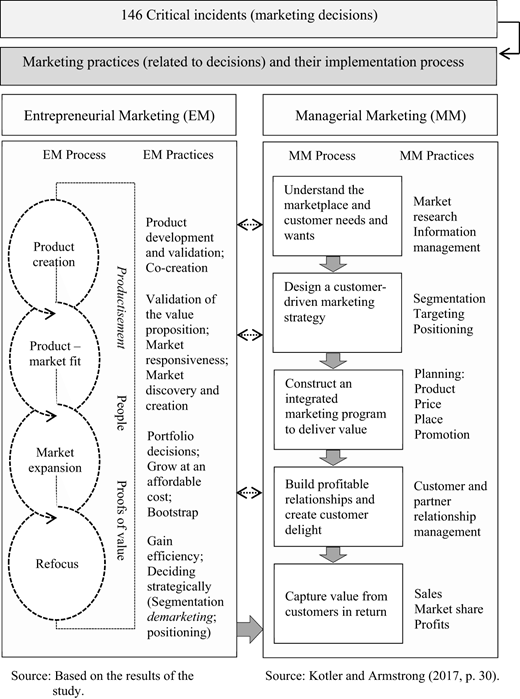
The reported EM practices derived from the analyzed decisions were aligned in a process and compared with the main marketing management tasks described in leading literature (Kotler et al., 2016; Kotler and Armstrong, 2017), an approach that has previously been used in EM studies (Hills et al., 2008; Stokes, 2000b). A distinctive EM framework taking the following form is revealed: product creation – product–market fit – market expansion – refocus. Three elements within the process assume particular relevance: product, people and proof of value. Rather than being sequential, the EM process is dynamic and requires several iterations until both the offer and market reach a more mature state. The EM framework emerging from the study is presented in Figure 1, alongside a comparative MM framework.
The results suggest that the EM process may be followed by MM practices, which can also be concomitant, indicating that EM and MM may be complementary.
Product creation. While the MM process starts with a focus on discovering and understanding market needs and behaviour (Kotler et al., 2016; Kotler and Armstrong, 2017), the results show that the EM process begins when the entrepreneur and his/her team invented or envisioned a new product (or service). Innovative product ideas arise from different sources, including idea generation, research and development (R&D) and reflecting the concept of user entrepreneurship (Shah and Tripsas, 2007), even from the attempt to solve the entrepreneurs’ personal needs. However, in none of the studied cases was the process rooted in market research to uncover unmet needs.
At the start, even before the relevance of the need is confirmed, the entrepreneurs focused on proving the concept and on technical validation of the business offer, often in partnership with prospective customers. Several advantages to undertaking such validations are revealed by the participants:
the new venture concurrently verifies the operational feasibility and market requisites for its products;
validations can be undertaken with lower costs and shared risks with prospects/partners in case of product failure;
prospects can be converted into an actual customer, which reinforces credibility that is crucial for future market approaches; and
helps accessing industry information otherwise difficult or even impossible to obtain, due to the novelty of the business idea.
This customer co-creation approach allows to lower the new product development risks and speed up the product introduction in the market (Morgan et al., 2019). Thus, lack of resources, which is one of the constraints of the entrepreneurs (Becherer and Helms, 2016; Hills et al., 2008), can be bypassed, while also creating bridges to the market. In this sense, the R&D activity and the market sensing become entangled. The product development and customer development are implemented simultaneously, following an iterative process that allows the validation of market assumptions, resonating with the principles of the business model design and lean start-up (Blank, 2013; Hansen et al., 2018; Ladd, 2018). Table 1 summarizes the entrepreneurs’ views on this topic.
The new companies’ future offers partly derive from the parties with which the entrepreneur cooperates and who his/her first customers are. The process for deciding the configuration of the offer relied largely on pragmatic and immediate criteria rather than on strategic ones and extensive market analysis. Under such conditions, marketing planning becomes less important as everything is being created, including the market.
Mainstream marketing literature highlights that marketing should start by identifying customer needs, and that focusing on the product will eventually lead to customers’ needs becoming obscured (Levitt, 1960). However, the study concludes that entrepreneurs benefit from the complementary effect of entrepreneurial and market orientation that allow them to recognize, create and explore opportunities (Ahmadi and O’Cass, 2016; Boso et al., 2013; Webb et al., 2011), by incorporating market feedback from a very early stage. This result is synergistic with the notion that customer intensity is an underlying dimension of EM (Morris et al., 2002).
Product–market fit. The MM approach recommends implementing market research to obtain market intelligence, but this may be at odds with the way entrepreneurs act. Questions about the adequacy of marketing research in lowering the rate of new product failure, including in the entrepreneurial context are not new (Crawford, 1977; Hills and Hultman, 2013). The participants in this study reaffirm the scepticism about the relevance of market research, as presented by the MM theory, as they find it difficult to assess ex ante how a new or under-developed market will respond to a new proposal.
As obtaining market information is recognized by the participants in this research as critical to reducing uncertainty, they often use personal interactions with customers and prospects to gather data to augment their confidence in the product–market fit. Such an opportunistic approach enables information about customers’ needs, behaviour and value creation process to be gathered at a very low cost, within real contexts. This is consistent with the co-creation approach to understanding customers’ needs, in which both the company and customers engage in learning, as opposed to a more traditional approach of hearing the voice of the customers (Jaworski and Kohli, 2006). Table 2 illustrates these points using extracts from the interviews.
During this stage, the value proposition for the new product or service starts to be adjusted. The results show that market validation encompasses: being able to confirm the existence and relevance of the need to be addressed; understanding how the market would like this need to be solved (technical specifications), which can result in having to redesign the offer; inferring the market potential through the identification of criteria for defining the market size; discovering new needs, which can also be addressed with the existing competencies; and finding how much the market is willing to pay for the value proposed.
Some entrepreneurs deliberately do not refine the project nor restrict their options in how to take it to market to leave room for further changes after market acceptance had been tested. This finding is in line with the themes of tactical flexibility and co-creation found in the EM literature (Hills et al., 2010; Jones et al., 2013b; Jones and Rowley, 2009; Whalen et al., 2016; Whalen and Akaka, 2016).
Market expansion. Consistent with the bottom-up approach, entrepreneurs grew their companies organically from an initial offer, rather than targeting new segments based on the analysis of an existing market (Jones and Rowley, 2009; Stokes, 2000b, 2000a). Contrary to MM, which recommends assessing indicators such as the substantiality of a given segment, entrepreneurs tended to make targeting decisions based on criteria such as:
the potential to explore existing capabilities and resources;
convenience; and
the potential to lower costs and risks.
The expansion decision process was often neither analytical nor involved broader market validation. However, within this decision style, the entrepreneurs did balance what the company can do and what the market needs to be done. Table 3 illustrates these points using excerpts from the interviews.
The market expansion task requires strong communication and accessible and effective sales channels. When the company is new and has little or no brand recognition, entrepreneurs view conventional marketing communication strategies, such as advertising, as having very low effectiveness. Instead, they experiment with face-to-face, low-cost activities to reach the market. Digital tools are also considered essential to affordably reach scattered markets, which is also gaining prominence in the mainstream marketing literature (Kotler et al., 2016).
The findings reveal a lack of strategic marketing activities during the expansion phase. Throughout the companies’ growth, experimentation trial-and-error and improvisation, which are important forms of entrepreneurial learning (Miner et al., 2001; Zahra et al., 2017), have a more important role than planning because they better reflect how entrepreneurs create value (Frederiksen and Brem, 2017). As entrepreneurs’ routes to market are effectually created (Sarasvathy, 2001), strategic marketing concepts such as segmentation, targeting, positioning and growth strategies appear to be less relevant for the entrepreneurial marketer in the early life of the firm.
Refocus. Such unplanned expansion encompasses several inefficiencies resulting from the growing complexity and lack of focus. As a result of this haphazard growth, a change in strategic direction may subsequently be needed, with entrepreneurs refocusing on fewer offers to maximize their returns. According to the participants, especially those from companies older than six years, this change can only be made when financial sustainability concerns have been reduced and sufficient knowledge about the market and the business has been internalized. At this point, marketing decisions are more likely to refocus on the most attractive segments in a process of selective demarketing (Kotler and Levy, 1971), with tactical actions reflecting the strategy as typically occurs in older firms. Table 4 synthesizes the main characteristics of this EM element and offers examples of the interviewees’ statements.
The entrepreneurs found it difficult, if not impossible, to define the market positioning from inception. This difficulty stems from a quest for the new venture’s identity that the entrepreneurs endure during the early life of the firm. Such fluid identity is fed from different sources, both internal and external, including the entrepreneur’s vision and own identity, but also the stakeholders’ inputs, consistent with previous findings (Gioia et al., 2010; Leitch and Harrison, 2016). This unstable process later fades naturally, allowing a better positioning to emerge. The evidence suggests that entrepreneurial marketers start thinking and acting more deliberately and strategically as companies stabilize their organic growth. This result is aligned with the temporal perspective, in which EM can be seen as a stage of the evolution of marketing in a company or a market (Miles et al., 2015).
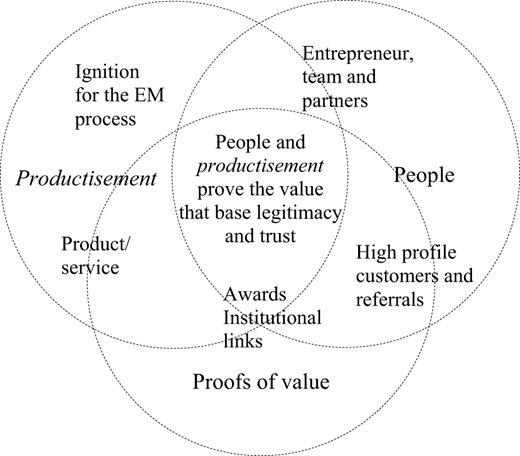
Main foci of entrepreneurial marketing: the three Ps of entrepreneurial marketing mix
Three recurring themes emerged from the participants’ narratives:
the importance of the new ventures’ product or offer development, which we labelled as productisement;
the central role of people; and
the need to offer proof of value to gain legitimacy and market trust.
These elements, represented in Figure 2, are connected and often intertwined.
Productisement. In addition to its role in igniting the EM process, the product’s centrality is related to its relevant communication and selling power, by offering concrete proof of the firm’s capabilities and promises. We use the term productisement to reflect this blend of the offer (product) and promotion (advertisement). We could not find in previous EM literature evidence of this role ascribed to the entrepreneurial offer. The current study identifies that offering a remarkable and skilfully created product or service helps:
building credibility and reputation;
generating buzz, and attracting the media attention;
engaging fans that help to spread the word; and
producing referrals, which is known to be an important entrepreneurial communication tool (Stokes and Lomax, 2002).
Some entrepreneurs believe there to be little value in developing other forms of promotion or sales effort if the product fails to deliver its promise. Given new companies have no market presence, they must provide evidence of their trustworthiness to reassure prospective customers that the relationship will work out (Aldrich and Fiol, 1994).
People. In addition to the importance of the founding team, the findings show that staff who join the firm during its journey are vital to performing the EM process. This idea is reflected in effectuation theory, embedded in the means “who I am” and “whom I know”, and also in the developing partnerships principle, considering not only the customers’ relationships but also other relevant stakeholders (Alqahtani and Uslay, 2020; Sarasvathy, 2001).
As one of the four Ps proposed for the EM mix (Zontanos and Anderson, 2004), the importance of people within the EM field is often highlighted. The study adds evidence to existing literature that shows that people, not only internal but also external to the firm, feed the firm’s emergent positioning through their important role in defining the firm’s unique identity and conveying it to the market (Gioia et al., 2010). The results also indicate that people are critical channels of marketing communication.
Proof of value. This idea is in accordance with the concept of legitimacy that can be defined as the assumption that some entities’ actions are desirable, suitable or appropriate (Suchman, 1995). To overcome the lack of legitimacy and earn trust, entrepreneurs use several tactics to prove their firms’ and their own value. As described above, the offer as a communication tool, healthy relationships and credible people are viewed as proof of value. The study also identified tactics such as promoting prizes awarded in innovation and other contests, any public funding received, relationships with prestigious institutions and scientific papers or conference presentations by team members. These features are indicators of the quality, integrity and viability of the new firm that also help to shape the firm’s identity and build its reputation (Snihur, 2016). Table 5 summarizes the three foci of EM using examples from the data.
As new firms lack legitimacy in the market (Stinchcombe, 1965), they need to establish honest and transparent relationships with different stakeholders based on evidence of their value proposition. Through this route, firms can progress beyond simply creating market interest and brand awareness to steadily earn trust and reduce customer’s uncertainty (Eggers et al., 2016).
Conclusion
Marketing plays an important role in the success of new and small entrepreneurial firms, particularly technology- and knowledge-based ones, which contribute significantly to innovation and economic development (Pradhan et al., 2020). This is a much-needed contribution, especially in face of economic challenges, as the one created by the Covid-19 pandemic (Wang et al., 2020). However, research has shown that traditional marketing theory and tools are not always appropriate to entrepreneurial contexts, giving rise to the EM concept, which remains underdeveloped, particularly regarding its distinction to traditional or administrative marketing (Becherer and Helms, 2016; Hills et al., 2008; Hills and Hultman, 2013; Whalen et al., 2016). Previous studies have proposed new EM dimensions or have described the scattered marketing practices implemented by entrepreneurs. More recently, Morrish and Jones (2020) proposed a specific EM framework to describe EM as it is enacted in post-disaster settings. Our study develops a more general EM framework that maps the marketing path that entrepreneurial firms, acting in fast-changing and turbulent contexts, follow during the early years, with four phases: product creation – product–market fit – market expansion – refocus.
The study concludes that, although the process is ignited by the product creation, it is not disconnected from the market. Instead, there is early involvement from prospective customers in the technical development and validation, and actual customers in the value proposition validation. This customer intimacy (Mort et al., 2012) allows entrepreneurs to understand better the needs that the product can solve, the way customers want them to be solved and the price they are willing to pay. It also helps to find new needs, which leads to organic growth within the boundaries of the firm’s capabilities and resources. This fuzzy growth comes with inefficiencies, leading to the need to refocus on the more profitable segments and offers, in a demarketing process (Kotler and Levy, 1971) and to make more strategic decisions.
The study also offers evidence that the entrepreneurial marketer ascribes high importance to people and the product, which are also part of the traditional marketing mix. However, new insights are created towards the importance of offering proof of value, namely, through productisement, to earn legitimacy and build market trust, suggesting that this practice should be central to the EM mix.
Implications, limitations and further research
The study adds for EM theory by showing that the EM process indeed follows a different pattern from MM. However, the results also allow concluding that EM is neither the opposite nor a substitute for MM. While EM activities are more frequently implemented when firms are small and new, practices associated with both perspectives can co-exist. The results offer empirical support for the idea that EM should not be seen as a substitute for MM, but as sitting alongside it (Carson and Gilmore, 2000a; Resnick et al., 2016). There is evidence of a temporal dimension to EM (Miles et al., 2015), with a more managerial form of marketing emerging as firms mature. However, as researchers have previously suggested, more research is needed to explore how marketing changes as firms evolve (Hills and Hultman, 2013; Jones and Rowley, 2011). A life cycle perspective adopted in other entrepreneurial studies (Etemad, 2018) seems relevant for this purpose. The drivers and timing of such evolution are among the areas to consider in future studies. Additionally, the effectiveness of both entrepreneurial and MM practices should be assessed taking into account the context in which these practices are implemented to deepen the understanding of their outcomes.
Additionally, the study offers empirical support for the coherence between EM practices and alternative perspectives from which marketing can be approached. These include effectuation theory (Sarasvathy, 2001), the service-dominant logic (Vargo and Lusch, 2004) and the creation perspective (Alvarez and Barney, 2005), which have been suggested to guide future EM research (Alqahtani and Uslay, 2020; Lam and Harker, 2015; Whalen et al., 2016; Whalen and Akaka, 2016; Yang and Gabrielsson, 2017).
The results also have practical implications by suggesting that entrepreneurs should focus attention on practices that warrant the reliability of the offer, on the relationships and the acquisition of market trust and legitimacy. These aspects were considered fundamental conditions to a marketing pathway. The importance of gaining market legitimacy, by presenting proof of value, is a highly salient distinctive characteristic of EM found in the study. Although this topic has been approached in other research (Smith and Martí, 2017), this study adds to the growing body of evidence and suggests further avenues for investigation in this area. The results show that the entrepreneurs end up creating such legitimacy in a somewhat ad hoc and intuitive way. In line with Zimmerman and Zeitz (2002), who introduced the term strategic legitimation to refer to how firms can exercise strategic choice over their level of legitimacy, the results suggest a more deliberate analysis of this issue is needed. Additionally, the study found that having reputable customers in the portfolio works as communication leverage, boosting the trust of the market. Hence, targeting specific customers is useful, as some may yield higher impacts in the long run for the firm than just their direct financial return.
The study also has implications for marketing teaching, by offering insights to advance the marketing curriculum, which remains better suited for large multinational bureaucratic organizational firms acting in stable business environments and strongly dominated by causal reasoning (Hultman and Hills, 2001; Kraus et al., 2012).
Finally, in terms of contribution for policymakers, the results suggest that institutional support to start-up companies may need to go far beyond financial support. The study showed that the lack of resources may not really hinder the implementation of marketing practices, as there are several low-cost tools that are considered effective by entrepreneurs, confirming resource leveraging as an important EM feature (Alqahtani and Uslay, 2020; Sadiku-Dushi et al., 2019). On the contrary, the availability of resources, namely, financial, can disincentive collaborations that are seen as major step stones in the EM process. Other institutional support could be favoured, such as facilitating access to networks; institutional certification that can prove the new company’s capacity; support, being either technical, financial or otherwise, to specifically develop technical pilot tests and market tests; access to outlet platforms to showcase existing products, among others. In fact, entrepreneurship support institutions could provide a better service to some start-up companies by helping them finding, or even being, themselves, early partner customers, assisting these companies in creating their clients’ portfolio, than facilitating the access to financial resources that they may not know how to use, inasmuch that often everything is being created, including the markets.
The results need to be interpreted in their context, however. By using a qualitative approach, based on the CIT, the results are not possible to generalize, although the CIT allows a degree of replication, in terms of pattern identification and transference (Chell and Pittaway, 1998; Hughes, 2007). Moreover, as we used a non-probability purposeful sample, based on the assumption that science and technology-based start-ups are more likely to implement entrepreneurial practices (Becherer and Helms, 2016; Zhu and Matsuno, 2016), it cannot be seen as representative of all entrepreneurs and small business owners.