Skip to Main Content
Purpose

This paper aims to enhance understanding of how sustainable entrepreneurship (SE) contributes to sustainable development in the tourism sector. To do so, specific factors that act as enablers or inhibitors of SE are identified according to a co-evolutionary lens.

Design/methodology/approach

A co-evolutionary explanation of the firm? Environment relationship is adopted to undertake a qualitative empirical study of the Castelli Romani tourism destination (Italy), via 23 semi-structured interviews according to a narrative approach.

Findings

The paper demonstrates that entrepreneurs play a crucial role in sustainable development but cannot act in isolation. In fact, according to the co-evolutionary approach, they influence and are influenced by 20 factors. Accordingly, SE can be conceptualised as resulting from effective co-evolutionary interactions between micro (i.e. entrepreneurs and their firm), meso (i.e. the destination where tourism firms are based) and macro (i.e. the wider socio-economic and natural system) levels.

Practical implications

Several actions are suggested to entrepreneurs and policymakers to help achieve specific sustainable development goals. These actions focus on: (1) training courses, (2) investments in technologies, (3) creation of innovative business models, (4) exploitation of cultural and natural resources, (5) community involvement and (6) multi-level partnerships.

Originality/value

This is the first study that adopts a co-evolutionary lens to investigate the influencing factors of SE in tourism, shedding light on the effects of their dynamic interdependence. Thus, it provides a more nuanced SE conceptualisation that takes a holistic and dynamic view of sustainability.

Entrepreneurship is considered crucial in stimulating economic growth (Vuorio et al., 2018), but at a cost to the environment and society (Patriotta and Siegel, 2019; Schaltegger and Wagner, 2011). Recently there has been a shift in this paradigm and a potential positive relationship between entrepreneurship and sustainability is being recognised. This view sees entrepreneurship as a lever for sustainable change and development (Argade et al., 2021) and has prompted the emergence of the concept of sustainable entrepreneurship (SE), understood as a particular kind of entrepreneur and firm that aims to achieve competitive advantage and profitability by contributing to solving, rather than causing socio-economic and environmental problems (Schaltegger et al., 2016; Terán-Yépez et al., 2020). This is particularly important considering that achievement of the UN's sustainable development goals (SDGs) is becoming increasingly urgent if the 2030 Agenda is to be met (UN General Assembly, 2015). Significantly, the most recent OECD reporting on achieving the targets (2022) highlights that only 25% of the targets for 12 of the 17 SDGs have been met to date. SE undoubtedly has a role to play in achieving the SDGs (Apostolopoulos et al., 2018; Schaltegger et al., 2018; UN General Assembly, 2020).

Given the current relevance of the topic, increasing research efforts have been devoted to investigating SE, highlighting the main research themes, factors, processes and outcomes (Anand et al., 2021). Many studies focus on the internal and external factors influencing SE (e.g. Griffiths et al., 2009; Shahid, 2023) and the SE concept and its prominent roles in sustainable development have been investigated within specific regions, such as the Middle East and North Africa (MENA) (e.g. Aljuwaiber, 2021), and sectors, such as agribusiness (e.g. Lang et al., 2022) and energy (e.g. Haldar and Tripathi, 2023).

At the same time, recent reviews of SE research highlight opportunities for a range of future research. Terán-Yépez et al. (2020) report that more research is needed into how SE is implemented in different economic sectors, while Anand et al. (2021) highlight the need for more attention on the relationships between SE and other actors. Moreover, several internal and external factors influencing SE have been analysed separately, pointing to the need to consider how they interact (e.g. Muñoz and Cohen, 2018; Mupfasoni et al., 2018). Thus, there is a need to understand the complex socio-economic and ecological dynamics underlying SE and how they can be appropriately managed to promote sustainable development.

In response, this study seeks to understand these dynamics in the context of the tourism sector, which has been widely studied by academics and practitioners in recent decades, given its role in sustainable development (Bramwell et al., 2017). Tourism can help to address many social and environmental issues, such as degradation, marginalised social groups and unemployment, particularly of women (Zolfani et al., 2015). Moreover, tourism organisations are strongly influenced by various internal and external factors at multiple levels; these interdependences have made tourism one of the largest industries worldwide, characterised by many (80% of the sector) small and micro enterprises (UNWTO, 2022). Thus, the tourism sector is a suitable context to understand better the link between SE and sustainable development, which to date remains poorly investigated (Sørensen and Grindsted, 2021). To fill this gap, this investigation aims to understand the reciprocal influences of SE's internal and external factors (Andrade-Valbuena et al., 2022), providing a more nuanced SE conceptualisation that takes a holistic and dynamic view of sustainability. To do so, the study uses multi-level empirical research (Crnogaj et al., 2014; Muñoz and Cohen, 2018; Wahga et al., 2017) to investigate the following research questions.

RQ1.

What are the influencing factors of SE and their reciprocal influences in the tourism sector?

RQ2.

How does SE in the tourism sector contribute to sustainable development?

The research focuses on the Castelli Romani tourism destination (Italy), conducting 23 semi-structured interviews, 12 with entrepreneurs and 11 with other actors that include representatives of local institutions (i.e. local policymakers), the local destination management organisation (DMO), entrepreneurs' associations, residents and tourists. A co-evolutionary lens is used to analyse the findings from the interviews, which enables conceptualising SE as the result of effective co-evolutionary interactions between micro (entrepreneurs and their firm), meso (where tourism firms are based), and macro (the wider socio-economic and natural system) levels. Consequently, SE can be conceived as an effective co-evolutionary process recognised as virtuous by entrepreneurs and stakeholders, internal and external to the firm, according to the holistic and dynamic view of sustainability proposed by Norgaard (1994).

The study contributes theoretically by refining the conceptualisation of SE. It also sheds light on the co-evolutionary lens as a useful perspective for holistically and dynamically studying SE and its contribution to sustainable development through multi-level empirical research. In doing so, this research proposes a model that shows how interactions between SE's internal and external level factors may co-evolve towards sustainable development. Finally, the study has practical implications for entrepreneurs and policymakers by identifying 20 specific factors and 15 related actions that enable sustainable development in the tourism sector by addressing four specific SDGs: 8 “Decent work and economic growth”, 11 “Sustainable cities and communities”, 12 “Responsible consumption and production” and 17 “Partnerships for the goals”.

Accordingly, this research is aligned with the new vision of the Journal of Small Business and Enterprise Development (JSBED) to provide theory-driven real-world entrepreneurship evidence (Murphy, 2022), thus, offering to its reader high-impact entrepreneurship research, and contributing to the future of the field.

Entrepreneurship and sustainability are crucial aspects of our (present and) future (Johnson and Schaltegger, 2020; Lüdeke-Freund, 2020). Although initially viewed as unrelated domains, the relationship between them has gained significant attention in recent years (Argade et al., 2021), leading to the birth of a new field called “sustainable entrepreneurship” (SE) (Anand et al., 2021). The evolution from entrepreneurship to SE can be seen as a response to the changing global landscape and growing awareness amongst entrepreneurs of environmental and social challenges. Sustainable entrepreneurs have begun to integrate sustainability principles into their business models, putting in place responsible practices and pursuing triple-bottom-line (economic, environmental and social) outcomes (Belz and Binder, 2017; Markman et al., 2016). Thus, SE has emerged in the last decade as a new research field closely linked to the sustainable development concept, consistent with the Brundtland Report (WCED-World Commission on Environment and Development, 1987), which emphasises the well-being of future generations and recommends considering society, economy and the natural environment from a holistic and dynamic perspective. Doing so sheds light on the limits of approaching analysis of these three dimensions of sustainability separately. Similarly, SE is considered a particular kind of entrepreneurship, characterised by organisations that seek competitive advantage and profitability in balance with economic prosperity, social justice and environmental responsibility, that is, by contributing to sustainable development (Belz and Binder, 2017; Schaltegger and Wagner, 2011). It is worth noting here that not all entrepreneurs and their firms regard themselves explicitly as SE although still making decisions and acting according to sustainability principles (Jolink and Niesten, 2015; Shepherd and Patzelt, 2011).

Like SE itself, the SE research field is multifaceted and focuses on a range of issues. One such issue is the identification of the internal and external factors capable of influencing SE. Internal factors range from the entrepreneurial level (e.g. age, education, personal knowledge, values) to the organisational level (e.g. business dimension, resources, organisational structure) (Kraus et al., 2018; Mupfasoni et al., 2018; Sarma et al., 2022). Cucari et al. (2020) provide evidence of the importance of entrepreneurial orientation and network embeddedness for designing and implementing a business model able to create both social and economic value, while Nunez and Musteen (2020) shed light on the importance of knowledge related both to the natural environment and local communities, as well as to economic activity, for discovering and exploiting business opportunities that support sustainable development.

In contrast, the external factors influencing SE are institutional (e.g. regulatory frameworks and environmental standards), technological, industrial (e.g. market transactions, industrial sector life cycle) (Griffiths et al., 2009; Kraus et al., 2018), societal and ecological (e.g. the need to address natural resources depletion, climate change and unemployment) (Jabeen et al., 2017; Sarango-Lalangui et al., 2018). This has prompted researchers to begin exploring SE within both specific regions and single countries. For example, Aljuwaiber (2021) identifies financial issues, together with ambiguous and poorly established legal frameworks, as the main critical factors related to SE in the MENA region. Similarly, Wahga et al. (2017) explore 22 SMEs from Pakistan's leatherworking industry to shed light on how place-specific pressures drive SE even in the absence of formal institutional mechanisms, such as lack of support from national institutions and poor enforcement of environmental regulations. Thus, it clearly emerges that SE is shaped by place-specific factors, which are difficult to replicate outside certain local contexts, reinforcing the strong relationship between sustainability and local development (Paniccia and Baiocco, 2020).

Yet, despite increased research interest in SE and its influencing factors, few studies examine these holistically (Muñoz and Cohen, 2018; Wahga et al., 2017). There have been calls for research that jointly considers the internal and external factors affecting SE (e.g. Nunez and Musteen, 2020), as well as for studies that investigate the close link between SE and local contexts (Anand et al., 2021; Rosário et al., 2022). These studies argue that SE needs to be observed and managed holistically to effectively contribute to sustainable development (Muñoz and Cohen, 2018; Patriotta and Siegel, 2019; Schaltegger et al., 2016). This study aims to respond to these calls by examining the interaction between the internal and external influencing factors of SE and how these operate in a specific context, that is the tourism sector.

Tourism is widely regarded as a multidimensional phenomenon, involving various actors (e.g. tourism firms, institutions, local communities and tourists) at different levels (micro, meso, macro), with widespread implications for sustainable development (Bramwell et al., 2017; Mellon and Bramwell, 2016). That “Tourism [is] a factor of sustainable development” (UNWTO, 1999, Art. 3) is emphasised by the Agenda 2030 for Sustainable Development (UN General Assembly, 2015).

In fact, tourism entrepreneurs and their firms are closely linked with the place where they are based – that is, the tourism destination – from which they draw inspiration, as well as natural and cultural resources to take advantage of business opportunities and to shape their identity (Barbieri, 2013; Freytag and Hjalager, 2021; Paniccia and Leoni, 2019). Prior research on tourism entrepreneurship has emphasised the importance of small and micro tourism firms in finding innovative solutions to deal with sustainability challenges, benefiting not only firms but also local contexts (Coles et al., 2016; Cucari et al., 2019; Paniccia and Baiocco, 2020; Weiermair et al., 2010), and contributing to the sustainable development of destinations (Sørensen and Grindsted, 2021). Some studies highlight that small and micro tourism firms usually engage in informal and relation-based networks with business partners, tourists, employees and communities, motivated by the need to develop the destination sustainably (Kallmuenzer et al., 2019). Other studies shed light on the crucial role played by the knowledge of tourism entrepreneurs and employees in developing new business models with sustainability at their core (Freytag and Hjalager, 2021). The role of policy is the subject of some studies, which acknowledge that it can both encourage tourism entrepreneurial initiatives (Paniccia and Leoni, 2019) and limit them through tax regimes or restrictions (Sigala, 2020). Some studies point to the potential for new tourism service providers to offer innovative solutions that both improve the tourist experience and the quality of life for local communities (Gretzel et al., 2015; Romão et al., 2018).

Thus, research suggests that the tourism sector depends heavily on entrepreneurship and can survive in the long term only if it is both sustainable and entrepreneurial (Andrade-Valbuena et al., 2018). Indeed, research increasingly links tourism, sustainability and entrepreneurship. For example, Butkouskaya et al. (2020), in addressing the importance of SE for the tourism sector, examine difficulties for tourism students – according to their gender – in creating new firms. Fu et al. (2019) and Lordkipanidze et al. (2005) find that SE in tourism is a means of obtaining competitive advantage by implementing new technologies, and Ali (2018) sheds light on how limited education and financial resources, as well as a policy vacuum, limit the potential to exploit business opportunities for socio-economic development and growth.

However, few studies explore both the different factors affecting SE in tourism and its contribution to sustainable development (Andrade-Valbuena et al., 2022). We aim to fill this gap by adopting a co-evolutionary lens to consider the relationship between entrepreneurs and their firms and the external environment. The co-evolutionary approach sees this relationship as circular, with reciprocal influences, and stresses the dialectic and dynamic character of the interdependences between them and their related factors.

A co-evolutionary lens is widely used in economic and management studies (e.g. Abatecola et al., 2020; Breslin, 2011; Hodgson, 2013) to examine and understand the firm—environment relationship. According to this view, firms and their environment adapt to each other in a dialectical relationship (Abatecola et al., 2016). Thus, co-evolution is a multilevel concept that occurs within and among firms, in their location, and in society as a whole (Breslin, 2011). This co-evolutionary approach implies that all these actors are required to adapt effectively, that is, the firm‒environment relationship is characterised by interdependence and reciprocal feedback (Weick, 1995). Accordingly, the firm‒environment adaptation can be understood as a joint dynamic outcome between firms' managerial intentionality and environmental pressures (Hrebiniak and Joyce, 1985).

Recently, co-evolution has made its way into tourism studies as a perspective from which to grasp the key interdependencies among the natural, socio-cultural, and economic resources of firms and their external environment, as well as their dynamics over time (Brouder and Eriksson, 2013; Cucari et al., 2019; Paniccia and Baiocco, 2020). Thus, applying a co-evolutionary lens to tourism allows identification of the factors that can promote co-evolutionary adaptations between tourism firms and their environment, which are understood as co-evolving entities since the evolution of the firm is influenced by the evolution of the environment, and vice versa (e.g. Leoni and Cristofaro, 2021; Paniccia and Leoni, 2019). In other words, there is a dialectical and circular relationship between tourism firms, institutions, local communities and tourists that co-determines the tourist offering. It enhances the natural and cultural identities of a destination with positive effects in terms of life quality (Bramwell et al., 2017; Ma and Hassink, 2013) and, in turn, positively influences sustainability, especially in the current post-pandemic context (e.g. Li et al., 2022; Zutshi et al., 2022). Thus, co-evolution in tourism encapsulates the interactions that take place at multiple levels, namely micro (tourism entrepreneurs and their firm), meso (the destination where tourism firms are based) and macro (the wider socio-economic and natural system).

In his seminal and highly influential work, Development Betrayed, Norgaard (1994) argues that sustainability simultaneously involves society and nature in a co-evolutionary process recognised as virtuous by humans. This concept is innovative in stressing that sustainability needs to be mutually recognised by a multiplicity of interdependent actors, at different interconnected levels, that shape the paths towards sustainable development. We adopt this co-evolutionary perspective as a suitable interpretative lens to analyse the complex dynamics of the multidimensionality of SE for sustainable development in the tourism sector.

To answer our research questions, a qualitative approach was chosen to describe, interpret, contextualise and gain insight into specific phenomena (Azungah, 2018; Yin, 2018). Qualitative data are particularly useful in understanding causal and complex mechanisms (Mills et al., 2010), especially when researchers deal with phenomena that are not well understood and not often investigated (Edmondson and McManus, 2007), such as SE and its adoption in the tourism field.

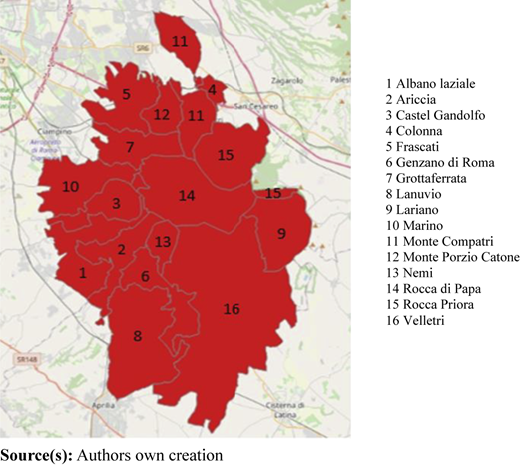
The empirical research considers the Castelli Romani tourism destination, located a few kilometres southeast of Rome (in Italy), comprising 16 geographically proximate municipalities and covering a territorial area of approximately 437 square kilometres (see Figure 1). Castelli Romani was chosen for the following main reasons: (1) its remarkable cultural and natural heritage, which makes it an important tourist destination [1] and are particularly relevant to issues of sustainable development; (2) the number of firms (n. 2,353) related to the tourism sector and its supply chain (Istat, 2022), as well as the number of municipalities comprising the area (n. 16), reflecting the multidimensional nature of the tourism phenomenon; and (3) the geographical proximity of the area and the authors, which made it possible to accurately collect information and therefore enhances the reliability and validity of the results.

Data was collected via semi-structured interviews to gather rich and detailed information from relevant informants (Aguinis and Solarino, 2019). The authors chose semi-structured interviews as they provide a guided but flexible conversation between researchers and participants (Qu and Dumay, 2011). Over a period of 10 weeks between January and July 2022, 23 semi-structured interviews were carried out; 12 interviews with entrepreneurs and 11 interviews with representatives of local institutions (i.e. local policymakers), the local destination management organisations (DMO), entrepreneurs' associations, residents and tourists. Entrepreneurs were selected by identifying tourism firms' typologies recognised as sustainable according to prior studies (Barbieri, 2013; Coles et al., 2016; Paniccia and Leoni, 2019). These consisted of entrepreneurs of agritourism, historic residences and Alberghi diffusi.

The data collection process was conducted by two authors with experience using this methodology and direct access to informants. The authors followed an interview protocol (Castillo-Montoya, 2016) consisting of three parts: firstly, the authors explained to participants the purpose of the study; secondly, the authors asked respondents both simple questions (such as their specific job role) and more study-specific questions; thirdly, participants were prompted to give examples and additional comments. The interviews were in-person and online, recorded (through mobile phones or laptops), transcribed and translated from Italian into English. Table 1 reports the main information for each specific interview.

Furthermore, the interviewees were asked to explain the changes that occurred over time in the destination by describing from their point of view the role played and the responsibilities taken by different actors to promote sustainable development. Additionally, the interviewees were asked to provide examples of cooperation strategies between the different actors within the destination. The narrative approach was applied to frame the phenomenon's dynamic and multifaceted nature; accordingly, the interviews were treated as a narrative production site (Lichrou et al., 2010). Here, the narrative is “the textual actualization of a story at a specific time and context”, where a story is understood as “a piece of fiction that narrates a chain of related events or happenings that involve certain characters” (Eriksson and Kovalainen, 2008, pp. 2011–212). Thus, interviews revolved around a temporal context, considering memories, current situations and predictions for the future.

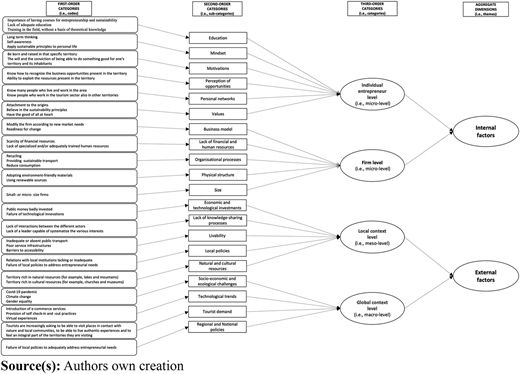
The interviews were analysed through constant comparison, by which the insights that emerged from each interview were compared with those from other interviews to identify commonalities and differences in opinions, attitudes and perspectives (Boeije, 2002; Eisenhardt and Graebner, 2007). To enhance the reliability of the research, all the interviews were transcribed (MacLean et al., 2004), and transcripts were analysed using a deductive thematic analysis, in which an initial codebook was used to develop themes (Braun and Clarke, 2006). Based on the research questions and the theoretical background, the main themes used were internal and external factors. Two authors read the interview transcripts multiple times, transforming them into codes, then grouping the codes into sub-categories, sub-categories into categories and, finally, categories into the two main themes (Nowell et al., 2017; Saldana, 2008; Spiggle, 1994). In this way, authors were able to extrapolate a final framework capable of visually summarising the results of the study. See Figure 2 for details on this process.

Furthermore, following Ibrahim and El-Maksoud (2022), the interview transcripts were triangulated with data from: (1) historical documents; (2) information from the websites of the Castelli Romani DMO and its 16 municipalities; (3) information from other local, regional and national websites (e.g. Istat, Lazio Region, local tourism associations); and (4) researchers' direct observations. This enhances the accuracy of the case study findings.

Findings are reported according to the two main themes of the thematic analysis: internal and external factors. Following the results of the thematic processes, in each theme, the specific categories are addressed, namely the different levels (i.e. entrepreneur, firm, local and global contexts).

4.1.1 Individual entrepreneur level

Two aspects emerge from the interviews with entrepreneurs: (1) capabilities of sensing and exploiting opportunities, namely their capacity to identify business opportunities in the tourism sector by effectively using cultural and natural resources in the destination; and (2) personal motivation, namely their intention to help society by contributing to the socio‒economic and environmental development of the area.

When my husband and I decided to open our agritourism, we thought of the Castelli Romani area and Castel Gandolfo for its perfect combination of nature (there is the lake) and history (there is the Pope's summer residence). [Agritourism entrepreneur]

Having been born here, I have always wanted to help improve this area. therefore, when I decided to become an entrepreneur, I did it not only for myself but thought I could do something good for others too. [Historical residence entrepreneurs]

Several interviewees also highlighted that the values and behaviours of most entrepreneurs in the selected destination are focused on sustainability issues and contribute to social cohesion and equitable resource distribution, triggering positive community change.

Moreover, in almost all cases, entrepreneurs' mindsets and personal networks have helped embrace new technologies and related practices. For example, entrepreneurs involved younger staff members to embrace a greater level of technological skills. The interviews also revealed that personal networks favour knowledge sharing about new practices and how to apply for public technology incentives.

Honestly, I believe that the possibility of establishing many relationships over time with other local entrepreneurs, but also and above all with the inhabitants of this village, has given me the possibility to survive, especially in the most difficult moments. [Historic residence entrepreneur]

Personally, I don't understand much about technology, but with the help of my son and other young colleagues from the entrepreneur association, I managed to implement some new technologies on my farm. [Agritourism entrepreneur]

In addition, entrepreneurs' personal networks also led to the creation of several associations (e.g. Castelli Romani hospitality Association, Winemakers Association in Grottaferrata and Association of the New Castelli Romani) in the area. The main aims of these associations are to create a point of reference for local entrepreneurs and to promote sustainable development of the destination by enhancing its identity and heritage. In reaching these aims, these associations closely interact with local communities and other stakeholders, strongly believing in the importance of knowledge-sharing.

We created this association during COVID-19 to help and support each other, as tourism entrepreneurs, in a moment of profound difficulty. Only collaborations and synergies can lead to the greater strength of our sector. [Local entrepreneurs association]

Most of the interviewed entrepreneurs do not have a university degree, and in the past have been more oriented towards employing personnel with vocational education. Recently they have started collaborating with universities, for example, taking students for internships which, in some cases, have led to stable jobs. This has allowed entrepreneurs to bring knowledge into the business that – in most cases – they do not possess.

I had the opportunity to carry out my stage at the Merumalia winery in Frascati. My experience made me better understand my local area and its wine traditions. I have started believing in the potential of this destination full of small realities to discover. [Resident]

Having this student at our agritourism has been a good chance for both. She could have a real experience of what it means to work day-by-day in this field. At the same time, I could take advantage of her knowledge of some management tools. [Agritourism entrepreneur]

4.1.2 Firm level

According to the interviewees, the characteristics of entrepreneurs influence the characteristics of their firms. In particular, the entrepreneurs' values and behaviours affect the firms' physical structure (e.g. by adopting environment-friendly materials) and organisational processes (e.g. by adopting renewable sources, providing e-mountain bikes and giving waste disposal information to guests). For example, one historic residence in the area, which has been a hotel for years, has revised its business model by adding agritourism and holiday lettings, and by hosting a hotel management school, a humanities-focused high school and a kindergarten.

I decided to go to this historic residence for a holiday with my girlfriend. A beautiful and well-kept structure that respects the typical natural setting of the area. In addition, the residence reserves various activities such as e-bike rental, guided tours, and excursions with tastings of vines and olive oil. Lastly, you can have breakfast at the bar run by the hotel management school. [Tourist]

However, these firms are all micro or small, highlighting two main critical issues: (1) the lack of human resources and (2) the lack of financial resources. In fact, these firms usually have one to three employees and a tight budget. This means they can only afford to do a small amount of training for employees and devote only a limited budget to long-term sustainability projects and innovations. Almost all entrepreneurs interviewed consider international, national and regional programs that support access to finance essential to supporting their sustainable development efforts, despite the numerous bureaucratic challenges to access them.

We can access some specific public and private funds devoted to SMEs for improving sustainability. For example, my bank, in 2020, offered me a credit solution called “Sustainability Loan”. [Historic residence entrepreneur]

I tried to apply to a public regional found specifically devoted to sustainability practices for SMEs, but I had to give up due to the numerous documents and information required to access it. [Agritourism entrepreneur]

4.2.1 Local context level

Since ancient times, Roman emperors and nobles chose to build their villas to experience otium (i.e. free time) in the Castelli Romani for its position (very close to Rome), climate (mild) and magnificent natural landscapes. In the eighteenth century, many travellers wrote about their visits to the area, emphasising the perfect combination of spectacular natural and cultural heritage. Goethe, for example, on 23 October 1787, wrote: “I spent this month in the countryside, […] in the hills behind Rome, one of the most beautiful places on earth where everything contributes to creating an authentic place for recreation”.

Local institutions have increasingly exploited these natural and cultural resources. For example, there are many food and wine products and related festivals and events organised in the different municipalities, contributing to strengthening the sense of community among residents and between residents and tourists. However, this can also bring conflict with entrepreneurs.

Today, inhabitants of Rome and tourists come to Ariccia to eat the real porchetta [i.e. Italian spin-roasted pork]. We also organise the Sagra della Porchetta [i.e. festival], which took place for the first time in 1950 when, under the guidance of Mayor Ciolio Ovidio, the producers formed a consortium to promote Porchetta beyond the narrow municipal boundaries. [Local policymaker]

It was a continuous festival from June to September but – at the beginning – we were not involved in the organisation. Now we participate, contributing to making known the typical local products. [Agritourism entrepreneur]

The establishment of various public associations and organisations (e.g. Castelli Romani Park, DMO Castelli Romani) is another expression of the increasing involvement of local institutions in the sustainable development of the area. The DMO Castelli Romani is a prominent body for tourism in the area.

We are trying to develop a strategy based on a synergistic collaboration between public and private actors, especially local entrepreneurs. [DMO Member]

Our destination manager is already working to build successful sustainability-oriented tourism products, in line with the specificities of our destination and the tourists' demand. [DMO Member]

However, entrepreneurs do not feel actively involved in the decision-making processes of local institutions or the DMO, which they consider as mainly operating in a top-down fashion. Consequently, according to most of the interviewed entrepreneurs, local policies are not always effective in addressing their needs. A similar sentiment is shared by local communities.

It has always been us who have created initiatives that have given prestige to our municipality. So, according to my previous experiences, I do not believe that public actors will be able to involve and effectively help us. [Albergo diffuso entrepreneur]

I've lived here since I was born, and I don't think that, over the years, the various local public administrations have done everything they could to improve this city. Indeed, sometimes they seem to row against our interests. [Resident]

Moreover, residents and tourists highlight that livability is a concern due to poor infrastructure (especially in terms of public transport), resulting in accessibility barriers. This issue is something that even Goethe noticed – in a letter from Velletri municipality, in 1787, he wrote “It is certainly inexplicable […] the difficulty and inconvenience of getting to these regions”.

My family founded this agritourism 50 years ago, and although I intend to continue the business, I am not sure I will succeed. To arrive here from the Rome airport, a tourist without a car must take two trains (not always punctual and available throughout the week) and two buses. All of this is mostly without indications in a language other than Italian. [Agritourism entrepreneur]

It would be nice if there were the possibility to move easily between the various Castelli [i.e. municipalities]. A tourist bus should be created – like the one you see in Rome and other big cities – so that a tourist (but also a resident), by purchasing a single ticket, can take a tour of all the Castelli and their prominent beauties. [Resident]

Using bikes is practically impossible: cycle paths are dirty and full of holes, made poorly and used as parking lots. However, if I continue to use the bike, it is because it takes me 25 minutes to go to work instead of 60 minutes by bus. [Resident]

Furthermore, some economic and technological local public investments did not fully produce the expected results, negatively affecting the possibility for the Castelli Romani destination – and the tourism firms in the area – to be better known and reached by local communities and tourists. This, in turn, has inevitable negative consequences on SE and related sustainable development.

The amphitheatre, for which four and a half million public money was spent years ago, today is all smeared, even with blasphemous and racial writings, not to mention the state of the entire structure. [Resident]

We loved everything we saw and ate here, but it would have been nice to have an app to download that would make it easier for us to understand how to get around and make reservations. [Tourist]

In 2017, an app dedicated to the area was created, but it did not last. It’s a pity because it would have been an excellent tool for information and tourism promotion of all our festivals and events. [Entrepreneurs Association]

Thus, the interviews reveal a lack of systemic management by the various actors operating in the area, as well as inadequate consideration of their related specific characteristics and needs. This is mainly due to a lack of knowledge-sharing processes between the various actors, which limit the possibility to (1) increase the knowledge (also of the local community) related to Castelli Romani heritage, (2) create coordinated tourism initiatives and (3) develop entrepreneurial skills.

Young generations especially need to learn all the potential of this area and its extraordinary heritage. This undermines the ability to wisely exploit what is here, enhancing it and benefiting from it for themselves and others. [Entrepreneurs Association]

We have so much to offer, but only some think about working for the good of all. Just look at the entities that should deal with the enhancement of our area; we have: the Parco dei Castelli Romani, the Museum Grand Tour, the DMO Castelli Romani, and I could go on for hours. Many organisations, many actions, but they are uncoordinated with each other. This creates confusion in us as residents; therefore, I can only imagine the effect on tourists. [Resident]

Soon, we aim to ameliorate our skills in terms of teamwork and leadership, communication and listening, problem-solving, and strategic thinking because we are aware of their importance to our community. [Local policy maker]

4.2.2 Global context level

In most cases, entrepreneurs have decided to open their firms inside pre-existing historic buildings to showcase that cultural heritage. Other firms have instead exploited the natural heritage; thus, accommodation establishments excluding hotels (e.g. agritourism) grew by 91%, from 163 in 2014 to 311 in 2021 (Istat, 2022). This allows entrepreneurs to offer authentic accommodation contexts, addressing the growing tourist demand for experiences characterised by human contact, immersion in nature, culture, tradition and the everyday life of local communities.

Many things have changed in these years. Before we opened our Albergo diffuso, the historic centre was practically abandoned. We have certainly contributed to the revitalisation of the local community, and we are proud of this! [Albergo diffuso entrepreneur]

Our guests really get the feeling that our offering is much more than a place to stay overnight. Indeed, by living in our historic residence and tasting our local dishes, they truly experience our culture. They absolutely love it, and we are always more than happy to help them discover as many local beauties as possible. [Historic residence entrepreneur]

My family and I have been coming here for several years, mainly in summer, and each time we choose a different Castelli [Romani] municipality to stay in. We have made many friends with whom we go for walks and eat. We like it because life goes “slower” here than in the city. [Tourist]

Furthermore, in the face of the ever-growing complexity of socio-economic and ecological challenges and following recent technological trends, some entrepreneurs have started to rethink their roles and services, attempting to be more innovative. This has resulted in the introduction of e-commerce services to sell ready meals and organic products, more flexible booking systems (e.g. self-check-in and check-out) and long-stay offerings for remote working. In addition, virtual experiences – such as online wine-tasting sessions and cooking classes – have been proposed.

We do everything we can to keep up with the times and, in my opinion, technology can give us a big hand in pursuing our goals, both economic and social. [Agritourism entrepreneur]

What I appreciated the most about staying here was being able to order local organic food online and to be able to check-in and check-out entirely independently. [Tourist]

We reorganise our hotel by adopting new digital technologies that allow us to provide our guests with digital key rooms. [Historic residence entrepreneur]

At the same time, entrepreneurial needs are not adequately satisfied by regional and national policies, especially during the COVID-19 pandemic. Entrepreneurs stressed that public subsidies were insufficient and often arrived late, with directives changing daily, making it practically impossible to follow them. Nevertheless, it should be noted that COVID-19 renewed tourist demand for nearby experiences, uncrowded places, outdoor life, smart working and so on, providing new business opportunities to firms in the area.

After the total lockdown, we had guests mainly from close municipalities. It was nice because this allowed us to be known and appreciated primarily by our “neighbours”. [Historic residence entrepreneur]

During the pandemic, our guests were exclusively people in the area for business reasons. Even now, we host a considerable number of workers. In fact, many people who must go to Rome for work – and used to stay there overnight before the pandemic – now prefer to stay here and work in the peace and beauty of our landscape. [Agritourism entrepreneur]

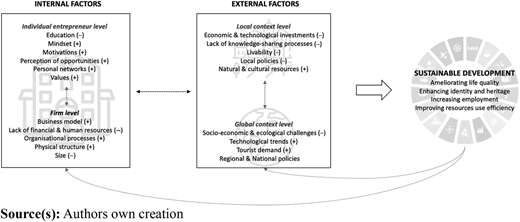
We have applied a co-evolutionary lens to categorise different factors emerging from the interviews. Internal factors related to entrepreneurs and their firms are grouped at the “micro” level, while external factors related to local and global contexts are grouped at the “meso” and “macro” levels, respectively.

As shown in Figure 3, and according to the characteristics of co-evolutionary relationships, individual entrepreneur factors and firm factors (micro-level) mutually affect each other and, in turn, affect and are affected by the factors belonging to the local (meso-level) and global (macro-level) contexts. In other words, the different actors at the three levels and related factors – according to the co-evolutionary lens – do not act in isolation, rather their interactions (i.e. mutual relationship) determine positive or negative effects on sustainable development. This latter, in turn, exerts its effects on each of the three levels and the respective actors and factors. Hence, it is possible to conceptualise SE as the result of effective co-evolutionary interactions between micro (tourism entrepreneurs and their firms), meso (the destination where tourism firms are based) and macro (the general environment) levels. In other words, entrepreneurs in the tourism industry can make decisions and take actions that effectively promote sustainable development only if sustainability-oriented local and global contexts support them, and vice versa.

In particular, the different factors identified in the three levels may act as enablers or inhibitors of SE. Among the 11 factors entrepreneurs and their firms (micro-level) relate to local and global contexts, eight enablers and three inhibitors emerged from the data collection. This aligns with previous studies (e.g. Hall and Wagner, 2012; Mintrom and Thomas, 2018; Mupfasoni et al., 2018), demonstrating how entrepreneurs are the key engine of sustainable development. In fact, while local and global contexts can encourage entrepreneurs and businesses to move towards sustainability, their ability is restricted and only entrepreneurs can bring sustainable actions into reality.

This is even more the case in the tourism industry (Papaluca et al., 2020), where entrepreneurs with awareness and commitment to sustainable development help to create new and innovative firms (Paniccia and Leoni, 2019), increasing employment and enhancing identity and heritage through the efficient use of resources, thus ameliorating life quality (Belias et al., 2022; Figueroa-Domecq et al., 2022; Sardianou et al., 2016). At the same time, it is also true that entrepreneurial sustainable-oriented mindsets, motivations and values need to be counterbalanced by knowledge and education, especially at the university level (Ashari et al., 2021; Deale, 2016). Most current tourism entrepreneurs did not receive a university education but consider it crucial for the development of the (sustainable) entrepreneurs of tomorrow. Moreover, the evidence provided by this study is consistent with Khattak (2020) and Kliuchnikava (2022), who emphasise that small size and lack of financial and human resources may hamper tourism entrepreneurs from sustainable practices.

Concerning the local context (meso level), many more factors inhibit SE than support it (i.e. four inhibitors out of five total factors). Concerning the global context (macro level), among the four identified factors, two act as enablers and two as inhibitors. Here we see how both local and regional/national policymakers need entrepreneur and resident/citizen support (Liang et al., 2021). In fact, as emphasised by Murphy (2022), policymakers know that entrepreneurship plays a crucial role in revitalising communities and stimulating economic development, with repercussions for the sustainable development of society as a whole. This suggests a need for local and regional/national policies to be designed in concert with entrepreneurs to help them and their firms achieve sustainable development goals (Ahmed and McQuaid, 2005; Grigore and Dragan, 2020; Musson, 2012). Doing so enhances livability – and thus life quality – for residents/citizens (Frigenti et al., 2022; Martínez-Bravo et al., 2021). In other words, sustainable development is possible if the various actors (at micro, meso and macro level) adopt an integrated approach in which they share priorities for what should be developed and sustained (Hillebrand, 2022), that is, share a common sustainable development strategy (Bachinger et al., 2022).

In summary, entrepreneurs and their firms (micro level) – with their enablers/inhibitors and their dynamics – influence the environment (at both meso and macro level) – with related enablers/inhibitors and their dynamics – towards sustainable development; and vice versa. Thus, SE can be conceived as an effective co-evolutionary process recognised as virtuous by entrepreneurs and stakeholders, both internal and external to the firm.

The findings of this study have several theoretical and practical implications. In terms of theoretical implications, the study informs and advances the field of entrepreneurship in general and SE in tourism, in particular. It also advances the co-evolutionary tourism literature by demonstrating that co-evolution is a useful perspective for holistically and dynamically studying SE through multi-level empirical research (Crnogaj et al., 2014; Muñoz and Cohen, 2018; Patriotta and Siegel, 2019). Adopting a co-evolutionary lens allows considering jointly internal and external factors affecting SE, advancing prior research on the topic in which those factors were considered separately (e.g. Kraus et al., 2018; Nunez and Musteen, 2020; Sarma et al., 2022) and providing a more nuanced and synthesised understanding of how these factors interact in the context of the complex socio-economic and ecological dynamics underlying SE. Concerning external factors, this investigation enriches previous literature mainly focused on institutional and industrial factors (e.g. Kraus et al., 2018; Terán-Yépez et al., 2020) by considering technological, societal and ecological factors (such as natural resources). These contributions provide a refined conceptualisation of SE, as advocated by Thananusak (2019) and Terán-Yépez et al. (2020), suggesting that SE results from effective co-evolutionary processes recognised as virtuous by entrepreneurs and stakeholders, both internal and external to the firm. When so conceived, it supports the achievement of competitive advantage and profitability by balancing economic prosperity, social justice and environmental responsibility, thus contributing to sustainable development (Belz and Binder, 2017; Schaltegger and Wagner, 2011).

Moreover, this study reinforces the link between entrepreneurship, sustainability and tourism, as advocated by Sørensen and Grindsted (2021). In particular, the model proposed by this investigation extends previous studies and answers multiple calls to examine SE in the tourism sector. It attempts to fill the gaps noted in the literature review of Andrade-Valbuena et al. (2022), which raised crucial questions about the role played by the institutional environment and tourism policies in promoting SE, by identifying the factors (both internal and external) and their reciprocal influences that can influence SE in tourism. The proposed model not only answers these two questions but also identifies which factors act as enablers and which as inhibitors of SE in tourism. By doing so, our findings are in contrast to some previous research. For example, while Ali (2018) affirms that Ghanaian entrepreneurs feel they can expand without entrepreneurial education, Italian tourism entrepreneurs recognise the crucial role that entrepreneurship-related courses may play in supporting the competitiveness of their firms and, thus, the sustainable development of the area in which their firms are based. These results answer calls to investigate SE in local contexts (Anand et al., 2021; Rosário et al., 2022) and sectors (Terán-Yépez et al., 2020). Moreover, the findings of this case study are consistent with those of Komppula (2014), Paniccia and Baiocco (2020) and Weiermair et al. (2010), in showing that tourism entrepreneurs play a key role in sustainable development (Agapito et al., 2022; Zhang et al., 2022). Our findings highlight that entrepreneurs' attachment to place is as crucial as their commitment to their firms (Koh and Hatten, 2002; Ryan et al., 2012).

Lastly, this article expands previous co-evolutionary tourism studies (e.g. Cristofaro et al., 2020; Paniccia and Leoni, 2019) by considering multiple actors simultaneously, thus, providing a more comprehensive overview of sustainable development. In other words, effective sustainable development can be reached only when all actors involved (entrepreneurs, citizens, policymakers, tourists, etc.) align their actions and decision towards sustainability principles, co-evolving together towards a better (present and) future.

The practical implications of our study are in demonstrating that a co-evolutionary framework can help entrepreneurs and policymakers. This investigation provides specific actions – according to the different levels – that can be taken to promote virtuous co-evolutionary adaptations, allowing entrepreneurs and policymakers to achieve sustainable development in general and four specific SDGs in particular: 8 “Decent work and economic growth”; 11 “Sustainable cities and communities”; 12 “Responsible consumption and production”; and 17 “Partnerships for the goals”. The 15 suggested actions – see Table 2 for details – mainly refer to the following aspects: (1) training courses, (2) investments in technologies, (3) creation of innovative business models, (4) exploitation of cultural and natural resources, (5) communities' involvement and (6) multi-level partnership.

However, it is worth noting that the proposed actions may vary among contexts, industries and countries. This is because the identified factors, and whether they act as an enabler or an inhibitor, may change according to their specific setting. That is, actions must be adapted to the specific reality/context to make them effective. For example, SE will be affected differently, and therefore with different effects on sustainable development, in European or MENA countries because of the diverse policies, technological trends, culture and resources that characterise them. In other words, what can be an enabler in Europe could be an inhibitor in MENA and this means that entrepreneurs and policymakers have to tailor their actions accordingly.

This study provides evidence of how SE contributes to sustainable development by identifying the factors acting as enablers or inhibitors of SE in the tourism sector and how they interact. In particular, the paper demonstrates that entrepreneurs play a crucial role in sustainable development, but they cannot act in isolation. In fact, according to the co-evolutionary approach, they influence and are influenced by 20 internal and external factors. Our findings have implications for scholars, entrepreneurs and policymakers. They can inform and assist them in prioritising a target set of actions that may foster SE and related development activities.

However, the study also presents some limitations that offer avenues for future research. Because our proposed framework is derived from a single case study it is not generalisable. Future research may consider applying our framework to other contexts to explore whether other relevant factors should be added. Future studies could also test the framework to see if and how the identified enablers and inhibitors change according to different contexts. Another limitation of the study concerns the qualitative and interpretive approach adopted. Future research could include mixed methods, including quantitative tools.

Funding: This research is an outcome of a larger project, titled “Small and Smart Villages Governance: Development and Validation of a Model from one of the Borghi più Belli d’Italia” funded by the Italian Ministry of University and Research under PRIN 2022 - 2022FZJ4L7.

1.

For an overview, see the provided  Appendix.
Abatecola
,
G.
,
Belussi
,
F.
,
Breslin
,
D.
and
Filatotchev
,
I.
(
2016
), “
Darwinism, organizational evolution and survival: key challenges for future research
”,
Journal of Management and Governance
, Vol. 
20
No. 
1
, pp. 
1
-
17
.
Abatecola
,
G.
,
Breslin
,
D.
and
Kask
,
J.
(
2020
), “
Do organizations really co-evolve? Problematizing co-evolutionary change in management and organization studies
”,
Technological Forecasting and Social Change
, Vol. 
155
, 119964.
Agapito
,
D.
,
Kronenburg
,
R.
and
Pinto
,
P.
(
2022
), “
A review on destination social responsibility: towards a research agenda
”,
Current Issues in Tourism
, Vol. 
26
No. 
4
, pp.
554
-
572
.
Aguinis
,
H.
and
Solarino
,
A.M.
(
2019
), “
Transparency and replicability in qualitative research: the case of interviews with elite informants
”,
Strategic Management Journal
, Vol. 
40
No. 
8
, pp. 
1291
-
1315
.
Ahmed
,
A.
and
McQuaid
,
R.W.
(
2005
), “
Entrepreneurship, management, and sustainable development
”,
World Review of Entrepreneurship, Management and Sustainable Development
, Vol. 
1
No. 
1
, pp. 
6
-
30
.
Ali
,
R.S.
(
2018
), “
Determinants of female entrepreneurs growth intentions: a case of female-owned small businesses in Ghana's tourism sector
”,
Journal of Small Business and Enterprise Development
, Vol. 
25
No. 
3
, pp. 
387
-
404
.
Aljuwaiber
,
A.
(
2021
), “
Entrepreneurship research in the Middle East and North Africa: trends, challenges, and sustainability issues
”,
Journal of Entrepreneurship in Emerging Economies
, Vol. 
13
No. 
3
, pp. 
380
-
426
.
Anand
,
A.
,
Argade
,
P.
,
Barkemeyer
,
R.
and
Salignac
,
F.
(
2021
), “
Trends and patterns in sustainable entrepreneurship research: a bibliometric review and research agenda
”,
Journal of Business Venturing
, Vol. 
36
No. 
3
, 106092.
Andrade-Valbuena
,
N.A.
,
Merigo-Lindahl
,
J.M.
and
Olavarrieta
,
S.
(
2018
), “
Bibliometric analysis of entrepreneurial orientation
”,
World Journal of Entrepreneurship, Management and Sustainable Development
, Vol. 
15
No. 
1
, pp. 
45
-
69
.
Andrade-Valbuena
,
N.
,
Baier-Fuentes
,
H.
and
Gaviria-Marin
,
M.
(
2022
), “
An overview of sustainable entrepreneurship in tourism, destination, and hospitality research based on the Web of Science
”,
Sustainability
, Vol. 
14
No. 
22
, 14944.
Apostolopoulos
,
N.
,
Al-Dajani
,
H.
,
Holt
,
D.
,
Jones
,
P.
and
Newbery
,
R.
(
2018
),
Entrepreneurship and the Sustainable Development Goals
,
Emerald Publishing
,
Bradford
.
Argade
,
P.
,
Salignac
,
F.
and
Barkemeyer
,
R.
(
2021
), “
Opportunity identification for sustainable entrepreneurship: exploring the interplay of individual and context level factors in India
”,
Business Strategy and the Environment
, Vol. 
30
No. 
8
, pp. 
3528
-
3551
.
Ashari
,
H.
,
Abbas
,
I.
,
Abdul-Talib
,
A.N.
and
Mohd Zamani
,
S.N.
(
2021
), “
Entrepreneurship and Sustainable Development Goals: a multigroup analysis of the moderating effects of entrepreneurship education on entrepreneurial intention
”,
Sustainability
, Vol. 
14
No. 
1
, 431.
Azungah
,
T.
(
2018
), “
Qualitative research: deductive and inductive approaches to data analysis
”,
Qualitative Research Journal
, Vol. 
18
No. 
4
, pp.
383
-
400
.
Bachinger
,
M.
,
Kofler
,
I.
and
Pechlaner
,
H.
(
2022
), “
Entrepreneurial ecosystems in tourism: an analysis of characteristics from a systems perspective
”,
European Journal of Tourism Research
, Vol. 
31
, 3113.
Barbieri
,
C.
(
2013
), “
Assessing the sustainability of agritourism in the US: a comparison between agritourism and other farm entrepreneurial ventures
”,
Journal of Sustainable Tourism
, Vol. 
21
No. 
2
, pp. 
252
-
270
.
Belias
,
D.
,
Malik
,
S.
,
Rossidis
,
I.
and
Mantas
,
C.
(
2022
), “
The impact of social tourism entrepreneurship on tourism sustainability—a systematic review
”,
World Journal of Entrepreneurship, Management and Sustainable Development
, Vol. 
18
No. 
5
, pp. 
595
-
615
.
Belz
,
F.M.
and
Binder
,
J.K.
(
2017
), “
Sustainable entrepreneurship: a convergent process model
”,
Business Strategy and the Environment
, Vol. 
26
No. 
1
, pp. 
1
-
17
.
Boeije
,
H.
(
2002
), “
A purposeful approach to the constant comparative method in the analysis of qualitative interviews
”,
Quality and Quantity
, Vol. 
36
No. 
4
, pp. 
391
-
409
.
Bramwell
,
B.
,
Higham
,
J.
,
Lane
,
B.
and
Miller
,
G.
(
2017
), “
Twenty-five years of sustainable tourism and the Journal of Sustainable Tourism: looking back and moving forward
”,
Journal of Sustainable Tourism
, Vol. 
25
No. 
1
, pp. 
1
-
9
.
Braun
,
V.
and
Clarke
,
V.
(
2006
), “
Using thematic analysis in psychology
”,
Qualitative Research in Psychology
, Vol. 
3
No. 
2
, pp. 
77
-
101
.
Breslin
,
D.
(
2011
), “
Interpreting futures through the multi-level co-evolution of organizational practices
”,
Futures
, Vol. 
43
No. 
9
, pp. 
1020
-
1028
.
Brouder
,
P.
and
Eriksson
,
R.H.
(
2013
), “
Tourism evolution: on the synergies of tourism studies and evolutionary economic geography
”,
Annals of Tourism Research
, Vol. 
43
, pp. 
370
-
389
.
Butkouskaya
,
V.
,
Romagosa
,
F.
and
Noguera
,
M.
(
2020
), “
Obstacles to sustainable entrepreneurship amongst tourism students: a gender comparison
”,
Sustainability
, Vol. 
12
No. 
5
, 1812.
Castillo-Montoya
,
M.
(
2016
), “
Preparing for interview research: the interview protocol refinement framework
”,
The Qualitative Report
, Vol. 
21
No. 
5
, pp. 
811
-
831
.
Coles
,
T.
,
Dinan
,
C.
and
Warren
,
N.
(
2016
), “
Carbon villains? Climate change responses among accommodation providers in historic premises
”,
Journal of Heritage Tourism
, Vol. 
11
No. 
1
, pp. 
25
-
42
.
Cristofaro
,
M.
,
Leoni
,
L.
and
Baiocco
,
S.
(
2020
), “
Promoting co-evolutionary adaptations for sustainable tourism: the ‘Alpine Convention’ case
”,
Tourism Planning and Development
, Vol. 
17
No. 
3
, pp. 
275
-
294
.
Crnogaj
,
K.
,
Rebernik
,
M.
,
Hojnik
,
B.B.
and
Gomezelj
,
D.O.
(
2014
), “
Building a model of researching the sustainable entrepreneurship in the tourism sector
”,
Kybernetes
, Vol. 
43
Nos
3/4
, pp. 
377
-
393
.
Cucari
,
N.
,
Wankowicz
,
E.
and
De Falco
,
S.E.
(
2019
), “
Rural tourism and Albergo Diffuso: a case study for sustainable land-use planning
”,
Land Use Policy
, Vol. 
82
, pp. 
105
-
119
.
Cucari
,
N.
,
D'Angelo
,
E.
,
Esposito
,
E.
and
Ciasullo
,
M.V.
(
2020
), “
Assessing the social entrepreneurship business model: an exploratory case study in the Italian cultural heritage sector
”,
Entrepreneurship Research Journal
, Vol. 
10
No. 
4
, 20190316.
Deale
,
C.S.
(
2016
), “
Entrepreneurship education in hospitality and tourism: insights from entrepreneurs
”,
Journal of Teaching in Travel and Tourism
, Vol. 
16
No. 
1
, pp. 
20
-
39
.
Edmondson
,
A.C.
and
McManus
,
S.E.
(
2007
), “
Methodological fit in management field research
”,
Academy of Management Review
, Vol. 
32
No. 
4
, pp. 
1246
-
1264
.
Eisenhardt
,
K.M.
and
Graebner
,
M.E.
(
2007
), “
Theory building from cases: opportunities and challenges
”,
Academy of Management Journal
, Vol. 
50
No. 
1
, pp. 
25
-
32
.
Eriksson
,
P.
and
Kovalainen
,
A.
(
2008
),
Qualitative Methods in Business Research
,
Sage Publications
,
Thousand Oaks
.
Figueroa-Domecq
,
C.
,
Kimbu
,
A.
,
de Jong
,
A.
and
Williams
,
A.M.
(
2022
), “
Sustainability through the tourism entrepreneurship journey: a gender perspective
”,
Journal of Sustainable Tourism
, Vol. 
30
No. 
7
, pp. 
1562
-
1585
.
Freytag
,
P.V.
and
Hjalager
,
A.M.
(
2021
), “
The coextension of food and tourism business models
”,
Journal of Gastronomy and Tourism
, Vol. 
5
No. 
3
, pp. 
163
-
175
.
Frigenti
,
L.
,
Beyer
,
T.
,
Fitzgerald
,
M.
and
Chrisney
,
M.D.
(
2022
),
The New Technology Frontier for Developing Economies: Digital Transformation to Achieve the Sustainable Development Goals
,
SSRN 4138717
,
available at:
https://www.andaf.it/media/379405/new-technology-frontier-for-developing-economies.pdf
Fu
,
H.
,
Okumus
,
F.
,
Wu
,
K.
and
Köseoglu
,
M.A.
(
2019
), “
The entrepreneurship research in hospitality and tourism
”,
International Journal of Hospitality Management
, Vol. 
78
, pp. 
1
-
12
.
Gretzel
,
U.
,
Sigala
,
M.
,
Xiang
,
Z.
and
Koo
,
C.
(
2015
), “
Smart tourism: foundations and developments
”,
Electronic Markets
, Vol. 
25
No. 
3
, pp. 
179
-
188
.
Griffiths
,
M.D.
,
Gundry
,
L.
,
Kickul
,
J.
and
Fernandez
,
A.M.
(
2009
), “
Innovation ecology as a precursor to entrepreneurial growth: a cross‐country empirical investigation
”,
Journal of Small Business and Enterprise Development
, Vol. 
16
No. 
3
, pp.
375
-
390
.
Grigore
,
A.M.
and
Dragan
,
I.M.
(
2020
), “
Towards sustainable entrepreneurial ecosystems in a transitional economy: an analysis of two Romanian city-regions through the lens of entrepreneurs
”,
Sustainability
, Vol. 
12
No. 
15
, 6061.
Haldar
,
S.
and
Tripathi
,
T.
(
2023
), “
What besets entrepreneurs in renewable energy sector? Insights from the Indian state of Gujarat
”,
International Journal of Energy Sector Management
, Vol. 
17
No. 
2
, pp. 
209
-
226
.
Hall
,
J.
and
Wagner
,
M.
(
2012
), “
The challenges and opportunities of sustainable development for entrepreneurship and small business
”,
Journal of Small Business and Entrepreneurship
, Vol. 
25
No. 
4
, pp. 
409
-
416
.
Hillebrand
,
B.
(
2022
), “
An ecosystem perspective on tourism: the implications for tourism organizations
”,
International Journal of Tourism Research
, Vol. 
24
, pp. 
517
-
524
.
Hodgson
,
G.M.
(
2013
), “
Understanding organizational evolution: toward a research agenda using generalized Darwinism
”,
Organization Studies
, Vol. 
34
No. 
7
, pp. 
973
-
992
.
Hrebiniak
,
L.G.
and
Joyce
,
W.F.
(
1985
), “
Organizational adaptation: strategic choice and environmental determinism
”,
Administrative Science Quarterly
, Vol. 
30
No. 
3
, pp.
336
-
349
.
Ibrahim
,
O.
and
El-Maksoud
,
A.
(
2022
), “
Enhancing tourism destination competitiveness of Hawara archaeological site
”,
International Journal of Tourism and Hospitality Management
, Vol. 
5
No. 
1
, pp. 
255
-
272
.
Istat
(
2022
),
Castelli Romani Data
,
available at:
http://dati.istat.it/Index.aspx?QueryId=7063#
Jabeen
,
F.
,
Faisal
,
M.N.
and
Katsioloudes
,
M.I.
(
2017
), “
Entrepreneurial mindset and the role of universities as strategic drivers of entrepreneurship: evidence from the United Arab Emirates
”,
Journal of Small Business and Enterprise Development
, Vol. 
24
No. 
1
, pp. 
136
-
157
.
Johnson
,
M.P.
and
Schaltegger
,
S.
(
2020
), “
Entrepreneurship for sustainable development: a review and multilevel causal mechanism framework
”,
Entrepreneurship Theory and Practice
, Vol. 
44
No. 
6
, pp. 
1141
-
1173
.
Jolink
,
A.
and
Niesten
,
E.
(
2015
), “
Sustainable development and business models of entrepreneurs in the organic food industry
”,
Business Strategy and the Environment
, Vol. 
24
No. 
6
, pp. 
386
-
401
.
Kallmuenzer
,
A.
,
Kraus
,
S.
,
Peters
,
M.
,
Steiner
,
J.
and
Cheng
,
C.F.
(
2019
), “
Entrepreneurship in tourism firms: a mixed-methods analysis of performance driver configurations
”,
Tourism Management
, Vol. 
74
, pp. 
319
-
330
.
Khattak
,
M.S.
(
2020
), “
Does access to domestic finance and international finance contribute to sustainable development goals? Implications for policymakers
”,
Journal of Public Affairs
, Vol. 
20
No. 
2
, e2024.
Kliuchnikava
,
Y.
(
2022
), “
The impact of the pandemic on attitude to innovations of SMEs in the Czech Republic
”,
International Journal of Entrepreneurial Knowledge
, Vol. 
10
No. 
1
, pp. 
34
-
45
.
Koh
,
K.Y.
and
Hatten
,
T.S.
(
2002
), “
The tourism entrepreneur: the overlooked player in tourism development studies
”,
International Journal of Hospitality and Tourism Administration
, Vol. 
3
No. 
1
, pp. 
21
-
48
.
Komppula
,
R.
(
2014
), “
The role of individual entrepreneurs in the development of competitiveness for a rural tourism destination—a case study
”,
Tourism Management
, Vol. 
40
, pp. 
361
-
371
.
Kraus
,
S.
,
Burtscher
,
J.
,
Vallaster
,
C.
and
Angerer
,
M.
(
2018
), “
Sustainable entrepreneurship orientation: a reflection on status-quo research on factors facilitating responsible managerial practices
”,
Sustainability
, Vol. 
10
No. 
2
, 444.
Lang
,
L.D.
,
Dong
,
N.T.
,
Ferreira
,
J.J.
,
Behl
,
A.
and
Dao
,
L.T.
(
2022
), “
Sustainable agribusiness entrepreneurship during the Covid-19 crisis: the role of social capital
”,
Management Decision
, Vol. 
60
No. 
9
, pp. 
2593
-
2614
.
Leoni
,
L.
and
Cristofaro
,
M.
(
2021
), “
To adopt or not to adopt? A co-evolutionary framework and paradox of technology adoption by small museums
”,
Current Issues in Tourism
, Vol. 
25
No. 
18
, pp.
2969
-
2990
.
Li
,
Z.
,
Zhao
,
Q.
,
Huo
,
T.
,
Shao
,
Y.
and
Hu
,
Z.
(
2022
), “
COVID-19: management focus of reopened tourist destinations
”,
Current Issues in Tourism
, Vol. 
25
No. 
1
, pp. 
14
-
20
.
Liang
,
Z.
,
Luo
,
H.
and
Bao
,
J.
(
2021
), “
A longitudinal study of residents' attitudes toward tourism development
”,
Current Issues in Tourism
, Vol. 
24
No. 
23
, pp. 
3309
-
3323
.
Lichrou
,
M.
,
O'Malley
,
L.
and
Patterson
,
M.
(
2010
), “
Narratives of a tourism destination: local particularities and their implications for place marketing and branding
”,
Place Branding and Public Diplomacy
, Vol. 
6
No. 
2
, pp. 
134
-
144
.
Lordkipanidze
,
M.
,
Brezet
,
H.
and
Backman
,
M.
(
2005
), “
The entrepreneurship factor in sustainable tourism development
”,
Journal of Cleaner Production
, Vol. 
13
No. 
8
, pp. 
787
-
798
.
Lüdeke-Freund
,
F.
(
2020
), “
Sustainable entrepreneurship, innovation, and business models: integrative framework and propositions for future research
”,
Business Strategy and the Environment
, Vol. 
29
No. 
2
, pp. 
665
-
681
.
Ma
,
M.
and
Hassink
,
R.
(
2013
), “
An evolutionary perspective on tourism area development
”,
Annals of Tourism Research
, Vol. 
41
, pp. 
89
-
109
.
MacLean
,
L.M.
,
Meyer
,
M.
and
Estable
,
A.
(
2004
), “
Improving accuracy of transcripts in qualitative research
”,
Qualitative Health Research
, Vol. 
14
No. 
1
, pp. 
113
-
123
.
Markman
,
G.D.
,
Russo
,
M.
,
Lumpkin
,
G.T.
,
Jennings
,
P.D.
and
Mair
,
J.
(
2016
), “
Entrepreneurship as a platform for pursuing multiple goals: a special issue on sustainability, ethics, and entrepreneurship
”,
Journal of Management Studies
, Vol. 
53
No. 
5
, pp. 
673
-
694
.
Martínez-Bravo
,
M.D.M.
,
Antolin-Lopez
,
R.
and
Martínez-del-Río
,
J.
(
2021
), “
Could cities become more sustainable and livable thanks to entrepreneurship? A review
”,
Academy of Management Proceedings
, Vol. 
1
, 15377.
Mellon
,
V.
and
Bramwell
,
B.
(
2016
), “
Protected area policies and sustainable tourism: influences, relationships and co-evolution
”,
Journal of Sustainable Tourism
, Vol. 
24
No. 
10
, pp. 
1369
-
1386
.
Mills
,
A.J.
,
Durepos
,
G.
and
Wiebe
,
E.
(
2010
),
Encyclopedia of Case Study Research
,
Sage Publications
,
Thousand Oaks
.
Mintrom
,
M.
and
Thomas
,
M.
(
2018
), “
Policy entrepreneurs and collaborative action: pursuit of the sustainable development goals
”,
International Journal of Entrepreneurial Venturing
, Vol. 
10
No. 
2
, pp. 
153
-
171
.
Muñoz
,
P.
and
Cohen
,
B.
(
2018
), “
Sustainable entrepreneurship research: taking stock and looking ahead
”,
Business Strategy and the Environment
, Vol. 
27
No. 
3
, pp. 
300
-
322
.
Mupfasoni
,
B.
,
Kessler
,
A.
and
Lans
,
T.
(
2018
), “
Sustainable agricultural entrepreneurship in Burundi: drivers and outcomes
”,
Journal of Small Business and Enterprise Development
, Vol. 
25
No. 
1
, pp. 
64
-
80
.
Murphy
,
P.J.
(
2022
), “
Editorial: a new vision for the journal of small business and enterprise development
”,
Journal of Small Business and Enterprise Development
, Vol. 
29
No. 
2
, pp.
177
-
181
.
Musson
,
A.
(
2012
), “
The build-up of local sustainable development politics: a case study of company leaders in France
”,
Ecological Economics
, Vol. 
82
, pp. 
75
-
87
.
Norgaard
,
R.B.
(
1994
),
Development Betrayed: the End of Progress and C O-Evolutionary Revisioning of the Future
,
Routledge
,
Abingdon
.
Nowell
,
L.S.
,
Norris
,
J.M.
,
White
,
D.E.
and
Moules
,
N.J.
(
2017
), “
Thematic analysis: striving to meet the trustworthiness criteria
”,
International Journal of Qualitative Methods
, Vol. 
16
No. 
1
, 1609406917733847.
Nunez
,
S.M.P.
and
Musteen
,
M.
(
2020
), “
Learning perspective on sustainable entrepreneurship in a regional context
”,
Journal of Small Business and Enterprise Development
, Vol. 
27
No. 
3
, pp. 
365
-
381
.
OECD
(
2022
),
The Short and Winding Road to 2030: Measuring Distance to the SDG Targets
,
OECD Publishing
,
Paris
,
available at:
https://www.oecd.org/publications/the-short-and-winding-road-to-2030-af4b630d-en.htm
Paniccia
,
P.M.A.
and
Baiocco
,
S.
(
2020
), “
Interpreting sustainable agritourism through co-evolution of social organizations
”,
Journal of Sustainable Tourism
, Vol. 
29
No. 
1
, pp. 
87
-
105
.
Paniccia
,
P.M.A.
and
Leoni
,
L.
(
2019
), “
Co-evolution in tourism: the case of Albergo Diffuso
”,
Current Issues in Tourism
, Vol. 
22
No. 
10
, pp. 
1216
-
1243
.
Papaluca
,
O.
,
Tani
,
M.
and
Troise
,
C.
(
2020
), “
Entrepreneurship and sustainability in tourism: an interpretative model
”,
Journal of Management and Sustainability
, Vol. 
10
No. 
1
, 38.
Patriotta
,
G.
and
Siegel
,
D.
(
2019
), “
The context of entrepreneurship
”,
Journal of Management Studies
, Vol. 
56
No. 
6
, pp. 
1194
-
1196
.
Qu
,
S.Q.
and
Dumay
,
J.
(
2011
), “
The qualitative research interview
”,
Qualitative Research in Accounting and Management
, Vol. 
8
No. 
3
, pp. 
238
-
264
.
Romão
,
J.
,
Kourtit
,
K.
,
Neuts
,
B.
and
Nijkamp
,
P.
(
2018
), “
The smart city as a common place for tourists and residents: a structural analysis of the determinants of urban attractiveness
”,
Cities
, Vol. 
78
, pp. 
67
-
75
.
Rosário
,
A.T.
,
Raimundo
,
R.J.
and
Cruz
,
S.P.
(
2022
), “
Sustainable entrepreneurship: a literature review
”,
Sustainability
, Vol. 
14
No. 
9
, 5556.
Ryan
,
T.
,
Mottiar
,
Z.
and
Quinn
,
B.
(
2012
), “
The dynamic role of entrepreneurs in destination development
”,
Tourism Planning and Development
, Vol. 
9
No. 
2
, pp. 
119
-
131
.
Saldana
,
S.
(
2008
),
An Introduction to Codes and Coding
,
Sage
,
Thousand Oaks
,
available at:
https://www.sagepub.com/sites/default/files/upm-binaries/24614_01_Saldana_Ch_01.pdf
Sarango-Lalangui
,
P.
,
Santos
,
J.L.S.
and
Hormiga
,
E.
(
2018
), “
The development of sustainable entrepreneurship research field
”,
Sustainability
, Vol. 
10
No. 
6
, 2005.
Sardianou
,
E.
,
Kostakis
,
I.
,
Mitoula
,
R.
,
Gkaragkani
,
V.
,
Lalioti
,
E.
and
Theodoropoulou
,
E.
(
2016
), “
Understanding the entrepreneurs' behavioural intentions towards sustainable tourism: a case study from Greece
”,
Environment, Development and Sustainability
, Vol. 
18
No. 
3
, pp. 
857
-
879
.
Sarma
,
S.
,
Attaran
,
S.
and
Attaran
,
M.
(
2022
), “
Sustainable entrepreneurship: factors influencing opportunity recognition and exploitation
”,
The International Journal of Entrepreneurship and Innovation
, 14657503221093007.
Schaltegger
,
S.
and
Wagner
,
M.
(
2011
), “
Sustainable entrepreneurship and sustainability innovation: categories and interactions
”,
Business Strategy and the Environment
, Vol. 
20
No. 
4
, pp. 
222
-
237
.
Schaltegger
,
S.
,
Lüdeke-Freund
,
F.
and
Hansen
,
E.G.
(
2016
), “
Business models for sustainability: a co-evolutionary analysis of sustainable entrepreneurship, innovation, and transformation
”,
Organization and Environment
, Vol. 
29
No. 
3
, pp. 
264
-
289
.
Schaltegger
,
S.
,
Beckmann
,
M.
and
Hockerts
,
K.
(
2018
), “
Collaborative entrepreneurship for sustainability. Creating solutions in light of the UN sustainable development goals
”,
International Journal of Entrepreneurial Venturing
, Vol. 
10
No. 
2
, pp. 
131
-
152
.
Shahid
,
S.
(
2023
), “
Perceived barriers and entrepreneurial exit intentions: moderating role of regular versus sustainable entrepreneurship
”,
European Business Review
, Vol. 
35
No. 
1
, pp. 
39
-
56
.
Shepherd
,
D.A.
and
Patzelt
,
H.
(
2011
), “
The new field of sustainable entrepreneurship: studying entrepreneurial action linking ‘what is to be sustained’ with ‘what is to be developed’
”,
Entrepreneurship Theory and Practice
, Vol. 
35
No. 
1
, pp. 
137
-
163
.
Sigala
,
M.
(
2020
), “
Tourism and COVID-19: impacts and implications for advancing and resetting industry and research
”,
Journal of Business Research
, Vol. 
117
, pp.
312
-
321
.
Sørensen
,
F.
and
Grindsted
,
T.S.
(
2021
), “
Sustainability approaches and nature tourism development
”,
Annals of Tourism Research
, Vol. 
91
, 103307.
Spiggle
,
S.
(
1994
), “
Analysis and interpretation of qualitative data in consumer research
”,
Journal of Consumer Research
, Vol. 
21
No. 
3
, pp. 
491
-
503
.
Terán-Yépez
,
E.
,
Marín-Carrillo
,
G.M.
,
del Pilar Casado-Belmonte
,
M.
and
de las Mercedes Capobianco-Uriarte
,
M.
(
2020
), “
Sustainable entrepreneurship: review of its evolution and new trends
”,
Journal of Cleaner Production
, Vol. 
252
, 119742.
Thananusak
,
T.
(
2019
), “
Science mapping of the knowledge base on sustainable entrepreneurship 1996-2019
”,
Sustainability
, Vol. 
11
No. 
13
, 3565.
UN General Assembly
(
2015
),
Transforming Our World: The 2030 Agenda for Sustainable Development
,
Division for Sustainable Development Goals
,
New York
.
UN General Assembly
(
2020
), “
Entrepreneurship for sustainable development
”,
available at:
https://unctad.org/system/files/official-document/a75d257_en.pdf
UNWTO
(
1999
), “
Global code of ethics for tourism
”,
available at:
https://www.unwto.org/global-code-of-ethics-for-tourism
UNWTO
(
2022
),
Key Tourism Statistics
,
available at:
https://www.unwto.org/tourism-statistics/key-tourism-statistics
Vuorio
,
A.M.
,
Puumalainen
,
K.
and
Fellnhofer
,
K.
(
2018
), “
Drivers of entrepreneurial intentions in sustainable entrepreneurship
”,
International Journal of Entrepreneurial Behavior and Research
, Vol. 
24
No. 
2
, pp. 
359
-
381
.
Wahga
,
A.I.
,
Blundel
,
R.
and
Schaefer
,
A.
(
2017
), “
Understanding the drivers of sustainable entrepreneurial practices in Pakistan's leather industry: a multi-level approach
”,
International Journal of Entrepreneurial Behavior and Research
, Vol. 
24
No. 
2
, pp. 
382
-
407
.
WCED-World Commission on Environment and Development
(
1987
),
From One Earth to One World: an Overview
,
Oxford University Press
,
Oxford
.
Weick
,
K.E.
(
1995
),
Sensemaking in Organizations
,
Sage
,
Thousand Oaks
.
Weiermair
,
K.
,
Keller
,
P.
,
Pechlaner
,
H.
and
Go
,
F.M.
(
2010
),
Innovation and Entrepreneurship: Strategies and Processes for Success in Tourism
,
Erich Schmidt Verlag GmbH & Co KG
,
Berlin
.
Yin
,
R.K.
(
2018
),
Case Study Research and Applications
,
Sage
,
Thousand Oaks
.
Zhang
,
H.
,
Leung
,
X.Y.
and
Bai
,
B.
(
2022
), “
Destination sustainability in the sharing economy: a conceptual framework applying the capital theory approach
”,
Current Issues in Tourism
, Vol. 
25
No. 
13
, pp. 
2109
-
2126
.
Zolfani
,
S.H.
,
Sedaghat
,
M.
,
Maknoon
,
R.
and
Zavadskas
,
E.K.
(
2015
), “
Sustainable tourism: a comprehensive literature review on frameworks and applications
”,
Economic Research-Ekonomska Istraživanja
, Vol. 
28
No. 
1
, pp. 
1
-
30
.
Zutshi
,
A.
,
Creed
,
A.
,
Bhattacharya
,
A.
,
Croy
,
G.
and
Dahms
,
S.
(
2022
), “
Sustainability during the COVID pandemic: analysis of hotel association communication
”,
Current Issues in Tourism
, Vol. 
25
No. 
23
, pp.
3840
-
3853
.
Published by Emerald Publishing Limited. This article is published under the Creative Commons Attribution (CC BY 4.0) licence. Anyone may reproduce, distribute, translate and create derivative works of this article (for both commercial and non-commercial purposes), subject to full attribution to the original publication and authors. The full terms of this licence may be seen at http://creativecommons.org/licences/by/4.0/legalcode

Data & Figures

Figure 1

The Castelli Romani destination and its municipalities

Figure 1

The Castelli Romani destination and its municipalities

Close modal
Figure 2

Thematic analysis

Figure 2

Thematic analysis

Close modal
Figure 3

Co-evolutionary sustainable entrepreneurship framework

Figure 3

Co-evolutionary sustainable entrepreneurship framework

Close modal
Table 1

Information on conducted interviews

N. of interviewType of informantMunicipalityType of interviewInterview duration
1Entrepreneur of agritourismVelletriIn person1 h 31 m
2Entrepreneur of agritourismAricciaIn person58 m
3Entrepreneur of agritourismMarinoIn person1 h 16 m
4Entrepreneur of agritourismAlbano lazialeOnline49 m
5Entrepreneur of agritourismColonnaOnline1 h 26 m
6Entrepreneur of historic residenceGrottaferrataIn person1 h 12 m
7Entrepreneur of historic residenceCastel GandolfoIn person1 h 37 m
8Entrepreneur of historic residenceFrascatiIn person1 h 30 m
9Entrepreneur of historic residenceFrascatiIn person1 h 31 m
10Entrepreneur of historic residenceGenzano di RomaOnline1 h 21 m
11Entrepreneur of historic residenceMonte CompatriOnline1 h 34 m
12Entrepreneur of Albergo diffusoNemiIn person1 h 4 m
13Local policymakerLarianoIn person1 h 25 m
14Local policymakerRocca PrioraIn person37 m
15Local policymakerMonte Porzio CatoneOnline1 h 30 m
16Local destination management organisation (DMO)In person52 m
17Local destination management organisation (DMO)Online1 h 35 m
18Entrepreneurs' associationGrottaferrataIn person1 h 53 m
19ResidentRocca di PapaIn person57 m
20ResidentLanuvioOnline38 m
21TouristFrascatiIn person52 m
22TouristVelletriIn person27 m
23TouristGrottaferrataIn person48 m

Source(s): Authors own creation

Table 2

Actions for entrepreneurs and policymakers for sustainable development

SDGFactorsActions
InternalExternalEntrepreneurs and policymakers
8 “Decent work and economic growth”Individual entrepreneur level
Education, Motivations, Perception of opportunities, Values
Firms level
Business Model, Financial and Human Resources, Organisational processes, Size
Local context level
Economic and Technological Investments, Livability, Local policies, Natural and cultural resources
Global context level
Socio-economic and ecological challenges, Technological trends, Regional and National policies
  • Increasing investments in technology and improving technological skills

  • Attending training courses that combine technical knowledge and human/ethical values to develop entrepreneurial and managerial skills and to raise the quality and capacity building in a sustainable way

  • Investing in local culture and products through the birth and development of start-ups

  • Facilitating access to financial services

  • Adopting policies and strategies that support entrepreneurship, creativity, and innovation, by creating jobs opportunity, especially for youth and women, in local communities

11 “Sustainable cities and communities”Individual entrepreneur level
Mindset, Motivations, Personal networks, Values
Firms level
Business Model, Organisational processes, Physical structure
Local context level
Economic and Technological Investments, Knowledge-sharing processes, Livability, Local policies, Natural and cultural resources
Global context level
Socio-economic and ecological challenges, Tourist demand, Regional and National policies
  • Collaborating with other actors to share experiences, best practices, and tools

  • Protecting and enhancing cultural and natural heritage through ad hoc investments and business models

  • Supporting the positive relationship between micro, meso, and macro levels by linking national, regional, and local development plans

12 “Responsible consumption and production”Individual entrepreneur level
Education Mindset Values
Firms level
Business model, Financial and human resources, Organisational processes, Physical structure
Local context level
Livability, Local policies, Natural and cultural resources
Global context level
Socio-economic and ecological challenges, Tourist demand, Regional and National policies
  • Attending training courses that combine sustainable management models and practices with the efficient use of natural and cultural resources

  • Adopting sustainable practices (e.g. waste reduction, renewable energy, sustainability reporting)

  • Developing and implementing sustainable development tools

17 “Partnerships for the goals”Individual entrepreneur level
Personal networks
Firms level
Business model, Organisational processes
Local context level
Knowledge-sharing processes, Local policies
Global context level
Socio-economic and ecological challenges, Tourist demand, Regional and National policies
  • Adopting knowledge sharing processes to increase the access to technology and innovation practices

  • Enhancing the coherence between local, regional, and national policies for sustainable development

  • Entering effective cooperation and partnership with multiple actors at multiple levels

  • Adopting a system perspective, combining entrepreneurial and policymakers visions

Source(s): Authors own creation

Table A1

Tourist attractions of the Castelli Romani destination

The Castelli Romani destination
Albano LazialeAricciaCastel GandolfoColonnaFrascatiGenzano di RomaGrottaferrataLanuvioLarianoMarinoMonte CompatriMonte Porzio CatoneNemiRocca di PapaRocca PrioraVelletri


Museums

Museo Civico Mario Antonacci Museo Diocesano di Albano Museo della Seconda Legione Partica

Palazzo Chigi


Museo Diocesano Museo Tuscolano-Scuderie Aldobrandini


Museo dell' Abbazia Greca di San Nilo

Museo Civico Lanuvino Museo del Castello di Civita Lavinia e il Carcere di Stendhal Sale della Stipe Votiva di Pantanacci (grotta del serpente)

-

Museo Civico Umberto Mastroianni


Inaf-Osservatorio Astronomico di Roma Museo della Città Complesso Archeologico del Barco Borghese

Museo delle Navi Romane di Nemi

Museo Geofisico


Museo Civico Archeologico Oreste Nardini Museo Diocesano Velletri Museo Civico di Geopaleontologia e Preistoria dei Colli Albani

Tourist attractions

Palaces and Villas

Palazzo Savelli Villa Doria-Pamphili

Palazzo Chigi Locanda Martorelli Villino Volterra

Palazzo Pontificio Ville Pontificie Villa Carolina- Torlonia

Palazzo Baronale

Palazzo Marconi Palazzo Vescovile Portale del Falco con oliveto e muro di cinta Parco dell’Ombrellino Villa Belvedere (Aldobrandini) Villa Falconieri Villa Tuscolana o Rufinella Villa Torlonia Villa Lancell otti Villa Sciarra (o Villa Belpoggio) Villa Sora

Palazzo e Parco Sforza Cesarini Palazzo Comunale Palazzo Dave Casino Maratti Casino Gomez Palazzo Jacobini

Villa Grazioli Villa Muti

Palazzo Colonna Villa in Località Crocette Ville suburbane dell’ager Lanuvinus Ville ad bivium

-

Palazzo Bandinelli Palazzo Castagna Palazzo Capri Palazzo Colonna Palazzo Matteotti Villa Desideri Villa Colizza Villa della Sirena Villa Gabrielli, nota anche come Villa Sara o Villa Capri Barco Colonna

PalazzoPalazzo Borghese

Villa Parisi Villa Mondragone Villa Vecchia

Palazzo Ruspoli

Villa del Cardinale

Palazzo Savelli

Palazzo dei Conservatori Palazzo Comunale ex Convento del Carmine cd Casa delle Culture Oratorio della Concezione di Maria


Places of worship

Chiesa dei Santi Francesco e Bonaventura (Cappuccini) Santuario di San Paolo Chiesa di Santa Maria della Stella Chiesa di San Pietro Cattedrale di San Pancrazio (Duomo) Chiesa di Santa Maria della Rotonda

Santuario di Santa Maria Immacolata, Chiesa di Santa Maria Assunta Santuario di Santa Maria di Galloro

Chiesa di San Tommaso da Villanova

Chiesa di San Nicola

Chiesa di San Francesco Chiesa di San Pietro Chiesa del Gesù Chiesa di Santa Maria in Vivario o San Rocco Chiesa di San Michele Arcangelo Chiesa di San Bonaventura Chiesa di Capocroce

Chiesa di Santa Maria della Cima Chiesa della Santissima Trinità Chiesa di San Francesco (Cappuccini) Chiesa della Santissima Annunziata

Abbazia di San Nilo

Collegiata di Santa Maria Maggiore Santuario della Madonna delle Grazie

Parrocchia Santa Maria Intemerata, Chiesa della Madonna del Buon Consiglio

Chiesa di Santa Maria delle Grazie Chiesa del Santissimo Rosario Chiesa di San Barnaba Santuario della Madonna dell’Acquasanta Cappella Sant’Antonio da Padova Oratorio del Gonfalone Chiesa della Santissima Trinità

Chiesa di San Silvestro Santuario della Madonna del Castagno Chiesa di Santa Maria Assunta (Duomo)

Chiesa di San Gregorio Magno

Chiesa di Santa Maria del Pozzo Santuario del Crocifisso

Chiesa di Santa Maria Assunta (Duomo) Chiesa del Crocifisso Santuario della Madonna del Tufo Chiesa del Sacro Cuore di Gesù Convento di Palazzolo (Chiesa di S. Maria di Palazzolo)

Santuario della Madonna della Neve Chiesa di Santa Maria Assunta

Chiesa di San Lorenzo Martire Chiesa di Santa Croce a Monte Calvario Cattedrale di San Clemente Santa Maria del Trivio Chiesa di San Michele Arcangelo Chiesa di San Martino


Fountains

Fontana delle Tartarughe Fontana del Mascherone Fontanella del Re

Fontane Gemelle Fontana della bella Flora

Fontana berniniana di Castel Gandolfo Fontana delle lavand aie

-

Fontana di piazza San Pietro Fontana di Piazza Paolo III Fontana di Piazza San Rocco

Fontana di San Sebastiano Le fontane Clementine

-

Fontana degli Scogli

-

Fontana dei Quattro Mori Fontana di corso Vittoria Colonna fontana del Nettuno o del Cavallo

Fontana dell' Angelo

-

Fontana della Gorgone (Medusa) Fontana della Dea Diana Memoriale a fontana dei Leoni

Fontana La Barcaccia Fontana di piazza della Repubblica

-

Fontana Monumentale di Piazza Cairoli Fontana monumentale di Piazza Mazzini


fontana di via Giuseppe Garibaldi fontana di piazza Giuseppe Garibaldi


Lakes

Yes

No

Yes

No

No

No

No

No

No

No

No

No

Yes

No

No

No

Food&Wine

Kiwi Latina Capocollo o Lonza Carne di bovino maremmano Coppiette Corallina romana Guanciale Mortadella di cavallo Mortadella romana Pancetta di suino Salame paesano Salsiccia paesan a al coriandolo dei Monti Aurunci Tordo Matto di Zagarolo Zampetti Salsa all’amatriciana Burrata di bufala Cacio fiore Caciocavallo di bufala (semplice e affumicato) Caciocavallo vaccino (semplice e affumicato) Caciotta di bufala Caciotta di mucca Caciotta genuina romana Caciotta mista ovivaccina del Lazio Pressato a mano Provol a di bufala (semplice e affumicata) Provola di vacca (semplice e affumicata) Provolone vaccino Olio monovarietale extravergine di Carboncella Olio monovarietale extravergine

Kiwi Latina Porchetta di Ariccia Capocollo o Lonza Carne di bovino maremmano Coppiette Corallina romana Guanciale Mortadella di cavallo Mortadella romana Pancetta di suino Salame paesano Salsiccia paesana al coriandolo dei Monti Aurunci Zampetti Salsa all’amatriciana Burrata di bufala Cacio fiore Caciocavallo di bufala (semplice e affumicato) Caciocavallo vaccino (semplice e affumicato) Caciotta di bufala Caciotta di mucca Caciotta genuina romana Caciotta mista ovi-vaccina del Lazio Pressato a mano Provola di bufala (semplice e affumicata) Provola di vacca (sempli ce e affumicata) Provolone vaccino Olio monovarietale extravergine di Carboncella Olio monovarietale extravergine di Olivastrone Ciambelle al vino

Kiwi Latina Capocollo o Lonza Carne di bovino maremmano Coppiette Corallina romana Guanciale Mortadella di cavallo Mortadella romana Pancetta di suino Salame paesano Salsiccia paesana al coriandolo dei Monti Aurunci Zampetti Salsa all’amatrici ana Burrata di bufala Cacio fiore Caciocavall o di bufala (semplice e affumicato) Caciocavall o vaccino (semplice e affumicato) Caciotta di bufala Caciotta di mucca Caciotta genuina romana Caciotta mista ovivaccina del Lazio Pressato a mano Provola di bufala (semplice e affumicata) Provola di vacca (semplice e affumicata) Provolone vaccino Olio monovariet ale extravergine di Carboncella Olio monovarietale extravergin

Capocollo o Lonza Carne di bovino maremmano Coppiette Corallina romana Guanciale Mortadella di cavallo Mortadella romana Pancetta di suino Salame paesano Salsiccia paesana al corian dolo dei Monti Aurunci Zampetti Salsa all’amatriciana Burrata di bufala Cacio fiore Caciocavallo di bufala (semplice e affumicato) Caciocavallo vaccino (semplice e affumicato) Caciotta di bufala Caciotta di mucca Caciotta genuina romana Caciotta mista ovivaccina del Lazio Pressato a mano Provola di bufala (semplice e affumicata) Provol a di vacca (semplice e affumicata) Provolone vaccino Olio monovarietale extravergine di Carboncella Olio monovarietale extravergine di Olivastrone

Capocollo o Lonza Carne di bovino maremmano Coppa Coppiette Corallina romana Guanciale Mortadella di cavallo Mortadella roma na Pancetta di suino Salame "Castellino" Salame paesano Salamino tuscolano Salsicce secche di suino Salsiccia paesana al coriandolo dei Monti Aurunci Zampetti Salsa all’amatriciana Burrata di bufala Cacio fiore Caciocavallo di bufala (semplice e affum icato) Caciocavallo vaccino (semplice e affumicato) Caciotta di bufala Caciotta di mucca Caciotta genuina romana Caciotta mista ovi-vaccina del Lazio Pressato a mano Provola di bufala (semplice e affumicata) Provola di vacca (semplice e affumicata) Provolone vacci no Olio monovarietale extravergine di Carboncella

Kiwi Latina Pane casareccio di Genzano Capocollo o Lonza Carne di bovino maremmano Coppiette Corallina romana Guanciale Mortadella di cavallo Mortadella romana Pancetta di suino Salame paesano Salsiccia paesana al coriandolo dei Monti Aurunci Zampetti Salsa all’amatriciana Salsa balsamica di uva Burrata di bufala Cacio fiore Caciocavallo di bufala (semplice e affumicato) Caciocavallo vaccino (semplice e affumicato) Caciotta di bufala Caciotta di mucca Caciotta genuina romana Caciotta mista ovivaccina del Lazio Pressato a mano Provola di bufala (semplice e affumicata) Provola di vacca (semplice e affumicata) Provolone vaccino Olio monovarietale extravergine

Capocollo o Lonza Carne di bovino maremmano Coppiette Corallina romana Guanciale Mortadella di cavallo Mortadella romana Pancetta di suino Salame paesano Salsiccia paesana al coriandolo dei Monti Aurunci Zampetti Salsa all’amatriciana Burrata di bufala Cacio fiore Caciocavallo di bufala (semplice e affumicato) Caciocavallo vaccino (semplice e affumicato) Caciotta di bufala Caciotta di mucca Caciotta genuina romana Caciotta mista ovi-vaccina del Lazio Pressato a mano Provola di bufala (semplice e affumicata) Provola di vacca (semplice e affumicata) Provolone vaccino Olio monovarietale extravergine di Carboncella Olio monovarietale extravergine di Olivastrone Ciambelle al vino

Kiwi Latina Capocollo o Lonza Carne di bovino maremmano Coppiette Corallina romana Guanciale Mortadella di cavallo Mortadella romana Pancetta di suino Salame paesano Salsic cia paesana al coriandolo dei Monti Aurunci Zampetti Salsa all’amatriciana Burrata di bufala Cacio fiore Caciocavallo di bufala (semplice e affumicato) Caciocavallo vaccino (semplice e affumicato) Caciotta di bufala Caciotta di mucca Caciotta genuina romana Caciotta mista ovivaccina del Lazio Pressato a mano Provola di bufala (semplice e affumicata) Provola di vacca (semplice e affumicata) Provolone vaccino Olio monovarietale extravergine di Carboncella Olio monovarietale extravergine di Olivastrone

Carciofo Romanesco del Lazio Kiwi Latina Capocollo o Lonza Carne di bovino maremmano Coppiette Corallina romana Guanciale Mortadella di cavallo Mortadella romana Pancetta di suino Salame paesano Salsiccia paesana al coriandolo dei Monti Aurunci Zampetti Salsa all’amatriciana Burrata di bufala Cacio fiore Caciocavallo di bufala (semplice e affumicato) Caciocavallo vaccino (semplice e affumicato) Caciotta di bufala Caciotta di mucca Caciotta genuina romana Caciotta mista ovivaccina del Lazio Pressato a mano Provola di bufala (semplice e affumicata) Provola di vacca (semplice e affumicata) Provolone vaccino Olio monovarietale extravergine di Carboncella Olio monovarietale

Kiwi Latina Capocollo o Lonza Carne di bovino maremmano Coppiette Corallina romana Guanciale Mortadella di cavallo Mortadella romana Pancetta di suino Salame paesano Salsiccia paesana al coriandolo dei Monti Aurunci Zampet ti Salsa all’amatriciana Burrata di bufala Cacio fiore Caciocavallo di bufala (semplice e affumicato) Caciocavallo vaccino (semplice e affumicato) Caciotta di bufala Caciotta di mucca Caciotta genuina romana Caciotta mista ovi-vaccina del Lazio Pressato a mano Provola di bufala (semplice e affumicata) Provola di vacca (semplice e affumicata) Provolone vaccino Olio monovarietale extravergine di Carbon cella Olio monovarietale extravergine di Olivastrone Ciambelle al vino Ciriola romana Ricotta secca

Capocollo o Lonza Carne di bovino maremmano Coppiette Corallina romana Guanciale Mortadella di cavallo Mortadella romana Pancetta di suino Salame paesano Salsiccia paesana al corian dolo dei Monti Aurunci Zampetti Salsa all’amatricia na Burrata di bufala Cacio fiore Caciocavallo di bufala (semplice e affumicato) Caciocavallo vaccino (semplice e affumicato) Caciotta di bufala Caciotta di mucca Caciotta genuina romana Caciotta mista ovivaccina del Lazio Pressato a mano Provola di bufala (semplice e affumicata) Provol a di vacca (semplice e affumicata) Provolone vaccino Olio monovarietale extravergine di Carboncella Olio monovarietale extravergine di Olivastrone

Capocollo o Lonza Carne di bovino maremmano Coppiette Corallina romana Guanciale Mortadella di cavallo Mortadella romana Pancetta di suino Salame paesano Salsiccia paesana al coriandolo dei Monti Aurunci Zampetti Salsa all’amat riciana Burrata di bufala Cacio fiore Caciocavallo di bufala (semplice e affumicato) Caciocavallo vaccino (semplice e affumicato) Caciotta di bufala Caciotta di mucca Caciotta genuina romana Caciotta mista ovi-vaccina del Lazio Pressato a mano Provola di bufala (semplice e affumicata) Provola di vacca (semplice e affumicata) Provolone vaccino Olio monovarietale extravergine di Carboncella Olio monovarietale extravergine di Olivastrone Ciambelle al vino Ciriola romana

Capocollo o Lonza Carne di bovino maremmano Coppiette Corallina romana Guanciale Mortadella di cavallo Mortadella romana Pancetta di suino Salame paesano Salsiccia paesana al coriandolo dei Monti Aurunci Zampetti Salsa all’amatriciana Burrata di bufala Cacio fiore Caciocavallo di bufala (semplice e affumicato) Caciocavallo vaccino (semplice e affumicato) Caciotta di bufala Caciotta di mucca Caciotta genuina romana Caciotta mista ovivaccina del Lazio Pressato a mano Provola di bufala (semplice e affumicata) Provola di vacca (sempl ice e affumicata) Provolone vaccino Olio monovarietale extravergine di Carboncella Olio monovarietale extravergine di Olivastrone

Capocollo o Lonza Carne di bovino maremmano Coppiette Corallina romana Guanciale Mortadella di cavallo Mortadella romana Pancetta di suino Salame paesano Salsiccia paesana al corian dolo dei Monti Aurunci Zampetti Salsa all’amatriciana Burrata di bufala Cacio fiore Caciocavallo di bufala (semplice e affumicato) Caciocavallo vaccino (semplice e affumicato) Caciotta di bufala Caciotta di mucca Caciotta genuina romana Caciotta mista ovivaccina del Lazio Pressato a mano Provola di bufala (semplice e affumicata) Provol a di vacca (semplice e affumicata) Provolone vaccino Olio monovarietale extravergine di Carboncella Olio monovarietale extravergine di Olivastrone

Capocollo o Lonza Carne di bovino Coppiette maremmano Corallina romana Guanciale Mortadella di cavallo Mortadella romana Pancetta di suino Salame paesano Salsiccia paesana al coriandolo dei Monti Aurunci Zampetti Salsa all’amatriciana Burrata di bufala Cacio fiore Caciocavallo di bufala (semplice e affumicato) Caciocavallo vaccino (semplice e affumicato) Caciotta di bufala Caciotta di mucca Caciotta genuina romana Caciotta mista ovivaccina del Lazio Pressato a mano Provola di bufala (semplice e affumicata) Provola di vacca (sempl ice e affumicata) Provolone vaccino Olio monovarietale extravergine di Carboncella Olio monovarietale extravergine di Olivastrone

Kiwi Latina Capocollo o Lonza Carne di bovino maremmano Coppiette Corallina romana Guanciale Mortadella di cavallo Mortadella romana Pancetta di suino Salame paesano Salsiccia paesana al coriandolo dei Monti Aurunci Zampetti Salsa all’amat riciana Burrata di bufala Cacio fiore Caciocavallo di bufala (semplice e affumicato) Caciocavallo vaccino (semplice e affumicato) Caciotta di bufala Caciotta di mucca Caciotta genuina romana Caciotta mista ovi-vaccina del Lazio Pressato a mano Provola di bufala (semplice e affumicata) Provola di vacca (semplice e affumicata) Provolone vaccino Olio monovarietale extravergine di Carboncella Olio monovarietale extravergine di Olivastrone Ciambelle al vino Ciriola romana Carciofo alla matticella Zuppa di cavoletti e baccalà Ricotta secca


di Olivastrone Ciambelle al vino Ciriola romana Ricotta secca Vino Castelli Romani (DOP, DOC) Vino Colli Albani (DOP, DOC) Vino Roma (DOP, DOC)

Ciriola romana Ricotta secca Vino Castelli Romani (DOP, DOC) Vino Colli Albani (DOP, DOC) Vino Roma (DOP, DOC)

e di Olivastrone Ciambelle al vino Ciriola romana Ricotta secca Vino Castelli Romani (DOP, DOC) Vino Colli Albani (DOP, DOC) Vino Marino (DOP, DOC) Vino Roma (DOP, DOC)

Ciambelle al vino Ciriola romana Ricotta secca Vino Castelli Romani (DOP, DOC) Vino Montecompa tri Colonna (DOP, DOC) Vino Roma (DOP, DOC)

Olio monovarietale extravergine di Olivastrone Ciambelle al vino Ciriola romana Pupazza frascatana Ricotta secca Vino Cannellino di Frascati (DOP, DOCG) Vino Castelli Romani (DOP, DOC) Vino Frascati (DOP, DOC) Vino Frascati Superiore (DOP, DOCG) Vino Roma (DOP, DOC)

di Carboncella Olio monovarietale extravergine di Olivastrone Biscotti e ciambelle all’uovo Bussolani Ciambelle al vino Ciriola romana Panini all’olio Tozzetti di pasta frolla Ricotta secca Vino Castelli Romani (DOP, DOC) Vino Colli Lanuvini (DOP, DOC) Vino Roma (DOP, DOC)

Ciriola romana Ricotta secca Vino Cannellino di Frascati (DOP, DOCG) Vino Castelli Romani (DOP, DOC) Vino Frascati (DOP, DOC) Vino Frascati Superiore (DOP, DOCG) Vino Roma (DOP, DOC)

Ciambelle al vino Ciriola romana Ricotta secca Actinidia Vino Castelli Romani (DOP, DOC) Vino Colli Albani (DOP, DOC) Vino Colli Lanuvini (DOP, DOC) Vino Roma (DOP, DOC)

extravergine di Olivastrone Ciambelle al vino Ciammellono Pane casareccio Ciriola romana Pizza d’ova Ricotta secca Vino Castelli Romani (DOP, DOC) Vino Roma (DOP, DOC) Vino Velletri (DOP, DOC)

Vino Castelli Romani (DOP, DOC) Vino Marino (DOP, DOC) Vino Roma (DOP, DOC)

Ciambelle al vino Ciriola romana Ricotta secca Vino Cannellino di Frascati (DOP, DOCG) Vino Castelli Romani (DOP, DOC) Vino Frascati (DOP, DOC) Vino Frascati Superiore (DOP, DOCG) Vino Montecompa tri Colonna (DOP, DOC) Vino Roma (DOP, DOC)

Serpette di Monte Porzio Catone Ricotta secca Vino Cannellino di Frascati (DOP, DOCG) Vino Castelli Romani (DOP, DOC) Vino Frascati (DOP, DOC) Vino Frascati Superiore (DOP, DOCG) Vino Roma (DOP, DOC)

Ciambelle al vino Ciriola romana Ricotta secca Fragolina Vino Castelli Romani (DOP, DOC) Vino Roma (DOP, DOC)

Ciambella degli sposi Ciambelle al vino Ciriola romana Ricotta secca Vino Castelli Romani (DOP, DOC) Vino Roma (DOP, DOC)

Ciambelle al vino Ciriola romana Ricotta secca Vino Castelli Romani (DOP, DOC) Vino Montecompa tri Colonna (DOP, DOC) Vino Roma (DOP, DOC)

Broccoletti sezzesi “sini” Broccolo romanesco Zucchina con il fiore Vino Castelli Romani (DOP, DOC) Vino Roma (DOP, DOC) Vino Velletri (DOP, DOC)

Food&Wine Festivals and Events

Festa patronale di San Pancrazio Festa della Madonna del Rosario Festa della Madonna della Rotonda Festa di San Francesco d’Assisi Mercatino dell’an tiquariato Bajocco Festival Franz Liszt Festival Albano Musica Festival Albano JAZZ Anfiteatro Festival

Sagra della Porchetta Festa di Santa Apollonia Festa della Madonna di Galloro

Festa del Santo Patrono S. Sebastiano Sagra delle Pesche Mercatino Profumo di Antico per le vie del Borgo Palio del Drago Marcia della Pace

Sagra delle Pincinelle Sagra dell’Uva Italia Sagra del Cocomero

Sant’Antonio Abate Festa dei Santi Patroni Filippo e Giacomo Festival Internazionale delle Ville Tuscolane Mercatino d’arte e d’antiquariato Festa della Musica

Infiorata La festa del pane casareccio IGP Mercatus Cynthianus

Festa patronale di San Nilo da Rossano Fiera Nazionale 'Na vota c’era

Festa della Rosa Festa della Madonna delle Grazie Festa della Musica Festa dell’Uva e del Vino

Sagra del Porcino

Sagra dell’Uva Sagra della ciambella al mosto Festa patronale di San Barnaba Festa della Compatrona Santa Lucia Mercatino dell'antiquariato

Degustando Processione dell’Assunta Festival del Jazz e Festival della Musica lirica Processione Madonna del Castagno Sagra della pizza Sagra delle fettuccine Processione Sant’Antonio Abat

Mostra internazionale presepiale Mostra Intercontinentale delle Orchidee Festa di Sant’Antonio Martire Carnevale Monteporziano Mercatino dell’antiquariato, dell’artigianato e delle curiosità

Sagra delle fragole Festa patronale dei Santi Filippo e Giacomo

Sagra delle Castagne Sagra del Fagiolo Regina La Mangialonga - Camminenno e magnenno Festa di Santa Maria Assunta Ottavario della Madonna della Pietà Festa del Patrono San Carlo Borromeo Festa della Ciambella degli Sposi

Festa di Sant’Antonio Abate Sagra dello Scottone Festa della Madonna della Neve Festa di San Rocco Festa della Bruschetta Sagra del Fungo Porcino Sagra dell’Agnello

Festa patronale di San Clemente La Pasquella La Festa dell’Uva e del Vino Palio delle Decarcie La Festa delle Camelie Sagra del Carciofo alla Matticella Estate Velletrana

Nature activities

Canoa Kayak Stand up paddle Vela Windsurf Mountain bike


Canoa Kayak Stand up paddle Vela Windsurf Mountain bike


Trekking Nordic walking Astroturismo

Canoa Kayak Stand up paddle Vela Windsurf Mountain bike

Equitazione Mountain bike Nordic walking Trekking


Equitazione Mountain bike Nordic walking Trekking

Source(s):Own elaboration based on the data provided by Istat (http://dati.istat.it/), Municipalities websites, Regione Lazio (https://www.regione.lazio.it/sites/default/files/2021-09/CUL-AllegatoA-Elenco-Beni-accreditati-Rete-2021_0.pdf), Istituto regionale per le Ville Tuscolane (https://www.irvit.it), Fondo Edifici di Culto (https://archiviodigitalefec.dlci.interno.it/fec/), Castelli Romani DM0 website (https://www. visitcastelliromani.it)

Source(s): Own elaboration based on the data provided by Istat (http://dati.istat.it/), Municipalities websites, Regione Lazio (https://www.regione.lazio.it/sites/default/files/2021-09/CUL-AllegatoA-Elenco-Beni-accreditati-Rete-2021_0.pdf), Istituto regionale per le Ville Tuscolane (https://www.irvit.it), Fondo Edifici di Culto (https://archiviodigitalefec.dlci.interno.it/fec/), Castelli Romani DMO website (https://www.visitcastelliromani.it)

Supplements

References

Abatecola
,
G.
,
Belussi
,
F.
,
Breslin
,
D.
and
Filatotchev
,
I.
(
2016
), “
Darwinism, organizational evolution and survival: key challenges for future research
”,
Journal of Management and Governance
, Vol. 
20
No. 
1
, pp. 
1
-
17
.
Abatecola
,
G.
,
Breslin
,
D.
and
Kask
,
J.
(
2020
), “
Do organizations really co-evolve? Problematizing co-evolutionary change in management and organization studies
”,
Technological Forecasting and Social Change
, Vol. 
155
, 119964.
Agapito
,
D.
,
Kronenburg
,
R.
and
Pinto
,
P.
(
2022
), “
A review on destination social responsibility: towards a research agenda
”,
Current Issues in Tourism
, Vol. 
26
No. 
4
, pp.
554
-
572
.
Aguinis
,
H.
and
Solarino
,
A.M.
(
2019
), “
Transparency and replicability in qualitative research: the case of interviews with elite informants
”,
Strategic Management Journal
, Vol. 
40
No. 
8
, pp. 
1291
-
1315
.
Ahmed
,
A.
and
McQuaid
,
R.W.
(
2005
), “
Entrepreneurship, management, and sustainable development
”,
World Review of Entrepreneurship, Management and Sustainable Development
, Vol. 
1
No. 
1
, pp. 
6
-
30
.
Ali
,
R.S.
(
2018
), “
Determinants of female entrepreneurs growth intentions: a case of female-owned small businesses in Ghana's tourism sector
”,
Journal of Small Business and Enterprise Development
, Vol. 
25
No. 
3
, pp. 
387
-
404
.
Aljuwaiber
,
A.
(
2021
), “
Entrepreneurship research in the Middle East and North Africa: trends, challenges, and sustainability issues
”,
Journal of Entrepreneurship in Emerging Economies
, Vol. 
13
No. 
3
, pp. 
380
-
426
.
Anand
,
A.
,
Argade
,
P.
,
Barkemeyer
,
R.
and
Salignac
,
F.
(
2021
), “
Trends and patterns in sustainable entrepreneurship research: a bibliometric review and research agenda
”,
Journal of Business Venturing
, Vol. 
36
No. 
3
, 106092.
Andrade-Valbuena
,
N.A.
,
Merigo-Lindahl
,
J.M.
and
Olavarrieta
,
S.
(
2018
), “
Bibliometric analysis of entrepreneurial orientation
”,
World Journal of Entrepreneurship, Management and Sustainable Development
, Vol. 
15
No. 
1
, pp. 
45
-
69
.
Andrade-Valbuena
,
N.
,
Baier-Fuentes
,
H.
and
Gaviria-Marin
,
M.
(
2022
), “
An overview of sustainable entrepreneurship in tourism, destination, and hospitality research based on the Web of Science
”,
Sustainability
, Vol. 
14
No. 
22
, 14944.
Apostolopoulos
,
N.
,
Al-Dajani
,
H.
,
Holt
,
D.
,
Jones
,
P.
and
Newbery
,
R.
(
2018
),
Entrepreneurship and the Sustainable Development Goals
,
Emerald Publishing
,
Bradford
.
Argade
,
P.
,
Salignac
,
F.
and
Barkemeyer
,
R.
(
2021
), “
Opportunity identification for sustainable entrepreneurship: exploring the interplay of individual and context level factors in India
”,
Business Strategy and the Environment
, Vol. 
30
No. 
8
, pp. 
3528
-
3551
.
Ashari
,
H.
,
Abbas
,
I.
,
Abdul-Talib
,
A.N.
and
Mohd Zamani
,
S.N.
(
2021
), “
Entrepreneurship and Sustainable Development Goals: a multigroup analysis of the moderating effects of entrepreneurship education on entrepreneurial intention
”,
Sustainability
, Vol. 
14
No. 
1
, 431.
Azungah
,
T.
(
2018
), “
Qualitative research: deductive and inductive approaches to data analysis
”,
Qualitative Research Journal
, Vol. 
18
No. 
4
, pp.
383
-
400
.
Bachinger
,
M.
,
Kofler
,
I.
and
Pechlaner
,
H.
(
2022
), “
Entrepreneurial ecosystems in tourism: an analysis of characteristics from a systems perspective
”,
European Journal of Tourism Research
, Vol. 
31
, 3113.
Barbieri
,
C.
(
2013
), “
Assessing the sustainability of agritourism in the US: a comparison between agritourism and other farm entrepreneurial ventures
”,
Journal of Sustainable Tourism
, Vol. 
21
No. 
2
, pp. 
252
-
270
.
Belias
,
D.
,
Malik
,
S.
,
Rossidis
,
I.
and
Mantas
,
C.
(
2022
), “
The impact of social tourism entrepreneurship on tourism sustainability—a systematic review
”,
World Journal of Entrepreneurship, Management and Sustainable Development
, Vol. 
18
No. 
5
, pp. 
595
-
615
.
Belz
,
F.M.
and
Binder
,
J.K.
(
2017
), “
Sustainable entrepreneurship: a convergent process model
”,
Business Strategy and the Environment
, Vol. 
26
No. 
1
, pp. 
1
-
17
.
Boeije
,
H.
(
2002
), “
A purposeful approach to the constant comparative method in the analysis of qualitative interviews
”,
Quality and Quantity
, Vol. 
36
No. 
4
, pp. 
391
-
409
.
Bramwell
,
B.
,
Higham
,
J.
,
Lane
,
B.
and
Miller
,
G.
(
2017
), “
Twenty-five years of sustainable tourism and the Journal of Sustainable Tourism: looking back and moving forward
”,
Journal of Sustainable Tourism
, Vol. 
25
No. 
1
, pp. 
1
-
9
.
Braun
,
V.
and
Clarke
,
V.
(
2006
), “
Using thematic analysis in psychology
”,
Qualitative Research in Psychology
, Vol. 
3
No. 
2
, pp. 
77
-
101
.
Breslin
,
D.
(
2011
), “
Interpreting futures through the multi-level co-evolution of organizational practices
”,
Futures
, Vol. 
43
No. 
9
, pp. 
1020
-
1028
.
Brouder
,
P.
and
Eriksson
,
R.H.
(
2013
), “
Tourism evolution: on the synergies of tourism studies and evolutionary economic geography
”,
Annals of Tourism Research
, Vol. 
43
, pp. 
370
-
389
.
Butkouskaya
,
V.
,
Romagosa
,
F.
and
Noguera
,
M.
(
2020
), “
Obstacles to sustainable entrepreneurship amongst tourism students: a gender comparison
”,
Sustainability
, Vol. 
12
No. 
5
, 1812.
Castillo-Montoya
,
M.
(
2016
), “
Preparing for interview research: the interview protocol refinement framework
”,
The Qualitative Report
, Vol. 
21
No. 
5
, pp. 
811
-
831
.
Coles
,
T.
,
Dinan
,
C.
and
Warren
,
N.
(
2016
), “
Carbon villains? Climate change responses among accommodation providers in historic premises
”,
Journal of Heritage Tourism
, Vol. 
11
No. 
1
, pp. 
25
-
42
.
Cristofaro
,
M.
,
Leoni
,
L.
and
Baiocco
,
S.
(
2020
), “
Promoting co-evolutionary adaptations for sustainable tourism: the ‘Alpine Convention’ case
”,
Tourism Planning and Development
, Vol. 
17
No. 
3
, pp. 
275
-
294
.
Crnogaj
,
K.
,
Rebernik
,
M.
,
Hojnik
,
B.B.
and
Gomezelj
,
D.O.
(
2014
), “
Building a model of researching the sustainable entrepreneurship in the tourism sector
”,
Kybernetes
, Vol. 
43
Nos
3/4
, pp. 
377
-
393
.
Cucari
,
N.
,
Wankowicz
,
E.
and
De Falco
,
S.E.
(
2019
), “
Rural tourism and Albergo Diffuso: a case study for sustainable land-use planning
”,
Land Use Policy
, Vol. 
82
, pp. 
105
-
119
.
Cucari
,
N.
,
D'Angelo
,
E.
,
Esposito
,
E.
and
Ciasullo
,
M.V.
(
2020
), “
Assessing the social entrepreneurship business model: an exploratory case study in the Italian cultural heritage sector
”,
Entrepreneurship Research Journal
, Vol. 
10
No. 
4
, 20190316.
Deale
,
C.S.
(
2016
), “
Entrepreneurship education in hospitality and tourism: insights from entrepreneurs
”,
Journal of Teaching in Travel and Tourism
, Vol. 
16
No. 
1
, pp. 
20
-
39
.
Edmondson
,
A.C.
and
McManus
,
S.E.
(
2007
), “
Methodological fit in management field research
”,
Academy of Management Review
, Vol. 
32
No. 
4
, pp. 
1246
-
1264
.
Eisenhardt
,
K.M.
and
Graebner
,
M.E.
(
2007
), “
Theory building from cases: opportunities and challenges
”,
Academy of Management Journal
, Vol. 
50
No. 
1
, pp. 
25
-
32
.
Eriksson
,
P.
and
Kovalainen
,
A.
(
2008
),
Qualitative Methods in Business Research
,
Sage Publications
,
Thousand Oaks
.
Figueroa-Domecq
,
C.
,
Kimbu
,
A.
,
de Jong
,
A.
and
Williams
,
A.M.
(
2022
), “
Sustainability through the tourism entrepreneurship journey: a gender perspective
”,
Journal of Sustainable Tourism
, Vol. 
30
No. 
7
, pp. 
1562
-
1585
.
Freytag
,
P.V.
and
Hjalager
,
A.M.
(
2021
), “
The coextension of food and tourism business models
”,
Journal of Gastronomy and Tourism
, Vol. 
5
No. 
3
, pp. 
163
-
175
.
Frigenti
,
L.
,
Beyer
,
T.
,
Fitzgerald
,
M.
and
Chrisney
,
M.D.
(
2022
),
The New Technology Frontier for Developing Economies: Digital Transformation to Achieve the Sustainable Development Goals
,
SSRN 4138717
,
available at:
https://www.andaf.it/media/379405/new-technology-frontier-for-developing-economies.pdf
Fu
,
H.
,
Okumus
,
F.
,
Wu
,
K.
and
Köseoglu
,
M.A.
(
2019
), “
The entrepreneurship research in hospitality and tourism
”,
International Journal of Hospitality Management
, Vol. 
78
, pp. 
1
-
12
.
Gretzel
,
U.
,
Sigala
,
M.
,
Xiang
,
Z.
and
Koo
,
C.
(
2015
), “
Smart tourism: foundations and developments
”,
Electronic Markets
, Vol. 
25
No. 
3
, pp. 
179
-
188
.
Griffiths
,
M.D.
,
Gundry
,
L.
,
Kickul
,
J.
and
Fernandez
,
A.M.
(
2009
), “
Innovation ecology as a precursor to entrepreneurial growth: a cross‐country empirical investigation
”,
Journal of Small Business and Enterprise Development
, Vol. 
16
No. 
3
, pp.
375
-
390
.
Grigore
,
A.M.
and
Dragan
,
I.M.
(
2020
), “
Towards sustainable entrepreneurial ecosystems in a transitional economy: an analysis of two Romanian city-regions through the lens of entrepreneurs
”,
Sustainability
, Vol. 
12
No. 
15
, 6061.
Haldar
,
S.
and
Tripathi
,
T.
(
2023
), “
What besets entrepreneurs in renewable energy sector? Insights from the Indian state of Gujarat
”,
International Journal of Energy Sector Management
, Vol. 
17
No. 
2
, pp. 
209
-
226
.
Hall
,
J.
and
Wagner
,
M.
(
2012
), “
The challenges and opportunities of sustainable development for entrepreneurship and small business
”,
Journal of Small Business and Entrepreneurship
, Vol. 
25
No. 
4
, pp. 
409
-
416
.
Hillebrand
,
B.
(
2022
), “
An ecosystem perspective on tourism: the implications for tourism organizations
”,
International Journal of Tourism Research
, Vol. 
24
, pp. 
517
-
524
.
Hodgson
,
G.M.
(
2013
), “
Understanding organizational evolution: toward a research agenda using generalized Darwinism
”,
Organization Studies
, Vol. 
34
No. 
7
, pp. 
973
-
992
.
Hrebiniak
,
L.G.
and
Joyce
,
W.F.
(
1985
), “
Organizational adaptation: strategic choice and environmental determinism
”,
Administrative Science Quarterly
, Vol. 
30
No. 
3
, pp.
336
-
349
.
Ibrahim
,
O.
and
El-Maksoud
,
A.
(
2022
), “
Enhancing tourism destination competitiveness of Hawara archaeological site
”,
International Journal of Tourism and Hospitality Management
, Vol. 
5
No. 
1
, pp. 
255
-
272
.
Istat
(
2022
),
Castelli Romani Data
,
available at:
http://dati.istat.it/Index.aspx?QueryId=7063#
Jabeen
,
F.
,
Faisal
,
M.N.
and
Katsioloudes
,
M.I.
(
2017
), “
Entrepreneurial mindset and the role of universities as strategic drivers of entrepreneurship: evidence from the United Arab Emirates
”,
Journal of Small Business and Enterprise Development
, Vol. 
24
No. 
1
, pp. 
136
-
157
.
Johnson
,
M.P.
and
Schaltegger
,
S.
(
2020
), “
Entrepreneurship for sustainable development: a review and multilevel causal mechanism framework
”,
Entrepreneurship Theory and Practice
, Vol. 
44
No. 
6
, pp. 
1141
-
1173
.
Jolink
,
A.
and
Niesten
,
E.
(
2015
), “
Sustainable development and business models of entrepreneurs in the organic food industry
”,
Business Strategy and the Environment
, Vol. 
24
No. 
6
, pp. 
386
-
401
.
Kallmuenzer
,
A.
,
Kraus
,
S.
,
Peters
,
M.
,
Steiner
,
J.
and
Cheng
,
C.F.
(
2019
), “
Entrepreneurship in tourism firms: a mixed-methods analysis of performance driver configurations
”,
Tourism Management
, Vol. 
74
, pp. 
319
-
330
.
Khattak
,
M.S.
(
2020
), “
Does access to domestic finance and international finance contribute to sustainable development goals? Implications for policymakers
”,
Journal of Public Affairs
, Vol. 
20
No. 
2
, e2024.
Kliuchnikava
,
Y.
(
2022
), “
The impact of the pandemic on attitude to innovations of SMEs in the Czech Republic
”,
International Journal of Entrepreneurial Knowledge
, Vol. 
10
No. 
1
, pp. 
34
-
45
.
Koh
,
K.Y.
and
Hatten
,
T.S.
(
2002
), “
The tourism entrepreneur: the overlooked player in tourism development studies
”,
International Journal of Hospitality and Tourism Administration
, Vol. 
3
No. 
1
, pp. 
21
-
48
.
Komppula
,
R.
(
2014
), “
The role of individual entrepreneurs in the development of competitiveness for a rural tourism destination—a case study
”,
Tourism Management
, Vol. 
40
, pp. 
361
-
371
.
Kraus
,
S.
,
Burtscher
,
J.
,
Vallaster
,
C.
and
Angerer
,
M.
(
2018
), “
Sustainable entrepreneurship orientation: a reflection on status-quo research on factors facilitating responsible managerial practices
”,
Sustainability
, Vol. 
10
No. 
2
, 444.
Lang
,
L.D.
,
Dong
,
N.T.
,
Ferreira
,
J.J.
,
Behl
,
A.
and
Dao
,
L.T.
(
2022
), “
Sustainable agribusiness entrepreneurship during the Covid-19 crisis: the role of social capital
”,
Management Decision
, Vol. 
60
No. 
9
, pp. 
2593
-
2614
.
Leoni
,
L.
and
Cristofaro
,
M.
(
2021
), “
To adopt or not to adopt? A co-evolutionary framework and paradox of technology adoption by small museums
”,
Current Issues in Tourism
, Vol. 
25
No. 
18
, pp.
2969
-
2990
.
Li
,
Z.
,
Zhao
,
Q.
,
Huo
,
T.
,
Shao
,
Y.
and
Hu
,
Z.
(
2022
), “
COVID-19: management focus of reopened tourist destinations
”,
Current Issues in Tourism
, Vol. 
25
No. 
1
, pp. 
14
-
20
.
Liang
,
Z.
,
Luo
,
H.
and
Bao
,
J.
(
2021
), “
A longitudinal study of residents' attitudes toward tourism development
”,
Current Issues in Tourism
, Vol. 
24
No. 
23
, pp. 
3309
-
3323
.
Lichrou
,
M.
,
O'Malley
,
L.
and
Patterson
,
M.
(
2010
), “
Narratives of a tourism destination: local particularities and their implications for place marketing and branding
”,
Place Branding and Public Diplomacy
, Vol. 
6
No. 
2
, pp. 
134
-
144
.
Lordkipanidze
,
M.
,
Brezet
,
H.
and
Backman
,
M.
(
2005
), “
The entrepreneurship factor in sustainable tourism development
”,
Journal of Cleaner Production
, Vol. 
13
No. 
8
, pp. 
787
-
798
.
Lüdeke-Freund
,
F.
(
2020
), “
Sustainable entrepreneurship, innovation, and business models: integrative framework and propositions for future research
”,
Business Strategy and the Environment
, Vol. 
29
No. 
2
, pp. 
665
-
681
.
Ma
,
M.
and
Hassink
,
R.
(
2013
), “
An evolutionary perspective on tourism area development
”,
Annals of Tourism Research
, Vol. 
41
, pp. 
89
-
109
.
MacLean
,
L.M.
,
Meyer
,
M.
and
Estable
,
A.
(
2004
), “
Improving accuracy of transcripts in qualitative research
”,
Qualitative Health Research
, Vol. 
14
No. 
1
, pp. 
113
-
123
.
Markman
,
G.D.
,
Russo
,
M.
,
Lumpkin
,
G.T.
,
Jennings
,
P.D.
and
Mair
,
J.
(
2016
), “
Entrepreneurship as a platform for pursuing multiple goals: a special issue on sustainability, ethics, and entrepreneurship
”,
Journal of Management Studies
, Vol. 
53
No. 
5
, pp. 
673
-
694
.
Martínez-Bravo
,
M.D.M.
,
Antolin-Lopez
,
R.
and
Martínez-del-Río
,
J.
(
2021
), “
Could cities become more sustainable and livable thanks to entrepreneurship? A review
”,
Academy of Management Proceedings
, Vol. 
1
, 15377.
Mellon
,
V.
and
Bramwell
,
B.
(
2016
), “
Protected area policies and sustainable tourism: influences, relationships and co-evolution
”,
Journal of Sustainable Tourism
, Vol. 
24
No. 
10
, pp. 
1369
-
1386
.
Mills
,
A.J.
,
Durepos
,
G.
and
Wiebe
,
E.
(
2010
),
Encyclopedia of Case Study Research
,
Sage Publications
,
Thousand Oaks
.
Mintrom
,
M.
and
Thomas
,
M.
(
2018
), “
Policy entrepreneurs and collaborative action: pursuit of the sustainable development goals
”,
International Journal of Entrepreneurial Venturing
, Vol. 
10
No. 
2
, pp. 
153
-
171
.
Muñoz
,
P.
and
Cohen
,
B.
(
2018
), “
Sustainable entrepreneurship research: taking stock and looking ahead
”,
Business Strategy and the Environment
, Vol. 
27
No. 
3
, pp. 
300
-
322
.
Mupfasoni
,
B.
,
Kessler
,
A.
and
Lans
,
T.
(
2018
), “
Sustainable agricultural entrepreneurship in Burundi: drivers and outcomes
”,
Journal of Small Business and Enterprise Development
, Vol. 
25
No. 
1
, pp. 
64
-
80
.
Murphy
,
P.J.
(
2022
), “
Editorial: a new vision for the journal of small business and enterprise development
”,
Journal of Small Business and Enterprise Development
, Vol. 
29
No. 
2
, pp.
177
-
181
.
Musson
,
A.
(
2012
), “
The build-up of local sustainable development politics: a case study of company leaders in France
”,
Ecological Economics
, Vol. 
82
, pp. 
75
-
87
.
Norgaard
,
R.B.
(
1994
),
Development Betrayed: the End of Progress and C O-Evolutionary Revisioning of the Future
,
Routledge
,
Abingdon
.
Nowell
,
L.S.
,
Norris
,
J.M.
,
White
,
D.E.
and
Moules
,
N.J.
(
2017
), “
Thematic analysis: striving to meet the trustworthiness criteria
”,
International Journal of Qualitative Methods
, Vol. 
16
No. 
1
, 1609406917733847.
Nunez
,
S.M.P.
and
Musteen
,
M.
(
2020
), “
Learning perspective on sustainable entrepreneurship in a regional context
”,
Journal of Small Business and Enterprise Development
, Vol. 
27
No. 
3
, pp. 
365
-
381
.
OECD
(
2022
),
The Short and Winding Road to 2030: Measuring Distance to the SDG Targets
,
OECD Publishing
,
Paris
,
available at:
https://www.oecd.org/publications/the-short-and-winding-road-to-2030-af4b630d-en.htm
Paniccia
,
P.M.A.
and
Baiocco
,
S.
(
2020
), “
Interpreting sustainable agritourism through co-evolution of social organizations
”,
Journal of Sustainable Tourism
, Vol. 
29
No. 
1
, pp. 
87
-
105
.
Paniccia
,
P.M.A.
and
Leoni
,
L.
(
2019
), “
Co-evolution in tourism: the case of Albergo Diffuso
”,
Current Issues in Tourism
, Vol. 
22
No. 
10
, pp. 
1216
-
1243
.
Papaluca
,
O.
,
Tani
,
M.
and
Troise
,
C.
(
2020
), “
Entrepreneurship and sustainability in tourism: an interpretative model
”,
Journal of Management and Sustainability
, Vol. 
10
No. 
1
, 38.
Patriotta
,
G.
and
Siegel
,
D.
(
2019
), “
The context of entrepreneurship
”,
Journal of Management Studies
, Vol. 
56
No. 
6
, pp. 
1194
-
1196
.
Qu
,
S.Q.
and
Dumay
,
J.
(
2011
), “
The qualitative research interview
”,
Qualitative Research in Accounting and Management
, Vol. 
8
No. 
3
, pp. 
238
-
264
.
Romão
,
J.
,
Kourtit
,
K.
,
Neuts
,
B.
and
Nijkamp
,
P.
(
2018
), “
The smart city as a common place for tourists and residents: a structural analysis of the determinants of urban attractiveness
”,
Cities
, Vol. 
78
, pp. 
67
-
75
.
Rosário
,
A.T.
,
Raimundo
,
R.J.
and
Cruz
,
S.P.
(
2022
), “
Sustainable entrepreneurship: a literature review
”,
Sustainability
, Vol. 
14
No. 
9
, 5556.
Ryan
,
T.
,
Mottiar
,
Z.
and
Quinn
,
B.
(
2012
), “
The dynamic role of entrepreneurs in destination development
”,
Tourism Planning and Development
, Vol. 
9
No. 
2
, pp. 
119
-
131
.
Saldana
,
S.
(
2008
),
An Introduction to Codes and Coding
,
Sage
,
Thousand Oaks
,
available at:
https://www.sagepub.com/sites/default/files/upm-binaries/24614_01_Saldana_Ch_01.pdf
Sarango-Lalangui
,
P.
,
Santos
,
J.L.S.
and
Hormiga
,
E.
(
2018
), “
The development of sustainable entrepreneurship research field
”,
Sustainability
, Vol. 
10
No. 
6
, 2005.
Sardianou
,
E.
,
Kostakis
,
I.
,
Mitoula
,
R.
,
Gkaragkani
,
V.
,
Lalioti
,
E.
and
Theodoropoulou
,
E.
(
2016
), “
Understanding the entrepreneurs' behavioural intentions towards sustainable tourism: a case study from Greece
”,
Environment, Development and Sustainability
, Vol. 
18
No. 
3
, pp. 
857
-
879
.
Sarma
,
S.
,
Attaran
,
S.
and
Attaran
,
M.
(
2022
), “
Sustainable entrepreneurship: factors influencing opportunity recognition and exploitation
”,
The International Journal of Entrepreneurship and Innovation
, 14657503221093007.
Schaltegger
,
S.
and
Wagner
,
M.
(
2011
), “
Sustainable entrepreneurship and sustainability innovation: categories and interactions
”,
Business Strategy and the Environment
, Vol. 
20
No. 
4
, pp. 
222
-
237
.
Schaltegger
,
S.
,
Lüdeke-Freund
,
F.
and
Hansen
,
E.G.
(
2016
), “
Business models for sustainability: a co-evolutionary analysis of sustainable entrepreneurship, innovation, and transformation
”,
Organization and Environment
, Vol. 
29
No. 
3
, pp. 
264
-
289
.
Schaltegger
,
S.
,
Beckmann
,
M.
and
Hockerts
,
K.
(
2018
), “
Collaborative entrepreneurship for sustainability. Creating solutions in light of the UN sustainable development goals
”,
International Journal of Entrepreneurial Venturing
, Vol. 
10
No. 
2
, pp. 
131
-
152
.
Shahid
,
S.
(
2023
), “
Perceived barriers and entrepreneurial exit intentions: moderating role of regular versus sustainable entrepreneurship
”,
European Business Review
, Vol. 
35
No. 
1
, pp. 
39
-
56
.
Shepherd
,
D.A.
and
Patzelt
,
H.
(
2011
), “
The new field of sustainable entrepreneurship: studying entrepreneurial action linking ‘what is to be sustained’ with ‘what is to be developed’
”,
Entrepreneurship Theory and Practice
, Vol. 
35
No. 
1
, pp. 
137
-
163
.
Sigala
,
M.
(
2020
), “
Tourism and COVID-19: impacts and implications for advancing and resetting industry and research
”,
Journal of Business Research
, Vol. 
117
, pp.
312
-
321
.
Sørensen
,
F.
and
Grindsted
,
T.S.
(
2021
), “
Sustainability approaches and nature tourism development
”,
Annals of Tourism Research
, Vol. 
91
, 103307.
Spiggle
,
S.
(
1994
), “
Analysis and interpretation of qualitative data in consumer research
”,
Journal of Consumer Research
, Vol. 
21
No. 
3
, pp. 
491
-
503
.
Terán-Yépez
,
E.
,
Marín-Carrillo
,
G.M.
,
del Pilar Casado-Belmonte
,
M.
and
de las Mercedes Capobianco-Uriarte
,
M.
(
2020
), “
Sustainable entrepreneurship: review of its evolution and new trends
”,
Journal of Cleaner Production
, Vol. 
252
, 119742.
Thananusak
,
T.
(
2019
), “
Science mapping of the knowledge base on sustainable entrepreneurship 1996-2019
”,
Sustainability
, Vol. 
11
No. 
13
, 3565.
UN General Assembly
(
2015
),
Transforming Our World: The 2030 Agenda for Sustainable Development
,
Division for Sustainable Development Goals
,
New York
.
UN General Assembly
(
2020
), “
Entrepreneurship for sustainable development
”,
available at:
https://unctad.org/system/files/official-document/a75d257_en.pdf
UNWTO
(
1999
), “
Global code of ethics for tourism
”,
available at:
https://www.unwto.org/global-code-of-ethics-for-tourism
UNWTO
(
2022
),
Key Tourism Statistics
,
available at:
https://www.unwto.org/tourism-statistics/key-tourism-statistics
Vuorio
,
A.M.
,
Puumalainen
,
K.
and
Fellnhofer
,
K.
(
2018
), “
Drivers of entrepreneurial intentions in sustainable entrepreneurship
”,
International Journal of Entrepreneurial Behavior and Research
, Vol. 
24
No. 
2
, pp. 
359
-
381
.
Wahga
,
A.I.
,
Blundel
,
R.
and
Schaefer
,
A.
(
2017
), “
Understanding the drivers of sustainable entrepreneurial practices in Pakistan's leather industry: a multi-level approach
”,
International Journal of Entrepreneurial Behavior and Research
, Vol. 
24
No. 
2
, pp. 
382
-
407
.
WCED-World Commission on Environment and Development
(
1987
),
From One Earth to One World: an Overview
,
Oxford University Press
,
Oxford
.
Weick
,
K.E.
(
1995
),
Sensemaking in Organizations
,
Sage
,
Thousand Oaks
.
Weiermair
,
K.
,
Keller
,
P.
,
Pechlaner
,
H.
and
Go
,
F.M.
(
2010
),
Innovation and Entrepreneurship: Strategies and Processes for Success in Tourism
,
Erich Schmidt Verlag GmbH & Co KG
,
Berlin
.
Yin
,
R.K.
(
2018
),
Case Study Research and Applications
,
Sage
,
Thousand Oaks
.
Zhang
,
H.
,
Leung
,
X.Y.
and
Bai
,
B.
(
2022
), “
Destination sustainability in the sharing economy: a conceptual framework applying the capital theory approach
”,
Current Issues in Tourism
, Vol. 
25
No. 
13
, pp. 
2109
-
2126
.
Zolfani
,
S.H.
,
Sedaghat
,
M.
,
Maknoon
,
R.
and
Zavadskas
,
E.K.
(
2015
), “
Sustainable tourism: a comprehensive literature review on frameworks and applications
”,
Economic Research-Ekonomska Istraživanja
, Vol. 
28
No. 
1
, pp. 
1
-
30
.
Zutshi
,
A.
,
Creed
,
A.
,
Bhattacharya
,
A.
,
Croy
,
G.
and
Dahms
,
S.
(
2022
), “
Sustainability during the COVID pandemic: analysis of hotel association communication
”,
Current Issues in Tourism
, Vol. 
25
No. 
23
, pp.
3840
-
3853
.

Languages

or Create an Account

Close Modal
Close Modal