Skip to article sections
Purpose

Despite the fact that entrepreneurs often tackle environmental, political and social causes, in the entrepreneurial literature the focus is most often on entrepreneurial self-efficacy. However, the role of other task-specific skillsets in entrepreneurial intention and the relationship of these skillsets with entrepreneurs’ social identity have been largely ignored in the literature. As entrepreneurial success requires strong interpersonal skills and the dominant aim of some entrepreneurs is to tackle social causes, we theoretically and empirically investigate for whom and why social self-efficacy can be an important predictor of entrepreneurial intention.

Design/methodology/approach

We examined the mediating role of entrepreneurial and social self-efficacies in the relationship between entrepreneurial social identity and entrepreneurial intention. The empirical analyses of this study are based on a sample of 1,006 Hungarian individuals. An online questionnaire was used to gather the data. PROCESS macro v4.1 (bootstrap samples 5,000) for Statistical Package for the Social Sciences (SPSS) was applied with models 4 and 6 to test whether social and entrepreneurial self-efficacies mediate the relationship between entrepreneurial social identity and entrepreneurial intention.

Findings

The findings indicate that the effect of Darwinian social identity on entrepreneurial intention is fully mediated by entrepreneurial self-efficacy. Both social and entrepreneurial self-efficacies fully explain the association between Communitarian social identity and entrepreneurial intention. However, future Missionaries anticipate the need for other task-specific skills beyond social and entrepreneurial skills to become an entrepreneur and achieve entrepreneurial success.

Originality/value

The study extends the entrepreneurship literature by showing that individuals’ entrepreneurial social identity and task-specific self-efficacies are intertwined in influencing the intention to create different values through entrepreneurial activities. The results also indicate that following the proliferation of the roles entrepreneurs undertake, next to entrepreneurial self-efficacy, other task-specific self-efficacies should be considered when studying the antecedents of entrepreneurial intention.

A significant number of ventures strive to generate profit while simultaneously creating values that benefit the broader society (Ardianti et al., 2022; Arend, 2014; Brieger et al., 2020; Grimstad et al., 2020; Jayawarna et al., 2013). These ventures contribute significantly to inclusive economic growth and social, technological and economic innovation (e.g. Acs et al., 2018). Given that the personal characteristics of founders/entrepreneurs influence the behavior and objectives of their ventures, it is crucial to understand how various entrepreneurial attributes interact in shaping the variability in the intended beneficiaries of values created through entrepreneurial activities (Brändle et al., 2018; Gruber and MacMillan, 2017; Fauchart and Gruber, 2011; Hambrick and Mason, 1984; Müller et al., 2023).

Entrepreneurial actions are frequently viewed as the expression of identity (Cardon et al., 2009; Shepherd and Haynie, 2009), and therefore the variations in entrepreneurial intention and behavior are frequently explained by the identity of entrepreneurs (e.g. Farmer et al., 2011; Fauchart and Gruber, 2011; Gruber and MacMillan, 2017). Entrepreneurial social identity, capturing the social aspects of founders’ or entrepreneurs’ self-concept, examines the variation in the self-conceptualization based on social motivations for venture creation, self-evaluation as a founder and the frame of reference (other relevant people) when making decisions (e.g. Gruber and MacMillan, 2017; Fauchart and Gruber, 2011). Therefore, observing the social identity of entrepreneurs allows one to distinguish entrepreneurs motivated by self-interest from those driven by a desire to create value for others.

However, other personal characteristics may also influence the decisions about the type of values created through entrepreneurial activities. Research has shown that task-specific self-efficacies, individuals’ judgments about their capacity to perform actions in order to achieve specific goals, are key predictors of behavioral intention (e.g. Bandura, 2006; Liu et al., 2020). So far, entrepreneurship research has concentrated on entrepreneurial self-efficacy (e.g. Newman et al., 2019; Duong and Vu, 2023). Entrepreneurial self-efficacy (ESE) refers to individuals’ beliefs about their ability to fulfill general entrepreneurial tasks, such as starting a new business, successfully identifying new business opportunities, creating new products, thinking creatively and commercializing ideas (Chen et al., 1998; Zhao et al., 2005). Despite the fact that entrepreneurial success requires strong interpersonal skills (Holmberg-Wright and Hribar, 2016; Ngah and Salleh, 2015) and the dominant aim of some entrepreneurs is to tackle social causes, the role of other task-specific skillsets than entrepreneurial self-efficacy in entrepreneurial intention has been largely ignored in the entrepreneurial literature. Thus, identifying the task-specific skill beliefs that may influence the venture-founding decisions of individuals with different entrepreneurial social identities is of utmost interest.

In this study, we argue that beliefs about social skills have an important role in entrepreneurial intention, particularly for ventures focused on creating values for the community or society. Social self-efficacy (SSE) refers to individuals’ belief in their social skills; their ability to navigate social interactions, establish and maintain interpersonal relationships and engage effectively with others (Anderson and Betz, 2001; Sherer et al., 1982). We posit that beliefs about social skills may play a crucial role in entrepreneurial intention in those cases when generating values for the good of the community or the society is the basic aim of the venture and the venture idea relates to a social context.

Therefore, we theoretically and empirically investigate how the effects of social and entrepreneurial self-efficacies on entrepreneurial intention vary across different entrepreneurial social identities. Entrepreneurial intention is defined as the motivation to engage in entrepreneurial behavior. Even if intention does not always lead to successful actions, studies show a positive relationship between intention and realization of the intended behavior (Ajzen et al., 2009; Armitage and Conner, 2001). Recent empirical evidence reinforces that entrepreneurial intention associates positively with entrepreneurial behavior (Gieure et al., 2020; Lihua, 2022).

Our findings confirm that entrepreneurial social identity theory (Fauchart and Gruber, 2011) offers a valuable framework for understanding individual-level differences in the antecedents of entrepreneurial intention, the role of task-specific self-efficacies in entrepreneurial intention and the intended beneficiaries of the values produced. Specifically, the results not only affirm the importance of entrepreneurial self-efficacy in entrepreneurial behavior (e.g. Newman et al., 2019; Miao et al., 2017) but also suggest that, as the roles future entrepreneurs assume diversify based on their social identity, other task-specific self-efficacies should also be considered. This study thus extends the entrepreneurship literature by showing that entrepreneurial social identity and task-specific self-efficacies are intertwined in influencing individuals’ intentions to create different types of value through entrepreneurial activities.

Entrepreneurial identity relates to the self-concept, answering the questions of who I am and how I should act as an entrepreneur (Murnieks and Mosakowski, 2007; Radu-Lefebvre et al., 2021). Several researchers consider entrepreneurial intention, behavior and value creation decisions as the expression of entrepreneurial identity (e.g. Farmer et al., 2011; Fauchart and Gruber, 2011; Gruber and MacMillan, 2017; Cardon et al., 2009; Shepherd and Haynie, 2009; Ceresia and Mendola, 2020; Gonzalez-Canosa et al., 2021). Therefore, researchers proposed the inclusion of self-identity in the theory of planned behavior (Ajzen, 1991) to better explain behavioral intentions (e.g. Ceresia and Mendola, 2020; Ko and Kim, 2020). Ajzen’s theory of planned behavior (1991) is one of the most prominent and widely used theories to explain and link entrepreneurial intention and planned entrepreneurial actions. Founding a venture is a planned process that starts with the development of an entrepreneurial intention guiding the behavior and ensuring the engagement in entrepreneurial activities (e.g. Gieure et al., 2020).

Based on the review of Radu-Lefebvre et al. (2021), in this study, we consider entrepreneurial identity as a property, a relatively stable group of individual characteristics, values and other attributes that distinguish and self-define a person in a meaningful manner relative to different entrepreneurial activities. Entrepreneurial identity is a multifaceted umbrella construct, and entrepreneurial studies are built on varying theoretical foundations (Radu-Lefebvre et al., 2021). We summarize the different entrepreneurial identity frameworks in Table 1.

As this study aims to examine whether individuals with different basic social motivations relate differently to entrepreneurship and possess varying skill beliefs, we have chosen the entrepreneurial identity framework of Fauchart and Gruber (2011). Fauchart and Gruber (2011) developed a taxonomy of entrepreneurial social identities based on the social identity theory of Tajfel et al. (1979). Individuals’ social identity refers to their knowledge about belonging to various social groups and their awareness that these group memberships represent emotional significance, values and norms. Based on their interpersonal experiences, individuals make social categorizations and decisions about their group memberships. The values and norms of the group with which individuals associate serve as a reference point for their behavior as well as for evaluating their own behavioral choices and those of others. As a result, group members tend to share common values and norms and display behaviors consistent with them. The size of the groups and the level of group embeddedness of the individuals vary. In some cases, the self can be considered as a unique entity, and an individual can express pro-self-behavior, but in other cases, an individual may self-select into social groups and prefer pro-social actions over self-serving behavioral choices (Tajfel et al., 1979).

Thus, the social identity theory delivers a framework to explain the variations in venture founders’ social motivations and social and commercial value creation aims (Sieger et al., 2016). Based on the observed heterogeneity of these social aspects of venture foundation (Fauchart and Gruber, 2011), we delineated three distinct entrepreneurial social identities with the labels Darwinian, Communitarian and Missionary.

Darwinian entrepreneurs are associated with traditional business-oriented meanings. They have the strong and primary motive of making profits and accumulating wealth for profitable firms. They view competition as their primary reference in the social space (Fauchart and Gruber, 2011). Communitarians work to improve their community. They see their activity as an important catalyst for developing the community of people they have a personal relationship with. They feel that they contribute to the community with their innovative products and value the support they receive from community members. Missionaries consider their firms as powerful agents of societal changes. They may pursue their political visions or engage in the advancement of social or environmental causes, as they want to establish a better world (McDonald and Messinger, 2011). Thus, while Darwinians prioritize value creation for themselves and other stakeholders of their venture, Communitarians and Missionaries are primarily motivated by a desire to contribute to the well-being of their smaller or broader communities.

According to the theory of planned behavior (Ajzen, 1991), skill beliefs or self-efficacies are also strong motivational antecedents of behavioral intention that, in turn, guide individuals to execute specific behaviors. As for the role of self-efficacies in entrepreneurial intention, the literature concentrates on entrepreneurial self-efficiency (ESE), which addresses whether individuals feel able to carry out general entrepreneurial tasks to start and operate ventures and to effectively respond to entrepreneurial opportunities (Chen et al., 1998; Zhao et al., 2005). The positive relationship between ESE and entrepreneurial behavior and intention seems to be well substantiated by empirical results (e.g. Barbosa et al., 2007; Fuller et al., 2018; Piperopoulos and Dimov, 2015).

Apart from ESE, the literature rarely takes into consideration other task-specific self-efficacies. Still, some studies recognize that social value creation and social entrepreneurship are related to a specific skillset, social entrepreneurial self-efficacy. Social entrepreneurial self-efficacy concerns beliefs about feeling able to solve societal problems. It was introduced in the entrepreneurship literature to predict social entrepreneurial intention (Hockerts, 2017) and has been shown to associate with Missionary identity (McDonald and Messinger, 2011) and social entrepreneurial intention (Wu et al., 2021). Social entrepreneurial self-efficacy, however, does not account for the inherently social nature of and the potential involvement of social skills in the venture foundation process.

Social self-efficiency (SSE) is the belief in one’s ability to deal effectively with others, to engage in social interactions and to initiate and maintain interpersonal relationships (Anderson and Betz, 2001; Sherer et al., 1982). Social skills and self-efficacy play a crucial role in career development and success (Fan et al., 2013), increase social capital (Kahai and Lei, 2019; Wu et al., 2012) and help individuals to successfully manage conflicts in work teams (Syna Desivilya and Eizen, 2005). Despite the fact that entrepreneurial success has a social component and interpersonal skills are important to start a business and achieve entrepreneurial success (e.g. Ngah and Salleh, 2015; Holmberg-Wright and Hribar, 2016), the entrepreneurship literature has largely ignored the potential role of SSE in entrepreneurial intention (Hossain et al., 2021). Hossain et al. (2021) linked SSE to social entrepreneurial intention and argued that extensive networking and social interactions allow individuals to identify problems in the community, build support and find solutions for the wider community using their social skills.

Thus, entrepreneurial social identities, ESE and SSE all seem to influence entrepreneurial intention and contribute to the chosen type of value associated with the venture foundation. Additionally, we argue that entrepreneurial social identity influences ESE and SSE, and these constructs interact in shaping entrepreneurial intention.

Task-specific self-efficacy will be higher the greater an individual’s task-specific experience of enactive or vicarious mastery when individuals receive social encouragement and are in a better physical and emotional state (Bandura, 1986). Therefore, Brändle et al. (2018) argued that Darwinians perceive the highest level of ESE, but Communitarian social identity also positively affects ESE.

Brändle et al. (2018) postulate that as Darwinians’ primary driver is economic self-interest, in contrast to other entrepreneurs, they do not feel anxious about the larger community, are the most likely to know role models in their immediate environment and experience enactive mastery and social encouragement. Communitarians may experience enactive and vicarious entrepreneurial mastery as they rely on their prior knowledge about their community when they start their venture; they are likely to know others acting within and for the same community and enjoy the support of their community (Seyoum et al., 2021).

Missionaries, however, set high targets, and thus they are less likely to experience enactive and vicarious entrepreneurial mastery than other types of entrepreneurs. They may also receive little encouragement as their mission may raise doubt in others, and they may feel a high level of anxiety for a larger community (Brändle et al., 2018; Hand et al., 2020; Sieger et al., 2016). On the other hand, Hand et al. (2020) suggest that identifying as an entrepreneur rather than being an entrepreneur with a specific identity is linked to greater ESE.

In addition, traditionally, the basic skillset expected from an entrepreneur relates to economic success, thus success in a Darwinian sense (Gruber and MacMillan, 2017). Therefore, we argue that this skillset alone may not be considered fitting for Communitarians or Missionaries to engage in entrepreneurial behavior. As, in general, occupation-specific self-efficacies affect career choices and work performance (Lent et al., 1994), it is reasonable to think that if entrepreneurs engage in social, political or environmental missions, they also need other task-specific self-efficacies.

Considering that Communitarians and Missionaries both aim to produce social values, and their frame of reference is a social group, we propose that, among the task-specific skillsets, SSE may have a crucial role in their entrepreneurial intention. At the same time, the social identity theory also suggests that the three entrepreneurial social identities may relate differently to SSE. Therefore, in the following sections, we propose to both theoretically and empirically study how social entrepreneurial identities, SSE and ESE interact in influencing the entrepreneurial intention of individuals.

The literature review suggests that all three social identities, ESE and SSE, may positively affect entrepreneurial intention. A positive relationship between entrepreneurial social identities and ESE was also established. However, the relationship between SSE and entrepreneurial social identities has not yet been studied in the mainstream literature. Based on the literature review, we argue that, as starting an entrepreneurship has a strong social aspect and requires the application of interpersonal skills, all three social identities may positively affect SSE. Moreover, we posit that, for the same reasons, SSE may be implicitly considered part of the general entrepreneurial skillset, i.e. ESE.

Still, it is also reasonable to suppose that SSE and ESE interact differently with the three entrepreneurial social identities in shaping entrepreneurial intention. Although there is a debate in the literature about whether a general entrepreneurial identity is linked to ESE or ESE fluctuates across the types of entrepreneurial social identities, we argue that as Darwinians work with the skillset considered important for commercial entrepreneurship and because of their self-centered activities, ESE is the most closely related to their identity. Gonzalez-Canosa et al. (2021) found that as Darwinian social identity increases, the role of ESE in entrepreneurial intention decreases, whereas the contrary happens in the case of Missionaries. We argue that this finding signals that Darwinian social identity and ESE may be closely correlated, whereas Missionary social identity and ESE may not be.

In contrast to ESE, SSE may be the highest in the case of Communitarians as they are active members of their immediate community, act for their community and use their prior knowledge about their community. Therefore, before market entry, Communitarians are more likely to experience enactive and vicarious social mastery than their peers are. Meanwhile, Missionaries may tackle issues, for example, environmental causes, relying on additional skills or acting for the larger community and Darwinians are thought to engage in self-centered value creation. Thus, SSE may be the most closely linked to the Communitarian identity and fulfill a more important role in Communitarians’ entrepreneurial intention than in that of Darwinians or Missionaries.

As Missionaries have high hopes and often tackle environmental or political causes, they are likely to think that they would need task-specific self-efficacies beyond ESE and SSE, and their social identity is probably the most loosely linked to their ESE and SSE.

Thus, we suppose that higher social identity is coupled with higher entrepreneurial intention, and this relationship is mediated by SSE and ESE. However, we also propose that the robustness of mediational links and the significance of direct and indirect effects vary by social identity. Therefore, we formulate the following three hypotheses.

H1.

Entrepreneurial self-efficacy fully mediates the relationship between Darwinian social identity and entrepreneurial intention.

H2.

Social self-efficacy fully mediates the relationship between Communitarian social identity and entrepreneurial intention.

H3.

Social self-efficacy and entrepreneurial self-efficacy serially partially mediate the relationship between Missionary social identity and entrepreneurial intention.

As we have posited that because of the social nature of venture foundation, SSE is in all probability considered part of ESE, H1 and H2 imply that social self-efficacy and entrepreneurial self-efficacy serially fully mediate the relationship between Darwinian and Communitarian social identities and entrepreneurial intention.

The empirical analyses of this study are based on a sample of 1,006 Hungarian individuals. The data collection was carried out as part of a bigger omnibus survey by a market research company on behalf of the university with which the authors are affiliated. The sampling frame was the working-age adult population (aged between 18 and 65 years) of Hungary. Representativeness was ensured alongside gender, age group and settlement type (see data for more demographic information on the participants). Participants filled out the survey in their home during the months of February–March 2022. Participation was voluntary and not incentivized.

To assess the constructs of our analyses, individuals were asked to state if they agree with several statements. The answers were registered on a Likert scale ranging from 1 (not at all) to 7 (fully agree). The reversed scale questions have been recoded into the same scale direction.

The 18-item questionnaire of Sieger et al. (2016) was used to assess the Darwinian (ID D: Cronbach’s alpha = 0.796, M = 5.47, SD = 0.20), Communitarian (ID C: Cronbach’s alpha = 0.867, M = 5.01, SD = 0.26) and Missionary (ID M: Cronbach’s alpha = 0.904, M = 4.55, SD = 0.11) social identities of individuals.

To assess ESE, the four-item questionnaire of Zhao et al. (2005) (Cronbach’s alpha = 0.883, M = 4.62, SD = 0.31) was adapted. We assessed individuals’ SSE with the six-item questionnaire of Sherer et al. (1982) (Cronbach’s alpha = 0.760, M = 4.17, SD = 0.04). Entrepreneurial intention was measured on a 1–7 Likert scale where the respondents answered the following question: How likely are you going to start your own business in the next five years? (M = 2.31, SD = 1.73).

A confirmative factor analysis (CFA, according to Pituch and Stevens, 2015) was applied to create the validated and reliable factors considering the general statistical expectations for composite reliability (CR), root mean square error approximation (RMSEA), comparative fit index (CFI), Tucker–Lewis index (TLI) and standardized root mean squared residual (SRMR) (Fornell and Larcker, 1981; Geldhof et al., 2014; Hu and Bentler, 1999).

In the case of social identities, Darwinian, Communitarian and Missionary social identities separate, and one-factor loading scenarios were compared. The unrestricted three-factor model (chi-square [χ2] = 944.36, p = 0.000, RMSEA = 0.081, CFI = 0.921, TLI = 0.902 and SRMR = 0.063) had a significantly better model fit than the single-factor model (χ2 = 1,586.37, p = 0.000, RMSEA = 0.107, CFI = 0.860, TLI = 0.830 and SRMR = 0.089).

In the case of the self-efficacies, the SSE and ESE separate and one-factor loading scenarios were also compared. The unrestricted two-factor model (χ2 = 108.88, p = 0.000, RMSEA = 0.052, CFI = 0.982, TLI = 0.973 and SRMR = 0.039) had a significantly better model fit than the single-factor model (χ2 = 489.29 p = 0.000, RMSEA = 0.123, CFI = 0.898, TLI = 0.847 and SRMR = 0.084).

Finally, separate and one-factor loading scenarios considering all independent variables were compared. The unrestricted five-factor model (χ2 = 2,365.60, p = 0.000, RMSEA = 0.078, CFI = 0.870, TLI = 0.852 and SRMR = 0.083) had a significantly better model fit than the single-factor model (χ2 = 5,786, p = 0.000, RMSEA = 0.126, CFI = 0.653, TLI = 0.615 and SRMR = 0.110).

The common method bias was controlled with the use of the common latent factor, which did not occur.

Gender (male = 1, female = 2, M = 1.47, SD = 0.50), age (M = 47.65, SD = 16.35), entrepreneur in family (EntrFam: yes = 1, no = 2, M = 1.65, SD = 0.48) and entrepreneurial training (EntrTc: yes = 1, no = 2, M = 1.82, SD = 0.38) were used as control variables to filter out the potential influencing power of the demographic and basic entrepreneur-related variables. The mean and standard deviation of the factors and their correlation can be seen in Table 2.

Before building up our mediation models, we have used a series of ordinary least squares (OLS) regressions to test whether the social identities and the two domain-specific self-efficacies associate with entrepreneurial intention. We have also verified the positive interactions between the social identities and the self-efficacies (Table 3).

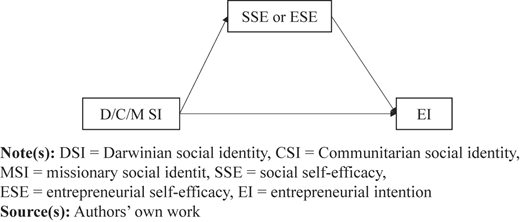
PROCESS macro v4.1 (bootstrap samples 5,000) for Statistical Package for the Social Sciences (SPSS) was applied with model 4 to test whether SSE or ESE mediates the effect of entrepreneurial social identities on entrepreneurial intention. Figure 1 shows the theoretical model 4.

The results indicate that the social identities with SSE or ESE as a mediator explain about 26–30% of changes in entrepreneurial intention. Darwinian social identity is fully mediated by ESE and partially mediated by SSE. The direct effect of Communitarian social identity disappears both in the presence of SSE and ESE. This means that the effect of Communitarian social identity is fully mediated by both SSE and ESE. Finally, both self-efficacies partially mediate the effect of Missionary social identity on entrepreneurial intention (Table 4).

The positive effect of SSE on ESE (Table 3) and the results of models 4 (Table 4) reaffirm the theoretical suggestion that ESE may partially or fully mediate the effect of SSE on entrepreneurial intention. Therefore, we have built up a serial mediation model (Model 6) for each social identity (Table 5). Model 6 can be gained by the extension of Model 4 with an additional mediator in such a way that the two mediators exercise their effects sequentially. We entered SSE as the first mediator and ESE as the second mediator into model 6 of each social identity.

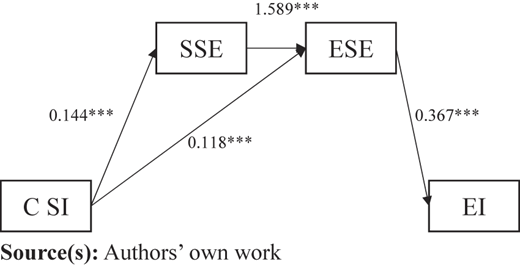
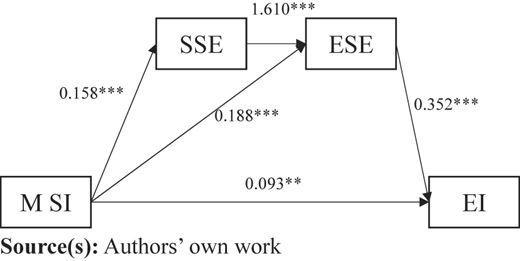
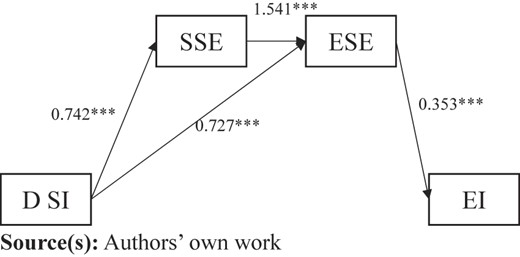
The model 6 results show that ESE fully mediates the effect of SSE on entrepreneurial intention (Tables 5 and 6). This result suggests that individuals understand the social nature of entrepreneurship and social skills are considered necessary to successfully fulfill entrepreneurial tasks. The findings also indicate that Darwinians reason that the basic entrepreneurial skillset (represented by ESE) is sufficient for them to run a successful business. Moreover, the result that Communitarian social identity is fully mediated by SSE suggests that Communitarians feel that social skills are enough to succeed as an entrepreneur. In contrast to these two social identities, Missionaries seem to acknowledge that they need additional skillsets to fulfill their entrepreneurial aspirations. Figures 2–4 summarize these relationships.

Thus, H1, H2 and H3 are confirmed.

Our results align with previous studies suggesting that entrepreneurial identity likely plays a positive role in shaping entrepreneurial intention across all entrepreneurial social identities (Hand et al., 2020). Furthermore, our findings reinforce the well-established role of ESE in influencing entrepreneurial intention (Barbosa et al., 2007; Fuller et al., 2018; Piperopoulos and Dimov, 2015). Our data indicate that Darwinian social identity is most strongly associated with ESE in shaping entrepreneurial intention. Additionally, our results offer new insights into the varying roles of SSE and ESE in entrepreneurial intention, depending on an individual’s entrepreneurial social identity. Specifically, Darwinians appear to place trust in their entrepreneurial skills, Communitarians seem to believe that SSE alone is sufficient for business success and Missionaries recognize the need for additional skillsets beyond social and entrepreneurial skills to achieve their entrepreneurial goals.

These findings have implications for both entrepreneurship research and practice. Our findings confirm that entrepreneurial social identity theory (Fauchart and Gruber, 2011) provides a productive framework for understanding individual-level variations in the antecedents of entrepreneurial intention, the role of ESE and SSE in entrepreneurial intention and the intended beneficiaries of the values produced. Our findings extend the literature on entrepreneurship by showing that individuals’ entrepreneurial social identity, entrepreneurial and social self-efficacies are intertwined in influencing the intention to create different values through entrepreneurial activities. This highlights the need for researchers to consider several task-specific self-efficacies when investigating entrepreneurial intention and behavior. Future research should expand beyond ESE to investigate the role of additional skillsets, particularly SSE for Communitarians and potential mission-specific skills for Missionaries. Longitudinal studies could provide insights into the causal relationships between social identities, self-efficacies and entrepreneurial outcomes. Further research could examine how SSE may compensate for lower levels of ESE among Communitarians and the potential development of a distinct “missionary self-efficacy” for Missionaries (Kročil et al., 2023).

As for the practical implications, policymakers should design entrepreneurial support programs that address both social and entrepreneurial skills, providing mentorship and skill development workshops tailored to different social identities. For example, Communitarians may require additional training in entrepreneurial skills, while Missionaries may need support in acquiring specialized skills aligned with their broader goals. Providing case studies and the consideration of potential role models to see how successful Communitarians and Missionaries solve everyday problems could help nascent entrepreneurs understand the skills and strategies needed for entrepreneurial success and navigate the challenges specific to their social identity.

In all probability, these practices would also assist nascent entrepreneurs in the formation of their entrepreneurial identity and making sense of the practices needed to fulfill their dual mission (Müller et al., 2023). Encouraging individuals to discover their entrepreneurial social identity and experience task-specific self-efficacies can help enhance individuals’ entrepreneurial intention and act on entrepreneurial opportunities matching their entrepreneurial social identity. These processes could encourage entrepreneurship and contribute to higher social welfare.

Finally, we enumerate the limitations of this study, based on which we propose further research avenues. The major limitation of this study is that all data is based on a self-report questionnaire. Future studies could rely on data from different sources, such as actual social activities or the types and aims of social relations or simulate decisions in different experimental settings. Furthermore, it would be worth assessing the SSE and ESE of established social and hybrid entrepreneurs.

The second limitation concerns using a single-item behavioral intention measure as the dependent variable. Although the link between behavioral intention and actual behavior is well established by theory and empirical results, longitudinal studies could verify the role of the constructs used in our examination of entrepreneurial behavior. Longitudinal studies could examine whether SSE, a Communitarian or Missionary, social identity before foundation, translates into successful social value creation. Based on our results, future research could also study whether SSE plays a more important role among social and hybrid entrepreneurs than among commercial entrepreneurs. In the same vein, the external circumstances that impede the translation of social value creation intention and SSE into meaningful actions should be studied.

Third, the cross-sectional nature of the data limits causal inferencing. Causality could be determined based on an experimental or longitudinal approach. Finally, the Hungarian sample limits the generalizability of results. Different entrepreneurial ecosystems and cultures may alter the effect of social identities on entrepreneurial intention and the pathways social identities exercise their effects. Future research could validate the findings of this study in different entrepreneurial environments and by an extended planned behavior model.

This study was motivated by the research question of whether the roles of ESE and SSE in entrepreneurial intention differ by entrepreneurial social identity. By offering new evidence on how entrepreneurial social identities interact with social and entrepreneurial self-efficacies to influence entrepreneurial intention, our findings contribute to the literature on entrepreneurial social identity, the antecedents of entrepreneurial intention and value creation objectives.

Funding: This study has been implemented with the support provided from the National Research, Development and Innovation Fund of Hungary (No. TKP2021-NKTA-19) and the Hungarian National Research, Development and Innovation Office (No: OTKA K_23 147233).
Acs
,
Z.J.
,
Estrin
,
S.
,
Mickiewicz
,
T.
and
Szerb
,
L.
(
2018
), “
Entrepreneurship, institutional economics, and economic growth: an ecosystem perspective
”,
Small Business Economics
, Vol. 
51
No. 
2
, pp. 
501
-
514
, doi: .
Ajzen
,
I.
(
1991
), “
The theory of planned behavior
”,
Organizational Behavior and Human Decision Processes
, Vol. 
50
No. 
2
, pp. 
179
-
211
, doi: .
Ajzen
,
I.
,
Czasch
,
C.
and
Flood
,
M.G.
(
2009
), “
From intentions to behavior: implementation intention, commitment, and conscientiousness 1
”,
Journal of Applied Social Psychology
, Vol. 
39
No. 
6
, pp. 
1356
-
1372
, doi: .
Anderson
,
S.L.
and
Betz
,
N.E.
(
2001
), “
Sources of social self-efficacy expectations: their measurement and relation to career development
”,
Journal of Vocational Behavior
, Vol. 
58
No. 
1
, pp. 
98
-
117
, doi: .
Ardianti
,
R.
,
Obschonka
,
M.
and
Davidsson
,
P.
(
2022
), “
Psychological well-being of hybrid entrepreneurs
”,
Journal of Business Venturing Insights
, Vol. 
17
, doi: .
Arend
,
R.J.
(
2014
), “
Social and environmental performance at SMEs: considering motivations, capabilities, and instrumentalism
”,
Journal of Business Ethics
, Vol. 
125
No. 
4
, pp. 
541
-
561
, doi: .
Armitage
,
C.J.
and
Conner
,
M.
(
2001
), “
Efficacy of the theory of planned behaviour: a meta‐analytic review
”,
British Journal of Social Psychology
, Vol. 
40
No. 
4
, pp. 
471
-
499
, doi: .
Bandura
,
A.
(
1986
),
Social Foundations of Thought and Action
,
Prentice-Hall
,
Englewood Cliffs, NJ
.
Bandura
,
A.
(
2006
), “Guide for constructing self-efficacy scales”, in
Pajares
,
F.
and
Urdan
,
T.C.
(Eds),
Self-efficacy Beliefs of Adolescents
,
Information Age Publishing
,
Greenwich, CT
, pp. 
307
-
337
.
Barbosa
,
S.D.
,
Gerhardt
,
M.W.
and
Kickul
,
J.R.
(
2007
), “
The role of cognitive style and risk preference on entrepreneurial self-efficacy and entrepreneurial intentions
”,
Journal of Leadership & Organizational Studies
, Vol. 
13
No. 
4
, pp. 
86
-
104
, doi: .
Brändle
,
L.
,
Berger
,
E.S.C.
,
Golla
,
S.
and
Kuckertz
,
A.
(
2018
), “
I am what i am - how nascent entrepreneurs’ social identity affects their entrepreneurial self-efficacy
”,
Journal of Business Venturing Insights
, Vol. 
9
No. 
6
, pp. 
17
-
23
, doi: .
Brieger
,
S.A.
,
Bäro
,
A.
,
Criaco
,
G.
and
Terjesen
,
S.A.
(
2020
), “
Entrepreneurs’ age, institutions, and social value creation goals: a multi-country study
”,
Small Business Economics
, Vol. 
57
No. 
1
, pp. 
425
-
453
, doi: .
Cardon
,
M.S.
,
Wincent
,
J.
,
Singh
,
J.
and
Drnovsek
,
M.
(
2009
), “
The nature and experience of entrepreneurial passion
”,
Academy of Management Review
, Vol. 
34
No. 
3
, pp. 
511
-
532
, doi: .
Ceresia
,
F.
and
Mendola
,
C.
(
2020
), “
Am I an entrepreneur? Entrepreneurial self-identity as an antecedent of entrepreneurial intention
”,
Administrative Sciences
, Vol. 
10
No. 
3
, p.
46
, doi: .
Chen
,
C.C.
,
Greene
,
P.G.
and
Crick
,
A.
(
1998
), “
Does entrepreneurial self-efficacy distinguish entrepreneurs from managers?
”,
Journal of Business Venturing
, Vol. 
13
No. 
4
, pp. 
295
-
316
, doi: .
Duong
,
C.D.
and
Vu
,
N.X.
(
2023
), “
Entrepreneurial education and intention: fear of failure, self-efficacy and gender
”,
Journal of Small Business and Enterprise Development
, Vol. 
31
No. 
4
, pp. 
629
-
654
, doi: .
Fan
,
J.
,
Litchfield
,
R.C.
,
Islam
,
S.
,
Weiner
,
B.
,
Alexander
,
M.
,
Liu
,
C.
and
Kulviwat
,
S.
(
2013
), “
Workplace social self-efficacy
”,
Journal of Career Assessment
, Vol. 
21
No. 
1
, pp. 
91
-
110
, doi: .
Farmer
,
S.M.
,
Yao
,
X.
and
Kung–Mcintyre
,
K.
(
2011
), “
The behavioral impact of entrepreneur identity aspiration and prior entrepreneurial experience
”,
Entrepreneurship Theory and Practice
, Vol. 
35
No. 
2
, pp. 
245
-
273
, doi: .
Fauchart
,
E.
and
Gruber
,
M.
(
2011
), “
Darwinians, communitarians, and missionaries: the role of founder identity in entrepreneurship
”,
Academy of Management Journal
, Vol. 
54
No. 
5
, pp. 
935
-
957
, doi: .
Fornell
,
C.
and
Larcker
,
D.F.
(
1981
), “
Evaluating structural equation models with unobservable variables and measurement error
”,
Journal of Marketing Research
, Vol. 
18
No. 
1
, pp. 
39
-
50
, doi: .
Fuller
,
B.
,
Liu
,
Y.
,
Bajaba
,
S.
,
Marler
,
L.E.
and
Pratt
,
J.
(
2018
), “
Examining how the personality, self-efficacy, and anticipatory cognitions of potential entrepreneurs shape their entrepreneurial intentions
”,
Personality and Individual Differences
, Vol. 
125
, pp. 
120
-
125
, doi: .
Geldhof
,
G.J.
,
Preacher
,
K.J.
and
Zyphur
,
M.J.
(
2014
), “
Reliability estimation in a multilevel confirmatory factor analysis framework
”,
Psychological Methods
, Vol. 
19
No. 
1
, pp. 
72
-
91
, doi: .
Gieure
,
C.
,
del Mar Benavides-Espinosa
,
M.
and
Roig-Dobón
,
S.
(
2020
), “
The entrepreneurial process: the link between intentions and behavior
”,
Journal of Business Research
, Vol. 
112
, pp. 
541
-
548
, doi: .
Gonzalez-Canosa
,
M.L.
,
Osorio-Tinoco
,
F.
,
Capelleras Segura
,
J.L.
,
Krauss-Delorme
,
C.
and
Pereira-Laverde
,
F.
(
2021
), “
Is it because I can or because of who I am? The moderating effect of entrepreneurship; social identity on entrepreneurial self-efficacys’ - entrepreneurial intention relationship
”,
Journal of Technology Management and Innovation
, Vol. 
16
No. 
4
, pp. 
46
-
55
, doi: .
Grimstad
,
S.M.F.
,
Glavee-Geo
,
R.
and
Fjørtoft
,
B.E.
(
2020
), “
SMEs motivations for CSR: an exploratory study
”,
European Business Review
, Vol. 
32
No. 
4
, pp. 
553
-
572
, doi: .
Gruber
,
M.
and
MacMillan
,
I.C.
(
2017
), “
Entrepreneurial behavior: a reconceptualization and extension based on identity theory
”,
Strategic Entrepreneurship Journal
, Vol. 
11
No. 
3
, pp. 
271
-
286
, doi: .
Hambrick
,
D.C.
and
Mason
,
P.A.
(
1984
), “
Upper echelons: the organization as a reflection of its top managers
”,
Academy of Management Review
, Vol. 
9
No. 
2
, pp. 
193
-
206
, doi: .
Hand
,
C.
,
Iskandarova
,
M.
and
Blackburn
,
R.
(
2020
), “
Founders’ social identity and entrepreneurial self-efficacy amongst nascent entrepreneurs: a configurational perspective
”,
Journal of Business Venturing Insights
, Vol. 
13
, e00160, doi: .
Hockerts
,
K.
(
2017
), “
Determinants of social entrepreneurial intentions
”,
Entrepreneurship Theory and Practice
, Vol. 
41
No. 
1
, pp. 
105
-
130
, doi: .
Holmberg-Wright
,
K.
and
Hribar
,
T.
(
2016
), “
Soft skills-the missing piece for entrepreneurs to grow a business
”,
American Journal of Management
, Vol. 
16
No. 
1
, p.
11
.
Hossain
,
M.U.
,
Arefin
,
M.S.
and
Yukongdi
,
V.
(
2021
), “
Personality traits, social self-efficacy, social support, and social entrepreneurial intention: the moderating role of gender
”,
Journal of Social Entrepreneurship
, Vol. 
15
, pp. 
1
-
21
, doi: .
Hu
,
L.T.
and
Bentler
,
P.M.
(
1999
), “
Cutoff criteria for fit indexes in covariance structure analysis: conventional criteria versus new alternatives
”,
Structural Equation Modeling: A Multidisciplinary Journal
, Vol. 
6
No. 
1
, pp. 
1
-
55
, doi: .
Jayawarna
,
D.
,
Rouse
,
J.
and
Kitching
,
J.
(
2013
), “
Entrepreneur motivations and life course
”,
International Small Business Journal
, Vol. 
31
No. 
1
, pp. 
34
-
56
, doi: .
Kahai
,
S.S.
and
Lei
,
Y.
(
2019
), “
Building social capital with Facebook: type of network, availability of other media, and social self-efficacy matter#
”,
International Journal of Human-Computer Studies
, Vol. 
130
, pp. 
113
-
129
, doi: .
Ko
,
E.-J.
and
Kim
,
K.
(
2020
), “
Connecting founder social identity with social entrepreneurial intentions
”,
Social Enterprise Journal
, Vol. 
16
No. 
4
, pp. 
403
-
429
, doi: .
Kročil
,
O.
,
Müller
,
M.
and
Kubátová
,
J.
(
2023
), “
Vulnerable social enterprises: sensemaking of the COVID-19 crisis in the Czech Republic
”,
Social Enterprise Journal
, Vol. 
19
No. 
2
, pp. 
144
-
166
, doi: .
Lent
,
R.W.
,
Brown
,
S.D.
and
Hackett
,
G.
(
1994
), “
Toward a unifying social cognitive theory of career and academic interest, choice, and performance
”,
Journal of Vocational Behavior
, Vol. 
45
No. 
1
, pp. 
79
-
122
, doi: .
Lihua
,
D.
(
2022
), “
An extended model of the theory of planned behavior: an empirical study of entrepreneurial intention and entrepreneurial behavior in college students
”,
Frontiers in Psychology
, Vol. 
12
, 627818, doi: .
Liu
,
Q.
,
Liu
,
J.
,
Cai
,
J.
and
Zhang
,
Z.
(
2020
), “
The relationship between domain-and task-specific self-efficacy and mathematical problem posing: a large-scale study of eighth-grade students in China
”,
Educational Studies in Mathematics
, Vol. 
105
No. 
3
, pp. 
407
-
431
, doi: .
McDonald
,
N.M.
and
Messinger
,
D.S.
(
2011
), “The development of empathy: how, when, and why”, in
Sanguineti
,
J.J.
,
Acerbi
,
A.
and
Lombo
,
J.A.
(Eds),
Moral Behavior and Free Will: A Neurobiological and Philosophical Approach
,
IF-Press
,
Vatican City
, pp. 
341
-
368
.
McGall
,
G.J.
and
Simmons
,
J.L.
(
1978
),
Identities and Interactions: An Examination of Human Associations in Everyday Life
,
The Free Press
,
New York, NY
.
Miao
,
C.
,
Qian
,
S.
and
Ma
,
D.
(
2017
), “
The relationship between entrepreneurial self-efficacy and firm performance: a meta-analysis of main and moderator effects
”,
Journal of Small Business Management
, Vol. 
55
No. 
1
, pp. 
87
-
107
, doi: .
Müller
,
M.
,
Vaseková
,
V.
and
Kročil
,
O.
(
2023
), “
Entrepreneurial solutions to social problems: philosophy versus management as a guiding paradigm for social enterprise success
”,
Journal of Small Business and Enterprise Development
, Vol. 
31
No. 
1
, pp. 
31
-
54
, doi: .
Murnieks
,
C.
and
Mosakowski
,
E.
(
2007
), “
Who am I? Looking inside the 'entrepreneurial identity'
”,
Babson College Entrepreneurship Research Conference (BCERC) 2007, Frontiers of Entrepreneurship Research 2007
,
available at:
 https://ssrn.com/abstract=1064901
Newman
,
A.
,
Obschonka
,
M.
,
Schwarz
,
S.
,
Cohen
,
M.
and
Nielsen
,
I.
(
2019
), “
Entrepreneurial self-efficacy: a systematic review of the literature on its theoretical foundations, measurement, antecedents, and outcomes, and an agenda for future research
”,
Journal of Vocational Behavior
, Vol. 
110
, pp. 
403
-
419
, doi: .
Ngah
,
R.
and
Salleh
,
Z.
(
2015
), “
Emotional intelligence and entrepreneurs’ innovativeness towards entrepreneurial success: a preliminary study
”,
American Journal of Economics
, Vol. 
5
No. 
2
, pp. 
285
-
290
, doi: .
Piperopoulos
,
P.
and
Dimov
,
D.
(
2015
), “
Burst bubbles or build steam? Entrepreneurship education, entrepreneurial self‐efficacy, and entrepreneurial intentions
”,
Journal of Small Business Management
, Vol. 
53
No. 
4
, pp. 
970
-
985
, doi: .
Pituch
,
K.A.
and
Stevens
,
J.P.
(
2015
),
Applied Multivariate Statistics for the Social Sciences: Analyses with SAS and IBM’s SPSS
,
Routledge
,
New York, NY
.
Radu-Lefebvre
,
M.
,
Lefebvre
,
V.
,
Crosina
,
E.
and
Hytti
,
U.
(
2021
), “
Entrepreneurial identity: a review and research agenda
”,
Entrepreneurship Theory and Practice
, Vol. 
45
No. 
6
, pp. 
1550
-
1590
, doi: .
Seyoum
,
B.
,
Chinta
,
R.
and
Mujtaba
,
B.G.
(
2021
), “
Social support as a driver of social entrepreneurial intentions: the moderating roles of entrepreneurial education and proximity to the US small business administration
”,
Journal of Small Business and Enterprise Development
, Vol. 
28
No. 
3
, pp. 
337
-
359
, doi: .
Shepherd
,
D.
and
Haynie
,
J.M.
(
2009
), “
Birds of a feather don’t always flock together: identity management in entrepreneurship
”,
Journal of Business Venturing
, Vol. 
24
No. 
4
, pp. 
316
-
337
, doi: .
Sherer
,
M.
,
Maddux
,
J.E.
,
Mercandante
,
B.
,
Prentice-Dunn
,
S.
,
Jacobs
,
B.
and
Rogers
,
R.W.
(
1982
), “
The self-efficacy scale: construction and validation
”,
Psychological Reports
, Vol. 
51
No. 
2
, pp. 
663
-
671
, doi: .
Sieger
,
P.
,
Gruber
,
M.
,
Fauchart
,
E.
and
Zellweger
,
T.
(
2016
), “
Measuring the social identity of entrepreneurs: scale development and international validation
”,
Journal of Business Venturing
, Vol. 
31
No. 
5
, pp. 
542
-
572
, doi: .
Stryker
,
S.
(
1968
), “
Identity salience and role performance: the relevance of symbolic interaction theory for family research
”,
Journal of Marriage and Family
, Vol. 
30
No. 
4
, p.
558
, doi: .
Stryker
,
S.
and
Burke
,
P.J.
(
2000
), “
The past, present, and future of an identity theory
”,
Social Psychology Quarterly
, Vol. 
63
No. 
4
, p.
284
, doi: .
Syna Desivilya
,
H.
and
Eizen
,
D.
(
2005
), “
Conflict management in work teams: the role of social self‐efficacy and group identification
”,
International Journal of Conflict Management
, Vol. 
16
No. 
2
, pp. 
183
-
208
, doi: .
Tajfel
,
H.
,
Turner
,
J.C.
,
Austin
,
W.G.
and
Worchel
,
S.
(
1979
), “
An integrative theory of intergroup conflict
”,
Organizational Identity: Read
, Vol. 
56
No. 
65
, doi: .
Wu
,
S.Y.
,
Wang
,
S.T.
,
Liu
,
F.
,
Hu
,
D.C.
and
Hwang
,
W.-Y.
(
2012
), “
The influences of social self-efficacy on social trust and social capital--a case study of facebook
”,
Turkish Online Journal of Educational Technology
, Vol. 
11
No. 
2
, pp. 
246
-
254
.
Wu
,
W.
,
Wang
,
H.
,
Wei
,
C.W.
and
Zheng
,
C.
(
2021
), “
Sharing achievement and social entrepreneurial intention: the role of perceived social worth and social entrepreneurial self-efficacy
”,
Management Decision
, Vol. 
59
No. 
11
, pp. 
2737
-
2754
, doi: .
Zhao
,
H.
,
Seibert
,
S.E.
and
Hills
,
G.E.
(
2005
), “
The mediating role of self-efficacy in the development of entrepreneurial intentions
”,
Journal of Applied Psychology
, Vol. 
90
No. 
6
, pp. 
1265
-
1272
, doi: .
Published by Emerald Publishing Limited. This article is published under the Creative Commons Attribution (CC BY 4.0) licence. Anyone may reproduce, distribute, translate and create derivative works of this article (for both commercial and non-commercial purposes), subject to full attribution to the original publication and authors. The full terms of this licence may be seen at http://creativecommons.org/licences/by/4.0/legalcode

Data & Figures

Figure 1
A model shows a flow from D or C or M S I to S S E or E S C and E I, with arrows linking the three boxes.The model shows a text box labeled “D or C or M S I”, on the bottom left. From this box, two arrows extend right. The first arrow extends upward and points to a box at the top centre labeled “S S E or E S C”. The second arrow extends rightward and points at a box at the bottom right labeled “E I”. From “S S E or E S C”, a downward arrow arises and points to “E I”.

SSE/ESE mediation control of social identities to entrepreneurial intention based on Hayes Model 4

Figure 1
A model shows a flow from D or C or M S I to S S E or E S C and E I, with arrows linking the three boxes.The model shows a text box labeled “D or C or M S I”, on the bottom left. From this box, two arrows extend right. The first arrow extends upward and points to a box at the top centre labeled “S S E or E S C”. The second arrow extends rightward and points at a box at the bottom right labeled “E I”. From “S S E or E S C”, a downward arrow arises and points to “E I”.

SSE/ESE mediation control of social identities to entrepreneurial intention based on Hayes Model 4

Close Figure 1
Figure 2
A figure shows mediation paths linking D S I, S S E, E S E, and E I in a Hayes Model 6 chain mediation.The model shows a text box labeled “D S I” at the bottom left. From this box, two arrows extend upward and point to a text box positioned at the top centre. The first arrow labeled “0.742 triple asterisk” points to the box on the left labeled “S S E”. The second arrow labeled “0.727 triple asterisks” points to the box on the right labeled “E S E”. From “S S E”, a rightward arrow labeled “1.541 triple asterisk” points to “E S E”. From “E S E”, a downward arrow labeled “0.353 triple asterisk” points to the text box labeled “E I”, which is on the bottom left.

SSE and ESE chain mediation of Darwinian social identity for entrepreneurial intention according to Hayes Model 6

Figure 2
A figure shows mediation paths linking D S I, S S E, E S E, and E I in a Hayes Model 6 chain mediation.The model shows a text box labeled “D S I” at the bottom left. From this box, two arrows extend upward and point to a text box positioned at the top centre. The first arrow labeled “0.742 triple asterisk” points to the box on the left labeled “S S E”. The second arrow labeled “0.727 triple asterisks” points to the box on the right labeled “E S E”. From “S S E”, a rightward arrow labeled “1.541 triple asterisk” points to “E S E”. From “E S E”, a downward arrow labeled “0.353 triple asterisk” points to the text box labeled “E I”, which is on the bottom left.

SSE and ESE chain mediation of Darwinian social identity for entrepreneurial intention according to Hayes Model 6

Close Figure 2
Figure 3
A model shows mediation paths linking C S I, S S E, E S E, and E I.The model shows a text box labeled “C S I” at the bottom left. From this box, two arrows extend upward and point to a text box positioned at the top centre. The first arrow labeled “0.144 triple asterisk” points to the box on the left labeled “S S E”. The second arrow labeled “0.118 triple asterisks” points to the box on the right labeled “E S E”. From “S S E”, a rightward arrow labeled “1.589 triple asterisk” points to “E S E”. From “E S E”, a downward arrow labeled “0.367 triple asterisk” points to the text box labeled “E I”, which is on the bottom left.

SSE and ESE chain mediation of communitarian social identity for entrepreneurial intention according to Hayes Model 6

Figure 3
A model shows mediation paths linking C S I, S S E, E S E, and E I.The model shows a text box labeled “C S I” at the bottom left. From this box, two arrows extend upward and point to a text box positioned at the top centre. The first arrow labeled “0.144 triple asterisk” points to the box on the left labeled “S S E”. The second arrow labeled “0.118 triple asterisks” points to the box on the right labeled “E S E”. From “S S E”, a rightward arrow labeled “1.589 triple asterisk” points to “E S E”. From “E S E”, a downward arrow labeled “0.367 triple asterisk” points to the text box labeled “E I”, which is on the bottom left.

SSE and ESE chain mediation of communitarian social identity for entrepreneurial intention according to Hayes Model 6

Close Figure 3
Figure 4
A figure linking M S I, S S E, E S E, and E I in a Hayes Model.The model shows the “S S E” and “E S E” chain mediation of missionary social identity for entrepreneurial intention according to Hayes Model 6. The model shows a text box labeled “M S I” at the bottom left. From this box, two arrows extend upward and point to a text box positioned at the top centre. The first arrow labeled “0.158 triple asterisk” points to the box on the left labeled “S S E”. The second arrow labeled “0.188 triple asterisks” points to the box on the right labeled “E S E”. From “S S E”, a rightward arrow labeled “1.610 triple asterisk” points to “E S E”. From “E S E”, a downward arrow labeled “0.352 triple asterisk” points to the text box labeled “E I”, which is on the bottom left. From “M S I”, a right pointing arrow labeled “0.093 double asterisks” points to “E I”.

SSE and ESE chain mediation of missionary social identity for entrepreneurial intention according to Hayes Model 6

Figure 4
A figure linking M S I, S S E, E S E, and E I in a Hayes Model.The model shows the “S S E” and “E S E” chain mediation of missionary social identity for entrepreneurial intention according to Hayes Model 6. The model shows a text box labeled “M S I” at the bottom left. From this box, two arrows extend upward and point to a text box positioned at the top centre. The first arrow labeled “0.158 triple asterisk” points to the box on the left labeled “S S E”. The second arrow labeled “0.188 triple asterisks” points to the box on the right labeled “E S E”. From “S S E”, a rightward arrow labeled “1.610 triple asterisk” points to “E S E”. From “E S E”, a downward arrow labeled “0.352 triple asterisk” points to the text box labeled “E I”, which is on the bottom left. From “M S I”, a right pointing arrow labeled “0.093 double asterisks” points to “E I”.

SSE and ESE chain mediation of missionary social identity for entrepreneurial intention according to Hayes Model 6

Close Figure 4
Table 1

Entrepreneurial identity frameworks

Aspects of entrepreneurial identityApplication of categoryTheoretical foundationsDefinition and application in entrepreneurship research
Person identitySelf-identity, person as an individualStryker (1968), Stryker and Burke (2000) attributes discerning an individual as a unique person; entrepreneurship studies examine salient person identities related to different entrepreneurial roles, such as risk-taker, communicator (Shepherd and Haynie, 2009)
Role identitySelf-identity, person as a role-playerStryker (1968), McGall and Simmons (1978) entrepreneurial identity is a super-ordinate identity comprehending diverse role identities (Cardon et al., 2009; Shepherd and Haynie, 2009); Cardon et al. (2009) distinguishes inventor, founder, and developer identities of entrepreneurs
Social identitySocial identity, person as a member of a social groupStryker (1968), Tajfel et al. (1979) self-concept deriving from group memberships, a way of interpreting behavioral options based on group membership; entrepreneurial or founder social identity is often referred to as the self-conceptualization based on the social motivation for starting a venture (Fauchart and Gruber, 2011; Gruber and MacMillan, 2017)

Source(s): Authors’ own work

Table 2

Factors’ descriptive statistics and correlations

MSDD SIC SIM SISSEESEEI
D SI5.081.271     
C SI4.571.480.457**1    
M SI5.471.050.913**0.095**1   
SSE4.161.240.384**0.359**0.304**1  
ESE4.681.450.401**0.361**0.307**0.735**1 
EI2.311.730.122**0.087**0.127**0.222**0.356**1

Note(s): *p ≤ 0.05 and **p ≤ 0.01. D SI = Darwinian social identity. C SI= Communitarian social identity. M SI = Missionary social identity. SSE = social self-efficacy. ESE = entrepreneurial self-efficacy. EI = entrepreneurial intention

Source(s): Authors’ own work

Table 3

OLS regression results

EISSEESE
ID D0.835***    0.742***  0.727***  
ID C 0.126***    0.144***  0.118*** 
ID M  0.214***    0.158***  0.129***
ESE   0.352***       
SSE    0.572***   1.541***1.588***1.610***
EntrFam−0.783***−0.812***−0.782***−0.685***−0.763***−0.069*−0.092**−0.074**−0.196***−0.215−0.198***
EntrTC−0.659***−0.642***−0.684***−0.476***−0.564***−0.178***−0.155***−0.198***−0.254***−0.227***−0.259***
Age−0.042***−0.042***−0.042***−0.038***−0.041***0.0000.0000.000−0.010***−0.009***−0.009***
Gender0.217**0.162*0.219**0.0670.1100.131***0.084**0.122***0.184***0.133**0.162***
Adj R20.2450.2340.2440.2970.2600.1770.1500.1250.5810.5720.570
F66.26***62.52***65.83***86.03***71.53***44.31***36.55***29.66***233.27***224.97***222.70***

Note(s): *p ≤ 0.1, **p ≤ 0.05 and ***p ≤ 0.01. D SI = Darwinian social identity. C SI = Communitarian social identity. M SI = Missionary social identity. SSE = social self-efficacy. ESE = entrepreneurial self-efficacy. EI = entrepreneurial intention. EntrFam = entrepreneur in the family. EnrTC = entrepreneurial training

Source(s): Authors’ own work

Table 4

Single mediator model results

(X → M) B(M → Y) B(X → Y) BTotal R2Total FTotal effect (X → Y)Direct effect (X → Y)Indirect effect (X → Y)
X = D SI M = SSE Y = EI0.742***0.472***0.835***0.270***61.4300.835***0.485**0.350
X = C SI M = SSE Y = EI0.144***0.528***0.126***0.265***60.0010.126***0.0500.076
X = M SI M = SSE Y = EI0.158***0.485***0.214***0.271***61.8640.214***0.138***0.077
X = D SI M = ESE Y = EI1.870***0.332***0.8350.302***72.0140.8350.2150.620
X = C SI M = ESE Y = EI0.437***0.351***0.126***0.301***71.6270.126***0.0050.122
X = M SI M = ESE Y = EI0.383***0.327***0.214***0.304***72.680.214***0.089**0.125

Note(s): *p ≤ 0.1, **p ≤ 0.05 and ***p ≤ 0.01. D SI = Darwinian social identity. C SI= Communitarian social identity. M SI = Missionary social identity. SSE = social self-efficacy. ESE = entrepreneurial self-efficacy. EI = entrepreneurial intention

Source(s): Authors’ own work

Table 5

Serial mediation model results

(X → M1) B(X → M2) B(M1 → M2) B(M1 → Y) B(M2 → Y) B(X → Y) BTotal R2Total FTotal effect (X → Y)Direct effect (X → Y)
X = M SI M1 = SSE M2 = ESE Y = EI0.158***0.188***1.610***−0.0810.352***0.214***0.304***65.8330.214***0.093**
X = D SI M1 = SSE M2 = ESE Y = EI0.742***0.727***1.541***−0.0720.353***0.835***0.302***61.7420.835***0.228
X = C SI M1 = SSE M2 = ESE Y = EI0.144***0.118***1.589***−0.0540.367***0.126***0.301***61.3760.126***0.007

Note(s): *p ≤ 0.1, **p ≤ 0.05 and ***p ≤ 0.01. M SI = Missionary social identity. D SI = Darwinian social identity. C SI= Communitarian social identity. SSE = social self-efficacy. ESE = entrepreneurial self-efficacy. EI = entrepreneurial intention

Source(s): Authors’ own work

Table 6

Serial mediation model indirect effects

EffectBoot SEBoot LLCIBoot ULCI
Ind D SI → EI0.6070.0920.4340.792
Ind1 D SI → SSE → EI−0.0540.099−0.2500.140
Ind2 D SI → ESE → EI0.2560.0600.1510.386
Ind3 D S → SSE → ESE - → EI0.4040.0720.2700.554
Ind C SI → EI0.1190.0180.0860.156
Ind1 C SI → SSE → EI−0.0080.019−0.0440.031
Ind2 C SI → ESE → EI0.0430.0110.0240.066
Ind3 C SI → SSE → ESE - → EI0.0840.0150.0560.116
Ind M SI → EI0.1220.0210.0850.166
Ind1 M S → SSE → EI−0.0130.021−0.0520.029
Ind2 M SI → ESE → EI0.0450.0130.0210.073
Ind3 M SI → SSE → ESE → EI0.0890.0170.0570.125

Note(s): D SI = Darwinian social identity. C SI= Communitarian social identity. M SI = Missionary social identity. SSE = social self-efficacy. ESE = entrepreneurial self-efficacy. EI = entrepreneurial intention

Source(s): Authors’ own work

Supplements

References

Acs
,
Z.J.
,
Estrin
,
S.
,
Mickiewicz
,
T.
and
Szerb
,
L.
(
2018
), “
Entrepreneurship, institutional economics, and economic growth: an ecosystem perspective
”,
Small Business Economics
, Vol. 
51
No. 
2
, pp. 
501
-
514
, doi: .
Ajzen
,
I.
(
1991
), “
The theory of planned behavior
”,
Organizational Behavior and Human Decision Processes
, Vol. 
50
No. 
2
, pp. 
179
-
211
, doi: .
Ajzen
,
I.
,
Czasch
,
C.
and
Flood
,
M.G.
(
2009
), “
From intentions to behavior: implementation intention, commitment, and conscientiousness 1
”,
Journal of Applied Social Psychology
, Vol. 
39
No. 
6
, pp. 
1356
-
1372
, doi: .
Anderson
,
S.L.
and
Betz
,
N.E.
(
2001
), “
Sources of social self-efficacy expectations: their measurement and relation to career development
”,
Journal of Vocational Behavior
, Vol. 
58
No. 
1
, pp. 
98
-
117
, doi: .
Ardianti
,
R.
,
Obschonka
,
M.
and
Davidsson
,
P.
(
2022
), “
Psychological well-being of hybrid entrepreneurs
”,
Journal of Business Venturing Insights
, Vol. 
17
, doi: .
Arend
,
R.J.
(
2014
), “
Social and environmental performance at SMEs: considering motivations, capabilities, and instrumentalism
”,
Journal of Business Ethics
, Vol. 
125
No. 
4
, pp. 
541
-
561
, doi: .
Armitage
,
C.J.
and
Conner
,
M.
(
2001
), “
Efficacy of the theory of planned behaviour: a meta‐analytic review
”,
British Journal of Social Psychology
, Vol. 
40
No. 
4
, pp. 
471
-
499
, doi: .
Bandura
,
A.
(
1986
),
Social Foundations of Thought and Action
,
Prentice-Hall
,
Englewood Cliffs, NJ
.
Bandura
,
A.
(
2006
), “Guide for constructing self-efficacy scales”, in
Pajares
,
F.
and
Urdan
,
T.C.
(Eds),
Self-efficacy Beliefs of Adolescents
,
Information Age Publishing
,
Greenwich, CT
, pp. 
307
-
337
.
Barbosa
,
S.D.
,
Gerhardt
,
M.W.
and
Kickul
,
J.R.
(
2007
), “
The role of cognitive style and risk preference on entrepreneurial self-efficacy and entrepreneurial intentions
”,
Journal of Leadership & Organizational Studies
, Vol. 
13
No. 
4
, pp. 
86
-
104
, doi: .
Brändle
,
L.
,
Berger
,
E.S.C.
,
Golla
,
S.
and
Kuckertz
,
A.
(
2018
), “
I am what i am - how nascent entrepreneurs’ social identity affects their entrepreneurial self-efficacy
”,
Journal of Business Venturing Insights
, Vol. 
9
No. 
6
, pp. 
17
-
23
, doi: .
Brieger
,
S.A.
,
Bäro
,
A.
,
Criaco
,
G.
and
Terjesen
,
S.A.
(
2020
), “
Entrepreneurs’ age, institutions, and social value creation goals: a multi-country study
”,
Small Business Economics
, Vol. 
57
No. 
1
, pp. 
425
-
453
, doi: .
Cardon
,
M.S.
,
Wincent
,
J.
,
Singh
,
J.
and
Drnovsek
,
M.
(
2009
), “
The nature and experience of entrepreneurial passion
”,
Academy of Management Review
, Vol. 
34
No. 
3
, pp. 
511
-
532
, doi: .
Ceresia
,
F.
and
Mendola
,
C.
(
2020
), “
Am I an entrepreneur? Entrepreneurial self-identity as an antecedent of entrepreneurial intention
”,
Administrative Sciences
, Vol. 
10
No. 
3
, p.
46
, doi: .
Chen
,
C.C.
,
Greene
,
P.G.
and
Crick
,
A.
(
1998
), “
Does entrepreneurial self-efficacy distinguish entrepreneurs from managers?
”,
Journal of Business Venturing
, Vol. 
13
No. 
4
, pp. 
295
-
316
, doi: .
Duong
,
C.D.
and
Vu
,
N.X.
(
2023
), “
Entrepreneurial education and intention: fear of failure, self-efficacy and gender
”,
Journal of Small Business and Enterprise Development
, Vol. 
31
No. 
4
, pp. 
629
-
654
, doi: .
Fan
,
J.
,
Litchfield
,
R.C.
,
Islam
,
S.
,
Weiner
,
B.
,
Alexander
,
M.
,
Liu
,
C.
and
Kulviwat
,
S.
(
2013
), “
Workplace social self-efficacy
”,
Journal of Career Assessment
, Vol. 
21
No. 
1
, pp. 
91
-
110
, doi: .
Farmer
,
S.M.
,
Yao
,
X.
and
Kung–Mcintyre
,
K.
(
2011
), “
The behavioral impact of entrepreneur identity aspiration and prior entrepreneurial experience
”,
Entrepreneurship Theory and Practice
, Vol. 
35
No. 
2
, pp. 
245
-
273
, doi: .
Fauchart
,
E.
and
Gruber
,
M.
(
2011
), “
Darwinians, communitarians, and missionaries: the role of founder identity in entrepreneurship
”,
Academy of Management Journal
, Vol. 
54
No. 
5
, pp. 
935
-
957
, doi: .
Fornell
,
C.
and
Larcker
,
D.F.
(
1981
), “
Evaluating structural equation models with unobservable variables and measurement error
”,
Journal of Marketing Research
, Vol. 
18
No. 
1
, pp. 
39
-
50
, doi: .
Fuller
,
B.
,
Liu
,
Y.
,
Bajaba
,
S.
,
Marler
,
L.E.
and
Pratt
,
J.
(
2018
), “
Examining how the personality, self-efficacy, and anticipatory cognitions of potential entrepreneurs shape their entrepreneurial intentions
”,
Personality and Individual Differences
, Vol. 
125
, pp. 
120
-
125
, doi: .
Geldhof
,
G.J.
,
Preacher
,
K.J.
and
Zyphur
,
M.J.
(
2014
), “
Reliability estimation in a multilevel confirmatory factor analysis framework
”,
Psychological Methods
, Vol. 
19
No. 
1
, pp. 
72
-
91
, doi: .
Gieure
,
C.
,
del Mar Benavides-Espinosa
,
M.
and
Roig-Dobón
,
S.
(
2020
), “
The entrepreneurial process: the link between intentions and behavior
”,
Journal of Business Research
, Vol. 
112
, pp. 
541
-
548
, doi: .
Gonzalez-Canosa
,
M.L.
,
Osorio-Tinoco
,
F.
,
Capelleras Segura
,
J.L.
,
Krauss-Delorme
,
C.
and
Pereira-Laverde
,
F.
(
2021
), “
Is it because I can or because of who I am? The moderating effect of entrepreneurship; social identity on entrepreneurial self-efficacys’ - entrepreneurial intention relationship
”,
Journal of Technology Management and Innovation
, Vol. 
16
No. 
4
, pp. 
46
-
55
, doi: .
Grimstad
,
S.M.F.
,
Glavee-Geo
,
R.
and
Fjørtoft
,
B.E.
(
2020
), “
SMEs motivations for CSR: an exploratory study
”,
European Business Review
, Vol. 
32
No. 
4
, pp. 
553
-
572
, doi: .
Gruber
,
M.
and
MacMillan
,
I.C.
(
2017
), “
Entrepreneurial behavior: a reconceptualization and extension based on identity theory
”,
Strategic Entrepreneurship Journal
, Vol. 
11
No. 
3
, pp. 
271
-
286
, doi: .
Hambrick
,
D.C.
and
Mason
,
P.A.
(
1984
), “
Upper echelons: the organization as a reflection of its top managers
”,
Academy of Management Review
, Vol. 
9
No. 
2
, pp. 
193
-
206
, doi: .
Hand
,
C.
,
Iskandarova
,
M.
and
Blackburn
,
R.
(
2020
), “
Founders’ social identity and entrepreneurial self-efficacy amongst nascent entrepreneurs: a configurational perspective
”,
Journal of Business Venturing Insights
, Vol. 
13
, e00160, doi: .
Hockerts
,
K.
(
2017
), “
Determinants of social entrepreneurial intentions
”,
Entrepreneurship Theory and Practice
, Vol. 
41
No. 
1
, pp. 
105
-
130
, doi: .
Holmberg-Wright
,
K.
and
Hribar
,
T.
(
2016
), “
Soft skills-the missing piece for entrepreneurs to grow a business
”,
American Journal of Management
, Vol. 
16
No. 
1
, p.
11
.
Hossain
,
M.U.
,
Arefin
,
M.S.
and
Yukongdi
,
V.
(
2021
), “
Personality traits, social self-efficacy, social support, and social entrepreneurial intention: the moderating role of gender
”,
Journal of Social Entrepreneurship
, Vol. 
15
, pp. 
1
-
21
, doi: .
Hu
,
L.T.
and
Bentler
,
P.M.
(
1999
), “
Cutoff criteria for fit indexes in covariance structure analysis: conventional criteria versus new alternatives
”,
Structural Equation Modeling: A Multidisciplinary Journal
, Vol. 
6
No. 
1
, pp. 
1
-
55
, doi: .
Jayawarna
,
D.
,
Rouse
,
J.
and
Kitching
,
J.
(
2013
), “
Entrepreneur motivations and life course
”,
International Small Business Journal
, Vol. 
31
No. 
1
, pp. 
34
-
56
, doi: .
Kahai
,
S.S.
and
Lei
,
Y.
(
2019
), “
Building social capital with Facebook: type of network, availability of other media, and social self-efficacy matter#
”,
International Journal of Human-Computer Studies
, Vol. 
130
, pp. 
113
-
129
, doi: .
Ko
,
E.-J.
and
Kim
,
K.
(
2020
), “
Connecting founder social identity with social entrepreneurial intentions
”,
Social Enterprise Journal
, Vol. 
16
No. 
4
, pp. 
403
-
429
, doi: .
Kročil
,
O.
,
Müller
,
M.
and
Kubátová
,
J.
(
2023
), “
Vulnerable social enterprises: sensemaking of the COVID-19 crisis in the Czech Republic
”,
Social Enterprise Journal
, Vol. 
19
No. 
2
, pp. 
144
-
166
, doi: .
Lent
,
R.W.
,
Brown
,
S.D.
and
Hackett
,
G.
(
1994
), “
Toward a unifying social cognitive theory of career and academic interest, choice, and performance
”,
Journal of Vocational Behavior
, Vol. 
45
No. 
1
, pp. 
79
-
122
, doi: .
Lihua
,
D.
(
2022
), “
An extended model of the theory of planned behavior: an empirical study of entrepreneurial intention and entrepreneurial behavior in college students
”,
Frontiers in Psychology
, Vol. 
12
, 627818, doi: .
Liu
,
Q.
,
Liu
,
J.
,
Cai
,
J.
and
Zhang
,
Z.
(
2020
), “
The relationship between domain-and task-specific self-efficacy and mathematical problem posing: a large-scale study of eighth-grade students in China
”,
Educational Studies in Mathematics
, Vol. 
105
No. 
3
, pp. 
407
-
431
, doi: .
McDonald
,
N.M.
and
Messinger
,
D.S.
(
2011
), “The development of empathy: how, when, and why”, in
Sanguineti
,
J.J.
,
Acerbi
,
A.
and
Lombo
,
J.A.
(Eds),
Moral Behavior and Free Will: A Neurobiological and Philosophical Approach
,
IF-Press
,
Vatican City
, pp. 
341
-
368
.
McGall
,
G.J.
and
Simmons
,
J.L.
(
1978
),
Identities and Interactions: An Examination of Human Associations in Everyday Life
,
The Free Press
,
New York, NY
.
Miao
,
C.
,
Qian
,
S.
and
Ma
,
D.
(
2017
), “
The relationship between entrepreneurial self-efficacy and firm performance: a meta-analysis of main and moderator effects
”,
Journal of Small Business Management
, Vol. 
55
No. 
1
, pp. 
87
-
107
, doi: .
Müller
,
M.
,
Vaseková
,
V.
and
Kročil
,
O.
(
2023
), “
Entrepreneurial solutions to social problems: philosophy versus management as a guiding paradigm for social enterprise success
”,
Journal of Small Business and Enterprise Development
, Vol. 
31
No. 
1
, pp. 
31
-
54
, doi: .
Murnieks
,
C.
and
Mosakowski
,
E.
(
2007
), “
Who am I? Looking inside the 'entrepreneurial identity'
”,
Babson College Entrepreneurship Research Conference (BCERC) 2007, Frontiers of Entrepreneurship Research 2007
,
available at:
 https://ssrn.com/abstract=1064901
Newman
,
A.
,
Obschonka
,
M.
,
Schwarz
,
S.
,
Cohen
,
M.
and
Nielsen
,
I.
(
2019
), “
Entrepreneurial self-efficacy: a systematic review of the literature on its theoretical foundations, measurement, antecedents, and outcomes, and an agenda for future research
”,
Journal of Vocational Behavior
, Vol. 
110
, pp. 
403
-
419
, doi: .
Ngah
,
R.
and
Salleh
,
Z.
(
2015
), “
Emotional intelligence and entrepreneurs’ innovativeness towards entrepreneurial success: a preliminary study
”,
American Journal of Economics
, Vol. 
5
No. 
2
, pp. 
285
-
290
, doi: .
Piperopoulos
,
P.
and
Dimov
,
D.
(
2015
), “
Burst bubbles or build steam? Entrepreneurship education, entrepreneurial self‐efficacy, and entrepreneurial intentions
”,
Journal of Small Business Management
, Vol. 
53
No. 
4
, pp. 
970
-
985
, doi: .
Pituch
,
K.A.
and
Stevens
,
J.P.
(
2015
),
Applied Multivariate Statistics for the Social Sciences: Analyses with SAS and IBM’s SPSS
,
Routledge
,
New York, NY
.
Radu-Lefebvre
,
M.
,
Lefebvre
,
V.
,
Crosina
,
E.
and
Hytti
,
U.
(
2021
), “
Entrepreneurial identity: a review and research agenda
”,
Entrepreneurship Theory and Practice
, Vol. 
45
No. 
6
, pp. 
1550
-
1590
, doi: .
Seyoum
,
B.
,
Chinta
,
R.
and
Mujtaba
,
B.G.
(
2021
), “
Social support as a driver of social entrepreneurial intentions: the moderating roles of entrepreneurial education and proximity to the US small business administration
”,
Journal of Small Business and Enterprise Development
, Vol. 
28
No. 
3
, pp. 
337
-
359
, doi: .
Shepherd
,
D.
and
Haynie
,
J.M.
(
2009
), “
Birds of a feather don’t always flock together: identity management in entrepreneurship
”,
Journal of Business Venturing
, Vol. 
24
No. 
4
, pp. 
316
-
337
, doi: .
Sherer
,
M.
,
Maddux
,
J.E.
,
Mercandante
,
B.
,
Prentice-Dunn
,
S.
,
Jacobs
,
B.
and
Rogers
,
R.W.
(
1982
), “
The self-efficacy scale: construction and validation
”,
Psychological Reports
, Vol. 
51
No. 
2
, pp. 
663
-
671
, doi: .
Sieger
,
P.
,
Gruber
,
M.
,
Fauchart
,
E.
and
Zellweger
,
T.
(
2016
), “
Measuring the social identity of entrepreneurs: scale development and international validation
”,
Journal of Business Venturing
, Vol. 
31
No. 
5
, pp. 
542
-
572
, doi: .
Stryker
,
S.
(
1968
), “
Identity salience and role performance: the relevance of symbolic interaction theory for family research
”,
Journal of Marriage and Family
, Vol. 
30
No. 
4
, p.
558
, doi: .
Stryker
,
S.
and
Burke
,
P.J.
(
2000
), “
The past, present, and future of an identity theory
”,
Social Psychology Quarterly
, Vol. 
63
No. 
4
, p.
284
, doi: .
Syna Desivilya
,
H.
and
Eizen
,
D.
(
2005
), “
Conflict management in work teams: the role of social self‐efficacy and group identification
”,
International Journal of Conflict Management
, Vol. 
16
No. 
2
, pp. 
183
-
208
, doi: .
Tajfel
,
H.
,
Turner
,
J.C.
,
Austin
,
W.G.
and
Worchel
,
S.
(
1979
), “
An integrative theory of intergroup conflict
”,
Organizational Identity: Read
, Vol. 
56
No. 
65
, doi: .
Wu
,
S.Y.
,
Wang
,
S.T.
,
Liu
,
F.
,
Hu
,
D.C.
and
Hwang
,
W.-Y.
(
2012
), “
The influences of social self-efficacy on social trust and social capital--a case study of facebook
”,
Turkish Online Journal of Educational Technology
, Vol. 
11
No. 
2
, pp. 
246
-
254
.
Wu
,
W.
,
Wang
,
H.
,
Wei
,
C.W.
and
Zheng
,
C.
(
2021
), “
Sharing achievement and social entrepreneurial intention: the role of perceived social worth and social entrepreneurial self-efficacy
”,
Management Decision
, Vol. 
59
No. 
11
, pp. 
2737
-
2754
, doi: .
Zhao
,
H.
,
Seibert
,
S.E.
and
Hills
,
G.E.
(
2005
), “
The mediating role of self-efficacy in the development of entrepreneurial intentions
”,
Journal of Applied Psychology
, Vol. 
90
No. 
6
, pp. 
1265
-
1272
, doi: .

Languages

or Create an Account

Close subscription notice
Close access options