This study aims to analyse the institutional dimensions that influence social entrepreneurship, focusing on the interactions between the country and individual levels. Specifically, the paper investigates the moderating effect of the regulative dimension on the relationships among the cultural-cognitive and normative dimensions and social entrepreneurship.
The study employs a multilevel logistic regression approach, utilising data from the Global University Entrepreneurial Spirit Students' Survey (GUESSS) 2018 and the World Bank. The dataset includes information from 53 countries and 165,679 individuals, enabling a comprehensive multilevel analysis.
The results highlight the moderating role of the regulative dimension in shaping the relationships between the cultural-cognitive and normative dimensions and social entrepreneurship. Notably, a supportive regulatory environment encourages general entrepreneurial activity yet can deprioritise social entrepreneurship. Similarly, normative support for entrepreneurship negatively impacts social entrepreneurship.
Policymakers should focus on providing more comprehensive support to social entrepreneurs, streamlining processes and facilitating a favourable regulatory environment. Additionally, local opinion leaders and influential stakeholders can play a crucial role in legitimising social entrepreneurs' activities by aligning them with community values and norms.
This paper is among the few that adopt a multilevel perspective on institutional factors in social entrepreneurship, addressing both the country and individual levels. Exploring the interaction effects across these dimensions emphasises the need for a specific approach to supporting social entrepreneurs – one that combines regulatory reforms with cultural and community-based support, reflecting the complex interplay between individuals and their contexts in shaping social entrepreneurship.
1. Introduction
A growing line of research explores the institutional dimensions influencing entrepreneurial activity (Stenholm et al., 2013; Chowdhury et al., 2019; Alvarez et al., 2025). Institutions define and limit the choices of individuals, allowing the creation of a stable structure that reduces the uncertainty of human interaction (North, 1990). The institutional perspective recognises that human behaviour is shaped by the constraints, incentives and resources established by various institutions, which can be categorised as formal or informal (North, 1990), or as regulative, normative or cultural-cognitive (Scott, 1995). In this study, we applied the institutional dimensions approach (Scott, 1995) and argue that those institutions shape the behaviour to become an entrepreneur or social entrepreneur. Although researchers have made some headway in examining social entrepreneurship from the institutional approach (Mair and Marti, 2009; Tracey et al., 2011; Stephan et al., 2015; Bolzani et al., 2020). There is still considerable ground to cover in this area of research. For instance, authors like Stephan et al. (2015) applied this theoretical framework to study social entrepreneurship specifically at the country level. Unfortunately, though, most research that analyses social entrepreneurship from the institutional approach has focused on the influence of formal and informal institutions (Sud et al., 2009; Estrin et al., 2013; Puumalainen et al., 2015; Pathak and Muralidharan, 2016; Popov et al., 2018). However, this literature overlooks the influence of individual interpretations of the constraints determined by institutions, perceived through the cultural-cognitive dimension. Consequently, a gap in the literature exists in explaining how institutional dimensions (regulative, normative and cultural-cognitive) are related and how they influence specific types of new ventures (Stenholm et al., 2013), including social entrepreneurship.
Diverse stakeholders recognise social entrepreneurship as a promising approach to addressing challenges like poverty, social exclusion, and environmental degradation (Müller et al., 2024; Scartozzi et al., 2024). By creating jobs for marginalised groups, building local skills, and promoting gender equality through women's empowerment, it drives positive social change (Suchek et al., 2022). Social entrepreneurship especially resonates with socially conscious individuals who question whether governments and traditional businesses can effectively tackle urgent social issues (Dacin et al., 2011). However, the literature has made limited progress in measuring this social impact (Ferreira et al., 2023).
The literature has an extended debate about the definition of social entrepreneurship (Dacin et al., 2010). While its definition varies, most agree that its core mission is to create social value by solving social problems (Dacin et al., 2010, p. 41). Social entrepreneurs often balance this mission with the need for financial sustainability, positioning themselves as hybrid organisations that do not fit neatly into the public, private, or nonprofit sectors (Doherty et al., 2014; Mas-Machuca et al., 2024). In this study, we define social entrepreneurship as entrepreneurial activity primarily oriented toward creating social value through the provision of goods and services that address societal needs. Consistent with this view, we follow prior cross-national research that operationalises social entrepreneurship through sectors where social value creation is central—such as human health and social work activities (Stephan et al., 2015; Bosma et al., 2020). This approach enables a comparable and contextually grounded analysis of social entrepreneurial activity across countries. Understanding how institutional complexity affects social entrepreneurs is especially difficult, as they are required to draw from both for-profit and non-profit institutional logic, which may conflict. This adds to the challenge social entrepreneurs face in measuring social value creation and impact (Mulloth and Rumi, 2022).
Consequently, this article aims to analyse the role that institutional dimensions (regulative, normative, and cultural-cognitive) play in social entrepreneurship, considering the different levels at which those institutions operate and the relationships among them. Using the institutional dimensions approach (Scott, 2013), we consider the relationship between individuals and their context, which is possible through the cultural-cognitive dimension.
We develop a multilevel model to examine how the institutional environment influences social entrepreneurship, focusing on the effects of the regulative, normative, and cultural-cognitive dimensions. This multilevel research is essential because the institutional dimensions theoretically have different levels of analysis (Urbano and Alvarez, 2014). While the regulative and normative dimensions indicate national or organisational measures, the cultural-cognitive dimension suggests an individual measure. According to Scott (2013), the cultural-cognitive dimension mediating between the external world of stimuli (i.e. the institutional environment) and individual responses requires an individual measure. Therefore, this study extends the institutional approach to examine how country- and individual-level institutions influence entrepreneurship, specifically social entrepreneurship.
This study advances the understanding of social entrepreneurship from an institutional perspective by explicitly addressing the multilevel nature of institutional influences. Prior research has mostly examined regulative and normative aspects, while the cultural-cognitive dimension—though often measured through individual perceptions—has remained conceptually underdeveloped. We build on the idea that such perceptions are not isolated personal traits but reflections of socially embedded cognitive frameworks and shared meanings that operate collectively (Dimaggio and Powell, 1983; Busenitz et al., 2000; Scott, 2013). In this sense, institutions influence how individuals perceive their own entrepreneurial capacities and how these perceptions are legitimised within a broader cultural context.
By framing the cultural-cognitive pillar as an institutional mechanism that links individual agency and societal structures, this research contributes conceptual clarity to an often-misclassified dimension and responds to calls for multilevel analyses in institutional theory (Saebi et al., 2019; Kruse et al., 2021). Using data from 53 countries and more than 165,000 individuals, our multilevel analysis demonstrates how self-confidence—understood as a socially constructed cognitive schema—has a stronger positive effect on social entrepreneurship than on commercial entrepreneurship. Moreover, when regulatory barriers are reduced, the influence of these individual beliefs weakens, showing that the regulative dimension moderates the relationship between institutional levels. Together, these insights advance institutional theory by illustrating how formal rules, social norms, and shared cognitive frameworks jointly shape the likelihood of socially oriented entrepreneurial activity across contexts.
2. Theoretical framework
The study is grounded in institutional theory (Scott, 1995, 2013), which conceptualises institutions as regulative, normative, and cultural-cognitive structures that provide stability and meaning to social behaviour. In entrepreneurship research, this framework has been widely applied to explain how institutional dimensions influence entrepreneurial activity (Busenitz et al., 2000; Urbano and Alvarez, 2014; Stephan et al., 2015; Urbano et al., 2026). Each institutional pillar operates at a distinct analytical level: the regulative and normative dimensions represent contextual, organizational, regional or country-level mechanisms that define incentives and legitimacy, while the cultural-cognitive dimension reflects individual-level schemas through which entrepreneurs interpret those institutional signals. Following the logic of cross-level embeddedness (Morgeson and Hofmann, 1999; Stenholm et al., 2013), institutions influence how individuals perceive their own capabilities and legitimacy, while those perceptions, in turn, translate institutional logics into concrete entrepreneurial actions. This multilevel logic provides the theoretical foundation for analysing how interactions among regulative, normative and cultural-cognitive dimensions shape social and commercial entrepreneurship across countries.
2.1 Regulative dimension and entrepreneurial activity
The regulative dimension, which is measured at the country level, in entrepreneurship research, refers to the rules and laws established that support new business creation (Busenitz et al., 2000). This dimension is visible “via the size of government intervention” (Bosma et al., 2018). In some cases, those regulations can also hinder entrepreneurship; for example, more legal processes to formalise a new business could be a barrier for some entrepreneurs due to the time and the financial resources they need to invest. Therefore, fewer procedures and lower costs are expected to contribute to entrepreneurial activity, as there are fewer barriers to starting a business. Prior literature found that the overall ease of doing business in a specific country has a positive effect on business creation (Urbano and Alvarez, 2014; Canare, 2018). However, research has also yielded contradictory results, as in Van Stel et al. (2007), who found no relationship between the creation of nascent and young business entrepreneurship and regulations at an administrative level, such as time, cost or the number of procedures. Another way of approaching the regulatory dimension is by examining the laws and procedures to raise capital to start the business. Bowen and De Clercq (2008) found that financial support influences entrepreneurial activity positively across countries.
As we mentioned, social entrepreneurs have different motivations and are not mobilised by the same regulatory-level facilitating factors. For example, social entrepreneurs, due to their differences in their mission in seeking a social rather than just monetary benefit (Moss et al., 2011), also have different sources of financing (Sahasranamam and Nandakumar, 2020). For instance, it is more difficult for social entrepreneurs to obtain financial resources due to the lack of legitimacy of their approach to creating value (Dart, 2004; Mair and Marti, 2009). In this sense, due to limited resources, while there is a benefit for commercial entrepreneurs to access the regular financial system, there is a detriment to the possibilities for social entrepreneurs. Stephan et al. (2015) found that social entrepreneurship is more likely in countries with less activist governments. Activism is the state's ability to provide public goods, and government institutions help solve society's social problems. This means that the government is not efficient in meeting people's needs. Ease-of-doing-business scores are higher in countries with higher income levels (World Bank, 2020). When the public sector is actively involved in solving social problems, the need for social services and goods decreases. Hence, the motivation of entrepreneurs to participate in social entrepreneurship also decreases (Mair and Marti, 2009). Social entrepreneurs arise in places where the state is unable to meet the full social needs of the population. Estrin et al. (2013) found a negative correlation between state activity in solving social problems and social entrepreneurial activity. According to these observations, we conjecture that the easier it is to do business in a country (fewer procedures, less time to create the business, greater availability of venture capital), the more likely it is to provide the resources for entrepreneurs in general, but at the same time, this negatively affects the social entrepreneurial activity.
Ease of doing business increases the probability of becoming an entrepreneur.
Ease of doing business decreases the probability of becoming a social entrepreneur compared to a commercial entrepreneur.
2.2 Normative dimension and entrepreneurial activity
In entrepreneurship research, the normative dimension refers to the degree of social acceptance and admiration which people attach to entrepreneurial activity (Busenitz et al., 2000). The normative dimension refers to societal cultural values, which are difficult to measure consistently across countries. Nevertheless, researchers have used different indicators to measure this dimension. Several authors argue that a socially supportive culture, together with respect and admiration for entrepreneurship, predicts higher levels of entrepreneurial activity within a country (Spencer and Gómez, 2004; Stephan and Uhlaner, 2010). Urbano and Alvarez (2014) found that favourable media attention and the positive social view of entrepreneurship as a career choice increase the probability of entrepreneurial activity across countries. However, they did not find conclusive evidence of a relationship between the high status attached to entrepreneurs and entrepreneurial activity in a country.
Social entrepreneurs are agents of change in their communities, and they need to build legitimacy to modify their contexts and practices effectively (Ruebottom, 2013). Furthermore, these individuals have different values; social entrepreneurs are motivated by a firm conviction to change the world and their communities (Tiwari et al., 2017), with a non-monetary focus on helping society (Germak and Robinson, 2014). However, the distinction between social and commercial entrepreneurship should not be viewed as absolute. While social entrepreneurs frequently engage in activities that challenge or reinterpret institutional arrangements, and commercial entrepreneurs tend to operate within established market logics, both can reproduce or transform structures depending on their objectives and the institutional context in which they are embedded (Zahra et al., 2009; Tracey et al., 2011; McMullen et al., 2021). Nevertheless, authors such as Kibler et al. (2018) found that in societies where the market economy is accepted and prioritised, and where institutional logics conflict, the legitimacy of social entrepreneurs is diminished. This lack of legitimacy leads to fewer social entrepreneurs. The results of the lack of legitimacy are explained by the fact that contradictory institutional demands tend to restrict social entrepreneurial actions and shape the social venture's strategies and structures (Cherrier et al., 2018). In the case of the normative dimension, when individuals identify informal support networks that foster social entrepreneurship, their vision of their own possibilities changes, leading them to see opportunities for success (Nicholls, 2010). However, if society provides sufficient support and status to traditional forms of entrepreneurial activity, it would be more challenging to support social activities that appear to yield no economic returns (Mair and Marti, 2009). Thus, we have the following hypotheses.
Social acceptance of entrepreneurial activity increases the probability of becoming an entrepreneur.
Social acceptance of entrepreneurial activity decreases the probability of becoming social entrepreneurs compared to commercial entrepreneurs.
2.3 Cultural-cognitive dimension and entrepreneurial activity
The cultural-cognitive dimension represents the socially constructed belief systems and shared cognitive frameworks through which individuals interpret and legitimise entrepreneurial behaviour (Busenitz et al., 2000; Stenholm et al., 2013). From an institutional perspective, these perceptions do not emerge in isolation; they are shaped by the symbolic systems, collective meanings, and cultural logics that define what is considered legitimate action within a society (Scott, 2013; DiMaggio and Powell, 1983). Following Busenitz et al. (2000), the cultural-cognitive dimension refers to the “knowledge and skills possessed by the people in a country about establishing and operating a new business”. In this study, we operationalise the cultural-cognitive dimension through the concept of self-confidence. Hence, self-confidence represents an individual-level manifestation of these broader cognitive institutions, reflecting the socially constructed belief that one's agency is legitimate and effective within a given context. We sometimes refer to the literature on self-efficacy, which is defined as the individual's confidence in the abilities and skills to complete an entrepreneurial task (Wennberg et al., 2013; Tiwari et al., 2017), and which positively influences new business creation across countries. For instance, although the individual-level causation between self-efficacy and behaviour operates at the individual level, it is shaped by the broader social environment, which influences people's perceptions of control over their actions (Krueger and Brazeal, 1994). In this sense, we consider this construct as an excellent approach to the cultural-cognitive dimension. Individuals will feel more confident in their capacities and think more positively about their performance when they are part of a supportive culture. For example, role models around them and close success stories of entrepreneurs who have been successful in their careers. This variable, as a proxy of the cultural-cognitive dimension, influences both entrepreneurship (Wilson et al., 2007; Turkina and Thai, 2015) and, specifically, social entrepreneurship (Hockerts, 2017; Tiwari et al., 2017; Nicolas et al., 2019). The measure of the cultural-cognitive dimension represents an individual-level construct, which, in turn, is a social construction, depending, among other factors, on the level and type of education and the individual's experiences with entrepreneurship (Maaβen et al., 2025). As we presented, this dimension is important because, although it is measured at the individual level, it is part of a broader construct in which the environment shapes these individual perceptions (Pérez-Nordtvedt and Fallatah, 2022). Therefore, the extent to which the cultural-cognitive dimension exerts a positive or negative influence on different types of entrepreneurial activity depends on the characteristics of the surrounding environment. Accordingly, we posit the following hypotheses:
Individuals with higher levels of self-confidence are more likely to be entrepreneurs.
Individuals with higher levels of self-confidence are more likely to be social entrepreneurs.
2.4 Regulative dimension as a moderator of the relationships between normative and cultural-cognitive dimensions with entrepreneurship
As we mentioned, there are contradictory results regarding the influence of the regulative dimension on entrepreneurship. Those results evidence the necessity of analysing the interaction between the dimensions and the moderating role of the regulative dimension. Muñoz and Kibler (2016) affirm that formal institutions (in this study, those related to the regulative dimension that supports entrepreneurship) are the dominant conditions for developing new social businesses. Moreover, interaction with less formalised local institutions is needed. In this sense, normative and cultural-cognitive are, in this study, those informal institutions that interact with the regulative dimension to promote social entrepreneurship. Other studies also show how more formal institutions at the macro level influence the positive effect of the cultural-cognitive dimension at the individual level and on entrepreneurship. (Wennberg et al., 2013) found that the cultural practice of institutional collectivism moderates the relationship between self-efficacy and entrepreneurship. Nicholls (2010) found that government activities that give visibility to favourable regulations for social entrepreneurs help create legitimacy at the cognitive level. The prior literature evidence the interrelation of regulative and cultural-cognitive dimensions. Stephan and Uhlaner (2010) affirm that “policymakers have concentrated on changing formal institutions to increase entrepreneurial opportunities and entrepreneurship rate”, although to impact entrepreneurship in the long term, policymakers need to address the basic social institutions that influence society; in this study, the normative and cultural-cognitive dimensions.
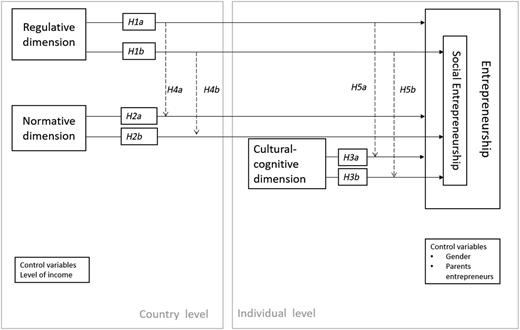
In consequence, relevant literature leads us to affirm that regulations to support entrepreneurship do not make more people want to start a new business; however, they help to facilitate the decision in combination with the other two institutions. Accordingly, individuals who already have strong self-confidence in their ability to become entrepreneurs (cultural-cognitive dimension) must be affected by the ease of doing business (regulative dimension). In the same way, in a society where the entrepreneurial culture is supportive of entrepreneurship (normative dimension), the ease of doing business (regulative dimension) will interact and strengthen this relationship. In other words, the regulative dimension moderates the relationship between cultural cognitive and normative dimensions and entrepreneurship and social entrepreneurship. Moreover, following previous hypotheses (H1 to H3) built from existing theory and the need to analyse the interaction of these dimensions according to the theory presented in this section, we propose the following hypotheses:
Ease of doing business positively moderates the relationship between the self-perception of the capacities and the probability of becoming an entrepreneur.
Ease of doing business negatively moderates the relationship between the self-perception of the capacities and the probability of becoming social entrepreneurs.
Ease of doing business positively moderates the relationship between social acceptance regarding entrepreneurial activity and the probability of becoming an entrepreneur.
Ease of doing business negatively moderates the relationship between social acceptance regarding entrepreneurial activity and the probability of becoming a social entrepreneur.
Figure 1 proposes the research model.
3. Methodology
3.1 Data and sample
The data used for the analysis is a combination of different sources. At the individual level, we use data from the GUESSS research project. The project has distributed the online survey every two years since 2003; in the 2018 edition, more than 1,000 universities from 54 countries participated (Sieger et al., 2016). The GUESSS database has been extensively used in prior research, has gained strong recognition within the academic community, and has been published and discussed in several influential scholarly journals (e.g. Bergmann and Stephan, 2013; Lima et al., 2015). This database has advantages because the instrument includes scales corresponding to proxy variables for the institutional dimensions included in this study. Our study examines how institutional dimensions influence entrepreneurial activity. GUESSS is the only secondary database that allows us to obtain validated, standardised data from university entrepreneurs across different countries. Regarding the country-level variables, we consider the World Bank databases, specifically the Doing Business project. Table 1 shows information about the sample.
3.2 Variables
3.2.1 Dependent variable at the individual level: entrepreneurship and social entrepreneurship
Entrepreneurship. This variable is dichotomous: A person is either an entrepreneur (1) or not (0). The entrepreneurs in this study are those who respond yes to at least one of the following questions: Are you currently trying to start your own business/to become self-employed? Are you already running your own business/are you already self-employed?
Social entrepreneurship. As the general entrepreneurship variable, this proxy variable for social entrepreneurship is also dichotomous: A person is either a social entrepreneur (1) or a commercial entrepreneur (0). It reflects the entrepreneurs in the sectors of human health and social work activities. The proxy for social entrepreneurship reflects entrepreneurial activity in the sectors of human health and social work services, following the operationalisation used in the Global Entrepreneurship Monitor (Bosma et al., 2020)and subsequent cross-country studies (Estrin et al., 2013; Stephan et al., 2015). While this measure focuses on sectors with a pronounced social mission, it captures the observable manifestation of socially oriented entrepreneurship within comparable institutional contexts. We acknowledge its limitations, as some social ventures may operate outside these sectors; however, this operationalisation remains the most consistent and replicable option for large-scale multilevel analyses.
3.2.2 Country-level predictors
Regulative dimension: Ease of doing business. The ease of doing business scores benchmark economies concerning regulatory best practices, showing the proximity to the best regulatory performance on each Doing Business indicator. An economy's ease of doing business score is reflected on a scale from 0 to 100, where 0 represents the lowest and 100 represents the best performance. This score collects different information regarding ten different topics: starting a business, dealing with construction permits, getting electricity, registering property, getting credit, protecting minority investors, paying taxes, trading across borders, enforcing contracts, and resolving insolvency (World Bank, 2020).
Normative dimension: Subjective norm. This dimension refers to the evaluation that people in society place on entrepreneurship. This variable refers to the individuals' perceived social pressure about entrepreneurship. The individuals answered the following question: “If you would pursue a career as an entrepreneur, how would people in your environment react?” Their answers were coded on a seven-point scale (1 = very negatively, 7 = very positively) and corresponded with three types of relationships: Your close family, your friends, and your fellow students. Based on these answers, we calculate the factor that indicates the subjective norm (Liñán and Chen, 2009).
3.2.3 Individual-level predictors
Cultural-cognitive dimension: Self-confidence. This variable captured perceptions of one's worth and the likelihood of succeeding. We combine the answers to two different statements, considering that in the survey, the instrument does not ask everyone the same questions, depending on their answers regarding whether they are entrepreneurs or not. The individuals give their level of agreement with two different statements (1 = strongly disagree, 7 = strongly agree): I am usually able to protect my interests. I feel that I am a person of worth, at least on an equal basis with others.
3.2.4 Controls
At the individual level, we controlled for gender: female = 0 and male = 1. The parents' entrepreneurs (1 = yes, 0 = no).
At the country level, we controlled for income level as a categorical variable: High = 1, Middle = 2 and Lower = 3 (World Bank, 2020). We included Gross Domestic Product per capita as a second economic covariate for robustness checks, as changes in national wealth may also affect entrepreneurship and social entrepreneurship. Moreover, we include the World Values Survey cultural map classification (Inglehart et al., 2014) as a cultural control.
3.3 Analysis
Multilevel models are developed for the analysis of data that is structured hierarchically. This structure consists of lower-level observations (in this study, individuals) nested within higher-level (countries). The individual-level observations are Level 1 or micro-level. Concerning the hierarchy structure, the country level is defined as the macro level; in social science, they are often called contexts (Aguinis et al., 2013). We estimate specifically the multilevel logistic regression model or mixed-effects logistic regression in Stata. As the observations are nested in different countries, we do not employ standard multivariate methods because they preclude us from assuming the independence of observations (Wennberg et al., 2013). Those approaches need to view individuals as acting homogenously but would not account for how the context affects their decisions (Morgeson and Hofmann, 1999).
Multilevel logistic regression aims to estimate the odds that an event occurs. In this study, we analyse the odds that an individual becomes an entrepreneur or a social entrepreneur while considering the dependency on individual factors nested in country-level data. Essentially, it will allow us to estimate the effect of country-level measures of regulative and normative dimensions on the individual decision to engage in entrepreneurial activity. At the same time, we analyse the influence of the cultural-cognitive dimension at the individual level and the way all three dimensions interact (cross-level). Multilevel modelling is important in this research field because it allows us to differentiate the institutional dimensions levels. Moreover, this type of estimation has several advantages over single-level regression analyses. It reduces the risk of false positive results (Type I errors) when higher levels (such as countries) exist in the sample are not considered. Also, it offers a development over the option of aggregate data to level 2, which has the risk of aggregation biases; this error is known as ecological fallacy. Finally, this model reflects the clustering or non-independence among the individuals; this means that context matters because of the similar experiences among individuals.
We proceed with a multilevel modelling estimation to analyse the predictors of entrepreneurship, comparing two models, one for general entrepreneurship and the other for social entrepreneurs compared to commercial entrepreneurs.
First, we estimate the unconditional mean or empty model, which contains no predictors. Based on this empty model, we calculate the intra-class correlation coefficient (ICC), which quantifies the degree of homogeneity of the outcome within clusters. The ICC represents the proportion of the between-cluster variation (in this study case: between-country variation of the chances of becoming an entrepreneur or being a social entrepreneur instead of commercial) in the total variation (in this study: the between-plus the within-country variation of the chances of becoming an entrepreneur or being a social entrepreneur instead of commercial). The ICC ranges from 0 to 1. On the one hand, ICC = 0 indicates that the chance of being an entrepreneur or social entrepreneur does not differ from country to country (there is no between-country variation).
On the other hand, ICC = 1 indicates perfect interdependence of residuals: The observations only vary between countries, which means in a given country, either everyone or nobody is an entrepreneur (there is no within-country variation). The ICC for entrepreneurship and the alternative dependent variable, social entrepreneurship, provided evidence regarding the data clustering: the observed values of 0.23 and 0.26, respectively, indicate that 23 and 26% of the total variance correspond to the country level. ICC levels above 0.15 are considered large (Hox, 2010).
To improve the interpretability of the model estimations, the variables at the individual level were cluster-mean centred (subtracting the country-specific mean to estimate the within-country effect). The country-level variables were grand-mean centred standardised based on their individual-level mean and standard deviation across the sample (we correct for the average country value of those variables) (Paccagnella, 2006; Enders and Tofighi, 2007). Robustness checks using grand-mean-centred individual-level controls yielded the same results.
We calculated the variance inflation factor (VIF) scores for the models to test for multicollinearity. The scores in each variable remain below the recommended cut-off value of 10, which provides no evidence of multicollinearity (Hair et al., 2014). The highest VIF score is 2.42, belonging to the ease of doing business variable (a proxy for the regulative dimension).
The likelihood-ratio test (LR) is significant in all the estimated models and explains whether the current mixed-effects model represents a significant improvement in fit relative to a standard logistic regression. The chi-square test indicates that the difference in fit is significant between models. We tested the postulated main effects at the individual and country levels (Models 1 and 4) with the control variables in the model. We first computed each interaction separately to test for the interaction effects (Models 2, 3, 5 and 6). We then conducted several robustness tests: for the interaction hypotheses, we included both interaction terms together. In addition to the regression coefficients, we report for each model the log-likelihood ratio and the McKelvey and Zavoina pseudo .
4. Results
Table 2 shows the models estimated to test the hypotheses. Models 1 and 4 include individual-level (Level 1) and country-level (Level 2) predictor variables for entrepreneurship and social entrepreneurship, respectively, including the controls. Models 2 and 5 include the main effects of the three institutional dimensions, considering the interactions among the dimensions. Finally, to compare the fit of the estimations, we estimate Models 3 and 6 that include the statistically significant interaction. It is important to note that the models regarding general entrepreneurship (Models 1 to 3) and social entrepreneurship (Models 4 to 6) are comparable in terms of the sign and significance of their results, but not the weight coefficients or model fit, because of the differences in the number of observations in each sample.
Including the control variables changes the significance of some coefficients, and we keep those control variables to avoid misspecification of the model. It is important to note that, as prior literature has found, being male increases the probability of becoming an entrepreneur. However, regarding social entrepreneurs, this relationship is the opposite. Results show that being a woman increases the probability of being a social entrepreneur in comparison to a commercial entrepreneur, and those results are statistically significant; moreover, regarding the country-level control variable, level of income, and countries where the income is higher, the probability of becoming a social entrepreneur decreases.
4.1 Main individual-level and country-level effects
H1a and H1b posit that the regulative dimension is positively associated with entrepreneurship and negatively related to social entrepreneurship compared to commercial entrepreneurship. In support of H1a, higher scores of ease of doing business are related positively to the likelihood of becoming an entrepreneur (β = 0.322, p < 0.001, see model 1). However, when the interaction effect is introduced to the model, holding the control variables constant, this coefficient decreases and loses significance (β = 0.247, p = NS, see model 3). Consistent with H1a, the regulative dimension shows a positive association with entrepreneurial activity; nevertheless, the strength of this effect diminishes when cross-level interactions are included in the model. Regarding the H1b, the coefficient is negative, as expected, but it is not statistically significant in any of the models (β = 0.0317, p = NS, see model 3). Thus, the results provide only partial support for H1a and no support for H1b.
According to H2a and H2b results, Models 2 and 5 show that the results are as expected and statistically significant. The normative dimension positively influences the general entrepreneurial activity (β = 0.036, p < 0.001) and negatively influences social entrepreneurship (β = −0.0854 p < 0.1).
H3a and H3b indicate that the cultural-cognitive dimension, related to the individual level dimension, is associated positively with entrepreneurship in general and positively with social entrepreneurship. In Models 3 and 6, which consider the control variables and the interactions, the results indicate that self-confidence predicts the likelihood of being an entrepreneur (β = 0.485, p < 0.001) and a social entrepreneur (β = 0.064, p < 0.1). Accordingly, the results provide support for H3a and H3b.
4.2 Interactions between institutional dimensions
H4a and H4b predicted that the regulative dimension positively moderates the relationship between normative and entrepreneurship in general, making the relationship stronger and negative with social entrepreneurship, making the relationship weak. In both cases, the interaction effect is positive, but it lacks significance (β = 0.003 and β = 0.004 and p = NS; see Models 2 and 5). Accordingly, the results do not provide support for H4a or for H4b. Because of those results, we estimate the following models (3 and 6) without considering this interaction to avoid misspecification.
Regarding the cross-level interaction, H5a and H5b hypothesise that the effect of the cultural-cognitive dimension on entrepreneurship (H3a) and social entrepreneurship (H3b) is maximised and weakened, respectively, in countries where it is easier to do business. First, the result of the interaction regarding being an entrepreneur or not is positive, as expected (β = 0.0855, p < 0.1), but negative when the interaction is estimated considering social entrepreneurs (β = −0.0793, p < 0.1). In both cases, the results are statistically significant. Second, the inclusion of the cultural-cognitive dimension and regulative interaction leads to an improved model fit. Hence, H5a and H5b are supported.
While seemingly multilevel analysis produces more efficient results than logit regressions, as a robustness check, we also ran separate logit regressions to estimate the model. Unreported results based on logistic regressions are consistent with those reported in this paper. We also explored whether there are some systematic differences across different stages of entrepreneurial activity (potential and nascent entrepreneurs) in terms of the influences of regulative, normative and cultural-cognitive dimensions, and the results are consistent.
5. Discussion
As we mentioned before, this research aims to analyse the influence of institutional dimensions on social entrepreneurship, considering the interactions between the dimensions and the country and individual levels. Specifically, the H1a refers to the regulative dimension measured through the proxy of the ease of doing business. The results of our model do not support H1a, and this corroborates the results of prior research that also explain how, although fewer regulations do not explain entrepreneurial activity across countries, this variable should influence the level of formalisation in the economy (van Stel et al., 2007; Stephan and Uhlaner, 2010). Additionally, informal institutions need to join those regulations to affect entrepreneurial activity. Moreover, we need to keep in mind that entrepreneurs in this sample are university students who could be managing their businesses very informally, in some cases, to pay for their studies or as a future option after they finish their studies. So, the informality of those new businesses should be addressed to have more conclusive results.
Although the negative coefficient for H1b suggests a potential adverse effect of ease of doing business on social entrepreneurship across all models, the result is not statistically significant. Therefore, H1b is not supported. We cannot make any assumption from those results, although we consider that the insignificance is due to the data restrictions. This result was statistically significant when we made the robustness check validations without considering the multilevel structure. The lack of data does not allow us to have specific measurements for social entrepreneurs at the level of the regulatory dimension, such as the availability of resources that support social entrepreneurship or social innovation. Therefore, it is necessary to replicate this model with other variables to operationalise the regulative dimension with specific data for new social ventures. Moreover, previous research found the important role that regulations play in social entrepreneurship (Nicholls, 2010). Besides, those considerations regarding the sample and the data restrictions are also applicable and vital to discuss, as we do not find empirical support for H4a and H4b regarding the interaction between the normative dimension and regulative dimension to influence entrepreneurship and social entrepreneurship, respectively.
Results support H2a regarding the positive relationship between the normative dimension and entrepreneurial activity. This result confirms suggestions in the literature on entrepreneurship and institutional context that a supportive social culture towards new business creation and the social acceptance of entrepreneurship as a career option help individuals decide to become entrepreneurs (Spencer and Gómez, 2004; Stephan and Uhlaner, 2010; Urbano and Alvarez, 2014). Moreover, a significant result is a negative relationship between the normative dimension and social entrepreneurial activity (H2b); this shows how there is less probability of an individual becoming a social entrepreneur in those communities where traditional entrepreneurial activity is respected and supported. This shows the importance of local support from informal spheres (Muñoz and Kibler, 2016), which are relevant for social entrepreneurs.
We found empirical support for the positive relationship between cultural cognitive dimension and entrepreneurship, including social entrepreneurship (H3a and H3b). This is very important because those hypotheses consider the dimensions at the individual level. In this sense, those results endorse the literature that found this positive relationship (Stenholm et al., 2013), complementing other sectors, such as social and from a multilevel perspective (Estrin et al., 2016). While previous work has primarily examined how formal and informal institutions influence entrepreneurial activity, our findings show that the cultural-cognitive dimension—operationalised at the individual level—plays a distinct and complementary role. By conceptualising self-confidence as a socially embedded cultural-cognitive schema, we demonstrate how institutional theory can incorporate micro-level perceptions as mechanisms that translate institutional logics into entrepreneurial action. This interpretation highlights the cross-level interdependence among the regulative, normative, and cultural-cognitive pillars (Tracey et al., 2011; Stenholm et al., 2013; McMullen et al., 2021), providing a more integrated view of how institutions shape socially oriented entrepreneurship across countries.
Finally, regarding H5a and H5b, this is evidence of the interaction between the cultural-cognitive and regulative dimensions. Results are in line with prior literature that discusses how the individual's confidence to start a business, specifically a social one, not only depends on the legislative interventions but also on their interactions with the individual cognition (Muñoz and Kibler, 2016). Moreover, our findings in this regard support the importance of combining formal regulations with social appropriation of entrepreneurial activity (Stephan and Uhlaner, 2010). Also, these results show that favourable regulations to start a business make a significant difference in how social entrepreneurs use their specific entrepreneurial skills (Estrin et al., 2016). Moreover, our results regarding the moderation effect are consistent with Alvarez et al. (2025), who examined the institutional dimensions as determinants of entrepreneurship across stages and found that the effect of the cultural-cognitive pillar is stronger in countries with higher regulatory quality. Although their study focuses on general entrepreneurial activity, the pattern of institutional interaction that they identify mirrors our findings: favourable regulatory environments enhance the positive effect of cultural-cognitive mechanisms (such as confidence and perceived capability) on entrepreneurship. In this study, this interplay explains how social entrepreneurs internalise and act upon the institutional logic of social value creation. The moderation effect thus demonstrates that entrepreneurial agency emerges from the alignment between external enablers (regulative dimension) and internalised cultural-cognitive schemas, particularly in contexts where achieving financial sustainability may require balancing or even compromising social objectives.
6. Conclusions
One of the main contributions of this study is the multilevel perspective to institutional dimensions and the interrelations between them. The institutional dimensions approach (Urbano et al., 2026) considers the role of the individual level in connection with the interactions among higher-level institutions (such as the regulative and normative dimensions), which are externally defined and in constant interaction with the individual level (the cultural-cognitive dimension), which receives contextual information and generates behavioural outputs accordingly.
6.1 Implications
This research has important implications for the practice of entrepreneurship and the design of appropriate and regionally relevant strategies to support entrepreneurship and social entrepreneurs. The results of the empirical analysis discussed in the previous section suggest that policymakers should emphasise supporting social entrepreneurs beyond reducing processes, because social entrepreneurs develop their businesses in spheres beyond the market economy. Especially in the financial system, it is more difficult for social entrepreneurs to gain the legitimacy needed to access resources, which is why it is necessary, at the level of the regulative dimension, to do much more in this regard. In concrete terms, this means: (1) sequencing reforms by venture stage—for instance, fast-track registration and model legal templates for new business, followed by simplified compliance and reporting for operating ventures; (2) creating fit-for-purpose financial instruments such as social impact procurement programs, patient capital funds, and guarantees for hybrid revenue models; and (3) establishing programs that combine legal, fiscal, and impact-measurement guidance with training and advisory services. Regarding the implications on the normative dimension, because prevalent market-oriented norms can crowd out social value orientations, policy and ecosystem actors should actively build legitimacy for social entrepreneurship. Concretely: (1) mobilise local opinion leaders and anchor institutions (municipalities, universities, hospitals) to endorse social ventures; (2) make role models and success cases visible through awards, media partnerships, and public showcases; and (3) align communication to reframe “success” beyond financial metrics, especially in contexts where social entrepreneurship fills gaps not addressed by markets or government. Strengthening these normative signals eases later interactions with funders and regulators. Finally, programs that reinforce self-confidence and perceived capability (as expressions of the cultural-cognitive dimension) are essential complements to regulatory reform. Effective instruments include targeted training and mentoring, peer-to-peer learning cohorts, and university–community incubators focused on social value creation. Our results indicate that when such initiatives are combined with supportive regulations, the likelihood that individuals engage in social entrepreneurship increases, consistent with the moderation we observe. Accordingly, policy should co-design interventions that develop the cultural-cognitive dimension in tandem with regulative improvements.
6.2 Limitations and further research
While data limitations constrain the full operationalisation of institutional dimensions influencing commercial and social entrepreneurship, the extensive sample spanning 53 countries and over 165,000 individuals lends substantial robustness to our findings. This dataset offers valuable evidence of the differentiated impacts of institutional factors, underscoring the importance of developing more finely adapted measures that capture the unique characteristics of different entrepreneurial types.
Another limitation is the use of a specific database that relies on university students as the sample. Even though it is a robust sample, the type of entrepreneurs analysed has characteristics of a specific entrepreneurial environment. However, we consider entrepreneurs carrying out activities to start their businesses and obtain income. Therefore, they have had to face the context outside the university, allowing a certain level of generalisation of the results to samples outside such an environment. Prior literature has also been used with university students in their samples, claiming the characteristics of those individuals, specifically, the seminal work of Busenitz et al. (2000) considers this type of sample adequate for understanding the institutional dimensions approach. These authors posit three important issues. First, university students know more about business issues than the public. Second, they represent an important part of the possible entrepreneurs. Third, most students have not decided on their career paths.
Future research should advance from here, analysing the university environment as another level at which other variables coexist and are considered proxies of the three institutional dimensions. This possibility of a third intermediate level was considered during the study; however, due to the short amount of data on social entrepreneurship to aggregate at this level, it was not possible to analyse the institutional dimensions in this way.
Moreover, the causality relationships should also be considered in further research, as well as how the entrepreneurs play the role of agents of change in institutions in their communities or even how institutions influence social performance (Ferreira et al., 2026). This study provides empirical evidence on how dimensions affect social entrepreneurs who are unique due to their specific motivations and objectives in a different way. However, more studies are needed on the inverse relationship of how social entrepreneurs change their institutional conditions. Qualitative or mixed methods studies measuring specific institutional dimensions for social entrepreneurs can be useful in analysing these types of relationships.