


The purpose of this article is to investigate the relationship between gender, innovation and growth in Italian innovative start-ups.
This is a quantitative study based on a sample of more than 4,600 Italian innovative start-ups. In order to ascertain whether female-led firms that invest more in innovation grow more than their male-led counterparts, sales growth is analysed through a fixed-effects regression over the period 2015–2019. Propensity score matching is also used to check for potential selection bias.
Results reveal that innovation is crucial for start-up growth and, most importantly, that female entrepreneurs exploit the potential of innovative activities for their firm’s growth better than their male peers.
The results provide important evidence on the link between gender and innovation and how these two elements interact for the growth of firms in their early life. Results also provide insights for policymakers to use in designing programs for promoting female entrepreneurship and participation in science.
1. Introduction
Innovative activities are important in creating competitive advantages at both firm and national levels (Chatzoglou and Chatzoudes, 2018). Since female entrepreneurship is one of the fastest-growing categories of entrepreneurship worldwide (Byrne et al., 2019; Global Entrepreneurship Monitor, 2020), female entrepreneurs make an important contribution to innovation and hence economic growth (De Bruin et al., 2006). However, the literature has only recently started to investigate the implications of gender on innovation, and the link between gender, innovation and firm growth is still largely unexplored in the literature on small businesses (Alsos et al., 2013).
Female entrepreneurship has, however, recently attracted increasing attention from governments as a potential driver of economic recovery after the Covid-19 pandemic. It is expected to grow because the introduction and promotion of remote working and staggered working hours in several countries is increasingly facilitating the work–life balance (Martínez-Rodríguez et al., 2022). In order to help fill the gap and examine the relation between gendered innovation and start-up growth, our research examines a paradigm of Young Innovative Companies, Italian innovative start-ups, which are firms in their early years whose core business is of high technological value. This type of firm was introduced by the Italian government in 2012 in Decree Law No.179/2012, known as the Italian Startup Act. To be considered an innovative start-up, and be registered as such with the Italian Chamber of Commerce, a firm needs to meet a set of requirements concerning age (being less than 60 months old), nationality (being based or having a production branch in Italy), balance sheet (revenues less than €5m and no distribution of profits) and core business (must be in the development, production and marketing of products or services with a high technological value). In addition, the firm must satisfy at least one of the following three requirements, as a proxy of an adequate level of innovation:
spending on research and development (R&D) and innovative activities is equal to at least 15% of the higher of either turnover or cost of production;
the firm employs a highly qualified workforce (at least 1/3 of employees hold Ph.D.s, are Ph.D students or researchers or at least two-third of employees hold a Master’s degree);
the firm holds a patent or owns a software licence.
All eligible firms benefit from Italian government support in terms of lower costs of setting up the company, fewer bureaucratic administrative procedures, more flexible rules for employee hiring and remuneration and access to specific financial support, including guarantee funds, tax exemptions and so on. This regulatory environment yields interesting results: data from Ministero dello Sviluppo Economico (2020) show that at the end of 2019, there were 10,893 innovative start-ups operating in Italy (+11.6% compared to 2018), grossing about €1.2 bn (+46.2% compared to 2018) and employing more than 61,000 units (+12.4% compared to 2018). Of these start-ups, 55.8% were based in Northern Italy, 20% in Central Italy and 24.2% in the South and Islands. In terms of sectoral distribution, 74.4% of Italian innovative start-ups are in the services sector, 16.5% in the manufacturing sector, 3.5% in commerce, 2.8% in tourism and the remaining 0.8% in agriculture [1].
Their characteristics mean that Italian innovative start-ups can provide clear evidence on the contribution of gender to innovation and firm growth. Our aim is therefore to ascertain whether female start-ups investing more in innovation (proxied by R&D intensity) show better growth rates than their male peers. To make the analysis, we run a panel fixed-effects regression on a dataset of 4,682 innovative start-ups obtained by combining data from the special start-up section of the Chamber of Commerce Registro delle imprese [2], the AIDA Bureau van Dijk (henceforth, AIDA) and ISTAT (Istituto Nazionale di Statistica). Using these data, our study investigates the impact of gender on the relationship between innovation and start-up growth.
The remainder of the paper is organized as follows. Section 2 reviews the literature on the relationship between gender, innovation and small firm growth. Section 3 describes the variables and the methodology used in the study. Section 4 presents the results, and implications are discussed in Section 5. Finally, Section 6 provides our conclusions, noting the limitations of the research and suggesting possible future developments.
2. Literature review
Innovation plays a crucial role in the growth process of a firm (Freel and Robson, 2004; Leiponen and Helfat, 2010). The relationship, although not always straightforward, is often positive (Coad, 2009; Ortega-Argilés et al., 2011). In fact, on the one hand, the process of innovation may show high failure rates and riskier returns (Li and Atuahene-Gima, 2001; Scherer and Harhoff, 2000; Van de Ven and Polley, 1992); on the other hand, innovativeness can improve competitiveness (Porter, 1980) and develop dynamic capabilities (Eisenhardt and Martin, 2000). Moreover, research has also demonstrated that innovation can be beneficial to new firms’ survival (Colombelli et al., 2016).
Despite the great number of studies confirming the positive relationship between innovation and small firm growth (Czarnitzki and Delanote, 2013; Falk, 2012; Fiorentino et al., 2021; Innocenti and Zampi, 2019; McKelvie et al., 2017), some empirical studies find that the impact of innovation may be context-dependent, and different types of innovation may lead to different business results (Rosenbusch et al., 2011). Starting from these findings, literature has explored the link between the innovation process of the firm and the characteristics of the entrepreneur (see, for example: Amoroso and Audretsch, 2022; Marcati et al., 2008; Mas-Tur and Ribeiro Soriano, 2014; Romero and Martínez-Román, 2012). In fact, the characteristics of the entrepreneur are a key element for the success of a firm, especially in its start-up phase (Braidford et al., 2017; Del Bosco et al., 2021; Onetti et al., 2018): decisions made by the founders shape not only the start-up itself but also its entire way of operating and developing (Hashai and Zahra, 2022; Hausman, 2005). Moreover, Olivari (2016) shows that entrepreneurial traits are important factors explaining firm innovation propensity. So in order to understand the link between start-up growth and innovation, it is necessary to identify the people behind firms, i.e. the entrepreneurs.
In this regard, one of the most widely investigated aspects in the entrepreneurship literature is the relationship between firm success and the gender of its founders. Starting from the assumption that entrepreneurship is a gendered phenomenon (Minniti, 2009), a number of studies have found that female entrepreneurs tend to be outperformed by their male counterparts in terms of profitability (Fairlie and Robb, 2009), growth (Alsos et al., 2006), survival rates (Boyer and Blazy, 2014), and competitiveness (Alves et al., 2017), among other things. This empirical evidence led to the development of the “Female Underperformance Hypothesis” (FUH), hypothesizing systematic underperformance of female-owned compared to male-owned firms (Crane, 2022; Demartini, 2018). This systematic difference can be explained both by intrinsic characteristics of the female entrepreneurs and by socio-economic factors. As far as intrinsic characteristics are concerned, the literature finds that women approach entrepreneurship and management differently from men (Aragon-Mendoza et al., 2016; Yukongdi and Lopa, 2017), because they tend to be more risk averse (Barber and Odean, 2001; Jianakoplos and Bernasek, 1998; Maxfield et al., 2010) and/or because they may have different business objectives and want to reach a better work-life balance (Jennings and McDougald, 2007; Lombard, 2001; Rosenbaum, 2017). Speaking socio-economically, in a male-dominated field like entrepreneurship there may be a tendency to perceive women in a more stereotypical way (Acs et al., 2011; Brescoll, 2016) and this could mean that women struggle to access information, networks and credit (Alsos et al., 2006; Poggesi et al., 2016). As a consequence, women-led ventures may tend to cluster in more labour-intensive and low-tech sectors where firms usually show lower rates of growth and profitability (Klapper and Parker, 2011).
However, given that research has found that female owned-firms are fundamentally different from male-owned ones (Hechavarria et al., 2019; Marconatto et al., 2022), the FUH has been questioned in more recent years (Crane, 2022; Demartini, 2018; Justo et al., 2015; Zolin et al., 2013). In fact, controlling for commonalities (Farhat and Mijid, 2018) and using risk-adjusted measures (Robb and Watson, 2012), no gender gap is found in survival rates, profitability or growth rates. Moreover, a recent study by Tarillon (2022) found no differences in the growth patterns of male and female start-ups in France. Evidence, however, is not conclusive and different approaches are needed to describe the phenomenon more clearly (Poggesi et al., 2016). Given the importance of innovation for firm success, the gap between male and female ventures might be explained by how the genders deal with innovation. As highlighted by Alsos et al. (2013), there is a need in the literature on female entrepreneurship to understand the link between gender and innovation in SMEs.
Prior literature in fact highlights that gender diversity on company boards has a positive impact on firm innovation (Ain et al., 2022; Attah-Boakye et al., 2020; Chen et al., 2016, 2018, 2021; Javaid et al., 2021). Javaid et al. (2021), for example, find that the presence of a female CEO improves the innovation output of firms listed on the Shanghai and Shenzhen stock exchanges. Chen et al. (2021) show that a higher number of female directors is associated with higher innovation output and higher R&D productivity, and Chen et al. (2018) find that female representation on boards is associated with greater innovative success, thus enhancing firm performance in industries with strong innovation intensity. So, although the literature demonstrates that the relationship between gender, innovation and firm performance is positive in listed firms, there is little evidence about private firms, and start-ups in particular (Alsos et al., 2013). In fact, it is known that female firms do not lag behind male ones in terms of patenting rates (Demiralp et al., 2018) and that women tend to exploit better the knowledge from research institutes and value chain partners (Amoroso and Audretsch, 2022). Gender diversity is also found to stimulate positively the innovation process in SMEs (Ritter-Hayashi et al., 2019; Ruiz-Jiménez and Fuentes-Fuentes, 2016). Investigating gendered innovation and growth, Amoroso and Link (2018) find a positive relationship between founder’s gender and employment growth in high-tech sector SMEs, and Quiroz-Rojas and Teruel (2021) show that Chilean female innovative small businesses grow more than their male counterparts. There are however to date no details of these beneficial effects on start-ups, and our main research question is thus: “Do women-owned innovative start-ups that invest more in innovation grow more than male-owned ones?”
In order to answer our research question, we focus on Italian innovative start-ups because, as laid down by Decree Law No. 179 of 2012, the core business of these young firms must be in products or services with a high technological value. Because we use a non-subjective definition of innovative start-ups (Fiorentino et al., 2021), we should be able to observe the impact of gendered innovation on the growth of firms in their start-up phase.
3. Research design
3.1 Sample
Our research focuses on innovative start-ups in Italy. The main sources of our data are the following:
the special section of the Registro delle Imprese containing a list of all the innovative start-ups operating in Italy at the time of consultation;
the AIDA database, containing financial data for most Italian SMEs;
ISTAT, which is the main producer of official statistics in Italy.
Our sample consists of 4,682 firms, for the period 2015–2019. Table 1 shows the frequency distribution of the final sample by location and sector. Panel A shows that most of the innovative start-ups are located in the North (50.17%), followed by Southern Italy (26.63%) and Central Italy (23.20%). Panel B shows that the vast majority of the start-ups in our sample operate in the services sector (74.69%); of the remainder about 20% operate in manufacturing, with only about 5% in agriculture, commerce and tourism. The distribution of our sample is similar to that of the universe of Italian innovative start-ups shown by the Ministero dello Sviluppo Economico (2020).
Sample distribution of Italian innovative start-ups by location and sector
| Panel A: geographical distribution of innovative start-ups | ||
|---|---|---|
| Macro-region | No. of firms | % of the total |
| North | 2,349 | 50.17% |
| Centre | 1,086 | 23.20% |
| South | 1,247 | 26.63% |
| Total | 4,682 | 100% |
| Panel B: sectoral distribution of innovative start-ups | ||
|---|---|---|
| Sector | No. of firms | % of the total |
| Agriculture | 25 | 0.53% |
| Manufacturing | 935 | 19.97% |
| Commerce | 163 | 3.48% |
| Tourism | 62 | 1.32% |
| Services | 3,497 | 74.69% |
| Total | 4,682 | 100% |
Source(s): Authors’ own creation
3.2 Variables
Since the aim of this paper is to investigate whether investments in innovation made by women-owned start-ups produce higher performance, our dependent variable is growth. Measuring growth is a complex task, because it is difficult to formalize an amount of expansion (Penrose, 2009), and because there are many methods for measuring the growth path of small businesses (Freel and Robson, 2004; Gilbert et al., 2006). However, sales revenues are the most appropriate and widely used measures for the growth of start-ups (Hashai and Zahra, 2022; Stuart, 2000; Weinzimmer et al., 1998), because they are the key element for creating the necessary cash flows that will enable start-ups to support their operations and expand (Hashai and Zahra, 2022). Moreover, revenues are relatively insensitive to capital intensity (Delmar et al., 2003), and therefore revenue-based measures should not suffer from the intrinsic differences between male-owned and female-owned ventures found in the literature (Klapper and Parker, 2011). For all these reasons, we use as dependent variable the growth of sales revenue, consistently with main literature on Italian innovative start-ups (Fiorentino et al., 2021; Innocenti and Zampi, 2019).
In order to answer our research question, we need an indicator which captures the gendered innovation effect on the start-up growth. We construct this variable using two elements. The first element is the internal R&D intensity (R&D) which we use as a proxy for the innovation process undertaken by each start-up. Similarly to other literature (Barron et al., 2002; Innocenti and Zampi, 2019), R&D is calculated as the ratio between Intangible Assets and Total Assets. The second element reflects the gender composition of the start-up team. The prevalence in the start-up capital/board of directors of women is measured, similarly to Del Bosco et al. (2021), as follows:
This ratio is calculated using data provided by each start-up at the time of application to the special section of the Italian Registro delle Imprese. Thus, to identify female start-ups, we use a dummy variable equal to 1 if the above ratio is higher than 50%, and 0 otherwise. We investigate the relationship between gender, innovation and growth using the interaction term between those two elements (R&D x FEMALE).
Finally, we also consider a set of control variables which are found to influence firm growth. These are R&D, which is the ratio between Intangible Assets and Total Assets; AGE, which is the number of years since the start-up foundation; SIZE, i.e. the natural logarithm of Total Assets; and GRADUATES, i.e. the natural logarithm of the number of people with at least a bachelor degree at regional (NUTS 2) level, which is used as a proxy for the level of human capital at regional level, an important factor in firm growth models (Crook et al., 2011).
3.3 Methodology
Recent studies on innovative start-ups use cross-sectional methods (Fiorentino et al., 2021; Innocenti and Zampi, 2019; Minola et al., 2021) but, as noted by Dobbs and Hamilton (2007), this kind of research design may be affected by problems related to causality; in other words, they may identify factors which accompany, rather than contribute to, growth. A more suitable way to study the growth process is the longitudinal study (Davidsson and Gordon, 2012; Dobbs and Hamilton, 2007; Salder et al., 2020). We thus use a panel approach to answer our research question, and we model start-up growth using the covariates described in Section 3.2 as follows:
where i is the firm, t is the time period, μi represents the firm-specific effect, and εit is the random error. Growthit is the annual growth rate and is calculated by taking the log-difference of sales between time t and time t−1. Each specification includes the year dummies to control for any factor not included in our specification. Since the dependent variable is the growth of the firm between t and t−1, all continuous variables are measured in t−1. This should partially alleviate endogeneity problems, although they cannot be completely ruled out in this setting (Nichols, 2007). Furthermore, in order to choose between a Fixed Effects (FE) and a Random Effects (RE) model, we performed the Hausman (1978) specification test: if the null hypothesis is rejected, the FE model is to be preferred to a RE model. We get a χ2(5) = 325.10 (p-value < 0.01), suggesting that the FE are appropriate for our specification. Therefore, we estimate Equation (1) using a panel FE model with clustered standard errors at firm level.
To give robustness to our results, we also use Propensity Score Matching (PSM), which has recently been increasingly used in studies on innovative start-ups (Finaldi Russo et al., 2016; Fiorentino et al., 2021), because it improves the comparability of two populations based on certain observed characteristics, and reduces selection bias (Widerstedt and Månsson, 2015). In fact, the endogenous nature of the characteristic of the entrepreneur being female or male may make it hard to identify the true impact of gender on innovation and growth. In other words, our results may be biased because of a mechanism of self-selection of female entrepreneurs, i.e. women may be underrepresented in the whole population of start-uppers, or may cluster in certain sectors in which particular growth trends are found (Delmar and Davidsson, 2000; Klapper and Parker, 2011). PSM should make it possible to identify a control sample of male start-ups which exhibit similar firm characteristics to their female counterparts. We first estimate a logit model where the dependent variable is a dummy equal to 1 if the firm is a female start-up, and 0 otherwise. The model for the logit estimates is the following:
where P(Female)i is the probability of being a female-owned start-up, and the independent variables are the same used in Equation (1), to which we add Sector and Region fixed effects to improve the explicative power of our model. From Equation (2), we then obtain the Propensity Score (PSCORE) which is the estimated probability of being treated (i.e. of being a female start-up) given the covariates: firms with similar propensity score will have, overall, a similar covariate distribution. The estimated propensity scores are then used as additional covariates to control for a potential selection bias (Caselli et al., 2021).
4. Results
4.1 Descriptive statistics and univariate results
Table 2 presents descriptive statistics for the pooled sample of 9,337 firm-year observations. The sample is made up of quite small firms: the mean (median) value of total assets is about 250,000 euro (64,000 euro), and as expected, it includes very young firms, with a mean age around 2 years. The start-ups in our sample are focused on innovation, since the mean R&D intensity is almost 32%.
Descriptive statistics for the pooled sample (N = 9,337)
| Variable | Mean | Median | St. dev | Min | Max |
|---|---|---|---|---|---|
| Sales Growth | 0.807 | 0.396 | 1.522 | −5.998 | 7.790 |
| R&D | 0.315 | 0.248 | 0.273 | 0.000 | 1.000 |
| AGE | 1.861 | 2.000 | 0.917 | 1.000 | 6.000 |
| SIZE | 250.543 | 64.017 | 1,149.464 | 0.001 | 63,103.961 |
| GRADUATES | 663.507 | 587.174 | 405.135 | 12.390 | 1,375.476 |
Note(s): “Size”, proxied by “Total Assets”, is expressed in thousands of Euro. “Graduates” is expressed in thousands of units. In the panel regression the natural logarithms of “Total Assets” and “Graduates” are used
Source(s): Authors’ own creation
Table 3 provides descriptive statistics for the two subsamples of male and female innovative start-ups, along with t-tests for the significance of the differences. There are no statistically significant differences between the two groups in terms of R&D intensity and age. Female start-ups tend to grow less than male start-ups, around 12% less, which may appear to support the FUH, but which may also reflect the composition of our sample which includes female start-ups that are smaller than male ones. The t-test shows that female firms are, on average, more than 115,000 euro smaller than male firms. Note however that these preliminary findings come from a simple univariate analysis, and do not take into account the influence of all the possible confounding factors. These are dealt with by the panel regression presented in the next section.
Comparison of mean and standard deviation between male and female start-ups
| Variable | Male start-ups | Female start-ups | ||||
|---|---|---|---|---|---|---|
| (N = 8,131) | (N = 1,206) | |||||
| Mean | St. dev | Mean | St. dev | Difference | t-stat | |
| Sales Growth | 0.823 | 1.537 | 0.700 | 1.417 | 0.123** | 2.791 |
| R&D | 0.316 | 0.272 | 0.304 | 0.278 | 0.012 | 1.458 |
| AGE | 1.865 | 0.917 | 1.844 | 0.919 | 0.020 | 0.723 |
| SIZE | 265.316 | 1,224.413 | 149.693 | 363.162 | 115.623*** | 6.746 |
| GRADUATES | 668.224 | 407.255 | 629.145 | 388.649 | 39.079** | 3.238 |
Note(s): This table presents the differences in mean and standard deviation for the pooled sample between male and female start-ups and the t-tests for the comparison of the mean values. *, ** and *** indicate the level of significance at 0.1, 0.5 and 0.01, respectively
Source(s): Authors’ own creation
Finally, Table 4 shows the Pearson correlations matrix for the variables used in our study.
Simple correlation matrix
| Variable | Sales growth | R&D | AGE | SIZE | GRADUATES |
|---|---|---|---|---|---|
| Sales Growth | 1 | ||||
| R&D | −0.0101 | 1 | |||
| AGE | −0.273*** | 0.138*** | 1 | ||
| SIZE | −0.0823*** | 0.193*** | 0.337*** | 1 | |
| GRADUATES | 0.00455 | 0.0165 | 0.0138 | 0.0709*** | 1 |
Note(s): This table presents the correlations between the main variables used in our analysis. *, ** and *** indicate the level of significance at 0.1, 0.5 and 0.01, respectively
Source(s): Authors’ own creation
We note that Sales Growth is negatively correlated with age and size, which is consistent with the literature on firm growth (Barba Navaretti et al., 2014; Dunne and Hughes, 1994; Evans, 1987; Huynh and Petrunia, 2010). Moreover, correlation coefficients range from a minimum of −0.273 to a maximum of 0.337, so collinearity should not be a problem in our analysis.
4.2 Regression results
Table 5 reports the results for the FE panel regression, with Sales Growth as the dependent variable. Model 1 uses only our main exploratory variables as regressors, and Model 2 adds the control variables. Both models include year fixed effects.
Results of the panel fixed effects regression on sales growth
| Variables | Model 1 | Model 2 |
|---|---|---|
| FEMALE X R&D | 0.952** | 0.780** |
| (0.403) | (0.378) | |
| R&D | 1.047*** | 1.204*** |
| (0.160) | (0.159) | |
| AGE | −1.691*** | |
| (0.171) | ||
| SIZE | −0.291*** | |
| (0.0355) | ||
| GRADUATES | 0.883 | |
| (0.992) | ||
| Constant | 1.103* | −6.310 |
| (0.654) | (6.145) | |
| Year FE | Yes | Yes |
| R2 | 0.130 | 0.179 |
| N | 9,337 | 9,337 |
Note(s): This table presents the results for the FE panel regression with Sales Growth as a dependent variable, obtained through Equation (1). The clustered standard errors are in parentheses. R2 reported is the “within” R2, from the mean-deviated regression. *, ** and *** indicate the level of significance at 0.1, 0.5 and 0.01, respectively
Source(s): Authors’ own creation
The interaction term (FEMALE X R&D) is significant at 5% in Model 1, signalling that female start-ups that are more innovation intensive tend to grow more than their male counterparts. When control variables are added, the coefficient of the interaction term stays positive, although at a lower magnitude. Nonetheless, our results are confirmed: women-owned start-ups that invest more in R&D tend to grow more than men-owned start-ups with a similar level of R&D intensity. Finally, with regard to the control variables, we find that R&D is a strong and positive determinant of growth, consistent with the literature on innovative start-up growth (Fiorentino et al., 2021; Innocenti and Zampi, 2019); and that AGE and SIZE exhibit a significant and negative relationship with growth. This is consistent with the literature which finds that bigger firms and older firms grow at a slower pace (Barba Navaretti et al., 2014; Dunne and Hughes, 1994; Evans, 1987; Huynh and Petrunia, 2010).
In addition to the panel FE model, we also use PSM in order to mitigate any possible selection bias. It is in fact acknowledged that the entrepreneurial path differs between women and men because of intrinsic factors (Yukongdi and Lopa, 2017) and environmental factors (Poggesi et al., 2016). This may mean that women choose not to engage in innovative entrepreneurial ventures in a self-selection mechanism which would bias our results. PSM mitigates this problem by estimating a propensity score which we use as an additional covariate in our model of start-up growth in order to account for selection bias. The propensity score is calculated through a logit model, in which the same independent variables are used as in Equation (1), as well as additional region and sector fixed effects.
Results of this estimation are presented in Model 3 of Table 6. In order to verify that the firms in the treatment and control groups are identical in terms of observed characteristics, two diagnostic tests are made. First, we re-estimate the logit model using only the matched sample. Results are presented in Model 4 of Table 6: none of the coefficients are statistically significant and the pseudo-R2 is much lower than in Model 3, which suggests that there are no observable differential trends between the treatment and the control sample. Second, we assess the distribution of the propensity scores before and after the matching, shown in Figure 1. After the matching, the kernel density distributions [3] of the propensity scores are nearly identical in the two groups.
Pre-match propensity score regression and post-match diagnostic regression
| Variables | Dependent variable | |
|---|---|---|
| Dummy equals 1 if female start-up and 0 otherwise | ||
| Model 3 Pre-match | Model 4 Post-match | |
| R&D | 0.00403 | −0.0312 |
| (0.120) | (0.155) | |
| AGE | 0.113 | 0.0483 |
| (0.0747) | (0.0991) | |
| SIZE | −0.142*** | −0.0221 |
| (0.0184) | (0.0280) | |
| GRADUATES | −1.465 | −0.140 |
| (1.703) | (2.229) | |
| Constant | 5.009 | 0.331 |
| (8.536) | (11.42) | |
| Year FE | Yes | Yes |
| Sector FE | Yes | Yes |
| Region FE | Yes | Yes |
| Pseudo R2 | 0.0232 | 0.0039 |
| N | 9,337 | 2,411 |
Note(s): This table reports the estimates of the logit model used for the propensity score matching before and after the matching. The dependent variable is a dummy variable equal to 1 if the firm is a female start-up, and 0, otherwise. All regressions include Year, Sector and Region fixed effects. Heteroskedastic robust standard errors are reported in parentheses. *, ** and *** indicate the level of significance at 0.1, 0.5 and 0.01, respectively
Source(s): Authors’ own creation
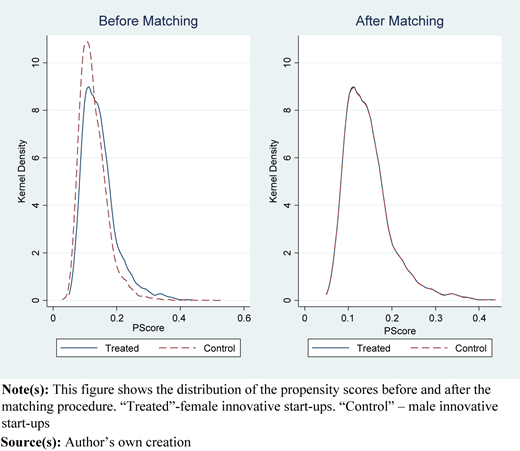
We add the propensity score as a covariate and, the main results, shown in Table 7, still hold. The treatment effect shows that female start-ups that are more innovation-intensive tend to grow more than their male peers. The results are also mostly consistent with regard to the control variables. Even after the PSM check, R&D is still an important determinant of growth for innovative start-ups, and growth rates tend to slow down with age. Furthermore, the size coefficient is no longer significant, probably because the propensity score captures the size effect in its estimation.
Results of the panel fixed effects regression on sales growth with propensity score adjustment
| Variables | Model 5 | Model 6 |
|---|---|---|
| FEMALE X R&D | 0.769** | 0.779** |
| (0.394) | (0.377) | |
| R&D | 1.047*** | 1.209*** |
| (0.160) | (0.158) | |
| PSCORE | 17.193*** | 8.993 |
| (2.051) | (7.598) | |
| AGE | −1.812*** | |
| (0.197) | ||
| SIZE | −0.141 | |
| (0.130) | ||
| GRADUATES | 2.396 | |
| (1.674) | ||
| Constant | −0.794 | −17.02 |
| (0.828) | (11.31) | |
| Year FE | Yes | Yes |
| R2 | 0.155 | 0.179 |
| N | 9,337 | 9,337 |
Note(s): This table presents the results for the FE panel regression with Sales Growth as a dependent variable, obtained through Equation (1) with propensity score (PSCORE) adjustment. The clustered standard errors are in parentheses. R2 reported is the “within” R2, from the mean-deviated regression. *, ** and *** indicate the level of significance at 0.1, 0.5 and 0.01, respectively
Source(s): Authors’ own creation
5. Discussion
Innovation has been thoroughly investigated in the entrepreneurship literature because of its key importance for firm growth, especially at the beginning of the life cycle (Falk, 2012; McKelvie et al., 2017). How this innovation is made is the key to the feasibility and growth of the business process. On this point there exist significant differences in approach between women and men (DeTienne and Chandler, 2007; Minniti, 2009; Stephan and El-Ganainy, 2007), which reflect both cultural and environmental factors (Poggesi et al., 2016). Starting from these considerations, the purpose of our paper is to understand whether the different approaches of female and male entrepreneurs have different impacts on how their firms grow. Focusing on Italian start-up firms, we examine the implications of gendered innovation for the growth of new ventures because, by law, these firms are required to engage in more innovative activities than non-innovative ones.
Our results show that female start-ups that are more innovation intensive tend to grow more than their male counterparts. This has two important implications which are investigated here. First, we examine the relationship between gender and innovation and the interlink with start-up growth. In fact, although literature on small firms has so far focused on the relationship between gender and innovation (Amoroso and Audretsch, 2022; Dohse et al., 2019; Ritter-Hayashi et al., 2019; Whittington and Smith-Doerr, 2005) and between gender and firm performance (Fairlie and Robb, 2009; Farhat and Mijid, 2018; Robb and Watson, 2012; Watson and Robinson, 2003), there are few studies on the joint relationship between the three aspects (Alsos et al., 2013). In fact, only Amoroso and Link (2018) and Quiroz-Rojas and Teruel (2021) have attempted to investigate this issue. Both studies find, consistently with the literature on listed firms (Chen et al., 2018, 2021), that female entrepreneurs better exploit the potential of innovation for the growth of their firms. However, to the best of our knowledge, there have been few findings on firms in their start-up phase. Our study attempts to fill this gap and shows that female start-ups that invest more in innovation grow at a higher pace than their male counterparts. These results are robust to correction for self-selection bias. Second, we contribute to the literature which has recently started to challenge the “Female Underperformance Hypothesis” (Crane, 2022; Demartini, 2018). In fact, our findings show not only that female-owned firms do not lag behind male-owned ones, but they also show better growth rates when innovation is added to the equation. Our results, therefore, suggest that the underperformance identified in the literature (see for example: Alsos et al., 2006; Alves et al., 2017; Boyer and Blazy, 2014; Fairlie and Robb, 2009) may be related to contextual factors rather than to intrinsic differences between male and female approaches to entrepreneurship. This is extremely plausible since, as highlighted by Poggesi et al. (2016), women entrepreneurs often have difficulty in finding and accessing information, credit and networks. This is the case in Italy as elsewhere (Bianco et al., 2013). Our findings thus constitute a further step along the road to identifying factors which could enhance the role of women in entrepreneurship.
Consistently with the literature on the relationship between innovation and small firm growth, and in particular with the nascent literature on Italian innovative start-ups (Fiorentino et al., 2021; Innocenti and Zampi, 2019), our results show that, overall, the innovation intensity of start-ups is an important determinant of their growth. Our findings, thus, provide further evidence supporting the theory that highlights the key role of innovation in enhancing the growth of firms (Teece et al., 1997).
6. Conclusions
This paper investigates the relationship between innovation, gender and new venture growth. Previous research has investigated the relationship between innovation and gender and between gender and firm growth, but only recently has the literature started to investigate the three aspects jointly (Amoroso and Link, 2018; Quiroz-Rojas and Teruel, 2021). To the best of our knowledge, no studies have as yet focused specifically on start-ups. We make an attempt to fill this gap using the dataset of Italian innovative start-ups created by the Italian government in 2012. Using a panel FE approach, we obtain two main results. First, consistently with recent studies on Italian innovative start-ups (Fiorentino et al., 2021; Innocenti and Zampi, 2019), we show that innovation is a strong determinant of start-up growth. This result has an important implication. Start-ups usually face severe financial constraints, and in countries of continental Europe where financial markets are still not a valid alternative to bank lending, policymakers could usefully introduce effective measures to relieve these constraints (Ferrucci et al., 2021) in order to help R&D-intensive start-ups exploit opportunities stemming from innovation. Second, most importantly, we link our research to the broader literature which studies the impact of board gender diversity on the R&D performance of listed firms (Chen et al., 2021) and find that female start-ups better exploit the positive influence of innovation on growth. These results are confirmed when selection bias is corrected through PSM. The results offer evidence against the “Female Underperformance Hypothesis” and suggest that the underperformance of female compared to male entrepreneurs is related to contextual and environmental factors rather than intrinsic differences between the genders.
This paper makes three important contributions to the literature. To our knowledge, it is one of the first studies specifically focusing on the impact of gendered innovation on start-up growth. In the particular context of start-ups, where the actions of entrepreneurs have a strong impact on firm day-to-day activity (Hausman, 2005), our results show that female entrepreneurs are better able to exploit the potential of innovation in terms of new venture growth. Second, we document the well-known positive impact of innovation on firm growth (Audretsch et al., 2014), confirming, like previous studies (Fiorentino et al., 2021; Innocenti and Zampi, 2019), that this relationship holds for innovative start-ups. Third, on the methodological side, we model growth using a panel approach, thus overcoming some of the limitations of the classic cross-sectional studies on small firm growth dynamics (Dobbs and Hamilton, 2007), and we test our results using PSM. We also offer important insights to policymakers. Our findings suggest that in order to sustain growth, governments should put in place specific programs aimed at fostering innovation and the participation of women in entrepreneurship and science, especially considering that in the field of STEM (Science, Technological, Engineering and Mathematics) a wide gender gap persists (Poggesi et al., 2020). And while technical innovation is only one of the nuances of a multi-faceted phenomenon (Kahn, 2018), closing the gap in the STEM education field may be one of the more direct channels that could lead to a large proliferation of innovative entrepreneurship (Bianchi and Giorcelli, 2020).
In general, our findings have important practical implications. First, considering the importance of innovation in fuelling economic growth (Pece et al., 2015; Semih Akçomak and ter Weel, 2009; Solow, 1956), and the fact that start-ups usually play a crucial role in fostering innovation (Antonietti and Gambarotto, 2020; Colombelli and Quatraro, 2019), policymakers need to support the creation of an innovative environment and stimulate both economically and bureaucratically collaboration between private firms and public institutions. In other words, there is a need for support for start-ups investing heavily in R&D to help them overcome the related financial constraints and allow them to better exploit the advantages of innovation. Second, new measures to foster female innovative entrepreneurship should be put in place alongside the Italian Start-up Act. STEM, in which innovative entrepreneurship is often found, is still today largely a man’s game [4]. We hope our results will inform measures to promote the participation of women in STEM and entrepreneurship programs in order to “break the glass ceiling” across the whole spectrum of businesses, from small to listed international firms (Powell and Butterfield, 2015; Sullivan and Meek, 2012). Policy needs to be made in two areas. On the one hand, to lower the gender gap in STEM, specific measures, such as scholarships for women, are required. On the other hand, existing programs need to be strengthened by further measures stimulating internationalization and better access to funding for female start-ups. Our results thus emphasize the importance of policies aimed at enhancing female participation in entrepreneurship and innovation, perhaps starting from education, where there is a clear gender gap in enrolment on STEM degree courses.
As with most research, this study too has some limitations. Although we partially mitigate the selection bias by means of PSM, it is important to note that this approach does not account for all unobservable differences between the two groups. The presence of endogeneity issues cannot therefore be completely ruled out, and other techniques, such as the instrumental variables technique, could yield better approximations of causality. Another problem is the nature of our dataset. On the one hand, mortality, as is widely recognized, is a constant threat in the start-up phase of firms. This means we were able to perform our analysis only on an unbalanced panel, and survivorship bias may mean that our results are less generalizable. On the other hand, firms are automatically removed from the section of the register of innovative start-ups after five years, so we have no information on start-ups surviving after the fifth year. These data may yield even more interesting findings. Finally, we note how we considered only 1-year growth as a dependent variable: since firms’ growth is a complex phenomenon which may show also a high time-variability (McKelvie and Wiklund, 2010), an analysis focusing on a smoother indicator of growth (e.g. a 3-year moving average) would yield more comprehensive results about the impact of gendered innovation on start-ups’ growth. However, since the median age of our sample is 2 years, these further analyses are not feasible and are left for future researches.
The limitations of our work could however open avenues for future research. Methodologies that address causality correctly would yield valuable findings. Future research could also focus on what happens to innovative start-ups after five years. In fact, when the firm is removed from the special section of the Italian register for innovative start-ups, it can be registered in another special section for “Innovative SMEs” containing more mature firms which are not start-ups but which meet other requirements as innovative SMEs. It would be interesting to investigate any significant differences between the two categories of firms. Finally, considering the high level of turnover of innovative start-ups, future research could usefully exploit methodologies like survival analysis, which could reveal whether the link between gender and innovation has the same impact on survivability as we found for growth.
Acknowledgment
The authors would like to thank Le Village by Crédit Agricole (CA) Parma for their generous support.
Funding: No funds, grants or other support was received.
Ethics approval: The paper is original, it has not been submitted to more than one journal for simultaneous consideration and it has not been published elsewhere.
Data and materials: Some data presented in this study are available on request from the corresponding author: these data are not publicly available and were sourced from AIDA Bureau van Dijk database. Publicly available datasets were also analysed: these data were sourced from ISTAT (https://www.istat.it/) and the special section of Italian innovative start-ups (https://startup.registroimprese.it/isin/search?0).
CReditT: Conceptualization: Arcuri Maria Cristina, Gandolfi Gino, Russo Ivan; Methodology: Arcuri Maria Cristina, Russo Ivan; Formal analysis and investigation: Arcuri Maria Cristina, Russo Ivan; Writing - original draft preparation: Arcuri Maria Cristina, Russo Ivan; Writing - review and editing: Arcuri Maria Cristina, Gandolfi Gino, Russo Ivan; Supervision: Arcuri Maria Cristina, Gandolfi Gino.
Competing interests: The authors have no relevant financial or non-financial interests to disclose.
Notes
Consistently with the time horizon of our analysis, we report data from the end of 2019. The territorial and sectoral distribution of the start-ups remained qualitatively similar in 2020 (see: Ministero dello Sviluppo Economico, 2021).
Registro delle Imprese is the official register of businesses of all companies operating in Italy. The special section containing innovative start-ups, used for this research, can be found online at: https://startup.registroimprese.it/isin/home.
Kernel density estimation is a non-parametric method to estimate the probability density function of a random variable. This means that we do not make specific assumptions about the underlying distribution of our variable PSCORE.
See Poggesi et al. (2020) for an extensive literature review.

