Business schools face increasing pressure to demonstrate the relevance and societal impact of their research in response to critiques of academic insularity and growing expectations from accreditation bodies and external stakeholders. This paper aims to examine how business schools can intentionally foster research with societal impact by developing a supportive institutional ecosystem to effectively support mission-driven research that addresses societal challenges The authors focus on the distinctive context of U.S.-based Jesuit business schools to examine how institutional strategies can foster research aligned with social good.
Drawing on qualitative insights from interviews and group discussions with deans from 22 Jesuit business schools in the USA, the authors explore leadership practices, cultural mechanisms and institutional structures that enable mission-driven scholarship. The analysis enabled us to identify common strategies and institutional practices that support socially impactful research cultures, leading to the development of a coherent ecosystem framework that begins with a clearly articulated mission and strategy, is reinforced through dean-led cultural leadership, and is sustained by aligned policies, incentives and evaluation systems.
The findings highlight the central role of deans in shaping culture, broadening definitions of research impact and embedding societal impact across teaching, research and service activity. We emphasize the importance of creating an institutional ecosystem that supports mission-aligned scholarship. This includes aligning faculty recruitment, evaluation and incentives with the goals of social relevance. Leadership commitment, cultural reinforcement and integration of mission into strategic planning are critical. Examples illustrate how Jesuit institutions embed societal impact into research by emphasizing both academic rigor and real-world contribution. The authors advocate for an expanded model of scholarship that values public engagement and policy relevance alongside traditional metrics.
While grounded in the Jesuit higher education context, the framework offers transferable insights for business schools seeking to legitimize, support and reward research that addresses pressing societal challenges. The paper contributes a practical, leadership-informed model for advancing research with societal impact and provides actionable guidance for academic institutions. While Jesuit business schools offer a unique perspective due to their explicit mission to promote social justice through education and research, this study contributes original insights into how such values can be operationalized within academic systems, both faith-based and secular, with practical guidance on how to schools can broaden their broaden their research impact and align scholarly work with pressing societal needs.
Introduction
In recent years, higher education has been under attack for its declining relevance, biased viewpoint and increasing expense. The campaign of the Trump Administration against elite universities in the USA is perhaps the most visible example, but criticism was there long before the administration began its second term, and the critics are not limited to members of the administration.
The critique focuses first on the student experience – that enrollment is costly and does not adequately prepare students for career success, while indoctrinating them to leftist views of the world. The relevance of faculty research is also questioned; the claim being academics talk to themselves and fail to address the major challenges facing society.
Business schools are not immune from these criticisms and add to that a long-standing criticism that business faculty research typically has limited connection to problems besetting businesses and society.
Regarding the latter, our world faces any number of challenges – a deteriorating planet, unemployment and underemployment, poverty, economic inequality, disruptive technologies such as AI and major migration pressures. These major problems of our day will only be solved with the active participation of the business sector, meaning they must be part of a business education if business students are going to be prepared for a successful business career.
A quality business school must meet the needs of society by focusing on the social impact of its teaching and scholarship. As deans representing 22 Jesuit business schools in the USA, albeit independent, private entities, we are drawn together by our Catholic, Jesuit heritage, one that has been educating for nearly 500 years as part of a global network [1].
Our schools have always seen business as a force for good and advocated for meeting the needs of all stakeholders, not just shareholders [2]. This has been articulated in different ways over the years, but the most recent statement was issued in 2020 as An Inspirational Paradigm for Jesuit Business Education[3]. That document notes our two-fold responsibility for addressing social impact in our teaching and scholarship:
Universities and, more specifically, undergraduate and graduate business schools play a crucial role in addressing these challenges and building opportunities for positive change. Their responsibility, at a minimum, is twofold:
to generate new knowledge that informs and transforms the way business is conducted through their research; and
to help raise awareness and provide a framework for reflection on the role each student plays in being part of the solution, and to support students and faculty as they develop concrete strategies for becoming part of the solution to these challenging issues.
One of the inspirations for the Inspirational Paradigm is Laudato Si’, the highly influential 2015 encyclical issued by Pope Francis (2015)[4]. Laudato Si’ addresses the growing environmental crisis on our planet and both critiques the role of the business sector in contributing to the problem and recognizes that the business sector can be part of the solution to the crisis.
At the same time, in more recent years, accrediting bodies such as AACSB and EFMD have been pressing schools to account for their societal impact, and since most US Jesuit business schools are AACSB accredited, we are aligned with this expectation in terms of our teaching, research and service to society [5]. Although there has been recent political pushback in the USA against efforts to address challenges such as global warming, economic inequality and immigration, our schools are not changing course [6]. In addition to accreditation bodies, several business education-focused organizations are advocating to bring societal impact to the forefront of business education. Groups such as the Humanistic Management Association, UN Principles for Responsible Management Education (PRME), Globally Responsible Leadership Initiative (GRLI) and the Global Business School Network (GBSN) are collaborators with many of our schools.
When it comes to fostering research with societal impact, our schools believe it happens by creating an ecosystem that supports such research, and our starting point is the Jesuit ethos we find ourselves part of on our respective campuses. While we are distinct and independent, we all have a common mission that we pursue in different ways.
This paper explores how business schools can effectively support mission-driven research that addresses societal challenges. With increasing global interest in the social impact of academic scholarship, we focus on the distinctive context of US-based Jesuit business schools to examine how institutional strategies can foster research aligned with social good. Using interviews and group discussions, we gathered qualitative insights from the deans of 22 Jesuit business schools in the USA. Through thematic analysis of their responses, we identified common strategies and institutional practices that support the development of socially impactful research cultures. The key is creating an institutional ecosystem that supports mission-aligned scholarship.
After a brief review of relevant prior studies and our methodology in this study, we present a simple model of how a business school can foster an ecosystem supporting research with social impact. We then provide practical steps that deans have taken to create such a culture, including specific examples of programs and initiatives. We end with a discussion of the limitations of this study and ideas for future investigation.
Prior studies
For decades, business school research has been criticized for its disconnect with industry and practitioners. Were scholarship connected to professional practice, it would of course be expected to have an impact on practice. Hambrick (1994) pointed this out in a presidential address to the Academy of Management, suggesting that management scholars were largely talking to themselves and not engaging with industry. More recently, roughly over the past decade, the critique has widened to include a failure to deal with society’s biggest challenges, such as global warming, poverty and income inequality, or migration. This growing critique happened in the wake of the development of the United Nations Social Development Goals (SDGs) in 2015 and was clearly articulated by the Responsible Research in Business and Management (2020) (RRBM) initiative in 2017 with its five “grand challenges” for management research.
We should also note that AACSB, the accrediting body for most of our schools, has raised the issue of research impact, starting as far back as 2008 [7]. And just recently, AACSB released for comment a draft report from its Global Research Impact Task Force, with the final report expected to be issued in April 2026 [8]. As the draft report notes, “The research landscape is shifting, bringing with it more audiences and greater demands that business schools must address to stay relevant and responsive.” (AACSB, 2025)
Within this same last decade, a robust literature on the societal impact of faculty scholarship has developed, not just for business scholarship, but campus wide and including other professional schools in the academy. In their literature review of business school impact, Redgrave et al. (2023) argue that a lack of relevance and engagement with stakeholders continues three decades after Hanford’s critique [9]. Other useful studies include Haley and Jack (2023) who thoroughly analyze the various elements of the problem – too much focus on high impact journals and citation measures at the expense of other measures of impact and other scholarship outlets. Faculty respond to the incentives and support they are given, and both are out of alignment with societal impact.
Keeling and Marshall (2022) called for the publication of Impact Articles – which were “specifically designed to allow collaborators to showcase their impact work and also share learning about how impact is (or is not) achieved.” They co-edited a 2022 special edition of the European Journal of Marketing (EJM) featuring five such articles and articles like these continue to appear in the journal (see Alkire et al. (2025)). The European Journal of Innovation Management put out a call for Real Impact Articles, clearly inspired by the EJM initiative. These initiatives show how the societal impact research landscape is changing.
It is not our intent here to survey the literature on this topic, but rather to respond to this special edition on “the view from the top” by providing the insights of our group of deans on how to support and enable business scholarship with societal impact.
Methods
This paper is based on the insights of deans from 22 Jesuit business schools in the USA. Deans were contacted individually and as a group to share their insights on fostering research with social impact among their faculties. The authors curated these suggestions and added their own. Deans were asked to provide specific descriptions of programs and initiatives that demonstrate support for research with impact, and examples are highlighted throughout the paper. This was a diverse group of deans, with some in the first year of their deanship and others serving for more than 20 years as dean at their institution. The schools themselves offer undergraduate and master’s degree programs, with some offering Doctor of Business Administration (DBA) programs.
Creation and evolution of the social impact research ecosystem
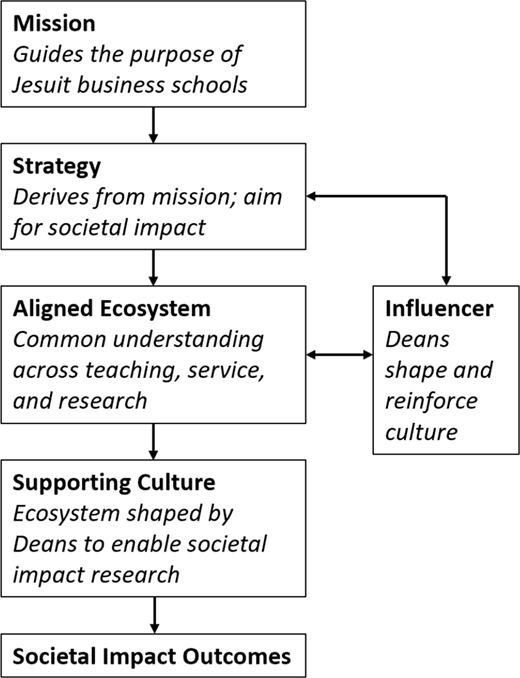
Social impact research flourishes in environments where mission-driven scholarship is valued and sustained by a supportive ecosystem. As deans of Jesuit business schools, we observed that our own ecosystems for doing social impact research begin with a clear mission and strategy, shaped and reinforced by school culture in our respective schools. We noted that leadership practices – such as inspiring a shared vision, challenging the process, modeling the way, enabling others to act and encouraging the heart (Kouzes and Posner, 2023) – provided actionable guidance for cultural transformation, resulting in an ecosystem designed to bring desired outcomes to life [10]. Figure 1 captures this process in a series of steps that lead to increasing numbers of faculty engaged in social impact research.
Simply stated, it all begins with mission – essential to all institutions with a clear purpose on what drives their institution. While purpose provides core motivation and inspiration, a clear mission addressing societal impact in a meaningful way ensures a clear roadmap articulating an approach or action to achieve the mission. For our Jesuit business schools, ecosystem development is rooted in mission across the institution and in each college and school. From mission, we are able to move to strategies that focus on how we operationalize what societal impact means in our respective schools and how we measure outputs (research, teaching, community engagement). Key in the framework is recognizing the role deans play in shaping and reinforcing culture. The deans in our study spoke about the actions they took to inculcate mission as the very fabric characterizing their schools and strategic plans. In implementing strategy, the dean’s role aligns with and engages others in developing systems and rewards to achieve desired outcomes captured in the mission statements. Deans have a moderating role in gauging and building support and common understanding around how mission and strategy impact teaching, scholarship and service. They develop strategies to support a culture that operationalizes the mission. When the ecosystem is aligned to that common understanding, culture change begins producing desired societal impact outcomes. How does that play out? We queried the deans on the processes they used and applied to shape and reinforce a culture of societal impact.
The deans in this study extended their influence beyond administration to cultural leadership. By articulating a vision for societal impact and modeling desired behaviors, they inspired faculty buy-in and elevated the reputation of the school around social impact research.
The most effective ecosystems integrate societal impact throughout academic life – embedding sustainability, ethics and social responsibility into curricula, incentivizing relevant research and fostering community engagement. Jesuit schools exemplify this integration, and AACSB accreditation standards now require evidence of positive societal impact across all three categories. Schools that succeed in this alignment – through partnerships, interdisciplinary research and service – position themselves as leaders in shaping business education for the common good.
We believe business schools need to create an ecosystem that inspires and supports faculty to do research with societal impact. As noted in the framework, that starts with having a school mission and vision that prioritizes service to society across all the activities of the school, including scholarship. One does not have to be a Jesuit business school to have such a mission, although we acknowledge that being faith-based makes it easier to establish.
In an analysis of mission statements from the 22 Jesuit business schools five important themes emerge, either implicitly or explicitly stated. These themes capture key characteristics from the mission and provide a foundation for the ecosystem that develops in the school through cultural changes:
Moral and ethical foundation: Nearly all schools highlight the importance of ethics, integrity, and moral courage in business leadership.
Service-oriented mindset: There is a shared dedication to using business as a tool for social good, justice and service to others.
Jesuit identity: Each mission reflects Jesuit educational values – holistic development, reflection and action.
Leadership development: All schools aim to cultivate principled, innovative and effective leaders.
Global and societal relevance: Many statements reference preparing students to address global issues and contribute to sustainable economies.
Examples of mission statements that inspire scholarship with impact can easily be found across our Jesuit network. Take, for example, the mission statement for the Gabelli School at Fordham University:
The Gabelli School of Business fosters responsible business leadership that inspires innovation, community, and impact. […] We are deeply committed to transformative business research and education that moves society forward and serves as a catalyst for meaningful and lasting global change that matters. (emphasis added)
Another example can be found in the mission statement of the College of Business Administration at Loyola Marymount University:
We advance knowledge and develop business leaders with moral courage and creative confidence to be a force for good in the global community. (emphasis added)
Finally, from the School of Management at the University of San Francisco we have:
Through rigorous management education and impactful research, from the heart of the San Francisco community, we inspire our students to cultivate their skills, lead with integrity, and serve others to promote a more just and sustainable economy. (emphasis added)
Not all mission statements are as explicit about research with impact, but none can be read to not support it, as across these mission statements there are persistent themes of academic excellence, ethical leadership for others, and service to society. Appendix includes the 22 mission statements.
Influencing culture through policy and practice: Aligning the ecosystem
A strong culture – characterized by shared values and leaders who champion societal impact – supports strategy aligned with mission. Leaders must define what is measured and rewarded, driving behavioral and cultural shifts (Schein and Schein, 2017). Hence, deans have an influencer role to play to align the ecosystem with the desired strategy and outcomes. Integrating societal impact throughout a school’s activities is a “both, and” approach: supporting academic freedom while ensuring the ecosystem has an indelible impact. A developing ecosystem motivates appreciation and engages in what Jesuit schools have characterized as “formation” – a concept that can be broadly applied outside of faith-based institutions with a strategic purpose and immensely valuable in influencing outcomes.
The concept of “formation,” central to Jesuit education, refers to intentional development of students and faculty as whole persons, grounded in justice, compassion and service. Formation extends beyond academic achievement to ethical discernment and societal impact, supported by mission-driven curricula and leadership practices.
In Jesuit education, formation refers to the intentional development of students and faculty as whole persons – mind, body and spirit – grounded in values that promote justice, compassion and service. As articulated by the Society of Jesus, a goal of Jesuit education is to form “men and women for others”–individuals who are intellectually competent, open to growth, religious, loving, and committed to doing justice. Formation is not limited to academic achievement but extends to cultivating ethical discernment, reflective practice, and a commitment to societal impact. It is embedded in the ecosystem of Jesuit institutions through mission-driven curricula, co-curricular engagement and leadership practices that model and reinforce desired behaviors. For students, this may include experiential learning (including research with faculty), service opportunities and reflective exercises that help them articulate their purpose and values. For faculty, formation is supported through recognition of socially impactful research (including research with students), alignment of tenure and promotion criteria with mission, and leadership that champions the integration of Jesuit values into scholarship and teaching.
Formation is not limited to Jesuit institutions; it is an intentional strategy advanced by leadership and supported by a team approach. This thinking can be built into how we shape and reinforce a culture generating social impact research. As the Framework suggests, the dean is expected to influence this process from stated mission to strategy to outcome.
Rewarding faculty for socially impactful research, aligning tenure and promotion criteria with mission and expanding definitions of research impact (e.g. public scholarship, policy guidance, community engagement) reinforce this culture.
An ecosystem valuing social impact research must include an expanded definition of research impact, recognizing scholarship that informs the public, guides policy and engages communities – not just traditional academic measures.
Innovative tools, such as the SDG Dashboard at St. Joseph’s University, Haub School of Business, measure faculty research impact across the UN’s Sustainable Development Goals (SDGs). The dashboard measures faculty research impact across the 17 Sustainable Development Goals of the United Nations. This includes its SDG Impact Intensity (SDGII) measure for journals and its ChatSDG, an AI-powered tool for generating reports analyzing article alignment with the SDGs. The dashboard is widely available to business schools around the globe [11].
Expanding evaluation criteria – like Saint Louis University’s 31 categories of scholarly impact – demonstrates commitment to embedding societal impact in faculty assessments and shared governance, fostering long-term institutional commitment.
Supporting the culture
A sustainable culture of societal impact also requires an interconnected ecosystem where engagement is embedded beyond the research enterprise. Studies indicate that faculty reward systems often fail to reflect the full range of academic functions, leading to misalignment between institutional mission and faculty incentives (O’Meara, 2015). Ernest Boyer’s framework for engaged scholarship advocates for recognizing teaching, research and service that contribute to the public good (Boyer, 1990). At Seattle University, for example, the Albers School redesigned its annual evaluation and rank and tenure systems to accommodate engaged scholarship, including public scholarship and community-engaged scholarship. Other schools have valued research stemming from service learning and related pedagogical outcomes from the research of pedagogy. At Loyola Marymount University and Regis University, faculty incentives such as college-supported summer research grants prioritize proposals that capture mission–related work; the universities also provide grants that are university mission related, hence aligned with how the College prioritizes business school mission-oriented work. These opportunities (both for pedagogical and research purposes) develop faculty who explore how their work can align with societal impact goals, influence public policy and/or advance theory and knowledge around global sustainability.
Not every faculty member will produce societal impact research, and schools should value the full research portfolio. Creating an environment where societal impact research is acknowledged, valued and rewarded ensures faculty pursue these goals. Schools need not choose one measure for impact; making room for alternative, mission-driven measures can capture quality and impact factors.
A thriving ecosystem is both top-down (dean-led strategy and advocacy) and bottom-up (faculty collaboration and shared governance). Deans reinforce the vision through strategic plans and leadership practices, while faculty co-create the portfolio of mission-driven scholarship.
Importantly, we also need to recognize that culture can also be a constraint on strategy and negatively impact the ecosystem. Leaders must assess enabling aspects and barriers, motivate dialogue and achieve consensus for change. Deans must understand how the ecosystem works and determine where change is needed. Motivating others to dialogue on desired change and achieving consensus on direction to the change will be important. They share an urgency on what change is needed and how to best ensure the business school community is ready to embrace change in this context. What values and norms are creating barriers for the desired outcomes? How might a dean shift the dialogue to consider alternative perspectives that put societal impact at the center of the mission? Focusing in on moving the organization to a set of shared values, assumptions and commitment to a perspective around societal impact ensures that faculty come together to co-create the appropriate portfolio that values advancing knowledge and making a positive impact on the greater community. This approach strengthens the ecosystem and provides a foundation for success in pursuing the mission.
Integrating societal impact imperatives across curricula – such as courses on sustainability, ethics, CSR and governance – along with student life and engagement opportunities ensures that we model the legitimacy of doing business differently. Universities that prioritize sustainability education empower students as change agents, reinforcing long-term impact (Sterling, 2020).
As an example, the Global Business School Network (GBSN), in collaboration with How to Change the World (two NGOs), engages business students (and faculty mentors) worldwide in real-world problem solving around sustainability issues. Through training and global connections, students and faculty develop the knowledge, skills and attitudes needed to become systems thinkers and empathetic changemakers. Their aim is as follows:
to identify select students at participating GBSN members with high potential to be positive changemakers throughout their careers and lives, and to provide those students with unique international collaboration and virtual mobility experiences that support, develop and enhance their changemaking abilities and potential.
Faculty mentors play a critical role in guiding students and, in some cases, exploring new areas of research and pedagogy. This type of co-curricular programming adds another dimension to the academic ecosystem and can influence all three pillars of faculty contribution – teaching, research and service – by building capacity for societal impact.
The ecosystem becomes even stronger when faculty include students in their scholarship. Many institutions embed this into capstone experiences across programs. For example, at St. Peter’s University, undergraduate students in the data science capstone collaborate with faculty on societal impact research projects, often resulting in conference presentations and journal articles. The school reinforces this annually with a Best Paper Award. At the University of Detroit Mercy, the Center for Practice and Research in Management and Ethics provides research grants to teams of faculty, practitioners, and students to address major social problems. In the Albers School at Seattle University, the annual Faculty-student Research Award encourages collaborative scholarship that contributes to the ecosystem for engaged teaching, learning and research.
When teaching, research and service contributions align with societal impact, the entire enterprise can embrace a culture that reinforces this shift and ensures its longevity in mission and strategy. Such alignment naturally leads to more research with meaningful societal impact.
Strategic and institutional anchors for developing the social impact ecosystem
Strategic anchors for social impact
To ensure alignment with the overarching goal of generating research with meaningful societal impact, business schools must reaffirm their commitment to a set of foundational strategic anchors. These anchors are operationalized through clearly defined institutional structures, consistent administrative processes and well-aligned incentive systems at the school or college level. Collectively, they represent a durable and credible institutional promise to faculty that research aimed at creating societal value is not only legitimate but also recognized and rewarded along with more traditional disciplinary scholarship. By embedding these principles into the core of academic operations, business schools can foster a research culture that equally prioritizes academic rigor and real-world relevance. Additionally, the shifting culture enables faculty to have their research inform pedagogy and deepen the cultural foundation for business schools to capture their value to the global community.
Institutional anchors for societal impact
In addition to considering the entire enterprise and cultural changes to a school through aligning teaching, service and research, there are some basic anchors that will impact the research part of that enterprise. To bring the strategic vision of societal impact into operational reality, business schools must embed that vision into the core institutional anchors that shape faculty work – evaluation, incentives, recruitment and partnerships. We offered a few examples earlier. These anchors not only signal the school’s priorities but also create the enabling conditions for a research culture that values relevance alongside rigor.
A critical first anchor lies in faculty evaluation. The definition of “Excellence in Research” must be broadened to explicitly include contributions that demonstrate real-world impact. Annual evaluation and Rank and Tenure (R&T) processes should be expanded – not replaced – to assess scholarly productivity through a more holistic lens that goes beyond traditional metrics such as the number of peer-reviewed publications, journal rankings and citation counts. Institutions should integrate additional evaluative criteria that capture a scholar’s influence on business practice or public policy, the adoption of their recommendations by external stakeholders, and engagement with the broader public. This broader framework allows for recognition of diverse scholarly pathways, including non-traditional research outlets and outputs, as legitimate and valuable contributions to a faculty member’s portfolio. Moreover, participatory research methods and other applied approaches should be explicitly acknowledged as rigorous and relevant, helping to normalize a wider range of epistemologies within business research. Previously cited examples at St. Joseph’s University, Seattle University and St. Louis University illustrate this approach.
The second anchor involves faculty incentives, which must align with the broader mission by providing tangible support for scholarship that bridges business and society. This includes establishing significant and targeted funding opportunities for research projects that address pressing societal challenges, as well as forming dedicated centers that can serve as institutional hubs for coordinating, resourcing, and amplifying such research. Examples of the former across our Jesuit network include the William and Elizabeth Burkavage Fellowship at the University of Scranton supporting summer research on sustainability topics and the Racial and Social Justice Initiative at the University of San Francisco. Examples of the latter include the Pedro Arrupe Center for Business Ethics at St. Joseph’s University, the Center for Practice and Research in Management and Ethics at the University of Detroit Mercy, and the Sustainable Economic and Enterprise Development (SEED) Institute at Regis University.
Incentives should also include formal recognition, such as awards that honor faculty whose work has demonstrable or measurable societal impact. As an example, at Gonzaga University, the Vision and Values Awards recognize faculty who do mission-based research. Furthermore, funding mechanisms should be in place to support the dissemination of faculty scholarship through open access channels and public forums, thereby increasing visibility and accessibility. Internal communications support – such as media training or editorial assistance – can help translate academic findings into accessible language for use by practitioners, policymakers and the public, ensuring broader uptake and influence.
A third institutional anchor centers on faculty hiring and doctoral student recruitment. Hiring processes should prioritize mission alignment, not just research productivity. Candidates should be asked to articulate how their research agendas contribute to societal impact, following a model already used by many Jesuit institutions. This approach fosters a faculty body that is both values-driven and academically rigorous. At the same time, doctoral programs in business schools should actively encourage and support dissertation research that tackles socially meaningful questions. Welcoming socially engaged research at the earliest stages of doctoral training ensures the next generation of scholars will be equipped – and encouraged – to pursue work that matters beyond just the academy. Along these lines, several of our schools have DBA programs, and, at Fairfield University, for example, nearly 25% of its dissertations have a sustainability focus.
Finally, external partnerships represent a crucial anchor for embedding societal impact into research efforts. Business schools should promote the co-creation of research with community, industry and policy partners to ensure that the questions asked – and the solutions generated – are grounded in real-world needs. At Boston College, the Center for Corporate Citizenship, with its strong ties to industry, bridges industry with business faculty and their scholarship. The Business, Faith, and the Common Good Institute at Creighton University promotes discussion, collaboration, and research which helps understand how business can contribute to the common good, including an annual symposium that brings together academics and practitioners to discuss how faith, business and the common good intersect.
Our global collaboration must also be expanded, particularly with peer institutions in the Global South, to foster more equitable knowledge exchange and amplify diverse perspectives. The International Association of Jesuit Business Schools (IAJBS), which our US schools support, sponsors an annual World Forum where mission-related scholarship can be presented and faculty can connect with like-minded scholars from across the globe. Additionally, the IAJBS co-sponsors the Journal of Management for Global Sustainability, which is an outlet for mission-related scholarship. Our schools also support the Journal of Jesuit Business Education, which, as the title suggests, is a forum for publishing mission-related scholarship. Further, the University of Detroit Mercy is launching a new journal, Advances in Management and Ethics Research, that will emphasize societal impact for practitioners.
In Table 1, we summarize the institutional anchors and how they have been realized across our 22 schools. Not every school uses every anchor, but the reader can get a sense of how it works across the group of schools. Over time, as schools share best practices, we would expect the frequency of practice adoption to increase.
Discussion
Theoretical contribution
The theoretical contribution of this study is modest, as it focuses on practical strategies and practices that can create a culture supporting research with societal impact. In Figure 1, we illustrated a process to create an ecosystem that fosters impactful scholarship. It starts with the mission of the school, which then informs strategic planning. The dean provides leadership to support the ecosystem and resulting culture, incentivising faculty research with societal impact.
Practical implications
In the previous section, we spotlighted a number of institutional practices that we believe contribute toward establishing an eco-system that supports research with societal impact. For those looking to support such an initiative, we provide a e “Leadership Checklist”. The checklist features a list of questions that a school can ask itself about research with societal impact:
The Leadership Checklist
Does the mission statement address societal impact?
Does the strategic plan address societal impact?
Are faculty incentives and support aligned with societal impact?
Is research with societal impact recognized in the annual evaluation process?
Is research with societal impact recognized in the rank and tenure process?
Are resources such as research grants and faculty training supporting research with societal impact available to faculty?
Is the school highlighting research with societal impact and emphasizing the tie to mission?
Is research with societal impact promoted and celebrated internally?
Is research with societal impact featured in the external communication of the school?
Is the school partnering with industry and academic allies to support research with societal impact?
Have you identified industry/non-profit/government organizations willing to support or consider research outcomes?
Are there other schools or organizations within higher ed who have a similar interest in research with societal impact?
How are you recruiting faculty for mission and how does research with societal impact play a part in that?
How are you creating a student experience that promotes societal impact, both within and outside the curriculum?
Limitations and future directions
We recognize that this “view-from-the-top” from 22 Jesuit business deans has limitations in its broader generalizability. Although the themes presented here emerged from broad engagement with deans across the USA from Jesuit business schools, this work does not purport to constitute a formal reflexive thematic analysis as proposed by Braun and Clarke (2006). Rather, it offers a practical, leadership-oriented framework for cultivating ecosystems that advance socially impactful research within mission-driven institutions. Jesuit universities are, by their 500-year-old tradition, already oriented towards having social impact. As was noted earlier, Jesuit business schools have always seen business as a force for good and advocated for meeting the needs of all stakeholders, not just shareholders. This is reflected in many, if not most, of the mission statements for the universities in our sample (see Appendix). It is, therefore, easier for our schools to internally justify and adopt a societal impact strategy.
We acknowledge that this may be different for non-faith-based institutions, but with the focus of AACSB and other accrediting bodies on societal impact, secular and nonsecular business schools will be looking for ways to give greater attention to research with social impact. Our ecosystem framework does provide schools with an approach for both implementing strategy around rewarding societal impact research as well as recognizing the key features ensuring ecosystem development, providing a more enduring culture around societal impact – making it part of the very fabric of the school.
Future studies could involve comparative studies across different types of institutions, both faith- and non-faith-based. It would be valuable to examine alternative theoretical frameworks and empirically measure the impact of creating such a research ecosystem, as well as identify which strategies work best within the different types of business schools (faith-based vs non-faith-based, private vs public, PhD granting vs master’s level vs undergraduate, are a few options).
This paper includes the insights and endorsement of the following US Jesuit business school deans. The authors are writing on their behalf: Lerzan Aksoy, Dean, Gabelli School of Business, Fordham University, Kenneth Anderson, Dean, College of Business Administration, Gonzaga University, Michael Behnam, Dean, Quinlan School of Business, Loyola University Chicago, Andrew DeGuire, Dean, College of Business Administration, Marquette University, Joseph DiAngelo, Dean, Haub School of Business, Saint Joseph’s University, Joseph Eisenhauer, Dean, College of Business Administration, University of Detroit Mercy, Otgo Erhemjamts, Dean, School of Management, University of San Francisco, Myles Gartland, Dean, Helzberg School of Management, Rockhurst University, Sean Hansen, Dean, Boler College of Business, John Carroll University, Anthony Hendrickson, Dean, Heider College of Business, Creighton University, Mark Higgins, Dean, Kania School of Management, University of Scranton, James Joseph, Executive Dean, Madden College of Business and Economics, LeMoyne College, Zhan Li, Dean, Dolan College of Business, Fairfield University, Jackson Nickerson, Dean, Chaifetz School of Business, Saint Louis University, Shawn O’Rourke, Dean, Richard Wehle School of Business, Canisius University, Marco Pagani, Dean, Williams College of Business, Xavier University, Kimberly Reeve, Dean, Guarini School of Business, Saint Peter’s University, Robert Savoie, Dean, College of Business, Loyola University New Orleans, Mary Ann Scully, Dean, Sellinger School of Business and Management, Loyola University Maryland and Daniel Turner, Dean, Albers School of Business and Economics, Seattle University.
Notes
While there are 25 Jesuit business schools in the USA, there are nearly 80 worldwide.
“Earlier reflections on Jesuit business education include Andre Delbecq, “Business Schools in Jesuit Education: Four Reflections,” (1981); Andre Delbecq et al., “Jesuit Higher Education for Business,” (2010); and David McCallum, SJ and Laura Horian, “A Leadership Education Model for Jesuit Business Schools,” Journal of Jesuit Business Education (International Association of Jesuit Universities, 2013).
The Inspirational Paradigm was developed under the auspices of the International Association of Jesuit Universities (2020) which convened a taskforce of 15 Jesuit business educators from across its global network. The document can be found here: https://iaju.org/sj_files/2023/11/An-Inspirational-Paradigm-for-Jesuit-Business-Education_English.pdf
Pope Francis released Laudato Si’ on May 24, 2015, and it can be found here: www.vatican.va/content/francesco/en/encyclicals/documents/papa-francesco_20150524_enciclica-laudato-si.html
Among our 25 schools, 23 are AACSB accredited, and one is a candidate for accreditation.
Given our strong affiliation with AACSB, we will use the term “societal impact” throughout the rest of this paper. While AACSB has recently responded to this political shift with changes to the clarifying language of its standards, we do not see this as a change to the prioritization it gives to societal impact.
Final Report of the AACSB International on the Impact of Research Taskforce, AACSB, 2008. www.aacsb.edu/insights/reports/impact-of-research
Global Research Impact Framework: Exposure Draft, AACSB, October 19, 2025. www.aacsb.edu/insights/reports/2025/research-impact-framework-exposure-draft
The authors also argue that research impact and relevance must be considered jointly with the educational mission of business schools, not separately as the literature typically does.
From 1997 to 2009, Barry Posner served as the dean of the business school at Santa Clara University, one of the 25 Jesuit business schools in the USA.
For more on SDGII, see Steingard and Rodenburg (2023).