
Port Designer's Handbook, Fourth edition
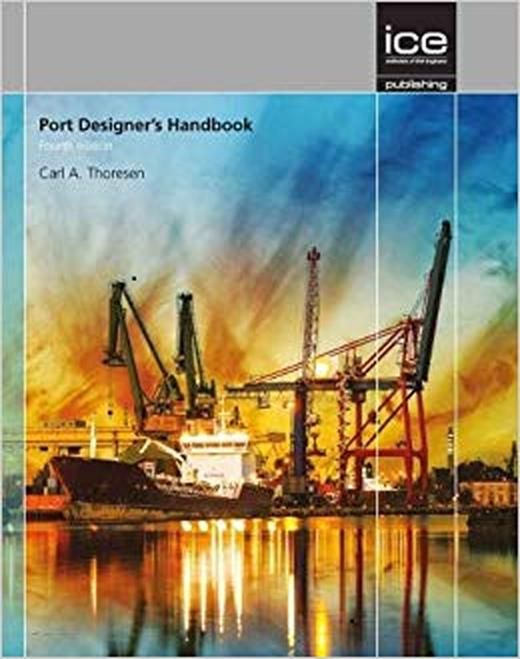
Any engineer with a primary interest in structures will feel, looking at this book's front cover, that it will have much to offer. At least three different crane types are prominently on display and, less obviously, there are also gantries and mooring/fendering systems associated with the berth structure itself. The book does indeed include a considerable amount of structural advice but this is mostly presented in a broad way by considering system types, rather than in a narrow, design manual type way. As an example, for berth structures, the author discusses a number of arrangements and advocates ‘…a design that will give a clearly (understood load capability) and the easiest possible construction work for the Contractor. Sophisticated solutions should be avoided.’ Surely such advice as this is applicable right across the construction industry.
The book contains 22 chapters and, as may be expected from its title, not all are likely to be of interest to the structural engineer. The first four and the last two chapters are concerned with broader maritime topics such as port planning, environmental forces, channels and harbour basins, berthing requirements, port maintenance and ship dimensions.
Chapter 14, Container terminals, also largely falls into the same category. As long-distance container ships become physically larger and operationally more costly, the number of terminals able to accommodate them within a 24 h turnaround window, which requires significant automation, is limited. The development of the ship-to-shore (STS) crane has been pivotal and, between 1970 and 2012, their basic structural arrangement has not altered, but their outreach and lift height have doubled by doubling the rail gauge.
Chapter 6, Design considerations, contains as its first figure a useful pictorial summary of the load types acting on each of the primary structural elements that comprise a berth. These loads, as per the Eurocodes, should be considered at ultimate, accidental, fatigue and serviceability limit states. Clear images of a rubber-tyred gantry, an STS crane and a mobile harbour crane (see the book's front cover) are provided to describe typical vertical wheel and outrigger loads. The durability and design life of maritime structures is always problematical, and a well-known joke from the author's circle is offered – this should at least outlast the design engineer's remaining career!
Berth structure types – that is, gravity wall, sheet pile wall, open berths and floating berths – are covered in Chapters 8 to 12, which collectively comprise the largest segment of the book. For those whose main interest is in architect-designed building structures, there is a description, albeit a brief one, of the proposed floating cruise terminal at Longyearbyen, Svalbard, Norway. This location has geotechnical and environmental conditions that are even more challenging than the norm for maritime projects. Indeed, such conditions, and the consequential need to consider constructability issues in depth, are a recurring theme throughout the book. For instance, with the increasing availability of heavy transport and lifting equipment, most berth structure elements can now be precast, if necessary at locations many hundreds of kilometres away.
Chapter 13 on Berth details and Chapter 15 on Fenders will mainly interest the specialist maritime structural engineer. Many recently developed berthing and fendering assets are essentially complex structures but, like STS cranes, are off-the-shelf items.
There are other very worthwhile structural engineering chapters on ship impact, safety considerations, erosion protection, steel corrosion, underwater concreting, concrete deterioration and concrete maintenance and repair; these again accentuate the need to consider constructability/durability/maintainability issues within the design phase. As an example, anti-washout concrete is advocated in Chapter 18, Underwater concreting. This product allows longer transport and placing times, has high viscosity but is flowable, is self-compacting, retains its cement paste and, lastly, ensures good diver visibility. As another example, chloride penetration and rebar corrosion are explained in great depth as the major source of concrete deterioration in Chapter 19, alongside others such as freeze–thaw action and poor construction execution underwater. These chapters will be particularly relevant to major bridge and offshore energy projects as well as to the maritime industry.
This book describes how the civil engineering profession serves a basic human need for communication and trade, while accommodating both severe environmental conditions and the usual commercial pressures. It contains pragmatic structural advice that can be applied to any project with even a minor maritime element, and which can also potentially be adapted to many other project types. While maritime civil structural engineers will undoubtedly find this a valuable book, those from other construction industry backgrounds, at all grades, will also not be disappointed.


