Timber is a natural composite material in which a lignin matrix bonds together and stabilises cellulose fibres. This composite feature equips many species of the material with stiffness, strength, durability and density characteristics that are desirable in several static, dynamic and impact scenarios. Consequently, timber has been successfully deployed in applications ranging from the demanding to the delicate. These include bridges, buildings, clogs, cricket bats, furniture, musical instruments, paper, ships, skis and tool handles. In civil engineering structures, the core requirements of low embodied energy and sustainability are driving more creative and abundant uses of timber. Commonly, these creative uses introduce important subtleties in fabrication and load response that can be appreciated, understood and addressed only via new fundamental research. This timber themed issue of the Structures and Buildings journal complements the August 2010 issue in reporting on the latest advances in some of these research areas.
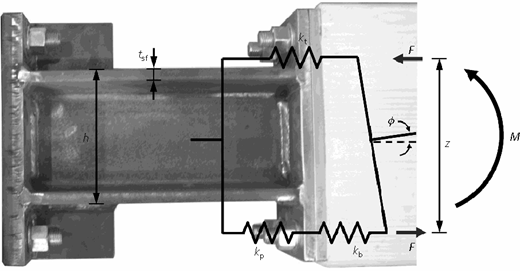
The first three papers address these issues of structural performance and fabrication for joints in timber-framed buildings. In the first paper, Andreolli et al. (2011) present a ductile, moment-resisting joint consisting of a steel stub connected to the ends of the timber members via steel plates and bonded-in steel rods. Extensive test data are presented to validate the desirable structural properties (stiffness, strength, failure mode and rotational capacity) of this joint system. A predictive approach (hinted at in Figure 1) which intelligently adapts ideas from modelling of semi-rigid joints in steel frameworks, is seen to compare satisfactorily with the test data. The ability to modify joint geometry for corner and foundation connections, and the use of prefabrication to minimise in-situ work are highlighted as user-friendly facets of this joint. The second paper, by Piazza et al. (2011), takes a wider view by comprehensively reviewing recent research into traditional dowel-type joints and into new joints comprising self-tapping screws inclined to the shear plane. Existing test data are analysed to provide models for ductility and energy dissipation within the joints. Inconsistencies are identified between different procedures currently proposed to characterise the structural performance of the joints, and new procedures are suggested to overcome robustly these inconsistencies.
Presented in the context of Japanese timber housing, the third paper resonates with us as our thoughts remain with the people of Japan who were struck by the earthquake and tsunami of 11th March 2011. Shiratori et al. (2011) consider the optimisation of a timber beam–timber column joint system composed of triangular-section beams and wedges which sit in notches in the columns and are pressed into these notches by prestressed bolts. This intimate contact encourages frictional damping within the joint. In an experimental study, joint structural performance was optimised with respect to the taper angle of the wedges. The tests show that wedges made of densified veneer wood (DVW) instead of beech and the use of DVW to reinforce the columns (otherwise made of poplar) in zones of peak dynamic contact stress with the beams have two beneficial effects. First, energy dissipation within the joint during cyclic loading is strongly improved. Second, post-cycling retrieval of high joint stiffness is easily achieved by re-tightening the bolts without necessarily replacing the wedges (which is easily done if needed). Hence there is interaction between the high structural performance and the ease of assembly for this joint. The paper proposes an analytical diagram to predict joint performance. Future tests and development of the diagram will lead to the ultimate optimisation of this promising joint system.
In the next paper, Harris (2011) develops a rigorous framework of ideas around the design and construction of timber gridshell structures. The discussion highlights the crucial roles of co-operation between engineers and architects, of early insight into geometry (via use of models) and into internal force flows through the structure, and of computer-aided design/manufacture for structural optimisation. Numerous existing examples (such as the Downland Gridshell and the Saldome) are given, providing clear evidence of the architecturally and structurally inspiring nature of timber shells.
The following two papers focus on timber–concrete composite (TCC) systems. Fragiacomo and Lukaszewska (2011) describe a TCC system in which the concrete slab with partially embedded connectors is prefabricated and is subsequently connected to the timber beams in situ. Advantages include reduced stresses within the TCC system from shrinkage of the concrete, because the slab is able to shrink freely before assembly with the joists. Data from tests on TCC joints and beams under various loading regimes are presented to vouch for the structural integrity of these systems. From a range of connection details considered, best results are reported for a notch connection reinforced with a coach screw. Then, Dias et al. (2011) discuss the considerations which underpinned the design and construction of a TCC road bridge in Portugal. Clear channels of communication between the design team, the bridge owner and the contractor are highlighted as having been crucial to the successful implementation of this novel solution. Data from a service load test on the completed bridge point to high stiffness, to efficient transverse load distribution and to the ability of simple finite-element models to predict load response. The authors suggest that this lightweight TCC bridge form may be economically used to replace existing concrete or steel bridges, while re-using the existing abutments and foundations.
Although long-term effects are quite important to the design of TCC elements, study of these effects has not featured highly on the research radar. The last two papers of this themed issue attempt to change that status quo. Van de Kuilen and Dias (2011) present the results of creep tests performed on seven joint configurations based on various combinations of normal or high strength concrete, smooth or profiled steel dowel bars of multiple diameters, and different timber species. Eurocode 5 is found to be somewhat optimistic in assessing the creep values of TCC joints with dowel-type fasteners, particularly for certain environmental conditions. Finally, To et al. (2011) describe an experimental study of the long-term behaviour of a TCC beam employing notched shear keys. Environmental effects (including the mechano-sorptive effect due to moisture in the timber) were closely monitored. A 3D FE model in ABACUS was found to predict the measured behaviour to a good degree of accuracy.
That this second timber themed issue builds dramatically on the success of its predecessor is in no small part due to the commendable interaction between the journal's editorial team, the publications team and the authors of the papers. Thank you all for this coordinated effort. Thanks also to the past and present journal editors Professor Ian May, Mr Rob Smith and Dr Leroy Gardner for your support.
The distinguished Oliver W. Holmes stated that ‘knowledge and timber should not be much used till they are seasoned'. I am pleased to say that both the timber used in and the knowledge gained from the above studies has been well seasoned, thus enabling the underpinning of future research and of robust structural design guidelines. In closing, let us join the lumberjacks in exclaiming the continuing arrival of this renewable material. Timber!!