

Droplet depinning on superhydrophobic surfaces is pervasive in nature and critical to many applications and hence has been studied extensively over the past few decades. A consensus has been reached that the droplet depinning force mainly stems from the synergistic dynamics of the three-phase contact line and the liquid–vapor interface. Nevertheless, the aforementioned conclusions were made using simple (pure water) droplets depinning on rigid superhydrophobic surfaces, denoted as simple rigid wetting, where the main influencing factors are liquid–vapor interfacial tension, surface texture geometry and material wettability. In recent years, an increasing amount of attention has been paid to complex soft wetting, where liquid physiochemical properties (e.g. viscoelasticity) and solid surface rigidity play an important role. To encourage the investigation of complex soft wetting, in this perspective, depinning of simple droplets on soft surfaces and depinning of viscoelastic droplets on rigid surfaces are briefly introduced. Then, possible factors that affect viscoelastic droplet depinning on soft superhydrophobic surfaces are discussed. Moreover, applications that are highly relevant to complex soft wetting are introduced.
Notation
- a
a molecule size that is approximated to be 1 nm
- Ca
capillary number
- d
pillar diameter
- E
Young’s modulus of a beam (pillar)
- F
depinning force
- G
shear modulus of a soft substrate
- h
pillar height
- k
spring constant of a beam (pillar)
- l
characteristic size of a wetting ridge
- lc
characteristic length of a viscoelastic fluid
- PCL
energy per second consumed by contact line sliding
- PEB
energy per second stored in the elastic liquid bridge
- PLV
energy per second stored in the liquid–vapor interface
- PPD
energy per second stored in the deflected pillar
- PVis
energy per second consumed by viscous dissipation near the contact line
- PWR
energy per second consumed by the motion of the wetting ridge
- R
droplet radius
- tc
characteristic time of a viscoelastic fluid
- v
contact line speed
- Wi
Weissenberg number
- γLV
liquid–vapor interfacial tension
- θa
advancing contact angle
- θr
receding contact angle
- μ
liquid viscosity
1 Introduction
Droplet depinning on superhydrophobic surfaces can be ubiquitously found in nature. The most known example is the lotus leaves, where droplets partially wet the surface structures and can easily roll off. This wetting state is referred to as the Cassie–Baxter state,1 resulting from the combined effects of the discrete micro-/nanostructures and the poor-wettable material properties.2 Superhydrophobic surfaces have demonstrated numerous applications ranging from energy, petroleum and printing to biotechnology, such as heat-transfer enhancement, drag reduction, anti-icing and oil/water separation, to name a few.3–6 The efficacy of those applications depends on the extent to which a droplet is pinned on a solid substrate. Hence, extensive attention has been paid to understand the fundamental correlation between the droplet depinning force and the surface characteristics – for example, surface texture geometry and intrinsic wettability. More details can be found in many reviews.2,7–15
Distinctly, this perspective aims to point out possible factors that influence droplet depinning, which have been neglected because prior studies were mostly conducted using pure-water droplets depinning on rigid substrates – that is, simple rigid wetting. There is an increasing need for flexible electronic devices, whose surface self-cleaning functionality and liquid cooling systems involve droplet depinning on soft surfaces. The local (wetting ridge16) and global (pillar deflection17–19) deformations of the soft substrate significantly alter the morphology and dynamics of the three-phase contact line, but the correlation between surface rigidity and droplet depinning force remains vague. Moreover, although the literal meaning of superhydrophobic surfaces is repellence to ‘water’, from a practical point of view, such surfaces should be required to repel a large variety of liquids – for example, viscoelastic fluids. However, droplet physiochemical properties such as viscoelasticity were rarely considered in the analysis of droplet depinning force.
Therefore, in this perspective, the fundamentals of simple rigid wetting are briefly iterated. Then, fundamentals regarding droplet depinning on planar soft surfaces, droplet depinning on pillared soft surfaces and depinning of viscoelastic droplets on rigid pillared substrates are introduced with an outlook on how surface elasticity and liquid viscoelasticity affect the droplet depinning force – that is, complex soft wetting. At last, real-time droplet manipulation, whose efficacy highly relies on the fundamentals of complex soft wetting, is discussed.
2 Simple rigid wetting
Taking a water droplet receding on a pillared superhydrophobic substrate as an example (Figure 1), from a microscopic perspective, the droplet is not strictly pinned, and its motion involves the sliding of a microscopic contact line on pillar tops and the distortion of the liquid–vapor interface in between adjacent pillars.20,21 Either the sliding of contact line over the entire pillar top or the rupture of the liquid–vapor interface (in a shape of a capillary bridge) leads to the apparent depinning of the droplet boundary (the boundary jumps from one array of pillars to the other). This apparent depinning determines the apparent receding contact angle and the droplet depinning force (F). Contact line sliding and liquid–vapor interface distortion coexist, and F stems from the energy per second (power) stored in the distorting liquid–vapor interface (PLV), the energy consumed by the sliding of the microscopic contact line that involves the exchange of liquid–solid and solid–vapor interfaces (PCL),14 and the viscous dissipation near the moving contact line (PVis),22 as
In the quasistatic regime, PVis is significantly smaller than the first two terms (capillary number Ca = μv/γLV ≪ 1, where μ is dynamic viscosity, v is the speed of the microscopic contact line and γLV is the liquid–vapor interfacial tension) and hence can be neglected. The pillar top is a locally smooth surface, and hence, PCL is approximated to be the apparent depinning force per unit length of the contact line, γLV(cos θr − cos θa), multiplying the rate at which an area is being slid by a contact line. PLV involves a complicated three-dimensional evolution of the liquid–vapor interface and hence is typically simplified as a stretched spring,23,24 where the spring constant is a function of γLV (μ is ignored) and a numerical factor depending on surface texture geometry.
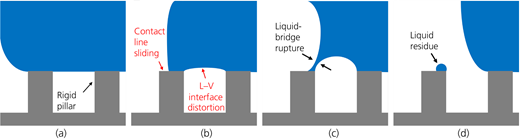
Schematics of a droplet receding on a rigid, pillared superhydrophobic surface. The receding process involves a sliding of contact line and a distortion of liquid–vapor (L–V) interface
Schematics of a droplet receding on a rigid, pillared superhydrophobic surface. The receding process involves a sliding of contact line and a distortion of liquid–vapor (L–V) interface
3 Droplet depinning on planar soft substrates
As shown in Figure 2(a), γLV can deform a substrate with a shear modulus of G by pulling the substrate upward,16,25–27 and the size of deformation (l, denoted as the wetting ridge) scales as
For a rigid substrate, l is smaller than a molecule (a ≈ 1 nm), and hence, the wetting ridge can be neglected. When a ≪ l ≪ R (where R is the droplet size), the wetting ridge affects the dynamics of the contact line as well as the depinning force. When a ≪ R ≤ l, the wetting ridge even affects the droplet macroscopic shape. The contact line sliding is accompanied by the motion of the wetting ridge, which consumes energy (PWR) and hence retards the contact line.16 Various studies have reported that the decrease in surface rigidity leads to the enhanced droplet pinning.28–31 The energy being consumed depends on the shape of the wetting ridge, and therefore, many investigations have been conducted to understand the evolution and the equilibrium shape of the wetting ridge.25–27 However, a quantitative correlation between droplet depinning force and substrate rigidity is yet to be established.
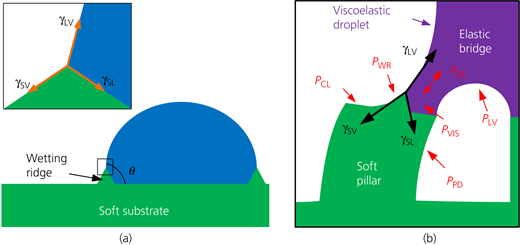
(a) Schematic diagram of surface deformation (wetting ridge) of a planar soft surface; (b) schematic diagram of surface deformation and the energy that contributes to droplet depinning on a pillared soft superhydrophobic surface
(a) Schematic diagram of surface deformation (wetting ridge) of a planar soft surface; (b) schematic diagram of surface deformation and the energy that contributes to droplet depinning on a pillared soft superhydrophobic surface
4 Droplet depinning on pillared soft substrates
Different from a planar soft substrate, where only the wetting ridge occurs, soft pillars allow both the wetting ridge on pillar tops and the global deflection of a pillar,17,19,32 as shown in Figure 2(b). The pillar deflection stores energy (PPD), which affects the droplet depinning. This energy can be approximated using the small deflection assumption of a beam (pillar) with a spring constant (k) of
where E is the Young’s modulus of the substrate material and d and h are the pillar diameter and height, respectively. Few studies have investigated the droplet depinning characteristics on pillared soft superhydrophobic substrates, but an agreement in results has not been achieved. For example, Chuang et al.28 allowed droplets to evaporate on soft pillars and reported that the apparent receding contact angles decrease with the decrease in the substrate Young’s modulus. A smaller receding contact angle typically represents a more significant pinning. Moreover, Coux and Kolinski32 measured the tilt angle (or sliding angle) of glycerol droplets on planar and pillared soft substrates. They reported that the droplet sliding angle (the larger the sliding angle, the greater the depinning force) on pillared soft substrates is larger than that on planar soft substrates. In contrast, it should be noted that the decoration of rigid pillars on a planar substrate typically decreases the droplet pinning.2 Therefore, those two studies suggest that the deflection of soft pillars enhances the droplet pinning. However, Papadopoulos et al.17 reported that the apparent receding contact angles increase with a decrease in Young’s modulus, indicating that the pillar deflection mitigates the droplet pinning. Besides to the disagreement between experimental results, a quantitative model that correlates the mechanical properties of the pillar and the droplet depinning force remains lacking.
5 Depinning of viscoelastic droplets on pillared substrates
Because of the broad applications of superhydrophobic surfaces, the liquids being repelled are not only water but also viscoelastic fluids (e.g. blood). Viscoelastic fluids exhibit behaviors of both viscous fluids and elastic solids. Typically, a viscoelastic fluid behaves more like an elastic solid as the shear rate (v/lc) increases, characterized by the Weissenberg number as
where lc and tc are the characteristic length and time of the viscoelastic fluid, respectively. tc can be defined based on the storage and loss modulus of the fluid.
As mentioned in prior paragraphs, different from planar substrates, the rupture of a capillary liquid bridge uniquely occurs on pillared superhydrophobic surfaces (Figure 1(c)). Xu et al.33 measured the sliding speeds of viscoelastic droplets and pure viscous droplets (their viscosities are identical) on an inclined pillared superhydrophobic surface. The results showed that the sliding speeds of viscoelastic droplets are significantly smaller (by ∼85% reduction) than that of the viscous counterpart. In contrast, when the authors repeated the experiments on planar surfaces, the speeds of viscoelastic and viscous droplets were similar. This is because on planar surfaces, where bridge rupture does not occur, the droplet speeds are determined only by the competition among viscous, gravitational and retentive (adhesion) forces. On pillared surfaces, the droplet motion uniquely involves the stretching of capillary bridges, which exhibit elastic behavior as the characteristic length of a bridge (lc) is quite small (please refer to Equation 4). This leads to an elastic energy (PEB) stored in the stretching bridge, which delays the bridge rupture and enhances the droplet pinning. This elastic energy depends on the pillar shape, the liquid viscoelasticity and the droplet speed. Due to its complexity, this energy has not yet been quantified, leaving the viscoelastic droplet depinning on superhydrophobic surfaces unpredictable.
6 Depinning of viscoelastic droplets on soft superhydrophobic surfaces
To sum up, the energy consumed by the wetting ridge, the energy stored in the deflecting pillar and the energy stored in the elastic bridge should collectively affect the depinning force of viscoelastic droplets on soft superhydrophobic surfaces (Figure 2(b)), given as
where PCL (CL: contact line) and PLV (LV: liquid–vapor interface) are wetting energy considered in most wetting systems, PWR (WR: wetting ridge) and PPD (PD: pillar deflection) are energy unique to soft substrates and PVis (Vis: viscous dissipation) and PEB (EB: elastic bridge) are energy stemming from the droplet inside (viscoelastic fluid). PCL, PWR and PVis result from the motion of a contact line, PLV and PEB result from the distortion of the liquid–vapor interface and PPD results from the deflection of a pillar. To understand the droplet depinning force in complex soft wetting, approximations of those terms and their contribution ratios should be examined in future studies.
7 Applications in real-time droplet manipulation
Equation 5 is instructive to various applications. Taking pillars containing magnetic particles as an example, the pillars deflect following the magnetic field lines, and this deflection changes how the droplet interacts with pillars (Figures 3(a) and 3(b)). Typically, the depinning force is smaller in the direction that follows the pillar deflection.34 When the substrate is subjected to a vertical vibration, the droplet undergoes a periodic advancing and receding motion.35–37 Thanks to the asymmetricity in droplet depinning force, the contact line recedes more easily in the direction following the pillar deflection, and therefore, this periodic motion leads to droplet directional transport (Figures 3(c) and 3(d)). The droplet can be directed to a different direction by changing the magnetic field direction at any time.38 This allows real-time droplet manipulation in any direction, which has broad applications, particularly in microfluidics and biomedical devices. However, the droplet speed has not yet been correlated with the surface characteristics because many factors are coupled. For example, if a pillar can be deflected by the magnetic field, its deflection associated with the liquid–vapor interfacial tension and the inertia in vibration should also be considered. Moreover, microfluidics for biotechnology applications commonly involves viscoelastic liquids. Therefore, the understanding of viscoelastic droplets depinning on soft superhydrophobic surfaces provides guidelines to various applications, particularly real-time droplet manipulation for microfluidic applications.
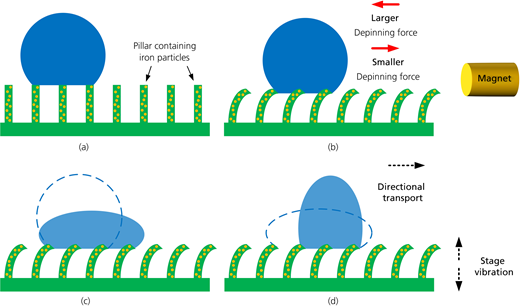
Schematic diagram of a droplet on soft pillar arrays that contain iron particles (a) without and (b) with a magnetic field; (c, d) schematic diagram of droplet directional transport on soft pillar arrays under a magnetic field and a vertical vibration
Schematic diagram of a droplet on soft pillar arrays that contain iron particles (a) without and (b) with a magnetic field; (c, d) schematic diagram of droplet directional transport on soft pillar arrays under a magnetic field and a vertical vibration
8 Summary
Depinning of water droplets on rigid superhydrophobic surfaces – that is, simple rigid wetting – has been investigated extensively over the past few decades. Due to an increasing need for soft superhydrophobic surfaces and viscoelastic (complex fluids) working environments, attention has been increasingly paid to complex soft wetting, where the subject of interest is viscoelastic droplets on soft superhydrophobic surfaces. This perspective discusses the fundamentals of how surface rigidity and liquid viscoelasticity affect droplet depinning on soft superhydrophobic surfaces. For substrate rigidity, the wetting ridge and the pillar deflection affect the droplet depinning. For liquid viscoelasticity, the stretching of the elastic liquid bridge also affects the droplet depinning. Nevertheless, the effects of surface rigidity and liquid viscoelasticity on droplet depinning force have not yet been quantitatively examined. This is because visualization and estimation of the microscopic contact line dynamics, surface deformation and the liquid–vapor interface evolution are difficult. Future studies should address the aforementioned issues by measuring the apparent depinning force and visualizing the microscopic dynamics simultaneously.
This perspective introduces few sources that contribute to the complex soft wetting system. However, some factors affecting droplet depinning are not covered – for example, particles inside a droplet (particle-laden droplets), particles surrounding a droplet (liquid marbles), surfactants and the coupling of dissolutions or reactions. For example, the solid substrate may dissolve into the droplet, where the substrate shape, contact line dynamics and the liquid properties are changing dynamically.39–41 Further studies are encouraged to examine this interesting problem, where wetting phenomena, solid mechanics, fluid dynamics and chemical reactions are coupled.
Acknowledgement
This work is partially supported by Basic and Applied Basic Research Foundation of Guangdong Province (China) Numbers 2021A1515110184, 2021B0301030005 and 2022A1515011214.

