

NiO/MgO solid solution materials have emerged as highly effective catalysts for various catalytic processes, including dry methane reforming, CO2 hydrogenation, methane partial oxidation, and steam reforming of hydrocarbons. The similar lattice parameters of NiO and MgO allow the formation of homogeneous solid solutions, where metallic Ni particles can be generated through the NiO reduction that is controlled by MgO isolation effect on NiO in the solid solution. The small size of these particles plays a crucial role in preventing carbon deposition and sintering in catalytic reactions. In this review, the basic principles of the formation of NiO/MgO solid solution, the reduction properties of the catalysts, and the insight into its high catalytic activity are elucidated. The synthesis methods of NiO/MgO solid solutions are presented. In addition, the recent progress of catalytic applications of NiO/MgO solid solutions is provided. By offering deep insights into solid solution catalysts, this review aims to facilitate their further development for diverse catalytic processes.
1. Introduction
In 1995, NiO/MgO solid solution materials were demonstrated as exceptionally efficient catalysts for dry methane reforming.1 Since then, these catalysts have been extensively studied for various catalytic processes.2–8 The NiO/MgO catalysts are initially designed for dry methane reforming, which offer significant advantages in terms of reducing carbon formation, a common issue in high-temperature catalytic processes. Thermodynamic analysis suggests that carbon formation is likely at elevated temperatures during methane reforming, necessitating a catalyst that can kinetically inhibit carbon deposition under conditions that favor it.9,10 Most of the group VIII metals (Rh, Ru, Ni, Pt, Pd, Ir, Co) are more or less effective for catalysis of dry methane reforming, while Ni-based catalyst was found to be the most active catalyst among the non-noble metals.9,11–14 The design of Ni-based catalysts that resist carbon deposition relies on two key factors:15 (1) carbon deposition occurs when the metal clusters exceed a critical size; (2) carbon deposition is favored by acidic supports. To prevent carbon deposition, it is essential to maintain metal cluster sizes below this critical threshold and reduce the acidity of the support material.16,17 Basic alkaline earth metal oxides, such as MgO, CaO, SrO, or BaO, are effective supports for this purpose.18 Among these, MgO is particularly suited because it has a lattice parameter similar to NiO, allowing for the formation of a homogeneous solid solution with varying compositions.19,20 By reducing the NiO/MgO solid solution with H2, Ni particles can be obtained and produce the active sites that are responsible for the catalytic process.21 The MgO isolation effect on NiO in the NiO/MgO solid solution inhibits the reduction of major Ni2+ions to Ni0 atoms, limiting the amount of Ni available and helps maintain small Ni particle sizes.22 In addition, these small particles are stabilized by partial embedding in the solid solution, reducing the tendency for sintering. These factors together make NiO/MgO a promising catalyst for inhibiting coke formation and sintering. Moreover, both Ni and Mg are abundant and low cost compared with commonly used elements (such as Ru, Pt, and La) in catalysts such as Ru/La2O3.23 The facile synthesis approaches of NiO/MgO solid solutions, such as impregnation and co-precipitation, along with their long-term stability, further reduce the overall cost of the catalysts.24,25 These advantages position NiO/MgO solid solutions as highly promising candidates for various catalytic applications.
Until now, NiO/MgO solid solutions remain among the most efficient catalysts for preventing coke formation and sintering during dry methane reforming and other processes.2,11,26–28 In this review, we elucidate the principles of reducing NiO/MgO solid solutions, discuss various synthesis methods, and explore the applications of these catalysts.
2. Formation and reduction of NiO/MgO solid solution
Different from conventional supported catalysts, where the active species are deposited onto a support, the active species in solid solution catalysts arise from the bulk solid solution itself. This allows for the formation of small, well-dispersed metallic particles that strongly interact with the matrix.11 The similarity in crystal structure and lattice parameters between the active metal species and the support matrix is crucial for solid solution formation. Both MgO and NiO share a face-centered cubic (fcc) structure and have similar lattice parameters: 4.2112 Å for MgO and 4.1684 Å for NiO.13 This similarity facilitates the formation of a stable solid solution at high temperatures.
NiO/MgO solid solution catalysts need to be activated (reduced) to produce active site (metallic Ni) on the surface of MgO. It was observed that the reduction NiO/MgO solid solution was much more difficult than that of pure NiO. As shown in the H2-TPR profile (Figure 1(a)), bulk NiO undergoes a straightforward reduction at 380°C, corresponding to its transformation into metallic Ni.29 In contrast, the reduction of 15 wt% NiO/MgO solid solution is more complex. A small peak appears at 200°C–350°C, corresponding to the reduction of surface Ni atoms, while a broader peak extends to ∼800°C. This phenomenon is due to the MgO isolation effect on NiO in the solid solution.22
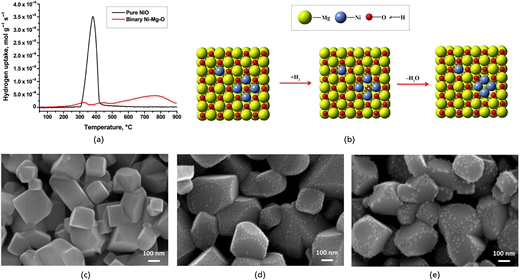
(a) H2-TPR profile of pure NiO and binary Ni–Mg–O solid solution. Reprinted with permission from Karnaukhov et al.29 (b) The isolation effect of reduction of NiO in an NiO/MgO solid solution. Reprinted with permission from Hu.22 Scanning electron microscope images of (c) Ni0.4Mg0.6O catalyst, and samples reduced at (d) 700°C, and (e) 800°C for 5 h. Reprinted with permission from Park et al.30
(a) H2-TPR profile of pure NiO and binary Ni–Mg–O solid solution. Reprinted with permission from Karnaukhov et al.29 (b) The isolation effect of reduction of NiO in an NiO/MgO solid solution. Reprinted with permission from Hu.22 Scanning electron microscope images of (c) Ni0.4Mg0.6O catalyst, and samples reduced at (d) 700°C, and (e) 800°C for 5 h. Reprinted with permission from Park et al.30
It was generally recognized that the reducibility of a metal oxide depends on the strength of the metal–oxygen (M-O) bond. However, this common knowledge was challenged by Hu’s analysis.22 Namely, while the M-O bond energies for MgO and NiO are similar (363 kJ/mol and 382 kJ/mol, respectively), NiO is easily reduced in hydrogen at 327°C, but MgO remains unreduced even at 1000°C. This is because the reduction of a metal oxide involves two steps: the break of M-O bond and the formation of metal–metal (M-M) bond. As Hu revealed,22 the difficulty of metal oxide reduction depends on the energy difference between M-O bond and M-M bond. Although Mg–O and Ni–O share similar strength, the bond energy of Mg–Mg (9 kJ/mol) is much lower than Ni–Ni (200 kJ/mol). This indicates that no reduction of MgO is mainly due to its low Mg–Mg bond strength, that is, the energy difference between Mg–O and Mg–Mg is too large. In other words, Ni–Ni bond formation plays a critical role in the reduction of NiO.22 This could allow to explain why the formation of NiO–MgO solid solution creates a difficulty for the reduction of NiO as follows. In NiO/MgO solid solution, there are two possible types of NiO species: (1) NiO surrounded by MgO and (2) NiO surrounded by NiO (Figure 1(b)). The first type of NiO cannot be reduced, because NiO is isolated by MgO, preventing the formation of Ni–Ni bond. In contrast, the reduction of the second type of NiO can take place upon the Ni–Ni bonds by way of removing O atom by hydrogen. Therefore, only a small amount of NiO (which is not isolated by MgO) could be reduced.22 Because of such an isolation effect,22 the content of Ni must be high enough (usually >10 wt%) in the NiO/MgO solid solution to ensure a reducibility of NiO.31
The reduction properties of NiO/MgO solid solution are crucial for catalytic performance. The isolation effect ensures that the Ni particles remain small and uniformly distributed on the surface of MgO (Figures 1(d) and 1(e)). Their size can also be influenced by reduction temperature and duration.30 The size of metallic Ni particles is particularly important in catalytic processes.6,32 In dry methane reforming, sintering and carbon deposition are the primary issues that degrade catalyst performance. Sintering takes place when the energy of affinity between metal atoms is higher than the constraint energy of metal–support interactions at high reaction temperatures (>700°C), which is often observed in supported catalyst.33 However, sintering is inhibited in NiO/MgO solid solutions for several reasons. First, the strong interaction between the MgO matrix and Ni particles—derived from the solid solution—anchors the Ni particles, making them less mobile and resistant to coalescence. Second, the isolation effect during reduction leads to uniformly distributed, small Ni particles, further preventing the formation of large clusters. Carbon deposition on a catalyst is affected by two main properties: surface structure and surface acidity.31 Larger Ni particles are more prone to carbon deposition than smaller ones.34 Therefore, the small Ni particles produced from the NiO/MgO solid solution effectively inhibit carbon formation, ensuring the catalyst’s long-term stability. Furthermore, the basicity of MgO could also contribute to the inhibition of carbon deposition.
3. Synthesis
NiO/MgO solid solutions can be synthesized through various methods, including impregnation, precipitation, sol–gel, mechanical mixing, melting, and combustion techniques.
3.1 Impregnation
Impregnation process is the most commonly used method for the preparation of NiO/MgO solid solution catalyst, in which as-prepared MgO is impregnated into nickel precursor solution. As a typical process, the aqueous solution of nickel nitrate (Ni(NO3)2) was prepared and MgO powders were impregnated into the solution.1 The resulting paste was dried at room temperature in air, followed by decomposition and calcination at 800°C in air for 1.5 h or longer, and NiO/MgO solid solution was subsequently obtained. Calcination plays two key roles: first, it decomposes the nickel precursors into NiO, and second, the high temperature promotes the diffusion of Ni and Mg atoms to form a solid solution. Besides nickel nitrate, other nickel precursors, such as nickel acetylacetonate, were also used for the preparation of NiO/MgO solid solutions through impregnation.35
3.2 Co-precipitation
The co-precipitation method offers precise control over the Ni ratio in the solid solution. Typically, NiO/MgO solid solutions are prepared with different Ni molar ratios through co-precipitation.36 Nickel nitrate hexahydrate (Ni(NO)3·6H2O) and magnesium nitrate hexahydrate (Mg(NO)3·6H2O) were dissolved in deionized water at the desired ratio. The precursor solution and 2 M KOH solution are simultaneously added to a flask while maintaining the pH around 10 to induce precipitation. At this pH, based on the Ksp value of Mg(OH)2 and Ni(OH)2, over 98% conversion of Mg and Ni ions into their corresponding hydroxides can be achieved.37 The precipitate was then filtered and rinsed with deionized water until the filtrate conductivity dropped below 200 µS/cm, ensuring that any residual KOH and Ni(NO3)2/Mg(NO3)2 were completely removed. The precipitate was dried at 120°C and calcined at 550°C for 6 h. This calcination step is crucial for converting nickel and magnesium hydroxides into oxides and facilitating atom diffusion to ensure the formation of a solid solution phase. In some cases, the precipitate may be washed with hot water or ethanol before drying to reduce drying time and enable lower drying temperatures.38,39
3.3 Sol–gel synthesis
The sol–gel method is a widely used technique for preparing MgO, and by incorporating nickel agents into the MgO synthesis precursor, NiO/MgO solid solutions can be obtained. For instance, NiO/MgO catalysts were prepared using a one-pot sol–gel method.40 Appropriate amounts 1 M solution of Ni(NO)3·6H2O and Mg(NO)3·6H2O were mixed to achieve different NiO loading. A 1 M citric acid solution of the same volume as the nitrate salts was then added to the nitrate solution. The resulting mixture was stirred and evaporated at 80°C until a green gel was formed. The gel was then dried overnight in an oven at 130°C, forming a yellow-green foam. Finally, the foam was calcined at 600°C for 4 h to yield the oxide form of the catalyst.
3.4 Mechanochemical synthesis
Mechanochemical synthesis involves the mechanical mixing of Ni and Mg precursors at room temperature to form NiO/MgO solid solutions. Typically, appropriate amounts of Ni(NO3)2·6H2O, Mg(NO)3·6H2O, and (NH4)2CO3 were mixed in an agate mortar at ambient temperature.41 After 20 min of mixing, a pasty mixture formed due to the release of hydroxide groups and the precipitation of metal nitrate precursors. The obtained paste was dried at 100°C for 24 h and calcined at 500°C for 3 h. This method can also take advantage of the redox reactions between Ni and Mg compounds to form solid solutions. For example, a series of NiO/MgO catalysts are prepared by ball-milling method.5 Mg and MgCO3, in a 2:1 molar ratio with Ni, are placed in a steel ball mill pot along with 20 stainless steel balls. The pot is then sealed with 12 bars of H2 and subjected to ball milling in planetary ball mill (QM-3SP4) at 550 rpm for 12 h. To inhibit the remarkable increase of sample temperature, the planetary ball mill should be suspended for 0.5 h every working hour. During the process, Mg reacts with MgCO3 to form MgO, and Ni incorporates into the MgO lattice. Similarly, NiO and Mg can also be used as the precursor of NiO/MgO solid solution by way of mechanochemical approaches.42 These mechanochemical methods can prevent the high temperature calcination process.
3.5 Molten salt synthesis
Molten salt synthesis employs salts, ionic liquids, or deep eutectic mixtures as alternative strategies for creating crystals with stable high-index oxide facets.43 Typically, Ni(NO3)2·6H2O and Mg(NO)3·6H2O mixtures with Mg/Ni ratios of 1:1 were ground with KCl, NaCl, and NH4Cl with molar ratio of 1:3:1:3.44 This process yielded intermediates in the form of chlorides, K3NaMCl6 (M = Mg, Ni). The mixture was then calcined at 400°C for 1 h under a nitrogen flow, resulting in the formation of the NiO/MgO solid solution.
3.6 Solution combustion synthesis
Solution combustion synthesis (SCS) is a versatile method used to produce high surface area powders for a variety of applications. SCS relies on the self-sustained exothermic reactions of aqueous solutions of oxidizers (typically metal nitrates) and fuels. In a cellulose-assisted combustion synthesis of Ni–MgO catalysts, metal nitrate hexahydrate (6.36 g of Mg(NO3)2·6H2O and 4.95 g of Ni(NO3)2·6H2O) was dissolved in 4 ml of H2O at room temperature and the obtained solution was added dropwise onto 4.5 g of cellulose paper uniformly.45 After impregnation, cellulose paper sheets were dried in the furnace at 80°C for 24 h, in atmospheric dry air. The combustion process was then carried out within seconds, with the temperature reached ∼700°C as monitored by a high-speed micro video recording system. NiO/MgO solid solution was obtained after the combustion process.
4. Applications
Initially designed for dry methane reforming and offering significant advantages in terms of reducing carbon formation, NiO/MgO solid solution materials have emerged as highly effective catalysts for various processes, including dry methane reforming, CO2 hydrogenation, methane partial oxidation, and steam reforming of hydrocarbons.
4.1 Carbon dioxide reforming (dry methane reforming)
Until now, NiO/MgO still represents the best catalysts for dry methane reforming for four reasons: high conversion efficiency, high stability, high selectivity, and low cost. Recent developments in NiO/MgO catalysts for dry methane reforming are summarized in Table 1. Its superb performance is mainly attributable to two factors: dispersion of reduced Ni species and surface property of support. The dispersion of reduced metallic Ni species can be affected by several factors, including NiO content, calcination temperature, and reduction conditions (Figure 2).
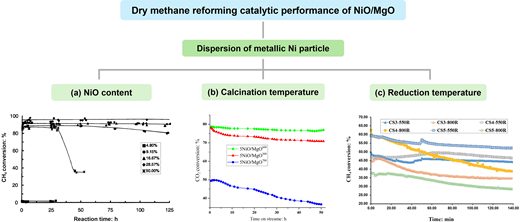
Effect of (a) NiO content, (b) calcination temperature, and (c) reduction temperature on the dry methane reforming catalytic performance of NiO/MgO solid solution. Figure 2(a) is reprinted with permission from Hu and Ruckenstein.31 Figure 2(b) is reprinted with permission from Jafarbegloo et al.51 Figure 2(c) is reprinted with permission from Usman and Wan Daud.53
Effect of (a) NiO content, (b) calcination temperature, and (c) reduction temperature on the dry methane reforming catalytic performance of NiO/MgO solid solution. Figure 2(a) is reprinted with permission from Hu and Ruckenstein.31 Figure 2(b) is reprinted with permission from Jafarbegloo et al.51 Figure 2(c) is reprinted with permission from Usman and Wan Daud.53
Representative NiO/MgO solid solution catalysts for dry methane reforming in recent years
| Catalyst | Preparation method | Reduction condition | Reaction conditions | Conversion/% | ||||
|---|---|---|---|---|---|---|---|---|
| Feedgas | T: °C | GHSV: L/g/h | TOS: h | CH4 | CO2 | |||
| 10wt% Ni/MgO46 | Impregnation | H2, 800°C, 1 h | CH4/CO2/N2 = 3:3:1 | 800 | 42 | 7.5 | 83 | 87 |
| Ni/MgO47 | Impregnation | 600°C, 4 h H2/Ar (5 vol%) | CH4/CO2/N2 = 10/10/5 | 550 | 15 | 1000 | 30 | 20 |
| 6 wt% Ni/MgO35 | Impregnation | H2, 650°C, 10 h | CH4/CO2 = 1:1 | 650 | 36 | 10 | 32.6 | 45.7 |
| Ni0.05Mg0.95O48 | Solvothermal synthesis | H2, 800°C, 14 h | CH4/CO2/Ar = 1/1/2 | 760 | 4 | 100 | 67.7 | 78 |
| Ni0.10Mg0.90O49 | Co-precipitation | H2, 700°C, 2 h | CH4/CO2 = 1/1 | 600 | 14 | 5 | 66.88 | 77.45 |
| Ni0.1Mg0.9O50 | Co-precipitation | H2, 700°C, 4 h | CH4/CO2 = 1/1 | 600 | 14 | 122 | 70 | 80 |
| 5% Ni/MgO51 | Sol–gel | H2, 750°C, 4 h | CO2/CH4 = 1/3 | 550–750 | 30–120 | 50 | 72 | 78 |
| 10% Ni/MgO40 | Sol–gel | H2, 750°C, 4 h | CO2/CH4 = 1/3 | 550–750 | 30 | 20 | 74.6 | 82.1 |
| Ni0.1Mg0.9O52 | Sol–gel | H2/N2 (2/3), 700°C, 2 h | CH4/CO2 = 1/1 | 750 | 60 | 20 | 86 | 93 |
| 10% Ni/MgO4 | Combustion | 5% H2, 600°C, 2 h | CH4/CO2/He = 1/1/3 | 600–700 | 72 | 25 | 80 | 95 |
| 20-8053 | Microemulsion synthesis | 30% H2/ N2, 550/800°C, 2 h | CH4/CO2 = 1/1 | 750–850 | 16.8 | 2 | 60 | 65 |
| NixMg1−xO25 | Co-precipitation | 5% H2/Ar, 800°C, 1 h | CH4/CO2/Ar = 1/1/3 | 700 | 30 | 36 | 81.5 | 88.5 |
| Ni/MgO54 | Microemulsion synthesis | 30% H2/N2, 550, 2 h | CH4/CO2 = 1/1 | 550–850 | 16.8 | 2 | 49.93 | 54.80 |
GHSV: gas hourly space velocity; TOS: time on stream
The NiO content plays a significant role in the dispersion of Ni on the MgO surface. Studies have shown that NiO content between 9.2 wt% and 28.6 wt% is optimal for maintaining high catalytic conversion rates and stability for up to 125 h (Figure 2(a)).31 In contrast, lower NiO content (4.9 wt%) yields negligible activity, while higher contents (e.g. 50 wt%) can result in poor stability, with conversion dropping from ∼85% to ∼35% after 50 h (Figure 2(a)). This is because, at low NiO content, a too small amount of Ni is generated due to the isolation effect of solid solution.22 In contrast, at high NiO content, large amount of NiO is reduced, which can result in serious sintering and the Ni particles become large and behave like bulk materials, leading to a low stability. Moreover, it was found that a large NiO content leads to severe carbon deposition. NiO/MgO solid solution catalysts were prepared by way of co-precipitation method with different Ni content from 3 to 25 wt%.49 Among these catalysts, 10 wt% NiO/MgO exhibited the highest conversion rate and stability of dry methane reforming within 300 min testing. Thermal gravimetric analysis of spent catalysts demonstrated that 25 wt% NiO/MgO sample presented a much larger carbon deposition rate of >25 wt%, while those on catalysts with lower NiO content were less than 10%. This is because 25 wt% NiO/MgO possessed a larger Ni particle size, thus facilitating the carbon deposition on the surface.
Calcination temperature can affect the properties of the solid solution, thus impacting its reducibility and Ni dispersion. A NiO/MgO solid solution with 5 wt% NiO was prepared by sol–gel method at different calcination temperatures (500°C, 600°C, and 700°C).51 The catalyst obtained at 600°C exhibited the best catalytic activity and stability for 50 h on stream (Figure 2(b)). Catalyst obtained at lower calcination temperature (500°C) displayed good initial activity but noticeable deactivation for 50 h on stream. This is because the incomplete solid solution formation at low temperatures leads to the poorer dispersion of NiO in MgO, resulting in a higher degree of nickel reduction and facile sintering of Ni particles during reduction and reaction. In contrast, the catalyst calcined at 700°C exhibited low activity and rapid deactivation. This is due to the formation of NiO/MgO solution, in which NiO with a low content (5%) would be nearly completely isolated by MgO and thus not reducible.
The calcination temperature also affects carbon deposition on NiO/MgO catalysts. Ni/MgO catalysts was prepared by way of microemulsion method with different calcination temperatures.54 According to H2-TPR profiles, the reduction peaks of NiO/MgO catalysts calcined at 450°C, 600°C, and 800°C appeared at 365.1, 703.9, and 809.8°C, respectively, indicating differences in reducibility. A higher calcination temperature results in a stronger solid solution phase, making catalyst reduction more difficult. Therefore, catalysts calcined at lower temperatures exhibited larger particle sizes due to easier reducibility. After 140 min of dry methane reforming at 750°C, carbon deposition on these three catalysts was measured at 2.648, 0.820, and 0.034 gc/gcat, respectively. This demonstrates that lower calcination temperatures lead to higher carbon deposition rates due to the larger Ni particle sizes.
The dispersion of Ni particles can be influenced by the reduction process, which in turn affects the stability of the NiO/MgO catalyst. A 20 wt% NiO/MgO solid solution catalyst was synthesized with three different calcination temperatures of 450°C, 600°C, and 800°C.53 The catalyst was then reduced in a 30% H2 in N2 atmosphere at 550°C or 800°C for 2 h, and subsequently used for dry methane reforming. As shown in Figure 2(c), the NiO/MgO catalyst calcined at 450°C and reduced at 550°C (CS3-450R) exhibited a slightly higher initial CH4 conversion rate (49.76%) compared with the catalyst reduced at 800°C (CS3-800R, 45.03%). However, the stability of CS3-800R was poor, resulting in a final CH4 conversion of 34.72% after 140 min on stream, significantly lower than that of CS3-450R (52.09%). This reduced stability was attributed to the larger Ni metallic particles formed at the higher reduction temperature, which are prone to sintering during the reaction, leading to deactivation. Similar effects were observed for the NiO/MgO catalysts calcined at 600°C or 800°C. For the catalyst calcined at 600°C, the CH4 conversion dropped from 47.29% to 46.37% for the 550°C reduction (CS4-550R) and from 62.48% to 38.82% for the 800°C reduction (CS4-800R). Similarly, for the catalyst calcined at 800°C, the CH4 conversion decreased from 59.22% to 52.09% for the 550°C reduction (CS5-550R) and from 37.84% to 28.46% for the 800°C reduction (CS5-800R) (Figure 2(c)).
In addition to Ni particle dispersion, the surface properties of the MgO matrix play a crucial role in the performance of the solid solution. Three types of MgO with different surface areas were prepared, designated as MgO(LA), MgO(CA), and MgO(HA).35 The NiO/MgO catalysts were synthesized by way of the impregnation method. CO2-TPD profiles revealed the basicity of the supports in the following order: MgO(LA) < MgO(HA) < MgO(CA). It is generally recognized that carbon deposition can be reduced or even prevented when metals are supported on metal oxides with strong Lewis basicity. This is because increased Lewis basicity enhances the catalyst’s ability to chemisorb CO2 during CO2 reforming of methane, where the adsorbed CO2 reacts with carbon (C) to form CO, thereby reducing coke formation.22 As a result, Ni/MgO(CA) demonstrated the best stability for dry methane reforming among the three catalysts, maintaining performance for 10 h on stream. In addition, transmission electron microscopy (TEM) images and Raman spectra showed that Ni/MgO(CA) exhibited the least carbon deposition and the lowest degree of graphitization.
4.2 Carbon dioxide hydrogenation
CO2 hydrogenation offers a promising approach to simultaneously reduce CO2 emissions and store renewable energy. For reduced NiO/MgO solid solution catalysts, the adsorption and activation of CO2 molecules occur on the active sites of the MgO surface, while H2 dissociation takes place on the metallic Ni particles. Therefore, both the properties of the metallic Ni particles and the MgO surface play crucial roles in determining the catalytic activity.
The surface properties and basicity of the MgO support influence its CO2 adsorption capacity, thereby affecting the catalyst’s performance. Ni–MgO catalysts with a 10 wt% nominal Ni loading were prepared using three different methods: sol–gel (SG), incipient wetness impregnation (IW), and co-precipitation (CP). The resulting catalysts were denoted as Ni–MgO–SG, Ni–MgO–IW, and Ni–MgO–CP, respectively.55 Among these three catalysts, Ni–MgO–SG exhibited the highest Brunauer, Emmett and Teller surface area and the greatest number of basic sites, as determined by N2 adsorption-desorption isotherms and CO2-TPD profiles. Moreover, X-ray photoelectron spectroscopy spectra revealed that the percentage of surface oxygen species (Osurf) followed the trend: Ni–MgO–IW (45.79%) < Ni–MgO–CP (47.87%) < Ni–MgO–SG (70.15%), suggesting that the sol–gel method generated more oxygen vacancies, providing more active adsorbed oxygen species. The combination of strong basicity and oxygen vacancies ensures a high CO2 adsorption capacity. Consequently, Ni–MgO–SG exhibited 82.6% of CO2 conversion efficiency and 99.4% of CH4 selectivity at 300°C, outperforming both Ni–MgO–IW (∼63% conversion) and Ni–MgO–CP (∼58% conversion) (Figure 3(a)).
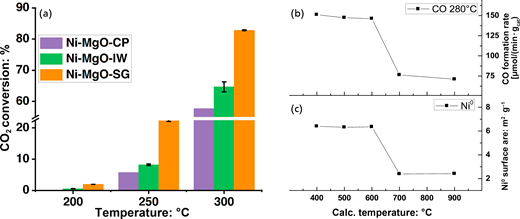
(a) CO2 conversion rate of CO2 hydrogenation over Ni–MgO catalysts. Reprinted with permission from Wang et al.55 (b) Formation rates of CO, and (c) Ni0 surface area of Ni0.1Mg0.9O catalyst as a function of calcination temperature. Reprinted with permission from Millet et al.56
Metallic Ni particles play a crucial role in the performance of NiO/MgO catalysts by facilitating H2 dissociation. It was found that the adsorption energies of H2 molecules on the Ni cluster and MgO (220) surface (220 facet was chosen based on high-resolution TEM observations) are –0.85 eV and –0.20 eV, respectively, indicating that H2 molecules are more accessible to adsorb on the Ni cluster.5 Ni/MgO samples were prepared using citric acid with NiO content from 10 wt% to 90 wt% for CO2 hydrogenation.23 The conversion of CO2 increased with increasing reaction temperature. Catalysts with 10 wt% and 20 wt% contents exhibited low conversion efficiency due to their limited Ni metal surface area. In contrast, Ni/MgO catalysts with Ni contents over 30 wt% demonstrated higher catalytic activity, reaching nearly 100% at 600 K. In another case, Ni0.1Mg0.9O catalysts were obtained from the calcination of hydroxy-solid-solution Ni0.1Mg0.9(OH)2 prepared by co-precipitation method.56 The catalysts were calcined at different temperatures from 400°C–900°C and in situ reduced in CO2/H2 atmosphere for CO2 hydrogenation. The surface area of Ni0 metallic particles displayed a two-plateau profile, remaining at approximately 6 m2/g for calcination temperatures of 400°C–600°C and dramatically dropping to ∼2 m2/g at 700°C, where it remained unchanged until 900°C (Figure 3(b)). This reduction in surface area is attributed to the stronger solid solution formed at higher temperatures, which leads to lower reducibility of Ni due to the isolation effect. Consequently, the CO formation rate followed a similar trend, namely, ∼150 μmol/min/gcat at calcination temperatures of 400°C–600°C and dropping to ∼75 μmol/min/gcat at 700°C–900°C.
The Ni–MgO interface also significantly impacts product selectivity in CO2 hydrogenation. Pure Ni particle exhibited 15% of CH4 selectivity with 6% of CO2 conversion.57 In contrast, by adding a small amount of MgO on the surface of Ni particles (1 wt%), the selectivity of CH4 increased to 56%. This enhancement was attributed to the initial conversion of CO2 into HCO* species on Ni surface. Over the Ni surface without MgO, the energy barrier for the hydrogenation of HCO* is high, making it a rate-determining step in CO2 hydrogenation. Consequently, the formation of CH4 from HCO* hydrogenation is inhibited. In contrast, the Ni–MgO interface facilitates the hydrogenation of HCO* species, thereby increasing CH4 selectivity.
4.3 Steam reforming
Steam reforming of organics is a chemical process where organic compounds, typically hydrocarbons or oxygenated hydrocarbons, react with steam (water vapor) to produce hydrogen gas (H2), carbon monoxide (CO), and carbon dioxide (CO2). It is widely used in industrial processes for hydrogen production, especially for refining petroleum, producing ammonia, and generating synthetic natural gas (syngas). Recent representative NiO/MgO solid solution catalysts for steam reforming are summarized in Table 2. The targets of steam reforming using NiO/MgO solid solution catalysts include methane, 58,61,63 ethanol,59,60,64, acetic acid,62 and phenol.65
Representative NiO/MgO solid solution catalysts for steam reforming in recent years
| Processes | Catalyst | Preparation method | Reduction condition | Reaction conditions | Performance |
|---|---|---|---|---|---|
| Methane steam reforming58 | NiO–MgO | Solution combustion | 50% H2, 800°C, 1 h | CH4/H2O = 1/2, 50% N2, 700°C | >90% CH4 conversion |
| Ethanol steam reforming59 | Ni/MgO | Co-precipitation | 10 vol% H2-N2, 400°C, 1 h | 0.030 ml/min ethanol-water, 180°C | 4.1 mmol/h conversion rate |
| Ethanol steam reforming60 | Ni/MgO | Sol–gel/impregnation | 5% H2/He, 600°C, 1 h | 1/2/17 ethanol/water/He, 60 ml/min, 500°C, 6 h | 100% ethanol conversion |
| Methane steam reforming61 | Ni/MgO | Impregnation | H2, 800°C, 5 h | methane/water/nitrogen (1/3/1), 800°C, 18 000 h−1, 24 h | 60% CH4 conversion |
| Acetic acid steam reforming62 | Ni0.12Mg0.88O | Impregnation | 10% H2/Ar, 650°C, 1 h | 140°C, H2O and Hac mixture/45 ml/min N2 | 90.3% acetic acid conversion |
| Methanol steam reforming63 | NixMgyO | Impregnation/hydrothermal/ co-precipication | 25 vol% H2/N2, 600 °C, 1 h | H2O/methanol = 1/3, 92 000/114 000 ml/(gcat·h), 400°C–700°C | 97.4% CH4 conversion |
| Ethanol steam reforming64 | 5%Ni/MgO | Impregnation/co-precipication | H2, 850°C, 1 h | H2O/ethanol of 3.0, 28 h | 60% ethanol conversion |
| Phenol steam reforming65 | 10wt% Ni/MgO | Impregnation | 10% H2/Ar, 650°C, 1 h | 20/1 phenol solution, 45 ml/min, 450°C | 83.1% conversion, 49.9% H2 yield |
| Steam reforming of compounds66 | Ni0.16/MgO | Impregnation | 10% H2/Ar, 750°C, 1 h | Steam/compounds = 20/1, 400–600 °C | >90% conversion |
The selectivity of steam reforming on NiO/MgO catalysts highly depends on the reduction state of Ni, namely the ratio of Ni0 to Ni2+. NixMg1−xO solid solution with different Ni0 content was prepared with a unique two-step process.59 In the first step, NixMg1−xO solid solutions with different composition were synthesized by way of co-precipitation method. The first calcination was carried out at 650°C in air to ensure the formation of homogeneous NixMg1−xO solid solution with thermodynamic equilibrium. In the second step, the as-prepared NixMg1−xO was impregnated with Ni precursors and then calcined again to obtain separate NiO. The calcination temperature was set at relatively low 400°C to restrict the diffusion of Ni2+ from NiO into the NixMg1−xO matrix. As a result, Ni/NixMg1−xO samples with different compositions are obtained and designated as 15NiMgss, 12.5ss-2.5NiO, 10ss-5NiO, 7.5ss-7.5NiO, 5ss-10NiO, 2.5ss-12.5NiO, and 15NiO/MgO. As shown in Figure 4(a), catalysts with different NiO content show noticeable differences in initial product distribution. 15NiMgss exhibits poor ethanol conversion and high H2 selectivity, while 15NiO/MgO shows the highest conversion with high CH4 selectivity. In situ diffuse reflectance infrared Fourier transform spectroscopy (DRIFTS) analysis reveals that the differences in selectivity are linked to the ethanol decomposition pathways on the Ni and MgO surfaces. When an ethanol–water mixture is introduced to the surface of the 10ss-5NiO catalyst (Figure 4(b)), peaks of δ(CH2) and δas(CH3) are observed in the range of 1490 − 1440 cm−1, along with a evident band of δs(CH3) at 1387 cm−1. Notably, the band of δ(OH) in ethanol at 1265 cm−1 is not detected, indicating the formation of ethoxy groups (CH3CH2O*) following the cleavage of the O–H bond in ethanol. In contrast, on the 15NiMgss catalyst, the peak of νas(OCO) disappears and the band of δs(CH3) shifts from 1350 cm−1 to 1393 cm−1 (Figure 4(c)). The peak at 1589 cm−1 could be attributed to ν(C–O), demonstrating the formation of acetyl intermediate (CH3CO*) instead of CH3COO*. This difference arises because the conversion from CH3CH2O* to CH3COO* requires a co-adsorption of C and O in CH3CH2O* on Ni sites (Figure 4(d)). However, the distance between neighboring Ni2+ sites in NixMg1−xO is longer than the sum of C–C bond length and C–O bond length in CH3CH2O*. Therefore, the transformation of CH3CH2O* to CH3COO* could only occur between adjacent Ni0 site and NixMg1−xO surface. This geometric effect promotes the dehydrogenation of methyl group, further increasing H2 selectivity and suppressing the formation of CH4 (Figure 4(d)).
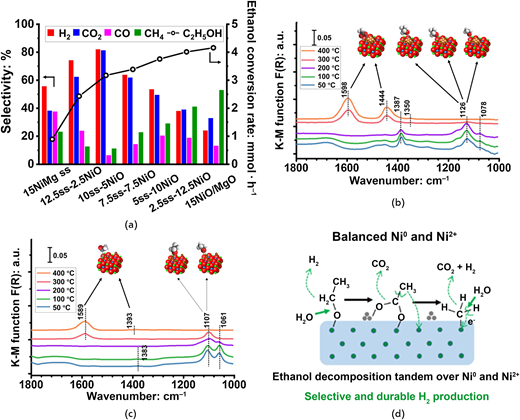
(a) Initial product distribution and ethanol conversion rate over different Ni/NixMg1−xO. In situ DRIFTS of temperature programmed reaction of adsorbed ethanol and water over (b) 10ss-5NiO and (c) 15NiMgss. (d) Schematic representation of ethanol steam reforming pathway over Ni0/Ni2+ sites. Reprinted with permission from Tian et al.59
(a) Initial product distribution and ethanol conversion rate over different Ni/NixMg1−xO. In situ DRIFTS of temperature programmed reaction of adsorbed ethanol and water over (b) 10ss-5NiO and (c) 15NiMgss. (d) Schematic representation of ethanol steam reforming pathway over Ni0/Ni2+ sites. Reprinted with permission from Tian et al.59
Ni0·4Mg0·6O, which was prepared by co-precipitation method, exhibited excellent performance for steam reforming of methane at 700°C.30 The catalyst sample was calcined at 1000°C and was subsequently reduced at 800°C in hydrogen. Its initial methane conversion was nearly 100% and no appreciable degradation was observed over 1000 h. This high conversion rate was attributed to the excellent resistance of the nano-sized Ni particles to carbon formation during the methane steam reforming process. The metallic nickel could be reversibly moved in and out of the parent solid solution, recovering its catalytic activity. When the catalyst was oxidized at 800°C for 5 h, the Ni nanoparticles completely disappeared, reducing the CH4 conversion rate to ∼58%. However, after being reduced again at 800°C for 5 h, the Ni particles were regenerated, and the catalytic activity recovered to its original level. This process, however, used a low CH4/H2O content (10%) in the feed gas diluted with Ar. In another case, a mixed gas of methane/water/nitrogen (molar ratio: 1/3/1) was used as the feed gas at a constant gas velocity of 18 000 h−1 for steam reforming of methane at 800°C.61 Ni/MgO catalysts on paper (ceramic fibers) was prepared by impregnation method. The Ni/MgO papers showed hydrogen productivities several times higher than those of the commercial catalysts, achieving a methane conversion of 75% and hydrogen production rate of 500 mmol/min/gNi, with a promising stability during continuous testing for 24 h.
4.4 Methane partial oxidation
NiO/MgO solid solution is also excellent catalysts for partial oxidation of methane.20 About 86% conversion of CH4 and above 90% selectivities to CO and H2 were obtained over reduced NiO/MgO solid solution catalyst at 850°C and a gas hourly space velocity (GHSV) of 72 L/g/h (CH4/O2 = 2/1). Remarkably, almost no change in activity and selectivity occurred during 50 h of reaction. The effect of NiO content in the solid solution was evaluated for the partial oxidation of methane. NiO/MgO solid solutions with varying NiO loadings of 5 wt%, 7 wt%, 10 wt%, and 15 wt% were tested for methane oxidation.67 As illustrated in Figure 5(a), these catalysts exhibited CH4 conversion rates of 75% to 80% at 700°C with a CH4/CO2 = 1:1 and GHSV = 18 L/g/h. Furthermore, long-term stability tests over the 5 wt% Ni/MgO catalyst during 50 h of partial methane oxidation confirmed its high stability, with no loss in catalytic performance (Figure 5(b)). The excellent performance of the Ni/MgO system was attributed to the formation of an ideal solid solution between NiO and MgO.
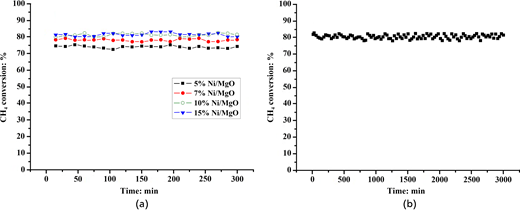
(a) CH4 conversion over prepared Ni/MgO catalysts, and (b) long time stability of 5% Ni/MgO catalyst in methane partial oxidation reaction. Reprinted with permission from Meshkani et al.67
(a) CH4 conversion over prepared Ni/MgO catalysts, and (b) long time stability of 5% Ni/MgO catalyst in methane partial oxidation reaction. Reprinted with permission from Meshkani et al.67
NiO/MgO catalysts with higher NiO content could operate more efficiently for partial methane oxidation at lower temperatures. Notably, methane partial oxidation reaction was carried out over Ni0.1Mg0.9O and Ni0.2Mg0.8O at different temperature.68 The reaction occurred preferentially above 600°C for Ni0.2Mg0.8O and above 650°C for Ni0.1Mg0.9O, indicating that a higher NiO loading in the NiO/MgO solid solution allows for methane oxidation at lower temperatures. A series of NiMg oxides were synthesized by way of co-precipitation and tested for methane oxidation activity, among which NiMg with a ratio of 9:1 (Ni9Mg) showed the highest activity.36 Ni9Mg exhibited a low T50 temperature (the temperature at 50% conversion of methane) of 454°C for methane partial oxidation, and demonstrated excellent stability for a long-term testing at a CH4 conversion slightly decrease from ∼100% to 94% over 40 h at 500°C. This value exceeds the commercial noble metal 1% Pd/Al2O3 catalyst which was below 80% after only 18 h of aging. This performance highlights the advantage of using NiO/MgO solid solutions with higher NiO content for methane oxidation at lower temperatures, providing a more stable and efficient alternative to noble metal-based catalysts.
The combination between exothermic partial oxidation of methane and endothermal dry reforming of methane can create an autothermal process. As demonstrated above, NiO/MgO solid solution materials are outstanding catalysts for these two processes, indicating their potential for excellent performance in their combination as a process. Indeed, a reduced NiO/MgO solid solution catalyst achieved around 90% CH4 conversion and approximately 98% selectivity towards CO and H2 at 790°C with a GHSV of 90 000 cm³/g/h (O2/CO2/CH4 = 14.5/26.9/58.6).69 This excellent performance remained stable over 50 h of reaction. In contrast, Ni/SiO2 and Ni/Al2O3 catalysts exhibited lower activity and stability.
5. Conclusions and prospects
Over the past three decades, significant progress has been made in developing NiO/MgO solid solution catalysts. The formation of the NiO–MgO solid solution facilitates the generation of small, stable metallic Ni particles as active sites during reduction. The strong interaction between these Ni particles and MgO helps prevent Ni sintering. In addition, the small particle size of metallic Ni and the basicity of MgO can suppress carbon deposition. These distinctive properties of NiO/MgO solid solution catalysts result in excellent catalytic performance across various processes, including dry reforming of methane, steam reforming of methane and other organics, partial oxidation of methane, and CO2 hydrogenation.
The isolation effect is crucial in the formation of active sites in NiO/MgO solid solution catalysts, as the isolation of NiO by MgO makes NiO reduction more challenging. Unlike conventional supported NiO catalysts, where the NiO content is typically below 5%, the NiO content in the NiO/MgO solid solution catalysts should exceed 10 wt% to ensure sufficient reducibility, allowing for the formation of small, isolated metallic Ni particles. The in situ evaluation of isolation effect on dynamic generation of active sites during the reduction and/or reaction should be an interesting future research direction.
The band gap of NixMg1−xO solid solutions exhibits strong non-parabolic behavior, with a notable discontinuity at low NiO concentrations. In addition, deep Ni3d levels are introduced into the MgO band gap, reducing the band gap and enhancing photocatalytic activity, suggesting its potential as a photocatalyst. Therefore, the exploration of NiO/MgO solid solution catalysts for the dry-reforming and steam-reforming of methane as well as CO2 hydrogenation will be an interesting research direction. Furthermore, NiO/MgO solid solution nanopowders have demonstrated excellent photocatalytic activity in the degradation of organic dyes such as rhodamine B, heteropolyaromatic methylene blue, azoic methyl orange, and methyl red.70 This finding highlights the potential of NiO/MgO solid solutions for environmental applications.
Density functional theory predictions suggest that the electron-acceptor behavior of MgNiO allows it to bind effectively to the electron-rich DNA base pairs of bacterial strains, indicating that NiO/MgO solid solutions may exhibit antibacterial activity.71 Notably, bare MgO showed activity against Escherichia coli, while NiO–MgO composites were effective against Staphylococcus aureus.72 Impressively, Ni0.5Mg0.5O nano-solid solutions showed antibacterial activity against both E. coli and methicillin-resistant S. aureus through disc diffusion methods.71 Therefore, NiO/MgO solid solutions would be promising for applications in both environmental remediation and biomedical fields.

