


Several studies have been made that analyze factors that affect the demand of tourism from several optics. This paper aims to study the factors that determine the demand for tourism in Mexico, through an econometric analysis, by using the Johansen cointegration model (1991) to determine the long-term elasticity between the demand of tourists and the wealth related to its main markets (the USA and Canada) and the relative prices in Mexico and its two main competitors (the Dominican Republic and Costa Rica).
The authors used econometric analysis using Johansen’s cointegration model (1991), using as a dependent variable the demand of tourists from the main countries of origin (the USA and Canada), taking as data the number of tourists by air in the period 1980-2015, according to information from the SIIMT. The independent variables are the relative wealth of the country of origin of the tourists (wealth of the tourist in Mexico concerning the wealth in their country of origin) and the relative prices of the destination country with respect to the country of competition. The source for per capita income and the consumer price index is the World Bank.
The results obtained in this document show that in the long-term the price is a factor of impact in the purchase decision of both markets analyzed. Presenting an elastic demand to the price, which implies that the market is sensitive to the variations of the price of tourist services, opting for the destination that offers better prices, with a higher sensitivity to the price when compared with Costa Rica. Coinciding with previous studies carried out in other tourist destinations, such as in the work of Patsouratis et al. (2005).
The main contribution of this work is to determine the long-term relationship, through a cointegration analysis of Johansen (1991). A methodology that has not been used to perform a competitive analysis between countries. Additionally, the present work uses variables different from those considered in previous works; the dependent variable is the demand of tourists from the main countries of origin (the USA and Canada) and as dependent variables the relative wealth of the country of origin of the tourists (Wealth of the tourist in Mexico with respect to wealth in their country of origin) and the relative prices of the destination country with respect to the country of competition.
1. Introduction
Tourism is one of the most important and dynamic economic sectors in the world, which is why various empirical studies have been, developed to estimate the determinants of international tourism demand.
The arrivals of international tourists registered a remarkable increase of 7 per cent in 2017 until reaching a total of 1.322 million, according to the last UNWTO World Tourism Barometer. Forecasts indicate that this strong momentum will continue in 2018, with a rate of between 4 per cent and 5 per cent.
It is estimated that international tourist arrivals (visitors staying overnight) increased by 7 per cent in 2017. This rate is much higher than the sustained and constant 4 per cent trend that had been reached, registered since 2010 representing the best result in seven years.
According to UNWTO (2018), international travel continues to grow strongly, consolidating the tourism sector as a key driver of economic development. As the third largest export sector in the world, tourism is essential for job creation and the prosperity of communities around the world.
According to the UNWTO in 2017, the Americas received 207 million international tourist arrivals, which translates into an increase of 3 per cent, with positive results in almost all destinations. In North America, an increase of 2 per cent was generated, contrasting the good results of Mexico and Canada with the decrease in the USA, the largest destination in the region.
The tourism sector is a key factor in the Mexican economy, which has been exposed because, despite the global economic crisis during 2014 and Mexico’s security issues, the arrival of international tourists in this country increased by 20 per cent. This positions Mexico in the top ten regarding arrivals, occupying the tenth place in the World Tourism Organization (WTO, 2016) rankings in 2015, thus continuing to hold a spot among the 10 most important tourist destinations in the world. In 2017, Mexico ranks eighth in the International Tourism Ranking because of the arrival of international tourists and the 14th Country in terms of foreign currency revenues for tourism (UNWTO, 2018).
Tourism in Mexico is between the second and third position as a source of foreign currency, varying the position based on the price of oil and being behind the income from remittances from the compatriots based in the USA, standing out as the main generating activity of currencies where private initiative intervenes. Tourism contributes to maintaining the favorable trade balance, contributing a little more than 8 per cent to the national GDP and generating more than 2 million direct jobs (SIIMT, 2015).
The article is organized as follows. Section 2 presents the literature review and the profile of Mexican tourists and the competing countries that are analyzed. Section 3 describes the methodologies used and the results. Finally, the conclusions are presented in Section 4.
2. Literature review
Tourism is one of the most important and dynamic economic sectors in the world, which is why various empirical studies have been developed to estimate the determinants of international tourism demand. For example, Crouch (1994) describes 80 studies in this regard, which focus on the per capita income of the countries of origin and the relative price of tourism services exported as the main determinants of demand. Within them they emphasize the works of Paraskevopoulos (1977); Loeb (1982), Stronge and Redman (1982), Truett and Truett (1987), Smeral and Witt (1996), Mudambi and Baum (1997), who carry out studies in which the elasticity of tourism demand is manifested with respect to income, relative prices, exchange rate and transportation. Other authors have considered explaining the demand according to the number of tourists arriving (Tie-Sheng and Li-Cheng, 1985); (Gunadhi and Boey, 1986); (Chadee and Mieczkowski, 1987); (Witt, 1990); (Walsh, 1996). On the other hand, some essential works have also been carried out considering qualitative factors as indicated by Bull (1991), such as the climate, the quality of the beaches, the attractiveness of culture, gastronomy and ease of transport. In a recent study on tourist demand research conducted in the period from 1961 to 2011, they identify other explanatory variables that have a significant influence on the estimated elasticities of demand such as origin, destination, length of stay, modeling method, frequency of data, measurement and sample size (Peng et al., 2015).
Thus, it is noted that a variety of factors influences the demand for vacations. As mentioned, the usual explanatory variables are tourist income, transportation costs, exchange rates, the price of the product itself, the price of its substitutes and investment in tourism, in addition to using various dummy variables to take into consideration factors such as oil crisis, economic recessions and closing of borders. Crouch (1994) explains that the specification of the function of demand varies according to the countries or regions, the period analyzed, the type of data (time series or panel data) and the nature of tourism (holidays, business trips and visits to relatives or friends).
The tourism product is of a perishable nature, which may influence the characteristics of competition between countries and affect management decisions in the public and private sector, which is why it is essential that these two actors know the factors that influence in the tourist demand. The studies mentioned above follow an approach with a simple equation, which does not explain the importance of interdependencies between competing destinations (Eadington and Redman, 1991). A subject of high relevance in the tourism sector, since traveling abroad is one of the options for the consumer, once the decision to travel has been made, the consumer may opt for tourism in different destinations with substitution variables. To consume tourist services, people must visit the place of delivery and, although their purchases of goods and services are subject to availability, consumers are limited by issues of resources and time. Both limitations suggest that the choice of destinations is a typical problem of consumer choice (Divisekera, 1995; Rugg, 1973). Hence, the importance of conducting studies taking into account the competition.
Dwyer and Kim (2003) develop a destination competitiveness model to compare between countries and between industries of the tourism sector, with which seeks to capture the main elements of competitiveness that the general literature highlights, through a set of indicators that are used to measure the competitiveness of any given destination. These indicators contain both objective and subjective measures that were important elements during the workshop held in Korea and Australia. The work has four main objectives to develop the destination competitiveness model that identifies the key success factors that determine the destination’s competitiveness, develop a set of appropriate indicators for the destination’s competitiveness, highlight the advantages and limitations of the model and identify areas for future conceptual and empirical research.
Patsouratis et al. (2005) perform an econometric analysis where he examines the competition of tourism between Mediterranean countries, with an emphasis on Greece. The estimating model includes as explanatory variables: income index, price index of the receiving country, price index of the competitors (Spain, Portugal and Italy) and exchange rate. The results show that the main determinants of tourism demand in Greece are the two price indices and the exchange rate, and Spain is the main competitor of the destination.
For his part, Buisán (1997) performs a work that provides empirical evidence on the main determinants of income from tourism in the Spanish economy. The author estimates an error correction model, based on the existence of a stable long-term relationship between income from tourism (dependent variable), an income variable (determined by GDP per capita of the country of origin of tourists) and another one of competitiveness with its main competing destinations (France, Portugal, Italy, Greece, Morocco, Tunisia, Egypt, Turkey and Mexico). It also quantifies the contribution of each explanatory variable to the evolution of exports by tourism in recent years, with particular emphasis on the development of competitiveness via prices. The most outstanding features of the research are the existence of a stable long-term relationship between tourism exports, a variable of income of the client countries and another that measures the competitiveness of Spanish tourism concerning domestic tourism in the countries of the region which comes the vast majority of foreign visitors. Second, the elasticities of the income and competitiveness variables are high and very significant, both in the long-term and in the short-term.
About Mexico, Brida et al. (2007) did a paper explaining the long-term effects of tourism demand in Mexico respect to American visitors. Using a cointegration analysis of Johansen (1991), taking as variables the public investment, relative prices of tourist products and per capita income of the USA. The author finds that the income of the USA positively affects the tourist demand.
2.1 Profile of tourists in Mexico
When studying the tourist demand for Mexico, it is found that it mainly has two relevant markets that represent 69 per cent of the total international tourists, of which 57.3 per cent are from the USA and 11.9 per cent from Canada (SIOM, 2015).
The USA is the most important tourist supplier in Mexico, the trips of this market have an average duration of nine nights, being the primary destinations Cancun, Riviera Maya, Los Cabos, Puerto Vallarta and Federal District (SIIMT, 2015), that is to say, is a segment of sun and beach, of this 19 per cent make their reservation through a tour operator. Canada is the second most important market, with an average duration of 13 nights, just as the Anglo-Saxon market has beach destinations such as; Cancun, Puerto Vallarta, Los Cabos and Federal District. In total, 46 per cent of these tourists make their purchase through a tour operator (SIIMT, 2015).
In 2012, Mexico lost competitiveness in global tourism, with a recovery in 2013, and stabilized in 2014 with an increase of 20 per cent in the reception of international tourists and 2015 presented the largest increase in the US tourist market with 17.1 per cent growth and 4.3 per cent Canada. Other destinations such as Hawaii, Cuba, Costa Rica, Dominican Republic and Jamaica that offer sun and beach destination begin to increase their percentage of participation in the reception of tourists from the USA and Canada.
According to the information provided by the Integral Information System for Tourist Markets (SIIMT), Figure 1 and 2 show the flow of tourists from the USA and Canada to Mexico’s main competitors. It is observed that Mexico has the highest growth in both markets, followed by the Dominican Republic, Costa Rica with a significant increase in attracting tourists from the USA, on the other hand, Jamaica showed a considerable loss in the Canadian market and little signs in the USA market. Bermuda and the Bahamas show strong growth in the Canadian market, and the US market remains almost stable The Bahamas and Bermuda lose 4 per cent of the market.
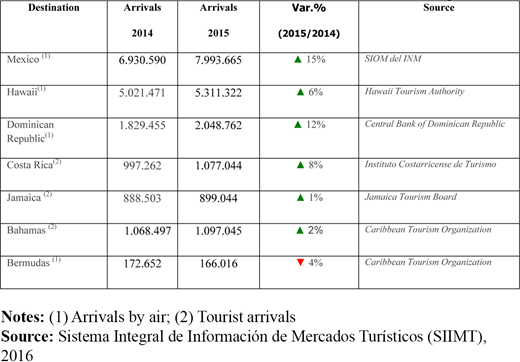
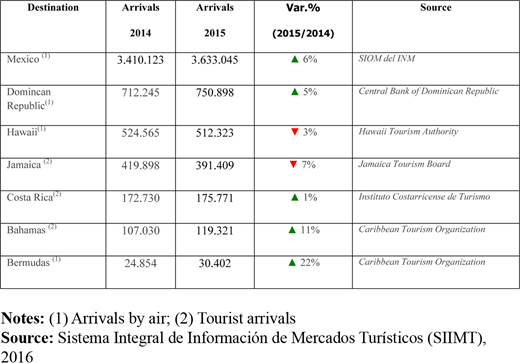
In the present study, Costa Rica and the Dominican Republic compete as countries because they have a sun and beach offer similar to that of Mexico, so it is pertinent to know the effects of the relative price of their products against the prices that Mexico offers.
3. Methodology
At the international level, of the 95 studies considered in Crouch (1994), close to 70 per cent use the number of tourists as a dependent variable, due, in most cases, to specific studies between the destination country and the origin. The rest of the work uses expenses or income as a dependent variable for tourism, and a few, the duration of the stay.
Regarding the price variable, the appropriate way to determine it is not clear, because the tourist acquires very different goods that correspond to several economic sectors, but it is important to consider the cost of living of the destination country for the tourist. The consumer price index of the destination country adjusted or not by the exchange rate has been used as a proxy for the price of tourism. Uysal and Crompton (1985) take into account the existence of competing tourist countries by specifying the tourism price variable as the cost of living in the destination country, relative to a weighted average of a set of alternative destinations.
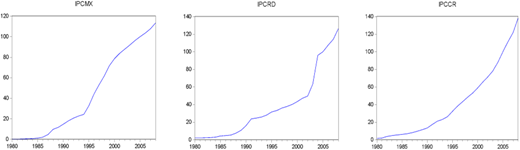
In this work, the demand of tourists from the leading countries of origin (the USA and Canada) is used as a dependent variable, taking as a data the number of tourists by air in the period 1980 - 2015 (graph 1), according to information from the SIIMT. The independent variables are the relative wealth of the country of origin of the tourists (wealth of the tourist in Mexico respect to the wealth in their country of origin) and the relative prices of the destination country concerning the country of competition. The source for per capita income (graph 2) and the consumer price index (graph 3) is the World Bank.
3.1 Developed model
where
Dit = Number of tourists that arrived in Mexico from the country i in the time frame t.
YRit = Relative wealth of the country i in the time frame t.
which is determined by:
GDPi = GDP per capita country i.
GDPmx = GDP per capita Mexico.
IPCRjt = Relative prices of the country j in the time frame t.
which is determined by:
eit = Random error
The relationship between the variable is expressed in logarithms.
3.2 Variable charts
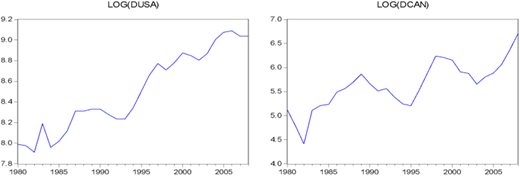
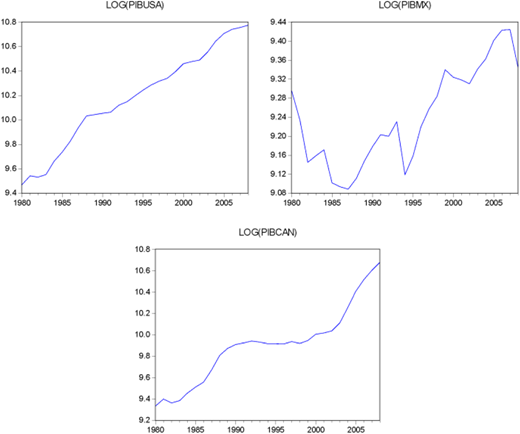
3.3 Econometric exercise
Unit root tests were performed, ADF (1981), KPSS (1992) and PP (1988). As the series presents structural changes, it is proposed to use the Harvey et al. (2011) test to determine the order of integration, since this test controls the particularity of a structural cut. This test considers a series generated by the process:
where
Contains the elements that indicate the period in which the break happens.
From these specifications, a Dickey–Fuller unit root test is performed.
This test produces statistical values under the null hypothesis of unit root existence. The test allows up to two structural cuts, so two statistics are denoted as MDF1 and MDF2. Thus, if these values are lower in absolute terms than the critical value, then the null hypothesis is not rejected and it is concluded that the series exhibits unit root.
The results of the stationarity tests are shown in Table I. The series were found to be non-stationary in levels and stationary in the first difference; in other words, integrated series of order 1. In most cases, the statisticians of the ADF test point in that direction, and the results of the Harvey test confirm it. The variables, Mexican consumer price index (IPCMx) and Costa Rican consumer price index (IPCcr), suggested non stationarity in levels in the ADF test, however, the KPPS and Harvey tests rejected it.
Stationary test for the analyzed variables
| ADF | KPSS | PP | Harvey | Integration | |||||
|---|---|---|---|---|---|---|---|---|---|
| Variable | Nivel | 1ra Dif. | Nivel | 1ra Dif. | Nivel | 1ra Dif. | MDF1 | MDF2 | level |
| Dusa | −0.97 | −4.79* | 0.66^ | 0.09 | −0,92 | −5.53* | −2.845** | −4.435** | I1 |
| Dcan | −0.98 | −4.66* | 0.66^ | 0.07 | −0,41 | −5.06* | −2.742** | −3.275** | I1 |
| Yusa | −1.12 | −2.30* | 0.70^ | 0.62^ | −6.83* | −4.19* | −2.547** | −3.997** | I1 |
| Ycan | −1.30 | −3.17* | 0.67^ | 0.12 | −1.25 | −3.54* | −1.655** | −2.526** | I1 |
| Ymx | −0.83 | −5.44* | 0.64^ | 0.09 | −0.77 | −5.43* | −2.904** | −4.805** | I1 |
| IPCmx | −0.13 | −2.21 | 0.69^ | 0.33 | −2.74 | −2.22 | −3.448** | −3.949** | I1 |
| IPCrd | 1.95 | −4.06* | 0.65^ | 0.46^ | −1.57 | −4.52* | −2.555** | −4.371** | I1 |
| IPCjam | 0.62 | −4.49* | 0.65^ | 0.59^ | 0.43 | −2.06 | −2.321** | −4.488** | I1 |
| IPCcr | −0.68 | −1.72 | 0.66^ | 0.52^ | 2.89 | −1.72 | −2.804** | −3.000** | I1 |
Notes:
*Rejects null non-stationarity at 5%;
Does not reject null stationarity at 5%;
Rejects null unit root at 5%
After the unit root tests, and once the variables were proven to be integrated of order I(1), the Johansen cointegration test is performed in each of the general specific estimates, generating a total of four estimates, presented in two general groups. Each group corresponds to the country that emits tourists and the competing countries. Table II shows the results of this exercise.
Cointegration testing
| System | Lag structure | Hypothesis | Probability | Normalized vector |
|---|---|---|---|---|
| Dusa, YRusa, IPCRrd | 4 | r ≥ 1 | 0.0466 | 1,0,350-1,296 |
| Dusa, YRusa, IPCRcr | 4 | r ≥ 1 | 0.0244 | 1,0,360-1,742 |
| Dcan, YRcan, IPCRrd | 4 | r ≥ 1 | 0.0023 | 1,0,032-0,342 |
| Dcan, YRcan, IPCRcr | 4 | r ≥ 1 | 0.0107 | 1,0,024-0,511 |
In all the systems analyzed, it was found that there is at least one cointegration vector, with significant coefficients and the expected signs. This confirms that the demand for tourists from the USA and Canada has a stable long-term relationship with the relative wealth between the countries concerned and Mexico, and with the relative prices between Mexico and the country of competition.
The normalized cointegration vectors are reported in the last column of the table. In all cases, the long-term relationship between tourist demand and the relative wealth is positive. That is, when the relative wealth of tourists increases, the influx of tourists to the country grows. In the case of relative prices, the relationship is negative. In other words, when Mexico prices increase in comparison with the competition country, the demand for tourists in the long-term decreases.
Because the variables were treated in their logarithmic transformation, the coefficients can be interpreted as long-term elasticities.
The results obtained from the model reveal that, in the long-term for the USA market, the relative price is an impact factor in the purchase decision, finding that, when comparing Mexico with the Dominican Republic, by increasing prices in Mexico the demand decreases by 1.29 per cent and when compared to Costa Rica the demand decreases by 1.74 per cent. Concerning relative wealth, it is found that, in the long-term, it is not a variable that has an important impact on the purchase decision, although it has a positive relationship, the effect on the increase in demand is not as significant. When compared to the Dominican Republic, it is found that a change of one per cent in the relative wealth of Americans increases the tourist demand by 0.35 per cent and when compared with Costa Rica a one per cent increase in relative wealth increases 0.36 per cent the demand for tourists from the USA. These comparisons imply that the most important variable for this market is the cost of living or the relative prices of the tourist services offered by the destination countries.
Regarding the demand of the Canadian market, when Mexico compares with the Dominican Republic, the behavior of the variable relative wealth of tourists is positive, but with little impact, an increase in wealth of one percent increases the demand for tourists by 0.032 per cent, while an increase in the cost of living in Mexico decreases the demand of this market by 0.34 per cent. When compared with Costa Rica, the most relevant variable is the cost of living, because a change of 1 per cent in prices decreases tourist demand by 0.51 per cent, while an increase of 1 per cent of relative wealth only increases tourist demand by 0.024 per cent. Finding that for both markets the variable of relative price or cost of living is the one that generates the most significant impact on the demand of tourists.
4. Conclusions
Tourism is a relevant activity in Mexico, currently representing 8.5 per cent of GDP and together with oil and remittances is in the first three places in the generation of foreign currency, being the only economic activity in which private initiative intervenes. The attraction of international tourism has gained strength in recent years, presenting an increase of approximately 10 per cent. The USA market is the most important market for Mexico, showing a growth of 9.6 per cent in 2017 concerning 2016. The second most important market for Mexico is Canada, which presented an increase of 1.6 per cent for 2016. Because of the relevance of tourism as an economic activity for the country and the dependence on the markets mentioned above, it is important to analyze the competitiveness of the destination against its two main competitors (the Dominican Republic and Costa Rica). The analysis shows the long-term variables that have an impact on the decision to purchase the destination in the markets analyzed.
To know the competitiveness of Mexico against its competitors and the variables that are decisive in the purchase decision, we considered the variables of relative wealth of tourists and the relative price, obtained from the cost of living in Mexico versus the cost of life of the competitor country.
The results obtained from the model used show that in the long-term the relative price is a determining factor in the purchase decision of both markets analyzed (the USA and Canada). The elasticity of the demand to the price implies that the market is sensitive to the variations in the price of tourist services, opting for the destination that offers the best rates, with a greater sensitivity to the price when compared to Costa Rica. This sensitivity coincides with previous studies carried out in other tourist destinations, such as in the work of Patsouratis et al. (2005), who find that the price index variable is a determining factor in tourism demand in Greece.
Concerning the relative wealth variable, a positive relationship with an elasticity of less than 1 is found in all cases. This relationship reveals that currently for the USA and Canada market, the destination Mexico with respect to its competitors is considered an inferior good, contrary to the results found by Brida et al. (2007), who finds tourism as a luxury good for the USA market in the period from 1980 to 2006, with an elasticity of the demand for income of 2.09.
Even though the variables used in both studies are not the same, the results show that over time Mexico as a destination has gone from being a luxury good to be an inferior good. This transformation means that previously, with an increase in the wealth of tourists, the influx of tourists to the country increased by a higher proportion. Now, being an inferior good implies that by increasing the wealth of tourists decide to increase the demand for tourism in Mexico although with a percentage increase less than rent. The above places Mexico as an economical option for tourists from its two main markets (the USA and Canada).
The results found in the model, the elasticity of demand with respect to income less than 1, coupled with the elasticity of demand to price, shows that in the long-term, Mexico has been losing competitiveness in attracting tourists with higher purchasing power. This loss of competitiveness is consistent with the data presented in the April bulletin of the SIIMT (2018), which shows an increase of 6.7 per cent in the arrival of tourists, but a decrease in average spending of −6.9 per cent. The above is a factor that must be considered by the destination managers, given that in the long-term the relative price is a factor and the elasticity of the demand are variables that affect the influx of tourists to the country. Therefore, they must be considered in the elaboration of the tourism sector plan and in the promotion strategies used, which should consider two options; diversify the market and generates strategies and policies to attract luxury tourism, which currently in the world represents, together with the luxury car sector, 20 per cent of the income of the global economy.
To capture a significant market, it will be necessary that the managers of the destination generate strategies through incentives to encourage the specialization of specific destinations that have an infrastructure to offer comprehensive travel experiences that provide tourists luxury experiences where the consumer is the protagonist. Given that, they seek to experience adventures with the luxury of globalization but the experience of the local culture, with tendencies to personalize the service. It is important to highlight that, to capture this market, Mexico must diversify its promotion strategy, paying particular attention to the Asian market.
The other option for destination managers is to strengthen the competitive advantages of the tourism sector in Mexico for the US and Canadian markets. Through professionalization strategies that allow Mexico to take advantage of the opportunity to be an option for tourists who have the possibility of travel to an international destination even when they do not have high purchasing power. On the other hand, capture the influx of tourists seeking a destination that offers experiences beyond the offer of sun and beach. For this, it is necessary that destination management strategies consider the option of diversifying the offer of tourist services, offering cultural, historical and adventure activities, as well as the development or strengthening of other market segments, such as meeting, medical and gastronomic tourism among others. In addition to the diversification of supply, actions must be proposed that promote the competitiveness of the destination, as is the case of the use of new technologies that provide valuable data on consumers in the tourism industry to conduct tourism intelligence.
Unlike its main competitors, Mexico has a wide range of options to serve various segments of the tourism market, having natural, cultural and historical wealth, unlike its competitors whose main strength is the offer of sun and sand. However, Costa Rica offers various options of nature and adventure tourism, and the Dominican Republic has started with the incorporation of nature tourism. These activities imply a greater challenge to maintain the competitiveness of destination Mexico, giving relevance to the review of the destination promotion policy and the diversification of products and services offered.
In the globalized market, Mexico encounters several competitors that have gained strength in the markets studied. Although Mexico has a higher demand for tourists, it is necessary to know the long-term factors that influence the decision to purchase demand, compared to other destination options. With the objective of having information that supports decision-making in the preparation of relevant public policies in the promotion of the destination, as well as the generation of added value of the companies in the sector.
In conclusion, if we seek to know the factors with the most significant impact on the demand of tourists to Mexico, it follows that the price is a considerable factor for tourists from both markets (the USA and Canada), which offers a competitive advantage to Mexico because it is a cheaper destination than the countries analyzed as competition. However, actions must be implemented to strengthen the competitiveness of the destination to avoid the risk of losing competitiveness and market.

