This paper determines how travel intentions can be predicted using self-disclosure behaviour, trust and intimacy. This case study focuses on Tinder users who utilised the application's Passport feature which allowed them to travel virtually and interact with other users around the globe amid global travel restrictions.
This quantitative research conveniently sampled 294 Tinder users who used the Passport feature during COVID-19 pandemic lockdowns. Data were analysed using PLS-SEM.
This study revealed that self-disclosure had a significant influence towards future travel intentions. Findings show that the more users self-disclose, the more their intent to travel increase. Trust and intimacy also had significant relationship on travel intentions while intimacy had a mediating effect between self-disclosure and travel intentions.
Tourism-oriented establishments and destination marketers should consider Tinder users as a market segment of future tourists. These users have developed travel intentions through in-app interactions and thus comprise an untapped market of potential tourists seeking for meet-ups and niche experiences in a post-pandemic era.
This study provides novelty in showing the predictive relationship of self-disclosure, trust and intimacy towards travel intentions. A model consisting of these constructs in the context of online interactions was also empirically tested and found adequate to predict travel intentions.
Introduction
Tinder is a geosocial dating application which utilises the Internet and global positional system to scout fellow users in proximal distance to afford individuals the convenience to facilitate online encounters and offline meet-ups (Choi et al., 2016). With the temporary halt in physical mobility brought about by the COVID-19 pandemic, Tinder became a platform for maintaining connections as the application rewarded its users with a waived subscription to their Passport feature to ameliorate the negative effects of the pandemic and encourage people to stay at home (Tinder, 2020). The Passport feature allows users to change their locations and interact with other users from anywhere across the globe right at the comfort of their homes. This recorded over 10M daily users navigating through the application with almost 6.7M subscribing and paying for premium features that produced a revenue of USD$ 1.4B during the pandemic alone (Best of Apps, 2021; Tinder, 2020). Even prior to the pandemic, Tinder users have already resorted to the Passport feature to plan future travel by virtually meeting users from foreign countries in advance and establishing relationships which can help create niche interests and genuine tourism experiences from local users on their actual travel (Condie et al., 2018; Leurs and Hardy, 2019). Amid the pandemic, however, it remains unclear whether travel intentions can be predicted because of the behaviours and interactions users have facilitated inside the application.
Inside Tinder, users present themselves using profiles to earn matches from likeminded users to facilitate interactions and relationships (Kallis, 2020). Users mimic social cues such as small talks, intimacies and at times courtships with the end goal of building communities, friendships or romantic relationships (Petrychyn et al., 2020). These relationships flourish because of a systematic process of revealing oneself through self-disclosure behaviour. Self-disclosure pertains to how people reveal specific details about themselves to establish and sustain relationships with others (Altman and Taylor, 1973; Derlega et al., 1993). Tinder users construct lasting impressions through continuous self-disclosure which leads to relationships (Ward, 2016). Despite emergent findings in Tinder Tourism literature suggesting that some users had no intention of meeting their online counterparts (James et al., 2019), Tinder is still considered as a temporary space where users interact before they gain motivation to conduct physical encounters with other users (Kallis, 2020; Miller, 2019; Timmermans and De Caluwé, 2017; Ward, 2017) or travel to the other user's destination (Leurs and Hardy, 2019). In this vein, this paper aims to investigate how users who remain at home amid global lockdowns develop travel intentions because of in-app interactions.
Before meeting or travelling in the physical realm, however, the reciprocation of trustworthy and intimate behaviours surrounds the concept of self-disclosure and should be given due consideration (Carpenter and Greene, 2015; Lieberman and Schroeder, 2020). Subsequently, the Tinder Passport feature affects the relationship-building process among users as the formation of trust and intimacy are accelerated during in-app interactions (James et al., 2019). This implies that appropriate examination of how disclosing personal circumstances through interactions, especially during the COVID-19 pandemic, can lead to intimate relations as well as subsequent behavioural intentions on Tinder. Prompted with these phenomena, there is a need to provide theoretical evidence on the relationship among self-disclosure, trust and intimacy towards future travel intentions. This study aims to create a baseline model using Tinder users as a case study to determine whether such constructs can predict future travel intentions.
Literature review and hypothesis development
Self-disclosure
Self-disclosure is defined as the “process of making the self-known to others” (Jourard and Lasakow, 1958, p. 91). In the manner of self-disclosing, individuals voluntarily and openly uncover information about themselves to other people (Krasnova et al., 2010; Qian and Scott, 2007). Such disclosed information ranges from personal details, ideas, emotions, attitudes, beliefs and experiences (Lin and Roberts, 2020). Self-disclosure has invaluable contribution in creating and sustaining relationships (Altman and Taylor, 1973). Early studies have extensively used self-disclosure in examining its role in relationship-building throughout the field of social sciences in the context of face-to-face interactions (Cozby, 1973; Derlega et al., 1993; Jourard, 1971); however, the recent literature explored on how people self-disclosed in online platforms, such as social media (O'Sullivan and Carr, 2018). This can perhaps be attributed to the shift from dyadic to mediated communication on today's technological era where social network usage has been getting more and more preference in interactions among people (Walsh et al., 2020). As evidenced by various scholars (i.e. Krasnova et al., 2010; Park et al., 2011; Tang and Wang, 2012), profiles from social networking sites (SNS) have been a strong platform where disclosing personal information was made possible. Surprisingly, self-disclosing was observed to be a norm among SNS users (Koohikamali et al., 2017) as well as in the sharing economy platforms and dating sites (Ma et al., 2017) as users frequently share content about themselves to update their online networks about what is happening to them. Similarly, Tinder is designed to enable users to self-disclose by requiring them to upload photos of themselves in their profiles (David and Cambre, 2016). Users are likewise encouraged to include biographies, interests and links to other SNS such as Instagram into their profiles which allows them to disclose more information about themselves to others.
Trust
The conceptualisation of trust been applied in the field of tourism to predict behavioural outcomes towards destinations (Abubakar, 2016) and brands (Lee, 2017). One of the most cited definitions of trust is attributed to the work of Mayer et al. (1995) which states that trust is “the willingness of a party to be vulnerable to the actions of another party based on the expectation that the other will perform a particular action important to the trustor, irrespective of the ability to monitor or control that other party” (p. 715). McKnight and Chervany (2001) developed a typology which distinguishes the different views on trust. The categories include disposition to trust, institution-based trust, trusting beliefs, trusting intentions and trust-related behaviours. However, trust is a dynamic concept which has been explored to have multiple stages (Rheu et al., 2020) and thereby difficult to measure by merely describing its type. Trust, therefore, should be carefully examined on the manner how it is established. Specifically, the propensity of an individual to trust others is crucial (Mayer et al., 1995). This is because people compare and evaluate potential risks and values from the actions disclosed by individuals throughout the interpersonal interactions they have facilitated (Jones and Shah, 2016). In the context of Tinder, profiles are essential in the formation of trust as users evaluate the authenticity of the other user based on the information they have provided on their profiles (Duguay, 2017).
Intimacy
Intimacy is broadly defined as a physical, behavioural and emotional exchange of what is personal and private among individuals through both verbal and non-verbal communication (Prager, 1997; Reis and Shaver, 1988). Previous studies have regarded this concept as a gratifying and fulfilling social phenomenon (Ryff and Singer, 2000; Sperry, 2010) and have been associated with terms such as closeness, attachment and support (Prager, 1997; Sperry, 2010). Tolstedt and Stokes (1983) groups three kinds of intimacy as affective, physical and verbal. Affective intimacy deals with emotional proximity between individuals. Physical intimacy is focused on haptics and actions including sex. Lastly, verbal intimacy is about words and self-disclosure. Early scholars have concluded that intimacy is promoted by self-disclosure (Greene et al., 2006; Laurenceau et al., 2004). With the current digital age, social intimacies have been observed to have permeated in online platforms which served as a space to facilitate online intimacies that are comparable with the conventional relationships facilitated offline (Lomanowska and Guitton, 2016). In fact, a growing number of individuals prefer creating relationships online (Nayar and Koul, 2020). This is particularly true for Tinder which was observed to facilitate “screened intimacies” where users have engaged in quick closeness and intimate relations through in-app interactions (David and Cambre, 2016).
Hypothesis development
Developing trust among strangers is a key challenge because of the probability that users would take advantage of others given the anonymity and mediated nature of technological communication (Horton and Zeckhauser, 2016). To bridge this dilemma, several scholars found that self-disclosure plays a role in facilitating trust across online platforms. On Facebook, Nemec Zlatolas et al. (2019) determined that trust and self-disclosure had a negative association when social identity of the user is not noticeable. Similarly, a study on Airbnb by Broeder and Crijns (2019) uncovered that self-disclosure influenced trust. It appears that profiles that have salient pictures (i.e. clear depiction of the eyes) are perceived to have higher self-disclosure which influences trust of the other user. In another Airbnb study, it was revealed that hosts who disclose longer information and substantive topics in their profiles are deemed more trustworthy and hence influences users' intention to book (Ma et al., 2017). These studies indicate that users who disclose substantial amount of information about themselves to others through their profile presentations result to a feeling of trust. In contrast, Li et al. (2020) found out that online self-disclosure did not predict trust. Their study claims that offline interactions are the most effectual way of disclosing compared to online diaries as the former can enrich the context and conversational exchange among participants. With these current findings, this study hypothesises
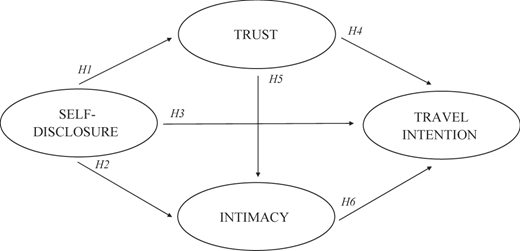
Self-disclosure has a significant influence of trust.
Farci et al. (2017) found out that intimacy was achieved by frequent self-disclosure behaviour in SNS. According to them, Facebook users facilitate collaborative disclosure strategies such as showing, sharing content, liking content, photo tagging and expecting mutual understanding which have developed into certain degrees of intimacies among users. Visual images and self-information frequently shared online were also seen to foster a level of familiarity, closeness and online intimacy among users (Houghton et al., 2018; Lin and Utz, 2017). The depth of online self-disclosure was likewise associated in developing intimacies as friendship quality was enhanced because openly sharing personal and intimate information among users trigger feelings of closeness toward each other (Desjarlais and Joseph, 2017; Ogba et al., 2019). However, Pang (2018) found no relationship between self-disclosure and intimacy and friendship closeness in a study conducted on WeChat. In this light, this study hypothesises
Self-disclosure has a significant influence on intimacy.
Self-disclosure literature narrowed down on predicting travel intention remains scant. Therefore, this research would provide novelty in establishing the relationship between these two variables. Azzahro et al. (2018) established that self-disclosure has a significant influence on the intention of users to continue using dating apps. The authors associate the users' self-disclosure behaviour with their desire to keep in touch with other users they have met inside the dating app. Similarly, Malloch and Zhang (2019) claimed that self-disclosure influenced behavioural intentions. In their experiment, self-disclosure played a vital role in helping participants to understand information disclosed in a health poster which was useful in determining their dietary intentions. Lastly, Lee (2020) examined the influence of a journalist's self-disclosure behaviour and the audience's behavioural intentions. This study revealed that the interactions and engagements of journalists to the audience through social media had influenced intention to consume the news. Given the current phenomenon on Tinder use, this study banks on the premise of existing research in behavioural intentions by hypothesising
Self-disclosure has a significant influence on travel intention.
Affective psychological responses such as trust have been investigated in recent literature to travel intention focussing on online contexts. In the study of Abubakr (2016), trust was positively related to travel intention in online community memberships. Similarly, Zhang et al. (2020) determined that interpersonal trust, relationship and offline travel decision making had significant relationships. Trust and intimacy were seen to have fostered the exchange between the online community whose attitudes, values, knowledge and experiences helped members transition from online acquaintances to offline travel companions. Trust was likewise seen as a partial mediator in destination social responsibility and intention to visit (Su et al., 2020). Thus, it is hypothesised
Trust has a significant influence on travel intention.
Trust has a mediating effect on self-disclosure and travel intention.
The previous literature links trust as a vital construct in developing intimacies and relationships. In the study of Balaji et al. (2016), customers established intimacy towards services they associate trust with. This is the same with Ponder et al. (2016) who found out that customers who have higher feelings of trust toward an establishment is more willing to build intimate relations with the same. After all, intimacy is bound to develop when emotional and behavioural antecedents, such as mutuality, are built (Batra et al., 2012). Mutuality can be derived as a by-product of building trust where people compare and evaluate potential risks and values from the actions disclosed by individuals throughout interpersonal interactions (Jones and Shah, 2016). Therefore, it can be synthesised that the disposition of an individual to trust gives off positive impressions and intentions towards the other in the form of intimacy.
Trust has a significant influence on intimacy.
Despite not having an established direct causal relationship with travel intention, similar cases of online interactions using the broader concept of behavioural intention points a relationship with intimacy. In the study conducted by Wang and Chang (2020), findings conclude that self-disclosing enabled audiences to form a continuous viewing behaviour in the context of continued intent in patronising a Vlog. Nora (2019) also found out that high customer intimacy leads to repurchase intentions in banking products. In the same light, Rodrigues and Rodrigues (2019) argues that intimacy for neo-luxury brands serves as a mediator towards intention to purchase and word-of-mouth behaviour. Thus, it is hypothesised:
Intimacy has a significant influence on travel intention.
Intimacy has a mediating effect on self-disclosure and travel intention.
Figure 1 illustrates the eight hypotheses of this study.
Methodology
This study referred to four previously published measurement scales as basis for developing the questionnaire. The self-disclosure scale (Gibbs et al., 2006), intimacy scale (Rau et al., 2008) and travel intention scale (Ryu and Jang, 2006) were adopted and followed a five-point Likert scale with response options ranging from strongly disagree to strongly agree as originally indicated in the respective studies they were adopted from. The values 1 = strongly disagree, 2 = disagree, 3 = neither agree nor disagree, 4 = agree and 5 = strongly agree are used. The trustworthiness scale (McCroskey and Teven, 1999) was adopted using a 7-point semantic differential scale. As the original scale shows TT 1, TT 3 and TT 4 having negative semantics on the right side, this study has reverse-scored these indicators in the data cleaning phase to maintain consistency with the rest of the adopted scales.
The measurement items were adapted to suit the research context and subsequently pre-tested by three experts to ensure relevance, consistency and clarity (Hair et al., 2014). The final survey questionnaire was distributed online from April and August 2021 from a pool of Tinder users through convenience sampling. Those who have used the Tinder Passport feature for the past year was the sampling criteria. Non-probability convenience sampling was utilised as this study particularly calls for a specific set of respondents which are bound by access and time within the reach of the researcher (Dörnyei, 2007). Adding to this, the total population of Tinder Tourists cannot be accessed to warrant a probability randomisation to produce the sample.
An online web-based survey was chosen as a research tool since the target respondents belong to a specific niche in which the Internet can reach, compared with other offline channels (Garton et al., 1999; Wellman, 1997). Moreover, the COVID-19 pandemic has compelled the researcher to adapt to the occasion and carryout data collection in the most realistic research approaches such as online (Ali et al., 2020). A total of 294 valid responses were carried out in the data analysis which satisfies the minimum sample requirement set by power analysis to minimise the possibility of bias and errors (Hair et al., 2018; Memon et al., 2020).
Data was analysed using partial least squares-structural equation modelling (PLS-SEM) with the software SmartPLS 3.0. PLS-SEM was chosen as the suitable technique because of the exploratory and predictive nature of this research (Hair et al., 2018). The main objective of this study is to predict the determinants of travel intentions while there is scarce prior knowledge on the structural model relationships and predictive research regarding the variables on hand (Hair et al., 2019). This study would hence benefit from PLS-SEM's statistical power to examine the constructs whose theoretical and empirical support is still developing (Hair et al., 2019). Moreover, PLS-SEM is likewise suitable in this study since more than half of the measurement items do not meet acceptable kurtosis and skewness values for normal distribution (Hair et al., 2014). Utilising the bootstrapping technique in PLS-SEM can overcome this issue (Hair et al., 2014; Ramayah et al., 2018).
Results
Descriptive statistics
Table 1 summarises the respondent profile and includes sex, age, residence, education level and occupation. Data are presented using the descriptive analyses of frequency and percentage.
Male respondents accounted for 51% of the sample while female respondents represented the remaining 49%. A great majority of the respondents is aged between 18 and 29. In terms of their residence, 19% were from the USA while 18% were from Singapore, 18% from Australia, 16% from the Philippines, 16% from the UK and 16% from other locations. Most were students (44%) and 33% employed full-time and 23% neither employed nor a student.
Evaluation of reflective model
The model estimation conducted in this study shows satisfactory internal consistency with composite reliability of self-disclosure (0.94), trust (0.91), intimacy (0.89) and travel intentions (0.82). These high values exhibit desirable reliability of the indicators (Nunnally, 1978) and adequate internal consistency (Hair et al., 2019; Gefen et al., 2000). Table 2 reports the outer loading of the indicator items of reflective measurement models. According to Hair et al. (2014), the outer loadings must indicate a value ≥ 0.708 to determine reliability whereas indicators whose outer loadings fell below the threshold should be subjected to a purification process. Indicators that do not contribute to the average variance extracted (AVE) of the construct should be deleted (Hair et al., 2014). Results show that items of IN had lower outer loadings indicating that such items do not converge nor captured by the constructs they reflect (Hair et al., 2014). Such indicators perhaps do not measure IN of Tinder users. After all, intimacy encompasses verbal and affective cues and the context of this study can only measure its verbal aspect (Rau et al., 2008). Hence, subsequent purification of such indicators was performed using the PLS algorithm. In summary, initial indicators of self-disclosure, trustworthiness and travel intention were maintained while only 3 out of 11 indicators of intimacy was carried out in the succeeding analyses.
Table 3 reports the AVE, outer loadings, t-values, p-values and significance levels of the indicators in the purified reflective model. Findings reveal that indicator reliability is confirmed with outer loadings exceeding the 0.708 threshold value recommended by Hair et al. (2019). Therefore, reflective items were all significant (p < 0.001). The AVE of self-disclosure, trust, intimacy and travel intention were likewise adequate and ranges from 0.54 to 0.76 (Hair et al., 2019). By having acceptable AVE values for all constructs confirms adequate convergent validity is met based on the minimum requirements (Fornell and Larcker, 1981).
Fornell-Larcker criterion and HTMT ratio were used to provide a holistic comparison for discriminant validity (Hair et al., 2019). Table 4 confirms discriminant validity by means of the Fornell-Larcker criterion as the AVE of each is higher than the latent variable's highest squared correlation and (Chin, 1998, 2010; Fornell and Larcker, 1981).
Given that constructs were not similar, this study accepts HTMT values below 0.85. The constructs did not exceed the HTMT ratio of 0.85 which further affirms discriminant validity (Hair et al., 2019).
Evaluation of structural model
VIF values of all indicators are less than the significant collinearity threshold of 5 which suggests that there are no potential collinearity issues and bias in structural model estimations computations (Hair et al., 2019). Therefore, all latent constructs were retained and the study proceeds to the evaluation of the structural model. A bootstrapping procedure was then conducted using 294 cases and 5,000 subsamples to determine the significance of hypothesised relationships among the constructs (Hair et al., 2019).
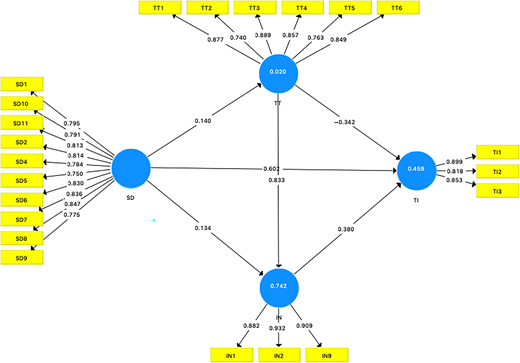
The results shown on Table 5 support the hypotheses. H1 is accepted with a significant positive effect of self-disclosure on trust (β = 0.14, p < 0.05). This is the same with H2 with a significant positive effect of self-disclosure on intimacy (β = 0.13, p < 0.001). H5 is likewise accepted with trust having a highly significant positive effect on intimacy (β = 0.83, p < 0.001). Significantly, the three hypotheses proposing the relationship with travel intention were supported. Self-disclosure shows a significant effect on travel intention (β = 0.60, p < 0.001) while trust has negative influence on travel intention (β = −0.34, p < 0.001). Lastly, intimacy has significant influence on travel intention (β = 0.38, p < 0.001). The effects of the two mediators, trust and intimacy, were likewise tested. Results of the mediation analysis shows that intimacy (γ = 0.05, p < 0.001) partially mediates self-disclosure and travel intention while trust (γ = −0.48, p = 0.064) did not have a mediating effect (Nitzl et al., 2016). The path coefficient results are summarised in Figure 2.
The coefficient of determination (R2) values of the endogenous latent variables can be interpreted for intimacy (0.74) as substantial, travel intention (0.46) approaching moderate and trust (0.02) as weak (Hair et al., 2019). The present case shows that the model on hand's in-sample explanatory power in predicting for travel intention was adequate. Results likewise show small to large effect sizes (f2) (Cohen, 1988). Large effects were observed between SD → TI (0.62) and TT → IN (0.64) while small effects exist for SD → IN (0.07), SD → TT (0.02), TT → TI (0.06), IN → TI (0.07).
Discussions
Findings of this study affirm the significant relationship between these variables. H1 complements previous studies which found out that self-disclosure has influenced trust (Broeder and Crijns, 2019; Nemec Zlatolas et al., 2019). Unlike Li et al. (2020), this study established that online self-disclosure plays a crucial role in relationship building. The high effect on this variable suggests that respondents give great consideration on the importance of self-disclosed information by other Tinder users. This can be associated with the fact that Tinder users being exposed with other users' photos, descriptions and interest tags. This finding is especially important as cybercrimes rose to an alarming scale during the pandemic period when it was observed that online users began impersonating and spread disinformation to fellow users to commit fraud (Naidoo, 2020). Moreover, users eventually exchange messages which compel them to disclose and elaborate more information about themselves – a clear indicator how self-disclosure influences trust through acts of reciprocity and vulnerability. This study likewise confirms the influence of self-disclosure on intimacy similar to the findings of the previous literature (Desjarlais and Joseph, 2017; Lin and Utz, 2017; Ogba et al., 2019). Findings also reveal that the manner of user-to-user self-disclosure fosters close interactions. For example, the frequent verbal interaction and communication exchange among users proved to be essential in relationship building. This can perhaps be traced to the whole purpose of Tinder as a dating application which aims to connect likeminded individuals who would share common interests in their conversations. Likewise, users are perhaps actively and consciously looking for online relationships (Lomanowska and Guitton, 2016). This leads to the notion that users, at this point, are willingly and deliberately disclosing information about the self in their message which leads to meaningful banters and eventually warm intimate feelings.
Another interesting finding was in H3 which provides novel empirical support for the relationship between self-disclosure and travel intention. This is analogous to the conclusion of previous research exploring the relationship of self-disclosure and behavioural intention (Azzahro et al., 2018; Wang and Chang, 2020). Findings of this study suggest that larger amounts of information being disclosed by a user increase the intention of the other user to travel. This implies that Tinder users develop a strong motivation to travelling to the other's geographic location after sufficient in-app interactions and self-disclosure behaviour. The findings on H4 also align with previous literature confirming the significant relationship between trust and travel intention (Abubakar, 2016; Zhang et al., 2020). However, findings show that a negative influence among the two constructs. This means that Tinder users have higher travel intentions when trust is low. According to Davari and Jang (2021), potential tourists with low levels of trust can yield high levels of travel intention as they associate future travel with past experiences and relationships with their hosts. In this study, it can be inferred that users who have low trust towards their current online Tinder match would still have strong intention to travel as they remain optimistic perhaps from previous meet-ups and experiences. This further complements the finding on H4a which does not show the mediating effect of trust on the relationship between self-disclosure and travel intention.
Findings on H5 reveal that the closeness among Tinder users and their matches is associated with trust. These findings follow the theoretical implications of studies which investigated on the relationship of trust and intimacy in marketing literature which argued that customers tend to develop intimacy towards those that have gained their trust (Balaji et al., 2016; Ponder et al., 2016). After all, users who trust each other are likely to build intimate relations. Lastly, findings affirm previous research on intimacy and behavioural intention (Nora, 2019; Wang and Chang, 2020) with H6 and further indicating a mediating effect of intimacy between self-disclosure and travel intention as hypothesised in H6a. The intention to travel to meet their matches is often stirred by the curiosity to know the other in person and a travel intention can be developed with the intimate insider information the other person provides about their country of origin. Likewise, providing constant self-disclosed information coupled with close and intimate affinity between users could ultimately kick an intention to meet the other or travel to the destination which a user have been enticed to go. During the in-app interactions, “inside” information shared by locals and potential hosts might have influenced potential guests to be enthusiastic and excited thus stimulating a strong intent to travel (James et al., 2019; Leurs and Hardy, 2019).
Conclusion and implications
This study draws its theoretical contribution on a proposed model which was the first to empirically test the predictive relationship between self-disclosure and travel intentions which has not been explored in previous literature. Using the case of Tinder users during the COVID-19 pandemic, the adequacy of the predictive relevance of the said model was determined with self-disclosure having a large effect size on travel intention. In this regard, this study advances the understanding of self-disclosure which can be used in predicting future travel intentions in a post-pandemic world. Moreover, findings of this study provide empirical support in predicting travel intentions with trust and intimacy. This study also provides managerial contributions by determining how the future of tourism can benefit from Tinder users. Leisure, entertainment and hospitality establishments can serve as the venues where users can meet-up in the future since public places can reduce risky encounters which Tinder Tourists often consider a threat to their security (Leurs and Hardy, 2019). Alternatively, travel agencies and destination managers ought to consider developing travel packages specifically targeted to Tinder users who prefer to enjoy niche experiences featuring the destination's tourist spots, culture and new experiences rather than meet-ups. Destination marketing organizations can also reinforce the information users' online counterparts have been providing them by strategically using Tinder as a platform for marketing and promotions. All in the same, findings of this study accentuate a futuristic perspective on post-COVID-19 tourism industry by introducing the untapped niche of Tinder users whose future travel intentions and transition from online to offline travel can be predicted using self-disclosure, trust and intimacy.
In spite of the contributions presented, this study is not without limitations. First, the samples obtained were drawn conveniently and could not generalise the entire population of Tinder users. Succeeding studies could bridge this gap by expanding the sampling method. Second, gender warrants a further interrogation in Tinder Tourism literature. Although this study did not reveal emergent findings on gender differences among users, previous studies have found out that this can be a factor affecting travel experiences (see Leurs and Hardy, 2019; James et al., 2019). In this light, constructs affecting these travel experiences such as risk, safety and security should also be investigated (see Gajic et al., 2021; Matiza, 2020). Moreover, the influence and impact of COVID-19 on travel intentions should be incorporated in future research as health issues affect tourist behaviour and perception during global pandemics. Lastly, the model presented should only be treated as a baseline and should be subsequently applied, expanded and confirmed by future studies within and outside the context of Tinder. This allows succeeding research to expand the knowledge and understanding on predicting travel intentions using self-disclosure.