The purpose of this paper is to develop an enhanced understanding of the evolution of actor networks for destination development.
The paper is based on observations and field notes of the authors regarding evolving organizational structures in the Dutch tourism industry and the conceptualization of this stepwise evolutionary process.
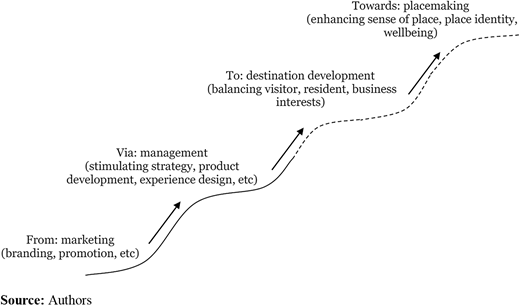
The authors observe and conceptualize recurring patterns in the ways in which coalitions emerge and develop (Figure 1) and which activities they pursue.
New insights are provided into the emergence and evolution of multi-actor networks that are driven by sustainable destination development. These insights are useful learnings for other destinations that pursue similar goals.
Introduction
Managing the future development of tourism destinations is increasingly complex. Whereas many scholars have addressed these issues in the past (Hall, 2000; Dredge et al., 2011), times are changing. New, alternative organizational structures and models for destination management and governance are emerging, as is discussed in this trends paper based on a set of observation made in The Netherlands. Forces driving change include the overall growth of the tourism industry, competition is increasing, visitors become experienced and more demanding, the negative impacts of tourism are openly debated and solutions to manage emerging issues involve the actions and capacities of many (and new) stakeholders, across different (policy) domains and governance levels (Peeters et al., 2018; Hartman, 2016). Clearly, a focus exclusively on destination marketing is insufficient and destination marketing organizations and national tourism organization (NTOs) shift their focus en masse from marketing to management. By doing so, they explicitly or implicitly acknowledge that the context wherein tourism and destination development take place has changed or is in the process of changing. To achieve goals, they will sooner or later encounter an interdependence on other actors and a need to build or become part of productive actor networks. As such, new fitting organizational models and governance approaches are needed and are actively sought. This trend can be observed in tourism practice in The Netherlands, as discussed later in this paper, and is reshaping the future of tourism destination development and management. In literature, we expect future contributions that further theorize and conceptualize these developments, building on this trend paper. Exploring the trend of (the practice of and/or the ambition of) building productive coalitions is important, as it sheds light on how actors seek interaction, connectivity and alignment of their actions, and define key roles and responsibilities in the process. This paper outlines five observations that stress the trend of new governance approaches and emerging organizational models in tourism destination development and management in The Netherlands.
Trend observations
Observation 1: The discourse on tourism development is transitioning from a goal-oriented focus on growth of jobs, income and tourist numbers to an orientation that focuses on tourism as a means for placemaking and well-being. In other words, to put value over volume (McKinsey and Company and World Travel and Tourism Council, 2017). This widens the scope of discussions on tourism development as it requires embracing a multi-goal, multi-domain, multi-actor and multi-level approach (Hartman, 2018a). Whether actors are driven by emerging opportunities, by solving urgencies or by managing the complexities of a progressing tourism industry, the interrelations and interdependencies of actors and their actions become more and more apparent. As a result, actors are driven together as they depend on each other to reach individual as well as collective goals.
Observation 2: Tourism destinations are conceptualized as cohesive “systems”. They are conceptualized as consisting of interrelated products, sectors and institutions and elements, agents and their actions are tied very closely to other elements, agents and their actions (Ma and Hassink, 2013; Brouder and Eriksson, 2013; Hartman, 2018b). For instance, islands or cities that are developed, managed, branded and promoted as a tourist destination and perceived as such by consuConceptualizing destinations by means of theories of complex systems helps to better understand how global drivers of change impact on tourism destinations, often in a largely autonomous way, and how this triggers in-system adaptive responses by a variety of actors. As actors and their actions are interrelated and affect each other, their (self-organized) collective behavior steers and shapes how tourism destinations develop and evolve over time. Collective actions are key to the outcomes of destination development processes.
Observation 3: At the micro level of destinations, we observe the emergence of sophisticated actor networks (Jørgensen, 2017) that operate as productive coalitions aiming to address the challenges they face as being part of the same system, i.e. tourism destination. In The Netherlands, we see actor networks emerging such as the Toerisme Alliantie Fryslân (tourism alliance Fryslân) in the province of Friesland, Drenthe Leisure Valley in the province of Drenthe, Toerisme Coöperatie Groningen (tourism cooperation Groningen) in the province of Groningen, Toeristische Uitvoeringsalliantie (tourism implementation alliance) in the province of Zeeland and Gastvrij Overijssel (hospitable Overijssel) in the province of Overijssel. Those networks consist of a combination of actors such as entrepreneurs, branch organizations, governments, nature associations, park management organizations, social movement organizations, educational institutions and research institutes. The involved actors seek collaboration to join forces and capacities for a range of topics such as, among other things, for creating tourism products and experience design, accelerate innovations, engage in lobby activities, stimulate collective learning, business innovation and placemaking. Practically, activities are organized by key players within those networks that stimulate actors to engage in what we can describe as visioning and strategic storytelling (Hartman et al., 2019). Moreover, it allows collectives to emphasize shared urgencies and opportunities and reinforce the importance of mobilizing capacities and building productive coalitions.
Observation 4: Process-wise, the emergence of these actor networks, albeit conceptually, seem to follow more or less a same type of logic. They tend to go through various phases. Rooted in the tradition of marketing, promotion and branding activities (phase 1: marketing), collectives are formed to proactively engage in strategy development, tourism product and experience design (phase 2: management) to stimulate innovation, reinforce competitive positions, aiming to manage and influence visitor flows away from hotspots and toward underutilized sites. However, being still largely within the domain of tourism and often with a focus on economic growth and increasing volumes. The next stage, shown for instance by the network of Gastvrij Overijssel, revolves around destination development taking into account the wider socio-economic and cultural impacts of tourism development on host-communities. Here, the focus is on value creation by tourism and developing an understanding of how tourism can be a means for wider societal goals. A next stage that is yet to present itself is that tourism is not treated as a separate industry, sector or policy domain. In this future state, tourism is an integral part of strategic and inclusive spatial planning and placemaking, aimed at creating good places to live and good places to visit. Generally, shifting from one stage to another takes time (e.g. multiple years) and depends on a set of proactive individuals that are successful boundary spanners in terms of linking multiple (policy) domains, multiple types of actors and their interest (e.g. entrepreneurs versus governments versus nature organizations) across multiple governmental and spatial scales.
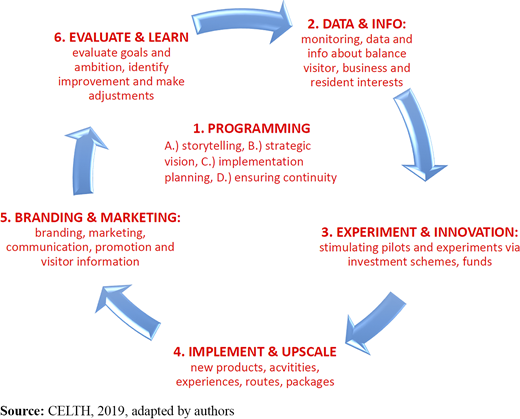
Observation 5: Content-wise, these actor networks, albeit conceptually, seem to follow more or less a same type of logic. Actor networks become productive coalitions when actors are working together in a strategic, organized and complementary manner based on a (more or less) division of tasks, roles and responsibilities within the coalition. We observe the emergence of a recurring organizational structure, that might show contours of new models for destination management and governance – an expect to explore further in a full research paper. Figure 2 outlines the main recurring activities according to the observations of the authors (CELTH, 2019). The overview is based on the product life cycle and is inspired by the organizational structure of the Toeristische Uitvoeringsalliantie Zeeland. Programming (Step 1) is necessary to get the other steps going. It consists of storytelling, visioning, strategic planning, implementation planning and ensuring (financial and organizational) continuity. Generally a task that is taken up by or informally assigned to governmental authorities. This enables authorities to directly streamline objective and approached to tourism in governments' overall policy objectives as well as more indirectly enable other actors to contribute and possible over time also influence these policy objectives. Data & Info (Step 2) emerges as a result of ambitions to make data-driven decisions, a task that fits well with knowledge institutions, public authorities that commission monitoring programs and private parties for implementations. Experiment & innovation (Step 3) concerns the importance to adjust and adapt to the changing market conditions and consumer demands. This role fits well with frontrunners from the industry and supported by governmental funds, entrepreneurial investment schemes, start-up incubators and economic boards. Implement & Upscale (Step 4) is the wider implementation of successful experiments and pilots by industry partners such as (policy) entrepreneurs in the tourism, leisure, hospitality, event sectors but also from the sector of cultural (e.g. museums) and nature (e.g. park management). Branding & Marketing (Step 5) is about establishing links between supply and demand, to motivate visitors to travel to the destination. This task is generally the responsibility of marketing organizations, tourist information organizations as well as individual businesses themselves. Evaluate & Learn (Step 6) is the process of checking whether actions have led to desired results. This step involves ex-post and ex ante evaluations that might be performed by governmental audit committees, independent research institutions, but also (research) journalist. These evaluations gather input to evaluate results, adapt goals and ambitions and reshape the processes to realize the goals and ambitions.
Conclusions and discussion
Based on our observations, we draw the conclusion that emerging actor networks fit very well within the current time frame, being dominated by debates amongst others on overtourism and value over volume. Regarding the future of tourism destination development, we estimate that establishing productive actor networks will gain importance and will emerge more and more on the political and policy agendas. Challenges for the future are multiple. In practice, an ambition to build actor networks may face endless barriers in terms of urgency, opportunity, capacity, motivation and leadership. As productive actor networks depend on individual actors and their actions, they cannot be “manufactured” and need to emerge and evolve, and subtly stimulated and supported. Learning from and linking with other initiatives in other destinations would be helpful, over time offering the possibility to give rise to an ecosystem that spans various destinations, at different spatial scales and governance levels. For academia, a future challenge would be to contribute to a better understanding of the key conditions for the emergence and development of productive actor networks, e.g. via case study research.
Funding
This paper is part of the research project Building Adaptive Tourism Areas, funded by the Taskforce for Applied Research (in Dutch: Nationaal Regieorgaan Praktijkgericht Onderzoek SIA), part of the Netherlands Organisation for Scientific Research (NWO).