


The purpose of this paper is to discuss the evolving interpretations of the Covid crisis and its impact on hospitality and tourism.
Scenario planning paper following Framework Foresight about the Covid pandemic and its impact on hospitality and tourism. Research input was gathered from research reports in different disciplines and discussions with an expert panel.
The paper argues that hypothesized recovery scenarios were founded on hope and inaccurate extrapolations, and that hospitality and tourism may head for permanently lower volumes.
The paper contributes to the debate on tourism resilience and hopeful visions of a sustainable restart.
Instead of just focusing on direct pandemic impact and that of governmental measures, a third variable of consumer confidence will be decisive, and more important than expected by many initially, in future scenarios for hospitality and tourism.
The proposed scenarios that were designed with executive level industry input have so far proven more realistic than prevalent views of a swift recovery.
Introduction
In the spring of 2022, many have saluted the waning of the Covid pandemic, probably for the third time. With cases rampant in Hong Kong, hospitalizations and ICU cases twice as high as during the previous “end” of the pandemic in June 2021 and 1,500 deaths per day in the USA, the facts do not support that optimism. Moreover, the official global death toll of 6 million may have to be adjusted upward to 18 million (Wang, 2022). Whilst for hospitality and tourism, the assessment of the crisis impact is crucial, this viewpoint paper will argue that hope, inaccurate extrapolations and unscientific interpretations have colored our expectations of hospitality and tourism recovery.
Hope has led many to overestimate the resilience of the sector. Ideas of how pandemics and crises are supposed to evolve have been extrapolated to predict a short crisis and steep recovery. The moralization or politization of the debate (Pizam, 2021) have made issues that are uncertain or debated among epidemiologists and virologists —uneven spreading patterns, seasonality, protection against variants, breakthrough cases, long term effects—, into firm convictions in controversies outside expert circles.
This paper uses Framework Foresight (Hines and Bishop, 2013; Hines, 2020) to identify and to challenge the assumptions that underlie our commonly expected or “baseline” future. Prior to Covid-19, even though a pandemic was expected to occur, the assumption that it would be caused by an influenza virus determined health policies. The diminishing impact of pandemics in the twentieth century (Oskam, 2020), combined with the swift recovery after the 2003 SARS pandemic (Information Services Department, 2003, 2004), has led to serious underestimations of the economic impact of the pandemic (Jonung and Roeger, 2006).
These in hindsight flawed assumptions explain that in the first months of the pandemic, scenarios revolved around the speed of recovery: the baseline was an immediate and full recovery (“V-shaped”), with the most plausible alternative being a more prolonged path (“U-shaped”) to full recovery (Smit et al., 2020). Subsequent waves of varying intensity were assumed to eventually be subdued by medical responses or by an evolution of the virus. Unprecedented and unplanned containment measures have been accompanied by economic support packages, averting immediate disaster but with estimations of their long-term consequences yet speculative.
This paper will first report the results of a scenario study conducted in 2021. Actual developments compared to common assumptions at that time illustrate that many views of the pandemic erred on the optimistic side by assuming that historical patterns would repeat themselves. The scenario results showed that, instead, the highly uncertain economic ramifications of the pandemic may yet become a decisive factor that was often overlooked. The paper will then look at current assumptions and projections to look ahead. A return to pre-Covid growth levels is not a given, and travel and tourism may head towards permanently lower volumes. Also, a turn towards a more responsible “restart” is desirable but not necessarily the most plausible outcome of this crisis.
Literature review
Crisis and disaster impact
There is extensive literature on the impact of crises and disasters on tourism and hospitality; for a critical discussion see Hall (2010) and the recent review by Ritchie and Jiang (2021). Prideaux et al. (2003) distinguish between crises and disasters: the first being related to managerial responses to emerging situations, whereas the latter are exogenous events to which reactions are only possible after they occur, “either by deploying contingency plans already in place or through reactive response”. In general, natural disasters or violence related safety issues have a localized impact on supply and demand, causing temporary shifts in destination choice (Mansfeld, 1994; Bonham et al., 2006; Zeng et al., 2005; Huang and Min, 2002; Cochrane, 2010; Gurtner, 2016; Pine and McKercher, 2004; Au et al., 2005). Widespread crises cause demand shocks, decreasing tourist spending across destinations (Boukas and Ziakas, 2013; Cellini and Cuccia, 2015; Henderson, 2007; Sheldon and Dwyer, 2010), that so far have also been temporary. A noteworthy exception to the optimistic recovery consensus was a scenario study on a hypothetical pandemic with devastating impact by Visit Scotland (Page et al., 2006).
The past two years have seen an “explosion of Covid-19 research in H&T”, with 417 articles found in Hospitality and Tourism journals in Scopus (Zopiatis et al., 2021, p. 278) escalating to “thousands” in Google Scholar in 2022 (Filep et al., 2022; Gössling and Schweiggart, 2022). Two review studies have proposed a categorization: Yang et al. (2021) distinguish studies about “psychological effects and behavior; (2) responses, strategies, and resilience; (3) sustainable futures; (4) impact monitoring, valuation, and forecasting; and (5) technology adoption”, whilst Zopiatis' et al. integrative review (2021) finds three clusters: (1) impact on industry, (2) the industry in the post-covid era and (3) pandemic's effect on tourist perceptions, also evolving in three stages of (1) conceptual studies of the pandemic as a transient event, (2) explorative studies of emerging risks and challenges and (3) empirical studies of, e.g. attitudes and behaviours.
The studies of industry impact include tactical responses, e.g. in the area of crisis perception and communication (Aldao et al., 2021; Alonso et al., 2020; Anguera-Torrell et al., 2021b; Canhoto and Wei, 2021; Dube et al., 2021; Farmaki, 2021; Im et al., 2021; Li et al., 2021a; Liu et al., 2021a), strategic measures to reduce or absorb demand shocks (Florido-Benítez, 2021; Liu et al., 2021b; Sanabria-Díaz et al., 2021; Wieczorek-Kosmala, 2022) or to adjust business models to a post-covid situation (Breier et al., 2021; Gursoy and Chi, 2020; Sharma et al., 2021) and the hospitality labour market, in which the crisis initially aggravated precarity (Baum et al., 2020), and subsequently also aggravated labour shortages (King et al., 2021). Consumer behaviour, risk perception and travel intentions are studied by Kim et al. (2022), Li et al. (2021b) and Zhan et al. (2022).
Reset/restart
While most of these studies envision a recovery, and hence a “post-Covid” future, in which pre-crisis numbers or pre-crisis growth is restored, a second group of studies interprets the crisis as a “wake-up call” or an opportunity for the transformation of tourism. This perspective associates the pandemic with consumerism, globalization and the growth-paradigm, and from there advocates a reset of tourism in a more sustainable, mindful and local model (Brouder, 2020; Gössling et al., 2020; Niewiadomski, 2020; Prideaux et al., 2020; Sigala, 2020). Rather than a prediction, this reset is a social necessity and a moral obligation, that includes tourism scholars (Gretzel et al., 2020). Some authors assume a shift in consumer preferences to support this transformation (Aldao et al., 2021), although this shift is sometimes inferred from weak signals such as “the significant increase in the amount of people starting home gardens and bread baking” (Everingham and Chassagne, 2020, 7). Hall et al. (2020) underscore the necessity of a transformation, but caution against wishful thinking, nuancing that transformation is not the most obvious outcome of the crisis as it requires the coordinated efforts of international stakeholders; Gössling and Schweiggart concur that “in tourism, there is a discourse of bouncing forward and a reality of bouncing back” (2022, p. 926).
Resilience
Without a single commonly accepted definition of “resilience” (Hall et al., 2017), a summarized notion would be that, whereas sustainability stands for mitigation or prevention of changes by protecting resources, resilience refers to a capacity to react and adapt to changes through a capacity to return to a desired state or “flip into a new stability domain” (Petrosillo et al., 2006, p. 106). Resilience is used for the capacity to recover from sudden disruptions as well as slow-paced developments such as climate change, and at multiple levels or scopes (Lew, 2014; Prayag, 2018; 2020). The reset/restart thinking represents an attempt to unify these different “resiliences”. However, past recoveries after, e.g. terrorist attacks (Gurtner, 2016; Liu and Pratt, 2017), natural disasters (Rittichainuwat, 2006; Schumann, 2013) or pandemics (Pine and McKercher, 2004; Zeng et al., 2005) are no guarantee for slow-paced change resilience, nor for a way out of yet unseen crises. Precisely, scenario planning as a way of “thinking the unthinkable” (Van der Heijden, 2005; Bishop et al., 2007), is a tool for communities and destinations to prepare for the unknown and build resilience (Oskam, 2022).
Looking back
This section looks back at initial reactions to the Covid crisis, general expectations and the scenario study by the authors with industry leaders that aimed to detect other plausible outcomes than the ones commonly envisioned. This process was conducted in 2021 following the Framework Foresight method (Hines and Bishop, 2013), to inductively arrive at a commonly expected or “baseline” scenario and at alternative scenarios by challenging underlying assumptions.
Method
The Framework Foresight Method (Hines and Bishop, 2013; Hines, 2020) provides a structured approach to identifying and challenging assumptions about how a current situation may evolve in the future, which combines Intuitive Logics with a non-quantitative Modified Trends methods. Starting point of this method is the analysis of a baseline future, defined as “the fundamental future with no surprises”, which is the one in which generally held assumptions and expectations play out as thought. By modifying the basic assumptions, the method then explores qualitatively alternative futures, towards the outer edges of the so-called “cone of plausibility”. In a recent revision of the method, Dator's archetypes of Continuation, Collapse, Equilibrium (Disciplined Society) and Transformation were incorporated (Dator, 2009; Hines, 2020). As in other scenario methods, the alternative futures are not meant as predictions but as plausible inputs for strategic anticipation.
Insight in thoughts and assumptions about the future is acquired in an exhaustive inventory of issues, trends, plans and projections in the domain of the study. As this analysis seeks to identify not only validated ideas but also positions in the debate and conflicting views, grey literature and newspaper sources are included as sources of information. The scenario design is based on the identification of prevalent assumptions in the debate. A further iteration and scenario validation took place with an expert panel (Table 1) that answered a survey and discussed the outcomes online in May 2021. In addition to the scenarios, questions were discussed about timing, shape, character and extent of recovery; market segments, purpose of travel and likeliness of plausible events. These questions were asked to feed the discussion, and to “pressure test” the tenets and assumptions that surfaced from the scenario research. The outcomes were resubmitted to the panel and used to refine findings on the changing patterns of demand and future market and industry norms.
Expert panel (April/May 2021)
| Company type | Position | Country | Company size |
|---|---|---|---|
| Business Travel Management | Former CEO | UK | 10,000–50,000 |
| Data Services | CEO | Spain | <100 |
| Data Services | Analyst | USA | 1,000–5,000 |
| Data Services | CEO | USA | 100–500 |
| Hotel Brand | EVP and CCO | UK | >100,000 |
| Hotel Brand | CCO | Belgium | >100,000 |
| Hotel Brand | CCO | USA | 10,000–50,000 |
| Hotel Brand | CTO | UAE | >100,000 |
| Hotel Brand | SVP Distribution | USA | >100,000 |
| Hotel Management | CCO | Thailand | 50,000–100,000 |
| Hotel Operator | CEO | Hong Kong | 500–1,000 |
| Hotel Operator | Chief Revenue Officer | USA | 1,000–5,000 |
| Hotel Operator | CEO | UAE | 10,000–50,000 |
| Hotel Owner | Board Member | USA | <100 |
| Hotel Owner | President | USA | 1,000–5,000 |
| Investor Hotel Real Estate | SVP Asset Management | USA | 100–500 |
| Leisure | Group CEO | UK | 100–500 |
| Research | CEO | UK | <100 |
| Timeshare | CEO | USA | 10,000–50,000 |
| Tour Operator | Non Exec Director | UAE | 5,000–10,000 |
| Travel Management | CEO | USA | 10,000–50,000 |
Domain description, issues, trends, plans and projections
The method proposes the collection and classification of information on “drivers for change” and arranges those in a logical flow. Rather than a description of verified facts and events, their contemporary perception leads to an identification of assumptions from which alternative scenarios can be derived. A first issue was the preparedness, in early 2020, for a global health crisis. The world —meaning national governments and large corporations— was not unprepared for pandemic scenarios, but plans had envisioned the virus to be of an influenza type. The expected pattern was predicted to lead to high morbidity and mortality, the fall-out of which —though labour absenteeism— would cause production and supply issues, and therefore economic damage (Department of Health, 2011). Several waves of an influenza pandemic could be expected to occur, and subsequent waves might result in severe food and medicine shortages even in advanced economies (Huff et al., 2015). Nevertheless, total damage was considered to be probably limited and temporary, and followed by an almost immediate full (V-shaped) recovery (Jonung and Roeger, 2006). This expectation was supported by the evidence of decreasing impact from influenza-pandemics, with an estimated approximate GDP effect of −4.8% of the Spanish flu (1918–19), −2.0% for the Asian flu (1957) and −0.7% for the Hong Kong flu pandemic (1968–69) (Burns et al., 2006). Furthermore, the 2003 SARS pandemic had seen this type of V-shaped recovery (Information Services Department, 2003, 2004).
A second important issue was the acceptance of medical responses. Developing scientific insights on the pandemic have unavoidably been inconsistent, conflicting or revoked, but with the novelty that these insights were covered and questioned as never before in the media. The non-expert interpretation of the pandemic has seen controversies, as well as mistrust in science and leadership (Ries et al., 2022). This mistrust has been accompanied by a social and political trend countering the effects of globalization, especially among those groups that feel excluded from the benefits of that process. The political expression of this trend has led to tariffs, trade wars, and violent conflict.
Social and political “side-effects” of the pandemic received increasing attention, such as socially inequal health impacts (Baena-Díez et al., 2020; BBC, 2020; La Sexta, 2020; Van Engen, 2020), rising unemployment during lockdowns (Bureau of Labor Statistics, 2020; Sardana, 2020) with travel and hospitality as hardest hit sectors (Lowry and Sperance, 2020), setbacks to international cooperation and trade (Allen et al., 2020; Roubini, 2020), including “vaccine nationalism” (Ekin, 2020), with the risk of localized food shortages (Newman, 2020). Public health was further impacted by system overload and care avoidance (Hochstenbach, 2020; Nieuwenhuis, 2020), decreased subjective well-being —or feelings of happiness—(Hardeman et al., 2020), increased loneliness and mental health problems (Davenport et al., 2020).
Existing influenza pandemic plans were abandoned in view of the unknowns of Covid (European Centre for Disease Prevention and Control, 2020; Oskam, 2020). The long-term effects of ad-hoc responses to events and in particular governmental support packages are a source of future uncertainty (Bofinger, 2020; Ilzetzki, 2020; Milanović, 2020; The Economist, 2020). Responses in travel and hospitality ranged from operational measures —hygiene and distancing rules—, or, at a more strategic level, the broadening of portfolios to leverage the risk of business segments under threat (Mateos Magariño, 2020), opportunistic portfolio changes (Anguera-Torrell et al., 2021a; González, 2020; Halpin, 2020) and greater interest in domestic tourism (Hinojosa, 2020; UNWTO, 2020b) or long stays (Grind et al., 2020).
Projections of how the pandemic was expected to develop were initially almost exclusively determined by vaccine development. The degree of protection, in the popular debate sometimes taken as dichotomous —protected/unprotected— is contingent on a number of factors, including availability, distribution and acceptance (Howard, 2020; O'Keefe, 2020). Herd immunity was initially believed achievable with a vaccination rate of 60–70%, an idea that has been abandoned (McNeil, 2020).
In 2020 an economic melt-down seemed unavoidable, with an estimated 20–30% of the economy at a standstill (Hermanides, 2020), debt ratios for advanced economies at 120% in 2021 (Ilzetzki, 2020), a GDP loss of 3.5% in 2020, up from a foreseen −5.9% (World Bank, 2020), a surge in bankruptcies (Mohamed, 2020), elsewhere postponed but not averted by financial support packages (Stil, 2020). In 2021 forecasts indicated a full recovery, albeit at different paces around the world (European Commission, 2021; IMF, 2021; OECD, 2021).
In March 2020, McKinsey published a scenario study that distinguished three levels of virus spread and public health response, on the one hand, and also three levels of knock-on effects and economic policy response. At that time, the authors favoured the more optimistic scenarios in which both types of responses would be moderately to highly effective, leading to a V or a U-shaped full recovery. But by 2022, the worst-case scenarios, respectively “Public-health control fails to control the spread of the virus for an extended period of time, e.g. until vaccines are available” and “Self-reinforcing recession dynamics kick in; wide-spread bankruptcies and credit defaults; potential banking crisis”, cannot yet be excluded. The different levels of severity of the crisis could lead to a W-shaped (double dip) or an L-shaped (no or limited recovery) scenario (Smit et al., 2020).
Initially, both deflationary and inflationary scenarios were suggested as effects from the interruptions in production, supply and consumption (Bartz and Kaiser, 2020; Blanchard, 2020; Bofinger, 2020; Brunnermeier et al., 2020). Pent-up demand and labour shortages drove up inflation in 2021 (Carlsson-Szlezak et al., 2021; OECD, 2021), a rise predicted to be hump-shaped to even out the previous standstill (Bachman, 2021; European Commission, 2021). In 2022, inflation outlooks are generally much more pessimistic.
In 2020, tourism arrivals fell 73%, close to the UNWTO's worst case forecast (UNWTO, 2020a; 2021). At that moment, projections were optimistic about consumers resuming their travel habits (Schaal, 2020; Simons, 2020; Spinks, 2020). A full recovery of demand would be spurred by postponed spending according to Marriott CEO Arne Sorensen: “So many life events have been postponed: weddings, vacations, anniversaries” (Solomon, 2020). With regards to the recovery of business travel, opinions were more divided, as some expect a permanent effect of the change to videoconferencing (Parsons, 2020; Sperance, 2020). Nevertheless, in 2021 the crisis deepened further, and the belief that a recovery would not occur before 2023 or later grew (UNWTO, 2021).
In the expectation of a swift and full recovery, three assumptions prevailed:
- (1)
Widespread vaccination will prevent further transmission;
- (2)
Social and economic restrictions will be short-lived;
- (3)
Consumer spending will be restored when society opens up.
Scenarios
These assumptions can be challenged by plotting them as uncertainties on a 3D scenario matrix, with eight hypothetical extreme outcomes. The four scenario archetypes of Continuation, Collapse, New Equilibrium and Transformation (Dator, 2009; Hines, 2020) lead to the selection of four outcomes that were plausible in 2021 (Figure 1):
- (1)
Cautious Rebound (baseline scenario). The “Cautious Rebound” would occur if both the effectiveness and the social acceptance of vaccinations were sufficient to suppress the pandemic. Health safety would be restored to pre-crisis levels, and travel restrictions could be lifted. Although economic damage from slow-paced years would be substantial, governmental support packages would have kept most businesses in a state of hibernation. The vaccine generates an optimism that spurs spending among those groups that were not affected directly by lockdowns and that have accumulated savings in 2020–2021. The U-shaped recovery would accelerate by the end of 2021, leading to a moderate level of inflation.
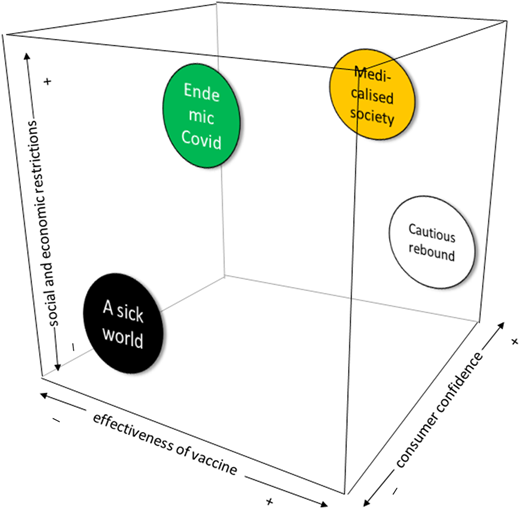
3D Scenario Matrix: Vaccine effectiveness, social restrictions and consumer confidence
3D Scenario Matrix: Vaccine effectiveness, social restrictions and consumer confidence
Travel, tourism and hospitality would then face several supply side issues. As the pendulum started swinging back from unemployment to labour shortages, companies that have maintained their core workforce would have an advantage over those that need a full restart or newcomers. Logistic issues would cause the recovery of international travel to lag behind the economic upturn, as a consequence of which the shift back from domestic tourism to travels abroad would also be more gradual (McCashin, 2020). Because of changes in the wealth distribution in outbound markets, mass and low-cost segments would be the latest to recover. Not only leisure travel would see an explosion of postponed consumption at the early stages of recovery; also business travel would pick up, with professional meetings and conferences being exceptionally successful, although their focus has shifted from content to networking events. This initial spending boom would gradually normalize in early 2022, with the market for professional meetings stabilizing below pre-crisis levels.
- (2)
A Sick World. The alternative scenario that corresponds with the “Collapse” archetype would become plausible if vaccines failed to suppress the pandemic, either because protection is insufficient, not durable, because of low vaccination rates or because of new virus variants. Without social containment measures, the pandemic rages on. Unmitigated by governmental support packages, the crisis impact creates self-enforcing mechanisms that aggravate the economic downturn, social segregation and international isolationism. The collapse of health care systems and care avoidance would affect “Covid-ghettos” and developing countries. Social tensions and violence further erode consumer confidence. International travel would go down to wartime volumes, and domestic tourism would become a privilege for those who remain in isolated bubbles.
- (3)
Endemic Covid. The scenario based on the “Disciplined Society” archetype would unfold if vaccine protection is limited or not durable, or because production and distribution capacity, or lack of social acceptance, leave large parts of the population without protection. In this scenario, the pandemic was expected to continue as a sequence of geographically limited outbreaks. This predictable behaviour will be incorporated into government planning, leading to local lockdowns each time the number of cases exceeds a previously established threshold. This permanent threat causes the economy to contract as demand and supply will be periodically interrupted. Consumer confidence will also suffer from this insecurity. Permanent low inflation, with periodically negative rates, accompany a long period of economic stagnation. Costly permanent safety cushions for businesses and households under temporary lockdown become a further burden to economic recovery.
A restart of travel in this approach requires international coordination, in order to ensure that the safety off all regions is measured by the same standard. Increased cooperation itself may become a factor that drives economic growth, or mitigates contraction. International trade will recover, as well as international travel, albeit with stricter health and safety controls. “Endemic Covid” means taking a step back, for consumers and for businesses, without the distribution of these sacrifices causing an imbalance that drives the system to a crisis. Regulation, self-discipline and coordination are the fragile pillars of this scenario. Its plausibility depends therefore on the existence of strong shared convictions in society.
- (4)
A medicalized society. The “Transformation” archetype envisions a technological solution to society's problems. The innovations can be expected to have wider ramifications. Eradication of the virus will have great economic benefits, accompanied by a further digitization and a flexibilization of society. But this may imply social and political transformations as well. Since the start of the pandemic, medical advisors have acquired an unprecedented role in preparing political decisions. At the same time, the academic debate is out in the open, with experts and non-experts taking strong positions in mass media and social media. In the United States, “pandemic anger” —linked to beliefs that the pandemic is a hoax or a conspiracy— is estimated to define the attitudes of approximately one-third of the population. On the other hand, violations of medical guidelines become penalized, and the prevalent medical theories are moralized: dissenting voices or behaviours provoke anger and are considered blameworthy. These trends signal a change in our thinking about society, which under certain circumstances may not remain temporary. In this scenario, we will see a strong political polarization. This medicalized world implies a permanent unpredictability as economic and social life have given up autonomy. Business continuity will require support policies in case of ongoing interventions. In combination with the increased importance of public health care, this strengthens the role of government in the economy.
Expert panel
The discussion with a panel of practitioner experts recognized the depicted scenarios as playing out simultaneously in different parts of the world (April/May 2021), with each having varying implications on different business types and market segments. A major handicap for management response capacity was the inconsistency in restrictions across the globe and a lack of reciprocity and coordination. Potential changes to planning scenarios were seen in government subsidies, unemployment, inflation and higher interest rates, rising nationalism and protectionism, poorer economies not accessing vaccines, labour shortages and supply chain challenges.
While the experts showed optimism for the immediate recovery of leisure travel driven by pent-up demand in countries with large domestic markets, business travel demand was expected to be down by 15–30% initially; a recovery would see changes in type of and reasons for travel, as periodical get-togethers with colleagues would complement virtual contacts and become key for employee morale. Equally, long-haul travel was expected to be reset to lower levels. As a general outcome of the crisis, the practitioners foresaw a need to undistort demand by unbundling and yielding high demand services, flexibility, and smart packaging. Participants in the discussion realized that, although there was a good insight into buying behaviours and into the commercial segmentation of their markets, the probable shifts in demand showed a knowledge gap in the understanding of actual customer needs and purposes for travel.
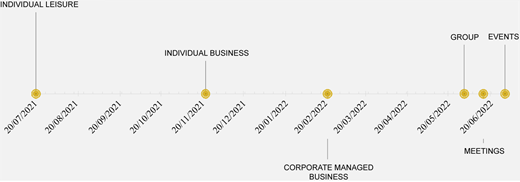
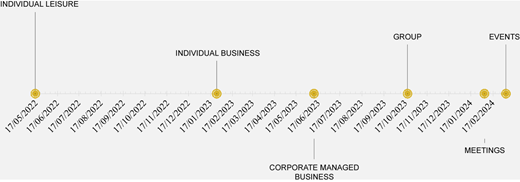
The panel's average estimation for the start of recovery and return to pre-crisis level is shown in Figures 2 and 3.
Looking ahead
Developing scenarios in a swiftly evolving situation enables us to evaluate the relevance of our observations, and obliges us to recalibrate the scenarios with new emerging outlooks and projections. In March 2022, the situation of our drivers of change can be assessed as follows:
- (1)
Vaccine effectiveness: Current numbers are still well in excess of those of previous lulls between pandemic waves, but the acceptance of morbidity and fatalities has grown (Yong, 2022). The future of the pandemic will be determined by further mutations and their capability to evade vaccine protection. Depending on infectiousness and virus virulence, an expert report gives three scenarios, the most optimistic of which would see 15,000 to 30,000 deaths per year, similar to other seasonal respiratory viruses; the pessimistic scenario would lead to 100,00 to 300,000 Covid deaths a year (Albarracín et al., 2022). Virologic scenarios see Covid becoming endemic as best case option, with more dangerous scenarios if the virus evolves to infect new cell types in the human body, if a new pandemic emerges because its genetic material merges with the genetic material of an existing animal coronavirus, or if the virus would succeed in not only evading, but exploiting the human host's immune response (Burke, 2022).
- (2)
Social and Economic Restrictions: Curiously also this driver remains highly unpredictable as measures not only respond to the health situation, but also to political sentiment and economic interests, both of which give clear signs of “pandemic fatigue”.
- (3)
Consumer confidence: Inflation rates were considerably higher in early 2022 than earlier predictions, although forecasts remained hump-shaped (Cuquerella Ricarte et al., 2022). The Russian invasion in Ukraine has deteriorated these outlooks. Establishing a causal link between this event and the pandemic can only be speculative (Zygar, 2022); however, it seems safe to say that both are symptoms of and countertrends to globalization.
The combination of a negative economic outlook, political unpredictability and the risk of a deteriorating health situation, makes the “Endemic Covid” or even “Sick World” scenarios more plausible, and those that foresee a full recovery, especially for hospitality and tourism, unattainable.
Concluding remarks
The interpretation that the Covid pandemic would be a temporary interruption of our social and economic lives stems from an extrapolation of past experiences, in particular influenza and SARS pandemics, combined with the resilience tourism and travel have shown in the decades of exponential growth. Whilst this reasoning is understandable, it is not necessarily justified or accurate. A scenario study must distinguish what is known, what is thought to be known and what is definitely unknown in order to identify the assumptions underlying the most commonly expected future. The assumed “return to normal” rests, in turn, on the assumptions that a health response would be effective and timely, policy responses would be temporary and that economic aftershocks could be managed.
Practical implications
Scenarios are an important instrument in resilience building at macro and meso levels, not because they provide accurate predictions of the future, but because they outline pathways to plausible alternatives. Destination and business strategies cannot bet on a single outcome, but should use scenarios as a tool to monitor developments and decide on appropriate action.
“Wait until this is over” is a productive strategy in a V-shaped recovery, but the implications of alternative scenarios are that multiple supply and demand shocks should be anticipated. Longer and returning travel restrictions, loss of purchasing power in at least part of society, a permanent change in the organization of work between office, home and travel as well as interrupted supply lines and widespread business failure are ever more plausible developments. Our 2021 scenario study identified four different patterns for these developments. Almost one year later, consumer confidence still appears to be a crucial element of the uncertainty mix. Full recovery is no longer the obvious end of this crisis; permanently lower volumes in both leisure and business travel have become plausible options.
Theoretical implications
The first academic implication is that the resilience of tourism after disasters and demand shocks may be explained by a context of exponential growth, but will not necessarily be repeated if that growth trend is disrupted. In the second place, a development towards more responsible tourism or degrowth, advocated by scholars as a consequence of this same growth context, although still justified, is not the necessary outcome of this crisis, as other less desirable paths are also imaginable. Third, the ongoing crisis adds to the discussion whether scholarly work must limit itself to the empirical study of things that have occurred, or whether it is admissible to endeavour into the uncharted territory of events that are yet to come (Community for Responsible Research in Business and Management, 2017). Medical science has reacted instantly to the emergence of the Covid-virus; the authors argue that the same urgency dictates that research in our discipline not be postponed until data are crystallized and the damage is done. A systematic scenario analysis can take us beyond “scholarly opinion”, while at the same time avoiding the traps of, e.g. linear demand forecasts (Filep et al., 2022). The scenario process should not be a one-off process to generate static ideas about the future, but it contributes to strategic orientations that need periodical reflection and recalibration.
Limitations
An obvious limitation of this study is that hindsight provides more certainty than foresight. Its objective is precisely the identification of uncertainty and the assessment of its magnitude; it is meant to facilitate developing strategic responses to what might happen, rather than to study what will happen. As a consequence, the research cannot be validated by the observation of actual events. Based on a constructivist paradigm, Yeoman et al. (2015) discuss that the output quality of scenarios will depend on “the engagement with stakeholders, validity of output and the scenarios as a process to action change”. Scenario planning therefore constitutes a proven process that facilitates engagement and strategic anticipation.

