Barnsley Transport Interchange is the first project to be initiated as part of the Remaking Barnsley regeneration programme. The interchange is also intended to fit with Yorkshire Forward's masterplan vision for the regeneration of Barnsley over the next 30 years. The design of the £24·5 million bus and rail interchange is modern, sustainable and will improve access to the town. The design incorporates a transparent ethylene tetra-fluoro-ethylene membrane canopy requiring minimal steel framework suspended on glu-laminated timber columns and extensive use of pre-patinated copper. Leading edge design techniques have been used including advanced three-dimensional modelling.
Work has commenced on site at Barnsley's new Transport Interchange, the first project to be initiated as part of the town's regeneration programme, Remaking Barnsley.
Jefferson Sheard Architects and Arup have been working closely with construction partner Laing O'Rourke and client South Yorkshire Passenger Transport Executive to ensure that Barnsley's new Transport Interchange fits in with Yorkshire Forward's masterplan vision for the improvement and regeneration of the town over the next 30 years. The new interchange will play a crucial role in making Barnsley a more attractive place to visit, providing better access to and from the town centre for both residents and visitors.
The £24·5 million interchange will deliver a modern environment with high-class facilities, including new shops and offices, and will provide a contemporary landmark with a lively street frontage of curved, organic shapes and warm natural colours. Sustainability has been maximised through the use of recyclable materials and design features that make use of natural daylight and natural ventilation. Engineering consultancy has been provided by Arup, who are also collaborating with Jefferson Sheard on the Waverley Steps entrance at Waverley Rail Station in Edinburgh.
Standing on the site of the current north and south bus stations, the interchange will provide an easy access ‘gateway’ into the town, as well as incorporating both rail and bus links. The clearance of a third existing bus station on the eastern side of the track will make way for a new distributor road, which will ease congestion, forming an essential part of the overall transport strategy.
The project architect comments: ‘Barnsley Transport Interchange has been identified as an important and much-needed project within Barnsley town centre and will be one of the first physical representations of the Remaking Barnsley Strategic Development Framework that will transform Barnsley over the next 30 years. The project will provide a high-quality, fully enclosed public transport passenger environment comprising a bus and coach concourse, passenger facilities, retail and offices.
‘The bus element will be a vast improvement on the existing facilities: all stands will be stacked closely together, and vehicular and pedestrian zones fully segregated; it will be user-friendly and ensure passenger safety.
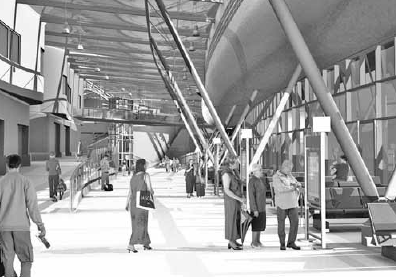
‘There are three distinct bands of accommodation running through the interchange. A series of commercial units or ‘pods’ front onto the town centre. The solid, curvy forms are finished in smooth render and are earthbound by a heavy natural stone base, in reference to the local vernacular. The pods are shaped by pedestrian flows that will filter through, to and from an ‘internal street’ linking the bus boarding/disembarking zone with both the existing and the future urban fabric (Fig. 1).
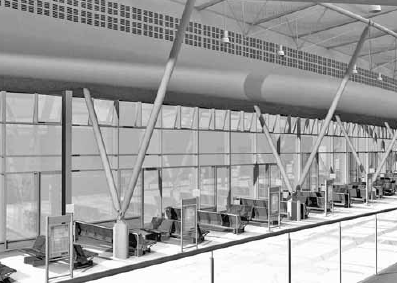
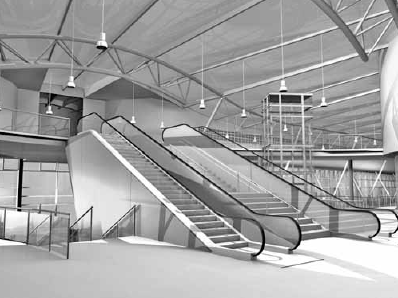
‘In contrast to the pods, the internal street has an architectural language of lightness. A transparent ETFE membrane canopy will allow natural light to flood into the concourse. This lightweight envelope requires a minimal steel framework, which will be suspended on slender glu-laminated timber columns (Fig. 2). The roof resembles two outstretched wings that embrace the bus element. The geometry rises up at the centre, acknowledging the hierarchy of the primary entrance below, and is conceived as conical, at the same time converging on a first-floor pedestrian bridge to the rail station (Fig. 3). The bridge is envisaged as an extension of the interchange, promoting a seamless transition between transport modes, and will later become a section of the masterplan's ’Green Sprint' designed to link the town centre with the Dearne Valley.
‘The extensive use of natural pre-patinated copper on the roof, bridge and sculptural feature—a focal point at the lower end of Regent Street—is hoped to give the new Interchange prominent character in the heart of Barnsley.’
The project's senior engineer adds: ‘The concept design was both innovative and unique, which has required us to use a number of leading-edge techniques, including the use of advanced 3D modelling, to develop the concept from an engineering perspective.’
It is anticipated that the new interchange will be completed and open to the public in May 2007.