

S. Hillmansen and R. A. Smith, Imperial College, London This discussion raises a number of relevant issues to the authors’ paper. The main areas of contention are the effect of lightweight trains on the maintenance requirements of the track system (in reference to section 4.2 of the paper).
An analysis is presented in this discussion which reveals that the primary advantage of lightweighting is the ability to increase the capacity of the line without incurring additional maintenance costs. This is confirmed by the Japanese experience–during the development of the Shinkansen each successive generation of vehicles were lighter and caused less track damage than the previous one. The introduction of new rolling stock is also usually accompanied by an increase in service frequency. The effect of lightweighting is therefore to facilitate an increase in service without incurring a maintenance penalty.
Although the primary aim of the paper was to investigate the benefits of mass reduction for high-speed rail, the case for light rail and urban commuter-type trains is of equal importance. For high-density urban transport there is also an advantage to lightweighting vehicles. These services have frequent stops and energy must be expended accelerating and decelerating the vehicle. A reduction of mass in these types of vehicle will have more of an impact in terms of energy consumption than high-speed services. In their 1985 paper,47 Ware and Gay present an economic analysis for saving weight from axles, which is of relevance to the current analysis:
The value of weight saving is simply established. For a typical station-to-station distance of 1 km and typical LRT performance level, a figure of about 65 watts-hours per tonne kilometre is obtained. With cars running 100,000 km per annum, energy costs of 4 p per kilowatt-hour and a real interest rate of 7 per cent per annum, this gives a capital cost equivalent per kilogram saved of
that is, it is worth spending about £4 to save 1 kg in weight.
The mechanisms of track degradation are driven by the wheel/rail input loads which are generated by the interaction between the vehicle and track system. These loads are often referred to as P0, P1 and P2.48,49 P0 is a static force and represents the wheel/rail contact load for the stationary vehicle. P1 is a dynamic high-frequency load, which is produced by impacts between the wheel and rail when a discontinuity is traversed. These discontinuities may either exist on the rail surface (rail joints and dips for example), or on the surface of the wheel rim (wheel flats for example). P1 occurs when a vibration mode between the wheel and rail, which are coupled by the very stiff contact patch, is excited. P2 is also a dynamic load, but is excited at lower frequencies, and occurs when the wheel and rail motion become coupled and vibrate in phase on the ballast.
P2 is the force of most interest to permanent way engineers because it has a direct influence on the degradation mechanisms in the track-bed. Because of the non-linear nature of these mechanisms, the relationship between the magnitude of the P2 force for a single wheel passage and the incremental degradation is also likely to be non-linear, and may exhibit a power law dependency. The use of the total track tonnage as a measure of line life is crude, but it may be adequate for a general mixed traffic railway in which the traffic mix is constant over time. A more detailed analysis would take into account the varying amount of damage caused by different rolling stock. For example, an 80 t locomotive will cause proportionally more damage than two 40 t trailing coaches.
The Railway Group Standards48,49 provide details of the procedure used to compute the P2 force given input information regarding track and vehicle characteristics. These data and procedures are indicated below for the example of the class 55 Deltic locomotive when running over the prescribed rail joint at 161 km/h.
Q = 86 000 N Maximum static wheel load
Vm = 44·7 m/s Maximum normal operating speed
Mν = 1680 kg Effective vertical unsprung mass per wheel
Az = 0·020 rad Total angle of vertical ramp discontinuity
Mz = 245 kg Effective vertical rail mass per wheel
Cz = 55·4 × 103 Ns/m Effective vertical rail damping rate per wheel
Kz = 62·0 × 106 N/m Effective vertical rail stiffness per wheel
where
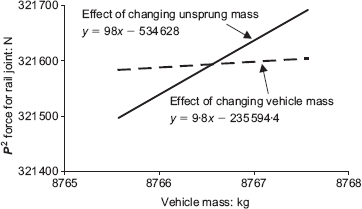
The maximum permissible P2 force for this vehicle and this defect equals 322 kN. These equations were input into a spreadsheet computer program to investigate the sensitivity of the vehicle mass and unsprung mass on the P2 force. Fig. 10 shows the result of the sensitivity analysis in which the mass is varied by ±1 kg about the normal vehicle operating point. The steep and shallow lines refer to the effect of the change in mass when applied to the unsprung mass and vehicle mass, respectively. The ratio of gradients is approximately 10. This simple calculation demonstrates that removing 1 kg from the unsprung mass is approximately ten times more effective in reducing the P2 force than a similar reduction in mass of the main vehicle body. During the design of vehicles and in particular the running gear, a considerable amount of attention is therefore focused upon minimising the unsprung mass to keep dynamic forces within permitted limits.
3. THE JAPANESE EXPERIENCE
Japan is widely recognised for being the world leader in high-speed railways and has the longest operational history. Fig. 11 shows the growth in the number of trains per day on the Tokaido Shinkansen line which runs between Tokyo and Osaka. The line is now close to capacity and further growth can only be achieved through increasing the passenger density within the vehicles. Over the course of its history, the evolution of rolling stock has been driven by the requirement to reduce maintenance costs and increase speeds. These have been achieved primarily by the introduction of successively lower-mass vehicles which can operate at greater speeds.
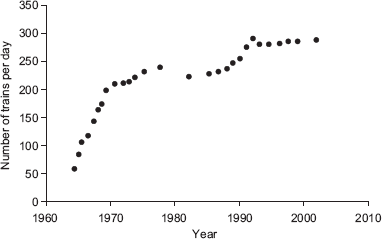
Figure 12 shows data taken from Tables 4 and 5 in the paper. It demonstrates that there is a very non-linear relationship between the Union Internationale des Chemins de Fer maintenance cost indices38 and daily tonnage. Rochard and Schmid use this curve in their analysis to determine that a reduction in mass of 25% leads to a reduction of maintenance costs of 5%. Although this analysis is correct, it has not been the main driver for reducing mass in other railway organisations. Rather it is the opportunity to increase the service frequency while having minimal effect on the maintenance costs. For example, if the mass is reduced by 25% and the service frequency increased by 25% then there will be no change in the maintenance requirement. This represents a stronger economic objective than reducing the maintenance costs.
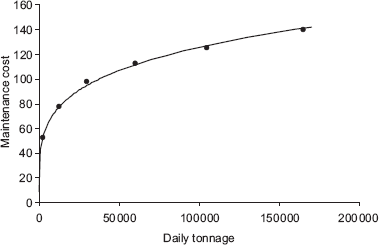
Union Internationale des Cihemins de Fer maintenance costs. These data were extracted from Tables 4 and 5 in the paper
Union Internationale des Cihemins de Fer maintenance costs. These data were extracted from Tables 4 and 5 in the paper
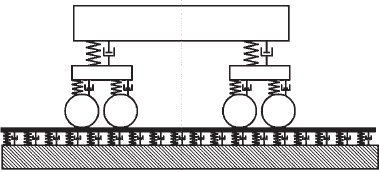
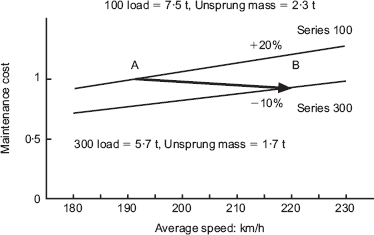
Figure 13 shows the results of a simple computation of wheel rail forces when perturbed by a rail dip-type defect. The model is schematically shown in Fig. 14. The simulations show that the introduction of the series 300 Shinkansen achieved an increase in operating speed and a decrease in both dynamic and static track forces. Data from Japan Rail Central shown in Fig. 15 also indicate a similar reduction in maintenance costs.
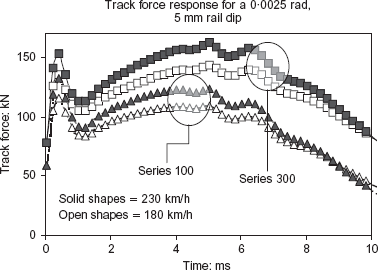
The wheel rail forces have been calculated for a series 100 and 300 Shinkansen traversing a rail dip
The wheel rail forces have been calculated for a series 100 and 300 Shinkansen traversing a rail dip
4. CONCLUDING REMARKS
The paper by Rochard and Schmid concluded that there were relatively marginal economic benefits to reducing the mass of high-speed rail vehicles, but the inclusion of externalities in the economic analysis greatly increased these benefits. In the current climate of increasing concern about global warming and the depletion of our fossil fuel reserves, it seems increasing likely that the external cost of pollution will be borne by the energy consumer in the future. The air and automobile market may be in a poorer position to face this new challenge than the railways, especially in countries with a high proportion of electrified route and extensive use of clean electricity generation.
Authors’ reply
The authors wholeheartedly welcome the commentary of Hillmansen and Smith and are pleased to find that our comments have engendered a debate that may lead to further research. We would like to comment as follows.
The cost benefits, discounted over 30 years and summarised in Table 7 of our paper, were calculated specifically for a theoretical train with a notional 25% reduction in mass compared to the class 373 Eurostar trains designed to operate services on the Channel Tunnel Rail Link between London St Pancras and the UK portal of the Channel Tunnel. Had we examined a similar mass reduction for high-speed train services between Paris and Brussels or from Köln to Frankfurt, we would have arrived at different values, reflecting the particular train service and route topography. We suspect though that the results for other high-speed routes would also be somewhat disappointing.
Reducing the mass of light rail and metro vehicles will indeed yield greater economic benefits than is the case for high-speed trains. This tenet also applies to other trains used for urban and peri-urban transport on services requiring frequent acceleration and braking. Almost by definition though, high-speed trains travel long distances with few or no stops between origin and destination and train service regulation is also usually aimed at minimising signal checks. Regenerative braking capability on such trains has only become worthwhile relatively recently with the use of four-quadrant pulse-width modulated converters where this feature does not increase train mass as significantly as with earlier technologies.
Hillmansen and Smith discuss the issue of P2 forces and of the unsprung mass of rolling stock in some detail and point out that these factors are of great interest to permanent way engineers. It is perhaps worth mentioning that the track experiences an effective unsprung mass that also includes part of the mass of the bogie and body of the vehicle and is thus dependent on the design of the suspension system and on its maintenance. We certainly agree that the P2 forces with their characteristic frequency patterns were highly significant in the days of jointed track and mixed traffic where ballast and subgrade deterioration near discrete irregularities was a major issue. However, high-speed railways use continuously welded rail with closely controlled track quality. In any case, most of the discussions concerning P2 forces and infrastructure deterioration related to freight vehicles with basic suspensions. The interested reader can find a very detailed treatise on the vertical wheel/rail forces in the standard paper by Jenkins et al.50
The authors would suggest that increasing speeds and the need for better performance near stations bring into play factors other than vertical loads (P0, P1, P2). Plan view forces, including traction, braking and curving forces, today have a significant effect on rail and track degradation, being involved in rolling contact fatigue among other things. These forces are also influenced by stiff suspensions and wheel profile changes. Thus maintenance costs are not wholly a function of low P2 forces and low unsprung mass. However, the authors are grateful to Hillmansen and Smith for pointing out that the non-linear nature of track damage generation can be exploited by running more lower-axle load trains for the same gross tonnage, with similar or lower maintenance costs, all other things being equal (acceleration rates, suspension design, etc.). It is also important to recognise that axle loads and unsprung mass still form important criteria in the calculation of access charges. However, many railways still relate track damage and maintenance intensity to gross tonnage carried or axle load.3751,52
Hillmansen and Smith are right to highlight the potential for reducing unsprung mass. There is little scope though for reducing the diameter of wheels for high-speed trains and the use of resilient wheels can no longer be advocated. Hollow axles may help to reduce wheelset mass, but the need to dissipate a substantial amount of energy when stopping a high-speed train typically requires two to four sets of brake discs and their flanges to be attached to each axle, thereby negating a significant fraction of the mass reduction derived from the use of hollow axles. Greater reductions in unsprung mass may be achievable by moving to cardan-shaft linked arrangements where the brake discs are mounted on the bogie or body. According to a recent paper on access charges produced by the Office of the Rail Regulator,53 the class 91 locomotives feature an unsprung mass of only 1740 kg per axle, thanks to the braking gear being possibly co-located with the body-mounted traction motors. This compares with an unsprung mass of about 2700 kg for the locomotives of classes 87, 89 and 90. Remarkably, the Mk4 coach has an unsprung mass of 1860 kg, a significant increase on the Mk3 vehicle with 1260 kg, due in part to the need for a greater braking capability. In moving to novel solutions however, it must be considered that the savings in track maintenance may well be cancelled out by higher rolling stock maintenance cost.
Hillmansen and Smith use the example of the reduction of dynamic loads between the series 100 and series 300 Shinkansen to demonstrate the associated reduction in maintenance cost. It is interesting to compare these trains using information from Fig. 1, noting that body-shell mass was reduced from approximately 10 t to about 6 t, leading to the reduction in axle load from 15 t to 11·4 t. Japanese train designers obviously took a holistic approach to reducing mass, as described by Fig. 2, not concentrating solely on reducing unsprung mass. Hillmansen and Smith's Fig. 15 indicates that Central Japan Railway consider the reduced maintenance cost to be due to the combined effect of reduced wheel load, axle load and unsprung mass, a reflection of a true systems approach.
At the time of writing, crude oil prices have reached US$50 per barrel. There is little prospect of a reduction in the short to medium term because world consumption is now greater than supply. New reserves are unlikely to be found and brought on stream at the rate of increase in consumption. The authors fully agree with Hillmansen and Smith that better use must be made of fuels derived from non-renewable resources and that internalisation of pollution costs for all transport modes will become the norm. Both factors will clearly stimulate the development of power generation from renewable sources and the more efficient use of this energy–for example, by reducing the mass of trains of all types. However, this should not lead to a focus on investment in reducing the mass of high-speed trains when much more significant savings can be made in urban and peri-urban transport.

