

Brunel challenged the conventional ‘Stephenson’ railway when he introduced the broad gauge and novel forms of track and locomotives. When multiple problems arose in service his engineering authority was challenged. His tenacity in responding to independent reports influenced sufficient opinion to vindicate his decisions and restore his authority
1. INTRODUCTION
This year sees the 200th anniversary of the birth of Isambard Kingdom Brunel, an occasion that will be commemorated by several events, focused largely on Bristol. These include the Bicentenary Conference, co-sponsored by the Institution of Civil Engineers (ICE), on 6 and 7 July. Brunel's connections with Bristol date from 1829, when he first submitted designs for the Clifton Suspension Bridge. His engineering abilities and his confident manner brought him to the attention of the proprietors of the Great Western Railway, who appointed him as their engineer on 7 March 1833, at 27 years of age. He determined upon the route and prepared engineering plans, sections and estimates, but only at the proprietors' second attempt did Parliament approve their Bill. The Act incorporating the Great Western Railway received the Royal Assent on 31 August 1835.
The ICE archives contain several items relating to Brunel's earliest years with the railway. One of these, a report to the directors,1 serves to illustrate his tenacity in sticking to, and fighting for, the engineering principles in which he so strongly believed; it is a response to an independent report on the railway's gauge, track formation and motive power, prepared by Nicholas Wood, the Northumbrian engineer and author of a leading treatise on railway engineering. It was written during a major debate on the very form of the Great Western line that was pivotal to the future of Brunel's career. This commentary offers a background to his report, beginning with the context of the debate that had occasioned the directors' approach to Wood.
2. THE BROAD GAUGE DEBATE
The interlude between the first and second Bills submitted to Parliament by the Great Western Railway had given Brunel time to reflect on the form of railway he would recommend to the directors of the new company. He showed at this early stage that he would not build a railway that simply adopted the specifications of the earliest routes of George and Robert Stephenson. Rather, he challenged each component of the ‘Stephenson’ railway to see whether there were fundamental improvements that could be made. He considered route alignment, track form and gauge, vehicular dynamics and motive power development potential, as an integrated study. His thinking was sufficiently advanced to encourage the omission from the railway's second Bill of any reference to track gauge.
A fortnight after the Act was obtained, Brunel reported his views to the railway's directors on radius and gradient for rail alignment, track gauge and vehicular centre of gravity. A broad track gauge and larger wheel diameters, he argued, would allow a lower centre of gravity and reduced resistance than the ‘standard’ gauge (1435 mm), resulting in lower operating costs and higher speed potential. He proposed the adoption of a track gauge between 6 ft 10 in. (2083 mm) and 7 ft (2134 mm). The directors accepted his views, and the latter dimension (actually laid to 2136 mm), famously and controversially, became the railway's gauge. The route alignment was relatively easy to adopt on the railway's eastern division as it followed the Thames Valley (facetiously known as the ‘billiard table’), but the western division was more difficult, requiring costly and time-consuming construction, notably with Box Tunnel.
Brunel rejected the track form initially adopted by George and Robert Stephenson, of rails secured in chairs fitted to stone block sleepers. He developed a novel form of track with wrought iron rails of cross-sectional ‘bridge’ form secured to longitudinal timber baulks. The timbers, with a cross-section (‘scantling’) between 5 and 7 in. (127–178 mm) deep and 12–14 in. (305–355 mm) wide, were secured at 15 ft (4572 mm) intervals to cross-timbers (‘transoms’), the width of the twin-track formation (Fig. 1). The transoms were bolted to beechwood piles to secure the timber frame against movement under traffic. The timber was ‘kyanised’, a form of preservation using bichloride of mercury developed by Dr Kyan.
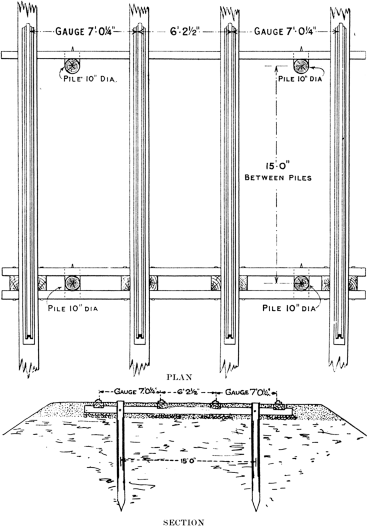
Plan and section of Brunel's original transon track
Plan and section of Brunel's original transon track
The rolling stock took full advantage of the broader gauge, with wider coach and wagon bodies, and their 4 ft (1219 mm) wheel diameter was one-third larger than the normal standard-gauge stock. Although the earliest vehicles had two axles, Brunel introduced three-axle stock shortly after the opening of the first stretch of line.
Brunel's radical thoughts about motive power were as controversial as his track. Although he left the design of locomotives to independent manufacturers, he specified that they should have a ‘standard’ velocity of 30 miles/h (48 km/h) ‘to be attained without requiring the piston to travel at a greater rate than 280 ft [85·4 m] per minute…a force of traction equal to 800 lb [3·560 kN] upon a level, independent of the power required to move its own weight and that of the tender with a supply of fuel and water for one hour's consumption’. With the exception of the North Stat locomotive (Fig. 2), a derivative of the proven Patentee type, built at the Robert Stephenson & Co. factory in Newcastle upon Tyne, the resulting designs, from several manufacturers, were curious, and characterised by large driving wheels, and small boilers and cylinders (Fig. 3). Those to the design of Thomas E. Harrison had boilers carried on separate vehicles from the cylinders and driving wheels.
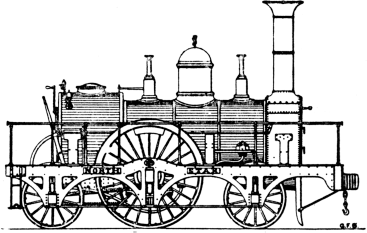
An example of the early locomotives ordered by Brunel: the North Star built by Robert Stephenson and Co. (drawn by G. F. Bird from a contemporary sketch by E. T. Lane)2
An example of the early locomotives ordered by Brunel: the North Star built by Robert Stephenson and Co. (drawn by G. F. Bird from a contemporary sketch by E. T. Lane)2
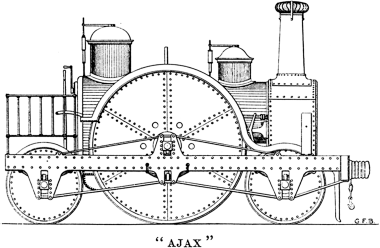
Another example of the early locomotives ordered by Brunel: the Ajax built by Mather Dixon and Co. (drawn by G. F. Bird from a contemporary sketch by E. T. Lane)2
Another example of the early locomotives ordered by Brunel: the Ajax built by Mather Dixon and Co. (drawn by G. F. Bird from a contemporary sketch by E. T. Lane)2
In the summer of 1837 Brunel recruited the 21-year-old Daniel Gooch, who was to report to him as Locomotive Superintendent. Gooch, who was also to become an influential figure in the annals of Great Western history, had to erect, and commence trials with, the locomotives as they were delivered on the first stretch of line between London and Maidenhead in the early months of 1838. It was soon clear that, with the exception of North Star, the locomotives were largely unreliable, and required constant maintenance and modification to keep them operational. He worked hard to provide an operational fleet for the commencement of passenger services on 4 June.
Early operations were far from successful, with complaints being received from travellers that the jolting they experienced in the badly sprung four-wheeled vehicles over the transom track was excessive. The locomotives were unreliable, and service delays caused many complaints. Of particular concern to Brunel was the rapid deterioration of the track under traffic, as the inadequate ballast shook down, leaving the longitudinal timbers perched on the piles and undulating between them. He tried out a variety of means to remedy this, including unbolting the piles and deepening the ballast with a coarser grade.
Six weeks after the opening, and with problems continuing, the directors' patience was stretched, and some were calling for Brunel's dismissal, while others proposed consulting Robert Stephenson. Brunel himself offered to resign, but the chairman, William Unwin Sims, and other prominent members of the Board held faith with their engineer. Although he believed that his remedial measures would eventually resolve the problems, Brunel suggested to the directors that they should call in three experienced engineers to report on the track and motive power, which, he was confident, would vindicate the decisions he had made. Anticipating the need to placate the proprietors at a general meeting, the directors agreed, and wrote accordingly to James Walker, president of the ICE, Robert Stephenson and Nicholas Wood.
Walker declined the directors' invitation ‘under the impression that the question would be controversially conducted’. Stephenson also declined, but not without explaining his reasons to Brunel. The two engineers, while disagreeing on issues of track form and gauge, were professional colleagues who sought each other's opinions on a variety of topics. Stephenson wrote ‘To report my opinions fully therefore would do harm instead of good to the cause in which you are interested and this I am sincerely desirous of avoiding.’
Nicholas Wood agreed to study the issues, as did John Hawkshaw, the young engineer of the Manchester & Bolton Railway, who had subsequently been approached. While Hawkshaw's report was submitted first, in November 1838, Wood had been unable to commence his enquiries until September, and he reported to the directors, from his home town of Killingworth, on 10 December. In the meantime, however, on 15 August, Brunel had written a vigorous and lengthy report to the directors in defence of his selection of the 7 ft track gauge, such that his whole reputation now depended upon its continued use.
Nicholas Wood embarked on a comprehensive assessment of standard- and broad-gauge railways, track formation, and the efficiency and power of the locomotives. He was assisted in this work by Dr Dionysius Lardner, the author of a treatise on steam engines that had been published in several editions. The recruitment of Lardner was itself controversial, as his theoretical approach to dynamics and thermodynamics had already been shown by some ‘practical’ engineers to be of questionable value.
Wood initiated a series of closely monitored trial runs with several of the Great Western locomotives and trains of carriages between Paddington and Maidenhead, and sought comparable data from standard-gauge lines. He obtained the full cooperation of the directors of the London & Birmingham Railway, and of Robert Stephenson, who had been apprenticed to him nearly 20 years before. Stephenson made available comparable data from the line, and assisted with further trial runs. Further trials were also conducted on the Liverpool & Manchester, Grand Junction and Manchester & Bolton Railways, through the cooperation of Edward Woods, Joseph Locke and John Hawkshaw respectively.
Wood spent much time comparing the Great Western track formation with that in use on standard-gauge railways. He built on the work of Professor Peter Barlow, further developing his ‘deflectometer’ to determine vertical and lateral track deflections with the passing of trains at different speeds. He selected different types of track formation in use on the standard-gauge lines, while his trials on the Great Western line were conducted on piled track, track from which the piles had been unbolted, track on which the transoms were cut free from the adjacent line, and track reliant on the longitudinal timbers only. He concluded that the stone sleepers on the London & Birmingham line afforded the firmest base, but that the transom track was marginally better than the earliest form of wooden-sleepered track, on which ‘there is not only a very considerable yielding of the timbers, but there is likewise an imperfect fastening between the chairs and sleepers…’.
Wood came down in favour of longitudinal timbers on the basis of wear and tear of rolling stock being less than that which occurred with stone block sleepers, as well as being quieter for the passengers. He decisively demonstrated, however, that the piles were supporting the longitudinal timbers rather than holding them down, and condemned their use for restraining the track frame. He concluded that ‘a more uniform and firm base will be obtained, by depending on the weight of the trains to ultimately consolidate the base of the timbers…presuming always, that a proper and firm base is prepared in the first instance.’ He did, however, recommend that timbers of larger scantling dimensions, and rails of increased weight should be adopted.
Wood considered Brunel's argument that the broad gauge benefited from the use of large-diameter wheels for the carriages, compared with the 3 ft (914 mm) wheels normally adopted on standard-gauge vehicles. For measuring rolling stock resistance, Wood had experience of using a dynamometer mounted on a truck, the wheels of which wound a roll of paper with a pencil trace, but this could not be made available for his Great Western experiments. Gradient could not be used for the trials either, as the railway was near level, so he released carriages from the rear of moving trains on a measured length of track to determine friction resistance. This took insufficient account of air resistance, however, so on Wood's behalf Lardner conducted experiments with trains of carriages freewheeled down Whiston incline on the Liverpool & Manchester line, and Madeley incline on the Grand Junction line. From this he calculated that only 22% of resistance was due to friction, thus diminishing the perceived benefit of 4 ft diameter wheels. He argued that the greater proportion was due to air resistance, and that was before consideration of the greater front-end area of the broad-gauge rolling stock.
Wood considered the ride quality in the railway carriages (Fig. 4), which had been the subject of public complaints. He developed instrumentation to record transverse rocking, pitching and horizontal oscillations, and conducted trials on each of the assisting standard-gauge lines, as well as on the Great Western. From these trials, Wood concluded that oscillation was by far the greatest motion, but that the issue was more to do with the design and condition of rolling stock and couplings than with the gauge of the track.
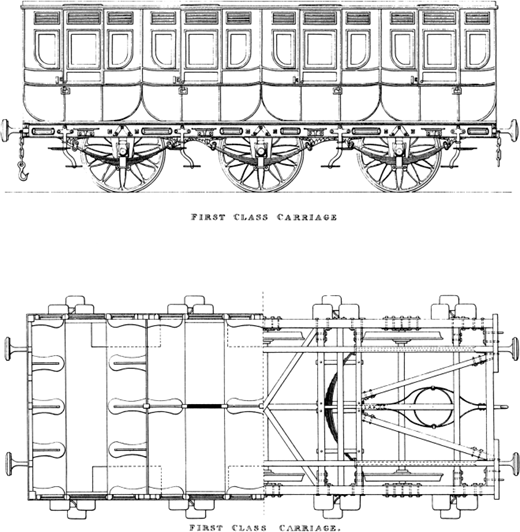
Six-wheeled first-class carriage introduced by the Great Western Railway in the late 1830s3
Six-wheeled first-class carriage introduced by the Great Western Railway in the late 1830s3
Wood finished his report by attributing the poorer performance of the Great Western locomotives, in comparison with the standard-gauge examples, as being almost entirely due to the greater front-end area of the rolling stock and the increase in air resistance that was incurred. Wood had based his conclusion on Lardner's theories on atmospheric resistance, having determined that this resistance varied at least in the ratio of the square of the velocity. He concluded that, at the present stage of locomotive development, ‘the limit of practical speed, combined with the requisite economy, is that which can be attained by engines capable of being erected on a lesser width of gauge than seven feet.’ He added, however, ‘that 7 feet is beyond that width which may be considered the best…[but] until we have determined, in the most satisfactory manner, the precise width of gauge, and what width best effects all the objects required, and which, under all the circumstances, is most conducive to the interests of the company, and affords the greatest accommodation to the public, it appears to me the present width should be retained.’
The speed with which Wood conducted his wide-ranging enquiry, and the urgency of the submission of his 82-page printed report to the Great Western proprietors, led to its delivery in mid-December 1838 before the comprehensive appendices, tables and diagrams were available. With the whole gauge issue and future policy on track and rolling stock to be decided upon, the directors were anxious to conclude the matter very quickly, and arranged for a general meeting of shareholders in London for 9 January. They therefore urged Brunel to respond quickly, and he had the unenviable task of digesting and responding to Wood's report in just ten days, including Christmas Day. His robust 22-page response1 followed just two weeks behind an equally robust response to John Hawkshaw's report to the directors. His polite reference to the ‘fair and impartial way’ in which Wood had treated the results of his study preceded a carefully compiled demolition of many of his conclusions.
A key part of Brunel's response concerned the data that Wood had obtained from his trials of North Star. The results of the trials were at variance with the performance of Stephenson's standard gauge Patentee locomotives, including his Harvey Combe locomotive on the London & Birmingham Railway, which was used for Wood's study. The trials, as well as the resistance trials had, however, been conducted mostly by Dionysius Lardner rather than by Wood himself. This prompted Brunel's guarded comment ‘that had Mr Wood personally superintended the experiments; had he brought his own practical knowledge of the subject to bear upon them; he would have discovered many operating and interfering causes…and thus, in my opinion, upon many of the most important points…come to very different conclusions.’
It is puzzling why Daniel Gooch had not spotted that North Star's blast-pipe was too narrow and was thus throttling the exhaust and creating significant back-pressure, which led directly to the locomotive underperforming. Much of Wood's conclusions about air resistance fell apart when a broader blast-pipe had been fitted, and the locomotive reverted to its true performance capability, after submission of his report. The basis of Wood's recommendation was shown to be a fallacy, and it is not surprising that Brunel had emphasised this point in his response. Quite why the narrow blast-pipe was in place during Wood's trials can only be speculated upon, and, sadly for his reputation, he had not challenged the data.
3. BRUNEL VINDICATED
The 9 January meeting, being a crucial vote of confidence in the directors as much as in Brunel, was carefully prepared. The directors circulated their report in advance, with due reference to Wood's and Hawkshaw's reports and to Brunel's responses. Their statement as to future policy was unequivocal
The Directors, upon a deliberate reconsideration of all the circumstances affecting the permanent welfare of the undertaking, divesting the question of all personal partialities or obstinate adherence to a system, unanimously acquiesce in the abandonment of the piles, in the substitution of a greater scantling of timber, and of a heavier rail, retaining the width of gauge with the continuous timber bearings, as the most conducive to the general interests of the Company.
However, when the meeting moved to approve and adopt the directors' report, the breadth of concern felt by many of the shareholders was fully expressed through an amendment tabled as follows
That the Reports of Messrs Wood and Hawkshaw contain sufficient evidence that the plans of construction pursued by Mr Brunel are injudicious, expensive, and ineffectual for their professed objects, and therefore ought not to be proceeded with.
Nearly 14 000 votes were cast, some by those attending the meeting, but the majority through proxy votes. The vote was close, but the amendment failed by 44% to 56%, thus clearing the way to acceptance of the directors' report and a vindication of Brunel's recommendations.
Daniel Gooch's role in the events leading up to, and during, Wood's enquiry is also pertinent to Brunel's responsibilities after January 1839. Brunel had sought to excuse the unreliability of the novel locomotives as being due to insufficient time for trials and modifications: ‘some such short experience and such trials were at least necessary to bring the system even on a par with others long previously in operation; but this opportunity we have not yet had.’ In an atmosphere where ‘scapegoats’ were being sought, and in spite of Gooch's Herculean efforts to keep going the motley collection of locomotives he had inherited, there were some calls from directors for his removal from office.
There was, however, a larger, more perceptive faction within the Board that appreciated the shortcomings of the locomotives and Gooch's efforts to keep them going. The directors therefore called upon him to report to the Board directly on the condition of each locomotive. By passing Brunel placed Gooch in an awkward situation, but he was obliged to do so, which elicited an angry letter from the chief engineer. Gooch later recorded however, that Brunel had ‘only shown it in his letter, and was personally most kind and considerate to me…’.
In February, Gooch was given the remit to design a new fleet of locomotives to be ready for the opening of the line to Bristol, for which again he was to report directly to the Board. Thereafter, Gooch's responsibilities to the Board as locomotive superintendent left Brunel to concentrate on the completion of the Great Western line, and, subsequently, the building of its associate broad-gauge companies. Brunel's interest in motive power remained, however, and he was always ready to challenge established principles, no better example of which was his adoption of atmospheric propulsion on the South Devon Railway in the 1840s.
The massive railway expansion of the 1840s brought the standard- and broad-gauge railway companies into territorial conflict, with the consequence of route duplication and transfer of goods and passengers at their interface. An extraordinary parliamentary enquiry resulted in an Act to restrict the territorial expansion of the broad gauge, largely to within the south and west of England and south Wales. Long after Brunel's death in 1859, the commercial realities of an integrated network saw the gradual conversion of the broad-gauge routes to standard gauge, the final changeover–of the Paddington to Penzance route–taking place in 1892.

