
1-20 of 8268
Keywords: ORGANISATION
Close
Follow your search
Access your saved searches in your account
Would you like to receive an alert when new items match your search?
Journal

Essential reading on civil engineering developments across all areas of transport.
Journal Articles
Proceedings of the Institution of Civil Engineers - Transport 1–2.
Published: 18 September 2026
... for organic pads Line graph showing particle number size distribution for organic particles at magnifications 200, 400, and 630. The horizontal axis shows particle diameter d p in micrometers on a logarithmic scale from about 0.1 to above 100. The vertical axis shows d N over d log d p on a logarithmic...
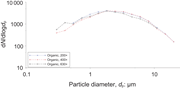
in Erratum: Particulate emissions from motorcycle brakes: non-combustion sources of urban pollution
> Proceedings of the Institution of Civil Engineers - Transport
Published: 18 September 2026
Figure 10. Particulate matter distribution for organic pads Line graph showing particle number size distribution for organic particles at magnifications 200, 400, and 630. The horizontal axis shows particle diameter d p in micrometers on a logarithmic scale from about 0.1 to above 100 More about this image found in Particulate matter distribution for organic pads Line graph showing part...
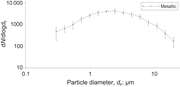
in Erratum: Particulate emissions from motorcycle brakes: non-combustion sources of urban pollution
> Proceedings of the Institution of Civil Engineers - Transport
Published: 18 September 2026
Figure 11. Particulate matter distribution and standard deviation for metallic pads A line graph showing particle number size distribution for metallic particles. The horizontal axis shows particle diameter d p in micrometers on a logarithmic scale from about 0.1 to above 100. The vertical axi... More about this image found in Particulate matter distribution and standard deviation for metallic pads ...
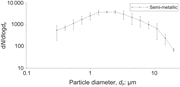
in Erratum: Particulate emissions from motorcycle brakes: non-combustion sources of urban pollution
> Proceedings of the Institution of Civil Engineers - Transport
Published: 18 September 2026
Figure 12. Particulate matter distribution and standard deviation for semi-metallic pads A line graph showing particle number size distribution for semi metallic particles. The horizontal axis shows particle diameter d p in micrometers on a logarithmic scale from about 0.1 to above 100. The ve... More about this image found in Particulate matter distribution and standard deviation for semi-metallic pa...
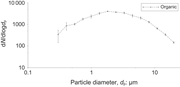
in Erratum: Particulate emissions from motorcycle brakes: non-combustion sources of urban pollution
> Proceedings of the Institution of Civil Engineers - Transport
Published: 18 September 2026
Figure 13. Particulate matter distribution and standard deviation for organic pads A line graph showing particle number size distribution for organic particles. The horizontal axis shows particle diameter d p in micrometers on a logarithmic scale from about 0.1 to above 100. The vertical axis More about this image found in Particulate matter distribution and standard deviation for organic pads ...
in Erratum: Particulate emissions from motorcycle brakes: non-combustion sources of urban pollution
> Proceedings of the Institution of Civil Engineers - Transport
Published: 18 September 2026
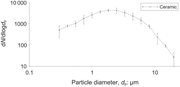
Figure 14. Particulate matter distribution and standard deviation for ceramic pads A line graph showing particle number size distribution for ceramic particles. The horizontal axis shows particle diameter d p in micrometers on a logarithmic scale from about 0.1 to above 100. The vertical axis ... More about this image found in Particulate matter distribution and standard deviation for ceramic pads ...
in Erratum: Particulate emissions from motorcycle brakes: non-combustion sources of urban pollution
> Proceedings of the Institution of Civil Engineers - Transport
Published: 18 September 2026
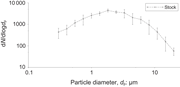
Figure 15. Particulate matter distribution and standard deviation for stock pads A line graph showing particle number size distribution for stock particles. The horizontal axis shows particle diameter d p in micrometers on a logarithmic scale from about 0.1 to above 100. The vertical axis show... More about this image found in Particulate matter distribution and standard deviation for stock pads A ...
in Erratum: Particulate emissions from motorcycle brakes: non-combustion sources of urban pollution
> Proceedings of the Institution of Civil Engineers - Transport
Published: 18 September 2026
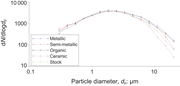
Figure 16. Particle matter comparison between different pad materials A line graph comparing particle number size distributions for metallic, semi metallic, organic, ceramic, and stock particles. The horizontal axis shows particle diameter d p in micrometers on a logarithmic scale from about More about this image found in Particle matter comparison between different pad materials A line graph ...
Journal Articles
Proceedings of the Institution of Civil Engineers - Transport 1–11.
Published: 08 September 2026
in Vibration transmission and damping characteristics of double-layer non-linear fasteners
> Proceedings of the Institution of Civil Engineers - Transport
Published: 08 September 2026
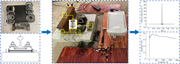
Figure 1. Hammer test configuration and impact force response characteristics Three panels depict a rail fastening assembly, an impact test setup, and graphs of hammer impact force and amplitude. The first panel combines a view and a schematic of the rail fastening assembly, with components nu... More about this image found in Hammer test configuration and impact force response characteristics Thre...
in Vibration transmission and damping characteristics of double-layer non-linear fasteners
> Proceedings of the Institution of Civil Engineers - Transport
Published: 08 September 2026
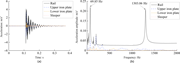
Figure 2. Time-domain and frequency-domain curves of the measured vibration acceleration: (a) time history; (b) frequency spectrum Two line graphs compare acceleration responses of the rail, upper iron plate, lower iron plate, and sleeper. The panel a graph plots time from 0 to 0.4 seconds aga... More about this image found in Time-domain and frequency-domain curves of the measured vibration accelerat...
in Vibration transmission and damping characteristics of double-layer non-linear fasteners
> Proceedings of the Institution of Civil Engineers - Transport
Published: 08 September 2026
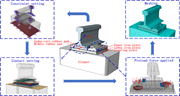
Figure 3. Refined dynamic finite-element model of the double-layer non-linear fastener A flow diagram outlines constraint setting, contact setting, preload force application, and meshing for a rail fastening model. The three-dimensional rail fastening model identifies the rail, sleeper, upper ... More about this image found in Refined dynamic finite-element model of the double-layer non-linear fastene...
in Vibration transmission and damping characteristics of double-layer non-linear fasteners
> Proceedings of the Institution of Civil Engineers - Transport
Published: 08 September 2026
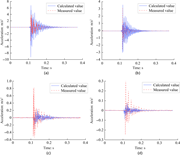
Figure 4. Acceleration responses of each layer in the dynamic system: (a) rail; (b) upper iron plate; (c) lower iron plate; (d) sleeper Four line graphs compare calculated and measured acceleration responses over time in panels a to d. The horizontal axis in all four panels covers time from 0 ... More about this image found in Acceleration responses of each layer in the dynamic system: (a) rail; (b) u...
in Vibration transmission and damping characteristics of double-layer non-linear fasteners
> Proceedings of the Institution of Civil Engineers - Transport
Published: 08 September 2026
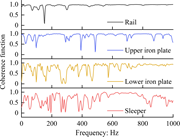
Figure 5. Coherence function of each layer in the dynamic system Four line graphs compare coherence functions of the rail, upper iron plate, lower iron plate, and sleeper. The horizontal axis covers frequency from 0 to 1000 hertz, and each graph covers coherence function values from 0 to 1. Th... More about this image found in Coherence function of each layer in the dynamic system Four line graphs ...
in Vibration transmission and damping characteristics of double-layer non-linear fasteners
> Proceedings of the Institution of Civil Engineers - Transport
Published: 08 September 2026
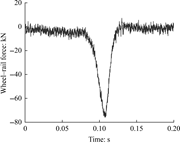
Figure 6. Wheel–rail force at the fastener fulcrum A line graph plots wheel-rail force over time, with a pronounced negative force trough near 0.11 seconds. The horizontal axis covers time from 0 to 0.20 seconds, and the vertical axis covers wheel-rail force from negative 80 to 20 kilonewtons.... More about this image found in Wheel–rail force at the fastener fulcrum A line graph plots wheel-rail f...
in Vibration transmission and damping characteristics of double-layer non-linear fasteners
> Proceedings of the Institution of Civil Engineers - Transport
Published: 08 September 2026
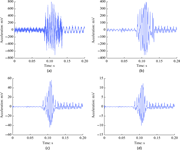
Figure 7. Acceleration responses of each layer in the dynamic system under train loading: (a) rail; (b) upper iron plate; (c) lower iron plate; (d) sleeper Four line graphs plot acceleration responses over time, with strong oscillation bursts near 0.10 to 0.12 seconds. The horizontal axis in a... More about this image found in Acceleration responses of each layer in the dynamic system under train load...
in Vibration transmission and damping characteristics of double-layer non-linear fasteners
> Proceedings of the Institution of Civil Engineers - Transport
Published: 08 September 2026
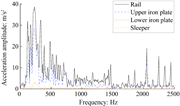
Figure 8. Acceleration response spectra of the dynamic system A line graph compares acceleration amplitudes of the rail, upper iron plate, lower iron plate, and sleeper across frequency. The horizontal axis covers frequency from 0 to 2500 hertz, and the vertical axis covers acceleration amplit... More about this image found in Acceleration response spectra of the dynamic system A line graph compare...
in Vibration transmission and damping characteristics of double-layer non-linear fasteners
> Proceedings of the Institution of Civil Engineers - Transport
Published: 08 September 2026
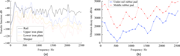
Figure 9. (a) Distribution of the transfer function of the dynamic system; (b) vibration decay rates of the fastener system Two line graphs compare transfer functions and vibration decay rates across frequency for rail fastening components. The panel a graph plots frequency from 0 to 2500 hert... More about this image found in (a) Distribution of the transfer function of the dynamic system; (b) vibrat...
in Vibration transmission and damping characteristics of double-layer non-linear fasteners
> Proceedings of the Institution of Civil Engineers - Transport
Published: 08 September 2026
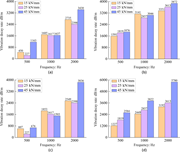
Figure 10. Comparison of vibration decay rates with varying stiffness of the under-rail rubber pad: (a) under-rail rubber pad, (b) middle rubber pad; and comparison of vibration decay rates with varying stiffness of the middle rubber pad: (c) under-rail rubber pad, (d) middle rubber pad Four gr... More about this image found in Comparison of vibration decay rates with varying stiffness of the under-rai...

